Review Article | 2026-09-28 Latest Published
By Muhammad
Longhua Tang
Ren Ren
Sailing He
Pier Paolo Pompa
PIER Photonics, Vol. 1, 60-91, 2026
Abstract
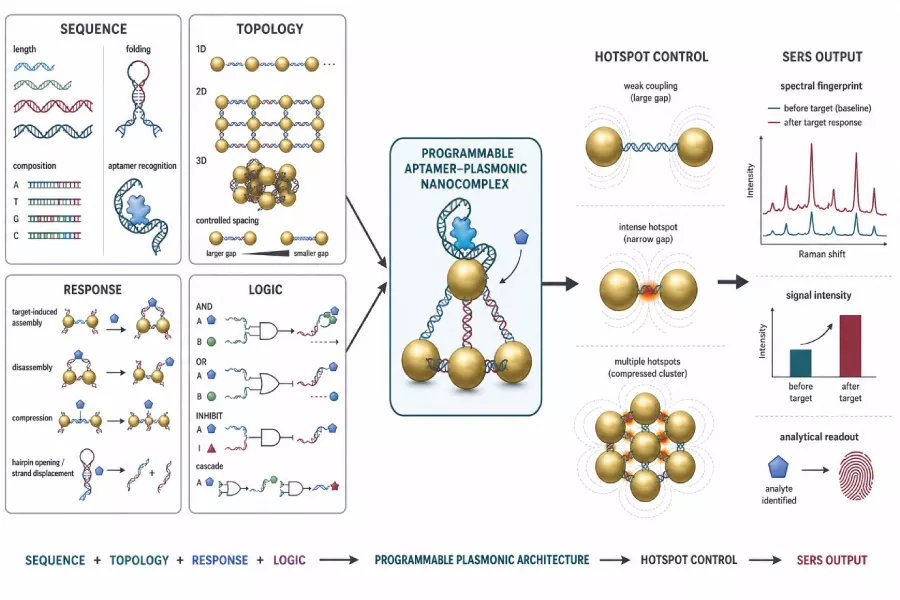
Surface-enhanced Raman spectroscopy (SERS) has emerged as a powerful platform for biomedical analysis, but its practical impact increasingly depends on how molecular recognition is translated into robust, programmable, and clinically compatible nanosystems. In this context, DNA aptamers act not only as biorecognition ligands, but also as programmable structural modules that define nanoparticle spacing, hotspot geometry, assembly dynamics, and signal-output logic. This review examines programmable DNA aptamer-plasmonic nanocomplexes as a design framework for biomedical SERS and organizes the field according to the architectural principles that govern analytical performance and translational potential. We classify current systems into linker-driven assemblies, conformational-switching platforms, catalytic and amplification-enabled networks, and higher-order addressable nanostructures, including DNA origami-based systems, and compare them across four design dimensions: sequence, topology, target-induced structural response, and signal-output logic. Unlike previous surveys organized primarily by target class or material, this design-centered framework enables architecture-performance trade-offs to be compared across systems beyond detection limits alone. We then highlight how these architectures shape sensing performance and biomedical applicability, while also examining the key barriers to clinical translation, including signal variability, limited standardization, aptamer instability, and manufacturing and regulatory constraints. Finally, we outline a translational roadmap for next-generation aptamer-SERS systems integrating reproducible plasmonic design, quantitative robustness, machine-learning-assisted analysis, and point-of-care compatibility. By connecting programmable architecture with signal transduction and translational readiness, this review provides a design-oriented perspective for the development of clinically relevant aptamer-SERS platforms.