Review Article | 2026-08-31 Latest Published
By Gang Wu Chao Wu Qixin Guo Julian Samuel Goodwin Evans Daoyou Guo
PIER Photonics, Vol. 1, 31-59, 2026
Abstract
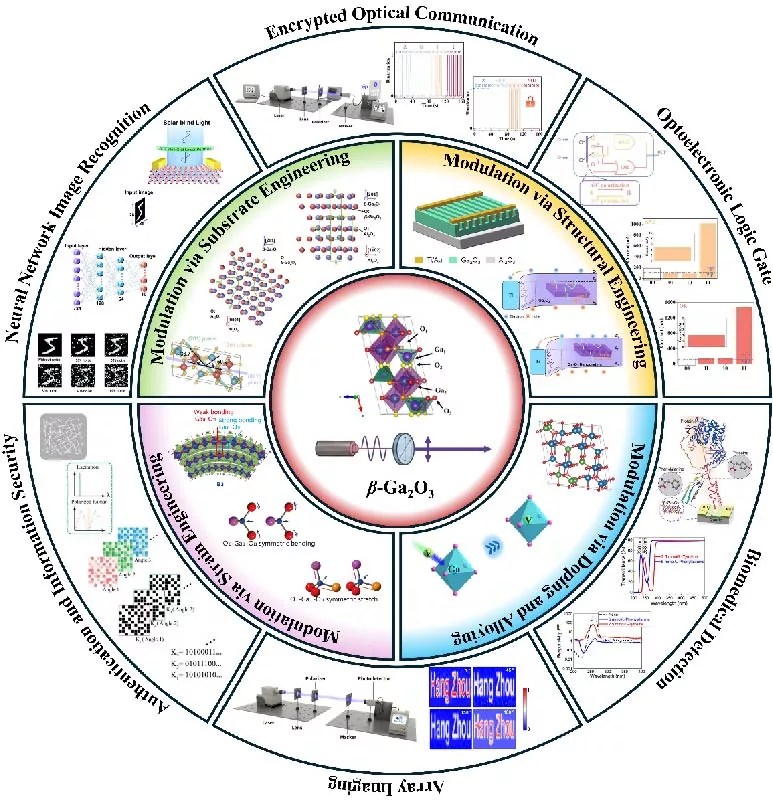
β-Ga2O3 combines solar-blind spectral selectivity, intrinsic crystallographic anisotropy, and ultrawide-bandgap robustness, making it a distinctive platform for ultraviolet polarization photodetection. This review examines how microscopic anisotropy is translated into usable polarization information across the material-device-system hierarchy. We first distinguish anisotropic optical absorption, the monoclinic dielectric tensor, excitonic effects, and direction-dependent carrier transport, emphasizing that these mechanisms are related but not interchangeable. We then assess substrate orientation, strain, doping/alloying, and structural engineering as routes to preserve, reshape, amplify, or introduce polarization selectivity. At the device level, responsivity, detectivity, polarization ratio, response speed, and operating bias are evaluated together with self-powered interface engineering and linear-polarimetric reconstruction, highlighting performance trade-offs and the possibility that interfaces may preserve, amplify, or obscure intrinsic anisotropy. Representative proof-of-concept demonstrations in optical communication, neuromorphic processing, physical unclonable functions, and wavelength-assisted molecular sensing are critically assessed from a system-level perspective. We conclude that future progress depends on establishing quantitative links among microscopic anisotropy, external modulation, interfaces, device readout, and polarization-information fidelity rather than pursuing isolated record metrics.
Review Article | 2026-08-31
PIER Photonics
Vol. 1, 31-59, 2026
download: 486
β-Ga2O3 Polarization-Sensitive Photodetectors: From Materials Fundamentals and Modulation Strategies Toward System Integration
Gang Wu, Chao Wu, Qixin Guo, Julian Samuel Goodwin Evans and Daoyou Guo
β-Ga2O3 combines solar-blind spectral selectivity, intrinsic crystallographic anisotropy, and ultrawide-bandgap robustness, making it a distinctive platform for ultraviolet polarization photodetection. This review examines how microscopic anisotropy is translated into usable polarization information across the material-device-system hierarchy. We first distinguish anisotropic optical absorption, the monoclinic dielectric tensor, excitonic effects, and direction-dependent carrier transport, emphasizing that these mechanisms are related but not interchangeable. We then assess substrate orientation, strain, doping/alloying, and structural engineering as routes to preserve, reshape, amplify, or introduce polarization selectivity. At the device level, responsivity, detectivity, polarization ratio, response speed, and operating bias are evaluated together with self-powered interface engineering and linear-polarimetric reconstruction, highlighting performance trade-offs and the possibility that interfaces may preserve, amplify, or obscure intrinsic anisotropy. Representative proof-of-concept demonstrations in optical communication, neuromorphic processing, physical unclonable functions, and wavelength-assisted molecular sensing are critically assessed from a system-level perspective. We conclude that future progress depends on establishing quantitative links among microscopic anisotropy, external modulation, interfaces, device readout, and polarization-information fidelity rather than pursuing isolated record metrics.
β-Ga2O3 Polarization-Sensitive Photodetectors: From Materials Fundamentals and Modulation Strategies Toward System Integration
Article | 2026-07-27
PIER Photonics
Vol. 1, 20-30, 2026
download: 379
Single-Wavelength-Driven DWDM Transmitter Chip on Monolithic Thin-Film Lithium Niobate with a Record-High Spectral Efficiency
Shen Wang, Yuyi Wang, Haohua Wang, Yuntao Zhu, Junjie Yi, Defeng Shan, Mingwang Jiang, Jiakai Dong, Yunjie Wang, Jingyi Wang, Kaixuan Chen, Xinlun Cai, Jie Liu, Changjian Guo, Siyuan Yu and Liu Liu
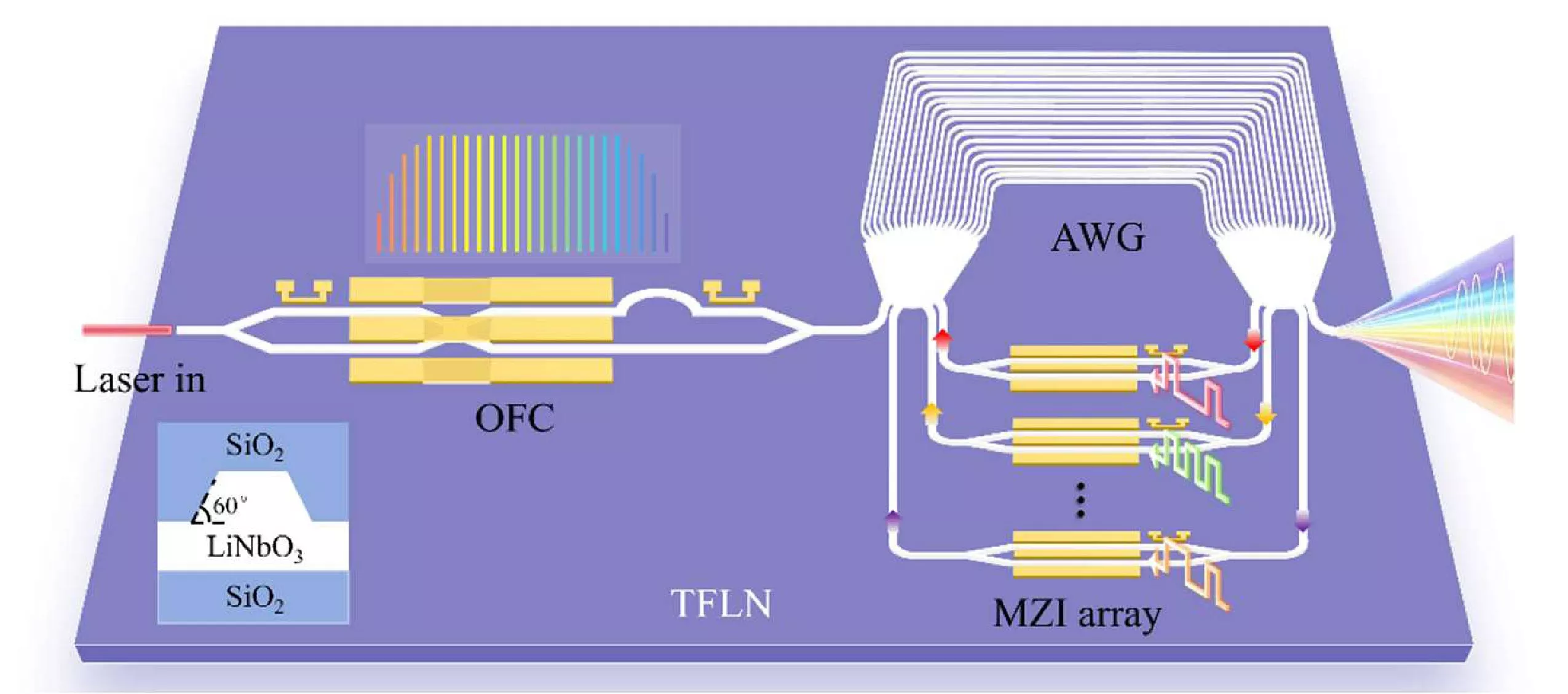
Optical transmission based on dense wavelength-division multiplexing (DWDM) is widely considered a key solution for increasing optical-link capacity. However, the complexity and stringent requirements for optical devices in such systems challenge full integration on a chip. Here, we demonstrate the first monolithic DWDM transmitter chip, built on a thin-film lithium niobate. The chip consists of an easy-to-drive and high-efficiency electro-optical (EO) frequency comb generator for a flat-top multi-wavelength source, a single arrayed waveguide grating for both multiplexing and demultiplexing to ensure no wavelength misalignment, and an EO Mach-Zehnder modulator array. Using a single-wavelength laser as input, the proposed transmitter can deliver a total modulated signal of 1.6 Tbps in eight 100-GHz spacing channels using an intensity-modulation direct-detection scheme. A record high spectral efficiency of 2 bps/Hz was achieved for an integrated DWDM transmission system using optical frequency combs. The energy consumption of the entire system was measured to be 2.76 pJ/bit. This work establishes a scalable route towards a versatile and integrated multi-wavelength data processor for DWDM data transmissions, optical computing, and microwave-photonics.
Single-Wavelength-Driven DWDM Transmitter Chip on Monolithic Thin-Film Lithium Niobate with a Record-High Spectral Efficiency
Article | 2026-07-27
PIER Photonics
Vol. 1, 12-19, 2026
download: 154
Record-High Third-Order Optical Nonlinearity in 2D ITO via Quantum Confinement at Telecommunication Wavelengths
Zhuoer Chen, Yiyun Zhang, Junru Niu, Lian Shen, Yeon Ui Lee, Hongsheng Chen, Bingtao Gao and Shilong Li
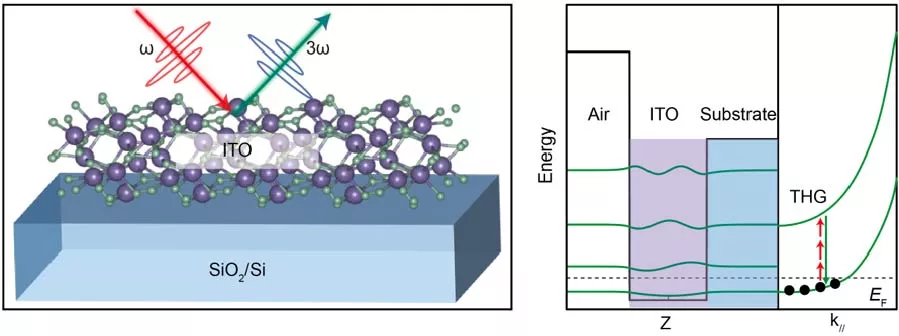
All-optical nonlinear modulators, capable of femtosecond-scale signal modulation, are pivotal for high-speed data transmission in next-generation space optical communications. However, the inherently weak third-order optical nonlinearity of conventional materials remains a significant bottleneck for efficient nonlinear signal processing. In this work, we unveil the extraordinary third-order nonlinear susceptibility χ(3) of atomically thin two-dimensional (2D) indium tin oxide (ITO) films within the 1550-nm telecommunications band. By leveraging quantum confinement effects, these 2D ITO layers form discrete electronic subbands that dramatically enhance intersubband transition dipole moments and thus the optical responses. Experimental measurements reveal a record-high angle-averaged χ(3) value of 2.0 × 10-(14) m2/V2, representing an approximately 300-fold enhancement over bulk ITO and surpassing graphene by a factor of five. Furthermore, the 2D ITO films maintain high transparency and possess the potential for ultrafast response speeds inherent to electronic nonlinear processes, making them ideal candidates for compact nonlinear photonic integration. These findings demonstrate that 2D ITO, as a representative example of bandgap-engineered transparent conductive oxides (TCOs), provides a versatile platform for high-performance all-optical switching and signal processing in optical networks.
Record-High Third-Order Optical Nonlinearity in 2D ITO via Quantum Confinement at Telecommunication Wavelengths
Editorial Highlight | 2026-07-13
PIER Photonics
Vol. 1, 10-11, 2026
download: 131
Singular Jones Metasurfaces - Polarization Addressability and Topological Phase Winding
Sailing He
PIER Photonics is a premier open-access journal launched by The Electromagnetics Academy to serve the rapidly evolving photonics community. Focusing on the frontiers and hot topics, the journal covers six strategic domains: Fundamental Science, Materials and Nanostructures, Integrated Photonic Systems, Healthcare and Life Sciences, Sustainability and Information Technology, and Emerging Frontiers. Built on the PIERS conference legacy, PIER Photonics offers rigorous peer review, rapid publication, and a vibrant platform for transformative photonics research.
Singular Jones Metasurfaces - Polarization Addressability and Topological Phase Winding
Article | 2026-07-13
PIER Photonics
Vol. 1, 3-9, 2026
download: 453
Polarization-Addressable Singular Jones Metasurfaces
Haoye Qin, Zijin Yang, Xinyang Mu, Wenjing Lv, Jue Li, Yuzhi Shi, Bo Li, Qinghua Song and Cheng-Wei Qiu
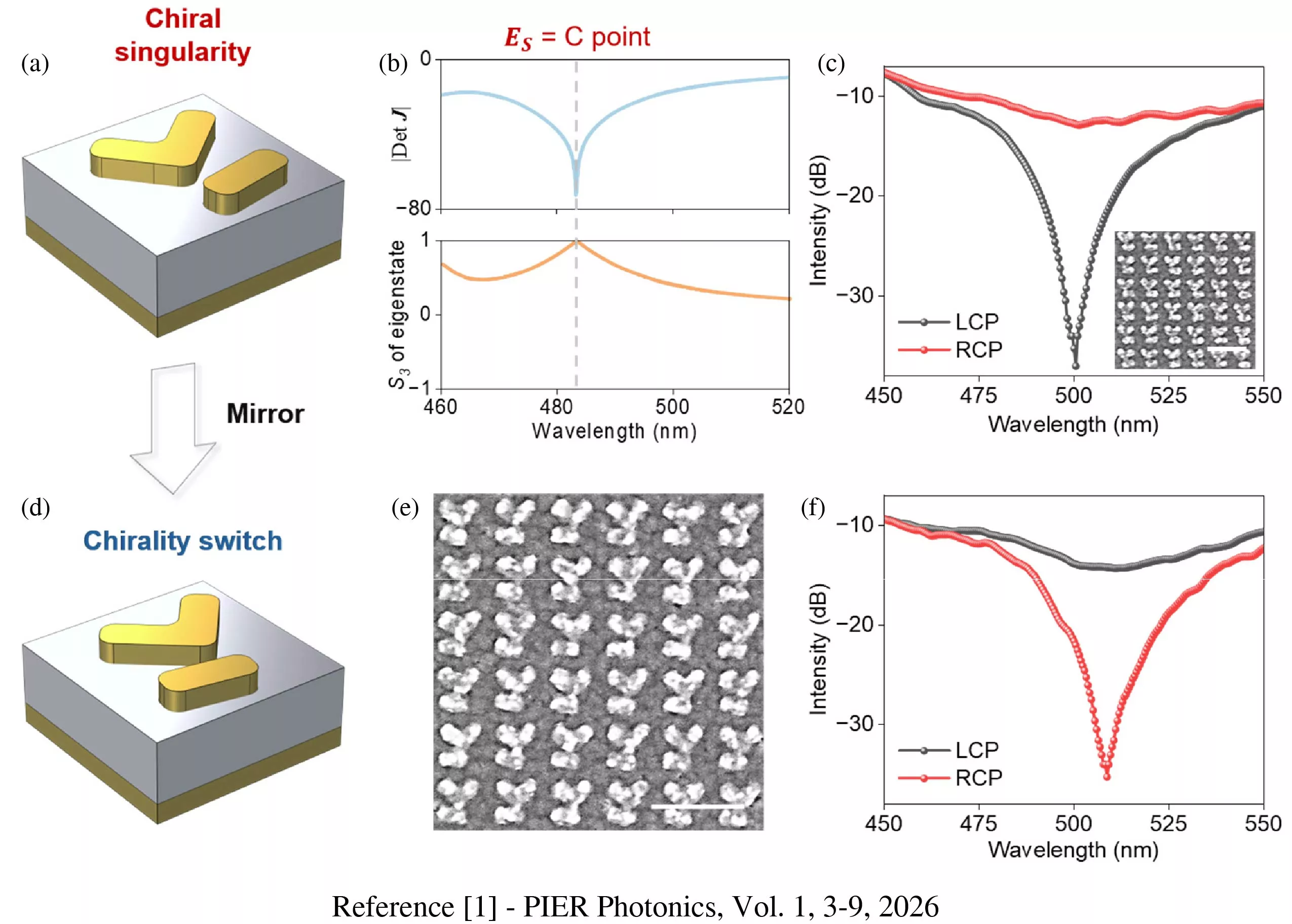
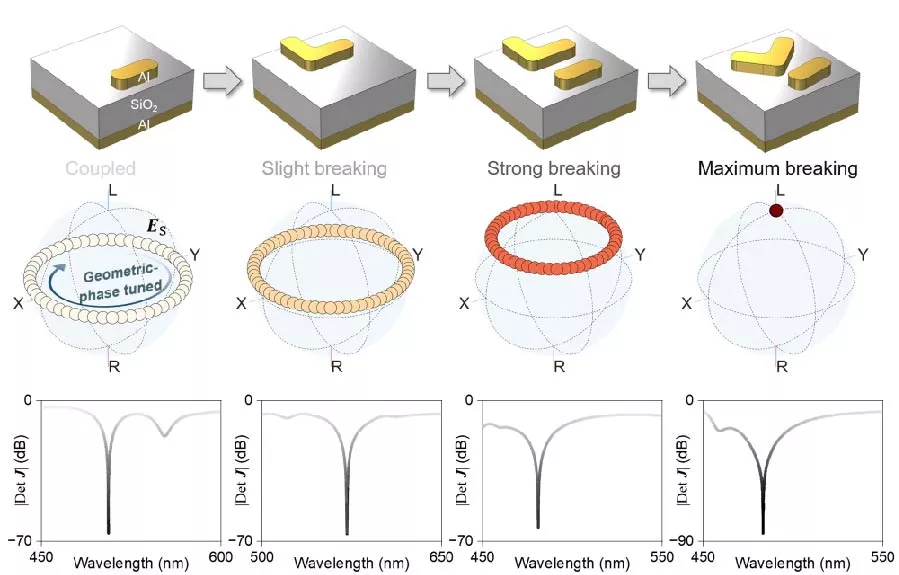
Singular optics are commonly explored through scalar or vectorial singularities, whereas matrix-level singularities remain far less developed for wave manipulations. Here, we experimentally demonstrate polarization-addressable singular Jones metasurfaces using reflective plasmonic nanostructures. By engineering polarization conversion in the reflection subspace, the Jones matrix can be driven to a singular condition, mapping an incident polarization eigenstate to a vectorial zero output. The corresponding eigen-polarization can be addressed across the Poincaré sphere by tailoring meta-atom geometries. Encircling the singularity in a two-dimensional parameter space can yield a full 2π topological phase winding, enabling dual-channel meta-holography and vortex generation. Extreme coupling breaking further produces circularly polarized zero-output eigenstates, revealing chiral Jones singularities. These results establish singular Jones metasurfaces as a compact platform for matrix-level singular optics, polarization-selective extinction, topological wavefront shaping, and chiral light-matter interactions.
Polarization-Addressable Singular Jones Metasurfaces
Editorial | 2026-07-10
PIER Photonics
Vol. 1, 1-2, 2026
download: 102
PIER Photonics - Focusing on the Frontiers and Hot Topics
Sailing He, et al.
PIER Photonics is a premier open-access journal launched by The Electromagnetics Academy to serve the rapidly evolving photonics community. Focusing on the frontiers and hot topics, the journal covers six strategic domains: Fundamental Science, Materials and Nanostructures, Integrated Photonic Systems, Healthcare and Life Sciences, Sustainability and Information Technology, and Emerging Frontiers. Built on the PIERS conference legacy, PIER Photonics offers rigorous peer review, rapid publication, and a vibrant platform for transformative photonics research.
PIER Photonics - Focusing on the Frontiers and Hot Topics