Search Results(13786)

2006-02-20
PIER
Vol. 60, 165-177
Scattering of Inhomogeneous Two-Dimensional Periodic Dielectric Gratings
Mohammad Khalaj-Amirhosseini
A general method is proposed to frequency domain analysis of inhomogeneous two-dimensional periodic gratings. Each component of electromagnetic fields is expressed by several spatial harmonic plane waves. Then, two differential equations are obtained for the reflection and transmission matrices, using wave-splitting approach. Solving these equations gives us the co- and cross-polarized reflection and transmission coefficients. The method is studied using some examples.
SCATTERING OF INHOMOGENEOUS TWO-DIMENSIONAL PERIODIC DIELECTRIC GRATINGS
2006-02-20
PIER
Vol. 60, 153-163
Coupling Model for the Two Orthogonal Microstrip Lines in Two Layer PCB Board (Quasi-TEM Approach)
Maryam Hashemi-Nasab and Ahmad Cheldavi
In the present paper a simple model has been given to simulate the signal propagation through two cross orthogonal microstrip lines in two different layers of the PCB board. First the structure has been analyzed using full wave software like HFSS, then a simple and suitable lumped equivalent circuit is proposed for the cross talk region and its parameters are obtained. Finally the sparameters of this equivalent circuit compared with the results of full wave simulations. The results show good agreement up to some GHz.
COUPLING MODEL FOR THE TWO ORTHOGONAL MICROSTRIP LINES IN TWO LAYER PCB BOARD (QUASI-TEM APPROACH)
2006-02-20
PIER
Vol. 60, 143-152
Microstripline Fed Cylindrical Dielectric Resonator Antenna with a Coplanar Parasitic Strip
A. Kumar , Hamsakutty Vettikalladi , Jaimon Yohannan and K. Mathew
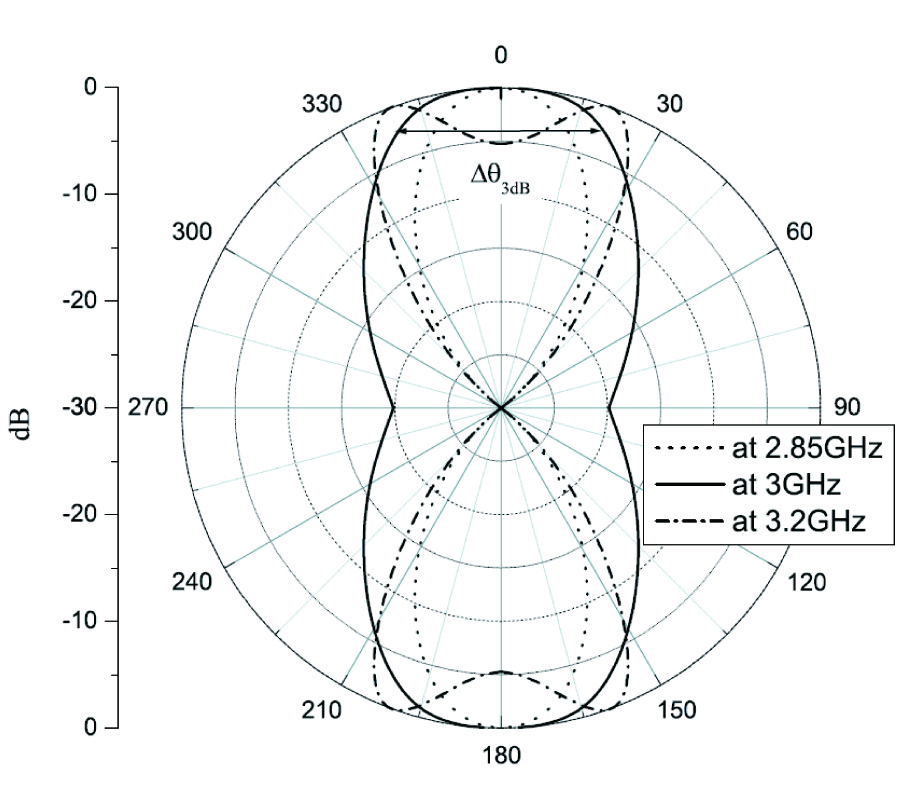
The paper discusses the experimental analysis on a cylindrical dielectric resonator antenna (DRA) with a parasitic conducting strip, loaded coplanar with the 50Ω microstripline feed. The antenna offers an impedance bandwidth as high as 17.33% at a centre frequency of 2.77 GHz, as a result of the enhanced coupling produced by the coplanar strip. The return loss, impedance, polarization and radiation characteristics of the antenna are studied. The radiation patterns are broad and the low cross-polarisation levels confirm that the antenna is linearly polarised over the entire impedance bandwidth.
MICROSTRIPLINE FED CYLINDRICAL DIELECTRIC RESONATOR ANTENNA WITH A COPLANAR PARASITIC STRIP
2006-02-20
PIER
Vol. 60, 131-142
A Rigorous Analysis and Experimental Researches of Waveguide Magic Tee at W Band
Hongchao Wu and Wen-Bin Dou
A waveguide magic tee at W band is analyzed exactly and developed. The analysis approach is a combination of the mode expansion method and finite element method, which is based on the weak form of Helmholtz equation. Mode expansion instead of PML (Perfectly Matched Layers) is used to truncate the computing space of finite element. A magic tee at W band (75∼110 GHz) with the structure, which is easy for manufacture, is developed. Calculated results are presented and compared to those in experiments. Agreement has been observed. A sensitivity analysis is carried out, which shows the influence of the tolerance of manufacture on the performance of the magic tee. And the power carrying capacity of the designed magic tee is also evaluated.
A RIGOROUS ANALYSIS AND EXPERIMENTAL  RESEARCHES OF WAVEGUIDE MAGIC TEE AT W BAND
2006-02-20
PIER
Vol. 60, 119-130
A Simple Broadband Printed Antenna
Steven Gao and A. Sambell
This paper presents a simple broadband proximity- coupled microstrip patch antenna. A circular patch is used as the main radiator, and an H-shaped shot is cut in the ground plane below the feed line. A stepped-width microstrip line is used to feed the patch through proximity coupling. By using a single patch, the prototype antenna achieves an impedance bandwidth of 26%. Low cross-polar levels below -20 dB are observed in both E- and H -planes. The broadband antenna is planar, small size, simple in structure, low in cost, and easy to be fabricated, thus attractive for practical applications.
A SIMPLE BROADBAND PRINTED ANTENNA
2006-02-20
PIER
Vol. 60, 107-117
Analysis of Coupled or Single Nonuniform Transmission Lines Using Taylor's Series Expansion
Mohammad Khalaj-Amirhosseini
A method is proposed for analysis of arbitrarily loaded lossy and dispersive nonuniform single or coupled transmission lines. In this method, all the per-unit-length parameters or matrices of the single or coupled lines and also the voltages and currents along the length of them are expanded in Taylor′s series. The solutions of voltages and currents are obtained after finding unknown coefficients of their series. The accuracy of the method is studied using analysis of some special types of single and coupled transmission lines.
ANALYSIS OF COUPLED OR SINGLE NONUNIFORM TRANSMISSION LINES USING TAYLOR'S SERIES EXPANSION
2006-02-20
PIER
Vol. 60, 95-106
Smart Antenna Array Patterns Synthesis: Null Steering and Multi-User Beamforming by Phase Control
Moctar Mouhamadou , Patrick Vaudon and Mohammed Rammal
In this article, an efficient method for the pattern synthesis of the linear antenna arrays with the prescribed null and multi-lobe Beamforming is presented. Multi-lobe pattern and adaptive nulling of the pattern is achieved by controlling only the phase of each array element. The proposed method is based on the Sequential Quadratic Programming (SQP) algorithm and the linear antenna array synthesis was modelled as a multi-ob jective optimization problem. Multi-ob jective optimization is concerned with the maximization (or minimization) of a vector of ob jectives functions in the directions of desired signal that can be sub ject of a number of constraints (in our case, the constraints can be imposed as the null in the direction of interfering signal). To verify the validity of the technique, several illustrative examples of uniform excited array patterns with the main beam is placed in the direction of the useful signal and null is placed in the direction of potential interferers, and multi-beam patterns are demonstrated.
SMART ANTENNA ARRAY PATTERNS SYNTHESIS: NULL STEERING AND MULTI-USER BEAMFORMING BY PHASE CONTROL
2006-02-20
PIER
Vol. 60, 85-94
The Relativistic Proper-Velocity Transformation Group
Abraham Ungar
The Lorentz transformation group of the special theory of relativity is commonly represented in terms of observer′s, or coordinate, time and coordinate relative velocities. The aim of this article is to uncover the representation of the Lorentz transformation group in terms of traveler′s, or proper, time and proper relative velocities. Following a recent demonstration by M. Idemen, according to which the Lorentz transformation group is inherent in Maxwell equations, our proper velocity Lorentz transformation group may pave the way to uncover the proper time Maxwell equation
2006-02-20
PIER
Vol. 60, 43-83
Exact Formulas for the Lateral Electromagnetic Pulses from a Horizontal Electric Dipole on the Boundary Between a Isotropic Medium and One-Dimensionally Anisotropic Medium
Kai Li and Yi-Long Lu
In this paper, the exact formulas are derived for the timedomain electromagnetic field generated by a delta-function current in a horizontal electric dipole located on the planar boundary between a homogeneous isotropic medium and one-dimensionally anisotropic medium. Similar to the isotropic case, the amplitude of the tangential pulsed electric field along the boundary is 1/ρ2, which is characteristic of the surface-wave or lateral pulse. The tangential electric field consists of a delta-function pulse travelling in Region 2 (anisotropic medium), a oppositely directed delta-function travelling in Region 1 (isotropic medium), and a final static electric field due to the charges left on the dipole. It is seen that the pulsed electromagnetic field components consist of the first and second pulsed in the two regions with different velocities.
EXACT FORMULAS FOR THE LATERAL ELECTROMAGNETIC PULSES FROM A HORIZONTAL ELECTRIC DIPOLE ON THE BOUNDARY BETWEEN A ISOTROPIC MEDIUM AND ONE-DIMENSIONALLY ANISOTROPIC MEDIUM
2006-02-20
PIER
Vol. 60, 19-41
Application of Physical Spline Finite Element Method (PSFEM) to Fullwave Analysis of Waveguides
Xingling Zhou and George Pan
In this paper, the physical spline finite element method (PSFEM) is applied to the fullwave analysis of inhomogeneous waveguides. Combining (rectangular) edge element and the PSFEM, the cubic spline interpolation is successfully applied to the wave equation. For waveguide problems, the resulting nonlinear eigenvalue problem is solved by a simple iteration method in which the initial estimate is taken as the linear Lagrange interpolation, and then the solutions are improved by a few iterations. The bandwidth of the resultant matrix from the PSFEM is the same as that of linear Lagrange interpolation and is sparse. As a result, sparse matrix solver can be used. Three typical examples are demonstrated and compared with the analytical solutions and with the linear Lagrange interpolation results. It is observed that the present method converges much faster than the Lagrange interpolation method.
APPLICATION OF PHYSICAL SPLINE FINITE ELEMENT METHOD (PSFEM) TO FULLWAVE ANALYSIS OF WAVEGUIDES
2006-01-09
PIER
Vol. 59, 17-38
Development of a 10 GHz Phased Array Cylindrical Antenna System in Corporating IF Phase Processing
Nikolaos Athanasopoulos , Nikolaos Uzunoglu and John Kanellopoulos
This paper presents an experimental Phased Array Antenna System operating at 10 GHz. Geometry of the antenna array is cylindrical. Antenna element excitation phases are adjusted at the intermediate frequency stage. Antenna element excitation amplitudes are taken to be constant. A least squares technique is used for phase computation and radiation pattern synthesis. The obtained radiation patterns provide steerable main lobes and nulls at predefined directions including control of the side lobes at specified levels. Units of the system are presented in detail and their architecture is explained. A phase calibration is used to compensate the system. Measurements of radiation patterns are presented and are compared with calculated patterns.
DEVELOPMENT OF A 10 GHz PHASED ARRAY CYLINDRICAL ANTENNA SYSTEM IN CORPORATING IF PHASE PROCESSING
2006-01-06
PIER
Vol. 59, 325-333
Mutual Coupling Effect on Thermal Noise in Multi-Element Antenna Systems
Snezana Krusevac , Predrag Rapajic and Rodney Kenneddy
In this paper, we investigate the thermal noise behavior of the multi-antenna communication systems, when antenna elements are closely spaced. We analyze the mutual coupling effect on thermal noise. We apply the Nyquist's thermal noise theorem to determine thermal noise power in the multi-antenna system and to confirm the partial correlation of thermal noise for antenna spacing lower then one wavelength. Simulation results confirm the decrease of thermal noise power level when antenna spacings drop below a half wavelength.
MUTUAL COUPLING EFFECT ON THERMAL NOISE IN MULTI-ELEMENT ANTENNA SYSTEMS
2006-01-06
PIER
Vol. 59, 299-324
Multi-Layer Crystals of Metallic Wires: Analysis of the Transmission Coefficient for Outside and Inside Exciation
Halim Boutayeb , Kouroch Mahdjoubi and Anne-Claude Tarot
This paper proposes a new analysis of the transmission coefficient at normal incidence for 2-D periodic crystals (also called Electromagnetic Band Gap (EBG) structures), which are finite in the direction of wave-propagation and are composed of metallic wires. The crystal is considered as a set of parallel Partially Reflecting Surfaces (PRSs), whose transmission and reflection characteristics are obtained rigorously using the Finite Difference Time Domain (FDTD) method. The transmission coefficient of the EBG structure is then obtained by using a plane-wave cascading approach considering single mode interactions between PRSs. The accuracy of the results given by the hybrid method is assessed compared to those obtained directly by the Finite Difference Time Domain (FDTD) method. The minima and maxima envelops and the resonance frequencies of the transmission coefficient are studied, with analytical expressions, for both, excitation from outside and excitation from inside. A discussion is also presented concerning the strength of the coefficient greater than one obtained when the plane-wave source is inside the EBG structure. In addition, by using a transmission line model, a normalized version for this coefficient is proposed, which considers the available power by the source.
MULTI-LAYER CRYSTALS OF METALLIC WIRES: ANALYSIS OF THE TRANSMISSION COEFFICIENT FOR OUTSIDE AND INSIDE EXCIATION
2006-01-06
PIER
Vol. 59, 267-297
A Time-Domain Theory of Waveguide
Geyi Wen
A new time-domain theory for waveguides has been presented in the paper. The electromagnetic fields are first expanded by using the complete sets of vector modal functions derived from the transverse electric field. The expansion coefficients are then determined by solving inhomogeneous Klein-Gordon equation in terms of retarded Green's function. The theory has been validated by considering propagation problems excited by various excitation waveforms, which indicates that the higher order modes play a significant role in the field distributions excited by a wideband signal.
A TIME-DOMAIN THEORY OF WAVEGUIDE
2006-01-06
PIER
Vol. 59, 251-265
Interference Supression of the Linear Antenna Arrays Controlled by Phase with Use of Sqp Algorithm
Moctar Mouhamadou , Paul Armand , Patrick Vaudon and Mohammed Rammal
The performance of mobile cellular radio networks is limited by the level of cochannel interference that can be tolerated. The use of antennas arrays is very helpful in enhancing the performance and capacity of the wireless communication system. This paper presents a method for antenna pattern synthesis that suppress multiple interfering narrow or wide band signals while receiving the desired signal by controlling only the phase. Excitation phases are computed using the Sequential Quadratic Programming (SQP) technique. This method transforms the nonlinear minimization (or maximization) problem to a sequence of quadratic subproblems, based on a quadratic approximation of the Lagrangian function.
INTERFERENCE SUPRESSION OF THE LINEAR ANTENNA ARRAYS CONTROLLED BY PHASE WITH USE OF SQP ALGORITHM
2006-01-06
PIER
Vol. 59, 231-249
Conducting Sheath Helical Winding on the Core-Cladding Interface of a Lightguide Having a Piet Hein Super Elliptical Core Cross-Section and a Standard Optical Fiber of Circular Cross-Section-a Comparative Modal Analysis
Vivek Singh , S. Maurya , B. Prasad and Sant Ojha
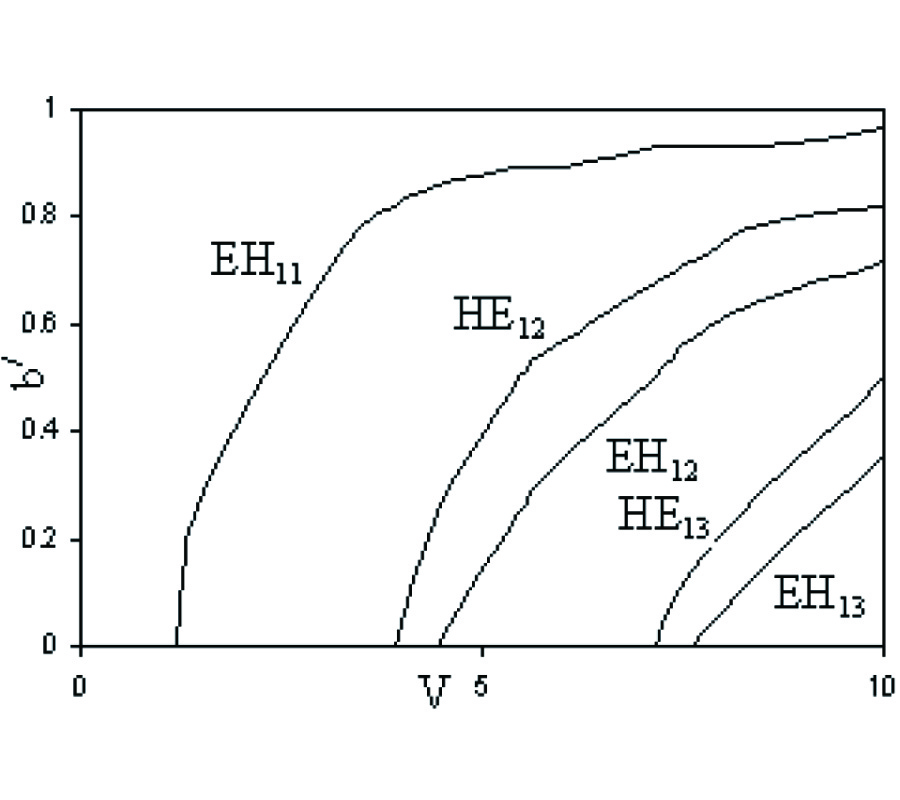
In this article, a theoretical and computational analysis has been made to obtain the modal dispersion characteristics of an unconventional optical waveguide with a Piet Hein core cross section having a conducting sheath helix winding on its core-cladding boundary. A simple analytical method using the vector boundary conditions has been utilized to get the modal eigen value equation. From this equation dispersion curves are obtained and plotted for some particular values of the pitch angles of the winding. Next, these predicted results are compared with those of a new optical fiber having a conducting sheath helix winding on its core-cladding boundary. It is seen that the cutoff values are somewhat lower for the Piet Hein lightguide than those for the circular guide. This is not unexpected since the Piet Hein curve approaches the shape of a square. The introduction of a conducting helical winding leads to a modification of the modal characteristics of the lightguides and gives us an additional means to control them.
CONDUCTING SHEATH HELICAL WINDING ON THE CORE-CLADDING INTERFACE OF A LIGHTGUIDE HAVING A PIET HEIN SUPER ELLIPTICAL CORE CROSS-SECTION AND A STANDARD OPTICAL FIBER OF CIRCULAR CROSS-SECTION-A COMPARATIVE MODAL ANALYSIS
2006-01-06
PIER
Vol. 59, 215-230
Asymptotics of Creeping Waves in the Case of Nondiagonalizable Matrix Impedance
Ivan Viktorovitch Andronov and Daniel Bouche
Creeping waves propagate in the shadow along the surface of a convex body. In the case of a perfectly conducting body coated with high index anisotropic dielectric, this surface can be described by anisotropic impedance boundary condition. In a previous paper the general case of anisotropic impedance was studied. In this paper we discuss a special case characterized by a degenerated impedance matrix. The ansatz for ordinary creeping waves does not allow the asymptotics to be constructed and a new ansatz is suggested. In contrast to the usual one, this ansatz contains an additional quick factor proportional to k1/6 (where k is the wavenumber). As a result, the field is described by an asymptotic sequence in inverse powers of k1/6 . We derive the principal order term of the asymptotics and discuss specific properties of creeping waves on a surface with degenerated impedance.
ASYMPTOTICS OF CREEPING WAVES IN  THE CASE OF NONDIAGONALIZABLE MATRIX IMPEDANCE
2006-01-06
PIER
Vol. 59, 199-213
Fractional Curl Operator in Chiral Medium and Fractional Non-Symmetric Transmission Line
Akhtar Hussain and Qaisar Abbas Naqvi
Fractional curl operator has been utilized to wave propagation in lossless, isotropic, homogeneous and reciprocal chiral medium when it contains interfaces. The fractional solutions for the corresponding standing wave solution and transverse impedance are determined. Equivalent fractional non-symmetric transmission line has also been analyzed.
2006-01-06
PIER
Vol. 59, 187-198
Analysis of Lossy Inhomogeneous Planar Layers Using Finite Difference Method
Mohammad Khalaj-Amirhosseini
A general method is introduced to frequency domain analysis of lossy Inhomogeneous Planar Layers (IPLs). In this method, the IPLs are subdivided to several thin homogeneous layers, at first. Then the electric and magnetic fields are obtained using second order finite difference method. The accuracy of the method is studied using analysis of some special types of IPLs.
ANALYSIS OF LOSSY INHOMOGENEOUS PLANAR LAYERS USING FINITE DIFFERENCE METHOD
2006-01-06
PIER
Vol. 59, 175-186
Dielectric Studies of Corn Syrup for Applications in Microwave Breast Imaging
Gopinathan Nair Bindu , Anil Lonappan , Vinu Thomas , Chandroth K. Aanandan and K. Mathew
Permittivity and conductivity studies of corn syrup in various concentrations are performed using coaxial cavity perturbation technique over a frequency range of 250 MHz-3000 MHz. The results are utilized to estimate relaxation time and dipole moments of the samples. The stability of the material over the variations of time is studied. The measured specific absorption rate of the material complies with the microwave power absorption rate of biological tissues. This suggests the feasibility of using corn syrup as a suitable, cost effective coupling medium for microwave breast imaging. The material can also be used as an efficient breast phantom in microwave breast imaging studies.
DIELECTRIC STUDIES OF CORN SYRUP FOR APPLICATIONS IN MICROWAVE BREAST IMAGING