Search Results(13878)

2006-08-28
PIER
Vol. 64, 135-148
Absorbing Properties of a Negative Permittivity Layer Placed on a Reflecting Grating
O. Kusayakin , Petr Melezhik , Anatoly Poyedinchuk and Oleksander Troschylo
Theoretical results on the electromagnetic properties of such a structure as a negative-permittivity layer placed on a reflecting grating are discussed. Effect of this structure resonant absorption of the excitation electromagnetic energy is studied in a wide range of problem parameters. The sufficient conditions of the effect appearance are determined by solving the dielectric-layer eigenoscillation problem. A comparative analysis of the absorption by the negative- and the positive-permittivity structures is made to reveal the characteristic features of the effect. Phenomenon of the absorption resonance splitting is shown in the case of plane wave oblique incidence on the structure. The E-polarized plane wave diffraction is considered to find out essential difference of the resonant absorption in the E and H cases.
ABSORBING PROPERTIES OF A NEGATIVE PERMITTIVITY LAYER PLACED ON A REFLECTING GRATING
2006-08-28
PIER
Vol. 64, 117-134
On Independence, Completeness of Maxwell's Equations and Uniqueness Theorems in Electromagnetics
Xingling Zhou
In this paper, the independence, completeness of Maxwell's equations and uniqueness theorems in electromagnetics are reviewed. It is shown that the four Maxwell's equations are independent and complete. A complete uniqueness theorem is proposed and proven for the first time by pointing out logic mistakes in the existing proof and presenting a truth table. Therefore, electrostatics and magnetostatics can be reduced from dynamical electromagnetics in all aspects including not only the equations as subsets of Maxwell's equations but also the corresponding uniqueness theorems. It is concluded that the axiomatic system of electromagnetic theory must consist of all four Maxwell's equations.
2006-08-28
PIER
Vol. 64, 99-116
Broadband Scattering Data Interpolation Based on a Relaxed Adaptive Feature Extraction Algorighm
Anna Raynal , John Moore and Hao Ling
A method using a relaxed adaptive feature extraction algorithm is investigated to interpolate broadband, high-frequency scattering from sparse, undersampled data. First, the adaptive feature extraction is extended to include a frequency-dependent scattering center model in order to better-describe broadband scattering physics from a complex target per the geometrical theory of diffraction. Second, the parameterization of the model is relaxed for more accurate extractions and a sparser model representation using fewer samples. Comparative results are presented for the relaxed versus the non-relaxed adaptive feature extraction algorithm for hypothetical examples and a numerically-solved ogive body of revolution. The relaxed algorithm is more computationally expensive, but results in significantly improved performance. The technique enhances adaptive feature extraction performance for broadband interpolation.
BROADBAND SCATTERING DATA INTERPOLATION BASED ON A RELAXED ADAPTIVE FEATURE EXTRACTION ALGORIGHM
2006-08-28
PIER
Vol. 64, 81-98
Resonance Frequencies and Far Field Patterns of Elliptical Dielectric Resonator Antenna: Analytical Approach
A. Tadjalli , Abdel Sebak and Tayeb Denidni
In this paper the classical boundary value approach employing the separation of variable technique is used to analyze the properties of elliptic dielectric resonator antennas. In this approach, the fields inside the resonator are expanded in terms of Mathieu and modified Mathieu functions. Numerical results are given for resonant frequencies of different modes as well for fields distribution inside the resonator. Series Green's functions are used to calculate the fields inside the cavity and also far field patterns for a given feed. Using the Green's function method provides more accurate results compared to a pure cavity model technique. The analysis and design are verified through numerical simulations. A parametric study has been performed to show effects of the elliptical dielectric resonator antennas (EDRAs) parameters on far field patterns.
RESONANCE FREQUENCIES AND FAR FIELD PATTERNS OF ELLIPTICAL DIELECTRIC RESONATOR ANTENNA: ANALYTICAL APPROACH
2006-08-28
PIER
Vol. 64, 69-80
FDTD Analysis of an Anisotropically Coated Missile
Zhuqian Gong and Guo-Qiang Zhu
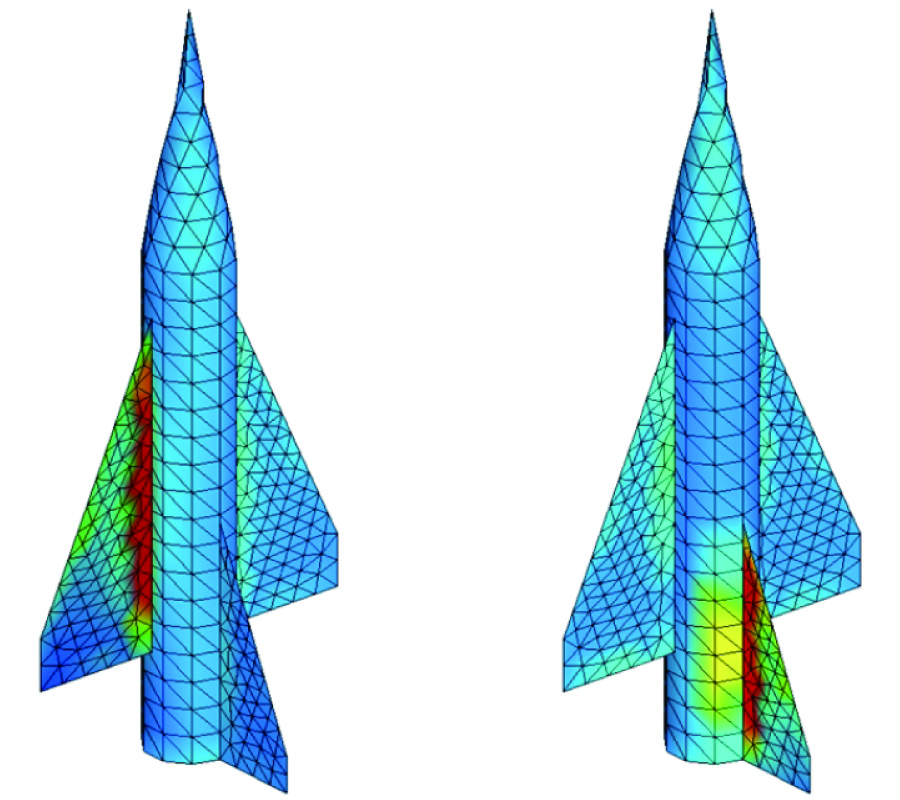
In this paper, the finite-difference time-domain (FDTD) method is applied to calculate the radar cross-section (RCS) of anisotropic coated missiles. We present a FDTD algorithm for cylindrical coordinates and derive the necessary extension to the FDTD equations for a general three-dimensional anisotropic scatterer. A new approach is proposed to obtain magnitude and phase information from the FDTD data. Computed results for two selected examples are compared with those obtained by eigenfunction expansion techniques and the moment method (MM) to demonstrate the validity of the new approach with very good agreement. The study of the bistatic radar cross-section for a missile demonstrates that the anisotropic material coating around it can effectively reduce its RCS.
FDTD ANALYSIS OF AN ANISOTROPICALLY COATED MISSILE
2006-08-28
PIER
Vol. 64, 53-67
Electromagetic Pulse Diffraction by a Moving Half-Plane
Adam Ciarkowski
This paper is concerned with the scattering of an electromagnetic (EM) pulse by a perfectly conducting half-plane, moving in a free space. It is assumed that the source signal is a plane wave pulse with its envelope described by a Dirac delta function. The representation for the total field is found, and physical interpretation of the solution is given. This representation, valid for all screen velocities, is then reduced to the case of moderate and low velocities, important for practical applications.
ELECTROMAGETIC PULSE DIFFRACTION BY A MOVING HALF-PLANE
2006-08-28
PIER
Vol. 64, 43-51
A Novel AMC with Little Sensitivity to the Angle of Incidence Using 2-Layer Jerusalem Cross FSS
Mehdi Hosseini , Abbas Pirhadi and Mohammad Hakkak
A novel artificial magnetic conductor (AMC), i.e., highimpedance surface (HIS), is proposed. The structure, which utilizes the well know Jerusalem Cross Frequency Selective Surface (JC-FSS), is a novel 3D AMC. It offers stable resonance frequency with respect to the incidence angle of both TE and TM-polarized plane waves, very compact size and acceptable bandwidth.
A NOVEL AMC WITH LITTLE SENSITIVITY TO THE ANGLE OF INCIDENCE USING 2-LAYER JERUSALEM CROSS FSS
2006-08-28
PIER
Vol. 64, 23-42
Diversity Techniques with Parallel Dipole Antennas: Radiation Pattern Analysis
Ali Khaleghi
Two parallel dipoles are assessed for antenna diversity. The three-dimensional radiation pattern is considered for signals correlation coefficient. The pattern analysis reveals that, depending on dipole spacing, three types of diversity techniques are generated: space, amplitude-pattern and phase-pattern diversity. The weighting of each technique in signals correlation coefficient mitigation is investigated. The results show that for closely spaced dipoles, the generated phasepattern diversity is the most dominant factor which greatly reduces the signals correlation coefficient. The diversity configuration is measured in a rich scattering environment. Results include signals correlation coefficient, diversity gain for selection combining and maximum ratio combining, effective diversity gain and antenna radiation efficiency can be demonstrated. We show that in rich multipath channel the minimum spatial distance, for effective diversity gain performance, is reduced from 0.5λ for uncoupled dipoles to 0.15λ for coupled dipoles.
DIVERSITY TECHNIQUES WITH PARALLEL DIPOLE ANTENNAS: RADIATION PATTERN ANALYSIS
2006-08-28
PIER
Vol. 64, 1-21
Numerical Analysis of Optical Waveguides Based on Periodic Fourier Transform
Koki Watanabe and Kousuke Kuto
Periodic Fourier transform is formally introduced to analyses of the electromagnetic wave propagation in optical waveguides. The transform make the field components periodic and they are then expanded in Fourier series without introducing an approximation of artificial periodic boundary. The proposed formulation is applied to two-dimensional slab waveguide structures, and the numerical results evaluate the validity and show some properties of convergence.
NUMERICAL ANALYSIS OF OPTICAL WAVEGUIDES BASED ON PERIODIC FOURIER TRANSFORM
2006-08-26
PIER
Vol. 63, 89-105
Rigorous Full Vectorial Analysis of Electromagnetic Wave Propagation in 1D
Juan-Antonio Martinez-Rojas , Jesus Alpuente-Hermosilla , José Piñeiro and Rocio Sanchez-Montero
We propose a new approach to solve the problem of the propagation of electromagnetic waves in unidimensional media with an arbitrary variation of their dielectric permittivity. This method is deduced from the Maxwell equations with a minimum of approximations and allows a full vectorial description of both the electric and magnetic fields through the direct calculation of their Cartesian coordinates.The problem is then equivalent to the solution of a pair of uncoupled ordinary differential equations. We use a very intuitive, highly accurate, pseudospectral technique to solve these equations. This pseudospectral method is based in a combination of Fourier and polynomial expansions of the solution providing very good precision and excellent stability with a relatively low computational effort. We present a simple model of a photonic crystal as an example of application of this technique to real electromagnetic problems.
RIGOROUS FULL VECTORIAL ANALYSIS OF ELECTROMAGNETIC WAVE PROPAGATION IN 1D
2006-08-21
PIER
Vol. 63, 319-335
Fractional Curl Operator and Fractional Waveguides
Akhtar Hussain , Saima Ishfaq and Qaisar Abbas Naqvi
Fractional curl operator has been utilized to study the fractional waveguide. The fractional waveguide may be regarded as intermediate step between the two given waveguides. The two given waveguides are related through the principle of duality. Behavior of field lines in fractional waveguides are studied withresp ect to fractional parameter α.
FRACTIONAL CURL OPERATOR AND FRACTIONAL WAVEGUIDES
2006-08-21
PIER
Vol. 63, 311-317
Bandwidth Enhansment of Microstrip Antenna
Abdelmonem Abdelaziz
A novel microstrip antenna with wide bandwidth is presented. Two different radiating elements connected together through a matched section and are embedded on a single layer structure. This new structure offers a dual-band microstrip antenna. By controlling the two resonance frequencies of the two elements, a wide frequency bandwidth of approximately 9% has been achieved. A more bandwidth enhancement, up to 12%, has been achieved by adding two parasitic elements to one element of the proposed antenna. Fabrication and measurement of S11 for the proposed antenna has been done. The measured results have been compared with the simulated results using commercial software HFSS version-8.0.
BANDWIDTH ENHANSMENT OF MICROSTRIP ANTENNA
2006-08-21
PIER
Vol. 63, 295-310
Group Theory Based Design of Isotropic Negative Refractive Index Metamaterials
Nantakan Wongkasem , Alkim Akyurtlu and Kenneth Marx
Novel isotropic planar and three-dimensional negative refractive index (NRI) metamaterial (MTM) designs consisting of periodically arranged cross structures are developed in the terahertz (THz) frequency regime using group theory. The novel designs not only avoid magnetoelectric coupling but also enable a simplified fabrication process. Using Finite-difference Time-Domain (FDTD) simulations, the design exhibits an NRI passband which is in good agreement with the S-parameters obtained from Fresnels equation. Cross-polarized fields are used to characterize the magnetoelectric coupling mechanism and determination of material properties of the medium via group theory aid in the characterization of the isotropy of the structure. Numerical simulations of a wedge composed of the proposed metamaterials prove the negative refractive index of the models.
GROUP THEORY BASED DESIGN OF ISOTROPIC NEGATIVE REFRACTIVE INDEX METAMATERIALS
2006-08-21
PIER
Vol. 63, 279-294
Vector Circuit Theory for Spatially Dispersive Uniaxial Magneto-Dielectric Slabs
Pekka M. T. Ikonen , Mikhail Lapine , Igor Nefedov and Sergei Tretyakov
We present a general dyadic vector circuit formalism, applicable for uniaxial magneto-dielectric slabs, with strong spatial dispersion explicitly taken into account. This formalism extends the vector circuit theory, previously introduced only for isotropic and chiral slabs. Here we assume that the problem geometry imposes strong spatial dispersion only in the plane, parallel to the slab interfaces. The difference arising from taking into account spatial dispersion along the normal to the interface is briefly discussed. We derive general dyadic impedance and admittance matrices, and calculate corresponding transmission and reflection coefficients for arbitrary plane wave incidence. As a practical example, we consider a metamaterial slab built of conducting wires and split-ring resonators, and show that neglecting spatial dispersion and uniaxial nature in this structure leads to dramatic errors in calculation of transmission characteristics.
VECTOR CIRCUIT THEORY FOR SPATIALLY DISPERSIVE UNIAXIAL MAGNETO-DIELECTRIC SLABS
2006-08-21
PIER
Vol. 63, 243-278
Singularity Subtraction Integral Formulae for Surface Integral Equations with RWG, Rooftop and Hybrid Basis Functions
Ilari Hanninen , Matti Taskinen and Jukka Sarvas
Numerical solution of electromagnetic scattering problems by the surface integral methods leads to numerical integration of singular integrals in the Method of Moments. The heavy numerical cost of a straightforward numerical treatment of these integrals can be avoided by a more efficient and accurate approach based on the singularity subtraction method. In the literature the information of the closed form integral formulae required by the singularity subtraction method is quite fragmented. In this paper we give a uniform presentation of the singularity subtraction method for planar surface elements with RWG, n̂ x RWG, rooftop, and n̂ x rooftop basis functions, the latter three cases being novel applications. We also discuss the hybrid use of these functions. The singularity subtraction formulas are derived recursively and can be used to subtract more than one term in the Taylor series of the Green's function.
SINGULARITY SUBTRACTION INTEGRAL FORMULAE FOR SURFACE INTEGRAL EQUATIONS WITH RWG, ROOFTOP AND HYBRID BASIS FUNCTIONS
2006-08-21
PIER
Vol. 63, 223-242
A Maxwell Garnett Model for Dielectric Mixtures Containing Conducting Particles at Optical Frequencies
Marina Koledintseva , Richard DuBroff and Robert Schwartz
Mathematical modeling of composites made of a dielectric base and randomly oriented metal inclusions is considered. Different sources of frequency-dependent metal conductivity at optical frequencies are taken into account. These include the skin-effect, dimensional (length-size) resonance of metal particles, and the Drude model. Also, the mean free path of electrons in metals can be smaller than the characteristic sizes of nanoparticles, and this leads to the decrease in conductivity of the metal inclusions. These effects are incorporated in the Maxwell Garnett mixing formulation, and give degrees of freedom for forming desirable optical frequency characteristics of composite media containing conducting particles.
A MAXWELL GARNETT MODEL FOR DIELECTRIC MIXTURES CONTAINING CONDUCTING PARTICLES AT OPTICAL FREQUENCIES
2006-07-29
PIER
Vol. 63, 209-222
Surface Resonances of Metal Stripe Grating on the Plane Boundary of Metamaterial
Andrey Brovenko , Petr Melezhik , Anatoly Poyedinchuk and Nataliya Yashina
The paper is devoted to the study of the interaction of the electromagnetic waves with the structure composed of perfectly conducting strip grating, situated on the plane boundary of metamaterial with effective permittivity, depending on the frequency of the wave of excitation. The rigorous solution to the relevant diffraction boundary value problem is developed. The extensive numerical experiments, performed with a help of corresponding algorithm constructed, allowed to establish several regularities in the complicated process of interaction of electromagnetic waves with grating on dispersive metamaterial. The efficient association of analytical and numerical study has provided the understanding of the nature of resonant phenomena appearing in this process.
SURFACE RESONANCES OF METAL STRIPE GRATING ON THE PLANE BOUNDARY OF METAMATERIAL
2006-07-29
PIER
Vol. 63, 193-207
Simulation, Analysis, Design and Applications of Array Defected Microstrip Structure (ADMS) Filters Using Rigorously Coupled Multi-Strip (RCMS) Method
M. Kazerooni and Ahmad Cheldavi
This paper presents a simple method to analyze and design a desired frequency band rejection in microstrip transmission lines with defected signal strip structure. Also some new structures called ADMS have been introduced and compared. The proposed circuits can be applied to various microwave and millimeter wave components. Finally this paper introduces the RCMS method, a very fast and efficient solution that determines current distribution on the cross section of the signal strip with arbitrary defection pattern. One microstrip line with defected patterns is discussed and then modeled using RCMS method. The results of the current and voltage distribution along an ADMS obtained using RCMS method are in good agreement with those obtained using FEKO (a full wave simulator).
SIMULATION, ANALYSIS, DESIGN AND APPLICATIONS OF ARRAY DEFECTED MICROSTRIP STRUCTURE (ADMS) FILTERS USING RIGOROUSLY COUPLED MULTI-STRIP (RCMS) METHOD
2006-07-29
PIER
Vol. 63, 171-191
Simulations of the Left-Handed Medium Using Discontinuous Galerkin Method Based on the Hybrid Domains
Yan Shi and Chang-Hong Liang
The increasing interest in electromagnetic effects in the Left-Handed medium (LHM) requires the formulae capable of the full analysis of wave propagation in such materials. First, we develop a novel technique for discretization of the Lorentz medium model. In order to overcome the instability inherent in the standard perfectly matched layer (PML) absorbing boundary condition (ABC), we derive the modified PML ABC which can be extended to truncate the boundary of LHM. Then a convergent high-order accurate scheme based on triangle domains, discontinuous Galerkin method (DGM), is extended to the new DGM based on hybrid domains, triangle domains and quadrilateral domains. Finally, we adopt the new DGM and modified PML formulations to analysis the electromagnetic phenomena in the LHM. The simulation results show accuracy and stability of the proposed scheme.
SIMULATIONS OF THE LEFT-HANDED MEDIUM USING DISCONTINUOUS GALERKIN METHOD BASED ON THE HYBRID DOMAINS
2006-07-29
PIER
Vol. 63, 153-170
New Magnetic Field Integral Equation for Antenna System
Geyi Wen
The traditional magnetic field integral equation has been generalized to the study of antenna radiation and coupling problems with the feeding lines included. A rigorous proof of the uniqueness of the new magnetic field integral equation has been presented. Some numerical examples have been expounded to demonstrate the validity of the new magnetic field integral equation formulation.
NEW MAGNETIC FIELD INTEGRAL EQUATION FOR ANTENNA SYSTEM