Search Results(13876)

0000-00-00
PIER
Vol. 44, 131-142
Numerical Analysis of Two Dimensional Tapered Dielectric Waveguide
Asok De and Girish Attimarad
A simple method is presented to obtain the scattering parameters of the two dimensional tapered dielectric waveguide, by discrete approximation to tapering, consisting of series of steps. The two dimensional step discontinuity of the junction of two different dielectric rectangular waveguides has been solved using integral equation arising from the field matching of the discrete modes and the continuous spectrum. Accurate numerical solution has been obtained using Ritz-Galerkin variational approach with appropriate sets of expanding functions. The results in the form of scattering parameters for varying tapered length have been depicted graphically. Computed results from generalized integral expressions are found to be in excellent agreement with results obtained in two-dimensional case. With this method it is possible to design the structure to enlarge the cross section of a mode in a slow and controlled manner.
NUMERICAL ANALYSIS OF TWO DIMENSIONAL TAPERED DIELECTRIC WAVEGUIDE
0000-00-00
PIER
Vol. 42, 173-192
Wave Propagation in a Curved Waveguide with Arbitrary Dielectric Transverse Profiles
Zion Menachem
A rigorous approach is derived for the analysis of electromagnetic (EM) wave propagation in dielectric waveguides with arbitrary profiles, situated inside rectangular metal tubes, and along a curved dielectric waveguide. The first objective is to develop a mode model in order to provide a numerical tool for the calculation of the output fields for radius of curvature 0.1 m ≤ R ≤ ∞. Therefore we take into account all the terms in the calculations, without neglecting the terms of the bending. Another objective is to demonstrate the ability of the model to solve practical problems with inhomogeneous dielectric profiles. The method is based on Fourier coefficients of the transverse dielectric profile and those of the input wave profile. These improvements contribute to the application of the model for inhomogeneous dielectric profiles with single or multiple maxima in the transverse plane. This model is useful for the analysis of dielectric waveguides in the microwave and the millimeter-wave regimes, for diffused optical waveguides in integrated optics, and for IR regimes.
Wave Propagation in a Curved Waveguide with Arbitrary Dielectric Transverse Profiles
0000-00-00
PIER
Vol. 41, 1-20
An Introduction to Photonic Band Gap (PBG) Materials
Geraldine Guida , Andre De Lustrac and Alain C. Priou
This paper introduces photonic band gap (PBG) materials that are periodic dielectric or metallo-dielectric materials conceived to control the propagation of electromagnetic waves. Firstly, the principle of these materials is explained. Doped PBG materials are then presented with their main properties and applications. New phenomena like super-prism or super-lens are also introduced. A review of different numerical methods used to study photonic band gap materials and to analyze their properties is given next. Manufacturing processes are then briefly described and foreseen applications are presented. Finally, the new field of the controllable photonic band gap materials is introduced.
An Introduction to Photonic Band Gap (PBG) Materials
0000-00-00
PIER
Vol. 40, 315-333
Scattering by a Gyrotropic Bianisotropic Cylinder of Arbitrary Cross Section: an Analysis Using Generalized Multipole Technique
Tat Yeo and Mook-Seng Leong
The electromagnetic scattering by a homogeneous gyrotropic bianisotropic cylinder of arbitrary cross section is analyzed in this paper using the generalized multipole technique (GMT) where only the longitudinal fictitious electric and magnetic currents are involved. The general scattering solution is formulated and numerical results of near fields and bistatic radar cross sections are presented for four specific examples, namely, a chiral circular cylinder, a chiral square cylinder, a gyrotropic bianisotropic circular cylinder, and a gyrotropic bianisotropic "lens" cylinder. Results obtained using the GMT for the chiral and the gyrotropic bianisotropic circular cylinders are in excellent agreement with those obtained from the eigen-function expansion. Results of the GMT for the chiral square cylinder are in excellent agreement with those obtained from the method of moments (MoM) solution.
SCATTERING BY A GYROTROPIC BIANISOTROPIC CYLINDER OF ARBITRARY CROSS SECTION: AN ANALYSIS USING GENERALIZED MULTIPOLE TECHNIQUE
0000-00-00
PIER
Vol. 40, 295-314
A Practical Approach to Modeling Doubly Curved Conformal Microstrip Antennas
Charles Macon , Keith D. Trott and Leo C. Kempel
Designers are increasingly integrating conformal microstrip antennas into the curved structures of either air or land vehicles. Quite often, these structures are doubly curved (e.g. curved along two orthogonal surface directions). This practice necessitates the development of accurate codes versatile enough to model conformal antennas with arbitrarily shaped apertures radiating from doubly curved surfaces. Traditional planar-structure-based design techniques are not well suited for this application. A hybrid finite element-boundary integral formulation appropriate for the high-frequency analysis and design of doubly curved conformal antennas is introduced in this paper. The novelty of this approach lies in its use of an asymptotic prolate spheroidal dyadic Green's function to model the physics of curved surface diffraction. To demonstrate the utility of this approach, the effects of curvature on the resonant frequency and input impedance of both a doubly curved conformal square and circular patch antenna are investigated. Different feed positions are also considered. Due to a paucity of published experimental data, the numerical results are benchmarked by comparison with the results for planar square and circular patch antennas. The planar results are obtained by using an experimentally validated planar finite element-boundary integral code.
A PRACTICAL APPROACH TO MODELING DOUBLY CURVED CONFORMAL MICROSTRIP ANTENNAS
0000-00-00
PIER
Vol. 40, 255-269
A Note on the Backward Scattering Theorem
Jan Grzesik
Recent efforts by C.-T. Tai to emphasize backward scattering within the makeup of the optical theorem are examined here from first principles. The present work exploits spectral field representations and a common asymptotic procedure so as to build up both the scattered fields and their contribution to the extinction integral. The result of all this is to reaffirm the strictly forward scattering nature of the optical theorem as commonly understood, while at the same time reconciling it with a backward scattering interpretation. The backward scattering, it so turns out, is backward in reciprocal space, wherein it affects the Fourier transform of the currents induced throughout the scattering object. The standard forward scattering attribute of the optical theorem, forward in the context of actual space, remains unimpaired. In truth, however, the backward spectral attribute is a mere technical formality, made available for only one of the two signature options which one can exercise when making specific the details of transformation. The alternate signature option leads to a forward appearance in spectral space also, with the actual value of the current transform appearing in the optical theorem quite intact. We develop these results in detail and then, for completeness, summarize the special form which they adopt for scattering obstacles with axial symmetry.
0000-00-00
PIER
Vol. 40, 229-254
Radio Wave Propagation in Perpendicular Streets of Urban Street Grid for Microcellular Communications. Part I: Channel Modeling
Hassan El-Sallabi and Pertti Vainikainen
This paper proposes a spatial variant wideband propagation model for perpendicular street of urban street grid. Analytical expression of the spatial variant multi-ray channel transfer function is derived. The model provides characteristics of each ray in explicit expressions. The ray characteristics are given in terms of complex amplitude for both vertical and horizontal polarizations, path length, angle of arrival and departure. A set membership criteria is proposed to determine the coupling radio paths. The proposed model is not only capable in providing macroscopic quantities like mean field values and mean delay spread, but also the full wideband channel information, i.e., space dependent complex channel responses with a high time dispersion resolution. The proposed model can be used for studying different propagation problems in urban street grid for microcellular communications with applications e.g., antenna diversity techniques, multi-input multi-output (MIMO) channel capacity analysis, etc.
RADIO WAVE PROPAGATION IN PERPENDICULAR STREETS OF URBAN STREET GRID FOR MICROCELLULAR COMMUNICATIONS. PART I: CHANNEL MODELING
0000-00-00
PIER
Vol. 40, 207-227
Electromagnetic Scattering from a Circular Target Above or Below Rough Surface
Chao-Fu Wang and Yeow-Beng Gan
The electromagnetic scattering from a perfectly electric conducting (PEC) target located above or below rough surface is investigated, for the case of TM polarization, using the Method of Moments (MoM). The rough surface with Gaussian profile is used to emulate the realistic situation of a statistically-rough surface, while the tapered incident wave is chosen to reduce the truncation error. The Monte-Carlo procedure is employed to calculate the angular correlation function (ACF), which is dependent on the depth, size and horizontal position of the buried target, as well as the moisture content in the soil, and the properties of the rough surface. The enhancement of the ACF on the non-memory line can be used to detect a target below the rough surface. The analysis on the statistical characteristics is also carried out, in view of the study on target detection.
ELECTROMAGNETIC SCATTERING FROM A CIRCULAR TARGET ABOVE OR BELOW ROUGH SURFACE
0000-00-00
PIER
Vol. 40, 177-205
Potential of Reflected GNSS Signals for Ice Sheet Remote Sensing
Martin Wiehl and B. Legresy
Earth-reflected GNSS (Global Navigation Satellite System) signals have become an attractive tool for remote sensing, e.g., ocean altimetry and scatterometric ocean wind measurements. For ice sheets, the large penetration capability and the large-scale surface averaging of the L-band signals could open a new look on firnpack characteristics like accumulation rates. In this paper we investigate theoretically reflections of GPS (Global Positioning System) signals from ice sheets. We derive a model of the reflection signal and perform simulations of airborne and spaceborne measurements. The results show that the signal, though complex, is sensitive to the roughness of the snow surface (and internal interfaces) and to firn parameters like accumulation rates. To extract valuable and concise information from the complex signal, we derive an example procedure that focusses on particular ground zones during a satellite receiver pass. The results indicate that it should be possible in principle to separately infer surface and firnpack parameters from the measurements. We conclude that GNSS reflections over ice sheets should be further persued, in particular by obtaining experimental data.
POTENTIAL OF REFLECTED GNSS SIGNALS FOR ICE SHEET REMOTE SENSING
0000-00-00
PIER
Vol. 40, 155-176
Mode Transfigurations in Chirowaveguides
Anatoly Poyedinchuk
It has been analyzed physical features of the modes behavior in a waveguide filled with the chiral medium. Both mathematical and physical models of their propagation have been defined and modes classification has been suggested. It has been shown that the same root feature in dispersion is typical both for chirowaveguide modes and for the unchiral waveguide; however the mode transfiguration is peculiar to all chirowaveguide modes and this determines the complex character of the final dispersion curves behavior. The following features are typical for chirowaveguide modes: connections between polarizations and between wave types, intersections of the dispersion curves, the spatial beatings and consecutive changes of the eigen function while moving the operating point along the dispersion curve (the mode transfiguration). The chirowaveguide performs polarization selection of propagating waves in such a way that only right-polarized waves can exist under big values of propagation constant in the chirowaveguide; the mode transfiguration is the reason of this.
MODE TRANSFIGURATIONS IN CHIROWAVEGUIDES
0000-00-00
PIER
Vol. 40, 131-153
Radio Propagation in Rural Residential Areas with Vegetation
Nathan Blaunstein , Dan Censor and Dimitry Katz
In this paper we describe radio wave propagation within mixed residential area consisting of vegetation and houses. We assume no specific knowledge of the houses and vegetation location,but only of their statistical parameters. A three-dimensional (3D) stochastic approach,whic h is based on the statistical description of the terrain features,houses and vegetation,and deterministic description of signal decay is presented. The scattering and diffraction from trees and buildings,as well as the diffused reflection from the rough structures of the obstructions are modeled using the statistical description of an array of non-transparent phase screens randomly distributed on the rough terrain. The model,whic h accounts for single scattering and diffraction phenomena and a similar model,whic h accounts for multiple scattering effects without effects of diffraction are compared with measurements carried out in typical rural mixed residential areas with vegetation. The accuracy of the theoretical prediction is analyzed accounting possible variations of the terrain features. The approach presented here is applicable in many cases,where specific topographical information is not available.
RADIO PROPAGATION IN RURAL RESIDENTIAL AREAS WITH VEGETATION
0000-00-00
PIER
Vol. 40, 113-129
Electromagnetic Scattering from a Dielectric Cylinder with Multiple Eccentric Cylindrical Inclusions
Hiroshi Toyama and Kiyotoshi Yasumoto
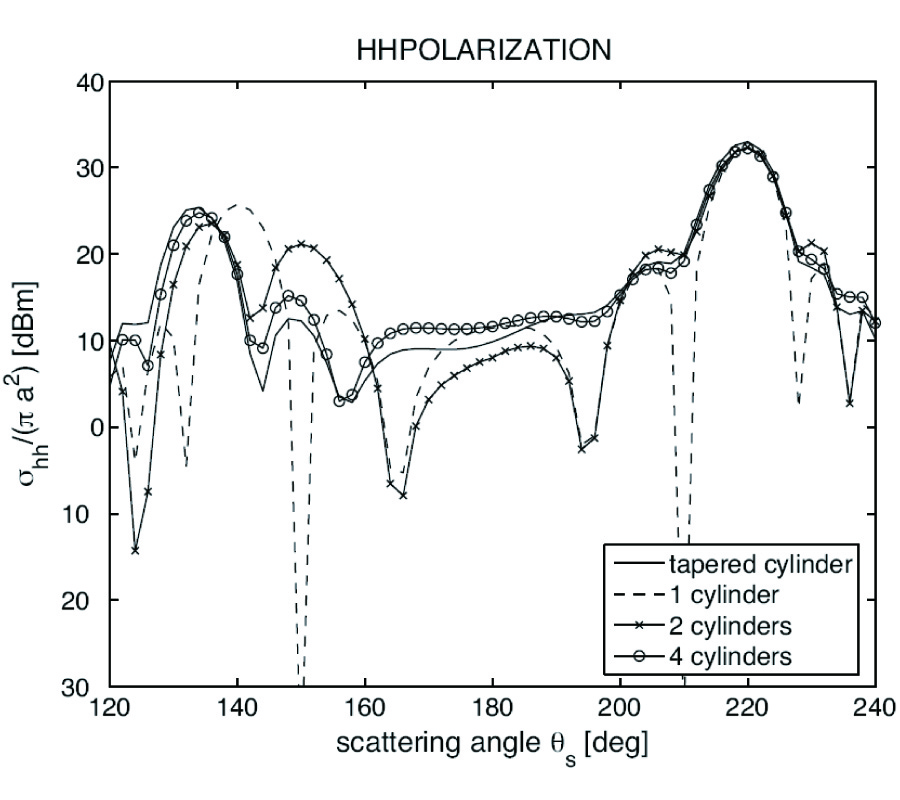
A simple and direct method to the problem of twodimensional electromagnetic scattering from a dielectric cylinder with multiple eccentric cylindrical inclusions is proposed. The method is based on the T-matrix approach. An aggregate T-matrix of the external cylinder for TM-wave and TE-wave excitations is derived in terms of the T-matrices of individual cylinders isolated in the host medium. The backscattering and differential scattering crosssections of the host cylinder are easily obtained by matrix calculations for the aggregate T-matrix. Numerical investigation is presented for the case where all cylinders have circular cross-sections. Numerical examples for up to three inclusions demonstrate that the scattering characteristics are significantly influenced by the internal asymmetry and inhomogeneity pertinent to the locations and material of the inclusions.
ELECTROMAGNETIC SCATTERING FROM A DIELECTRIC CYLINDER WITH MULTIPLE ECCENTRIC CYLINDRICAL INCLUSIONS
0000-00-00
PIER
Vol. 40, 91-111
Electromagnetic Scattering by a Multilayer Gyrotropic Bianisotropic Circular Cylinder
Tat Yeo and Mook-Seng Leong
In this paper, we investigate the electromagnetic scattering by a multilayer gyrotropic bianisotropic circular cylinder in free space. The coupled wave equations of longitudinal field components in the gyrotropic bianisotropic medium are derived. The eigenfunction expansion method is used to solve the scattering problem after uncoupling the coupled wave equations. A 12 × 12 or 16 × 16 linear algebraic equation is solved for two cases: one with the center being a perfect electric conducting (PEC) cylinder; and one without the PEC center, respectively. The gyrotropic bianisotropic media can be degenerated into gyrotropic medium, uniaxial bianisotropic medium, biisotropic medium and chiral medium etc. Numerical results presented for the last case was shown to agree exactly with published results. Numerical results of electromagnetic scattering by gyrotropic bianisotropic circular cylinders are presented also.
ELECTROMAGNETIC SCATTERING BY A MULTILAYER GYROTROPIC BIANISOTROPIC CIRCULAR CYLINDER
0000-00-00
PIER
Vol. 40, 71-90
Length Reduction of Evanescent-Mode Ridge Waveguide Bandpass Filters
Kawthar Zaki
Length reduction of evanescent-mode ridge waveguide bandpass filters is investigated extensively. Based on the conventional filter configuration, two new filter configurations are proposed: one is the generalized filter, and the other is the folded filter. In the generalized filter configuration, the cross sections of the evanescent waveguide and the ridge waveguide are not necessarily the same. It is found that the filter length can be reduced by enlarging the evanescent waveguide height. In the folded filter configuration, the filter is folded back at the middle coupling section. The folded junction is ridged to provide the required coupling between the two ridge waveguide resonators it connects. A design example demonstrates the feasibility of this filter configuration.
LENGTH REDUCTION OF EVANESCENT-MODE RIDGE WAVEGUIDE BANDPASS FILTERS
0000-00-00
PIER
Vol. 40, 55-69
Spatial Correlation Functions for Fields in Three-Dimensional Rayleigh Channels
Philippe De Doncker
Starting from a continuous plane-wave representation of the electric and magnetic fields, spatial auto- and cross-correlation functions for field components and their modulus are derived in the three-dimensional Rayleigh channel case. It is shown that existing results, generally relying on two-dimensional or isotropic models, can significantly differ from those obtained thanks to a three-dimensional approach.
SPATIAL CORRELATION FUNCTIONS FOR FIELDS IN THREE-DIMENSIONAL RAYLEIGH CHANNELS
0000-00-00
PIER
Vol. 40, 29-53
Stripline Transition to Ridge Waveguide Bandpass Filters
Kawthar Zaki
Full wave optimization is implemented to design a wide band transition from shielded stripline to ridge waveguide. A bandpass ridge waveguide filter, with input/output realized through tapped-in stripline is designed. Using rigorous mode matching technique the generalized scattering matrices of all the building blocks are obtained. Design procedure is described and examples are given to demonstrate the features of the tapped-in coupling structure. The tapped-in structure results in a considerable reduction of the filter's total length compared to the use of two transitions.
STRIPLINE TRANSITION TO RIDGE WAVEGUIDE BANDPASS FILTERS
0000-00-00
PIER
Vol. 38, 311-331
A Full Wave Three Dimensional Analysis of Forest Remote Sensing Using VHF Electromagnetic Wave
Helene Roussel and Walid Tabbara
A forest made of an infinite biperiodic array of trees over a lossy ground, is illuminated by a linearly polarized electromagnetic plane wave in the range of 20 to 90 MHz. Due to the ratio of the wavelength to the array period, only the specular mode is propagative. Therefore, a reflection coefficient is computed and not a backscattering coefficient. It is obtained by means of a full wave approach, based on an integral representation of the electric field. This approach takes into account all possible interactions between each component of the medium as well as ground penetration and provides full information on the phase of the scattered field. Two models of the forest are developed, the two layers one where trees are separated and the four layers one whee the canopy is replaced by an equivalent homogeneous medium. The low frequency (VHF) used here make this homogenization possible and allows one to consider trees with simple shape, the wave being unable to sense details of a tree.
A FULL WAVE THREE DIMENSIONAL ANALYSIS OF FOREST REMOTE SENSING USING VHF ELECTROMAGNETIC WAVE
0000-00-00
PIER
Vol. 38, 283-310
Scattering by an Array of Conducting, Lossy Dielectric, Ferrite and Pseudochiral Cylinders
Michal Polewski and Jerzy Mazur
Theory of scattering by conducting, lossy dielectric, ferrite and/or pseudochiral cylinders is investigated using a combination of a modified iterative scattering procedure and the orthogonal expansion method. The addition theorems for vector cylindrical harmonics, which transform harmonics from one coordinate system to another, are presented. The scattered field patterns for open structures and frequency responses of the transmission coefficients in a rectangular waveguide describing the resonances of the posts on the dominant waveguide mode are derived. The validity and accuracy of the method is verified by comparing the numerical results with those given in literature.
SCATTERING BY AN ARRAY OF CONDUCTING, LOSSY DIELECTRIC, FERRITE AND PSEUDOCHIRAL CYLINDERS
0000-00-00
PIER
Vol. 38, 269-281
Applicability of Two Stochastic Evaluation Methods to Electromagnetic Wave in Near Field Leaked from Ite Group Under Parallel Working Situation --- Introduction of Some Composition Principle in Space and Time Domain
Mitsuo Ohta and Akira Ikuta
In this study, by introducing fundamental composition principle in space and time domain, a trial of applying two stochastic evaluation methods to compound electromagnetic wave leaked from ITE group under parallel working situation are proposed. More specifically, a combined theory for the probability distribution based on the extended additive law on the cumulant statistics including an additive property for energy state quantity is proposed. Next, as a fundamental process in a time domain, an evaluation method for a compound of time ratio presenting in each state based on a stochastic exclusive property is proposed. The effectiveness of the proposed theory is experimentally confirmed by applying it to the observation data leaked from VDT group in the actual office environment.
APPLICABILITY OF TWO STOCHASTIC EVALUATION METHODS TO ELECTROMAGNETIC WAVE IN NEAR FIELD LEAKED FROM ITE GROUP UNDER PARALLEL WORKING SITUATION --- INTRODUCTION OF SOME COMPOSITION PRINCIPLE IN SPACE AND TIME DOMAIN
0000-00-00
PIER
Vol. 38, 253-267
Fast Solution for Large Scale Electromagnetic Scattering Problems Using Wavelet Transform and Its Precondition
Xing-Chang Wei and Er Ping Li
Nowadays, electrically large complex electromagnetic problems exist in modern defence and communication industry. Accurate and efficient calculation for such electromagnetic radiation and scattering is a high computational complex task and a challenge to conventional electromagnetic solvers such as Method of Moment (MOM) where high memory and long computational time are required owing to its large size compared to operating wavelength. This paper presents the fast solution method with wavelet transform in the computation of scattering from large scale complex objects. Because of the vanishing moments, the moment matrices arising in these problems are sparsified by wavelet, and consequently, the induced current and equivalent magnetic current can be obtained quickly. Moreover, a precondition method is postulated and implemented in the fast solution of the transformed moment matrix equation with iteration methods.
FAST SOLUTION FOR LARGE SCALE ELECTROMAGNETIC SCATTERING PROBLEMS USING WAVELET TRANSFORM AND ITS PRECONDITION