Search Results(13876)

0000-00-00
PIER
Vol. 85, 381-391
Planar Slab of Chiral Nihility Metamaterial Backed by Fractional Dual/PEMC Interface
Qaisar Abbas Naqvi
Fields inside the chiral nihility slab which is backed by perfect electric conductor are determined. It is noted that both electric and magnetic fields exist inside the grounded chiral nihility slab when it is excited by a plane wave. Electric field inside the slab disappears for excitation due to an electric line source. Magnetic field inside the slab disappears when geometry changes to corresponding dual geometry. Dual geometry means chiral nihility slab backed by perfect magnetic conductor and excited by a magnetic line source. Using fractional curl operator, fields are determined for fractional order geometries which may be regarded as intermediate step between the two geometries which are related through principle of duality. Discussion is extended for chiral nihility slab which is backed by perfect electromagnetic conductor (PEMC).
0000-00-00
PIER
Vol. 85, 323-348
Localization of Omni-Directional Mobile Device in Multipath Environments
Chee Kiat Seow and Soon Yim Tan
This paper presents a comprehensive Non Line of Sight (NLOS) localization scheme in a multipath environment where the scatterers with smooth surfaces are aligned parallel or perpendicular to each other. It leverages on the estimation of Angle of Arrival (AOA) and Time of Arrival (TOA) of the omni-directional mobile device's signal received at the reference devices. Unlike the conventional Line of Sight (LOS) localization schemes that rely on the various mitigation techniques to mitigate the multipaths that are mistaken as the LOS signal, our proposed two step localization scheme not only utilizes the LOS path but also any one bound scattering NLOS multipath arriving at the reference devices for localization. Channel experiment coupled with simulation results in a typical multipath environment has demonstrated that our proposed localization scheme outperforms the conventional localization schemes that are coupled with their own mitigation techniques. Robustness in performance of our proposed localization scheme towards different scatterers' orientation where they are not aligned parallel or perpendicular to each other are also investigated.
LOCALIZATION OF OMNI-DIRECTIONAL MOBILE DEVICE IN MULTIPATH ENVIRONMENTS
0000-00-00
PIER
Vol. 79, 305-319
Study on Conformal FDTD for Electromagnetic Scattering by Targets with Thin Coating
Xiao-Juan Hu and De-Biao Ge
In order to simulate the electromagnetic scattering of targets with thin-coating accurately, a conformal finite-difference timedomain (CFDTD) method based on effective constitutive parameters is presented in this paper. Two kinds of coating problems are considered. For a coated target with medium backing material, the CFDTD formulations on conformal cells are the same as those of the conventional FDTD, but the parameters in FDTD formulations are replaced by effective constitutive parameters to include the curved coating message of target. For a coated target with perfectly conducting (PEC) backing material, the contour-path integral is used to exclude the curved PEC part, and effective constitutive parameters are then introduced to include the coating message. The bistatic radar cross section (RCS) of coated spheres with medium backing material and with PEC backing material are computed, respectively, to validate the presented CFDTD scheme. The backscattering of a composite airfoil, which is made of radar absorbing material (RAM) and metal framework, and coated by fiberglass-reinforced plastics, is also analyzed to demonstrate the feasibility of presented scheme.
STUDY ON CONFORMAL FDTD FOR ELECTROMAGNETIC SCATTERING BY TARGETS WITH THIN COATING
0000-00-00
PIER
Vol. 78, 49-59
Modeling with NURBS Surfaces Used for the Calculation of RCS
Yan Zhao , Xiao-Wei Shi and Le Xu
In this paper, the edge-facet model is transformed to the Non-Uniform Rational B-Spline (NURBS) model. The parameters of the knot vectors and the control points of NURBS are computed based on the data points on the surface of a target, and the NURBS model is constructed with the parameters. The degrees of the two parametric directions of a NURBS surface and the B-spline basis function are also analyzed. The relative errors between the NURBS models and the real models prove that the modeling method proposed in this paper is exact. Finally, the results of the Radar Cross Section (RCS) computed by the Physical Optics (PO) method with NURBS models are illustrated, and the results prove that the modeling method is of high precision and can be widely used in computational electromagnetics techniques.
MODELING WITH NURBS SURFACES USED FOR THE CALCULATION OF RCS
0000-00-00
PIER
Vol. 77, 409-416
Novel Dual-Mode Dual-Band Bandpass Filter Using Double Square-Loop Structure
Zhi-Xi Chen , DDD Li and Chang-Hong Liang
A dual-mode dual-band bandpass microstrip filter using double square-loop structure is proposed in this paper. Each of the square-loop forms a dual-mode resonator with controllable respective passband. Two tuning patches placed symmetrically at the side of the perturbation patch are used to change the higher passband frequency, while while keeping the lower invariable. Several attenuation poles in the stopband are realized to improve the selectivity of the proposed bandpass filter. The filter is evaluated by experiment and simulation with good agreement.
NOVEL DUAL-MODE DUAL-BAND BANDPASS FILTER USING DOUBLE SQUARE-LOOP STRUCTURE
0000-00-00
PIER
Vol. 77, 97-110
Uniform Gain Power-Spectrum Antenna-Pattern Theorem and Its Possible Applications
Shubhendu Joardar and Ashit Bhattacharya
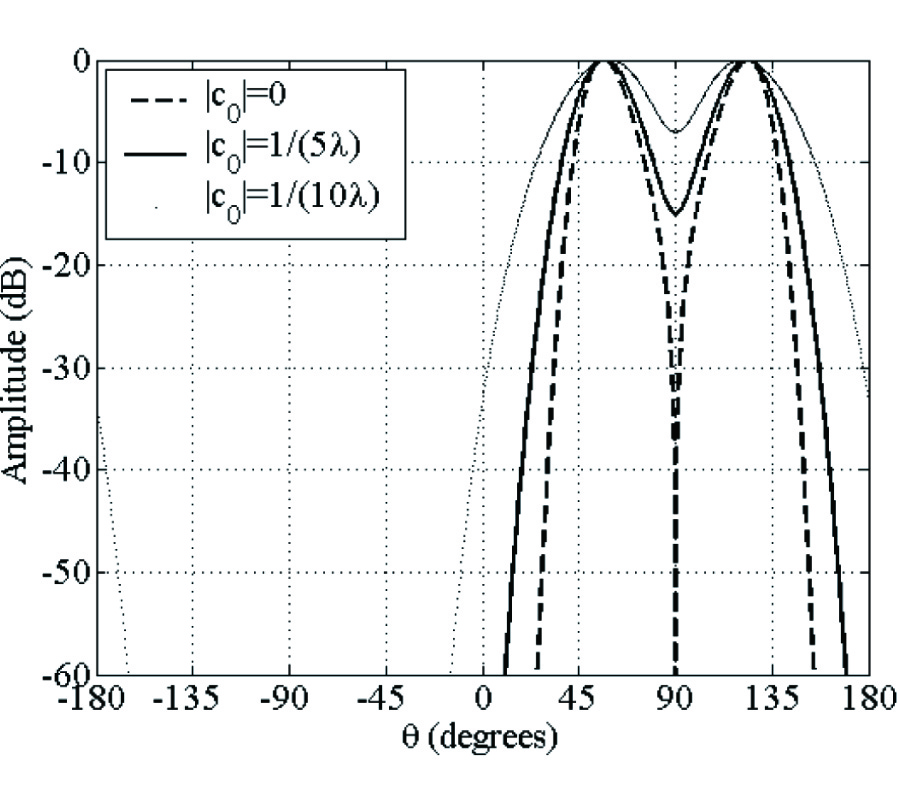
For certain applications in radio astronomy, viz. radio spectrographs, spectrum monitoring etc., only the amplitude power spectrum coverage within an angle of observation could be of interest. Ideally, the antenna structures of such instruments should illuminate this covering angle with a fixed uniform gain. This might be achieved using a combination of dipole antennas, a single vertical dipole, a loop antenna etc., but are subjected to limited bandwidth. This limitation could be overcome if many electrically-identical wideband antennas are positioned across the perimeter of a circle lying in the horizontal plane such that the antennas' adjacent half power beam angles touch each other. It has been theoretically observed that if two identical antennas are positioned at an angle with respect to one-another in such a way that their adjacent half power beam angles coincide, then if the amplitude power spectrums of the two are added, the result is effectively an amplitude power spectrum obtained from a single antenna having an uniform gain and uniform signal to noise ratio within the angle subtended by them. This angle also happens to be equal to the half power beamwidth of the individual antennas. A proper design using frequency independent antennas might possibly result to an user specified uniform amplitude power spectrum gain coverage across any required angle, with a theoretically unlimited bandwidth. More number of identical antennas might be positioned in similar fashion for extending the angular coverage. The power spectrums from these antennas could be directly added which effectively represent the power spectrum from a single antenna possessing uniform gain coverage within an angle equal to the product of individual half power beamwidth angle with one less the number of antennas, thus achieving user defined gain, wide bandwidth, and uniform signal to noise ratio across the angle. It is also possible to recover the time domain signal by applying Fourier Transform on the outputs of the antennas followed by an addition of their amplitudes while keeping the phase information identical to that of one antenna (taken as reference), and taking its inverse Fourier Transform.
UNIFORM GAIN POWER-SPECTRUM ANTENNA-PATTERN THEOREM AND ITS POSSIBLE APPLICATIONS
0000-00-00
PIER
Vol. 76, 229-236
A Wideband Monopole with g Type Structure
Hong-Tao Zhang , Ying-Zeng Yin and Xi Yang
In this paper,a new monopole with G type structure is proposed,consisting of two wires rectangle rings with radius of 2 mm. The software Numerical Electromagnetic Code (NEC) is used to analyze the proposed antenna and a prototype is designed. The experimental and numerical results of the designed wideband antenna are presented and analyzed,and a 510MHz bandwidth from 0.86 GHz to 1.37 GHz is demonstrated. The experimental and numerical results fit well.
A WIDEBAND MONOPOLE WITH G TYPE STRUCTURE
0000-00-00
PIER
Vol. 75, 153-162
Analysis and Application of Novel Structures Based on Split Ring Resonators and Coupled Lines
Jia-Xiao Niu , Xi-Lang Zhou and Lin-Sheng Wu
In this paper, novel structures using split ring resonators (SRRs) and coupled lines are proposed and analyzed. SRRs are etched on three different planes and their propagation characteristics are compared. Two compact narrow band band-pass filters based on these structures are designed and their performances are demonstrated by simulated and measured results, which are in good agreement.
ANALYSIS AND APPLICATION OF NOVEL STRUCTURES BASED ON SPLIT RING RESONATORS AND COUPLED LINES
0000-00-00
PIER
Vol. 72, 325-337
Radar Cross-Section Studies of Spherical Lens Reflectors
Sergei Vinogradov , Paul Smith , John Kot and Nasiha Nikolic
The reflectivity of a Spherical Lens Reflector is investigated. The scattering of an electromagnetic plane wave by a Spherical Lens Reflector is treated as a classical boundary value problem for Maxwell's equations. No restrictions are imposed on the electrical size of reflectors and the angular size of the metallic spherical cap. The competitiveness of the Spherical Lens Reflector against the Luneberg Lens Reflector is demonstrated. It has been found that Spherical Lens Reflectors with relative dielectric constant in the range 3.4 ≤ εr ≤ 3.7 possess better spectral performance than 3- or 5-layer Luneberg Lens Reflectors in a wide frequency range.
RADAR CROSS-SECTION STUDIES OF SPHERICAL LENS REFLECTORS
0000-00-00
PIER
Vol. 72, 215-240
Analysis of the Fields in Three Dimensional Cassegrain System
Abdul Ghaffar , Qaisar Abbas Naqvi and Kohei Hongo
High frequency field expressions are derived around feed point of a three dimensional Cassegrain system using the Maslov's method. Maslov's method is a systematic procedure for predicting the field in the caustic region. It combines the simplicity of ray theory and generality of the transform method. Numerical computations are made for the analysis of field pattern around the caustic of a Cassegrain system.
ANALYSIS OF THE FIELDS IN THREE DIMENSIONAL CASSEGRAIN SYSTEM
0000-00-00
PIER
Vol. 68, 113-150
Diffraction of Electromagnetic Wave by Disk and Circular Hole in a Perfectly Conducting Plane
Kohei Hongo and Qaisar Abbas Naqvi
The scattering of electromagnetic plane wave by a perfectly conducting disk is formulated rigorously in a form of the dual integral equations (abbreviated as DIE). The unknowns are the induced surface current (or magnetic field) and the tangential components of the electric field on the disk. The solution for the surface current is expanded in terms of a set of functions which satisfy Maxwell's equation for the magnetic field on the disk and the required edge condition. At this step we have used the method of the Kobayashi potential and the vector Hankel transform. Applying the pro jection solves the rest of a pair of equations. Thus the problem reduces to the matrix equations for the expansion coefficients. The matrix elements are given in terms of the infinite integrals with a single variable and these may be transformed into infinite series that are convenient for numerical computation. The numerical results are obtained for far field patterns, current densities induced on the disk, transmission coefficient through the circular aperture, and radar cross section. The results are compared with those obtained by other methods when they are available, and agreement among them is fairly well.
DIFFRACTION OF ELECTROMAGNETIC WAVE BY DISK AND CIRCULAR HOLE IN A PERFECTLY CONDUCTING PLANE
0000-00-00
PIER
Vol. 61, 133-142
Near-Infrared Light Scattering by Ice-Water Mixed Clouds
Xianming Sun , Yiping Han and Hai-Hua Wang
Based on the Mie theory, the light scattering properties of clouds consisting of pure water, pure ice spheres and concentric water- ice spheres are studied in the near-infrared regions, respectively. We computed the single scattering albedo, phase function, and asymmetry parameters of water clouds, ice clouds, and ice-water mixed clouds. The near infrared reflectivity of the ice-water mixed clouds is computed by using the adding-doubling method and compared to the other two types of clouds. It is shown that it is possible to use the near infrared reflectivity to derive the microphysical characteristics of the clouds.
NEAR-INFRARED LIGHT SCATTERING BY ICE-WATER MIXED CLOUDS
0000-00-00
PIER
Vol. 49, 87-111
Low-Frequency Solution for a Perfectly Conducting Sphere in a Conductive Medium with Dipolar Excitation
Panayiotis Vafeas , G. Perrusson and Dominique Lesselier
This contribution concerns the interaction of an arbitrarily orientated, time-harmonic, magnetic dipole with a perfectly conducting sphere embedded in a homogeneous conductive medium. A rigorous low-frequency expansion of the electromagnetic field in positive integral powers (jk)n, k complex wavenumber of the exterior medium, is constructed. The first n = 0 vector coefficient (static or Rayleigh) of the magnetic field is already available, so emphasis is on the calculation of the next two nontrivial vector coefficients (at n = 2 and at n = 3) of the magnetic field. Those are found in closed form from exact solutions of coupled (at n = 2, to the one at n = 0) or uncoupled (at n = 3) vector Laplace equations. They are given in compact fashion, as infinite series expansions of vector spherical harmonics with scalar coefficients (for n = 2). The good accuracy of both in-phase (the real part) and quadrature (the imaginary part) vector components of the diffusive magnetic field are illustrated by numerical computations in a realistic case of mineral exploration of the Earth by inductive means. This canonical representation, not available yet in the literature to this time (beyond the static term), may apply to other practical cases than this one in geoelectromagnetics, whilst it adds useful reference results to the already ample library of scattering by simple shapes using analytical methods.
LOW-FREQUENCY SOLUTION FOR A PERFECTLY CONDUCTING SPHERE IN A CONDUCTIVE MEDIUM WITH DIPOLAR EXCITATION
0000-00-00
PIER
Vol. 47, 87-110
Electromagnetic Scattering from Parallel Chiral Cylinders of Circular Cross-Sections Using an Iterative Procedure
Mohamed Al Sharkawy , Atef Elsherbeni and Samir Mahmoud
The electromagnetic scattering from a 2D chiral circular cylinders, illuminated by either a TEz or a TMz plane wave, is investigated using an iterative scattering procedure. The developed formulation and the implemented code simulate different types of cylinders, where the cylinders can be made of anisotropic chiral material with uniform or non-uniform chiral admittance distribution, homogeneous isotropic dielectric material, perfectly conducting material or a combination of all of them. The technique applies the boundary conditions on the surface of each cylinder in an iterative procedure in order to solve for the field expansion coefficients. Numerical verifications are presented to prove the validity of the formulation before presenting the scattering from an array of chiral cylinders showing significant RCS reduction in forward or backward directions based on the selection of the chirality parameter.
ELECTROMAGNETIC SCATTERING FROM PARALLEL CHIRAL CYLINDERS OF CIRCULAR CROSS-SECTIONS USING AN ITERATIVE PROCEDURE
0000-00-00
PIER
Vol. 46, 189-202
Nonlinear Waves in Doped Material with Uniaxial Electrical-Magnetic Coupling
Dajun Cheng
Helix particle exhibits uniaxial electrical-magnetic coupling and doped material with helix particles has the nonlinearity properties of electromagnetic waves. Based on the small nonlinearity assumption, nonlinear electromagnetic waves propagating in doped materials with transversely and longitudinally uniaxial electrical-magnetic coupling are analytically formulated, respectively. It is shown that this class of nonlinear material can simultaneously support right- and left-handed elliptically-polarized nonlinear waves. In the case of transversely uniaxial electrical-magnetic coupling, the two nonlinear waves propagate with different phase velocities (sub- and super-luminously, respectively) and spatial profiles. For the case of longitudinally uniaxial electrical-magnetic coupling, the two nonlinear waves exhibit different spatial profiles but propagate with the same phase velocity. It is also found that complex nonlinear waves, which propagate with complex phase factor, could exist for certain constitutive parameters of this class of nonlinear material.
NONLINEAR WAVES IN DOPED MATERIAL WITH UNIAXIAL ELECTRICAL-MAGNETIC COUPLING
0000-00-00
PIER
Vol. 46, 165-188
Analysis of Resonance and Quality Factor of Antenna and Scattering Systems Using Complex Frequency Method Combined with Model-Based Parameter Estimation
Long Li and Chang-Hong Liang
The generalized system function, H(s), directly associated with the radiated or scattered fields is presented in this paper, which is constructed by applying the model-based parameter estimation (MBPE) technique combined with the complex frequency theory. A complex frequency ω̃ relating the real resonant frequency with radiated or scattered Q factor is introduced to antenna and scattering systems. By analyzing the characteristics of complex poles and zeros of H(s) in a finite operational frequency band, and combining with adaptability of MBPE, we can determine the resonant frequency and Q-value of the antenna and scattering systems effectively. The intensity of resonance can be estimated in terms of Q-value and residues at the complex resonant frequencies. Some examples of the practical antenna arrays and scattering systems are given to illustrate the application and validity of the proposed approach in this paper.
ANALYSIS OF RESONANCE AND QUALITY FACTOR OF ANTENNA AND SCATTERING SYSTEMS USING COMPLEX FREQUENCY METHOD COMBINED WITH MODEL-BASED PARAMETER ESTIMATION
0000-00-00
PIER
Vol. 46, 143-163
Solving Mixed Dielectric/Conducting Scattering Problem Using Adaptive Integral Method
Wei-Bin Ewe , Joshua Le-Wei Li and Mook-Seng Leong
This paper presents the adaptive integral method (AIM) utilized to solve scattering problem of mixed dielectric/conducting objects. The scattering problem is formulated using the Poggio-Miller- Chang-Harrington-Wu-Tsai (PMCHWT) formulation and the electric field integral equation approach for the dielectric and conducting bodies, respectively. The integral equations solved using these approaches can eliminate the interior resonance of dielectric bodies and produce accurate results. The method of moments (MoM) is applied to discretize the integral equations and the resultant matrix system is solved by an iterative solver. The AIM is used then to reduce the memory requirement for storage and to speed up the matrix-vector multiplication in the iterative solver. Numerical results are finally presented to demonstrate the accuracy and efficiency of the technique.
SOLVING MIXED DIELECTRIC/CONDUCTING SCATTERING PROBLEM USING ADAPTIVE INTEGRAL METHOD
0000-00-00
PIER
Vol. 46, 127-142
Phase Centre Optimization in Profiled Corrugated Circular Horns with Parallel Genetic Algorithms
Leonardo Lucci , Renzo Nesti , Giuseppe Pelosi and Stefano Selleri
Achieving a high stability of the phase centre position in horn antennas with respect to frequency is a very desirable aim in reflector antenna design; a highly stable phase centre reduces efficiency dropping for defocusing at the frequency band extremes. By using an appropriate profile for the horn antenna it is possible to obtain horns both compact and with a stable phase centre. In this paper an automatic design procedure, based on Genetic Algorithms, to obtain such horns is described. The algorithm operates on many horn profile parameters, including corrugations, and is based on an accurate fullwave mode matching/combined field integral equation analysis code. To keep computing time down a full parallel algorithm over a 12 CPU parallel virtual machine is described.
PHASE CENTRE OPTIMIZATION IN PROFILED CORRUGATED CIRCULAR HORNS WITH PARALLEL GENETIC ALGORITHMS
0000-00-00
PIER
Vol. 46, 105-126
Design of Switched Beam Planar Arrays Using the Method of Genetic Algorithms
Stelios Mitilineos , Chrysoula Papagianni , Georgia Verikaki and Christos N. Capsalis
A system consisting of a smart antenna and a processor can perform filtering in both the time and space domain,th us reducing the sensitivity of the receiver to interfering directional noise sources. Smart antennas can be used for further increase in the capacity of a communication system and for variable speed of transmission for multimedia information. Switched beam antenna arrays are a subset of smart antennas that cover either the x-y plane or a portion of it with multiple radiation patterns. A processor can decide which pattern to use for reception or transmission. In this paper the use of genetic algorithms (GAs) is examined in the design of switched beam antenna arrays. The antenna consists of five or six elements and the radiation patterns vary from 4 to 8, covering the x-y plane with the main beams of the radiation patterns pointing at 0°, 90°, 180°, 270° and 0°, 45°, 90°, 135°, 180°, 225°, 270°, 315° respectively. The positions of the antenna elements are either chosen exclusively by the GA or are assumed to form a circular array with one central element and the GA decides for the radius and the offset angle of the circle. Furthermore, the GA is asked to design an array covering the first 120° of the x-y plane with 4 radiation patterns pointing at 15°, 45°, 75° and 105°. Such a configuration can be used in sector antennas,whic h are widely used in 2G mobile communication systems.
DESIGN OF SWITCHED BEAM PLANAR ARRAYS USING THE METHOD OF GENETIC ALGORITHMS
0000-00-00
PIER
Vol. 46, 33-75
Periodic Open Resonators: Peculiarities of Pulse Scattering and Spectral Features
Andrey Perov , Yuriy K. Sirenko and Nataliya Yashina
The approach based on investigation of characteristic properties of the resolving operators (resolvents) of stationary boundary value problems of the theory of wave diffraction by gratings is used for the analysis of the basic regularities running the formation of resonant non-stationary scattered fields. Information about singularities provides the description of the anomalous effects connected with possibility of existence, in the structures under consideration, of eigen modes having super high Q-factor, with linear "interaction" of modes in the parameter regions of spectrum crowding.
PERIODIC OPEN RESONATORS: PECULIARITIES OF PULSE SCATTERING AND SPECTRAL FEATURES