Search Results(13784)

0000-00-00
PIER
Vol. 37, 251-287
Small-Slope Approximation Method: A Further Study of Vector Wave Scattering from Two-Dimensional Surfaces and Comparison with Experimental Data
Gerard Berginc
This paper deals with the calculation of the scattering cross-section of polarized electromagnetic plane waves from 2-D metallic and dielectric randomly rough surfaces. The scattering crosssection of object is calculated by the Local Small Slope Approximation (SSA), the scattering cross-section is then compared with experimental data. In this paper, second order terms of the SSA method have been numerically implemented in order to obtain accurate results for a large range of slope. In this paper, we consider scattered and incident wave vectors in arbitrary directions, metallic and dielectric materials with complexp ermittivity. Surfaces are considered with Gaussian probability density functions for surface heights and Gaussian or non-Gaussian correlation functions. The coherent and incoherent components of the electromagnetic intensity for cross- and co-polarization are calculated in the bistatic case and we give several comparisons of the theory with measured data.
SMALL-SLOPE APPROXIMATION METHOD: A FURTHER STUDY OF VECTOR WAVE SCATTERING FROM TWO-DIMENSIONAL SURFACES AND COMPARISON WITH EXPERIMENTAL DATA
0000-00-00
PIER
Vol. 37, 235-250
Scattering of a Plane Wave by Rough Surfaces: A New Curvilinear Coordinate System Based Approach
Gerard Granet , M. Kofi Edee and Didier Felbacq
We present a curvilinear coordinate based method giving the field scattered by a plane surface with a cylindrical local perturbation illuminated by a plane wave. The boundary-value problem turns on the same scalar eigen equation that is solved in the spectral domain. Numerical results are successfully compared with those obtained by other rigorous methods
SCATTERING OF A PLANE WAVE BY ROUGH SURFACES: A NEW CURVILINEAR COORDINATE SYSTEM BASED APPROACH
0000-00-00
PIER
Vol. 37, 221-234
Study on the Two-Frequency Scattering Cross Section and Pulse Broadening of the One-Dimensional Fractal Sea Surface at Millimeter Wave Frequency
Cheol Kim
Based on the Kirchhoff approximation for the surfaces with small slopes, the pulse beam wave scattering fromthe onedimensional fractal sea surface with the actual spectrum is studied. The influence of the different fractal dimension, incident angle, and the center frequency on the distributions of the two-frequency scattering cross section is analyzed. The numerical result shows that there exists the largest coherence bandwidth for the two-frequency scattering cross section at the specular direction. The coherence bandwidth will increase with the decrease of the fractal dimension and with the increase of the incident angle and the center frequency, as well. It is also found that the scattering power takes a pulse shape, but with a pulse broadening for the incident power being δ function, this pulse broadening is inversely proportional to the coherence bandwidth.
STUDY ON THE TWO-FREQUENCY SCATTERING CROSS SECTION AND PULSE BROADENING OF THE ONE-DIMENSIONAL FRACTAL SEA SURFACE AT MILLIMETER WAVE FREQUENCY
0000-00-00
PIER
Vol. 37, 205-219
Two-Scale Polarimetric Emissivity Model: Efficiency Improvements and Comparisons with Data
David Lyzenga and John F. Vesecky
The two-scale model provides a framework for explaining the polarization and angular dependence of the microwave radiation emitted from the ocean surface. In this model the surface is viewed as a collection of randomly oriented facets. The emissivity of each facet is calculated using the small perturbation method (SPM), and that of the entire surface is obtained by integrating the local emissivity over all possible surface slopes, weighted by the probability of encountering these slopes. Since each SPM calculation involves a double integral, the model requires in principle the evaluation of a fourdimensional integral. This paper explores two methods for reducing the computational time required by the two-scale model. In one version, the azimuthal dependence of the local emissivity is represented by a truncated Fourier series and slope integral is computed numerically. In the second version the slope integral is carried out analytically, after expanding the integrand as a Taylor series in the surface slope. Hydrodynamic modulation effects are included in order to explain the upwind-downwind asymmetry of the emissivity. The calculated emissivities from the two versions of the model are compared with each other and with airborne and spaceborne measurements.
TWO-SCALE POLARIMETRIC EMISSIVITY MODEL: EFFICIENCY IMPROVEMENTS AND COMPARISONS WITH DATA
0000-00-00
PIER
Vol. 37, 191-203
A Semi-Empirical Algorithm of Water Transparency at the Green Wavelength Band of Optical Remote Sensing
Jouni Pulliainen and Martti Hallikainen
This study employed water transparent characteristics from the Gulf and archipelago of Finland and the corresponding data sets of optical sensors at the green wavelength band to estimate Secchi disk depth (SDD). The SDD is one major optical measurement of water transparency in the study area,where the coastal waters are dominated by absorption from both dissolved and particulate organic matter since the Gulf is optically dominated by scattering from suspended sediments. Concurrent in situ measurements,Landsat TM and simulated SeaWiFS data were obtained in August 1997. The results show that the SDD from the narrow green bandwidth (20 nm) data of simulated SeaWiFS is slightly better than the SDD from the broad green bandwidth (80 nm) data of TM using the semi-empirical algorithm developed in the study. The study of water transparent characteristics in the area still needs to be further investigated using SeaWiFS,MODIS and MERIS in the future.
A SEMI-EMPIRICAL ALGORITHM OF WATER TRANSPARENCY AT THE GREEN WAVELENGTH BAND OF OPTICAL REMOTE SENSING
0000-00-00
PIER
Vol. 37, 143-190
A Composite Model for Estimation of Polarimetric Thermal Emission from Foam-Covered Wind-Driven Ocean Surface
Jin Au Kong
This paper presents theoretical studies of polarimetric thermal emission from foam-covered ocean surface based on a composite volume and rough surface scattering model using the radiative transfer theory. The sea foam is modeled as a layer containing randomly distributed thin-film water bubbles. The small perturbation method (SPM) is used for random rough ocean surface, where the bistatic scattering is calculated up to the second order. The radiative transfer equations with a rough interface are solved using an iterative technique. Model predictions are compared with empirical expressions for foam emissivity and with the WINDRAD measurement data.
A COMPOSITE MODEL FOR ESTIMATION OF POLARIMETRIC THERMAL EMISSION FROM FOAM-COVERED WIND-DRIVEN OCEAN SURFACE
0000-00-00
PIER
Vol. 37, 129-141
Mathematical Modeling of Electromagnetic Wave Scattering by Wavy Periodic Boundary Between Two Media
Jean Chandezon , Anatoly Poyedinchuk , Yury A. Tuchkin and Nataliya Yashina
The extension of C method, combined with idea of Tikhonov's regularization is proposed. The regularizing algorithm for numerical solution of electromagnetic wave diffraction by the boundary of dielectric media is developed. This algorithm is based on the solution of the system linear algebraic equations of C method as subject of regularizing method of A. N. Tikhonov. The numerical calculations of scattered field in the case of E-polarization are presented. The efficiency and reliability of the method for the solution of the problems of boundary shape reconstruction have been proved and demonstrated numerically for several situations.
MATHEMATICAL MODELING OF ELECTROMAGNETIC WAVE SCATTERING BY WAVY PERIODIC BOUNDARY BETWEEN TWO MEDIA
0000-00-00
PIER
Vol. 37, 101-128
Modelization of the Scattering of Electromagnetic Waves from the Ocean Surface
Gabriel Soriano
In this paper, two models for the solution of the electromagnetic bistatic scattering from sea surface are suggested. A rigorous formalism leading to weakly singular integral equations is presented, as well as the surface impedance approximation for low penetrable media and the beam simulation method to synthesize incident beams with arbitrary size. This rigorous integral method is used to test first order approximations, and it is shown that the Small Slope Approximation is very accurate in predicting the scattering crosssection fromthe high spatial frequencies of the sea surface. This result led us to suggest an improvement of the classical two-scale model, consisting in replacing the small perturbation theory by the small slope approximation. This change allows the cut-off spatial frequency to be shifted so that the use of geometrical Optics is restricted to the large scales.
MODELIZATION OF THE SCATTERING OF ELECTROMAGNETIC WAVES FROM THE OCEAN SURFACE
0000-00-00
PIER
Vol. 37, 79-99
Higher Order Emission Model Study of BI-Sinusoidal Surface Brightness Temperatures
Joel Tidmore Johnson
Models for microwave thermal emission from a rough surface are currently of interest due to the goal of improved sea surface wind vector retrievals from polarimetric brightness temperature measurements. Models based on either a small slope approximation or on a physical optics approach have been proposed and have shown some success in matching observations. Both of these models involve series solutions, but computation of higher order terms typically is difficult, particularly for multi-scale sea surface models. Knowledge of higher order term contributions, however, would assist in understanding the limitations of the low-order methods applied in practice. In this paper, higher order results from both the small slope and physical optics methods are studied and compared for a simple bi-sinusoidal surface model (i.e. height profile = Asin(2πx/Px) sin(2πy/Py), where Px and Py are the surface periods in the x and y directions, respectively). Results show both methods to provide good predictions for moderate slope "large scale" surfaces (i.e. periods large compared to the observing electromagnetic wavelength) when shadowing and multiple scattering effects are negligible, while only the small slope theory correctly predicts emission from "small scale" profiles. The influence of both shadowing and multiple scattering effects is examined, and the "binary" shadowing behavior used in the physical optics method is suggested as a source of larger errors observed as shadowing effects increase.
HIGHER ORDER EMISSION MODEL STUDY OF BI-SINUSOIDAL SURFACE BRIGHTNESS TEMPERATURES
0000-00-00
PIER
Vol. 37, 31-78
Microwave Analytical Backscattering Models from Randomly Rough Anisotropic Sea Surface --- Comparison with Experimental Data in C and Ku Bands
Christophe Bourlier and Gerard Berginc
The small slope approximation (SSA) and the Kirchhoff approach (KA) are applied to the prediction of microwave sea surface backscatter for both Ku and C bands for various wind speeds and incident angles. Numerical results are obtained assuming a non-directional surface wavenumber spectrum and compared with azimuthally averaged C- and Ku-band radar backscattering data. The KA can be obtained rigorously for a perfectly-conducting surface, whereas for a dielectric surface, either the KA of order one (KA1) or the stationary phase (SP) method can be used. Numerical results are obtained assuming a non-directional surface wavenumber spectrum and compared with azimuthally C and Ku bands radar backscattering data for incidence angles of interest for remote sensing. Since the SSA and KA formulations are expressed in polar coordinates, the backscattering coefficient is expressed in terms of surface height autocorrelation and its derivatives of one- and second- orders computed from integrating the sea spectrum multiplied by Bessel functions of the first kind. This allows to have for KA and first-order SSA (SSA-1), a single numerical integration over the radial distance instead of four, when the cartesian coordinates is chosen. Moreover, the azimuthal harmonic magnitudes of the backscattering coefficient according to the wind direction can be performed separately. For an isotropic sea surface assumed to be perfectly conducting where the KA is valid, the deviation between SSA and KA models is smaller than the one computed from the SP model for HH polarization. For the VV polarization, the difference is greater, since the polarization term of SSA is given by the small perturbation method, whereas for the KA approach, it is equal to the Fresnel coefficient. For an anisotropic sea surface, the comparison of KA with SSA-1 leads to the same conclusion. The isotropic part and the second azimuthal harmonic of the backscattering coefficient are also compared with empirical backscattering models CMOD2-I3 and SASS-II valid in C and Ku bands, respectively.
MICROWAVE ANALYTICAL BACKSCATTERING MODELS FROM RANDOMLY ROUGH ANISOTROPIC SEA SURFACE --- COMPARISON WITH EXPERIMENTAL DATA IN C AND KU BANDS
0000-00-00
PIER
Vol. 37, 1-30
Polarimetric Emission Model of the Sea at Microwave Frequencies and Comparison with Measurements
Peter W. Gaiser
At wo-scale scattering model of the sea developed in terms of wind-generated stochastic processes of the surface-the elevation spectral density of the small-scale structure and the probability density of slopes of the large scale roughness-is combined with the Durden/Vesecky [1] wave height spectral model to analyze recent polarimetric measurements. Ad hoc parameter values are found for the wave model that allow the two-scale model to account for essentially all of the azimuthal features, amplitude and phase, appearing in all four Stokes parameters for the Jet Propulsion Laboratory (JPL) aircraft measurements at 19.35 and 37 GHz [2] and recent Naval Research Laboratory (NRL) aircraft measurements at 10.7 GHz. The excellent agreement provides support for the validation of the approximations of the two-scale model for the range of conditions encountered. The ad hoc parameters of the wave model are developed using the 19.35 and 37.0 GHz data and then tested with 10.7 GHz data. The twoscale model should be useful in studies dealing with simulations and retrievals of surface wind direction from satellite-based polarimetric measurements.
POLARIMETRIC EMISSION MODEL OF THE SEA AT MICROWAVE FREQUENCIES AND COMPARISON WITH MEASUREMENTS
0000-00-00
PIER
Vol. 36, 319-335
Mode-Matching Analysis of Waveguide T-Junction Loaded with an h-Plane Dielectric Slab
Z. Jiang , Z. Shen and X. Shan
This paper presents a full-wave mode-matching analysis of a rectangular waveguide T-junction partially loaded with an H-plane dielectric slab. First, the longitudinal section electric (LSE) and longitudinal section magnetic (LSM) modes in an H-plane dielectric-filled rectangular waveguide are obtained. Second, the dielectric-loaded Tjunction is then divided into four regions and their electromagnetic fields are expanded into the summation of their modal functions using the resonator method. Finally, a mode-matching process for the tangential field components across regional interfaces is carried out to derive the generalized scattering matrix of the waveguide T-junction. Using the cascading connection technique of generalized scattering matrix, various waveguide couplers and power dividers/combiners with H-plane dielectric slabs can be easily analyzed and designed. Numerical results are presented and compared with those obtained by measurement or Ansoft's HFSS. Good agreement is observed.
0000-00-00
PIER
Vol. 36, 279-317
A Variable Metric Electrodynamics. Plane Waves
Bernard Jancewicz
Classical electrodynamics can be divided into two parts. In the first one, a need of introducing a plenty of directed quantities occurs, namely multivectors and differential forms but no scalar product is necessary. We call it premetric electrodynamics. In this part, principal equations of the theory can be tackled. The second part concerns solutions of the equations and requires establishing of a scalar product and, consequently, a metric. For anisotropic media two scalar products can be introduced depending on the electric permittivity and magnetic permeability tensors. In the case of plane electromagnetic waves both of them are needed because two constitutive equations are needed: one for the electric fields, the other for the magnetic field. We show which part of the description of plane electromagnetic waves is independent of scalar products, and where they become necessary.
A VARIABLE METRIC ELECTRODYNAMICS. PLANE WAVES
0000-00-00
PIER
Vol. 36, 265-278
Design of Dual-Frequency Microstrip Patch Antennas and Application for IMT-2000 Mobile Handsets
Y. J. Wang and C. Lee
Two major objectives are concerned in this paper. On one hand, a multiplicity of typical methodologies available for achieving dual-frequency operation for microstrip patch antennas are summarized and classified into three categories, based on their intrinsic mechanisms. On the other hand, by employing the dual-frequency solutions, microstrip patch antennas are applied to the mobile handsets of the third-generation IMT-2000 system. Two novel microstrip patch antennas with broadband property and miniaturized size have been proposed and discussed theoretically and experimentally. Only a single simply-slotted patch, either semi-disc or square, is introduced in each of the two probe-fed antennas. Both antennas exhibit the impedance bandwidths (return loss · −10 dB) of 25.6% and 34.4% respectively, which would be suitable for the practical application of the IMT-2000 mobile handsets.
DESIGN OF DUAL-FREQUENCY MICROSTRIP PATCH ANTENNAS AND APPLICATION FOR IMT-2000 MOBILE HANDSETS
0000-00-00
PIER
Vol. 36, 247-264
Electromagnetic Coupling Analysis of Transient Signal through Slots or Apertures Perforated in a Shielding Metallic Enclosure Using FDTD Methodology
Ya Wang , Wee Jin Koh , C. Lee and Kye See
The paper presents electromagnetic coupling of an electrical fast transient plane wave penetrating through slots or apertures perforated in one side of a shielding metallic enclosure. Numerous slots and apertures of different configurations and dimensions have been developed, which include a single slot of different length, a single aperture of different width, multiple-angular apertures of different geometry, multiple-cell aperture of different cell numbers, multiple thin slots, an aperture-cell array making up the whole side of the enclosure, and a miscellany case simulating a PC main frame. FDTD numerical method is applied to the EMI/EMC model, while time-domain outputs are converted to frequency-domain responses for further analyses using a FFT program. Practical conclusions and recommendations are drawn to aid shielding enclosure design and electromagnetic interference protection.
ELECTROMAGNETIC COUPLING ANALYSIS OF TRANSIENT SIGNAL THROUGH SLOTS OR APERTURES PERFORATED IN A SHIELDING METALLIC ENCLOSURE USING FDTD METHODOLOGY
0000-00-00
PIER
Vol. 36, 193-246
A Survey of Various Frequency Domain Integral Equations for the Analysis of Scattering from Three-Dimensional Dielectric Objects
Baek-Ho Jung , Tapan Kumar Sarkar and Y.-S. Chung
In this paper, we present four different formulations for the analysis of electromagnetic scattering from arbitrarily shaped three-dimensional (3-D) homogeneous dielectric body in the frequency domain. The four integral equations treated here are the electric field integral equation (EFIE), the magnetic field integral equation (MFIE), the combined field integral equation (CFIE), and the PMCHW (Poggio, Miller, Chang, Harrington, and Wu) formulation. For the CFIE case, we propose eight separate formulations with different combinations of expansion and testing functions that result in sixteen different formulations of CFIE. One of the objectives of this paper is to illustrate that not all CFIE are valid methodologies in removing defects, which occur at a frequency corresponding to an internal resonance of the structure. Numerical results involving the equivalent electric and magnetic currents, far scattered fields, and radar cross section (RCS) are presented for three canonical dielectric scatterers, viz. a sphere, a cube, and a finite circular cylinder, to illustrate which formulation works and which does not.
A SURVEY OF VARIOUS FREQUENCY DOMAIN INTEGRAL EQUATIONS FOR THE ANALYSIS OF SCATTERING FROM THREE-DIMENSIONAL DIELECTRIC OBJECTS
0000-00-00
PIER
Vol. 36, 179-192
Modeling of Bipolar Junction Transistor in FDTD Simulation of Printed Circuit Board
F. Kung and H. T. Chuah
A simple and efficient approximate method to incorporate nonlinear bipolar junction transistor (BJT) into Finite-Difference Time-Domain (FDTD) framework is presented. This method applies Taylor expansion on the nonlinear transport equations of the BJT based on Gummel-Poon model [5]. The results are two coupled one-step explicit finite difference schemes for the electromagnetic fields in the vicinity of the BJT, which can be solved easily. A simulation example is carried out for a power amplifier and the result compares well with the measurement. A two-step simulation scheme is introduced to hasten the process of reaching transient steady state. Finally, brief comments on treating the FDTD framework as a dynamical system is included. This perspective is useful for analyzing the stability of FDTD framework with nonlinear lumped elements.
MODELING OF BIPOLAR JUNCTION TRANSISTOR IN FDTD SIMULATION OF PRINTED CIRCUIT BOARD
0000-00-00
PIER
Vol. 36, 153-177
Validation and Numerical Convergence of the Hankel-Bessel and Mathieu Rigorous Coupled Wave Analysis Algorithms for Radially and Azimuthally --- Inhomogeneous, Elliptical, Cylindrical Systems
John Jarem
A Rigorous Coupled Wave Analysis (RCWA) algorithm for electromagnetic (EM) scattering from radially and azimuthally inhomogeneous material elliptical systems based on State Variable (SV) techniques and based on circular-cylindrical Hankel-Bessel expansion modes is developed for the first time. The algorithm in conjunction with the elliptical system RCWA algorithm [1], which was based on SV techniques and Mathieu expansion modes, is used to validate and study numerical convergence of both elliptical RCWA algorithms. The formulation of the SV, Hankel-Bessel elliptical algorithm is presented. Two numerical elliptical examples are studied in detail by both algorithms, a homogeneous one which consists of three different uniform materials located in three elliptical regions and an inhomogeneous one which consists of an azimuthal, dielectric, step profile which is located between two uniform material elliptical regions. In this paper EM field scattering from a step profile which possessed a much larger dielectric step profile difference than was studied in [1] is presented. Validation and numerical convergence data of the Hankel-Bessel and the Mathieu [1] RCWA algorithm is presented for the first time, both in plot figures and in tables, when different numbers of expansion modes were used, when different number of layers were used, and when different numbers of SV harmonics were used. Validation of the RCWA algorithms was further carried out for the homogeneous case, by using Mathieu expansion modes in all regions and was carried out by using Hankel-Bessel expansion modes and Mathieu expansion modes in different regions. Validation of the Hankel-Bessel and Mathieu [1] RCWA algorithms was observed to a high degree of accuracy. It was found for the numerical example tested, that the number of modes used in the RCWA algorithms needed to exceed a critical minimum value in order to obtain meaningful, accurate results, and after this critical number of modes was exceeded, that convergence occurred rapidly as the number of modes increased. It was also found that as the number of layers used in the algorithm increased that the numerical accuracy of the RCWA solution slowly increased.
VALIDATION AND NUMERICAL CONVERGENCE OF THE  HANKEL-BESSEL AND MATHIEU RIGOROUS COUPLED WAVE ANALYSIS  ALGORITHMS FOR RADIALLY AND AZIMUTHALLY --- INHOMOGENEOUS, ELLIPTICAL, CYLINDRICAL SYSTEMS
0000-00-00
PIER
Vol. 36, 139-152
The Electromagnetic Field Produced by a Horizontal Electric Dipole Over a Dielectric Coated Perfect Conductor
J. L. Tang and W. Hong
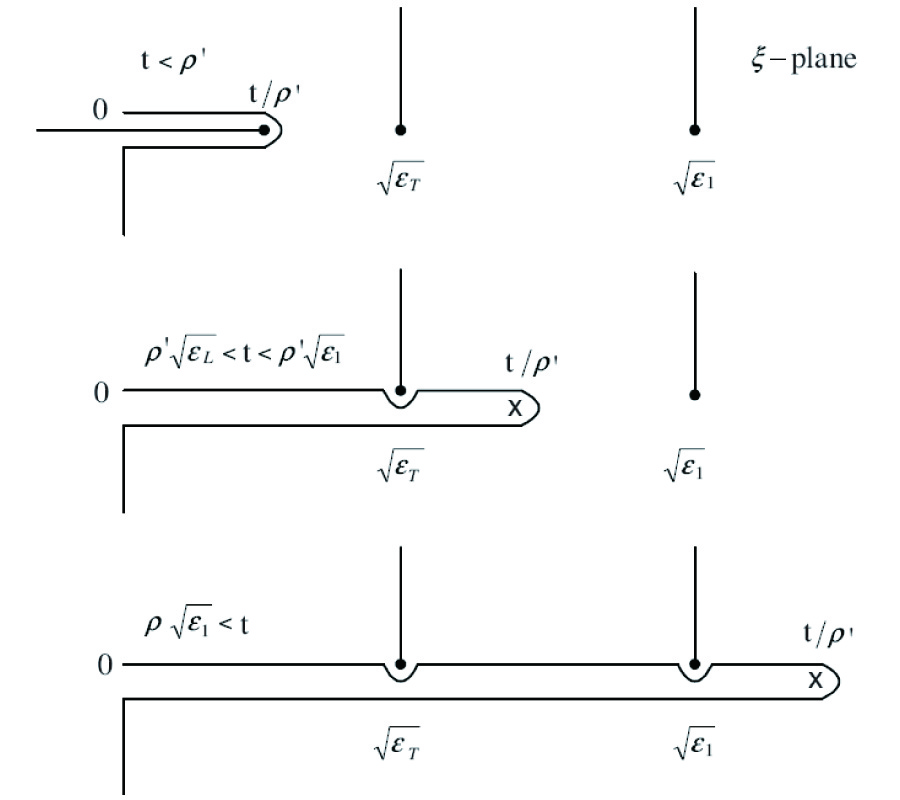
The analytical expressions for the electromagnetic field generated by a horizontal electric dipole over a dielectric coated perfect conductor are derived by transformation of integral path. From the expressions, it can be clearly observed that the excited field consists of the direct wave, reflected wave, trapped surface wave and lateral wave. The propagation wave number of trapped surface wave, which depends on electric parameters and thickness of the dielectric layer, is between the wave number k0 and k1.
THE ELECTROMAGNETIC FIELD PRODUCED BY A HORIZONTAL ELECTRIC DIPOLE OVER A DIELECTRIC COATED PERFECT CONDUCTOR
0000-00-00
PIER
Vol. 36, 121-137
Volterra Differential Constitutive Operators and Locality Considerations in Electromagnetic Theory
Dan Censor and Timor Melamed
Macroscopic Maxwell's theory for electrodynamics is an indeterminate set of coupled, vector, partial differential equations. This infrastructure requires the supplement of constitutive equations. Recently a general framework has been suggested, taking into account dispersion, inhomogeneity and nonlinearity, in which the constitutive equations are posited as differential equations involving the differential operators based on the Volterra functional series. The validity of such representations needs to be examined. Here it is shown that for such representations to be effective, the spatiotemporal functions associated with the Volterra differential operators must be highly localized, or equivalently, widely extended in the transform space. This is achieved by exploiting Delta-function expansions, leading in a natural way to polynomial differential operators. The Four-vector Minkowski space is used throughout, facilitating general results and compact notation.