Search Results(13800)

2012-01-19
PIER M
Vol. 23, 79-91
Application of Electromagnetic Reciprocity Principle to the Computation of Signal Coupling to Missile-Like Structures
Korkut Yegin
Lorentz Reciprocity principle is often used to describe electrical networks and reception/radiation properties of antennas residing in a linear, time-invariant, and symmetric medium. In its reaction integral form, it is usually conceived as a mathematical tool to prove electromagnetic relations. However, reciprocity, more than a mathematical tool, can be used as a powerful alternative to convert a penetration problem into a radiation one for numerical computations and measurements. We review the reciprocity formulation and show simple steps on how to apply reciprocity to penetration problems. Numerical calculations for a wire probe (antenna) inside missile-like structure are carried out for both radiation and its reciprocity formulated penetration problems, and it is shown numerically that results from both methods are identical. One of the advantages of this indirect formulation is that the radiation properties of the structure can be easily measured contrary to the direct measurement of the penetrated signal inside the structure.
APPLICATION OF ELECTROMAGNETIC RECIPROCITY PRINCIPLE TO THE COMPUTATION OF SIGNAL COUPLING TO MISSILE-LIKE STRUCTURES
2012-01-19
PIER
Vol. 124, 211-231
HF-Band Wireless Power Transfer System: Concept, Issues, and Design
Byung-Jun Jang , Seongjoo Lee and Hyungoo Yoon
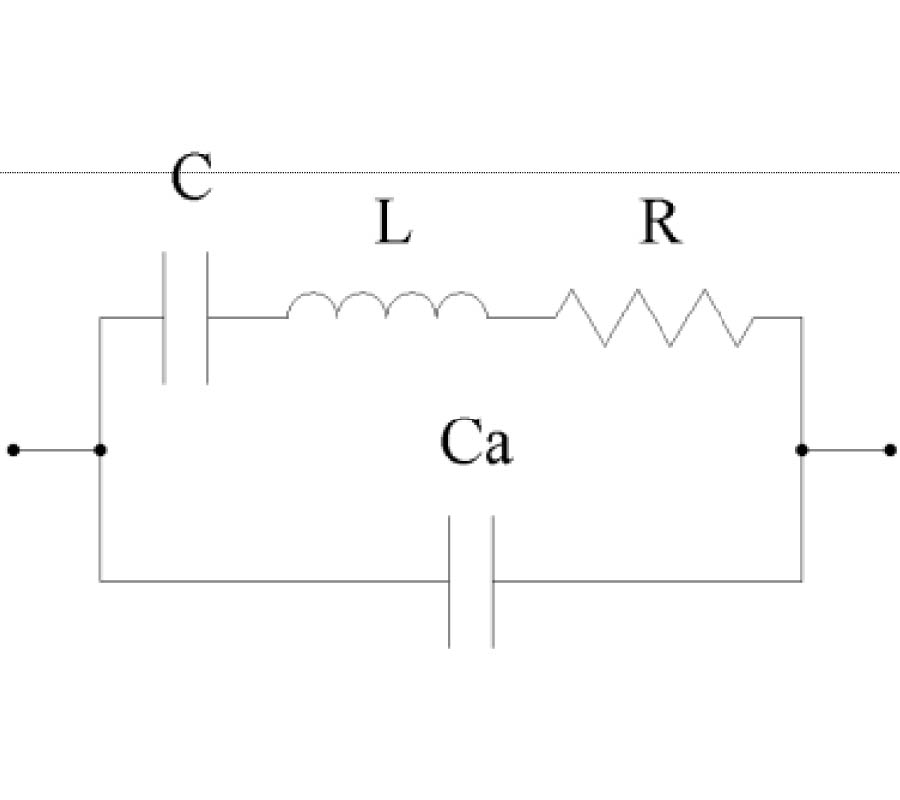
High-frequency (HF) band wireless power transfer systems offer the promise of cutting the last cord, allowing users to seamlessly recharge mobile devices as easily as wireless communication. Yet there are still many technical issues that need to be overcome. Among them, one of the most difficult problems is maintaining impedance match over a short range, where the distance between a transmitter and receiver could vary. In this paper, the effect of impedance mismatch of a HF-band wireless power transfer system is carefully investigated and two compensation methods are suggested to overcome this within a short range, where frequent impedance mismatch can occur. Each method has pros and cons. In order to verify the feasibility of the proposed methods, HF-band wireless power transfer systems, with a pair of rectangular loop resonators, were designed. The efficiency and input impedance variation were simulated and measured. From these results, proposed methods show enhanced efficiency performance than a typical wireless power transfer system without any compensation circuits.
HF-BAND WIRELESS POWER TRANSFER SYSTEM: CONCEPT, ISSUES, AND DESIGN
2012-01-19
PIER
Vol. 124, 187-210
On Body Concealed Weapon Detection Using a Phased Antenna Array
Stuart William Harmer , Shawn Edward Cole , Nicholas John Bowring , Nacer Ddine Rezgui and David Andrews
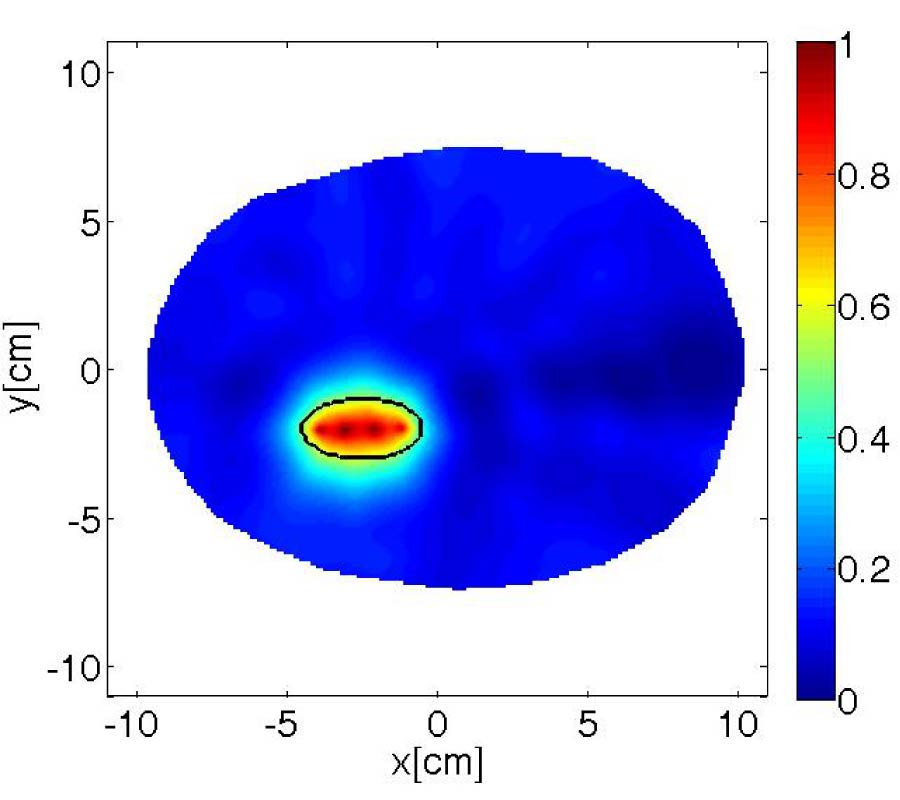
The detection and identification of metal items and, in particular weapons, of linear size ≥10 cm, concealed upon the human body, is demonstrated as being entirely feasible by using a phased array of suitably ultra wide band transceivers. The complex natural resonances and especially the fundamental resonance, are excited by ultra wide band, stepped frequency continuous wave illumination of the target, using a phased array of antennae to focus the radiation. Broadband illumination of the target with microwave radiation of suitable frequency range (Typically 0.3-3 GHz for handgun sized objects) excites low order complex natural resonances and the late time response of the concealed item can be spatially located using phased array imaging techniques. Further processing of the late time response enables classification of the concealed object, based on the complex natural resonant frequencies of the object, so that threat items such as handguns and knives can be differentiated from benign items such as mobile phone handsets and cameras.
ON BODY CONCEALED WEAPON DETECTION USING A PHASED ANTENNA ARRAY
2012-01-19
PIER
Vol. 124, 163-186
Nonlinear Modeling of Trapping and Thermal Effects on GaAs and GaN Mesfet/HEMT Devices
Mohamed Chaibi , Tomas Fernandez Ibanez , Asmae Mimouni , José Rodriguez-Tellez , Antonio Tazón and Angel Mediavilla Sanchez
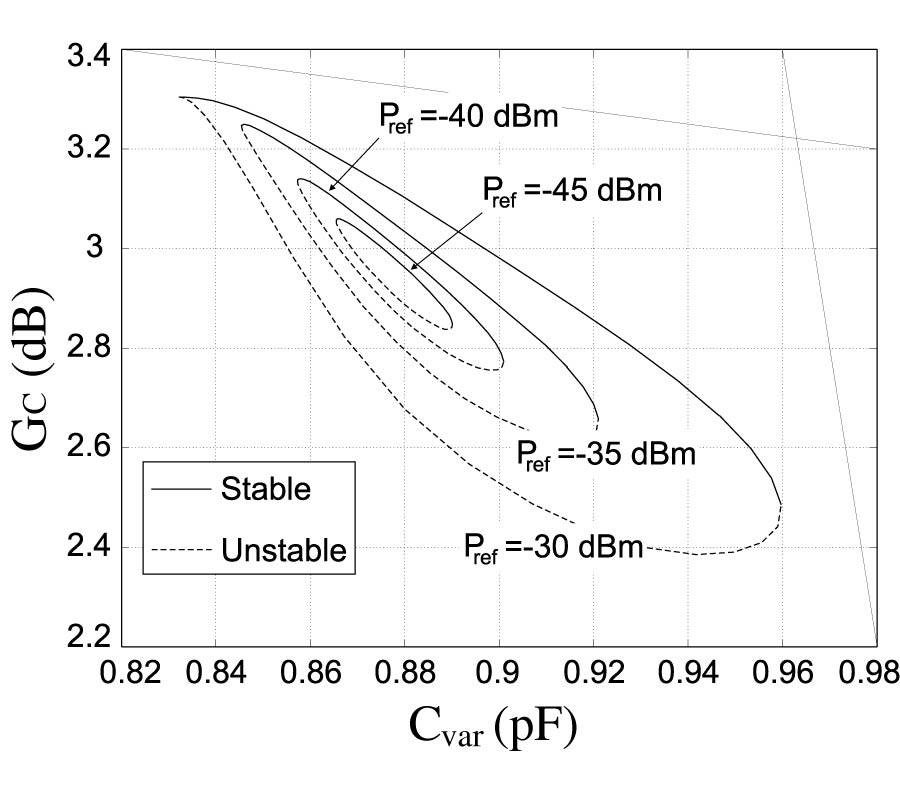
A novel nonlinear model for MESFET/HEMT devices is presented. The model can be applied to low power (GaAs) and high power (GaN) devices with equal success. The model provides accurate simulation of the static (DC) and dynamic (Pulsed) I-V characteristics of the device over a wide bias and ambient temperature range (from -70ºC to +70ºC) without the need of an additional electro-thermal sub-circuit. This is an important issue in high power GaN HEMT devices where self-heating and current collapse due to traps is a more serious problem. The parameter extraction strategy of the new model is simple to implement. The robustness of the model when performing harmonic balance simulation makes it suitable for RF and microwave designers. Experimental results presented demonstrate the accuracy of the model when simulating both the small-signal and large-signal behavior of the device over a wide range of frequency, bias and ambient temperature operating points. The model described has been implemented in the Advanced Design System (ADS) simulator to validate the proposed approach without convergence problems.
NONLINEAR MODELING OF TRAPPING AND THERMAL EFFECTS ON GaAs AND GaN MESFET/HEMT DEVICES
2012-01-18
PIER B
Vol. 38, 165-188
High Frequency Scattering by a Second-Order Generalized Impedance Discontinuity on a Cylindrically Curved Surface
Gokhan Cinar and Alinur Buyukaksoy
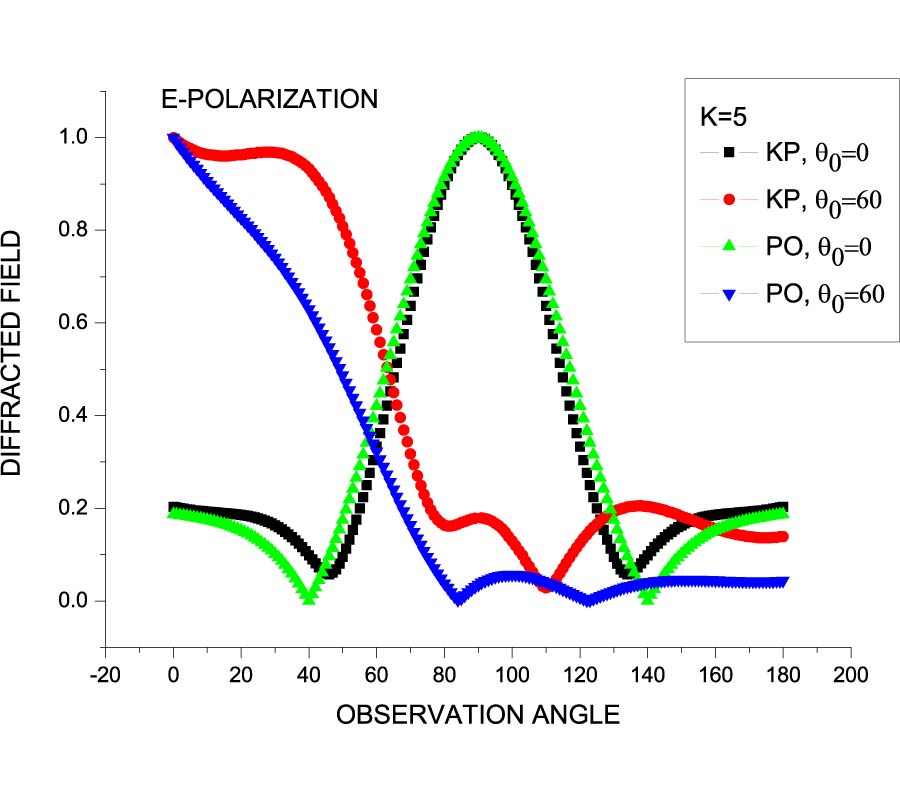
The aim of the present paper is to obtain explicit asymptotic expressions for the "transfer (diffraction) coefficients" related to the diffraction of high frequency cylindrical waves from the discontinuity occurred in the material properties as well as in the thicknesses of a coated cylindrically curved metallic sheet characterized by the second order GIBCs. Relying on the locality of the high frequency diffraction phenomenon, the angular interval φ∈(-π;π) is extended to the abstract in nite space φ∈(-∞;∞) wherein the diffracting structure is replaced by a two-part cylindrically curved second order impedance sheet ρ = a extending from φ = -∞ to φ = ∞. The resulting boundary value problem is formulated as a Hilbert equation which is solved asymptotically in the high frequency limit. Some graphical results showing the e ects of various parameters on the transfer coecients are presented.
HIGH FREQUENCY SCATTERING BY A SECOND-ORDER GENERALIZED IMPEDANCE DISCONTINUITY ON A CYLINDRICALLY CURVED SURFACE
2012-01-18
PIER Letters
Vol. 29, 43-50
Tunable Filtenna Using Varactor Tuned Rings Fed with an Ultra Wideband Antenna
Jason Leo Durbin and Mohammad Saed
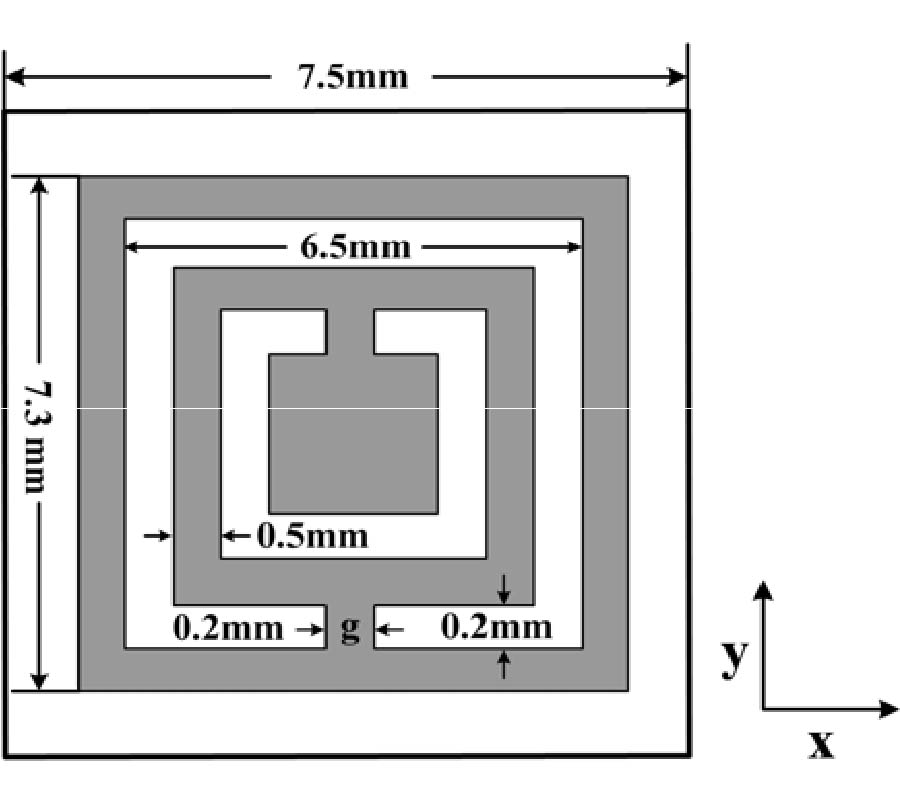
A tunable filtering antenna (filtenna) realized using rings fed with an ultra-wideband (UWB) planar, elliptical monopole antenna is proposed. An array of slotted rings with varactors is placed in close proximity of the planar monopole to obtain the low profile tunable filtenna. The array of rings can be viewed as a small tunable frequency selective surface. The design produces a tuning range of about 3.8-4.4 GHz over a varactor reverse bias voltage of 1-4 V.
TUNABLE FILTENNA USING VARACTOR TUNED RINGS FED WITH AN ULTRA WIDEBAND ANTENNA
2012-01-18
PIER
Vol. 124, 151-162
Proposal of Cylindrical Rolled-Up Metamaterial Lenses for Magnetic Resonance Imaging Application and Preliminary Experimental Demonstration
Yihong Xie , Jianfeng Jiang and Sailing He
In this paper, we propose a cylindrical rolled-up negative permeability metamaterial (MM) lens for magnetic resonance imaging (MRI), and some analyses are given. The proposed cylindrical MM lens is fabricated by rolling a MM slab (constituted with capacitive-loaded copper split rings) into a tube that resembles a hollow ring. It can focus the field of a magnetic line source, which can increase the penetration depth and improve the sensitivity of a surface coil. The proposed cylindrical MM lens can also improve the discrimination of the signals coming from two independent sources. A clinical experiment is carried out in a General Electric Signa 1.5 T MRI system in order to verify the focusing ability of the proposed device.
PROPOSAL OF CYLINDRICAL ROLLED-UP METAMATERIAL LENSES FOR MAGNETIC RESONANCE IMAGING APPLICATION AND PRELIMINARY EXPERIMENTAL DEMONSTRATION
2012-01-17
PIER C
Vol. 26, 259-273
A Selective Linear Transceiver Design Over Correlated Large-MIMO Channels
Fengyong Qian , Ruikai Mai , Yuesheng Zhu and Hui Li
With tens or an even larger number of antennas utilized, large-MIMO systems have many potential merits. However, there are also some difficulties with its practical realization. For example, the feedback overhead caused by sending back a large precoding matrix is heavy. In this paper, we propose a selective linear transceiver scheme to reduce the overwhelming feedback overhead in correlated large-MIMO systems. In line with the required reduced amount of feedback, antennas which can provide a potentially large diversity gain are firstly chosen independently of the actual channel realization. The transceiver is then designed over correlated MIMO channels in an iterative way to minimize the sum of detection errors under the transmit power constraint. Although optimal solutions for the case of full transceiver have been given under some special scenarios, we modify them to improve the BER performance of systems. Monte-Carlo simulation results verify that the proposed selective linear transceiver is a useful scheme in large-MIMO systems to provide a tradeoff between performance and feedback overhead.
A SELECTIVE LINEAR TRANSCEIVER DESIGN OVER CORRELATED LARGE-MIMO CHANNELS
2012-01-17
PIER
Vol. 124, 137-150
Improved Antenna Array Adaptive Beamforming with Low Side Lobe Level Using a Novel Adaptive Invasive Weed Optimization Method
Zaharias D. Zaharis , Christos Skeberis and Thomas Xenos
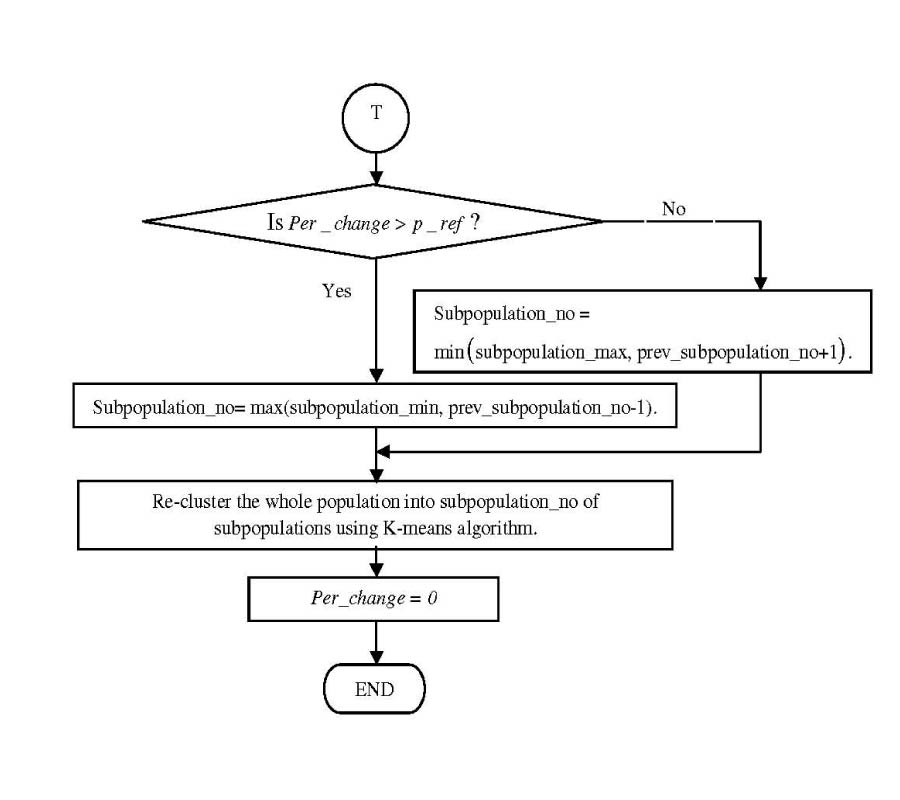
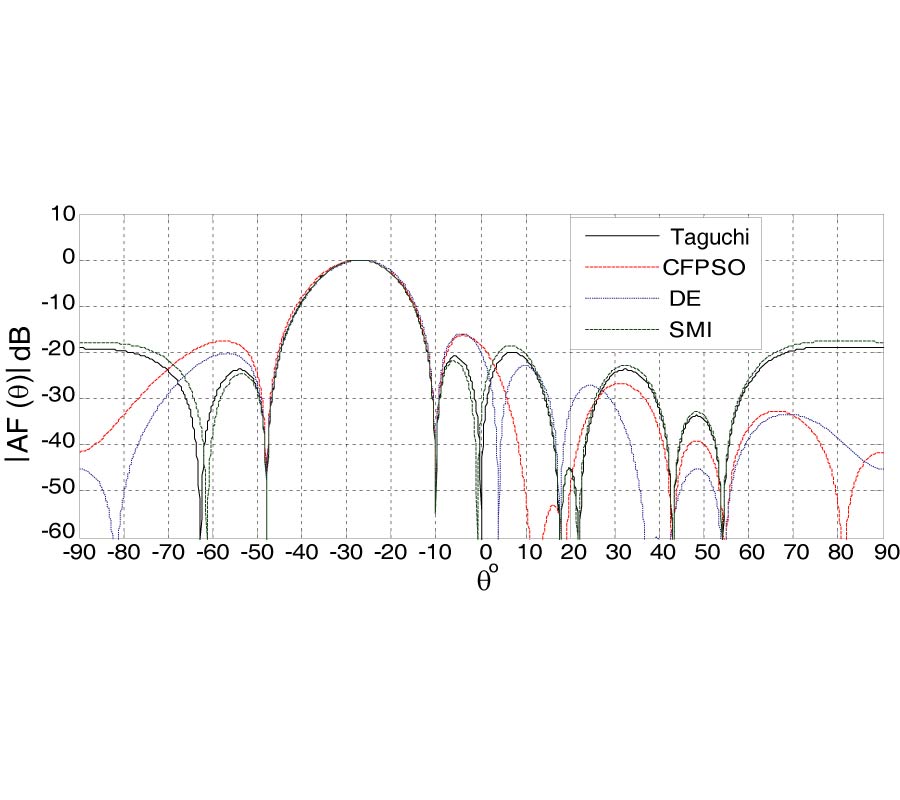
An improved adaptive beamforming technique of antenna arrays is introduced. The technique is implemented by using a novel Invasive Weed Optimization (IWO) variant called Adaptive Dispersion Invasive Weed Optimization (ADIWO) where the seeds produced by a weed are dispersed in the search space with standard deviation specified by the fitness value of the weed. The adaptive seed dispersion makes the ADIWO converge faster than the conventional IWO. This behavior is verified by applying both the ADIWO and the conventional IWO on well-known test functions. The ADIWO method is utilized here as an adaptive beamformer that makes a uniform linear antenna array steer the main lobe towards the direction of arrival (DoA) of a desired signal, form nulls towards the respective DoA of several interference signals and achieve low side lobe level (SLL). The proposed ADIWO based beamformer is compared to a Particle Swarm Optimization (PSO) based beamformer and a well known beamforming method called Minimum Variance Distortionless Response (MVDR). Several cases have been studied with different number of interference signals and different power level of additive zero-mean Gaussian noise. The results show that the ADIWO provides sufficient steering ability regarding the main lobe and the nulls, works faster than the PSO and achieves better SLL than the PSO and MVDR.
IMPROVED ANTENNA ARRAY ADAPTIVE BEAMFORMING WITH LOW SIDE LOBE LEVEL USING A NOVEL ADAPTIVE INVASIVE WEED OPTIMIZATION METHOD
2012-01-16
PIER
Vol. 124, 119-135
Design Analysis of New Metamaterial for EM Absorption Reduction
Mohammad Rashed Iqbal Faruque , Mohammad Tariqul Islam and Norbahiah Misran
A new triangular metamaterials (TMMs) is designed for electromagnetic (EM) absorption reduction at microwave frequencies in this paper. The reduction of EM absorption with a new TMMs attachment is investigated in this research. The finite-difference time-domain method with lossy-Drude model is adopted in this investigation. The method of EM reduction is presented and the effects of position, distance, and size of metamaterials are analyzed. TMMs have achieved a 1.0923 W/kg for SAR 1 gm which is 45.44% reduction of the initial SAR value for the case of 1 gm SAR.
DESIGN ANALYSIS OF NEW METAMATERIAL FOR EM ABSORPTION REDUCTION
2012-01-13
PIER B
Vol. 38, 135-164
Subcell Method for Modeling Metallic Resonators in Metamaterials
Larry Kevin Warne , William A. Johnson , Lorena I. Basilio , William L. Langston and Michael B. Sinclair
This paper describes a subcell modeling technique for metallic resonators where the actual metal traces are replaced by a thin wire having equivalent magnetic and electric radii, as well as an impedance per unit length. The formulas for these quantities in the case of rectangular traces are given. In addition, the gap of a split-ring resonator is replaced by a lumped load. The response of the resonator can then be modeled using thin-wire algorithms in an integral equation code. It is demonstrated that the number of unknowns and runtime can be reduced by factors of a thousand using the subcell models. This is particularly important in cases where metamaterial designs with tapered properties are encountered and periodic boundary conditions are not applicable, because with this simplification larger numbers of resonator cells can be handled.
SUBCELL METHOD FOR MODELING METALLIC RESONATORS IN METAMATERIALS
2012-01-13
PIER B
Vol. 38, 107-134
Combining Advances in EM Induction Instrumentation and Inversion Schemes for Uxo Characterization
Charles Oden
Several experimental time-domain EM induction instruments have recently been developed for unexploded ordnance (UXO) detection and characterization that use multiple transmitting and receiving coil combinations. One such system, the US Geological Survey's ALLTEM system, is unique in that it measures both the electro-dynamic response (i.e., induced eddy currents) and the magneto-static response (i.e., induced magnetization). This allows target characterization based on the dyadic polarizability of both responses. This paper examines the numerical response of the ALLTEM instrument due to spheroidal, conductive, and permeable UXO targets; and to conductive and optionally viscous magnetic earth. An inversion scheme is presented for spheroidal targets that incorporates fully polarimetric measurements for both magneto-static and electro-dynamic excitations. The performance of the inversion algorithm is evaluated using both simulated and surveyed data. The results are examined as a function of the number of coil combinations, number of instrument locations, and uncertainty in sensor location and orientation. Results from the specific cases tested (prolate spheroids lying horizontally) show that 1) that collecting data from more than 12 sensor locations or from more than four coil combinations reduced the chances that inversion solutions would be from a local minimum, and 2) that uncertainties in position greater than 3 cm or in orientation greater than 10 degrees cause errors in the estimated spheroid principal lengths of greater than 100%. Soil conductivities less than 1 S/m contribute negligible interference to the target response, but viscous magnetic soils with permeabilities greater than 10-6 MKS units do cause detrimental interference.
COMBINING ADVANCES IN EM INDUCTION INSTRUMENTATION AND INVERSION SCHEMES FOR UXO CHARACTERIZATION
2012-01-13
PIER B
Vol. 38, 71-105
Closed Analytical Formulae for Multi-Pole Magnetic Rings
Udo Ausserlechner
Multi-pole permanent magnetic encoders are used for wheel speed sensing in automotive systems. This paper discusses rings and discs magnetized along axial direction. The vector field is calculated analytically in 3D as sums over all poles. For the case of discs with vanishing inner and infinite outer diameter the summation is done in closed form with a new summation formula. The results are discussed and several plots of field patterns are given in normalized form: At very small air-gap the field shows an overshoot. At moderate and large air-gaps it is a sine-function with exponentially decaying amplitude. The amplitude versus air gap, reading radius, thickness of the magnetic layer, and number of poles is studied and excellent agreement with measurements is found. The effect of a steel-back on the field is explained. It is also shown how to maximize the torque transmitted in axially magnetized couplings.
CLOSED ANALYTICAL FORMULAE FOR MULTI-POLE MAGNETIC RINGS
2012-01-13
PIER Letters
Vol. 29, 35-42
A Calibration Procedure for Two-Port VNA with Three Measurement Channels Based on T-Matrix
Wei Zhao , Hong-Bo Qin and Li Qiang
A simplified calibration procedure using T-matrix concept is presented for two-port vector network analyzer (VNA) with three measurement channels. Compared with Short-Open-Load-Thru (SOLT) calibration method based on 10-term error model where 10 error terms must be solved and saved at each frequency, the proposed method need define fewer characteristic variables. Moreover, a length-unknown 50Ω line can be used instead of a random single-port standard, for example, substituting Load standard with 50Ω line in SOLT calibration procedure. Via the simplified calibration procedure, the scattering parameters of a two-port device under test (DUT) can be finally obtained. Experimental verification is carried out, and good agreement is observed.
A CALIBRATION PROCEDURE FOR TWO-PORT VNA WITH THREE MEASUREMENT CHANNELS BASED ON T-MATRIX
2012-01-12
PIER Letters
Vol. 29, 25-33
Design of a Wideband Monopulse Antenna Using Four Conical Helix Antennas
Hassan Gharibi and Farrokh Hojjat-Kashani
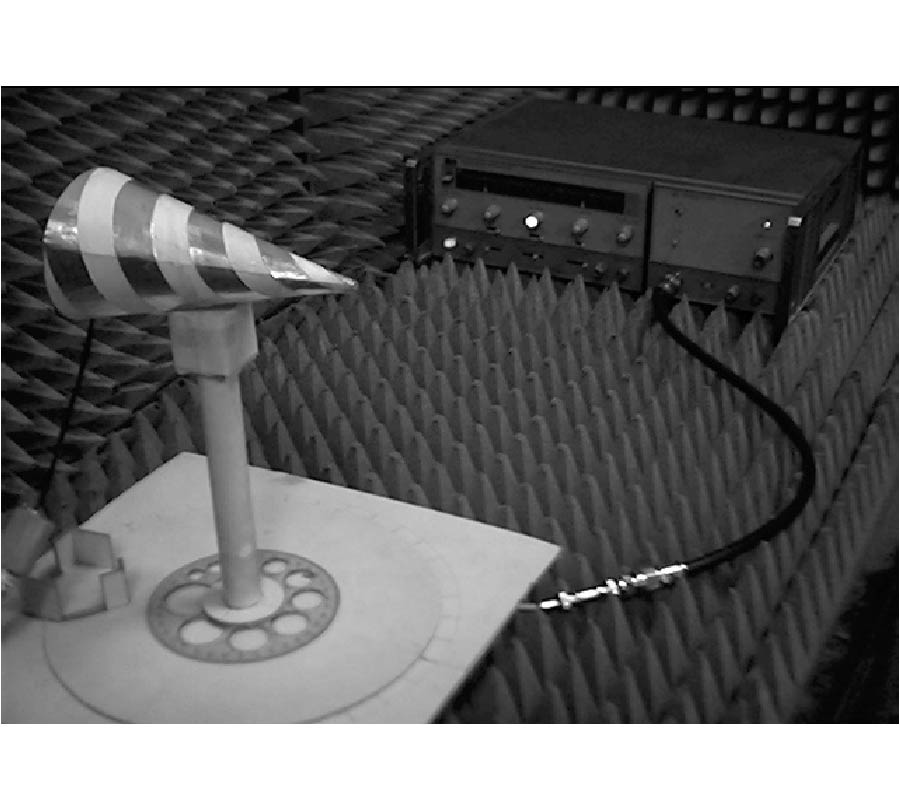
A novel S-band monopulse antenna with four conical helix antennas on a microstrip substrate comparator is designed, fabricated and measured. Conical helix antenna height is 3λ, and comparator size is 130mm×150mm. The bandwidth (SWR <2 dB) of the antenna is 21.3% with an operating frequency range of 2.7 GHz-3.35 GHz. The maximum gain of the sum pattern is 17.4 dB, and the null depths of the difference pattern are less than -30 dB.
DESIGN OF A WIDEBAND MONOPULSE ANTENNA USING FOUR CONICAL HELIX ANTENNAS
2012-01-12
PIER
Vol. 124, 101-118
The Interferometry Phase of InSAR Coherent Jamming with Arbitrary Waveform Modulation
Qingfu Liu , Shiqi Xing , Xuesong Wang , Jian Dong , Dahai Dai and Yongzhen Li
This paper focuses on the interferometry phase of an active coherent jamming in InSAR (Interferometry Synthetic Aperture Radar) images. Based on the signal models of coherent jammer, the jamming's imaging results are derived by employing the Omega-K algorithm. By comparing the imaging results of InSAR's two channels, the jamming's interferometry phases for both working modes, the single-pass and repeat-pass modes, are proved to be constants. And the values of the interferometry phases are determined by the jammer's geometry position relative to InSAR baseline, but independent of the jamming's waveform modulation and its background terrain.
THE INTERFEROMETRY PHASE OF INSAR COHERENT JAMMING WITH ARBITRARY WAVEFORM MODULATION
2012-01-12
PIER
Vol. 124, 85-100
Hybrid-Surrogate-Model-Based Efficient Global Optimization for High-Dimensional Antenna Design
Ling-Lu Chen , Cheng Liao , Wenbin Lin , Lei Chang and Xuan-Ming Zhong
Efficient global optimization has been extensively used in problems with expensive cost functions. However, this method is not suitable for high-dimensional problems. In this paper, the radial basis function network is introduced into the efficient global optimization, to avoid local optima and achieve a fast convergence for high-dimensional optimization. Our algorithm is applied to a 12-dimensional optimization of a transmitting antenna. Compared to the genetic-algorithm-based efficient global optimization and the differential evolution strategy, our algorithm converges to the global optimal value more efficiently.
HYBRID-SURROGATE-MODEL-BASED EFFICIENT GLOBAL OPTIMIZATION FOR HIGH-DIMENSIONAL ANTENNA DESIGN
2012-01-12
PIER
Vol. 124, 71-83
Design Analysis of a Beam Splitter Based on the Frustrated Total Internal Reflection
Jia-Ren Chang Chien , Chi-Chung Liu , Chien-Jang Wu , Pei Yu Wu and Chang Ching Li
In this work, a theoretical analysis on the design of the beam splitter (BS) based on the frustrated total internal reflection (FTIR) is made. We consider a model structure made of a low-index gap layer bounded by two high-index layers. In the design of a 50/50 BS, we find that there exists a critical gap thickness which is a decreasing function of the angle of incidence for both TE and TM waves. There also exists a critical wavelength for the incident wave, and it increases with increasing angle of incidence. Finally, at a fixed gap thickness and wavelength of incident wave, the critical angle in $TE$ wave is slightly larger than that of $TM$ wave. The analysis provides some fundamental information that is of particular use to the design of a BS within the framework of FTIR.
DESIGN ANALYSIS OF A BEAM SPLITTER BASED ON THE FRUSTRATED TOTAL INTERNAL REFLECTION
2012-01-11
PIER B
Vol. 38, 57-70
Reconfigurable Fishnet Metamaterial Using Pneumatic Actuation
Iryna Khodasevych , Wayne Rowe and Arnan Mitchell
The design, fabrication and measurement of a reconfigurable fishnet metamaterial based on a new method of tuning by changing unit cell geometry is reported. Retractable elements are added to the unit cell utilizing pneumatically actuated switching. It is shown that the pneumatic actuation approach can unite a number of metallic elements into a complex conducting structure. Experimental demonstration confirms that the structure operates at two different frequencies in the GHz range in distinct actuation states. The measured results also show good agreement with numerical simulations.
RECONFIGURABLE FISHNET METAMATERIAL USING PNEUMATIC ACTUATION
2012-01-11
PIER Letters
Vol. 29, 15-23
A Planar Compact Triple-Band Monopole Antenna for WLAN/WiMAX Applications
Jie Cai , Xiang Zhao , Changjun Liu and Liping Yan
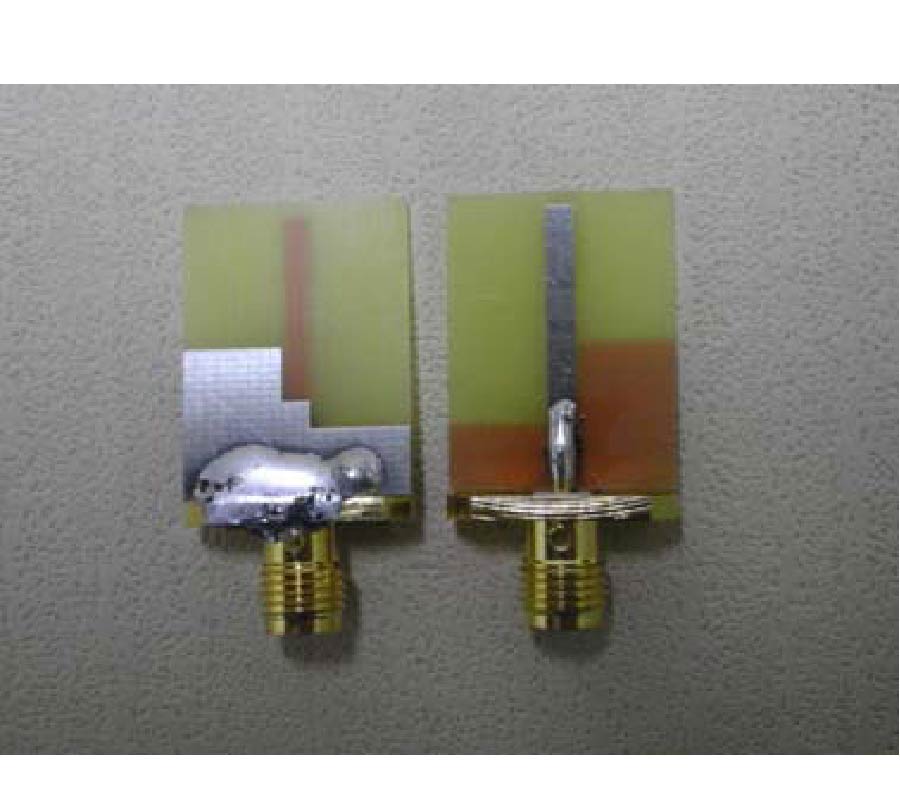
A planar triple-band monopole antenna with a U-shaped stripline and a L slot is presented. The antenna is very compact with a size of 20×30×1.5 mm3 and fed by a 50 Ω microstrip line with a defected ground. The measured -10dB impedance bandwidth of the proposed antenna covers 2.33 GHz-2.51 GHz, 3.25 GHz-3.82 GHz, and 4.83 GHz-8.4 GHz, respectively, which meets the specifications of WLAN 2.4/5.2/5.8GHz and WiMAX 3.5/5.5 GHz. The radiation characteristics shows a monopole-like pattern, and the measured results are in agreements with the simulated ones.
A PLANAR COMPACT TRIPLE-BAND MONOPOLE ANTENNA FOR WLAN/WiMAX APPLICATIONS