Performance Analysis of Os Structure of CFAR Detectors in Fluctuating Target Environments
Mohamed El Mashade
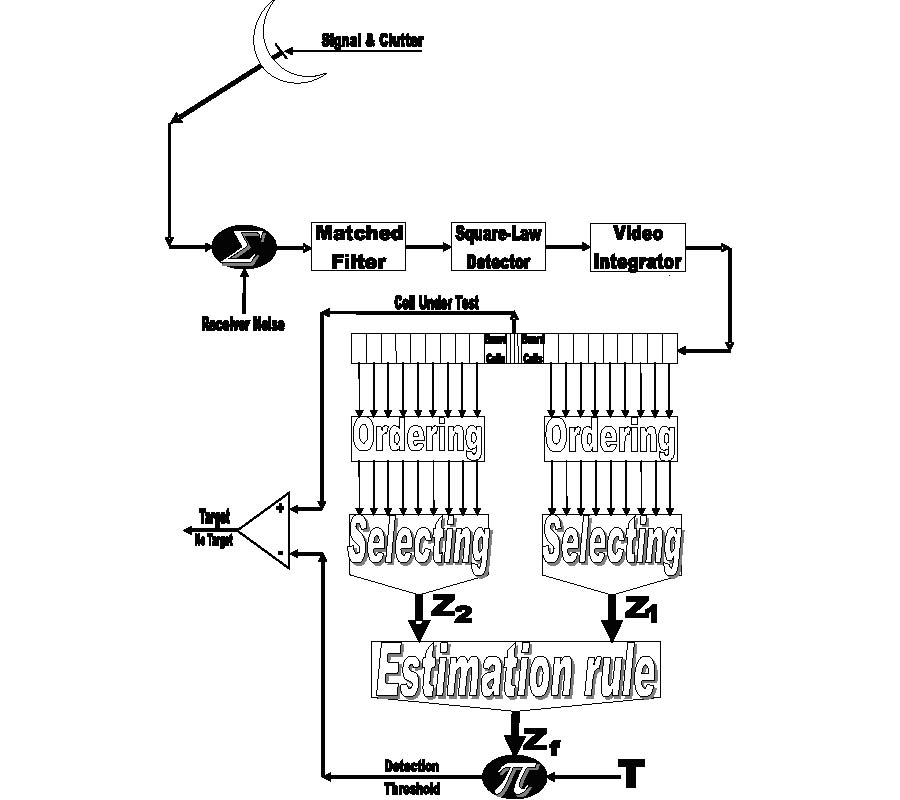
This paper is intended to the analysis of adaptive radar detectors for partially correlated χ2 targets. This important class of targets is represented by the so-called moderately fluctuating Rayleigh targets, which, when illuminated by a coherent pulse train, return a train of correlated pulses with a correlation coefficient in the range 0 < ρ < 1 (intermediate between SWII and SWI models). The detection of this type of fluctuating targets is practically of great importance. Since the CFAR detectors represent an attractive class of schemes that can be used to overcome the problem of clutter by adaptively setting their threshold based on local information of total noise power, they are commonly used to decide the presence or absence of the radar target of interest, which is of partially correlated χ2 type. In addition, the OS based algorithms are chosen to carry out this task owing to their immunity to outlying targets which may be present amongst the contents of the reference window. Moreover, since the large processing time of the single-window OS detector limits its practical applications, our scope here is to analyze the performance of OS modified versions for moderately fluctuating Rayleigh targets in nonideal situations. This analysis includes the single-window as well as the double-window OS detection schemes for the case where the radar receiver postdetection integrates M square-law detected pulses and the signal fluctuation obeys χ2 statistics with two degrees of freedom. These detectors include the mean-level (ML-), the maximum (MX-) and the minimum (MN-) OS algorithms. Exact formulas for their detection probabilities are derived, in the absence as well as in the presence of spurious targets. The primary and the secondary interfering targets are assumed to be of the moderately fluctuating Rayleigh targets. Swerling's well known cases I and II represent the cases where the signal is completely correlated and completely decorrelated, respectively, from pulse to pulse. Under the multiple-target operations, the ML-OS detector has the best homogeneous performance, the MN processor has the best multitarget performance when a cluster of radar targets appears in the reference window, while the MX scheme doesn't offer any excessive merits, neither in the absence nor in the presence of outlying targets, as expected.