Search Results(13802)

2010-09-16
PIER Letters
Vol. 17, 133-143
A Compact Low-Pass Filter with Sharp Cutoff and Low Insertion Loss Characteristic Using Novel Defected Ground Structure
Dan Xi , Ying-Zeng Yin , Le-Hu Wen , Yuannan Mo and Yan Wang
In this paper, a compact stepped-impedance hairpin resonator (SIHR) low-pass filter (LPF) with an improved split-ring resonator defected ground structure (ISRR DGS) and two elliptical DGSs is presented. The proposed LPF exhibits the advantages of low insertion loss, sharp cutoff characteristic, wide stopband over the ordinary LPFs. The introduced DGSs are presented to improve the in-band and out-band characteristic. An equivalent RLC circuit model of the two kinds of DGSs is presented and analyzed. Combining with these two structures, a new SIHR LPF having 3-dB cutoff frequency of 2.5 GHz is fabricated and measured. Measured results show that the selectivity of the proposed LPF is more than 100 dB/GHz and the insertion loss is less than 0.5 dB in the passband. A wide stop-band bandwidth with 20 dB attenuation from 2.58 up to 7.5 GHz is achieved. Moreover, the occupied area is only 20×25 mm2.
A COMPACT LOW-PASS FILTER WITH SHARP CUTOFF AND LOW INSERTION LOSS CHARACTERISTIC USING NOVEL DEFECTED GROUND STRUCTURE
2010-09-16
PIER Letters
Vol. 17, 125-132
Compact Wideband Bandpass Filter with Quadruple-Mode Stub-Loaded Resonator
Hong-Wei Deng , Yong-Jiu Zhao , Lu Zhang , Xue-Shun Zhang and Wei Zhao
In this paper, a novel compact wideband bandpass filter (BPF) is proposed using quadruple-mode resonator formed by attaching a short-circuited stub at the center plane and two identical impedance-stepped open stubs to high impedance microstrip line. The resonator can generate two even-modes fm1, fm3 and two odd-modes fm2, fm4 in the desired band. The even-mode resonant frequencies can be flexibly controlled by the short-circuited stub, whereas the odd-mode ones are fixed. When the open stubs are attached to the center plane nearby, they can be mainly applied to adjust fm3, fm4 into desired passband as the high odd-mode and even-mode resonant frequencies are vulnerable to their electronic lengths. Two transmission zeros near the lower and upper cut-off frequencies are separately created by the short-circuited stub and interdigital feeding lines, leading to a high rejection skirt. A wideband BPF with the fractional bandwidth 64% is simulated, fabricated and measured. The measured results agree well with the EM simulations.
COMPACT WIDEBAND BANDPASS FILTER WITH QUADRUPLE-MODE STUB-LOADED RESONATOR
2010-09-16
PIER Letters
Vol. 17, 115-123
A Compact Dual Inverted C-Shaped Slots Antenna for WLAN Applications
Dan Xi , Le-Hu Wen , Ying-Zeng Yin , Zhen Zhang and Yuannan Mo
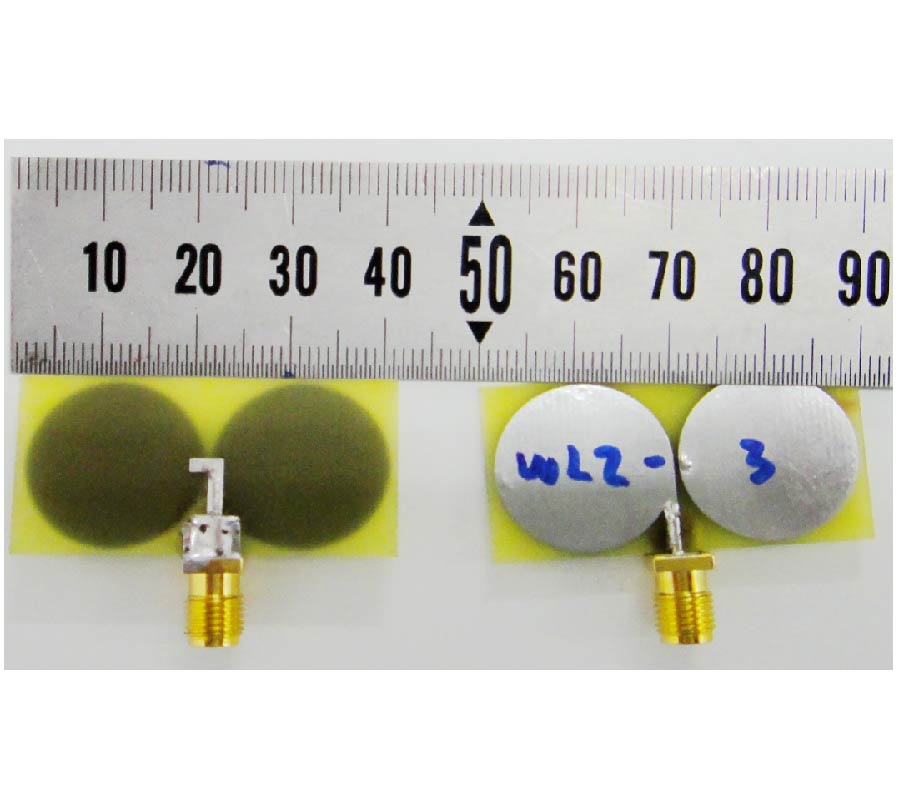
A novel design of a compact dual inverted C-shaped slots antenna for dual-band (IEEE 802.11b/g, 2.4-2.484 GHz and IEEE 802.11a, 5.15-5.35/5.725-5.825 GHz) WLAN applications is proposed in this paper. The antenna is based on dual inverted C-shaped slots and a μ-shaped feeding structure. These fundamental configurations are applied to achieve two operating bands with resonating frequencies at about 2.45 GHz and 5.5 GHz to cover the dual WLAN bands. The proposed antenna is fabricated and tested. The simulated and measured results show that the slot antenna obtains two independent operation bands of 2.4-2.515 GHz and 5.14-5.85 GHz for S11≤-10 dB, and also stable gain characteristic with peak gain variations less than 1 dBi for both the bands. Details of the analysis and research progresses are shown in the following sections to illustrate the design steps and the performance of the proposed antenna.
A COMPACT DUAL INVERTED C-SHAPED SLOTS ANTENNA FOR WLAN APPLICATIONS
2010-09-16
PIER C
Vol. 16, 111-125
Electromagnetic Simulation and Characterization a Metal Ceramic Package for Packaging of High Isolation Switches
Sandeep Chaturvedi , Sangam V. Bhalke , G. Sai Saravanan and Shiban Kishen Koul
Packaging of planar MMICs poses a unique challenge at microwave frequencies as the dimensions of the encapsulating cavity are comparable to wavelength at the operational frequencies. In addition, the effect of ground loops (caused by bond wires exposed to ground over extended length due to gaps between interconnects) deteriorates the situation even further in circuits like MMIC switches requiring high isolation between ports. The ground loops cause reflections thereby deteriorating the insertion loss figure of merit. This paper presents optimization of design of a metal ceramic package used for packaging an SPDT MMIC switch working in the frequency range of 5-6 GHz. The microwave performance of the package was simulated using EM simulation with parameters including cavity dimensions, port placement, gaps between interconnect lines, package feed-thrus and MMIC chip pads. Detailed characterization of the bare package and packaged SPDT MMIC done later shows a good match between the simulated and measured performance. The SPDT MMIC performance degradation was arrested by improvement in the package structure and it showed insertion loss of -1.6dB and input/output (I/O) return losses of ~16dB in the new package as compared to the values of -2.1dB insertion loss and -12dB I/O return losses in the original package. The port-to-port isolation remained unchanged (~40 dB in both cases) as it is governed by the MMIC assembly inside the package rather than the conditions at the I/O interfaces in this kind of large sized packages.
ELECTROMAGNETIC SIMULATION AND CHARACTERIZATION A METAL CERAMIC PACKAGE FOR PACKAGING OF HIGH ISOLATION SWITCHES
2010-09-16
PIER C
Vol. 16, 99-110
The Design of a Novel Compact CRLH Bandpass Filter with Harmonics Suppression
Behnam Ghahremani , Manouchehr Kamyab and Meisam Golmohammadi
This paper presents the design procedure and implementation of an innovative compact bandpass filter in UHF band by using Composite Right/Left Handed Transmission Line (CRLH-TL) by using parasitic effects of these structures. The CRLH-TL is utilized in order to minimize the overall size of component and reject higher ordered harmonics. The metamaterial transmission line is about one-eighth of a wavelength long and acts as both resonator and inverter which provide capacitive coupling between neighboring sections. To show the validity of design procedure, two prototype bandpass filters were fabricated and tested. We have shown that very good agreement exists between simulation results and those obtained by measurement.
THE DESIGN OF A NOVEL COMPACT CRLH BANDPASS FILTER WITH HARMONICS SUPPRESSION
2010-09-16
PIER M
Vol. 14, 101-111
Broadening of Omnidirectional Photonic Band Gap in Si-Based One Dimensional Photonic Crystals
Vipin Kumar , Khundrakpam Saratchandra Singh , Sudesh Kumar Singh and Sant Ojha
A simple design of one dimensional gradual stacked photonic crystal (GSPC) structure has been proposed. The proposed structure consists of a periodic array of alternate layers of SiO2 and Si as the materials of low and high refractive indices respectively. The structure considered here has three stacks of periodic structures with five layers each. The lattice period of successive stack is increased by a certain multiple (say gradual constant, γ) of the lattice period of the just preceding stack. For numerical computation, the method of transfer matrix method (TMM) has been employed. It is found that such a structure has wider reflection bands in comparison to a conventional dielectric PC structure, and the width of the omni-directional reflection (ODR) bands can be enlarged by increasing the value of the gradual constant. Hence, a GSPC structure can be used as a broadband omnidirectional reflector, and the bandwidth of omni-directional gaps can be tuned to a desired wavelength region by choosing appropriate value of γ.
BROADENING OF OMNIDIRECTIONAL PHOTONIC BAND GAP IN SI-BASED ONE DIMENSIONAL PHOTONIC CRYSTALS
2010-09-16
PIER
Vol. 108, 177-204
The Effect of Soil Texture in Soil Moisture Retrieval for Specular Scattering at C-Band
Rishi Prakash , Dharmendra Singh and Nagendra Prasad Pathak
The objective of this paper is to analyze the behavior of specular scattering for different soil texture fields at various soil moisture (mv) and analyze the data to retrieve the soil moisture with minimizing the effect of the soil texture. To study the soil texture effect on specular scattering 10 different soil fields were prepared on the basis of change in soil constituents (i.e, percentage of sand, silt and clay) and experiments were performed in both like polarizations (i.e., HH-polarization and VV-polarization) at various incidence angles (i.e., varying incidence angle from 25°to 70°in step of 5°). Angular response of specular scattering coefficients (σ°hh in HH-polarization and σ°vv VV-polarization) were analyzed for different soil texture fields with varying soil moisture content whereas the surface roughness condition for all the observations were kept constant. The changes in specular scattering coefficient values were observed with the change in soil texture fields with moisture for both like polarizations. Further, copolarization ratio (P=(σ°hh/σ°vv) study was performed and it was observed that the dependency of copolarization ratio for change in soil texture field at constant soil moisture is less prominent whereas the value of copolarization ratio is varying with variation of moisture content. This emphasizes that copolarization ratio may be minimizing the effect of soil texture while observing the soil moisture on specular direction. Regression analysis is carried out to select the best suitable incidence angle for observing the moisture and texture at C-band in specular direction and 60°incidence angle was found the best suitable incidence angle. An empirical relationship between P and mv was developed for the retrieval of mv and the obtained relationship gives a good agreement with observed mv. In addition, mv was also retrieved through the Kirchhoff Approximation (SA) and a comparison was made with the retrieved results of empirical relationship. The empirical relationship outperformed the SA.
THE EFFECT OF SOIL TEXTURE IN SOIL MOISTURE RETRIEVAL FOR SPECULAR SCATTERING AT C-BAND
2010-09-15
PIER B
Vol. 25, 293-314
Improved Analytical Model for Surface-Mounted PM Motors Considering Slotting Effects and Armature Reaction
Thierry Lubin , Smail Mezani and Abderrezak Rezzoug
This paper presents an exact analytical method for the computation of the magnetic field distribution in surface-mounted permanent-magnet (PM) motors for any pole and slot combinations including fractional slot machines. The proposed model takes into account the slotting effect and the armature reaction magnetic field. The analytical method is based on the resolution of the two-dimensional Laplace's and Poisson's equations in polar coordinates (by the separation of variables technique) for each subdomain, i.e., magnet, airgap and slots. Magnetic field distributions, back electromotive force and electromagnetic torque (cogging torque and load torque) computed with the proposed analytical method are verified with those obtained from finite element analyses.
IMPROVED ANALYTICAL MODEL FOR SURFACE-MOUNTED PM MOTORS CONSIDERING SLOTTING EFFECTS AND ARMATURE REACTION
2010-09-14
PIER B
Vol. 25, 277-292
Planar Monopole UWB Antenna with Unii1/Unii2 WLAN-Band Notched Characteristics
Leonardo Lizzi , Giacomo Oliveri , Paolo Rocca and Andrea Massa
In this paper, a planar monopole antenna for Ultra-Wideband (UWB) communications with a notched behavior in the two sub-bands UNII1 and UNII2 of the Wireless Local Area Network (WLAN) band is presented. The antenna geometry is described by means of a spline curve and a rectangular slot. Numerical and experimental results are reported to assess the effectiveness of the proposed design in terms of impedance matching and radiation characteristics.
PLANAR MONOPOLE UWB ANTENNA WITH UNII1/UNII2 WLAN-BAND NOTCHED CHARACTERISTICS
2010-09-14
PIER B
Vol. 25, 261-275
Design, Fabrication and Characterization of a Dielectric Resonator Antenna Reflectarray in Ka-Band
Mohd Haizal Jamaluddin , Ronan Sauleau , Xavier Castel , Ratiba Benzerga , Laurent Le Coq , Raphael Gillard and Thierry Koleck
A new reflectarray configuration is proposed for low-loss applications at millimeter waves. It is based on the use of dielectric resonator antennas (DRA) as radiating unit-cells. The phase response of the elementary cell is controlled by adjusting the length of a parasitic narrow metal strip printed on the top of each DRA. A 330° phase dynamic range is obtained for DRAs made in rigid thermosetting plastic (εr=10). As the antenna radiating aperture is non flat, an original low-cost fabrication process is also introduced in order to fabricate the parasitic strips on the DRA surface. A 24×24-element array radiating at broadside has been designed at 30 GHz and characterized between 29 and 31 GHz. The antenna gain reaches 28.3 dBi at 31 GHz, and the measured -1 dB-gain radiation bandwidth is 5.2%. The 3.2 dB loss observed between the measured gain and theoretical directivity is mainly due to the spillover loss (2.3 dB). The total dielectric and conductor loss is less than 0.9 dB.
DESIGN, FABRICATION AND CHARACTERIZATION OF A DIELECTRIC RESONATOR ANTENNA REFLECTARRAY IN KA-BAND
2010-09-14
PIER B
Vol. 25, 241-259
Multi-Floor Indoor Positioning System Using Bayesian Graphical Models
Abdullah Al-Ahmadi , Abdusamea. I. A. Omer , Muhammad Ramlee Kamarudin and Tharek Bin Abdul Rahman
In recent years, location determination systems have gained a high importance due to its rule in the context aware systems. In this paper, we will design a multi-floor indoor positioning system based on Bayesian Graphical Models (BGM). Graphical models have a great flexibility on visualizing the relationships between random variables. Rather of using one sampling technique, we are going to use multiple sets each set contains a collection of sampling techniques, the accuracy of each set will be compared with each other.
MULTI-FLOOR INDOOR POSITIONING SYSTEM USING BAYESIAN GRAPHICAL MODELS
2010-09-14
PIER Letters
Vol. 17, 105-114
A 9-21 GHz Miniature Monolithic Image Reject Mixer in 0.18-μm CMOS Technology
Wei-Chih Chien , Chih-Ming Lin , Yung-Hsiang Chang and Yeong-Her Wang
A compact 9-21 GHz monolithic image reject mixer (IRM) with a chip dimension of 0.9×0.74 mm2 has been designed and fabricated using a standard 0.18 μm CMOS technology. The compact configuration is composed of a 90°coupler for local oscillator (LO) and two doubly balanced ring mixers for mixing core. Particularly, a radio frequency (RF) dual balun with advanced intermediate frequency (IF) extraction technique can not only eliminate the use of power divider in IRM design, and simultaneously provide balanced signals for ring mixing, but also obtain high side band suppression without any additional IF low-pass filter. Moreover, the entire passive circuits are constructed by utilizing broad side coupling structure to achieve high-level integration further. From the measured results, the IRM exhibits a 19.4-22.4 dB conversion loss, a maximum image rejection ratio (IRR) of 34 dB, all port-to-port isolations better than 28 dB over RF frequency range of 9 to 21 GHz, and an input 1 dB compression power of 14 dBm.
A 9-21 GHz MINIATURE MONOLITHIC IMAGE REJECT MIXER IN 0.18-μm CMOS TECHNOLOGY
2010-09-14
PIER C
Vol. 16, 85-98
Bit Error Rate Reduction for Multiusers by Smart UWB Antenna Array
Shu-Han Liao , Min-Hui Ho and Chien-Ching Chiu
In this paper, a new ultra wideband circular antenna array (UCAA) combining genetic algorithm (GA) to minimize the bit error rate (BER) is proposed. The ultra wideband (UWB) impulse responses of the indoor channel for any transmitter-receiver location are computed by SBR/Image techniques, inverse fast Fourier transform and Hermitian processing. By using the impulse response of multipath channel, the BER performance of the binary pulse amplitude modulation (B-PAM) impulse radio (IR) UWB system with circular antenna array can be calculated. Based on the topography of the antenna and the BER formula, the array pattern synthesis problem can be reformulated into an optimization problem and solved by the genetic algorithm. The novelties of our approach is not only choosing BER as the object function instead of sidelobe level of the antenna pattern, but also considering the antenna feed length effect of each array element. The strong point of the genetic algorithm is that it can find out the solution even if the performance index cannot be formulated by simple equations. Simulation results show that the synthesized antenna array pattern is effective to focus maximum gain to the multiusers.
BIT ERROR RATE REDUCTION FOR MULTIUSERS BY SMART UWB ANTENNA ARRAY
2010-09-14
PIER
Vol. 108, 155-175
A Comparative Study on ISAR Imaging Algorithms for Radar Target Identification
Jong-Il Park and Kyung-Tae Kim
Inverse synthetic aperture radar (ISAR) images represent the two-dimensional (2-D) spatial distribution of the radar cross-section (RCS) of an object and, thus, they can be applied to the problem of target identification. The traditional approach to ISAR imaging is the range-Doppler algorithm based on the 2-D Fourier transform. However, the 2-D Fourier transform often results in poor resolution ISAR images, especially when the measured frequency bandwidth and angular region are limited. Instead of the Fourier transform, high resolution spectral estimation techniques can be adopted to improve the resolution of ISAR images. These are the autoregressive (AR) model, multiple signal classification (MUSIC), and matrix enhancement and matrix pencil MUSIC (MEMP-MUSIC). In this study, the ISAR images from these high-resolution spectral estimators, as well as the FFT approach, are identified using a recently developed identification algorithm based on the polar mapping of ISAR images. In addition, each ISAR imaging algorithm is analyzed and compared in the framework of radar target identification. The results show that the dynamic range as well as the resolution of the ISAR images plays an important role in the identification performance. Moreover, the optimum size of the subarray (i.e. covariance matrix) for MUSIC and MEMP-MUSIC in terms of target identification is experimentally derived.
A COMPARATIVE STUDY ON ISAR IMAGING ALGORITHMS FOR RADAR TARGET IDENTIFICATION
2010-09-14
PIER
Vol. 108, 141-153
A Dual-Wideband Bandpass Filter Based on E-Shaped Microstrip SIR with Improved Upper-Stopband Performance
Yan-Liang Wu , Cheng Liao and Xiang-Zheng Xiong
A novel dual-wideband microstrip bandpass filter (BPF) with improved upper-stopband performance is presented. With the use of some special structures such as E-shaped microstrip Stepped-Impedance Resonator (SIR) and input-output cross-coupling feed structure, this filter can generate five transmission zeros which are beneficial for improving its frequency selectivity and upper-stopband performance. Finally the microstrip dual-wideband BPF has been simulated, fabricated and measured. Measurement results show that the two passbands are centered at 3.7 GHz and 5.8 GHz with the fractional bandwidth of 31% and 13% respectively. Meanwhile more than 50% relative upper stopband bandwidth with 20 dB rejection has been realized. The simulated and measured results are in good agreement.
A DUAL-WIDEBAND BANDPASS FILTER BASED ON E-SHAPED MICROSTRIP SIR WITH IMPROVED UPPER-STOPBAND PERFORMANCE
2010-09-13
PIER
Vol. 108, 131-140
Efficient Radar Target Recognition Using a Combination of Range Profile and Time-Frequency Analysis
Seung-Ku Han , Hyo-Tae Kim , Sang-Hong Park and Kyung-Tae Kim
In this paper, a new hybrid classification method using both range profile (RP) and time-frequency image is proposed. The time-frequency image is obtained using the short-time Fourier transform before calculating the RP and this image is used for classification. 2-Dimensional Principal Components Analysis (2DPCA) is used to further compress the time-frequency image and to derive useful features from the image. The proposed method achieves a higher correct classification ratio than existing methods, especially when the signal-to-noise ratio is low.
EFFICIENT RADAR TARGET RECOGNITION USING A COMBINATION OF RANGE PROFILE AND TIME-FREQUENCY ANALYSIS
2010-09-10
PIER B
Vol. 25, 225-239
Novel, Dual Band, Single and Double Negative Metamaterials: Nonconcentric Delta Loop Resonators
Cumali Sabah
Novel, dual band, single and double negative metamaterials composed of nonconcentric and different sized delta loop resonators are presented. The proposed structures provide two distinct resonant frequencies in the microwave region. Effective medium parameters of these metamaterial structures are extracted using retrieval method to demonstrate the presence of the mentioned frequencies. In addition, equivalent circuit model for the individual magnetic resonator and wire strip is presented to give a clear explanation for the resonance behavior of the structures and to validate the proposed designs. The results show that the proposed metamaterials can be used as an alternative to the known counterparts especially when a dual band operation is needed at the frequency region of interest.
NOVEL, DUAL BAND, SINGLE AND DOUBLE NEGATIVE METAMATERIALS: NONCONCENTRIC DELTA LOOP RESONATORS
2010-09-10
PIER C
Vol. 16, 69-84
Cancellation of Complicated Drfm Range False Targets via Temporal Pulse Diversity
Gang Lu , Shengnan Liao , Shuangcai Luo and Bin Tang
In this paper, a jamming cancelation approach based on the concept of pulse diversity is proposed to suppress some newer complicated digital radio frequency memory (DRFM) range false targets (RFT). Just repeating the intercepted radar electromagnetic signal, as done in the conventional re-transmitting jammer, is not effective because only one range false target is produced. In contrast, the newer DRFM-based RFT generation methods, especially chopping and interleaving (C&I) and smeared spectrum (SMSP) can yield a multi-lobe filter output by transforming the internal structure of the intercepted radar signal. The presented approach to overcome this challenge is based on the temporal pulse diversity technique, and it does not require parameter estimation of the jamming signal. By transmitting pulses with specific transmission pulse block and the following proper processing, it can cancel out the protruding spikes of the jammer at the price of an acceptable performance loss. Particularly, this method is applicable to broad DRFM repeat jammer in electronic warfare (EW) area.
CANCELLATION OF COMPLICATED DRFM RANGE FALSE TARGETS VIA TEMPORAL PULSE DIVERSITY
2010-09-10
PIER C
Vol. 16, 51-67
Modified Matrix Pencil Algorithm for Termite Detection with High Resolution Radar
Nick W. D. Le Marshall and Andrew Z. Tirkel
Non-invasive termite detection avoids damage to the structure under investigation. In this paper, we present the design and simulation of a hybrid radar array, with sub-arrays designed for both close range imaging and wide-area direction of arrival (DOA) processing for non-invasive termite detection. This radar array achieves wide area detection via novel modifications to the Matrix Enhanced Matrix Pencil algorithm and array transformation and achieves high resolution imaging through near field beam-steering from a large random array. The array hardware is designed to be implemented using available technology and low cost electronics.
MODIFIED MATRIX PENCIL ALGORITHM FOR TERMITE DETECTION WITH HIGH RESOLUTION RADAR
2010-09-10
PIER C
Vol. 16, 37-50
Numerical Optimization of Pitch Profile for Overall Efficiency Enhancement of a Space TWT
Hong-Xia Yi , Pu-Kun Liu and Liu Xiao
Obtaining higher efficiency during the development of space Traveling Wave Tubes (TWTs) is always one of the most important goals for scientists. In this paper, a scheme of obtaining the maximum theoretical overall efficiency is explored by optimizing the helix pitch profile of a TWT based on the collectability of spent beam. The collectability of the spent beam was evaluated by the maximum collector efficiency, and this maximum collector efficiency was employed to calculate the maximum theoretical overall efficiency. The energy distribution of the spent beam and the output power of TWTs were calculated by the 3-D large signal Beam-Wave Interaction Simulator (BWIS) of MTSS. The detailed design of a Ku-band helix TWT is described according to three optimization goals (theoretical overall efficiency, theoretical collector efficiency and electronic efficiency). The simulation results indicate that the optimization for high interaction circuit efficiency or collector efficiency by itself is not adequate to obtain maximum overall efficiency. The maximum theoretical overall efficiency of 77% was achieved via the optimization of slow wave structure for theoretical overall efficiency.
NUMERICAL OPTIMIZATION OF PITCH PROFILE FOR OVERALL EFFICIENCY ENHANCEMENT OF A SPACE TWT