Search Results(13802)

2010-09-24
PIER M
Vol. 14, 113-121
Analysis of Epsilon-Near-Zero Metamaterial Super-Tunneling Using Cascaded Ultra-Narrow Waveguide Channels
Jian Bai , Shouyuan Shi and Dennis W. Prather
The Epsilon-Near-Zero (ENZ) super-tunneling structure with weakly coupled cascaded ultra-narrow channels is proposed and demonstrated to have notably wider bandwidth than single stage tunneling structure. An extensive parametric study for such structures is performed to investigate the factors which can affect super-tunneling performance. It is found that the coupling between the ultra-narrow channels is required to be weak enough to ensure a continuous supertunneling band. In addition, electric field in the cascaded channels is enhanced, compared with that in the single channel structure.
ANALYSIS OF EPSILON-NEAR-ZERO METAMATERIAL SUPER-TUNNELING USING CASCADED ULTRA-NARROW WAVEGUIDE CHANNELS
2010-09-24
PIER
Vol. 108, 323-341
Analysis of Perpendicular Crossing Dielectric Waveguides with Various Typical Index Contrasts and Intersection Profiles
Hung-Wen Chang and Yan-Huei Wu
We present a rigorous 2D numerical study of the transmission, reflection and crosstalk coefficients of the perpendicular, identical dielectric crossing waveguide with various core-cladding index contrasts for both TE and TM polarizations. Our method is based on a hybrid frequency-domain finite-difference (FD-FD) technique computed with the cross-symmetry model. By varying the intersection profile, such as the circular, filleted, tapered and elliptical shapes, we achieve, even for a large 3.5 to 1.5 index ratio, a low 0.25dB insertion loss, a nontrivial reduction over the straight direct crossing case.
ANALYSIS OF PERPENDICULAR CROSSING DIELECTRIC WAVEGUIDES WITH VARIOUS TYPICAL INDEX CONTRASTS AND INTERSECTION PROFILES
2010-09-23
PIER B
Vol. 26, 23-38
Adaptive Nulling with Weight Constraints
Randy L. Haupt
Adaptive nulling algorithms that minimize the total array output power from the array require constraints on the adaptive weights, otherwise nulls would be placed in the main beam and the desired signal rejected. The concept of cancellation patterns is reviewed and extended to partial adaptive nulling. Cancellation patterns are then extracted from adaptive nulling results with a genetic algorithm and a 32 element dipole array model. The cancellation patterns provide insight into the constraints needed for the successful implementation of a power minimization adaptive algorithm.
ADAPTIVE NULLING WITH WEIGHT CONSTRAINTS
2010-09-23
PIER B
Vol. 26, 1-21
Error Analysis of a Two-Layer Method for the Electromagnetic Characterization of Conductor-Backed Absorbing Material Using an Open-Ended Waveguide Probe
Gary Dester , Edward J. Rothwell , Michael John Havrilla and Milo Hyde IV
A two-layer nondestructive method for characterizing the electric and magnetic properties of lossy conductor-backed magnetic materials using a flanged rectangular-waveguide probe is examined. The two reflection measurements necessary to determine both permittivity and permeability are made by first applying the probe to the material under test and then applying the probe to a knownmaterial layer placed on top of the material under test. The theoretical reflection coefficient is obtained using a rigorous full-wave solution, and an extrapolation scheme is used to minimize the error due to truncating the modal expansion of the waveguide fields. An error analysis is performed to compare the performance of the technique to the two-thickness method, which utilizes two different thicknesses of the material under test. The properties of the known material layer that result in the least error due to network analyzer uncertainty are determined. The sensitivity of the two-layer method is also explored and discussed.
ERROR ANALYSIS OF A TWO-LAYER METHOD FOR THE ELECTROMAGNETIC CHARACTERIZATION OF CONDUCTOR-BACKED ABSORBING MATERIAL USING AN OPEN-ENDED WAVEGUIDE PROBE
2010-09-23
PIER B
Vol. 25, 349-367
Radiophysical and Dielectric Properties of Ore Minerals in 12--145 GHz Frequency Range
Vasiliy V. Tikhonov , Dmitriy A. Boyarskii , Olga N. Polyakova , Andrey L. Dzardanov and Grigory N. Goltsman
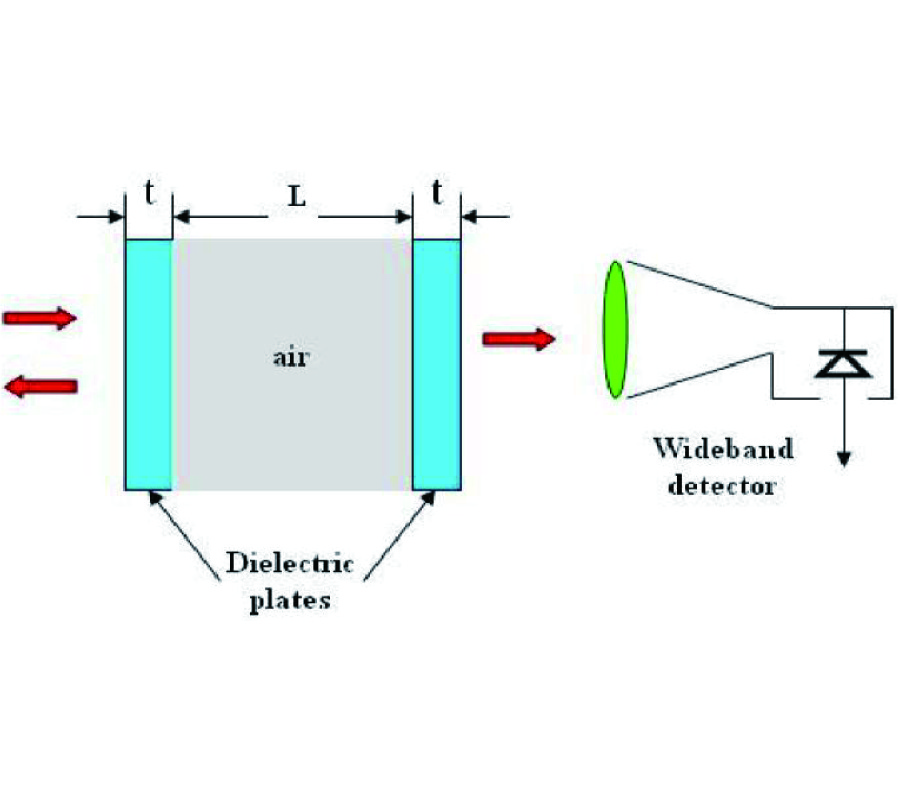
The paper discusses a retrieval technique of complex permittivity of ore minerals in frequency ranges of 12--38 GHz and 77--145 GHz. The method is based on measuring frequency dependencies of transmissivity and reflectivity of plate-parallel mineral samples. In the 12--38 GHz range, the measurements were conducted using a panoramic standing wave ratio and attenuation meter. In the 77--145 GHz range, frequency dependencies of transmissivity and reflectivity were obtained using millimeter-band spectrometer with backward-wave oscillators. The real and imaginary parts of complex permittivity of a mineral were determined solving an equation system for frequency dependencies of transmissivity and reflectivity of an absorbing layer located between two dielectric media. In the course of the work, minerals that are primary ores in iron, zinc, copper and titanium mining were investigated: magnetite, hematite, sphalerite, chalcopyrite, pyrite, and ilmenite.
RADIOPHYSICAL AND DIELECTRIC PROPERTIES OF ORE MINERALS IN 12--145 GHZ FREQUENCY RANGE
2010-09-23
PIER Letters
Vol. 17, 171-179
A Wide-Band, Polarization-Insensitive and Wide-Angle Terahertz Metamaterial Absorber
Chao Gu , Shaobo Qu , Zhibin Pei , Hang Zhou , Jiafu Wang , Baoqin Lin , Zhuo Xu , Peng Bai and Wei-Dong Peng
In this paper, a wide-band, polarization-insensitive, wide-angle terahertz metamaterial absorber is presented. Simulated results show that the absorber can achieve polarization-insensitive, wide-angle absorptions in a wide band from 4.15 to 4.85 THz. The retrieved impedance shows that the impedance of the absorber could be tuned, in the absorption band, to match approximatively that of free space on one side and to mismatch on the other side, rendering both the reflectance and transmission minimal and thus the corresponding absorbance maximal. The simulated absorbances under three different loss conditions suggest that high absorbance is mainly due to the metallic absorption (Ohmic loss). The dielectric loss of the substrate is minor compared with the metallic absorption. The distribution of the surface current density indicates that the electric and magnetic responses are mainly caused by the front structure. This wide-band terahertz metamaterial absorber has potential applications in many functional devices such as microbolometers, thermal detectors, and solar cells.
A WIDE-BAND, POLARIZATION-INSENSITIVE AND WIDE-ANGLE TERAHERTZ METAMATERIAL ABSORBER
2010-09-23
PIER Letters
Vol. 17, 163-170
Miniature Electromagnetic Band-Gap Structure Using Spiral Ground Plane
Huan-Huan Xie , Yong-Chang Jiao , Kun Song and Bin Yang
An important application of electromagnetic band-gap (EBG) structures is reducing the mutual coupling and eliminating the scan blindness for array antennas. However, some array antennas have small element spacing,and traditional mushroom-like EBG materials are too large. Under this condition, miniature EBG structures are desired for these array antennas. In this paper, a novel method using spiral ground plane is proposed to reduce EBG structure sizes. A low frequency band-gap can be obtained by adjusting the width and length of the spiral arms. An experimental prototype is fabricated to validate the analysis. The measurement results show a good agreement with the simulation data. Compared with traditional mushroom-like EBG structures, the proposed EBG achieves more than 77% size diminution.
MINIATURE ELECTROMAGNETIC BAND-GAP STRUCTURE USING SPIRAL GROUND PLANE
2010-09-23
PIER C
Vol. 16, 137-146
A Compact Rectenna Device at Low Power Level
Samuel Riviere , Frederic Alicalapa , Alexandre Douyère and Jean-Daniel Lan Sun Luk
This article describes the design and performances of a rectenna that collects low incident power density levels, at a single ISM-band frequency (f0=2.45 GHz). A new rectenna topology consisting only of an antenna, a matching circuit, a Schottky diode, and a DC filter has been modeled using a global simulation. A circular aperture coupled patch antenna is proposed to suppress the first filter in the rectenna device, and in addition, the losses associated with this filter. The harmonics rejection of the antenna is primarily used to reduce the rectenna size. The implementation of the filter in the antenna structure, combined with a reduction of the rectenna size, gives several advantages in several applications where the size and weight are critical criteria. The maximum energy conversion efficiency in this configuration is 34% and is reached for a load of 9.2 kΩ and a RF collected power of SRF=17μW/cm2(≈-10 dBm RF incident upon the diode).
A COMPACT RECTENNA DEVICE AT LOW POWER LEVEL
2010-09-23
PIER
Vol. 108, 307-322
Can Maxwell's Fish Eye Lens Really Give Perfect Imaging?
Fei Sun and Sailing He
Both explicit analysis and FEM numerical simulation are used to analyze the field distribution of a line current in the so-called Maxwell's fish eye lens [bounded with a perfectly electrical conductor (PEC) boundary]. We show that such a 2D Maxwell's fish eye lens cannot give perfect imaging due to the fact that high order modes of the object field can hardly reach the image point in Maxwell's fish eye lens. If only zeroth order mode is excited, a good image of a sharp object may be achieved in some cases, however, its spot-size is larger than the spot size of the initial object field. The image resolution is determined by the field spot size of the image corresponding to the zeroth order component of the object field. Our explicit analysis consists very well with the FEM results for a fish eye lens. Time-domain simulation is also given to verify our conclusion. Multi-point images for a single object point are also demonstrated.
CAN MAXWELL'S FISH EYE LENS REALLY GIVE PERFECT IMAGING?
2010-09-23
PIER
Vol. 108, 293-306
Enhancement of Blue Light Emission Using Surface Plasmons Coupling with Quantum Wells
Jia Zhao , Kang Li , Fanmin Kong and Du Liu-Ge
3-dimension finite-difference time-domain (FDTD) method is used to simulate the enhanced blue light emission of gallium nitride light emitting diode (GaN-LED) using the surface-plasmons (SPs) coupling with the quantum wells. The numerical simulation results demonstrate that when the silver film is coated on GaN-LED, the excited SPs play a key role in the enhanced blue light emission, and the enhancement depends on the geometries of GaN-LED and silver film. An enhancement factor is given to describe the enhancement effect of light emission. By changing the structure parameters of GaN-LED and silver film, the enhanced peak of the light emission in the visible region can be controlled. Under the optimal parameters, about 17 times enhancement at 460 nm can be obtained, and the enhancement effect is evidently demonstrated by the SPs field distribution.
ENHANCEMENT OF BLUE LIGHT EMISSION USING SURFACE PLASMONS COUPLING WITH QUANTUM WELLS
2010-09-22
PIER C
Vol. 16, 127-136
A Wideband Microstrip-Line-Fed Isosceles Trapezoidal Dielectric Resonator Antenna with Modified Ground Plane
C. Gopakumar and K. Mathew
A microstrip-line-fed Isosceles Trapezoidal Dielectric Resonator Antenna (ITDRA) with a parasitic strip and modified ground plane is introduced. It is proved by simulation and experiment that the antenna's resonant frequency can be lowered and the bandwidth can be increased considerably by introducing a slot and optimizing its position and dimensions in the ground plane. The proposed antenna is a wide band antenna with a 2:1 VSWR bandwidth of 21.5% centered at 2.51GHz and exhibits good radiation characteristics and moderate gain in the entire operating band. The antenna covers important application bands viz. ISM: Bluetooth/WLAN 2.4/Wibree (802.11 b/g/n)/ZigBee, WiBro and DMB. The wideband response in the relatively lower frequency range which includes the above mentioned application bands are not much seen anywhere in literature. Details of the design along with experimental and simulation results are presented and discussed.
A WIDEBAND MICROSTRIP-LINE-FED ISOSCELES TRAPEZOIDAL DIELECTRIC RESONATOR ANTENNA WITH MODIFIED GROUND PLANE
2010-09-22
PIER
Vol. 108, 277-291
Log-Amplitude Variance of Laser Beam Propagation on the Slant Path through the Turbulent Atmosphere
Hong-Yan Wei , Zhen-Sen Wu and Qingliang Ma
Based on the altitude-dependent model of ITU-R slant atmospheric turbulence structure constant, the log-amplitude variance of laser beam propagation on the slant path through turbulent atmosphere is obtained with transmitter and receiver parameters and can be degenerated to the result of the horizontal path with atmospheric structure constant as a fixed value. These expressions are convenient tools for beam-wave analysis. Finally, we apply the ITU-R turbulence structure constant model to calculate collimated, divergent and convergent beam log-amplitude variance. The numerical conclusions indicate the log-amplitude variance of laser beam propagation on slant path is generally smaller than those on horizontal path.
LOG-AMPLITUDE VARIANCE OF LASER BEAM PROPAGATION ON THE SLANT PATH THROUGH THE TURBULENT ATMOSPHERE
2010-09-22
PIER
Vol. 108, 249-275
Performance Evaluation of Track Association and Maintenance for a Mfpar with Doppler Velocity Measurements
Faruk Kural , Feza Arikan , Orhan Arikan and Murat Efe
This study investigates the effects of incorporating Doppler velocity measurements directly into track association and maintenance parts for single and multiple target tracking unit in a multi function phased array radar (MFPAR). Since Doppler velocity is the major discriminant of clutter from a desired target, the measurement set has been expanded from range, azimuth and elevation angles to include Doppler velocity measurements. We have developed data association and maintenance part of a well known tracking method, Interacting Multiple Model Probabilistic Data Association Filter (IMMPDAF), with the Doppler velocity measurements and demonstrated the performance improvement through simulations in terms of track update interval, track maintenance rate, RMS position estimation error, probability of detection and processing time. Since Doppler velocity measurements are employed in track maintenance, non-linear filters are used in the scheme leading to the use of Extended Kalman Filter (EKF) based PDAF. Comprehensive simulations have revealed that using Doppler velocity measurements along with 3D position measurements in heavy clutter conditions lead to an increase in track maintenance rate, track update interval; a decrease in position estimation error, processing time and no considerable effect on the probability of detection. This result is very significant for the efficient use of the limited resources of a multi function phased array radar.
PERFORMANCE EVALUATION OF TRACK ASSOCIATION AND MAINTENANCE FOR A MFPAR WITH DOPPLER VELOCITY MEASUREMENTS
2010-09-21
PIER
Vol. 108, 235-247
Fast Inhomogeneous Plane Wave Algorithm for Analysis of Composite Bodies of Revolution
Xi Rui , Jun Hu and Qing Huo Liu
A fast inhomogeneous plane wave algorithm is developed for the electromagnetic scattering problem from the composite bodies of revolution (BOR). Poggio-Miller-Chang Harrington-Wu (PMCHW) approach is used for the homogeneous dielectric objects, while the electric field integral equation (EFIE) is used for the perfect electric conducting objects. The aggregation and disaggregation factors can be expressed analytically by using the Weyl identity. Compared with the traditional method of moments (MoM), both the memory requirement and CPU time, are reduced for large-scale composite BOR problems. Numerical results are given to demonstrate the validity and the efficiency of the proposed method.
FAST INHOMOGENEOUS PLANE WAVE ALGORITHM FOR ANALYSIS OF COMPOSITE BODIES OF REVOLUTION
2010-09-20
PIER Letters
Vol. 17, 153-161
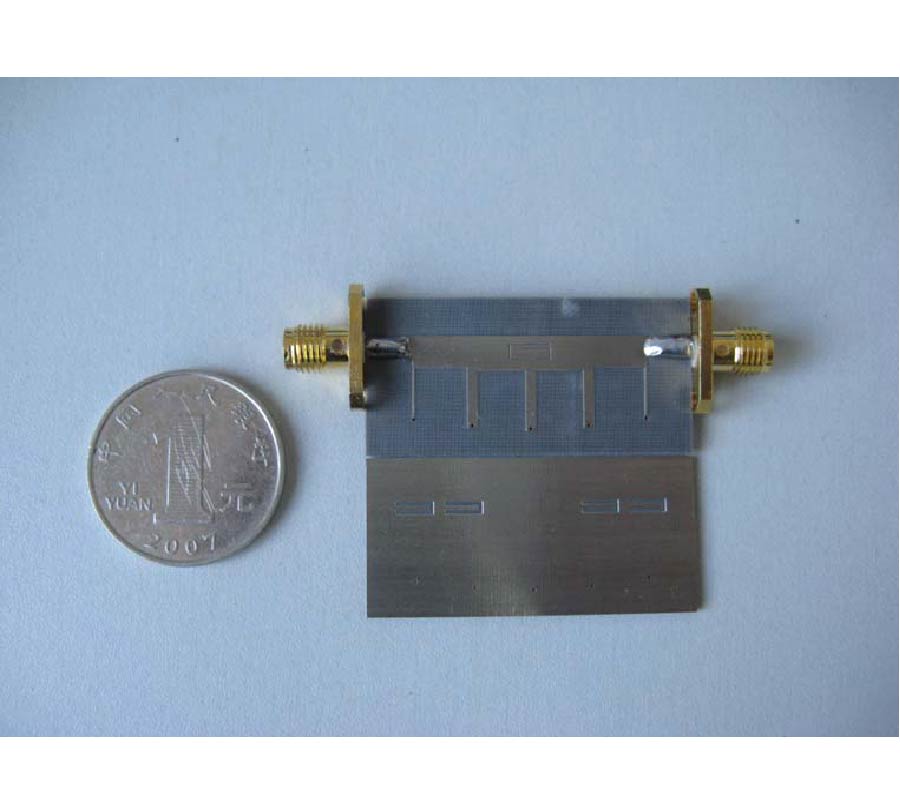
Single Metal Layer CPW Metamaterial Bandpass Filter
Ibraheem A. I. Al-Naib , Christian Jansen and Martin Koch
We propose single metal layer metamaterial bandpass filters based on compact complementary u-shaped resonators. Previously, metamaterial bandpass filters could only be achieved if a second conducting layer was utilized. Here, we propose a resonator concept that can directly be integrated with a single sided coplanar waveguide, enabling low fabrication costs and simple system integration. Furthermore, already a single unit cell yields a pronounced bandpass behavior without the need for cascading multiple resonators. Both, measurements and numerical simulations are presented. Using RO3003 as substrate, a low insertion loss of 1.71 dB and a corresponding 3-dB bandwidth ratio of 3.1% is achieved.
SINGLE METAL LAYER CPW METAMATERIAL BANDPASS FILTER
2010-09-20
PIER
Vol. 108, 221-234
Hybrid PIFA-Patch Antenna Optimized by Evolutionary Programming
Rocio Sanchez-Montero , Sancho Salcedo-Sanz , J. A. Portilla-Figueras and Richard J. Langley
In this paper we study the optimization process of a novel hybrid antenna, formed by a Planar Inverted-F Antenna (PIFA) and a coplanar patch in the same structure, and intended to be used in mobile communications and WIFI applications simultaneously. This hybrid device has been recently proposed and characterized in the literature, and it has been shown that it allows a bandwidth of 850 MHz (49%) in the lower band and 630 MHz (11.25%) in the upper band. In spite of these good performance results, the fine tuning of the joint PIFA-patch parameters in the hybrid antenna is a hard task, not easy to automatize. In this paper we propose the use of an Evolutionary Programming (EP) approach, an algorithm of the Evolutionary Computation family, which has been shown to be very effective in continuous optimization problems. We use a real encoding of the antenna's parameters and the CST Microwave Studio simulator to obtain the performance of the antenna. The simulator is therefore incorporated to the EP algorithm as a part of the antenna's evaluation process. We will show that the EP is able to obtain very good sets of parameters in terms of the designer necessities, usually a larger bandwidth at the design frequencies. In this case, the bandwidth of the EP optimized antenna results in 980 MHz (55%) for the lower band and 870 MHz (17%) for the upper band.
HYBRID PIFA-PATCH ANTENNA OPTIMIZED BY EVOLUTIONARY PROGRAMMING
2010-09-17
PIER B
Vol. 25, 331-348
Comparative Performance of Gravitational Search Algorithm and Modified Particle Swarm Optimization Algorithm for Synthesis of Thinned Scanned Concentric Ring Array Antenna
Anirban Chatterjee , Gautam Mahanti and Narendra Nath Pathak
Scanning a planar array in the x-z plane directs the beam peak to any direction off the broadside along the same plane. Reduction of sidelobe level in concentric ring array of isotropic antennas scanned in the x-z plane result in a wide first null beamwidth (FNBW). In this paper, the authors propose pattern synthesis methods to reduce the sidelobe levels with fixed FNBW by making the scanned array thinned based on two different global optimization algorithms, namely Gravitational Search Algorithm (GSA) and modified Particle Swarm Optimization (PSO) algorithm. The thinning percentage of the array is kept more than 45 percent and the first null beamwidth (FNBW) is kept equal to or less than that of a fully populated, uniformly excited and 0.5 λ spaced concentric circular ring array of same scanning angle and same number of elements and rings.
COMPARATIVE PERFORMANCE OF GRAVITATIONAL SEARCH ALGORITHM AND MODIFIED PARTICLE SWARM OPTIMIZATION ALGORITHM FOR SYNTHESIS OF THINNED SCANNED CONCENTRIC RING ARRAY ANTENNA
2010-09-17
PIER Letters
Vol. 17, 145-152
Active Phase Locking of Fiber Amplifiers with 180 GHz Ultrabroad Linewidth
Pu Zhou , Xiaolin Wang , Yanxing Ma , Kai Han and Zejin Liu
A fiber laser with 180 GHz ultrabroad linewidth is developed using a broadband light source and a bandpass filter. Active phase locking of two fiber amplifiers with 180 GHz linewidth is successfully realized using stochastic parallel gradient descent technique. The fringe contrast of the interference pattern is as high as 65% when active phase control is implemented. The reported results indicate a promising power scalability of fiber amplifier modules developed for phase locking.
ACTIVE PHASE LOCKING OF FIBER AMPLIFIERS WITH 180 GHz ULTRABROAD LINEWIDTH
2010-09-17
PIER
Vol. 108, 205-219
Analysis of Microwave Emission of Exponentially Correlated Rough Soil Surfaces from 1.4 GHz to 36.5 GHz
Peng Xu , Kunshan Chen and Leung Tsang
We analyzed the microwave emission from a rough soil surface with exponential correlation by characterizing its dependences of polarization, look angle, and frequency. Using the same set of physical surface parameters of rms height and correlation lengths, results are obtained for a wide range of frequencies at 1.4 GHz, 5 GHz, 10 GHz, 18 GHz, and 36.5 GHz. Accurate simulations for the 2-D scattering problem are conducted by Galerkin's method with the rooftop basis function, followed by near-field integration, fine discretization, and cubic spline interpolation of surfaces. The multilevel UV method was employed to accelerate the solution. Accuracy is ensured by energy conservation check. Simulation results are compared with SPM, KA and AIEM. Results suggest that there exists distinct emission characteristic between the exponential and the Gaussian correlated surface. These charcateristics should be very useful in developing retrieval algorithm of the soil moisture from emissivity measurements.
ANALYSIS OF MICROWAVE EMISSION OF EXPONENTIALLY CORRELATED ROUGH SOIL SURFACES FROM 1.4 GHz TO 36.5 GHz
2010-09-16
PIER B
Vol. 25, 315-330
Synthesis of Optimal Narrow Beam Low Sidelobe Linear Array with Constrained Length
Jean-Jacques Fuchs and Benjamin Fuchs
The synthesis of optimal narrow beam low sidelobe linear array is addressed. Only the length of the array is constrained. The number, the positions and the weightings of the elements are left free. It is proven, that the optimal design is always an array with a small number of elements. One first demonstrates that among equally spaced linear arrays of given length, the sparsest Dolph-Chebyshev design, i.e., the one with the largest admissible inter-element distance, is the optimal one. Then, the restriction to equally spaced elements is removed, and the general problem is solved and discussed. It is shown that the sparsest Dolph-Chebyshev designs are optimal for array lengths in given specified intervals and close to optimal for all other lengths.
SYNTHESIS OF OPTIMAL NARROW BEAM LOW SIDELOBE LINEAR ARRAY WITH CONSTRAINED LENGTH