Search Results(13803)

2010-05-03
PIER Letters
Vol. 14, 91-100
A Novel Duality Between Permeability and Permittivity in a Concentric Sphere
Noushin Vaseghi , Ali Abdolali and Homayoon Oraizi
Consider a TEM plane wave incident on a spherical multilayer structure, then the following theorem is valid. This theorem reveals a duality between permeability and permittivity of media in a spherical multilayer structure. Theorem: Consider a sphere with arbitrary radius and parameters s (ε22) surrounded by a homogenous medium with parameters (ε11). Then consider the case that each medium is filled by its dual medium according to the interchange εi↔μi. Then, the forward and backward radar cross sections of the structure are the same for the two dual cases. However, in half planes φ=((2k+1)π)/4;(k=0,1,2,3), the interchange εi↔μi has no similar effect on the value of the radar cross section.
A NOVEL DUALITY BETWEEN PERMEABILITY AND PERMITTIVITY IN A CONCENTRIC SPHERE
2010-05-03
PIER M
Vol. 12, 155-164
Coupling Between an Irradiated Aperture and Monopole Antennas into a Complex Enclosure
François Caudron , Achour Ouslimani , Rene Vezinet , Abed-elhak Kasbari , Jean-Luc Lavergne and Jean-Sébastien Borrod
The coupling between an irradiated aperture and a monopole antenna into a complex enclosure is investigated. The aperture is realized at the one side of the enclosure and the monopole antenna at the other side. The proposed study uses Babinet's principle to extend the Random Coupling Model to determine the radiation impedance of apertures. An experimental study is carried out using a computer box as an enclosure. A high intensity external electromagnetic radiation is applied to the aperture. The induced voltages is measured along the monopole antenna. The simulated probability levels of the induced voltages agree well with the experimental ones.
COUPLING BETWEEN AN IRRADIATED APERTURE AND MONOPOLE ANTENNAS INTO A COMPLEX ENCLOSURE
2010-05-03
PIER M
Vol. 12, 143-153
New Formula for the Reflection Coefficient of an Open-Ended Rectangular Waveguide with or Without an Infinite Flange
Jong-Heon Kim , Bayanmunkh Enkhbayar , Jae-Hoon Bang , Bierng-Chearl Ahn and Eun-Jong Cha
New formulas are presented for the reflection coefficient at the open end of a rectangular waveguide radiating into air including the effect of wall thickness or flange. Existing formulas require significant amount of numerical calculations and do not cover the practical range of waveguide dimensions. Reflection coefficients of open-ended standard waveguides are simulated using commercial electromagnetic software and curve-fitted to derive new formulas. Proposed formulas include the effects of waveguide wall thickness and broad-to-narrow wall aspect ratio. The accuracy of proposed formulas is compared with existing analytical, numerical and experimental results.
NEW FORMULA FOR THE REFLECTION COEFFICIENT OF AN OPEN-ENDED RECTANGULAR WAVEGUIDE WITH OR WITHOUT AN INFINITE FLANGE
2010-05-03
PIER M
Vol. 12, 131-141
Path Loss Modeling for Near-Ground VHF Radio-Wave Propagation through Forests with Tree-Canopy Reflection Effect
Yu Song Meng , Yee Hui Lee and Boon Chong Ng
This paper presents a new methodology to model the near-ground short-range propagation loss in forested areas at the VHF and the UHF band. The path loss modeling is performed by an integration of the foliage induced effect and the effect from the radio-wave reflection/reflections. The analysis shows that the reflection from the dense tree canopy is important for short-range propagation at the VHF band and therefore, cannot be ignored. When taking into consideration the contribution from the possible tree-canopy reflection, the modeled path loss is reduced by more than 15 dB in the VHF band. A good agreement of the modeled path loss with the measured loss in tropical forested areas is achieved.
PATH LOSS MODELING FOR NEAR-GROUND VHF RADIO-WAVE PROPAGATION THROUGH FORESTS WITH TREE-CANOPY REFLECTION EFFECT
2010-05-01
PIER Letters
Vol. 14, 79-90
Remote Sensing with Tdmf Radar: Some Preliminary Results
Songhua Yan , Xiongbin Wu and Zezong Chen
HF radar in ocean remote sensing makes use of electromagnetic waves of 10m to 100m wavelength from the rough sea surface to measure surface current and ocean wave parameter. Recently, a new time division multiple frequency HF radar system called OSMAR2009 has been developed by the Wuhan University. One main advantage of the system is that it is of great help in extracting current parameters and significant wave height. A further advantage is the ability to avoid interference. In addition, this technique offers the opportunity to measure the current shear. These advantages are gained by transmitting time division multiple frequency chirp instead of one frequency chirp. This paper introduces the technical design and the advantage of OSMAR2009 and describes the remote sensing experiment implemented in East China sea during 2009, followed by the field results and the brief analysis of such results.
REMOTE SENSING WITH TDMF RADAR: SOME PRELIMINARY RESULTS
2010-04-30
PIER B
Vol. 21, 87-111
Linear Antenna Array Synthesis with Constrained Multi-Objective Differential Evolution
Siddharth Pal , Boyang Qu , Swagatam Das and P. N. Suganthan
Linear antenna array design is one of the most important electromagnetic optimization problems of current interest. In contrast to a plethora of recently published articles that formulate the design as the optimization of a single cost function formed by combining distinct and often conflicting design-objectives into a weighted sum, in this work, we take a Multi-objective Optimization (MO) approach to solve the same problem. We consider two design objectives: the minimum average Side Lobe Level (SLL) and null control in specific directions that are to be minimized simultaneously in order to achieve the optimal spacing between the array elements. Our design method employs a recently developed and very competitive multi-objective evolutionary algorithm called MOEA/D-DE that uses a decomposition approach for converting the problem of approximation of the Pareto Fronts (PF) into a number of single objective optimization problems. This algorithm employs Differential Evolution (DE), one of the most powerful real parameter optimizers in current use, as the search method. As will be evident from the shape of the approximated PFs obtained with MOEA/D-DE, the two design-objectives are in conflict and usually, performance cannot be improved significantly for one without deteriorating the other. Unlike the single-objective approaches, the MO approach provides greater flexibility in the design by yielding a set of equivalent final solutions from which the user can choose one that attains a suitable trade-off margin as per requirements. We illustrate that the best compromise solution attained by MOEA/D-DE can comfortably outperform state-of-the-art single-objective algorithms like Genetic Algorithm (GA), Particle Swarm Optimization (PSO), Tabu Search Algorithm (TSA), and Memetic Algorithm (MA). In addition, we compared the results obtained by MOEA/D-DE with those obtained by one of the most widely used MO algorithm called NSGA-2 and another generic multi-objective DE variant that uses non-dominated sorting, on the basis of the Rindicator, hypervolume indicator, and quality of the best trade-off solutions obtained.
LINEAR ANTENNA ARRAY SYNTHESIS WITH CONSTRAINED MULTI-OBJECTIVE DIFFERENTIAL EVOLUTION
2010-04-30
PIER Letters
Vol. 14, 69-78
Compact Bandpass Filter Using Folded Loop Resonator with Harmonic Suppression
B. Jitha , P. C. Bybi , Chandroth K. Aanandan , Pezholil Mohanan and Kesavath Vasudevan
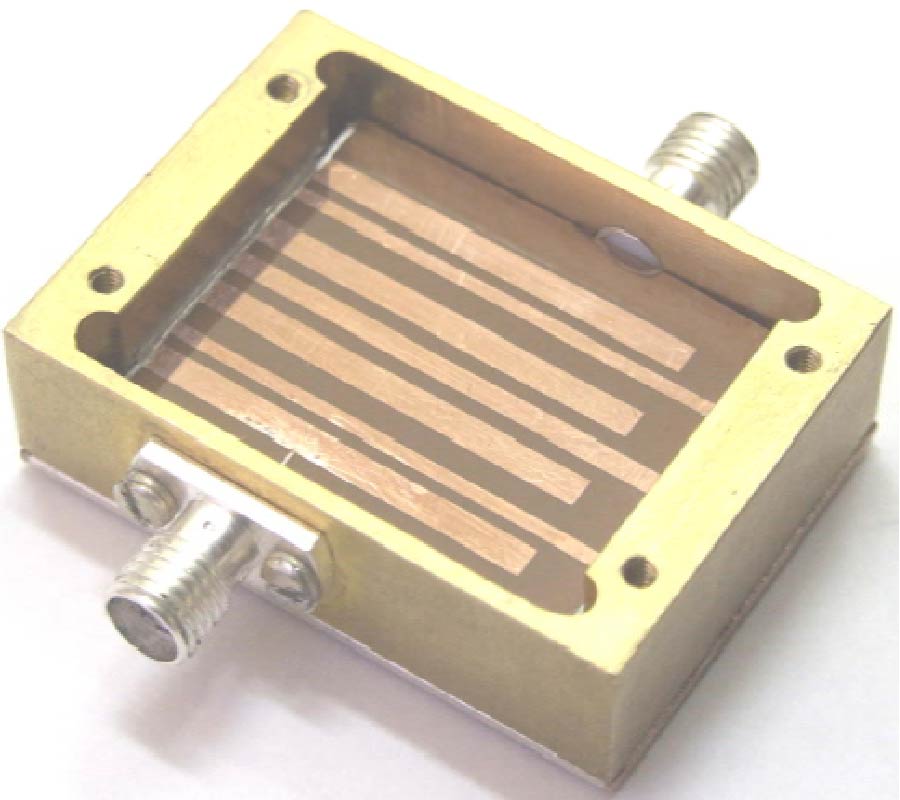
A novel compact microstrip bandpass filter using folded open loop resonator is presented. The resonator elements are placed in close proximity to parallel coupled microstrip lines. The presence of undesired harmonics is eliminated here by properly modifying the configuration of the folded resonator. The measured and simulated results are in good agreement.
COMPACT BANDPASS FILTER USING FOLDED LOOP RESONATOR WITH HARMONIC SUPPRESSION
2010-04-29
PIER M
Vol. 12, 115-130
Analysis of Self-Collimation Based Cavity Resonator Formed by Photonic Crystal
Natesan Yogesh and Venkatachalam Subramanian
The self-collimation effect in photonic crystal is used for the realization of open cavity resonator formed by photonic prisms in a four-port arrangement. The confinement, field enhancement and energy storage capabilities of the proposed cavity are explored in this paper. The effect of dielectric losses included in the system and role of the position of line source in the confinement effect of the cavity are brought out. Decay of short Gaussian pulse placed inside the cavity is analyzed through finite-difference time-domain studies. Due to the high confinement and divergence less beam propagation, utility of the proposed cavity for rotational gyroscope application is also revealed.
ANALYSIS OF SELF-COLLIMATION BASED CAVITY RESONATOR FORMED BY PHOTONIC CRYSTAL
2010-04-29
PIER M
Vol. 12, 107-113
Self-Consistent Approach to the Electrodynamic Analysis of the Chiral Structures
Vyacheslav Alexandrovich Neganov , Dmitry Petrovich Tabakov and Ivan Mikhailovich Gradinar
Rigorous electrodynamic analysis is proposed to estimate the surface current density on the perfectly conducting chiral elements in the diffraction problems. It is reduced to the solution of the integral singular equations. The diffraction of plane electromagnetic wave on the cylindrical open ring is considered as an example.
SELF-CONSISTENT APPROACH TO THE ELECTRODYNAMIC ANALYSIS OF THE CHIRAL STRUCTURES
2010-04-29
PIER
Vol. 103, 403-418
Evolution of Transient Electromagnetic Fields in Radially Inhomogeneous Nonstationary Medium
Oleksandr M. Dumin , O. O. Dumina and Victor A. Katrich
To solve radiation problems in time domain directly the modal representation of transient electromagnetic fields is considered. Using evolutionary approach the initial nonstationary three-dimensional electrodynamic problem is transformed into the problem for one-dimensional evolutionary equations by the construction of the modal basis for electromagnetic fields with arbitrary time dependence in spherical coordinate system. Elimination of the radial components of electrical and magnetic field from Maxwell equation system permits to form the four-dimensional differential operators. It is proved that the operators are self- adjoint ones. The eigen-functions of the operators form the basis. The completeness of the basis is proved by means of Weyl Theorem about orthogonal detachments of Hilbert space. The expansion coefficients of arbitrary electromagnetic field are found from the set of evolutionary equations. The transient electromagnetic field can be found directly without Fourier transform application by means of one-dimensional FDTD method for the medium with dependence on longitudinal coordinate and time or using Laplace transform and wave splitting for the case of homogeneous stationary medium. The above mentioned methods are compared with the three-dimensional FDTD method for the case of the problem of small loop excitation by transient current.
EVOLUTION OF TRANSIENT ELECTROMAGNETIC FIELDS IN RADIALLY INHOMOGENEOUS NONSTATIONARY MEDIUM
2010-04-29
PIER
Vol. 103, 393-401
A Compact Polarization Beam Splitter Based on a Multimode Photonic Crystal Waveguide with an Internal Photonic Crystal Section
Yaocheng Shi
We present the design and simulation of an ultra-compact polarization beam splitter (PBS) by combining a photonic crystal (PhC) multimode waveguide and an internal PhC section. The PhC multimode waveguide is designed to collect the powers reflected by or transmitted through the internal PhC structure which serves as a polarization sensitive scatterer. Plane wave expansion (PWE) method is used to calculate the band structure and the finite-difference time-domain (FDTD) method is employed to obtain the spectrum response. The simulation results show that the present design can give an ultra-compact PBS with high extinction ratio over a broad bandwidth.
A COMPACT POLARIZATION BEAM SPLITTER BASED ON A MULTIMODE PHOTONIC CRYSTAL WAVEGUIDE WITH AN INTERNAL PHOTONIC CRYSTAL SECTION
2010-04-29
PIER
Vol. 103, 371-391
Efficient Determination of the Near-Field in the Vicinity of an Antenna for the Estimation of Its Safety Perimeter
Jaime Laviada-Martinez , Yuri Alvarez-Lopez and Fernando Las Heras Andres
The following paper deals with the problem of computing a safety perimeter, i.e., where the electromagnetic field due to a radiating system exceeds a certain electromagnetic value. The flexibility of the source reconstruction method (SRM) is employed to compute the fields almost everywhere around the antenna. Techniques for fast computing of the fields in the spectral and spatial domains exploiting the characteristics of the SRM are considered in order to avoid expensive integrations over the sources surface. Results for a logperiodic antenna and a base station antenna for cellular phone systems are shown, and compared with the usual far-field approximation.
EFFICIENT DETERMINATION OF THE NEAR-FIELD IN THE VICINITY OF AN ANTENNA FOR THE ESTIMATION OF ITS SAFETY PERIMETER
2010-04-28
PIER C
Vol. 13, 159-170
A Compact CPW-Fed UWB Slot Antenna with Cross Tuning Stub
Johnson William and Rangaswamy Nakkeeran
Design and analysis of a compact coplanar waveguide (CPW) fed Ultra Wideband (UWB) slot antenna is presented in this paper. The antenna consists of a rectangular slot with cross like structure at the anterior portion of the feed which acts as tuning stub. The CPW feed is designed for 50 ­Ω impedance. The physical dimension of the proposed antenna is 19 mm (length)×20 mm (width)×1.6 mm (thickness), and the electrical size is 0.3 λl (length)×0.32 λl (width)(fl=4.8 GHz). The characteristics of the designed structure are investigated by using MoM based electromagnetic solver, IE3D. An extensive analysis of the proposed antenna in the frequency and time domains are presented. The antenna was fabricated with FR4 substrate and characterized by measuring returnloss, radiation pattern (5.5 GHz) and gain. The measured results are appreciably in good agreement with the simulated ones. A better impedance bandwidth is obtained from 4.8 GHz to 12.8 GHz that constitutes a fractional bandwidth of 90% with return loss less than or equal to -10 dB (VSWR < 2). Time domain analysis of the antenna is also performed, which witnessed the linear phase and less distortion. The simple configuration and low profile nature of the proposed antenna leads to easy fabrication that may be built for any wireless UWB device applications.
A COMPACT CPW-FED UWB SLOT ANTENNA WITH CROSS TUNING STUB
2010-04-28
PIER
Vol. 103, 355-370
Radiation Pattern Synthesis for Maximum Mean Effective Gain with Spherical Wave Expansions and Particle Swarm Techniques
Pedro Luis Carro Ceballos , J. De Mingo Sanz and Paloma García Dúcar
A new Mean Effective Gain (MEG) expression using SphericalWave Expansions (SWE) is presented in order to evaluate the impact of mobile environments on radiating structures. The proposed approach takes into account the pattern polarization and transforms a continuous functional optimization problem into an approximate discrete formulation. It allows to synthesize efficient antenna radiation patterns in terms of the Mean Effective Gain when it is combined with modern heuristic optimization techniques. In addition, antenna performance limits are evaluated by means of certain bounds. These depend on the modal number which is required to describe accurately far fields and depend ultimately on the antenna size. The method estimates the optimum patterns for two different wireless scenarios that are characterized by the statistical probability density functions of incoming waves and particularized in the case of Gaussian statistics. The numerical evaluation has been performed by means of the Particle Swarm Optimization (PSO) technique, which is slightly modified to include a specific constrain and whose parameters have been computed previously by solving a canonical problem. Finally, representative results in outdoor and mixed wireless scenarios are discussed, pointing out some useful consequences in antenna design.
RADIATION PATTERN SYNTHESIS FOR MAXIMUM MEAN EFFECTIVE GAIN WITH SPHERICAL WAVE EXPANSIONS AND PARTICLE SWARM TECHNIQUES
2010-04-28
PIER
Vol. 103, 339-354
Perturbation Method for the Calculation of Losses Inside Conductors in Microwave Structures
Damien Voyer , Ronan Perrussel and Patrick Dular
A perturbation method based on the decoupling of propagation and diffusion phenomenons is proposed in order to calculate losses in microwave structures. Starting from the first problem in which the conducting regions are not described, a perturbation is calculated by solving a second problem restricted to the vicinity of the conductors; iterations between these problems can be performed when the perturbed solution is not sufficiently accurate. The perturbation approach is however more accurate than a method based on a surface impedance model, without introducing the huge calculations that appear when both conducting region and external medium are described in a single problem. 2D examples are presented using the finite element method and the integral equation method.
PERTURBATION METHOD FOR THE CALCULATION OF LOSSES INSIDE CONDUCTORS IN MICROWAVE STRUCTURES
2010-04-28
PIER
Vol. 103, 323-338
Polar Format Algorithm for Spotlight Bistatic SAR with Arbitrary Geometry Configuration
Jinping Sun , Shiyi Mao , Guohua Wang and Wen Hong
This paper presents an effective Polar Format Algorithm (PFA) for spotlight bistatic synthetic aperture radar (SAR) with arbitrary geometry configuration. Nonuniform interpolation and resampling are adopted when converting raw data from polar coordinates to Cartesian coordinates according to the characteristics of raw data samples in spatial frequency space. Thus, the proposed algorithm avoids both rotation transformation and the calculation of azimuth compensation factor and thereby avoids the corresponding approximate error appeared in the conventional PFA. Meanwhile, the proposed algorithm inherits the character of decomposing 2-D interpolation to two 1-D interpolations from conventional PFA algorithm applied in monostatic SAR imaging. Therefore, the processing flow, computation efficiency and performance of the proposed algorithm are the same as those of conventional PFA for monostatic spotlight SAR. Point target simulations are provided to validate the proposed algorithm.
POLAR FORMAT ALGORITHM FOR SPOTLIGHT BISTATIC SAR WITH ARBITRARY GEOMETRY CONFIGURATION
2010-04-27
PIER B
Vol. 21, 69-85
On the System Modeling of Antennas
Yvan Duroc
With the emergence of UWB systems and, in particular, the pulsed modulations, the modeling of antennas as Linear Time Invariant (LTI) systems has been studied in the last years extensively. This approach offers the advantage of modeling the antennas in frequency domain as well as in time domain. Further, the performance in terms of dispersion is taken into account implicitly in the modeling. This paper presents and compares methods in order to model antennas as LTI systems. The models are analyzed and discussed: physical interpretations are specified; differences between the models are highlighted; alternatives are proposed; advantages and drawbacks of approaches are emphasized.
ON THE SYSTEM MODELING OF ANTENNAS
2010-04-27
PIER B
Vol. 21, 47-67
Coupling Coefficients of Resonators in Microwave Filter Theory
Vladimir V. Tyurnev
This paper is an overview of important concepts and formulas involved in the application of coupling coefficients of microwave resonators for the design of bandpass filters with a particular emphasis on the frequency dispersion of coupling coefficients. The presumptions and formulas are classified into accurate, approximate, and erroneous ones.
2010-04-27
PIER C
Vol. 13, 149-158
Small Semi-Circle-Like Slot Antenna for Ultra-Wideband Applications
Farooq Amini , Mohammad Naghi Azarmanesh and Mouhammad Ojaroudi
In this paper, a small modified circle-like slot antenna with modified radiating patch, for UWB applications is proposed. The proposed antenna consists of a modified radiating patch with novel notch and a semi-circle-like with a slope which provides a wide usable fractional bandwidth of more than 135% (3.07-16.26 GHz). By optimizing the notched radiating patch, the total bandwidth of the antenna is greatly improved. The designed antenna has a small size of 27.5×27.5 mm2.
SMALL SEMI-CIRCLE-LIKE SLOT ANTENNA FOR ULTRA-WIDEBAND APPLICATIONS
2010-04-27
PIER M
Vol. 12, 95-105
Characterization of the Regular Polygonal Waveguide for the RF EM Shielding Application
Blaise Ravelo and Belahcene Mazari
This article presents a theoretical characterization of the regular polygonal waveguide (RPW) having n-sides. Based on the symmetrical circular symmetry of the RPW and the circular waveguide (CW), the analogy between the electromagnetic (EM) behaviors of these to waveguide (WG) is established. After a brief recall about the state of the art concerning the WG engineering and its application, we introduce a basic theory of the WG presenting a regular polygonal cross-section with n-sides. By considering, the fundamental mode TE11, we develop the main mathematical formulas summarizing the different characteristics (cut-off frequency, fc, propagating constant, k11 and S-parameters) appropriated to any RPW in function of its physical parameters (number of sides, n, diameter, D and height, h). In order to verify the validation of the developed analytical expressions, comparisons between the HFSS simulated and theoretical dispersion diagrams of regular pentagonal (n=5), hexagonal (n=6), heptagonal (n=5) metallic (copper) WG with for example, 50 mm outer diameter are presented. So, it was demonstrated that very good correlation between the theoretical predictions (fc(n), k11(n)) is found with a relative error less than 1%. As application of the present study in terms of EM wave shielding, simulation of metallic wall with hexagonal aperture is also performed. Finally, discussion about the future work is drawn in conclusion.
CHARACTERIZATION OF THE REGULAR POLYGONAL WAVEGUIDE FOR THE RF EM SHIELDING APPLICATION