Search Results(13802)

2010-05-28
PIER M
Vol. 12, 205-216
Three-Dimensional Electromagnetic Diffraction by a Slot System with Parallel Plane Dielectric Interfaces
Vladimir Serdyuk and Joseph Titovitsky
An efficient method is presented for rigorous description of three-dimensional electromagnetic diffraction fields in slot systems containing several parallel plane interfaces between dielectrics and conductors. For such structures, the method employs the representation of spatial field components in terms of two complex scalar functions. They specify two field polarizations, which reflect and refract on all parallel dielectric interfaces independently, one from the other, which essentially simplify the total solution of diffraction problem. As an example, the application of eigen-function expansions and mode-matching technique solves the specific problem of three-dimensional diffraction of a plane electromagnetic wave by a slot in a thin conducting screen located ahead of a half-infinite dielectric.
THREE-DIMENSIONAL ELECTROMAGNETIC DIFFRACTION BY A SLOT SYSTEM WITH PARALLEL PLANE DIELECTRIC INTERFACES
2010-05-28
PIER
Vol. 104, 333-384
Polarimetric Scattering Modeling and Information Retrieval of SAR Remote Sensing --- a Review of Fdu Work
Ya-Qiu Jin
Synthetic aperture radar (SAR) imagery technology is one of most important advances in space-borne microwave remote sensing during recent decades. Completely polarimetric scattering from complex terrain surfaces can be measured. Polarimetric SAR (POLSAR), and its relevant technologies, such as POL-interferometric SA (POLINSAR), bistatic SAR (POL-BISAR), high resolution (in m and dm resolution) SAR, inverse SAR (ISAR) etc., have been providing rich all-weather, all-time and high resolution data and images of active miscrowave remote sensing. Fully understanding and retrieving information from polarimetric scattering signatures of natural media and SAR images have become a key issue for the SAR remote sensing and its broad applications. Many researches on polarimetric scattering and SAR imagery technology have been carried out (e.g., [1-6]). This paper presents a review of the research works in Fudan University (FDU) during recent years on theoretical modeling of the terrain surface for polarimetric scattering simulation and Mueller matrix solution, mono-static and bistatic SAR image simulation, new parameters for unsupervised surface classification, DEM inversion, change detection from multi-temporal SAR images, and reconstructions of buildings from multi-aspect SAR images, etc. [7-46]. Some applications are briefly reported.
POLARIMETRIC SCATTERING MODELING AND INFORMATION RETRIEVAL OF SAR REMOTE SENSING --- A REVIEW OF FDU WORK
2010-05-28
PIER
Vol. 104, 313-331
Optimizing Nano-Optical Antenna for the Enhancement of Spontaneous Emission
Hui Gao , Kang Li , Fanmin Kong , Hao Xie and Jia Zhao
We study the characteristics of nano-optical antenna made of two gold nano-particles by three dimensional numerical calculations in visible and near infrared bands. To carry the computational burden and guarantee the precision and speed of a three dimensional FDTD calculation, adaptive mesh refinement technology is used. In this paper, we first highlight the concrete way of controlling the emitter position and orientation to fulfill the requirements of larger spontaneous emission enhancement. Then, we analyze the far field distribution and find that the far fied directivity is strongly influenced by surface plasmon polaritons (SPPs). Choosing the incident wavelength of 600 nm, we compute the decay rates and radiant efficiency as a function of antenna geometry limitations. Next, the particle aspect ratio is optimized, and we obtain that L/R = 4 is the best for our optical-antenna. Furthermore, we present a spectrum analysis. Around 5000 fold spontaneous emission enhancement is successfully achieved. Finally, we find a piecewise linearity relationship between the particle length and resonant wavelength.
OPTIMIZING NANO-OPTICAL ANTENNA FOR THE ENHANCEMENT OF SPONTANEOUS EMISSION
2010-05-27
PIER Letters
Vol. 15, 13-18
Capacitive Sensor Arrangement to Detect External Load on a Mobile Terminal Antenna
Arttu Huttunen , Sami Myllymaki , Mikko Komulainen and Heli Jantunen
The feasibility of using a capacitive sensor to sense the proximity of an external load, especially a finger, to a mobile terminal antenna was experimentally studied using a PIFA-type antenna as one of the sensor's electrodes. It was found that with the proposed arrangement it is possible to detect objects with permittivity close to that of body tissue or the conductivity level of aluminium and the size of a human finger at distances up to 15 mm.
CAPACITIVE SENSOR ARRANGEMENT TO DETECT EXTERNAL LOAD ON A MOBILE TERMINAL ANTENNA
2010-05-27
PIER M
Vol. 12, 193-204
On Developing Alternating Voltage Around a Rotating Circular Ring Under Plane Wave Excitation in the Presence of an Eccentrically Positioned Metallic Core
Constantinos Valagiannopoulos
Rotating coils constitute a type of electrical transformers used to produce alternating voltage pulses exploiting the phenomenon of electromagnetic induction. In this study, we investigate the influence of the electromagnetic scattering from a metallic obstacle located inside the moving component. In particular, a perfectly conducting spherical core is positioned eccentrically inside a thin circular ring, rotating around an arbitrary axis passing through its own center, under plane wave excitation. Methods and formulas implemented in scattering and induction problems have been utilized for the derivation of the developed potential difference around the loop. Several graphs of the voltage output versus the geometrical characteristics of the con guration, are shown and explained.
ON DEVELOPING ALTERNATING VOLTAGE AROUND A ROTATING CIRCULAR RING UNDER PLANE WAVE EXCITATION IN THE PRESENCE OF AN ECCENTRICALLY POSITIONED METALLIC CORE
2010-05-27
PIER
Vol. 104, 297-311
Phase Detection with Sub-Nanometer Sensitivity Using Polarization Quadrature Encoding Method in Optical Coherence Tomography
Wen-Chuan Kuo , Chung-Yu Chuang , Ming-Yu Chou , Wen-Hung Huang and Sheng-Tsung Cheng
This paper presents a phase-resolved optical coherence tomography (OCT) system that uses the polarization quadrature encoding method in a two-channel Mach-Zehnder interferometer. OCT is a powerful optical signal acquisition method that can capture depth-resolved micrometer-resolution images. In our method, a complex signal is optically generated, and its real and imaginary components are encoded in the orthogonal polarization states of one sample beam; absolute phase information can then be acquired instantaneously. Neither phase modulation nor numerical Fourier or Hilbert transformation to extract phase information is required, thereby decreasing data acquisition rates and processing time. We conducted signal post-processing to select data from the instabilities of reference scanning delay lines; the measured phase sensitivity was as low as 0.23°, and the corresponding path-difference resolution was 265 pm. A localized surface profile measurement of a chromium-coated layer deposited on a commercial resolution target surface was conducted. The results confirmed that successful images can be obtained even with very small optical path differences using the proposed method.
PHASE DETECTION WITH SUB-NANOMETER SENSITIVITY USING POLARIZATION QUADRATURE ENCODING METHOD IN OPTICAL COHERENCE TOMOGRAPHY
2010-05-27
PIER
Vol. 104, 283-295
Element Position Perturbation for a Narrow Spot Beam with Applications to Satellite Communication Antennas
W. A. Bukhsh , Lars Jonsson and Patrik Persson
Design of array antennas for satellite applications is always a trade-off between physical constrains and pattern requirements. In this paper, the focus is on the design of a large array antenna for earth coverage applications using spot beams. The array antenna has a diameter of 1 m and consists of circular polarized horn antennas positioned in a non-uniform grid. By using a binary coded genetic algorithm (BCGA) the desired element positions and their excitations are optimized to fulfill the pattern requirements. In addition thinning has been used to study the possibility of maintaining good antenna performance when reducing the number of elements. The proposed antenna design has robust side lobe level, beam width and gain; all remain virtually unchanged under a change of operating frequency ±7% and under lobe steering over earth ±8.8o.
ELEMENT POSITION PERTURBATION FOR A NARROW SPOT BEAM WITH APPLICATIONS TO SATELLITE COMMUNICATION ANTENNAS
2010-05-26
PIER Letters
Vol. 15, 1-11
Localization Approach Based on Ray-Tracing Including the Effect of Human Shadowing
Josefa Gómez Perez , Abdelhamid Tayebi , Francisco Manuel Adana Herrero and Oscar Gutierrez Blanco
This work presents an accurate and realistic positioning approach for indoor environments based on fingerprinting and ray-tracing techniques. Fading caused by multipath seriously degrades the performance of communication systems operating inside buildings. For this reason, the proposed localization method considers multipath effects due to reflections and diffraction from walls, roof and floor. However, fading in indoor environments can also be caused by the movement of people or the presence of furniture. Because people are the primary absorption agents in indoor channels, their influence on the radio propagation channel must be considered. The proposed localization method takes into account the effects of human body shadowing to provide a realistic estimation of the mobile station position. Numerical calculations in real indoor scenarios show reasonable results.
LOCALIZATION APPROACH BASED ON RAY-TRACING INCLUDING THE EFFECT OF HUMAN SHADOWING
2010-05-26
PIER Letters
Vol. 14, 181-187
Novel UWB BPF Using Quintuple-Mode Stub-Loaded Resonator
Hong-Wei Deng , Yong-Jiu Zhao , Lu Zhang , Xue-Shun Zhang and Wei Zhao
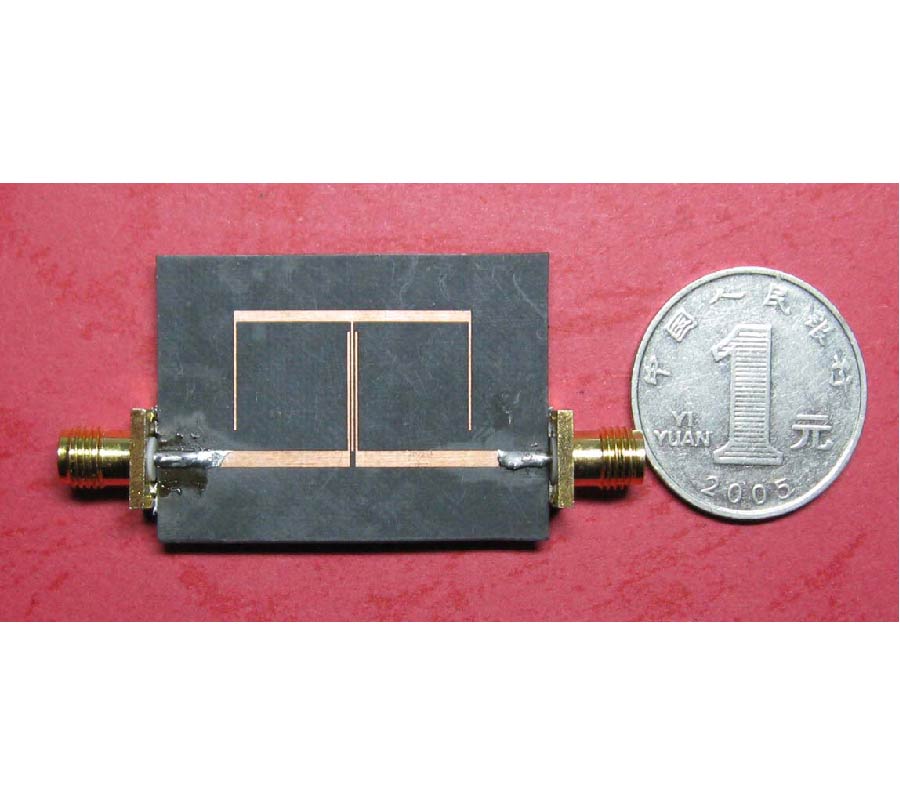
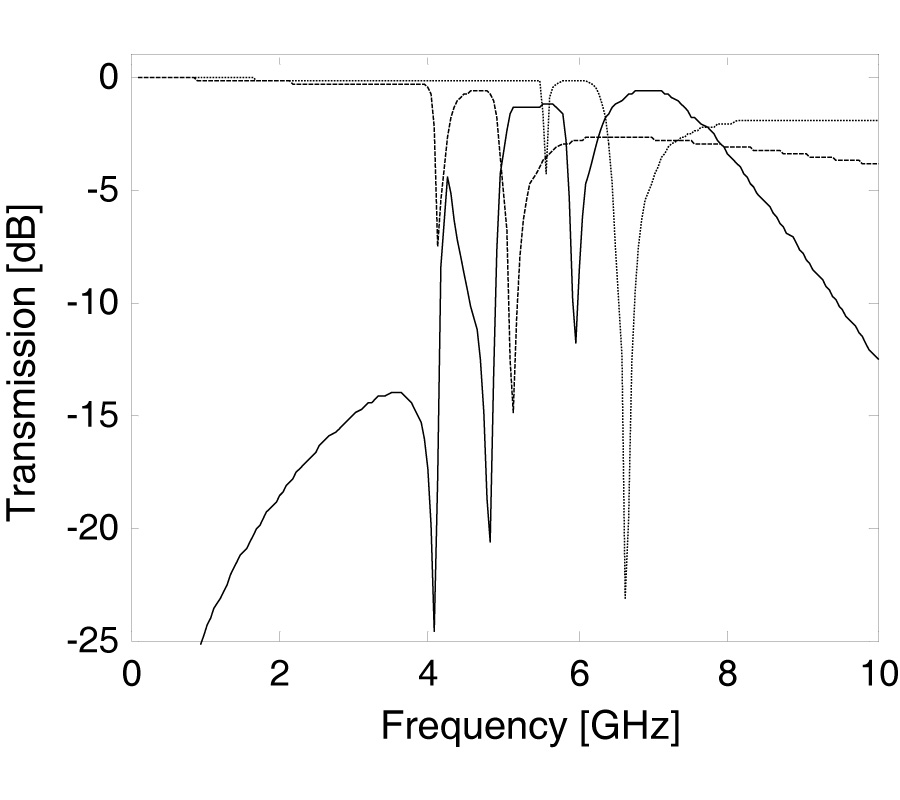
In this letter, a novel compact UWB bandpass filter (BPF) with sharp rejection skirt is realized using quintuple-mode stub-loaded resonator. The resonator can generate three odd-modes and two even-modes in the desired band. By simply adjusting the lengths of open stubs in shunt and shortcircuited stubs, the first five resonant modes of the resonator can be roughly allocated within the 3.1-10.6 GHz UWB band meanwhile the sixth resonant mode in the upper-stopband can be suppressed. The pair of short stubs can generate two transmission zeros near the lower and upper cut-off frequencies, leading to a sharp rejection skirt. A quintuple-mode UWB BPF is designed and fabricated and the measured results demonstrate the feasibility of the design process.
NOVEL UWB BPF USING QUINTUPLE-MODE STUB-LOADED RESONATOR
2010-05-26
PIER C
Vol. 14, 1-9
Realization of a Highly Miniaturized Elliptic-Function Band-Pass Filter Using Microstrip Quasi Multi- Mode Resonator for Wide-Band Applications
Mehdi Nosrati , Milad Mirzaee and Bal Singh Virdee
A compact elliptic-function band-pass filter (BPF) is introduced using microstrip folded quasi multi-mode resonator. The prototype filter is synthesized from the two-port network and equivalent circuit models using available element value tables. To optimize the performance of the filter, electromagnetic simulation (EM) is used to tune the dimensions of the filter. The filter using dual cascaded quasi multi-mode resonators provides a very sharp cut-off frequency response with low insertion loss. It also realized a broad band pass-band, a compact size and two transmission zeros at both the lower and upper stop-bands. The filter is also evaluated by experiment and simulation with good agreement.
REALIZATION OF A HIGHLY MINIATURIZED ELLIPTIC-FUNCTION BAND-PASS FILTER USING MICROSTRIP QUASI MULTI- MODE RESONATOR FOR WIDE-BAND APPLICATIONS
2010-05-26
PIER C
Vol. 13, 245-257
A Method to Design Dual-Band, High-Directivity EBG Resonator Antennas Using Single-Resonant, Single-Layer Partially Reflective Surfaces
Yuehe Ge , Karu P. Esselle and Trevor S. Bird
A new method is presented to design dual-band, high-directivity, EBG-resonator antennas using simple, single-resonant, single-layer partially reflective surfaces (PRS). The tailored abrupt reflection phase change of partially reflecting surfaces, observed only at the resonance frequency of the PRS resonant inclusions (such as dipoles and slots), is exploited for this purpose. An example single-resonant PRS, based on a frequency-selective surface (FSS) composed of a printed slot array, was designed. Then it is used to design an EBG-resonator antenna to demonstrate the feasibility of achieving dual-band performance. Cavity models are employed, together with the reflection characteristics of the PRS, to understand the operation of the device at critical frequencies such as cavity resonance frequencies and the PRS resonance frequency. Antenna simulations and computed results confirm the dual-band operation of this very simple, singlelayer, low-profile EBG-resonator antenna. It resonates in two bands centered at 10.5 GHz and 12.3 GHz. The peak directivity in each band is 18.2 dBi and 20.5 dBi, and the 3dB directivity bandwidth of each band is 7.5% and 8.7%, respectively.
A METHOD TO DESIGN DUAL-BAND, HIGH-DIRECTIVITY EBG RESONATOR ANTENNAS USING SINGLE-RESONANT, SINGLE-LAYER PARTIALLY REFLECTIVE SURFACES
2010-05-26
PIER
Vol. 104, 267-282
An Automatic Model Order Reduction of a UWB Antenna System
Zhan Zhang and Yee Hui Lee
This paper proposes an efficient and automatic means of achieving a reduced model of a transfer function for UWB antenna design. According to the formulation of a transfer function, we have derived two factors, which are critical in determining the radiation pattern and input impedance respectively. Their special formula allow us to establish a reduced model automatically using the Model Order Reduction (MOR) techniques of a second order system. The process is free of any human factors and suitable to any antenna systems, thus enabling a direct and efficient interface with the optimization process in the design of a UWB antenna system. In addition, the proposed way of establishing a transfer function of the whole antenna system has successfully cascaded the entire system into separate subsystems, thus offering deeper insights in analyzing a UWB antenna system.
AN AUTOMATIC MODEL ORDER REDUCTION OF A UWB ANTENNA SYSTEM
2010-05-26
PIER
Vol. 104, 253-266
S Parameter Theory of Lossless Block Network
Chang-Hong Liang , Yan Shi and Tao Su
The energy conservation of lossless network reflects a series of novel symmetry in S parameter. This paper presents the generalized modulus symmetry, spurious reciprocity, constant characteristic phase and determinant of the lossless block network. The perfect matching condition of block load network [Γl] and the invariable lossless property of S parameter of generalized block network are developed. Application examples are given to illustrate the application and validity of the proposed theory.
S PARAMETER THEORY OF LOSSLESS BLOCK NETWORK
2010-05-26
PIER
Vol. 104, 239-251
Metallized Foams for Antenna Design: Application to Fractal-Shaped Sierpinski-Carpet Monopole
Jaume Anguera , Jean Daniel , Carmen Borja , Josep Mumbru , Carles Puente , Tiphaine Leduc , Khalid Sayegrih and Peter Van Roy
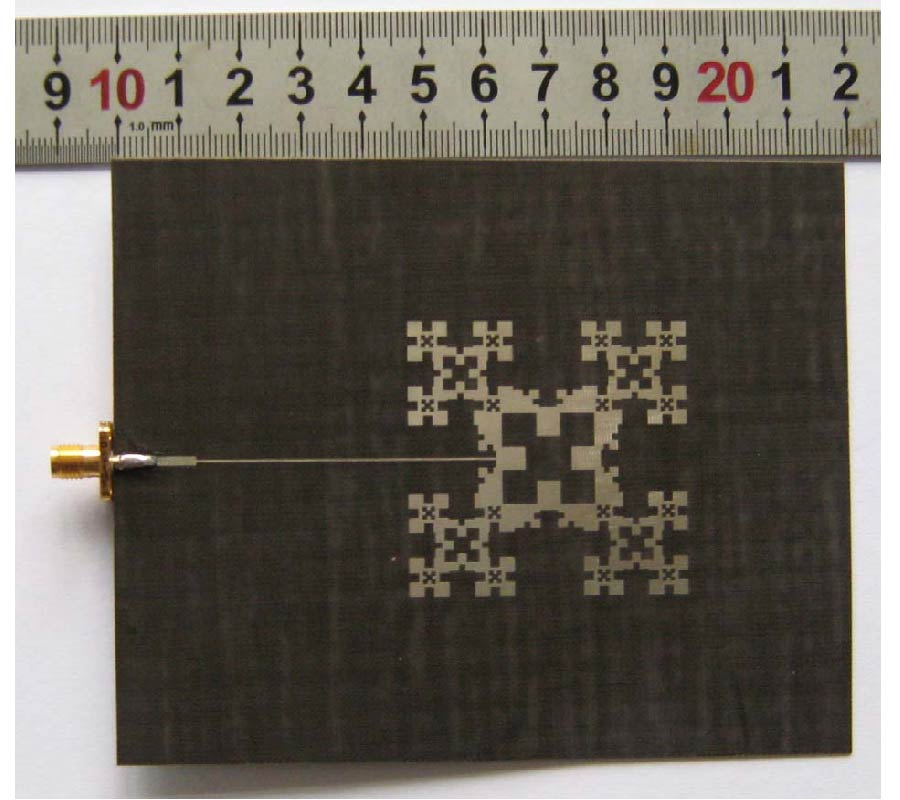
The technology of metallized foam offers a new approach to the design of wire-like, flat, and 3D antennas. Only the necessary metal skin depth (some microns in UHF band) is deposited over arbitrary shaped structures. Thanks to this technology new antenna designs have been possible offering low weight, possible shaping, and innovative architectures. To demonstrate these possibilities, a monopole inspired in the Sierpinski fractal carpet is built. The proposed design is suitable for a pico-cell base station antenna since the antenna operates at GSM850, GSM900, GSM1800, GSM1900, UMTS, Bluetooth/WLAN, WIMAX, and WIFI featuring omni-directional radiation pattern and an average total efficiency of 79%.
METALLIZED FOAMS FOR ANTENNA DESIGN: APPLICATION TO FRACTAL-SHAPED SIERPINSKI-CARPET MONOPOLE
2010-05-26
PIER
Vol. 104, 221-237
Multifractal Dimension and Its Geometrical Terrain Properties for Classification of Multi-Band Multi-Polarized SAR Image
Hse Tzia Teng , Hong-Tat Ewe and Sin Leng Tan
Multifractal dimensions Dq for real q are a more general parameter than the fractal dimension in describing geometrical properties. It has been shown that the four multifractal dimensions D-1, D0, D1 and D2 are able to extract different surface information of SAR images. In this paper, we investigate the dimension properties of multifractal dimensions. For land use classification where the textural information on the surface is important, it is necessary to look into the properties of multifractal dimensions with the geometrical properties of terrain. In order to extract the surface information from SAR images, the optimum number of multifractal dimensions to be used in the classification process is considered. To address the suitability of these parameters, these parameters are applied on a multi-band SAR image with regions of different textural information and the results are studied. The abilities of multifractal dimensions in extracting information for different land use classes are considered. In general, although multifractal dimensions provide additional information about the land use classes, there is no clear relation among the land use classes, image polarization and multifractal dimensions.
MULTIFRACTAL DIMENSION AND ITS GEOMETRICAL TERRAIN PROPERTIES FOR CLASSIFICATION OF MULTI-BAND MULTI-POLARIZED SAR IMAGE
2010-05-25
PIER
Vol. 104, 201-219
Multiple Order Dual-Band Active Ring Filters with Composite Right/Left-Handed Cells
Oscar Garcia-Perez , Luis Enrique Garcia-Munoz , Daniel Segovia-Vargas and Vicente Gonzalez-Posadas
In this paper, a novel dual-band active filter topology is presented. The non-linear phase response of a composite right/left-handed cell is used to achieve the desired dual-band performance. Additionally, the proposed structure based on coupled ring resonators yields a very compact solution in which high-order implementations can be easily obtained by cascading multiple rings. The theoretical principles of this type of filters are analyzed in detail. Finally, three prototypes based on first-, second- and third-order structures validate the feasibility of this type of filters. Good agreement between simulations and measurements has been achieved.
MULTIPLE ORDER DUAL-BAND ACTIVE RING FILTERS WITH COMPOSITE RIGHT/LEFT-HANDED CELLS
2010-05-24
PIER B
Vol. 21, 347-383
Flexible Hollow Waveguide with Two Bendings for Small Values of Step Angles, and Applications
Zion Menachem
This paper presents an improved approach for the propagation of electromagnetic (EM) fields in the case of the exible hollow waveguide that consists of two bendings in the same direction. In this case, the objective is to develop a mode model for infrared (IR) wave propagation along the exible hollow waveguide, in order to provide a numerical tool for the calculation of the output fields, output power density and output power transmission. The main steps of the method for the two bendings will introduced in the derivation, in detail, for small values of step angles. The derivation for the first section and the second section of the waveguide with the two bendings is based on Maxwell's equations. The separation of variables is obtained by using the orthogonal-relations. The longitudinal components of the fields are developed into the Fourier-Bessel series. The transverse components of the fields are expressed as functions of the longitudinal components in the Laplace plane and are obtained by using the inverse Laplace transform by the residue method. This model can be a useful tool in all the cases of the hollow toroidal waveguides, e.g., in medical and industrial regimes.
FLEXIBLE HOLLOW WAVEGUIDE WITH TWO BENDINGS FOR SMALL VALUES OF STEP ANGLES, AND APPLICATIONS
2010-05-24
PIER
Vol. 104, 183-199
Co-Frequency Interference Suppression Algorithm via Maximum Signal Minus Interference Level
Lingjiang Kong and Meifang Luo
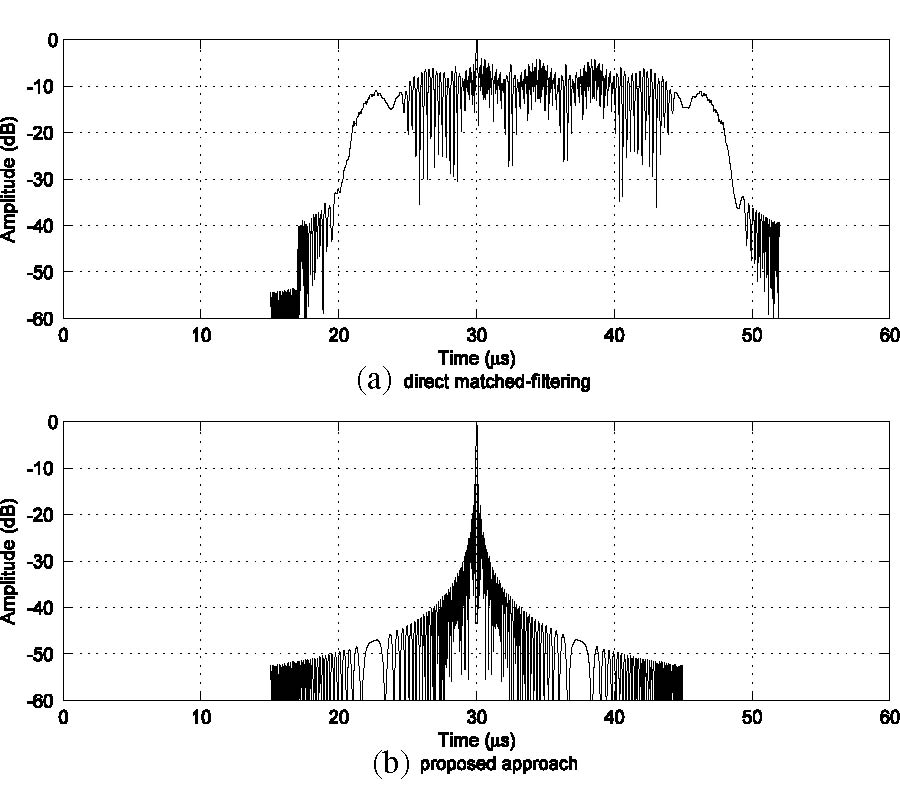
Co-frequency interference problem is severe in shared-spectrum multistatic radar system, leading to detection problems in applications. In order to mitigate the co-frequency interferences, an adaptive pulse compression algorithm based on Maximum Signal Minus Interference Level criterion(MSMIL) is proposed in this paper, the main idea of which is to adaptively design an appropriate filter at each range cell, maximizing the result of signal power minus interference power, so that both range sidelobes and cross-correlation interference can be suppressed. Simulation results show that the algorithm outperforms the traditional multistatic adaptive pulse compression (MAPC) method in interference suppression. Compared with MAPC method, after one iteration step, the output SIR of the proposed algorithm is increased by about 10 dB. And after two iteration steps, it is increased by more than 40 dB. Moreover, it also outperforms the MAPC in convergence speed.
CO-FREQUENCY INTERFERENCE SUPPRESSION ALGORITHM VIA MAXIMUM SIGNAL MINUS INTERFERENCE LEVEL
2010-05-22
PIER B
Vol. 21, 329-346
Focal Region Fields of Cassegrain System Placed in Homogeneous Chiral Medium
Muhammad Qasim Mehmood , Muhammad Junaid Mughal and Tariq Rahim
In this paper the high frequency electromagnetic field expressions for two dimensional Cassegrain system embedded in a chiral medium are presented. Due to failure of Geometrical Optics (GO) at the caustic region, Maslov's method is used to find the field expressions. Two different cases have been analyzed. Firstly, the chirality parameter () is adjusted to support positive phase velocity (PPV) for both left circularly polarized (LCP) and right circularly polarized (RCP) modes traveling in the medium. Secondly, is adjusted such that one mode travels with PPV, and the other mode travels with negative phase velocity (NPV). The results for both cases are presented in the paper.
FOCAL REGION FIELDS OF CASSEGRAIN SYSTEM PLACED IN HOMOGENEOUS CHIRAL MEDIUM
2010-05-22
PIER B
Vol. 21, 299-328
Analytical Methods in the Theory of Thin Impedance Vibrators
Mikhail Nesterenko
The advantages and disadvantages of more extended approximated analytical methods of the integral equations solution for the current in thin perfectly conducting and impedance vibrators have been investigated in details in this paper. The solutions of the problem about the electromagnetic waves scattering by the thin vibrators with the distributed surface impedance, obtained with the help of the method of expansion of the searched function for the current in a series on small parameter. The method of consistent iterations and asymptotic averaging method are given. The comparison of the calculated results with the experimental data in the case of excitation of the vi-brator in the centre by the point source of voltage is represented.
ANALYTICAL METHODS IN THE THEORY OF THIN IMPEDANCE VIBRATORS