1. Simplified filter tuning using time domain, , HP Application, Santa Rosa, CA, Note 1287-8, 1999.
doi:10.1109/22.20035
2. Mirzai, A. R., C. F. N. Cowan, and T. M. Crawford, "Intelligent alignment of waveguide filters using a machine learning approach," IEEE Trans. Microwave Theory & Tech., Vol. 37, No. 1, 166-173, January 1989.
doi:10.1109/22.963147 Google Scholar
3. Harscher, P. and R. Vahldieck, "Automated computer-controlled tuning of waveguide filters using adaptive network models," IEEE Trans. Microwave Theory & Tech., Vol. 49, No. 11, 2125-2130, November 2001.
doi:10.1109/TMTT.2002.805291 Google Scholar
4. Miraftab, V. and R. R. Mansour, "Computer-aided tuning of microwave filters using fuzzy logic," IEEE Trans. Microwave Theory & Tech., Vol. 50, No. 12, 2781-2788, December 2002. Google Scholar
5. Cegielski, T. and J. Michalski, "Heuristic methods for automated microwave filter tuning," Proceedings of XVII International Conference on Microwave, Radar and Wireless Communications MIKON-2008, Vol. 3, 647-650, Poland, Wroclaw, May 19-21, 2008.
doi:10.1007/BF03037088 Google Scholar
6. Amari, S. L., "Mathematical theory of neural learning," New Generation Computing, Vol. 8, 281-294, 1991.
doi:10.1016/0893-6080(89)90020-8 Google Scholar
7. Hornik, K., M. Stinchcombe, and H. White, "Multilayer feedforward networks are universal approximators," Neural Networks, Vol. 2, 359-366, 1989. Google Scholar
8. Haykin, S., Neural Networks: A Comprehensive Foundation, Prentice Hall, Upper Ssaddle River, NJ, 1999.
doi:10.1137/1116025
9. Vapnik, V. N. and A. Chervonenkis, "On the uniform convergence of relative frequencies of events to their probabilities," Theory of Probability Appl., Vol. 16, 264-280, 1971. Google Scholar
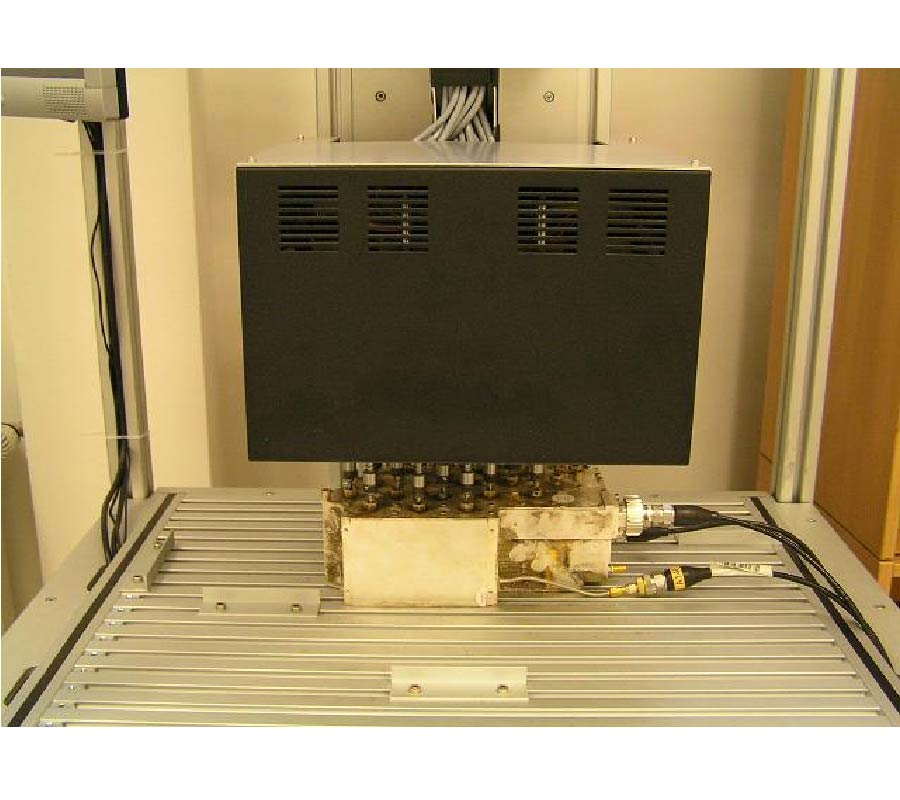
10., Intelligent automatic filter tuning tool (IAFTT) is registered with Priority certificate #2516" (Hannover Cebit 2007), and patent pending European Patent Application No. P382895 assigned by Polish National Patent Office". More information on www.trimsoluti.
11. Yu, M. and W. C. Tang, "A fully automated filter tuning robots for wireless base station diplexers, workshop computer aided filter tuning," IEEE Int. Microwave Symposium, Philadelphia, June 8-13, 2003.
doi: --- Either ISSN/ISBN or Series/Volume title must be supplied.