Vol. 141
Latest Volume
All Volumes
PIERM 141 [2026] PIERM 140 [2026] PIERM 139 [2026] PIERM 138 [2026] PIERM 137 [2026] PIERM 136 [2025] PIERM 135 [2025] PIERM 134 [2025] PIERM 133 [2025] PIERM 132 [2025] PIERM 131 [2025] PIERM 130 [2024] PIERM 129 [2024] PIERM 128 [2024] PIERM 127 [2024] PIERM 126 [2024] PIERM 125 [2024] PIERM 124 [2024] PIERM 123 [2024] PIERM 122 [2023] PIERM 121 [2023] PIERM 120 [2023] PIERM 119 [2023] PIERM 118 [2023] PIERM 117 [2023] PIERM 116 [2023] PIERM 115 [2023] PIERM 114 [2022] PIERM 113 [2022] PIERM 112 [2022] PIERM 111 [2022] PIERM 110 [2022] PIERM 109 [2022] PIERM 108 [2022] PIERM 107 [2022] PIERM 106 [2021] PIERM 105 [2021] PIERM 104 [2021] PIERM 103 [2021] PIERM 102 [2021] PIERM 101 [2021] PIERM 100 [2021] PIERM 99 [2021] PIERM 98 [2020] PIERM 97 [2020] PIERM 96 [2020] PIERM 95 [2020] PIERM 94 [2020] PIERM 93 [2020] PIERM 92 [2020] PIERM 91 [2020] PIERM 90 [2020] PIERM 89 [2020] PIERM 88 [2020] PIERM 87 [2019] PIERM 86 [2019] PIERM 85 [2019] PIERM 84 [2019] PIERM 83 [2019] PIERM 82 [2019] PIERM 81 [2019] PIERM 80 [2019] PIERM 79 [2019] PIERM 78 [2019] PIERM 77 [2019] PIERM 76 [2018] PIERM 75 [2018] PIERM 74 [2018] PIERM 73 [2018] PIERM 72 [2018] PIERM 71 [2018] PIERM 70 [2018] PIERM 69 [2018] PIERM 68 [2018] PIERM 67 [2018] PIERM 66 [2018] PIERM 65 [2018] PIERM 64 [2018] PIERM 63 [2018] PIERM 62 [2017] PIERM 61 [2017] PIERM 60 [2017] PIERM 59 [2017] PIERM 58 [2017] PIERM 57 [2017] PIERM 56 [2017] PIERM 55 [2017] PIERM 54 [2017] PIERM 53 [2017] PIERM 52 [2016] PIERM 51 [2016] PIERM 50 [2016] PIERM 49 [2016] PIERM 48 [2016] PIERM 47 [2016] PIERM 46 [2016] PIERM 45 [2016] PIERM 44 [2015] PIERM 43 [2015] PIERM 42 [2015] PIERM 41 [2015] PIERM 40 [2014] PIERM 39 [2014] PIERM 38 [2014] PIERM 37 [2014] PIERM 36 [2014] PIERM 35 [2014] PIERM 34 [2014] PIERM 33 [2013] PIERM 32 [2013] PIERM 31 [2013] PIERM 30 [2013] PIERM 29 [2013] PIERM 28 [2013] PIERM 27 [2012] PIERM 26 [2012] PIERM 25 [2012] PIERM 24 [2012] PIERM 23 [2012] PIERM 22 [2012] PIERM 21 [2011] PIERM 20 [2011] PIERM 19 [2011] PIERM 18 [2011] PIERM 17 [2011] PIERM 16 [2011] PIERM 14 [2010] PIERM 13 [2010] PIERM 12 [2010] PIERM 11 [2010] PIERM 10 [2009] PIERM 9 [2009] PIERM 8 [2009] PIERM 7 [2009] PIERM 6 [2009] PIERM 5 [2008] PIERM 4 [2008] PIERM 3 [2008] PIERM 2 [2008] PIERM 1 [2008]
2026-10-29 Latest Published
By Weihua Chen Pengyu Yan Xiaoheng Yan Bo Zuo Feiyu Zhu
Progress In Electromagnetics Research M, Vol. 141, 17-33, 2026
Abstract
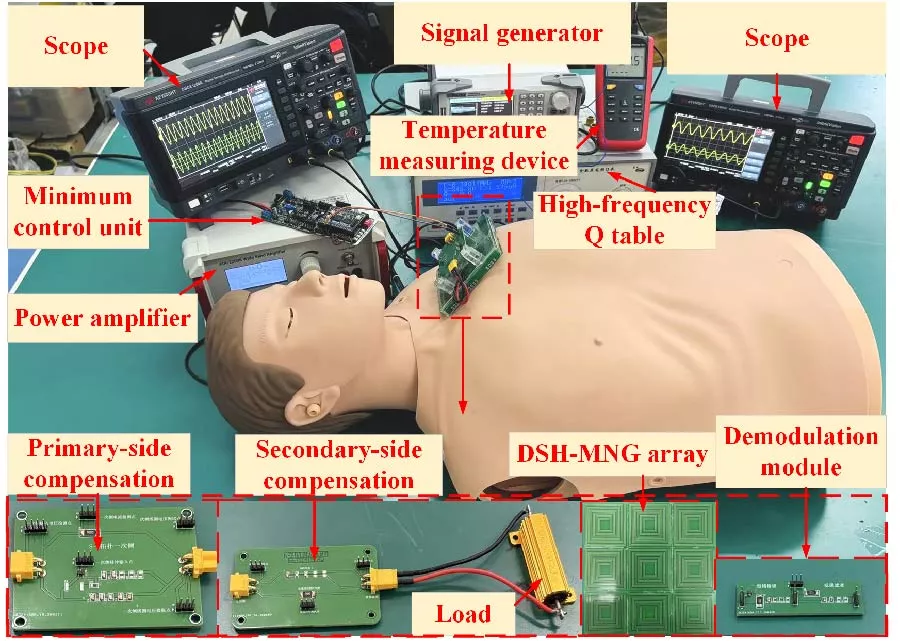
To address poor energy-transmission performance and weak anti-interference capability in wireless power and data transfer (WPDT) systems for implantable cardiac pacemakers, this study proposes an amplitude-shift-keying WPDT system for cardiac pacemakers based on a dual-strand hybrid magnetic metamaterial (DSH-MNG) array. First, we designed the DSH-MNG basic unit based on equivalent medium theory and the ohmic loss formula. We then analyze the influence of the metamaterial's structural parameters on the loss and optimize the number of turns and turn spacing of the basic unit to achieve optimal transmission efficiency. Next, an equivalent circuit model based on the DSH-MNG array system was derived. Finally, the improvement effect on the system's transmission performance is verified through simulation and experiments. The experimental results show that within a transmission distance of 20-40 mm, the system's transmission efficiency with the DSH-MNG array increased by 15.5% to 40.3%, and the modulation index has increased from 0.169-0.208 to 0.198-0.266. When the receiving coil is subjected to a horizontal offset of 5 mm to 15 mm and an angular offset of 15° to 45°, this system can still maintain a transmission efficiency of 24.8% to 66.3%, and the modulation index remains between 0.204 and 0.259.
2026-10-29
PIER M
Vol. 141, 17-33, 2026
download: 2
Wireless Power and Data Transfer System for Cardiac Pacemakers Based on Dual-Strand Hybrid Magnetic Metamaterial Array
Weihua Chen, Pengyu Yan, Xiaoheng Yan, Bo Zuo and Feiyu Zhu
To address poor energy-transmission performance and weak anti-interference capability in wireless power and data transfer (WPDT) systems for implantable cardiac pacemakers, this study proposes an amplitude-shift-keying WPDT system for cardiac pacemakers based on a dual-strand hybrid magnetic metamaterial (DSH-MNG) array. First, we designed the DSH-MNG basic unit based on equivalent medium theory and the ohmic loss formula. We then analyze the influence of the metamaterial's structural parameters on the loss and optimize the number of turns and turn spacing of the basic unit to achieve optimal transmission efficiency. Next, an equivalent circuit model based on the DSH-MNG array system was derived. Finally, the improvement effect on the system's transmission performance is verified through simulation and experiments. The experimental results show that within a transmission distance of 20-40 mm, the system's transmission efficiency with the DSH-MNG array increased by 15.5% to 40.3%, and the modulation index has increased from 0.169-0.208 to 0.198-0.266. When the receiving coil is subjected to a horizontal offset of 5 mm to 15 mm and an angular offset of 15° to 45°, this system can still maintain a transmission efficiency of 24.8% to 66.3%, and the modulation index remains between 0.204 and 0.259.
Wireless Power and Data Transfer System for Cardiac Pacemakers Based on Dual-Strand Hybrid Magnetic Metamaterial Array
2926-10-28
PIER M
Vol. 141, 9-16, 2026
download: 0
A Novel High-Sensitivity Photonic Crystal Sensor for Temperature Sensing
Fatima Zohra Siabah, Faiza Bounaas and Amel Labbani
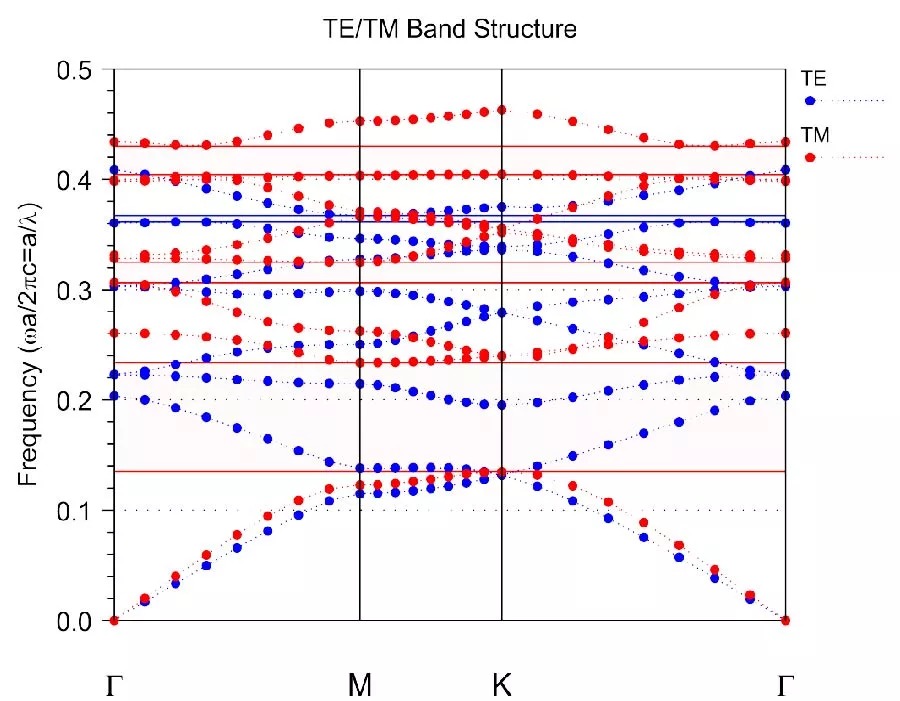
This study proposes and numerically investigated a high-sensitivity two-dimensional photonic crystal temperature sensor using a hexagonal silicon lattice. The design features a resonant microcavity coupled with two quasi-linear waveguides to enhance light-matter interactions and optimise the thermo-optic response. Rigorous finite-difference time-domain (FDTD) simulations indicate that the sensor achieves a high thermal sensitivity of ST = 105 pm/° C, accompanied by an excellent linear fitting coefficient. Furthermore, the optimised cavity demonstrates a high quality factor of Q =7739.5 and a narrow resonant linewidth, resulting in an ultra-low detection limit. With an ultra-compact footprint of 62.73 μm², the sensor is fully compatible with standard silicon-on-insulator (SOI) CMOS fabrication processes. These attributes render the proposed device a promising candidate for high-precision, dense thermal monitoring in integrated photonic circuits, lab-on-chip devices, and environmental sensing applications.
A Novel High-Sensitivity Photonic Crystal Sensor for Temperature Sensing
2026-10-28
PIER M
Vol. 141, 1-8, 2026
download: 8
A Polarization Reconfigurable Dual-Band Dual-CP Shared Aperture Antenna Using RF MEMS Switch
Bhawna Kalra, Soumava Mukherjee, Ghanshyam Singh, Mahendra Mohan Sharma and Jaiverdhan
This paper presents a novel polarization reconfigurable, dual-band, dual-circularly polarized, shared-aperture antenna. The proposed antenna consists of multilayer configurations with two polarization states, i.e., left-hand circular polarization (LHCP) and right-hand circular polarization (RHCP) at L5 (1.164-1.88 GHz) and S (2.48-2.50 GHz) bands. A multisegmented ring is used as a radiator for the L5/S band and is excited electromagnetically through two coupling elements. These coupling elements are connected to a compact polarization reconfigurable hybrid power divider using two vias. This innovative reconfigurable circuit with a hybrid power divider performs circular polarization (LHCP/RHCP) reconfigurability operation using RF-MEMS switches, which improves the antenna's performance. Polarization states can be switched from LHCP to RHCP and vice versa using these RF MEMS switches. The proposed antenna provides a good agreement between simulated and measured results for both bands. Good impedance matching (return loss > 10 dB) and circular polarization (AR < 3) are obtained in the operating bands. The realized peak gain is of the order of 5.32 dBiC for LHCP and 5.66 dBiC for RHCP in the L5 band, and similarly it is 6.67 dBiC for LHCP and 6.99 dBiC for RHCP in the S band using a low-loss multilayer combination of substrate materials.
A Polarization Reconfigurable Dual-Band Dual-CP Shared Aperture Antenna Using RF MEMS Switch