Design of a Flexible and Tri-Band MIMO Antenna for Conformal Wi-Fi 7/5G Applications
Tian-Xiang Wang,
Chengzhu Du and
Xi Sun
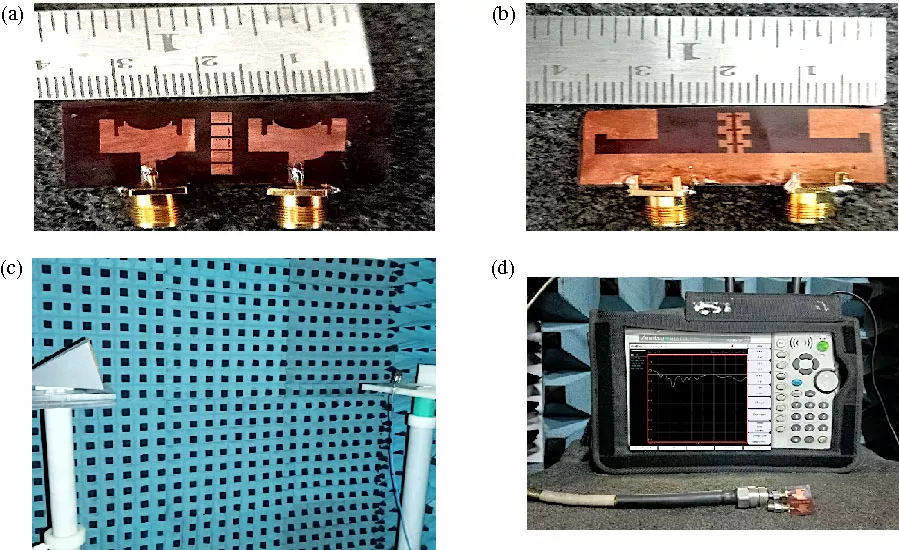
This paper describes a flexible dual-port multiple-input multiple-output (MIMO) antenna system tailored for multi-band operation, covering 2.4 GHz Wi-Fi, 3.5 GHz 5G, as well as the 5-7 GHz band used in wireless applications such as Wi-Fi 7. The antenna is fabricated on a liquid crystal polymer (LCP) substrate, featuring an ultra-thin profile of 0.1 mm and a compact size of 60 × 35 mm2, making it highly suitable for integration into modern flexible and wearable devices. To achieve high port isolation, a complementary split-ring resonator (CSRR) structure is incorporated between the two radiating elements. The measurement results indicate that the antenna achieves impedance bandwidths across 1.36-2.71 GHz, 3.07-3.655 GHz, and 4.015-8.245 GHz, which fully cover the target frequency bands of 2.4-2.483 GHz, 3.4-3.5 GHz, and 5.15-7.125 GHz. The antenna's performance is comprehensively characterized by evaluating key parameters including S-parameters, envelope correlation coefficient (ECC), diversity gain (DG), total active reflection coefficient (TARC), gain, mean effective gain (MEG), and radiation patterns, along with other relevant metrics. All measured results confirm that the antenna meets the essential requirements for MIMO and diversity systems. Furthermore, bending tests conducted at two distinct radii of 30 mm and 50 mm confirm stable antenna performance, verifying its mechanical robustness and reliability under practical bending conditions.