Low-Frequency Dual-Port Microwave Sensor Based on CSRR and Electric Field Coupled for Precise Permittivity Detection in Biological Samples
Muhammad Nugrah Kusumah,
Syah Alam,
Indra Surjati,
Lydia Sari,
Yuli Kurnia Ningsih,
Fitri Kurnia Sari,
Teguh Firmansyah,
Noor Azwan Shairi and
Zahriladha Zakaria
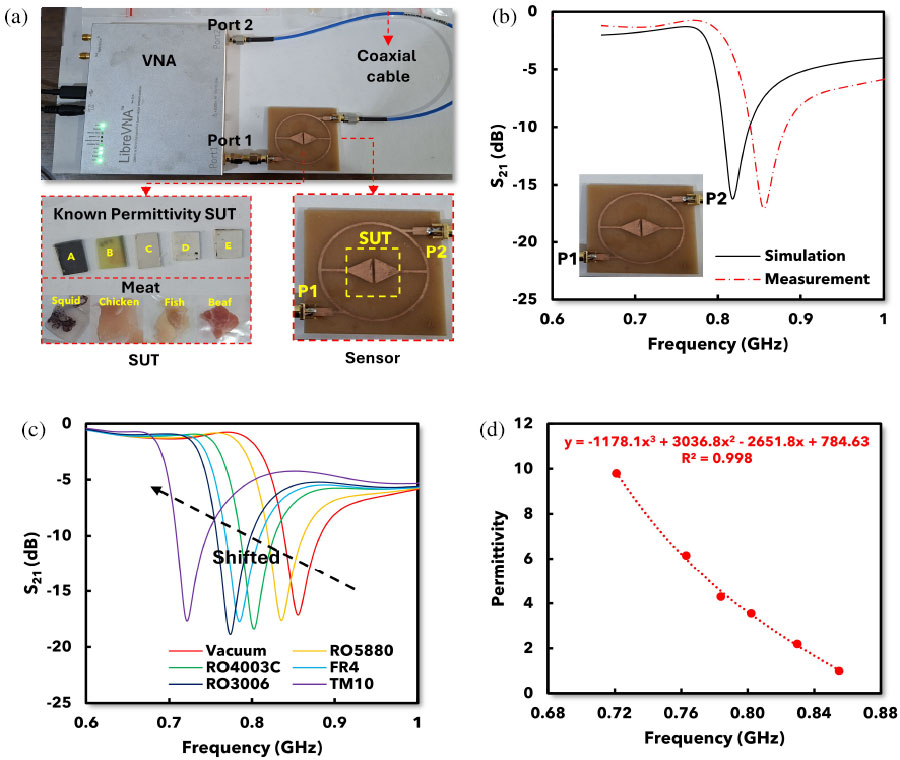
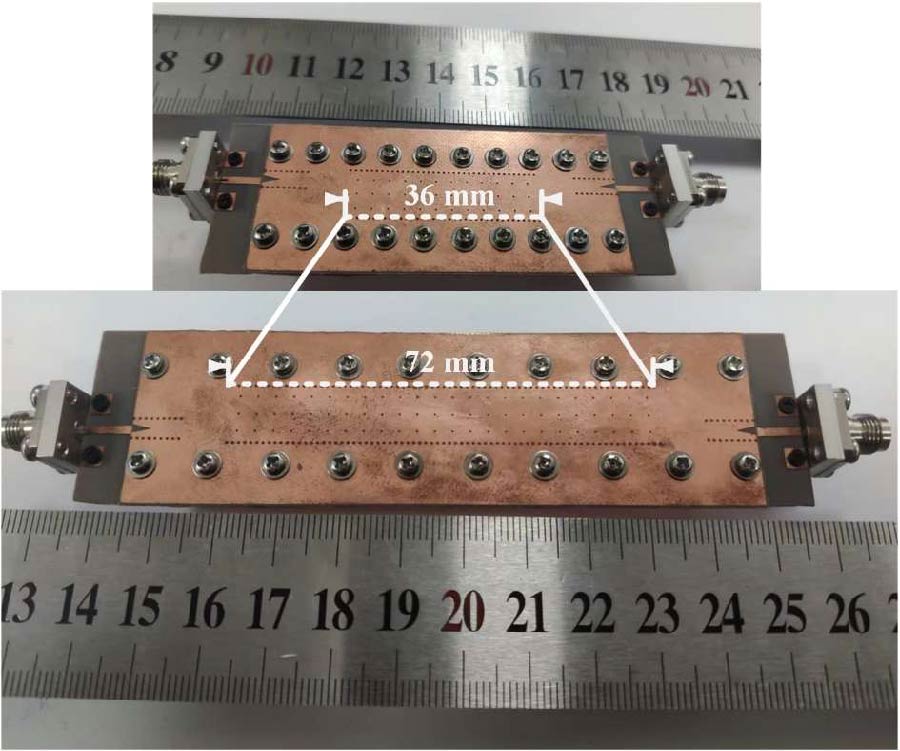
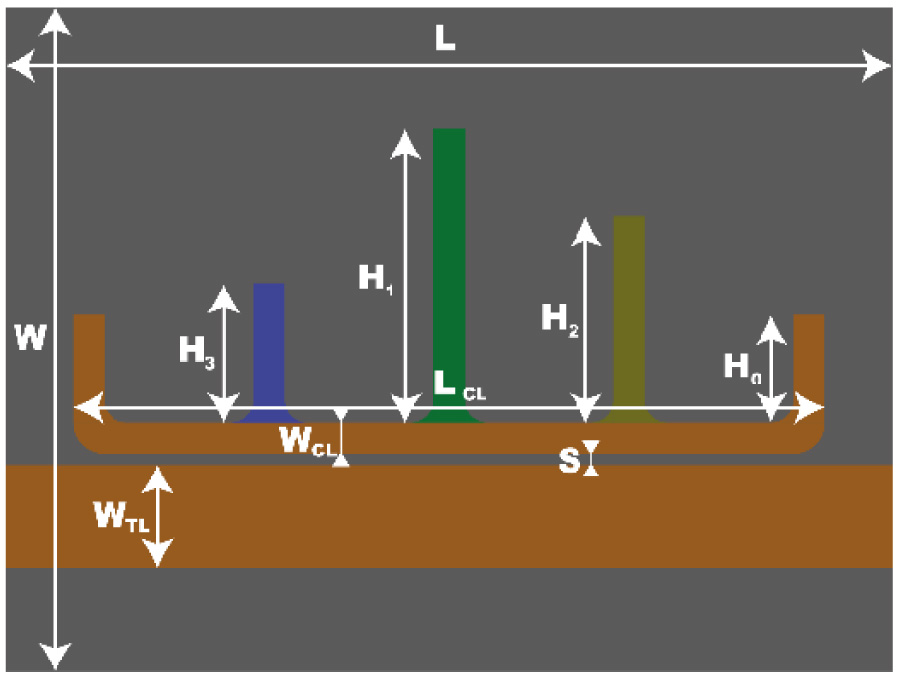
This paper presents the development of a low-frequency dual-port microwave sensor designed for permittivity detection in both solid and biological materials. The sensor integrates a circular split-ring resonator (CSRR) with an electric field coupled (ELC) structure on a planar dielectric substrate, resulting in a compact and simple architecture that supports ease of fabrication and low-cost implementation. Operating at a resonant frequency of 0.86 GHz, the sensor is particularly suitable for characterising biological samples such as meat, fish, squid, and chicken, as lower frequencies offer deeper penetration and better interaction with high-loss biological tissues. Validation through full-wave simulation and experimental measurement confirms the sensor's capability to detect permittivity variations across a wide range of materials. A polynomial fitting model is employed to extract permittivity values based on resonance frequency shifts, achieving accurate results with a maximum error below 7% and overall accuracy exceeding 93%. The device demonstrates reliable performance in estimating permittivity values from εr = 1-9.8, including unknown biological samples with normalized sensitivity of 0.02% and frequency detection resolution 0.019 GHz. Measurements show clear frequency shifts that correlate with dielectric changes, and the experimental results align closely with the simulation data. The simple structure of the sensor also supports straightforward integration with common measurement instruments such as vector network analysers, making it practical for real-time monitoring and portable applications. The low operating frequency combined with the straightforward design provides an effective solution for applications requiring permittivity detection of lossy, heterogeneous, or biological materials. This work contributes a feasible and efficient sensor platform for use in medical diagnostics, food quality inspection, and other industrial contexts where reliable, low-cost dielectric sensing is essential.