Vol. 140
Latest Volume
All Volumes
PIERM 140 [2026] PIERM 139 [2026] PIERM 138 [2026] PIERM 137 [2026] PIERM 136 [2025] PIERM 135 [2025] PIERM 134 [2025] PIERM 133 [2025] PIERM 132 [2025] PIERM 131 [2025] PIERM 130 [2024] PIERM 129 [2024] PIERM 128 [2024] PIERM 127 [2024] PIERM 126 [2024] PIERM 125 [2024] PIERM 124 [2024] PIERM 123 [2024] PIERM 122 [2023] PIERM 121 [2023] PIERM 120 [2023] PIERM 119 [2023] PIERM 118 [2023] PIERM 117 [2023] PIERM 116 [2023] PIERM 115 [2023] PIERM 114 [2022] PIERM 113 [2022] PIERM 112 [2022] PIERM 111 [2022] PIERM 110 [2022] PIERM 109 [2022] PIERM 108 [2022] PIERM 107 [2022] PIERM 106 [2021] PIERM 105 [2021] PIERM 104 [2021] PIERM 103 [2021] PIERM 102 [2021] PIERM 101 [2021] PIERM 100 [2021] PIERM 99 [2021] PIERM 98 [2020] PIERM 97 [2020] PIERM 96 [2020] PIERM 95 [2020] PIERM 94 [2020] PIERM 93 [2020] PIERM 92 [2020] PIERM 91 [2020] PIERM 90 [2020] PIERM 89 [2020] PIERM 88 [2020] PIERM 87 [2019] PIERM 86 [2019] PIERM 85 [2019] PIERM 84 [2019] PIERM 83 [2019] PIERM 82 [2019] PIERM 81 [2019] PIERM 80 [2019] PIERM 79 [2019] PIERM 78 [2019] PIERM 77 [2019] PIERM 76 [2018] PIERM 75 [2018] PIERM 74 [2018] PIERM 73 [2018] PIERM 72 [2018] PIERM 71 [2018] PIERM 70 [2018] PIERM 69 [2018] PIERM 68 [2018] PIERM 67 [2018] PIERM 66 [2018] PIERM 65 [2018] PIERM 64 [2018] PIERM 63 [2018] PIERM 62 [2017] PIERM 61 [2017] PIERM 60 [2017] PIERM 59 [2017] PIERM 58 [2017] PIERM 57 [2017] PIERM 56 [2017] PIERM 55 [2017] PIERM 54 [2017] PIERM 53 [2017] PIERM 52 [2016] PIERM 51 [2016] PIERM 50 [2016] PIERM 49 [2016] PIERM 48 [2016] PIERM 47 [2016] PIERM 46 [2016] PIERM 45 [2016] PIERM 44 [2015] PIERM 43 [2015] PIERM 42 [2015] PIERM 41 [2015] PIERM 40 [2014] PIERM 39 [2014] PIERM 38 [2014] PIERM 37 [2014] PIERM 36 [2014] PIERM 35 [2014] PIERM 34 [2014] PIERM 33 [2013] PIERM 32 [2013] PIERM 31 [2013] PIERM 30 [2013] PIERM 29 [2013] PIERM 28 [2013] PIERM 27 [2012] PIERM 26 [2012] PIERM 25 [2012] PIERM 24 [2012] PIERM 23 [2012] PIERM 22 [2012] PIERM 21 [2011] PIERM 20 [2011] PIERM 19 [2011] PIERM 18 [2011] PIERM 17 [2011] PIERM 16 [2011] PIERM 14 [2010] PIERM 13 [2010] PIERM 12 [2010] PIERM 11 [2010] PIERM 10 [2009] PIERM 9 [2009] PIERM 8 [2009] PIERM 7 [2009] PIERM 6 [2009] PIERM 5 [2008] PIERM 4 [2008] PIERM 3 [2008] PIERM 2 [2008] PIERM 1 [2008]
2026-10-27 Latest Published
By Mohamed Moumou Khalid Mounirh Soufiane El Adraoui Mohammed Kanjaa Mohsine Khalladi
Progress In Electromagnetics Research M, Vol. 140, 117-127, 2026
Abstract
In this paper, we model the interband conductivity of a graphene sheet using a rational-function expansion based on complex-conjugate pole-residue (CCPR) pairs via an efficient vector-fitting approach. We then incorporate the developed model into a time-domain transmission-line matrix (TLM) method with a voltage source and normalized admittance, representing graphene as an equivalent surface current density via an auxiliary differential equation (ADE) scheme. Reflection and transmission coefficients for electromagnetic (EM) wave interaction with an infinite graphene sheet are computed. Numerical results show excellent agreement with available theoretical data, demonstrating that interband conductivity contributions significantly modify graphene's electromagnetic response in the mid- and near-infrared regimes and cannot be neglected. Furthermore, the tunability of the transmission coefficient under varying temperatures and chemical potentials is investigated. The proposed method provides an alternative TLM-based approach for modeling graphene's full Kubo conductivity, extending the application domain of the TLM method from the far-infrared regime to the mid- and near-infrared regimes, and offers a new approach for the design and analysis of tunable graphene-based electromagnetic devices.
2026-10-27
PIER M
Vol. 140, 117-127, 2026
download: 6
Time-Domain ADE-TLM Modeling of Graphene Interband Conductivity Using Vector-Fitted Complex-Conjugate Pole-Residue Pairs
Mohamed Moumou, Khalid Mounirh, Soufiane El Adraoui, Mohammed Kanjaa and Mohsine Khalladi
In this paper, we model the interband conductivity of a graphene sheet using a rational-function expansion based on complex-conjugate pole-residue (CCPR) pairs via an efficient vector-fitting approach. We then incorporate the developed model into a time-domain transmission-line matrix (TLM) method with a voltage source and normalized admittance, representing graphene as an equivalent surface current density via an auxiliary differential equation (ADE) scheme. Reflection and transmission coefficients for electromagnetic (EM) wave interaction with an infinite graphene sheet are computed. Numerical results show excellent agreement with available theoretical data, demonstrating that interband conductivity contributions significantly modify graphene's electromagnetic response in the mid- and near-infrared regimes and cannot be neglected. Furthermore, the tunability of the transmission coefficient under varying temperatures and chemical potentials is investigated. The proposed method provides an alternative TLM-based approach for modeling graphene's full Kubo conductivity, extending the application domain of the TLM method from the far-infrared regime to the mid- and near-infrared regimes, and offers a new approach for the design and analysis of tunable graphene-based electromagnetic devices.
Time-Domain ADE-TLM Modeling of Graphene Interband Conductivity Using Vector-Fitted Complex-Conjugate Pole-Residue Pairs
2026-10-25
PIER M
Vol. 140, 106-116, 2026
download: 8
Analytical Model and Correction for Axial Effective Permeability Distribution of Cylindrical Ferrite Cores
Xinyu Li, Kewei Zhu, Yitong Wu and Jinyang Gao
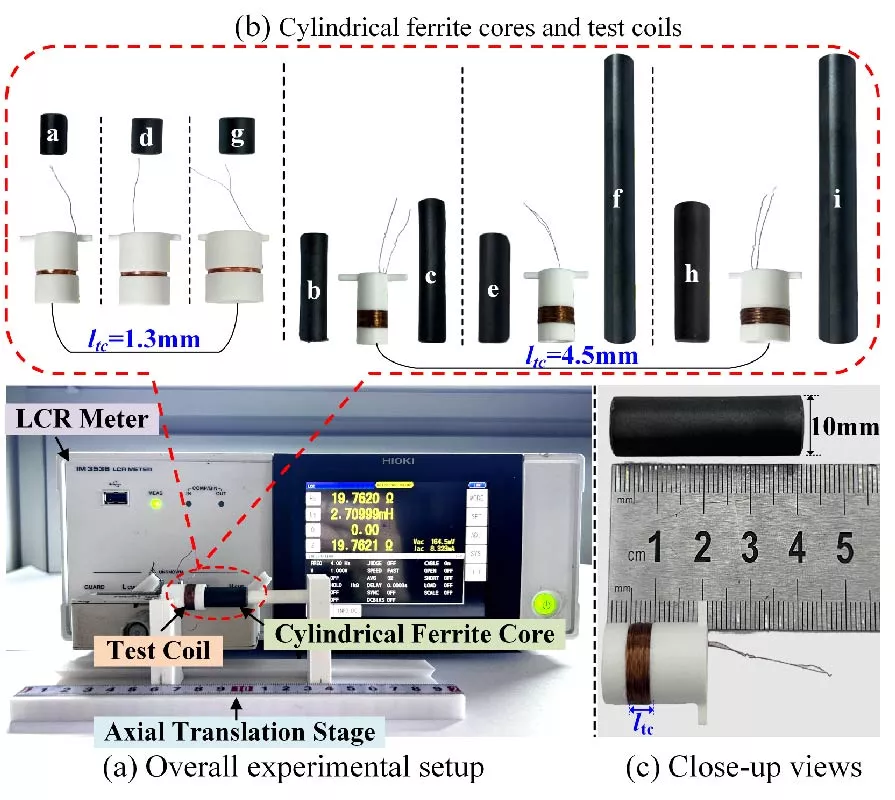
Cylindrical ferrite cores are widely used in wireless implantable medical devices (WIMDs) to enhance magnetic coupling performance. Conventional uniform-permeability models feature simple formulations and low computational costs, making them suitable for rapid engineering analysis. However, they cannot describe the axially varying magnetic response inside finite-length ferrite cores. Due to the demagnetizing effect caused by finite core dimensions, the effective permeability shows a non-uniform axial distribution. To address this issue, an analytical model for the axial effective permeability distribution of finite-length cylindrical cores is established based on demagnetizing field theory and the magnetic charge model. Furthermore, a unified-parameter correction model and a piecewise correction model are developed based on finite element simulation results to improve the prediction accuracy. Over the aspect-ratio range of 1-10, the piecewise correction model reduces the maximum axial relative error from 15.64% to 2.67% compared with the unified-parameter correction model. An effective permeability measurement platform is further established, where the average effective permeability at different axial positions is obtained by varying the relative axial position between the test coil and the magnetic core, enabling experimental validation of the correction models. The results show that the axial effective permeability of cylindrical cores gradually decreases from the center toward both ends and exhibits a symmetric distribution with respect to the center. Experimental results are generally consistent with predictions of the piecewise correction model in terms of the axial distribution characteristics, while noticeable deviations remain for cores with small aspect ratios. The proposed model enables direct calculation of the axial effective permeability distribution of cylindrical ferrite cores from their geometric parameters, providing a theoretical basis for the analysis and optimization of WIMD receivers and other electromagnetic devices employing cylindrical ferrite cores.
Analytical Model and Correction for Axial Effective Permeability Distribution of Cylindrical Ferrite Cores
2026-10-20
PIER M
Vol. 140, 96-105, 2026
download: 11
Multi-Band Negative Group Delay SSPP Circuits Using Backside H-Shaped Units
Qi Wang, Fayu Wan, Nathan B. Gurgel, Lagouge Tartibu, Glauco Fontgalland, Sébastien Lallechere and Blaise Ravelo
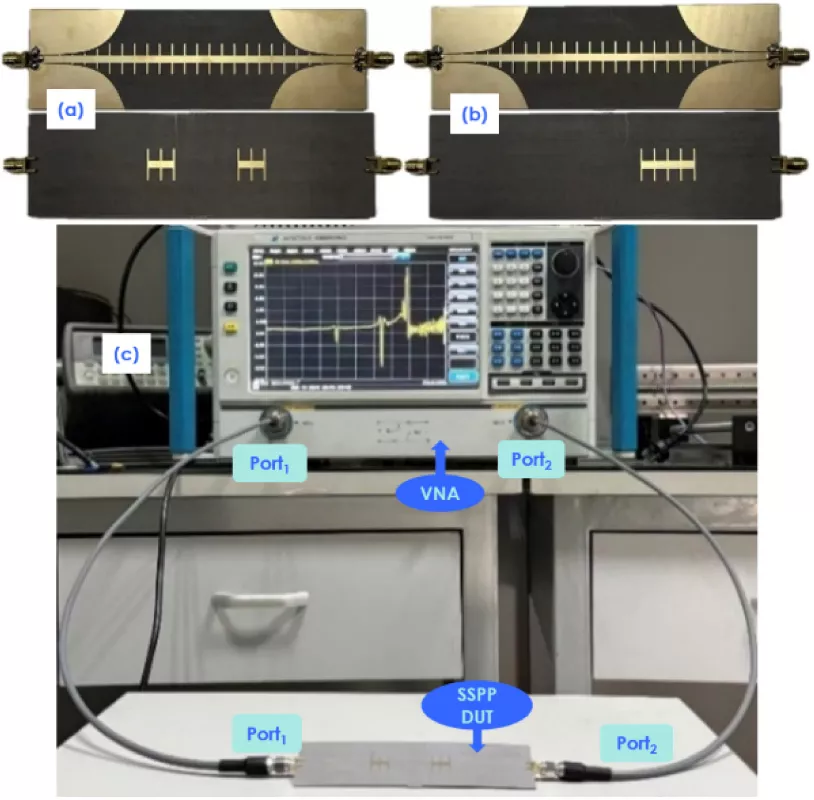
Spoof surface plasmon polariton (SSPP) circuits typically have a positive group delay (PGD), leading to undesired pulse broadening and limiting the performance of high-speed communication systems. To address this issue, a novel approach is introduced by integrating identical H-shaped units on the backside of a conventional coplanar waveguide (CPW) SSPP circuit. Negative group delay (NGD) is achieved through mutual coupling between these units, effectively compensating for PGD-induced distortions. Parametric scans revealed that increasing the number of NGD units enables multi-band NGD circuit operation, while incorporating multiple groups of isolated units further enhances NGD performance without significantly altering the center frequency. The experimental results demonstrate a dual-band NGD response with group delays (GD) GD(f1) = -2.33 ns and GD(f2) = -6.55 ns at f1 = 5.33 GHz and f2 = 8.07 GHz, respectively, and a four-band response with GDs GD(f1) = -1.66 ns, GD(f2) = -4.94 ns, GD(f3) = -4.64 ns, and GD(f4) = -1.46 ns at f1 = 3.24 GHz, f2 = 5.96 GHz, f3 = 7.64 GHz, and f4 = 8.39 GHz, respectively. These findings validate the effectiveness of the backside NGD structure in extending SSPP functionality, offering significant potential applications in microwave communication and sensing systems in which precise delay control and multi-band operation are critical.
Multi-Band Negative Group Delay SSPP Circuits Using Backside H-Shaped Units
2026-10-19
PIER M
Vol. 140, 85-95, 2026
download: 8
Structured SPD Multi-View Fusion for Synthetic Aperture Radar Target Recognition under Extended Operating Conditions
Tong Xie, Jiacheng Ni, Jia Liang, Chao Li and Yubin Qin
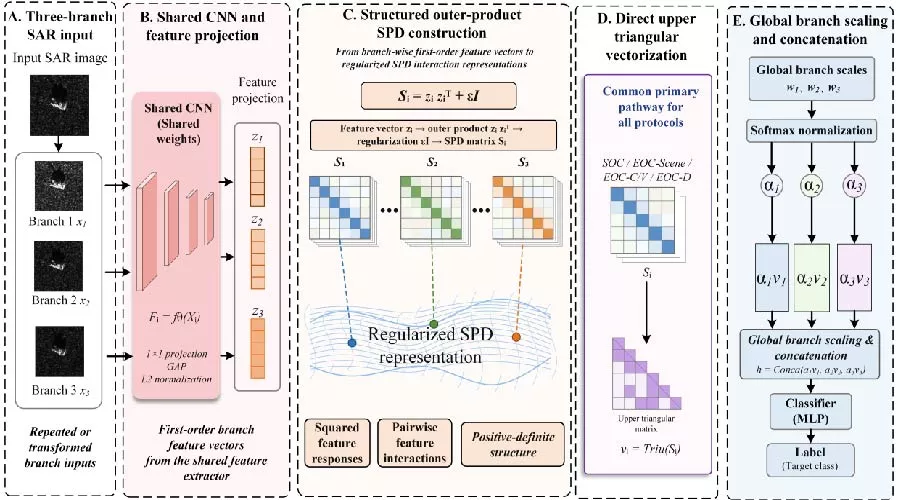
Synthetic Aperture Radar (SAR) Automatic Target Recognition (ATR) often suffers from significant performance degradation under Extended Operating Conditions (EOCs), including depression-angle shifts, target configuration variations, and complex background clutter. Most convolutional neural network (CNN)-based methods represent SAR images using first-order Euclidean features, which may be insufficient to explicitly model structured interactions among compact feature dimensions. To address this limitation, we propose a structured SPD-based shared-branch SAR ATR framework. Specifically, a shared CNN backbone processes three label-preserving branch inputs to obtain branch feature maps. After feature projection, global average pooling, and L2 normalization, a regularized outer-product matrix is constructed for each branch to explicitly encode pairwise multiplicative feature interactions. The resulting positive-definite matrix is compactly represented by direct upper-triangular vectorization. Descriptors from the three branches are subsequently integrated via globally shared Softmax scaling and concatenation before classification. The evaluation reports five independent runs and compares vector, covariance, Log-SPD, and parameter-matched nonlinear representations. The controlled analyses reveal protocol-dependent behavior, with the outer-product representation showing its clearest relative advantage under depression-angle variation. For settings using repeated branch inputs, no complementary-view claim is made. Overall, the results support the structured outer-product representation within the evaluated MSTAR protocols.
Structured SPD Multi-View Fusion for Synthetic Aperture Radar Target Recognition under Extended Operating Conditions
2026-10-13
PIER M
Vol. 140, 74-84, 2026
download: 67
Temperature Distribution and Current-Carrying Capacity of XLPE High-Voltage Cables under Different Laying Methods
Gaohui Yu, Liujie Wan, Guozhu Wang and Zhiqiang Bai
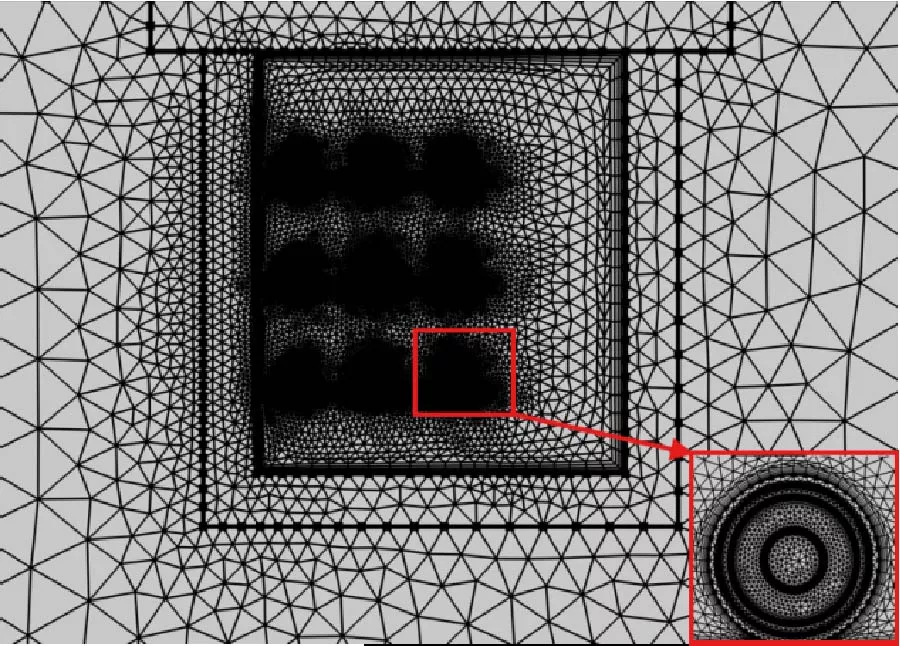
Current research on cable current-carrying capacity mostly focuses on a single laying form and lacks a systematic comparison of temperature-load characteristics under three mainstream laying conditions: direct burial, pipe duct laying, and cable trench laying. This paper takes the YJLW03-64/110\,kV single-core high-voltage cable as the research object, develops a two-dimensional electromagnetic-thermal-fluid multi-physics field-coupling model, and determines the carrying capacity by constraining the conductor's maximum allowable temperature to 90 ℃. The finite element software COMSOL is used to complete the simulation analysis of multiple conditions under the three laying methods. For direct burial laying, the improvement effect of high thermal conductivity sandy soil backfill thickness of 100 mm and 200 mm on heat dissipation is explored; for pipe duct laying, the temperature distribution and carrying capacity differences between air gap and cement-based thermally conductive grout filling are compared; for cable trench laying, the convective heat transfer effect of solid supports and different support opening rates is analyzed. The results show that the improvement measures under the three laying methods can respectively increase the cable current-carrying capacity by varying degrees. The results can provide support and technical reference for selecting high-voltage cable laying methods, as well as expanding and renovating carrying capacity.
Temperature Distribution and Current-Carrying Capacity of XLPE High-Voltage Cables under Different Laying Methods
2026-10-05
PIER M
Vol. 140, 66-73, 2026
download: 94
Microwave Measurements of Complex Permittivity by a Cylindrical Dielectric Resonator in a Closed Metal Cavity - A Further Analysis
Jyh Sheen and Zuo-Wen Hong
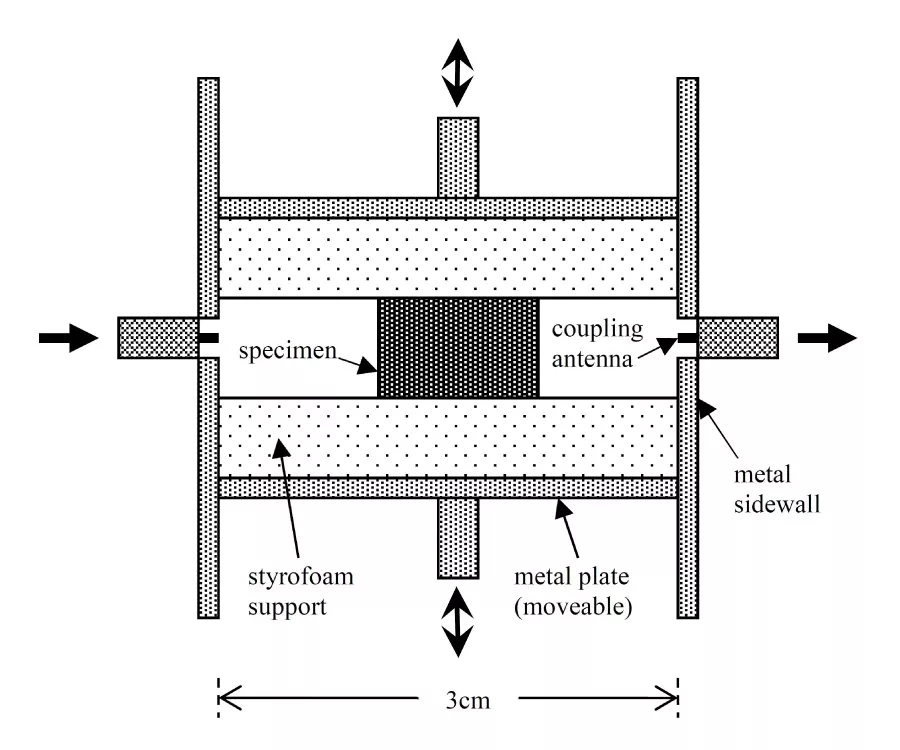
This paper describes various aspects of the analysis of a technique for measuring the dielectric constant and loss tangent using a cylindrical dielectric resonator in a closed metal cavity. The resonator's TE01δ resonant mode mode was selected as the measurement target. The clear electric and magnetic field patterns inside the dielectric resonator are provided from a theory derived by improving a very simple field model. Resonant frequencies under different dielectric constants are studied. All the possible sources of the conducting dissipation are investigated to improve the accuracy of the loss tangent measurement. The influence of the energy storage factor on the calculation of loss tangent measurement is investigated, too. This cavity is also used for measuring complex permittivity over a sweeping frequency range, and the accuracy as well as the limitations of its swept-frequency capability are discussed. The improved field model is compared with the primitive one through experimental measurements.
Microwave Measurements of Complex Permittivity by a Cylindrical Dielectric Resonator in a Closed Metal Cavity - A Further Analysis
2026-09-19
PIER M
Vol. 140, 55-65, 2026
download: 212
Machine Learning-Based Reflection Coefficient Response Prediction of AMC-PEC Metasurface Antenna Using SVR
Deval Kumar, Somsing Rathod and Amit Kumar Singh
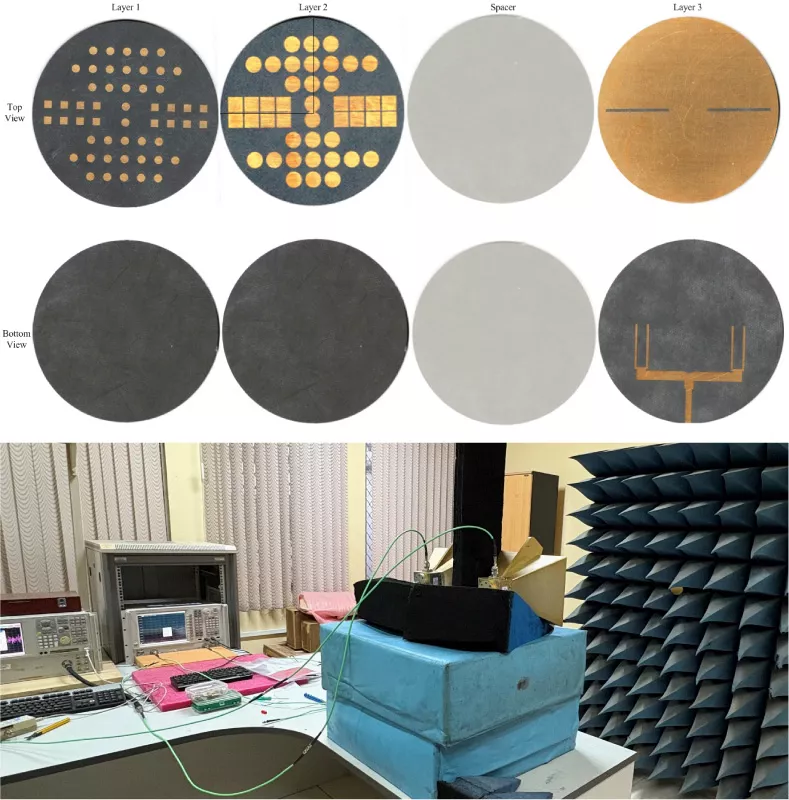
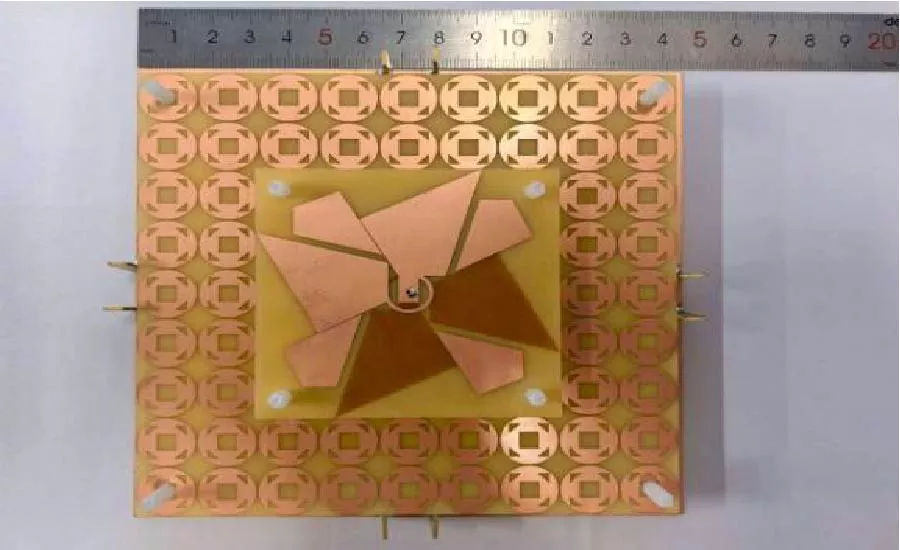
Full-wave electromagnetic simulation is computationally intensive during parametric antenna design and optimization. This study proposes a Support Vector Regression (SVR) based framework to predict the reflection coefficient of an Artificial Magnetic Conductor-Perfect Electric Conductor (AMC-PEC) metasurface antenna array in the X-band. The antenna comprises circular AMC cells and rectangular/grid PEC radiating elements arranged in a spatially optimized architecture. A dataset of 500 samples was generated using openEMS full-wave simulations, with antenna geometrical parameters as inputs and S11 as the target response. An SVR model with a radial basis function kernel was trained and validated against simulations and measurements of a fabricated multilayer prototype. The predicted, simulated, and measured resonances occurred at approximately 9.8, 9.9, and 10.0 GHz, respectively, while measurements confirmed broadband impedance matching from 9.04 to 11.0 GHz. The SVR achieved a Mean Absolute Error (MAE) of 0.20 dB, Root Mean Square Error (RMSE) of 0.26 dB, and coefficient of determination (R2) of 0.998, outperforming Artificial Neural Network (ANN) and Gaussian Process Regression (GPR) models trained on the same dataset. Predictions were generated in under one second, providing a speedup of approximately three orders of magnitude over full-wave simulation. The results demonstrate accurate and computationally efficient prediction for antenna design and optimization.
Machine Learning-Based Reflection Coefficient Response Prediction of AMC-PEC Metasurface Antenna Using SVR
2026-09-17
PIER M
Vol. 140, 26-54, 2026
download: 333
Ultrasensitive Multiplexed Detection of Breast Cancer Exosomal EpCAM, VEGF and CD63 via Phase-Interrogated SPR with Zr/Ce-MOF@Fe3O4 Magnetic Amplification and Preliminary Extension to CAR-T Immune Monitoring
Sailing He, Faten Bashar Kamal Eddin, Alamgir, Houxin Fan, Kaixin Zheng, Shuang E, Junbo Liang, Junbo Cai, Bojian Xie, Jinhua Ding, Mohammed Zourob, Hongsheng Lu, De-Man Han and Wenda Luo
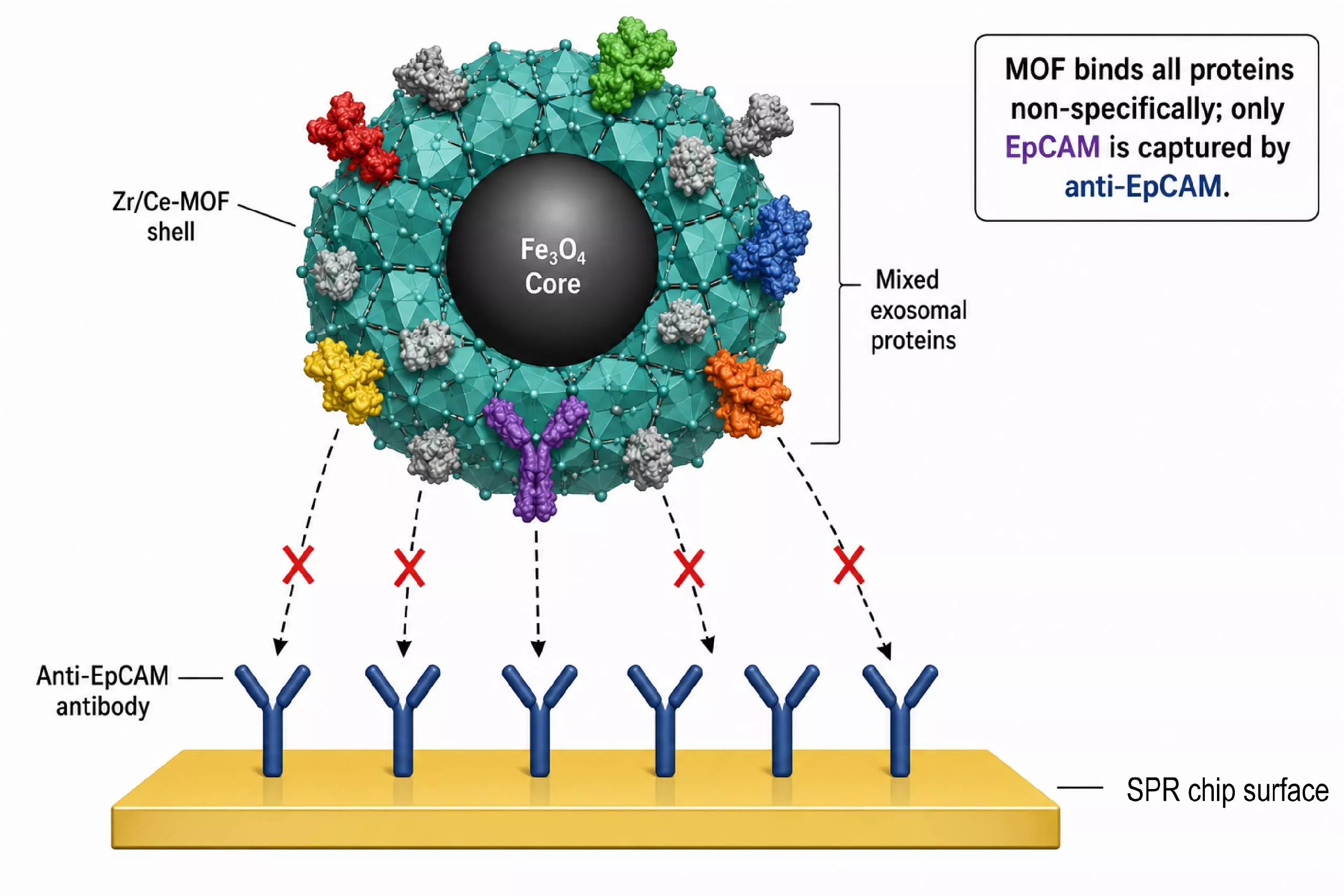
Exosomal surface proteins are emerging as minimally invasive liquid-biopsy biomarkers for breast cancer, yet their trace-level abundance poses challenges for biosensor sensitivity and multiplexing capacity, and conventional assays miss the substantial cargo in vesicles. Here, we report a mass-amplification-enhanced multiplexed SPR platform coupling antibody-directed magnetic enrichment with a phase-interrogated Ag/ZnSe waveguide chip for simultaneous detection of EpCAM, VEGF, and CD63, with a proof-of-concept extension to the immune-activation marker IFN-γ. A bimetallic Zr/Ce-MOF@Fe3O4 nanocomposite (confirmed by SEM-EDS) provided high refractive-index mass loading and magnetic separability, interfaced with a multi-channel Ag/ZnSe/APTES/GO chip (anti-EpCAM, anti-VEGF, anti-CD63) via a phase-polarization-modulation SPR system and PDMS microfluidics. MOF amplification improved the LOD for EpCAM from 0.86 to 0.07 pg mL-1 (12.3-fold) and for VEGF from 2.45 to 0.21 pg mL-1 (11.7-fold). Intact exosomes gave antibody-specific responses on anti-EpCAM (6.22°), anti-VEGF (3.09°), and anti-CD63 (9.54°), with signal-to-background ratios up to 106.0 and cross-reactivity below 0.4°; in matched healthy and patient serum, MOF-amplified responses were consistently higher in patients across all three markers (6.5-fold EpCAM, 6.2-fold VEGF, 8-fold CD63), with comparable discrimination extended to urine on the CD63 channel. Lysates analyzed on anti-EpCAM channels showed negligible healthy signals (0.29° without MOF, 1.63° with MOF) versus a patient increase from 5.80° to 18.4° (3.17-fold), corresponding to an apparent 41 pg mL-1 total solubilized EV-associated EpCAM. As proof of concept for immune-status phenotyping, CD63-captured exosomes from a patient with clinical suspicion of immune activation showed a 12-fold higher IFN-γ signal than healthy samples (9-fold with MOF), with Langmuir kinetics indicating higher apparent binding affinity in the patient. Nanoparticle tracking confirmed exosome populations within the characteristic 30-150 nm range (mean 66.5-92.8 nm), and inter-chip/inter-channel reproducibility were 2.72% and 0.64% CV. As a complementary label-free imaging readout, the EV/MOF workflow was also implemented on a differential guided-mode resonance (dGMR) platform, where intact whole-EV binding produced MOF-amplified resonance-stripe pixel shifts without vesicle lysis; patient-derived EVs showed ~9.4-fold enhancement (vs 6.86-fold by phase-interrogated SPR), and healthy-derived EVs showed $\sim10.8$-fold enhancement, pushing the dGMR whole-EV response into a near-order-of-magnitude amplification regime. In a comparative discussion, sandwich SERS detection of EV-associated IFN-γ in CAR-T therapy further demonstrated that molecular fingerprint-based SERS can resolve specific immune markers, complementing the quantitative strengths of SPR and extending the platform toward immune-status monitoring. This platform demonstrates proof-of-concept feasibility for multiplexed exosomal marker detection directly in crude clinical matrices, with larger cohort studies required to establish diagnostic utility.
Ultrasensitive Multiplexed Detection of Breast Cancer Exosomal EpCAM, VEGF and CD63 via Phase-Interrogated SPR with Zr/Ce-MOF@Fe3O4 Magnetic Amplification and Preliminary Extension to CAR-T Immune Monitoring
2026-09-15
PIER M
Vol. 140, 13-25, 2026
download: 506
A Compact Dual-Band MIMO Antenna with CSRR Loading and T-Shaped Hybrid-Slot Decoupling
Xuebin Peng, Jiabei Zhu, Yajing Liu, Zhi Song and Yanbing Xue
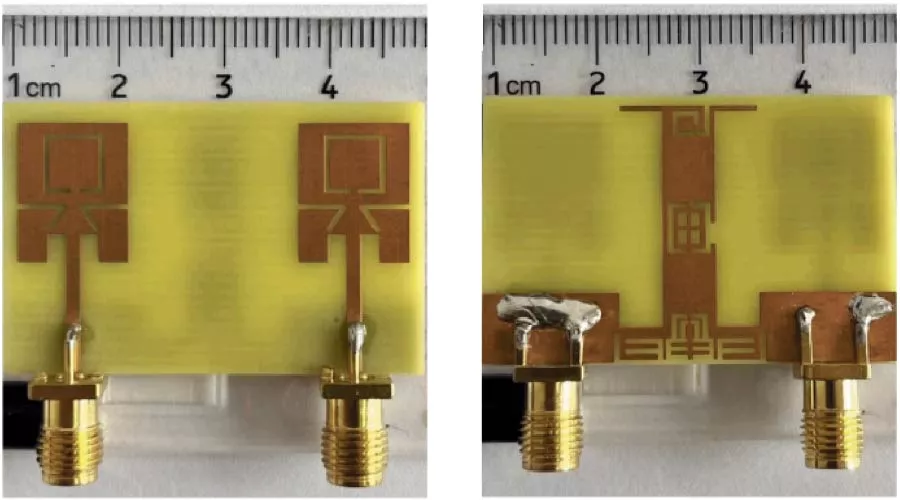
This paper presents a compact dual-band two-element multiple-input multiple-output (MIMO) antenna for terminal-device wireless communication. The antenna element is based on a rectangular patch, and miniaturization is achieved by combining slot loading with a partial ground plane. A complementary split-ring resonator (CSRR) introduces an additional resonant mode, enabling dual-band operation. A 2 × 1 MIMO configuration is formed by arranging two elements in parallel. To reduce mutual coupling, a four-stage T-shaped hybrid-slot decoupling structure with E-, L-, window-, and spiral-shaped slots is introduced on a common ground plane, effectively suppressing surface current coupling. The dimension of the antenna is 0.45λ0 × 0.31λ0 × 0.019λ0. The antenna operates over 3.17-4.37 GHz and 4.76-5.02 GHz, with a port isolation better than -20 dB over both bands, reaching -34.58 dB at 3.52 GHz and -22.79 dB at 4.87 GHz. The envelope correlation coefficient (ECC) is below 0.005, and the diversity gain (DG) is approximately 10 dB. The measured results agree with the simulated ones. These results indicate that the proposed antenna achieves a good balance between compact size and high isolation, making it suitable for size-constrained terminal MIMO applications.
A Compact Dual-Band MIMO Antenna with CSRR Loading and T-Shaped Hybrid-Slot Decoupling
2026-09-12
PIER M
Vol. 140, 1-12, 2026
download: 187
Wideband Low-Profile Circularly Polarized Crossed-Dipole Antenna Based on AMC Reflector
He Liu, Han Lin, Zhonggen Wang and Wenyan Nie
This paper proposes a wideband, low-profile, circularly polarized (CP) crossed-dipole antenna with an artificial magnetic conductor (AMC) reflector. The antenna consists mainly of a pair of orthogonal half-wavelength dipoles, two 90$^\circ$ phase-delay rings, four parasitic patches, four pairs of vertically arranged metallic strips, an AMC reflector, and a square ground plane. CP radiation is generated by exciting bow-tie dipole arms via phase-delay rings. Introducing parasitic patches and vertical metallic strips optimizes the surface current distribution, broadening the impedance-matching bandwidth and axial ratio bandwidth (ARBW). Meanwhile, using the AMC structure as a reflector effectively reduces the antenna profile. We fabricate a prototype of the proposed antenna to verify consistency between simulated and measured results. The measured results show that impedance bandwidth (IBW) is 1.51-2.54 GHz (50.9%), and ARBW is 1.53-2.51 GHz (48.5%). The antenna achieves a peak gain of 8.5 dBic and an average gain of 7.05 dBic across the entire operating band. Furthermore, the antenna features an ultra-low profile of 0.12λL at the lowest operating frequency.
Wideband Low-Profile Circularly Polarized Crossed-Dipole Antenna Based on AMC Reflector