Search Results(13805)

2009-09-04
PIER B
Vol. 17, 213-231
Dimensional Synthesis for Wide-Band Bandpass Filters with Quarter-Wavelength Resonators
Qingfeng Zhang and Yi-Long Lu
ℜThis paper presents a dimensional synthesis method for designing wide-band quarter-wavelength resonator bandpass filters. In this synthesis method, an alternative lowpass prototype filter and the edge frequency mapping method are proposed and applied. The improved K- and J-inverter model with the exponent- weighted turns ratio is also proposed in order to incorporate the frequency dependence of inverters. Based on the edge frequency mapping method and the improved inverter model, an iterative dimensional synthesis procedure is then presented. As design examples, a four-pole rectangular coaxial bandpass filter with 63% fractional bandwidth is designed and fabricated. The simulation and measurement results show good equal ripple performance in the passband.
DIMENSIONAL SYNTHESIS FOR WIDE-BAND BANDPASS FILTERS WITH QUARTER-WAVELENGTH RESONATORS
2009-09-04
PIER B
Vol. 17, 187-212
Geometry-Based Statistical Model for Radio Propagation in Rectangular Office Buildings
Yifan Chen , Zhenrong Zhang , Luoquan Hu and Predrag B. Rapajic
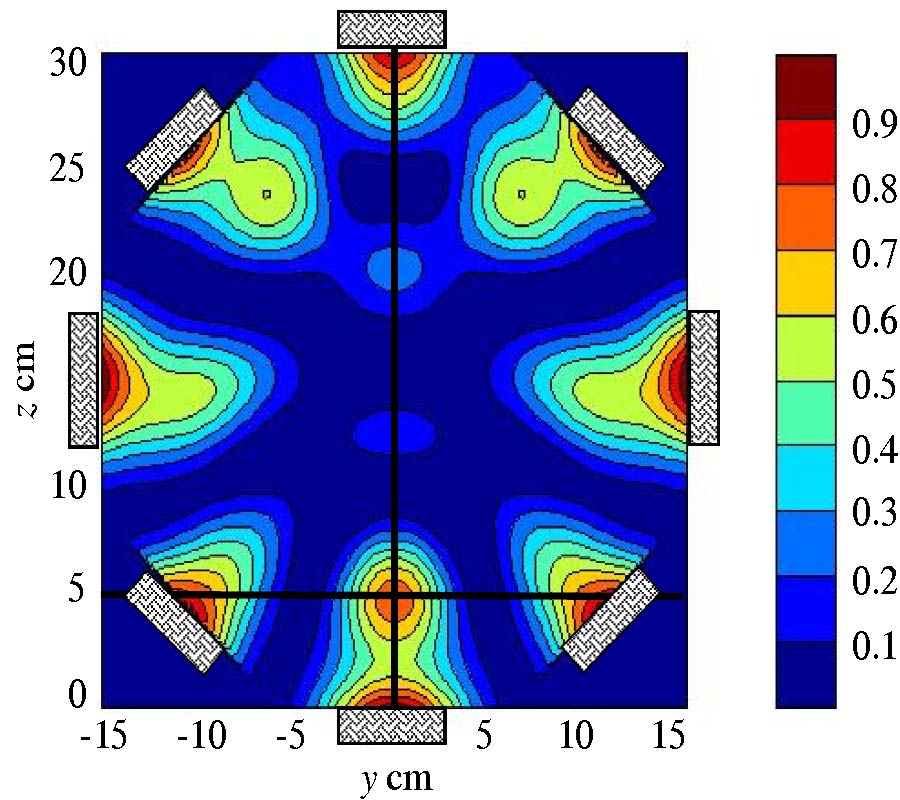
We present a new approach to the modeling of angle and time of arrival statistics for radio propagation in typical office buildings, in which the majority of interior scattering objects are either parallel or perpendicular to the exterior walls. We first describe the reradiating elements in office buildings as randomly distributed arrays of thin strips. The amount of clutter and the amount of transmission/reflection loss are then accounted for through several key parameters of the site-specific features of indoor environment, such as the layout and materials of the building under consideration. Subsequently, the important channel parameters including power azimuthal spectrum (PAS) and power delay spectrum (PDS) are derived. An appealing observation is that when the path angles from multiple channel trials are measured and collectively analyzed, deterministic angle clustering becomes evident. This phenomenon agrees well with the existing ray-tracing (RT) results reported by Jo et al. in buildings of this type and cannot be explained by other geometric channel models (GCMs). Furthermore, the proposed model predicts an asymmetric cluster PAS for a single-channel-trial scenario, which yields an excellent fit to the experimental data presented by Poon and Ho. Finally, we have also investigated the behaviors of the superimposed PAS and PDS under various channel conditions.
GEOMETRY-BASED STATISTICAL MODEL FOR RADIO PROPAGATION IN RECTANGULAR OFFICE BUILDINGS
2009-09-04
PIER Letters
Vol. 11, 65-72
Quasi-Lumped Design of UWB BPF Using Suspended Stripline
Xian-Jie Liao , Min-Hua Ho , Wei-Hong Hsu , Wei-Qin Xu and Li-Jing Lin
We propose a novel UWB bandpass filter (BPF) design using the suspended stripline (SSL). The filter composes of a lowpass and a high-pass circuit, both implemented by SSL structures. A notch response structure might be implemented to the filter by embedding a resonant slotline. The quasi-lumped elements circuit models were developed to analyze these circuits' performance. Experiments were conducted, and good agreements were observed between the measurements and simulations.
QUASI-LUMPED DESIGN OF UWB BPF USING SUSPENDED STRIPLINE
2009-09-03
PIER
Vol. 96, 37-62
Theoretical Model of Electromagnetic Scattering from 3D Multi-Layer Dielectric Media with Slightly Rough Surfaces
Zhiwei Lin , Xiaojuan Zhang and Guangyou Fang
A theoretical model of scattering from three-dimensional arbitrary layered media with 3D infinite rough surfaces based on the small perturbation method (SPM) is derived in the present paper. The scattering field and bistatic scattering coe±cient for linear polarized waves are derived respectively. Firstly, the electric and magnetic fields in each region of the layered structure are expanded into perturbation series in spectral domain. Secondly, the expansion coefficients of each order are obtained by applying the boundary conditions. As a result, the expressions of the zeroth-, first- and second-order solutions of the scattering problem based on the SPM are obtained, in which the second-order solution is the primary contribution of this work. The theoretical model is helpful to understand the dependence between the scattering field and physical properties of the layered structure (such as surface roughness and dielectric constants at different depths). The result can be applied to modeling of the received radar signal from nature targets such as layered soil and ice with full polarizations.
THEORETICAL MODEL OF ELECTROMAGNETIC SCATTERING FROM 3D MULTI-LAYER DIELECTRIC MEDIA WITH SLIGHTLY ROUGH SURFACES
2009-09-02
PIER
Vol. 96, 21-36
Accelerated Three Dimensional Ray Tracing Techniques Using Ray Frustums for Wireless Propagation Models
Hayeon Kim and Haeng-Seon Lee
In this paper, accelerated techniques for three dimensional ray tracing using the concept of ray frustums are presented for the fast characterization of wireless communications, where various radio propagation paths such as wall-transmitted wave and scattered wave from buildings and ground are generated. To accommodate such scatterers, objects are modeled by triangulated meshes, and potential ray paths are searched and stored in the form of ray frustums. The presented acceleration techniques using the frustums include sorting of triangulated surfaces, hashing functions and space partitioning. The validity of the method is verified by comparison with measurement data.
ACCELERATED THREE DIMENSIONAL RAY TRACING TECHNIQUES USING RAY FRUSTUMS FOR WIRELESS PROPAGATION MODELS
2009-09-02
PIER Letters
Vol. 11, 55-64
Pattern Synthesis for Planar Array Based on Elements Rotation
Fan Zhang , Fu-Shun Zhang , Chen Lin , Gang Zhao and Yong-Chang Jiao
Aimed at improving the radiating characteristics (pattern and polarization) and simplifying the design of feeding network, a new approach is applied and discussed. For uniformly excited planar antenna array, by rotating each element in its local coordinates and determining the rotation angles of the elements, the 3D radiating characteristic of the planar antenna array can be improved. The Differential Evolution (DE) algorithm is applied for optimizing rotation angles of the elements. Furthermore, the effects of the elements rotation are discussed in detail.
PATTERN SYNTHESIS FOR PLANAR ARRAY BASED ON ELEMENTS ROTATION
2009-09-02
PIER C
Vol. 10, 75-86
Loaded Coupled Transmission Line Approach of Left-Handed (LH) Structures and Realization of a Highly Compact Dual-Band Branch-Line Coupler
Mohsen Hayati and Mehdi Nosrati
A novel approach of left-handed (LH) structures is introduced to reduce the size of microwave components by combining a loaded coupled transmission lines and complementary split ring resonators (CSRRs). The performance of the loaded part of the proposed model is equal by two cascaded unit elements. The equivalent circuit model and subsequently, the left and right handed transmission frequencies of the proposed structure are presented. A highly miniaturized dual-band branch-line coupler (BLC) is analyzed, designed, tested and proposed by this technique. The size reduction is reported about 75% in analogy with the conventional ones. The measurement results are in good agreement with the theoretical ones.
LOADED COUPLED TRANSMISSION LINE APPROACH OF LEFT-HANDED (LH) STRUCTURES AND REALIZATION OF A HIGHLY COMPACT DUAL-BAND BRANCH-LINE COUPLER
2009-08-31
PIER B
Vol. 17, 169-185
Multilayer Perceptron Neural Analysis of Edge Coupled and Conductor-Backed Edge Coupled Coplanar Waveguides
P. Thiruvalar Selvan and Singaravelu Raghavan
In recent years, Computer Aided Design (CAD) based on Artificial Neural Networks (ANNs) have been introduced for microwave modeling, simulation and optimization. In this paper, the characteristic parameters of edge coupled and conductor-backed edge coupled Coplanar Waveguides have been determined with the use of ANN model. Eight learning algorithms, Levenberg-Marquart (LM), Bayesian Regularization (BR), Quasi-Newton (QN), Scaled Conjugate Gradient (SCG), Conjugate Gradient of Fletcher-Powell (CGF), Resilient Propagation (RP), Conjugate Gradient back- propagation with Polak-Ribiere (CGP) and Gradient Descent (GD) are used to train the Multi- Layer Perceptron Neural Networks (MLPNNs). The results of neural models presented in this paper are compared with the results of Conformal Mapping Technique (CMT). The neural results are in very good agreement with the CMT results. When the performances of neural models are compared with each other, the best results are obtained from the neural networks trained by LM and BR algorithms.
MULTILAYER PERCEPTRON NEURAL ANALYSIS OF EDGE COUPLED AND CONDUCTOR-BACKED EDGE COUPLED COPLANAR WAVEGUIDES
2009-08-31
PIER Letters
Vol. 11, 47-54
A Wideband and Dual Frequency Three-Dimensional Transition-Fed Circular Patch Antenna for Indoor Base Station Application
You-Huo Huang , Qi-Zhong Liu and Shi-Gang Zhou
The design and performance of a stacked patch antenna for wideband and dual-frequency operation are presented in this paper. The proposed antenna consists of a three dimensional (3D) circular transition-fed patch that is excited by a coaxial probe. By introducing a regular patch and a ring patch above the 3D circular transition-fed patch, good input impedance matching has been achieved over two frequency bands. The lower band possesses an impedance bandwidth (VSWR < 2) of 22.8% (0.775 to 0.975 GHz) and a peak gain of 5.2 dBi, while the upper band has an impedance bandwidth (VSWR < 2) of 65.8% (1.425 to 2.825 GHz) and a peak gain of 7.4 dBi. Other than the wideband and dual-band operation features, this antenna also has a beam tilted downward with a broadside beam pattern on the horizontal plane. Therefore, this antenna is very suitable for the indoor base station that is required to service several wireless communication systems, included CDMA800, GSM900, 3G, PCS, UMTS, BLUETOOTH and WLAN, by a single antenna.
A WIDEBAND AND DUAL FREQUENCY THREE-DIMENSIONAL TRANSITION-FED CIRCULAR PATCH ANTENNA FOR INDOOR BASE STATION APPLICATION
2009-08-31
PIER Letters
Vol. 11, 39-46
Leaky Wave Antenna Realization by Composite Right/Left-Handed Transmission Line
Aya Fekry Abdelaziz , Tamer Mostafa Abuelfadl and Osman Lotfy Elsayed
This paper presents a realization of composite right/left handed transmission lines using coupled microstrip lines. This structure exploits the advantages of the microstrip lines, while increases the coupling by a floating conductor at the ground plane. The performance of this composite right/left-handed line is demonstrated by both simulated and measured results, and they show good agreement. The designed line has broad bandwidth with low losses and small size. A novel dominant mode leaky wave antenna design, using the previous structure, is presented with backward to forward scanning capability.
LEAKY WAVE ANTENNA REALIZATION BY COMPOSITE RIGHT/LEFT-HANDED TRANSMISSION LINE
2009-08-28
PIER M
Vol. 8, 235-247
Microstrip Antenna's Gain Enhancement Using Left-Handed Metamaterial Structure
Huda Abdul Majid , Mohamad Kamal Abd Rahim and Thelaha Masri
The design, simulation and fabrication of a left-handed metamaterial (LHM) structure is presented. The combination of the modified square rectangular Split Ring Resonator (SRR) and the Capacitance Loaded Strip (CLS) were used to obtain the negative value of permeability, μ and the negative permittivity, ε. Nicolson-Ross-Wier approach was used to identify the double negative region. A good agreement between simulated and measured results has been achieved. Upon incorporation with a single patch microstrip antenna, the performance of the antenna was improved where the gain of the microstrip antenna was increased up to 4 dB, and its bandwidth widens from 2.9% to 4.98%. These improvements are due to the negative refraction characteristics of the LHM structure that acts as a lens when placed in front of the antenna.
MICROSTRIP ANTENNA'S GAIN ENHANCEMENT USING LEFT-HANDED METAMATERIAL STRUCTURE
2009-08-28
PIER B
Vol. 17, 153-167
Wideband and Low Sidelobe Linear Series Fed Yagi-Like Antenna Array
Reza Bayderkhani and Hamid Reza Hassani
In this paper a linear series fed Yagi-like antenna array is introduced leading to an end-fire fan beam with low sidelobe level, SLL, high front to back ratio, F/B, and wide impedance bandwidth. The array can provide -29 dB SLL at centre frequency of 16.26 GHz, -20 dB SLL bandwidth of 7.5%, 23 dB F/B and 10.6% impedance bandwidth. Further improvement in SLL can be achieved by extending narrow strips from the finite ground plane of the antenna structure leading to some -32 dB SLL at centre frequency and a -20 dB SLL bandwidth of 8.7%. To verify the accuracy of the simulation results, both of the arrays are fabricated and tested. Finally, to show the applicability of the proposed design, the linear end-fire array of the above are stacked on top of each other and simulation results for a 2-D phased array are provided.
WIDEBAND AND LOW SIDELOBE LINEAR SERIES FED YAGI-LIKE ANTENNA ARRAY
2009-08-28
PIER B
Vol. 17, 135-151
The Multi-Objective Optimization of Non-Uniform Linear Phased Arrays Using the Genetic Algorithm
Fikret Tokan and Filiz Gunes
In this article, a linear phased antenna array for beam scanning is considered with a fixed narrow/broad interference out of the scanning region. This interference is aimed to be suppressed by optimizing the positions of array elements while avoiding the rise of maximum sidelobe level (MSLL) during the main beam is scanning within the prescribed region. These two objectives; suppressing the fixed interference and avoiding the rise of MSLL during scanning are in conflict with one another. In order to evaluate the effectiveness of such multi-objective approaches it is important to report Pareto optimal solutions which are the objective way of solving multi-objective optimization problems. Thus, in this work, the genetic algorithm (GA) is introduced for the purpose of obtaining the Pareto optimal fronts for the two conflicting objectives to show the effectiveness of the proposed method.
THE MULTI-OBJECTIVE OPTIMIZATION OF NON-UNIFORM LINEAR PHASED ARRAYS USING THE GENETIC ALGORITHM
2009-08-28
PIER B
Vol. 17, 117-133
Study of Propagation Loss Prediction in Forest Environment
Yu Song Meng , Yee Hui Lee and Boon Chong Ng
A comprehensive review of radio wave attenuation in forest environments is presented in this paper. The classic analytical methods of propagation loss modeling and prediction are described first. This provides information on the physical processes that the radio waves undergo while propagating through a forest. The focus of this paper is on the review and summary of the experimental work done in this area and the development of empirical propagation loss prediction models. The propagation loss variation due to external factors such as antenna height-gain, depolarization, humidity effect etc. are examined and discussed individually. In view of current research work done in this area, some possible future work is proposed to improve the performance of radio links in forest environment.
2009-08-28
PIER Letters
Vol. 11, 31-38
A Planar Eye Shape Antenna for Ultra-Wide Band Applications
Behzad Ahmadi
In this paper a new planar monopole antenna is presented. The performance parameters like return loss of the single antenna as well as transmission function, group delay, and the fidelity factor of a two-antenna system are calculated. The radiator is eye-shaped, and it can be used in dipole or monopole configurations. Good ultra wide band performance is achieved. Small size, simple design requirements and good performance are among the most advantageous features of this new of planar antennas.
A PLANAR EYE SHAPE ANTENNA FOR ULTRA-WIDE BAND APPLICATIONS
2009-08-28
PIER Letters
Vol. 11, 21-30
A 16-31 GHz Miniature Quadruple Subharmonic Monolithic Mixer with Lumped Diplexer
Chih-Ming Lin , Jui-Ting Chang , Chun-Chi Su , Shih-Han Hung and Yeong-Her Wang
A novel 16-31 GHz quadruple subharmonic monolithic passive mixer with a chip dimension of 0.82×0.7 mm2 is designed and fabricated using the 0.15 μm GaAs pHEMT process. The novel configuration of the quadruple subharmonic mixer consists of a lumped frequency diplexer and a low-pass filter utilizing a pair of anti-parallel Schottky barrier diode to achieve quadruple subharmonic mixing mechanism. The lumped frequency diplexer formed with a low-pass network and a high-pass network is used to reduce the chip dimension while operating at low frequency band and to improve the isolation between the RF and LO ports with a broadband operation. The low-pass filter supports an IF frequency range from DC to 2.5 GHz. From the measured results, the mixer exhibits a 12.5-16.5 dB conversion loss, a LO-to-RF isolation better than 15 dB, a 50-59 dB high 4LO-to-RF isolation over 16-31 GHz RF bandwidth, and an input 1 dB compression power of 2 dBm.
A 16-31 GHz MINIATURE QUADRUPLE SUBHARMONIC MONOLITHIC MIXER WITH LUMPED DIPLEXER
2009-08-28
PIER Letters
Vol. 11, 11-19
Harmonic Suppression Characteristic of a CPW-Fed Circular Slot Antenna Using Single Slot on a Ground Conductor
Junho Yeo and Dongho Kim
A CPW-fed circular slot antenna with a slot on a ground conductor is presented for harmonic suppression. The antenna has a multi-band rejection characteristic where the second and higher rejection bands are integer-multiple of the first band, and this is generated by inserting single slot on a ground conductor of the antenna. Good agreement between the simulated and measured results is reported and the integer-multiple notch bands can be adjustable by changing the length of the slot on the ground plane.
HARMONIC SUPPRESSION CHARACTERISTIC OF A CPW-FED CIRCULAR SLOT ANTENNA USING SINGLE SLOT ON A GROUND CONDUCTOR
2009-08-28
PIER Letters
Vol. 11, 1-9
Spoke Top Antenna for Transient Radiation
Julie A. LaComb
When an antenna transmits a short pulse of energy such as used for ultra-wide band applications, the pulse gets distorted upon transmission. To examine the properties of pulse transmission it is helpful to analyze the system in the time domain versus the frequency domain. Presented is a spoke top antenna for transient radiation. The spokes reduce the reflection from the open end of the antenna significantly reducing the trailing pulses commonly seen in the time domain. Comparisons are made with a dipole antenna. Both analytical, modeled and experimental results are presented.
SPOKE TOP ANTENNA FOR TRANSIENT RADIATION
2009-08-27
PIER
Vol. 96, 9-20
Dual-Band Modified Wilkinson Power Divider Without Transmission Line Stubs and Reactive Components
Yongle Wu , Yuan'an Liu and Shulan Li
In this paper, a novel modified Wilkinson power divider without transmission line stubs (such as short-circuit stubs and open-circuit stubs) and reactive components (such as isolation inductor L and capacitor C) is developed for dual-band applications. This symmetric power divider consists of six sections of transmission lines and an isolation resistor, and the corresponding nonlinear design equations are derived by using the even- and odd-mode analysis. Moreover, by solving the final nonlinear design equations, accurate numerical design data along with different frequency ratios are obtained, and the effective normalized parameters are given simultaneously in the figure and table formats for specific applications. To theoretically verify the design parameters, an ideal equal power divider operating at both 900 MHz and 5.85 GHz is simulated. Finally, the proposed structure and design method are validated by simulated and experimental results of a typical microstrip planar power divider operating at both 1 GHz and 3.5 GHz.
DUAL-BAND MODIFIED WILKINSON POWER DIVIDER WITHOUT TRANSMISSION LINE STUBS AND REACTIVE COMPONENTS
2009-08-27
PIER
Vol. 96, 1-7
Temporal 1-Soliton Solution of the Complex Ginzburg-Landau Equation with Power Law Nonlinearity
Anjan Biswas
This paper obtains the exact 1-soliton solution of the complex Ginzburg-Landau equation with power law nonlinearity that governs the propagation of solitons through nonlinear optical fibers. The technique that is used to carry out the integration ofthis eqyuation is He's semi-inverse variational principle.