Search Results(13900)

2009-09-23
PIER
Vol. 96, 287-298
Design of Narrow Band-Pass Frequency Selective Surfaces for Millimeter Wave Applications
Jian-Cheng Zhang , Ying-Zeng Yin and Jin-Ping Ma
A design methodology of narrow band-pass frequency selective surfaces (FSSs) using the Fabry-Perot approach is presented. The whole FSS structure consists of two identical single layer FSSs separated by a foam layer, which forms a Fabry-Perot interferometer (FPI). The band-pass characteristic is a result of the FPI. The pass band can be controlled by the thickness of the foam, and the bandwidth can be controlled by the reflection coefficients of the single layer FSSs. The effects of both metallic and dielectric losses are discussed. It is interesting to note that the transmission peaks of FPI with high Q factor decline rapidly and finally disappear as the losses increase, and the insertion loss is mainly due to the refection. The relationship between the insertion loss and the Q factor of the FPI is examined. As examples, narrow band-pass FSSs at about 96 GHz with different bandwidths are designed.
DESIGN OF NARROW BAND-PASS FREQUENCY SELECTIVE SURFACES FOR MILLIMETER WAVE APPLICATIONS
2009-09-23
PIER Letters
Vol. 12, 1-10
Analysis of the Performance of Injection Locked Oscillators in a Data Transmitting Polarisation Agile Antenna Application
Carlos Vazquez-Antuna , Samuel Ver-Hoeye , Miguel Fernandez-Garcia , Luis Herran Ontanon and Fernando Las Heras Andres
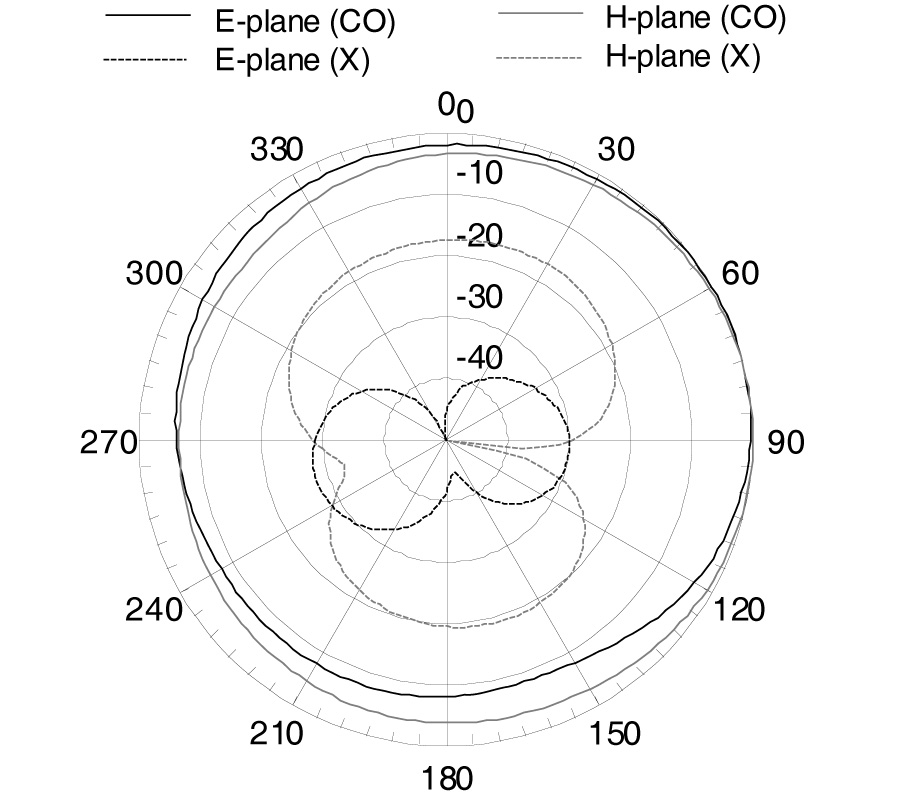
In this work, a polarisation agile antenna based on an array of two injection locked oscillators is presented. The proposed topology provides a theoretical relative phase shift range of 360 degrees between the output signals, which can be easily controlled through two DC voltages. The behaviour of the system is studied, both through simulations and measurements of the manufactured prototype, focusing on the joint performance of the oscillators. The data transmission capabilities of the system are analysed, proposing a solution for phase modulated signals.
ANALYSIS OF THE PERFORMANCE OF INJECTION LOCKED OSCILLATORS IN A DATA TRANSMITTING POLARISATION AGILE ANTENNA APPLICATION
2009-09-23
PIER Letters
Vol. 11, 173-181
Measure the Complex Permeability of Ferromagnetic Thin Films: Comparison Shorted Microstrip Method with Microstrip Transmission Method
Yunqiu Wu , Zong-Xi Tang , Yuehang Xu and Biao Zhang
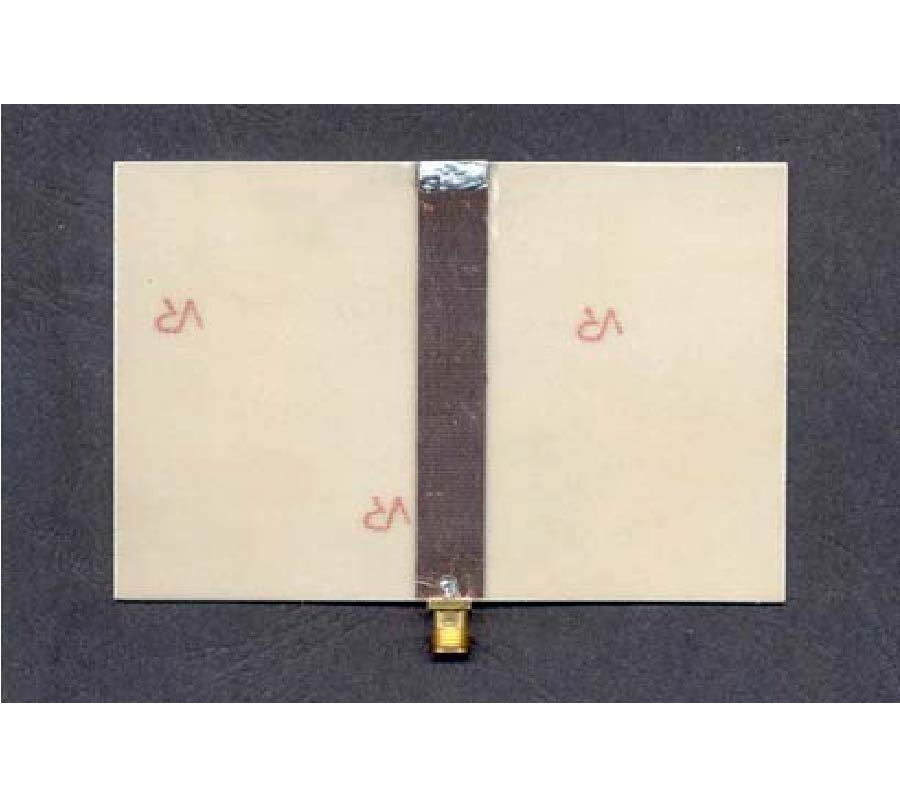
In this paper, two broadband measurement methods, shorted microstrip method and microstrip trnasmission method, are discussed, and the complex permeability of ferromagnetic thin films is measured from 100MHz to 18GHz. The S-parameters of the two measurement fixtures are measured by vector network analyzer (VNA). The perturbations of the thin film loaded in the measurement fixture are analyzed; the discontinuity between coaxial and microstrip is considered; the effective permeability is deduced from measured S-parameters; the permeability of ferromagnetic thin films is extracted from effective permeability by using conformal mapping. The results show that the experimental results agree with the theoretical ones closely, and higher measurement sensitivity and accuracy are achieved by using shorted microstrip method.
MEASURE THE COMPLEX PERMEABILITY OF FERROMAGNETIC THIN FILMS: COMPARISON SHORTED MICROSTRIP METHOD WITH MICROSTRIP TRANSMISSION METHOD
2009-09-23
PIER Letters
Vol. 11, 167-172
A Compact Microstrip Bandstop Filter
Saeed Fallahzadeh and Majid Tayarani
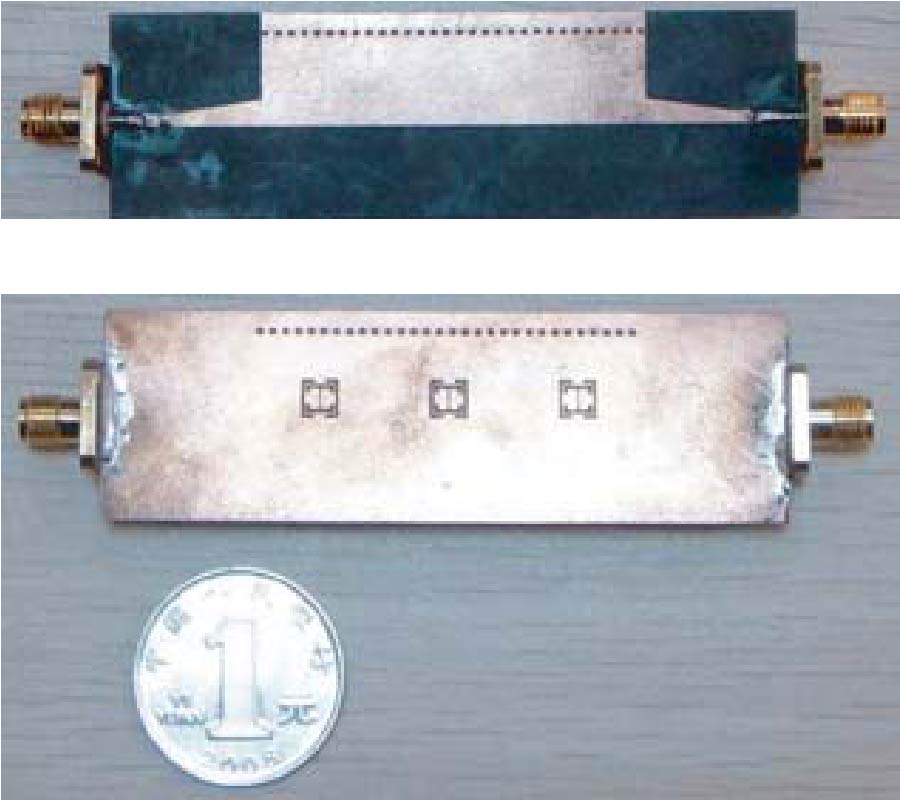
In this paper, a novel microstrip bandstop filter by etching a square split ring in the center of microstrip line is proposed. Low insertion loss in the passband, high rejection level and integrated structure should be mentioned as advantages for this resonator. A transmission line model for this resonator is introduced and its resonant frequency is calculated analytically. Good agreement between the experimental results, full-wave simulation, transmission line model and analytical result has been achieved.
A COMPACT MICROSTRIP BANDSTOP FILTER
2009-09-23
PIER C
Vol. 10, 215-230
Adaptive Transmit Antenna Selection and Power Allocation Scheme for Turbo-Blast System with Imperfect Channel State Information
Xiaomin Chen , Dazhuan Xu and Xiangbin Yu
In this paper, a new technique that combines adaptive transmit antenna selection, transmit power allocation and iterative detection is introduced for the modified Turbo-BLAST system. At the transmitter, in order to minimize the BER performance of the overall system, an adaptive transmit antenna selection scheme is proposed to select the appropriate antenna subset for the actual transmission, and the proper power is allocated for the selected antennas subject to the total transmit power constraint. At the receiver the modified MMSE detector taking the imperfect CSI into account is used to remove the co-antenna interference. Finally the turbo principle is employed for iterative detection to further lower the BER results. Simulation results show that the introduced adaptive transmit antenna selection and power allocation algorithm can significantly improve the BER performance, and the iterative detection technique can further enhance the performance.
ADAPTIVE TRANSMIT ANTENNA SELECTION AND POWER ALLOCATION SCHEME FOR TURBO-BLAST SYSTEM WITH IMPERFECT CHANNEL STATE INFORMATION
2009-09-22
PIER B
Vol. 18, 43-58
Responses in Trasnformers Built with Planar Coils Inner Ring Coils Excited by Square Waves
Eduard Montgomery Meira Costa
This paper presents an analysis about the results of experiments using planar coils inner ring coils to determine a transformer. The excitation of this system was a square wave voltage, where experiments were realized in two ways: considering planar coil as primary and observing responses on secondary being ring coil (direct system) and the inverse (ring coil as primary and planar coil as secondary-inverted system). In this study, a phenomenon not common in literature on system response is analyzed, showing effects of changes on transfer function in both cases when varying turn numbers of each coil and several variations on responses due to changes on resistances, parasitic capacitances, self and mutual inductances of the coils. The uncommon phenomenon appears as modulated response on specific turn ratio. The obtained results can be used to researches in areas as power electronics and pulse transformers.
RESPONSES IN TRASNFORMERS BUILT WITH PLANAR COILS INNER RING COILS EXCITED BY SQUARE WAVES
2009-09-22
PIER C
Vol. 10, 201-214
Understanding Standard OFDM WiMAX Signal Access in Radio Over Fiber System
Chien-Hung Yeh , Chi-Wai Chow , Chia-Husan Wang , Fu-Yuan Shih , Yu-Fu Wu , Yen-Liang Liu and Sien Chi
Radio over Fiber (RoF) system has attracted much industry and research interest to extend the wireless cell coverage and reduce the cost by using the distributed remote antenna units (RAUs). However, the effective transmission fiber length in the RoF systems would be limited due to the time division duplex (TDD) mode used in the practical WiMAX access. Here, we study the transmission limitations and performances of the standard WiMAX signal for RoF systems. The throughputs and packet-losses at different fiber lengths are also investigated and analyzed. Besides, in order to increase the emitting power of the RAUs, a robust TDD switching mechanism is proposed in each RAU for RoF system.
UNDERSTANDING STANDARD OFDM WIMAX SIGNAL ACCESS IN RADIO OVER FIBER SYSTEM
2009-09-21
PIER
Vol. 96, 267-285
Multi-Resolution Retrieval of Non-Measurable Equivalent Currents in Microwave Imaging Problems-Experimental Assessment
Paolo Rocca
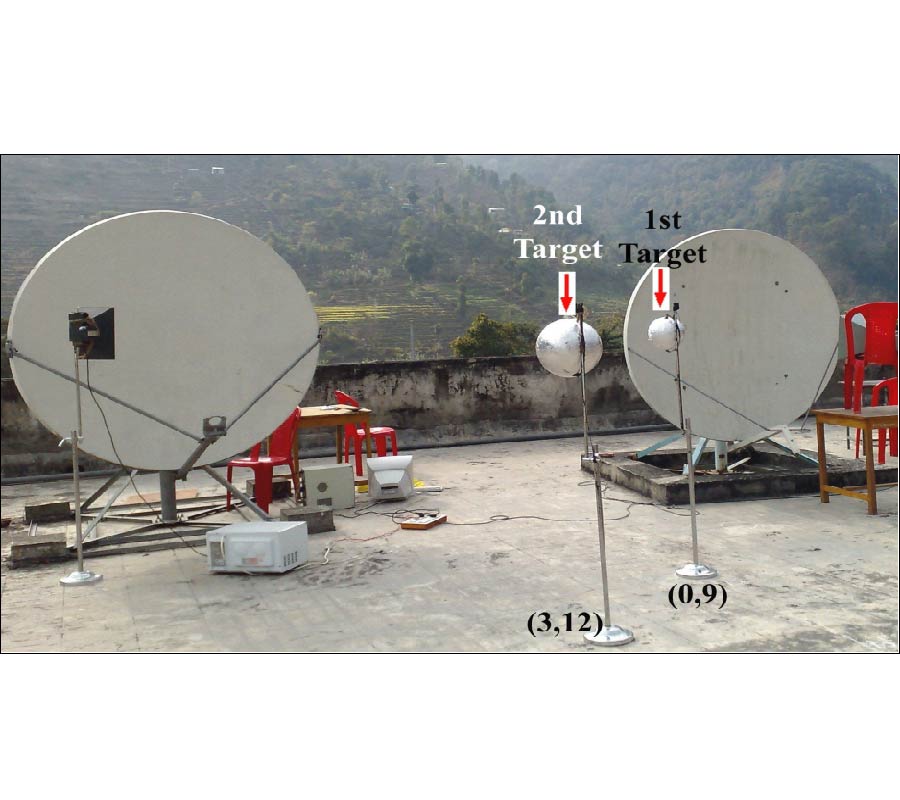
In this paper, an approach based on a multi-scaling strategy for the reconstruction of the non-measurable components of equivalent current distributions is tested against experimental data. An extensive set of simulations is carried out considering single and multiple scatterers with homogeneous as well as inhomogeneous properties. Selected results are reported and discussed to show potentialities and limitations of the method.
MULTI-RESOLUTION RETRIEVAL OF NON-MEASURABLE EQUIVALENT CURRENTS IN MICROWAVE IMAGING PROBLEMS-EXPERIMENTAL ASSESSMENT
2009-09-21
PIER B
Vol. 18, 25-42
The Novel Two Phase Field-Assisted Hybrid Srg: Magnetostatic Field Analysis, Simulation, and Experimental Confirmation
Seyed Ebrahim Afjei and Hossein Torkaman
This paper introduces a new configuration for a two phase field assisted hybrid switched reluctance generator, which can operate in motoring mode as well. This concept allows higher output power production compare to standard SRG. The proposed novel generator consists of two magnetically independent stator and rotor sets (layers), where each stator set includes four salient poles with windings wrapped around them, while the rotor comprises of two salient poles with different arc lengths and no windings. There is a stationary reel, which has the field coils wrapped around it and is placed between the two-stator sets. In this format, the developed magnetic field from the stator poles travels to the rotor then to the rotor shaft and finally completes its path via the generator housing. To evaluate the generator performance, two types of analysis, namely the numerical technique and the experimental study have been utilized. The analysis is carried out for the machine in self exited generator mode as well as field assisted mode. In the numerical analysis, the finite element analysis is employed, whereas in the experimental study, a proto-type generator has been built and tested.
THE NOVEL TWO PHASE FIELD-ASSISTED HYBRID SRG: MAGNETOSTATIC FIELD ANALYSIS, SIMULATION, AND EXPERIMENTAL CONFIRMATION
2009-09-21
PIER Letters
Vol. 11, 159-165
Influence of Disorder on a Chirped Mirror Based on Porous Silicon
Jesus Manzanares-Martinez , Paola Castro-Garay and Efrain Urrutia-Banuelos
We report on the modeling of light reflection in disordered chirped mirrors with a photonic band gap in the visible. The stop band limits have a threshold-like behavior as a function of disorder and sustain a certain amount of disorder before changing. We determine the disorder value that leads to a substantial broadening of the total reflection range.
INFLUENCE OF DISORDER ON A CHIRPED MIRROR BASED ON POROUS SILICON
2009-09-21
PIER Letters
Vol. 11, 149-158
Controlling the Frequency of Simultaneous Switching Noise Suppression by Using Embedded Dielectric Resonators in High-Impedance Surface Structure
Chin-Sheng Chang , Jian-Yi Li , Wen-Jeng Lin , Mau-Phon Houng , Lih-Shan Chen and Ding-Bing Lin
This work presents a novel design for high-impedance surface (HIS) embedded dielectric resonator (DR) structures to efficiently control bandwidth of suppressing simultaneous switching noise (SSN) in high speed digital printed circuit boards (PCBs). The proposed structure is designed by periodically embedding high dielectric constant materials into the substrate between a continuous power plane and a middle patch. A conventional HIS structure has only one resonance frequency to produce stopband while the proposed structure has two resonances to widen the suppression bandwidth. The -30 dB stopband of the proposed structure is about two times wider than that of a conventional HIS structure. The excellent SSN suppression behavior was verified by measurements and simulations.
CONTROLLING THE FREQUENCY OF SIMULTANEOUS SWITCHING NOISE SUPPRESSION BY USING EMBEDDED DIELECTRIC RESONATORS IN HIGH-IMPEDANCE SURFACE STRUCTURE
2009-09-21
PIER C
Vol. 10, 187-199
New Method of Integrating Periodic Permanent Magnet (Ppm) Assembly in Traveling Wave Tubes (TWTs)
Thomas Mulcahy , Heather Song and Frank Francisco
In traveling wave tube (TWT) amplifiers, an axial focusing magnetic field is required to keep electrons traveling in a narrow, pencil-like beam over the considerable length of the circuit. Conventionally, this focusing has been accomplished by using a periodic permanent magnet system housing axially polarized ring magnets. Making the structure to this point has been a complicated process consisting of brazing multiple metals together and honing the piece to the desired specifications. We present a new method of fabricating this housing structure monolithically using iron, developing magnetically oversaturated housing regions, and saving processing time and effort.
NEW METHOD OF INTEGRATING PERIODIC PERMANENT MAGNET (PPM) ASSEMBLY IN TRAVELING WAVE TUBES (TWTS)
2009-09-20
PIER M
Vol. 9, 35-40
The Propagation and Cutoff Frequencies of the Rectangular Metallic Waveguide Partially Filled with Metamaterial Multilayer Slabs
Dan Zhang and Jian-Guo Ma
In this paper, the wave propagation and the cutoff frequencies of a rectangular metallic waveguide, partially filled the metamaterial multilayer slabs have been studied. The equations of the TMM method are not complex and the numerical examples show that we can easily obtain the characteristics of the metamaterial multilayer's rectangular waveguide satisfyingly. The cutoff frequencies of the metamaterial waveguide show very different characteristics compared with the usual waveguide.
THE PROPAGATION AND CUTOFF FREQUENCIES OF THE RECTANGULAR METALLIC WAVEGUIDE PARTIALLY FILLED WITH METAMATERIAL MULTILAYER SLABS
2009-09-20
PIER Letters
Vol. 11, 139-148
Bazro3:Yb Nanophosphor for Efficient Up-Conversion Light Emission
Luis-Armando Diaz-Torres , Elder De-la-Rosa , Jorge Oliva , Pedro Salas and Victor M. Castano
Strong visible green upconversion emission in nanocrystalline BaZrO3:Yb3+ powder, obtained by a hydrothermal process at 100ºC, is reported. The unconverted emission has a quadratic dependence on the pump intensity with a lifetime around half that of the NIR lifetime. Results suggest cooperative upconversion as the mechanism responsible for the green fluorescence. This efficient Yb3+-based cooperative up-conversion process allows the development of novel emitting materials in the UV-VIS range.
BaZrO<sub>3</sub>:YB NANOPHOSPHOR FOR EFFICIENT UP-CONVERSION LIGHT EMISSION
2009-09-20
PIER Letters
Vol. 11, 129-137
Enhanced Temperature Sensing by Using One-Dimensional Ternary Photonic Band Gap Structures
Anirudh Banerjee
This paper demonstrates a novel way to enhance the temperature sensitivity in one-dimensional (1D) photonic band gap (PBG) material by using a ternary periodic structure (i.e. three material layers constituting a period of lattice). The temperature sensitive wavelength band shift of (Si/SiO2) periodic structure was significantly enhanced when the structure was modified by sandwiching a thin layer of Bi4Ge3O12 between every two layers, constituting a period of lattice. When the thickness of sandwiched layer was increased further enhancement in temperature sensitivity was observed. These 1D ternary PBG structures can be substituted in place of 1D binary PBG for enhancing the temperature sensing performance.
ENHANCED TEMPERATURE SENSING BY USING ONE-DIMENSIONAL TERNARY PHOTONIC BAND GAP STRUCTURES
2009-09-20
PIER Letters
Vol. 11, 119-128
Multi-Harmonic DC-Bias Network Based on Arbitrarily Width Modulated Microstrip Line
Samuel Ver-Hoeye , Carlos Vazquez-Antuna , Marta Gonzalez Corredoiras , Miguel Fernandez-Garcia , Luis Herran Ontanon and Fernando Las Heras Andres
In this work, we present a novel DC-bias network for multiharmonic microwave circuits based on an arbitrarily width-modulated microstrip line. The arbitrary shape of the width-modulated microstrip line is obtained by using multiple microstrip taper sections. The method is illustrated through the design of four different DC-bias networks blocking from 1 to 4 harmonic components of a 2.5 GHz signal. The designs with an optimum shape for the arbitrarily widthmodulated microstrip line have been manufactured and measured, obtaining a good agreement between the simulated and measured behavior.
MULTI-HARMONIC DC-BIAS NETWORK BASED ON ARBITRARILY WIDTH MODULATED MICROSTRIP LINE
2009-09-19
PIER M
Vol. 9, 21-34
Enlarged Photonic Band Gaps in One-Dimensional Magnetic Star Wave Guide Structure
Sanjeev Srivastava and Sant Ojha
Photonic band structure and reflection properties of one-dimensional magnetic star wave-guide (MSWG) structure composed of a backbone (or substrate) waveguide along which a finite side branches grafted periodically have been investigated. The dispersion relation and hence the photonic band gaps (PBGs) of the magnetic SWG structure have been obtained by applying the Interface Response Theory (IRT). Investigation of dispersion characteristics shows that the existence of band gaps in magnetic SWG structures does not require the contrast in the wave impedance of the constituent materials, which is unlike the usual magnetic photonic crystal structure, where there must be the contrast in the wave impedance for the existence of the band gaps. Moreover, magnetic SWG structures have wider reflection bands in comparison to normal magnetic photonic crystal (MPC) structure for the same contrast in the wave impedance. Analysis shows that the width of forbidden bands for MSWG structure changes with the change in permittivity and permeability of the backbone, and side branches materials even the ratio of wave impedance is the same, but it remains the same in case of MPC structure. In addition to this, we have studied the effects of variation of number of grafted branches and substrates i.e., number of nodes on the reflection bands of magnetic SWG structure.
ENLARGED PHOTONIC BAND GAPS IN ONE-DIMENSIONAL MAGNETIC STAR WAVE GUIDE STRUCTURE
2009-09-19
PIER M
Vol. 9, 9-20
Wide-Angle Reflection Wave Polarizers Using Inhomogeneous Planar Layers
Mohammad Khalaj-Amirhosseini and Sayed Razavi
In this paper, inhomogeneous planar layers are optimally designed as reflection wave polarizers in a desired incidence angles range. First, the electric permittivity function of the structure is expanded in a truncated Fourier series. Then, the optimum values of the coefficients of the series are obtained through an optimization approach. The validation and the performance of the proposed structure are verified using some examples.
WIDE-ANGLE REFLECTION WAVE POLARIZERS USING INHOMOGENEOUS PLANAR LAYERS
2009-09-19
PIER M
Vol. 9, 1-8
Effective Skin Depth for Multilayer Coated Conductor
Hong-Wei Deng , Yong-Jiu Zhao , Chang-Ju Liang , Wan-Shun Jiang and Yueming Ning
In this paper, the effective skin depth which provides a useful evaluation for field penetration in multilayer coated conductor is proposed. The reflection on the interface between the adjacent conductors is considered in theoretical derivation. It is found that the effective skin depths of the gold and gold-nickel coated copper rapidly vary with the thickness of the outer layer (gold) when the gold thickness is less than twice gold skin depths and achieve stabilization as the gold thickness increases to five times gold skin depths.
EFFECTIVE SKIN DEPTH FOR MULTILAYER COATED CONDUCTOR
2009-09-18
PIER
Vol. 96, 251-266
Fast Capacitance Extraction for Finite Planar Periodic Structures Using the Generalized Forward-Backward and Novel Spectral Acceleration Method
Chatrpol Lertsirimit and Danai Torrungrueng
The generalized forward-backward and novel spectral acceleration (GFB/NSA) method is applied to capacitance extraction problems of finite planar periodic structures. In the GFB method, the interaction within a unit cell can be calculated and stored beforehand. The interactions between relatively far-separated unit cells are however calculated by the GFB/NSA method to further accelerate the calculation speed. The contributions to a receiving element on finite planar periodic structures are separated into weak and strong source contributions by an appropriate separation index, which is conveniently specified by an amount of unit cells rather than a distance. The strong source contribution is performed by the standard matrix-vector multiplication in the GFB method, while the weak source contribution is computed using the NSA algorithm. Numerical examples show comparisons of the GFB/NSA method with a commercial software, including the efficiency of the method. With the array increment in one direction, the GFB/NSA method shows O(N) in the calculation time per iteration, while its memory requirement for a very large problem also tends to be O(N), where N is the number of unknowns.
FAST CAPACITANCE EXTRACTION FOR FINITE PLANAR PERIODIC STRUCTURES USING THE GENERALIZED FORWARD-BACKWARD AND NOVEL SPECTRAL ACCELERATION METHOD