Search Results(13902)

2008-10-16
PIER B
Vol. 10, 21-34
Parallel Flow Velocity Shear Kelvin Helmholtz Instability with ac Electric Field
Rama Pandey , Umesh Chandra Srivastava , Sima Kumari and Abhay Kumar
Electrostatic velocity shear Kelvin-Helmholtz instability has been studied for bi-Maxwellian plasma in the presence of perpendicular a.c. electric field by using the method of characteristic solution. The effects of a.c. electric field temperature variation, velocity shear scale length,electron ion temperature ratio and other parameters on growth rate have been discussed.
PARALLEL FLOW VELOCITY SHEAR KELVIN HELMHOLTZ INSTABILITY WITH AC ELECTRIC FIELD
2008-10-15
PIER B
Vol. 10, 1-19
A Generalized Design Procedure for a Microwave Amplifier: A Typical Application Example
Filiz Gunes and Candas Bilgin
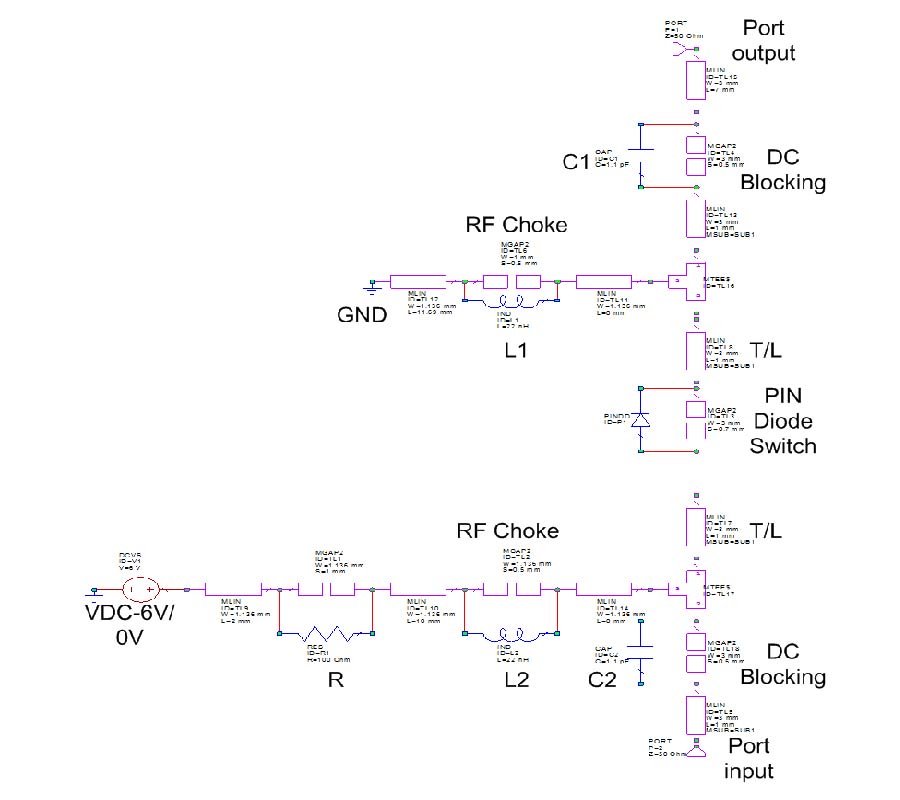
In this work, a generalized procedure is carried out for the design of a microwave amplifier. First of all, the Performance Data Sheets (PDS) resulted from the active device characterization are used as Feasible Design Target Space (FDTS). Employing the PDS, the compatible (Noise F, Input VSWR Vi, Gain GT ) is determined over the predetermined bandwidth B between fmin and fmax operation frequencies with the source ZS and load ZL terminations as the design target. In the design stage, the Simplified Real Frequency Technique (SRFT) is utilized in the scattering-parameter formulation of the front- and back-end matching two-ports to provide the source and load terminations to the transistor, respectively. As an application example, a novel high technology transistor is chosen and the design targets are determined using the PDSs of the device and its frontand back-end matching two-ports are characterized by the scatteringparameters using the novel SRFT for each design target. Furthermore, the performances of the resulted amplifier circuits are analyzed and compared with the simulated results.
A GENERALIZED DESIGN PROCEDURE FOR A MICROWAVE AMPLIFIER: A TYPICAL APPLICATION EXAMPLE
2008-10-09
PIER
Vol. 86, 169-198
A Novel Ultra-Compact Broadband Antenna for Microwave Breast Tumor Detection
Houssam Kanj and Milica Popović
This paper presents a novel resistively loaded antenna design for microwave breast cancer detection. The antenna is planar and ultra-compact,and can be easily manufactured using PCB technology with embedded thin-film resistive layers. Through numerical simulations,the antenna demonstrates a return loss below -10 dB over a wide frequency range from 2 to 35 GHz. For pulse radiation in the ultra-wideband (UWB) range in a biological medium, the antenna shows an excellent fidelity above 0.95 and a relatively high radiation efficiency of 39.21% in comparison to resistively loaded antennas. In addition,a design rule guideline is presented for designing the antenna to radiate in a specific background medium and with a given lower operating frequency. Finally,a complete microstrip feed design is presented for the antenna operating in the UWB range.
A NOVEL ULTRA-COMPACT BROADBAND ANTENNA FOR MICROWAVE BREAST TUMOR DETECTION
2008-10-07
PIER B
Vol. 9, 281-299
Fast and Optimal Design of a k-Band Transmit-Receive Active Antenna Array
Shaohua Yang , Qi-Zhong Liu , Jun Yuan and Shi-Gang Zhou
An active-antenna array with 18 transmit elements and 18 receive elements is designed and fabricated. This T/R array can work at two different frequencies (19.5 GHz and 21.5 GHz) with multiple levels of isolation between the transmit and receive channels. A hybrid element-level vector finite element and adaptive multilevel fast multipole method (ELVFEM/AMLFMA) is applied to simulation the performance parameters of the array element and the full array fast. To obtained the maximum directivity of the array,the best distances of the T/R elements in the array are optimized by using the genetic algorithm (GE) combining with VFEM/AMLFMA. The design efficiency of the array is improved at a ratio of 30%. Finally the performance of the T/R array fabricated is measured in experiments and some good results are obtained.
FAST AND OPTIMAL DESIGN OF A K-BAND TRANSMIT-RECEIVE ACTIVE ANTENNA ARRAY
2008-10-07
PIER B
Vol. 9, 263-279
Analytical Formulae for Radar Cross Section of Flat Plates in Near Field and Normal Incidence
Philippe Pouliguen , Régis Hémon , Christophe Bourlier , Jean-Francois Damiens and Joseph Saillard
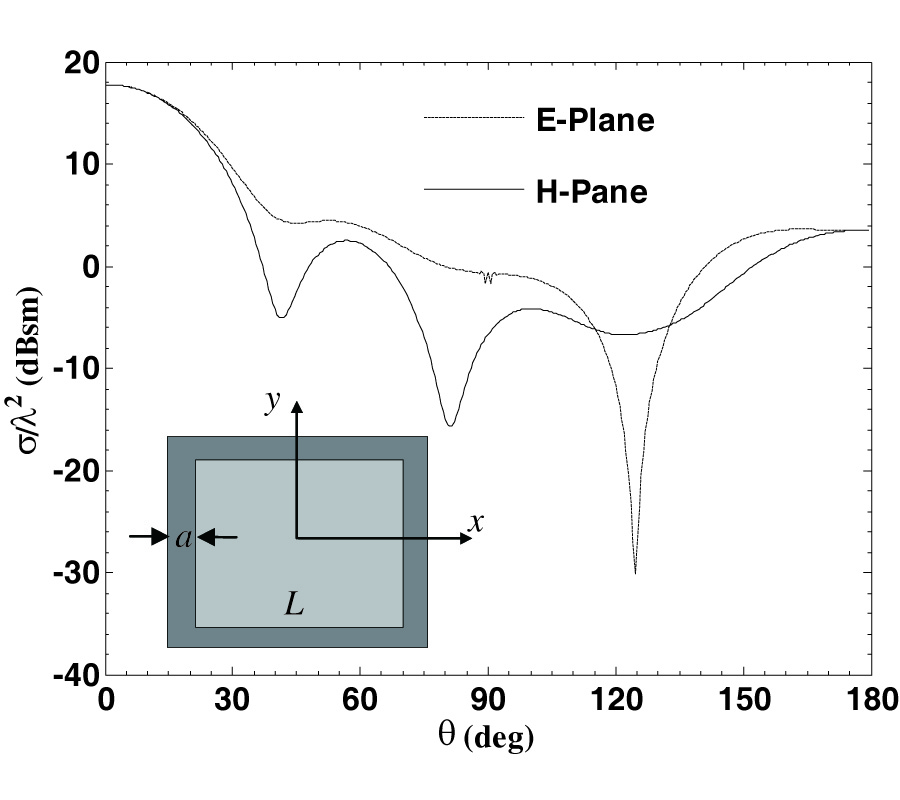
Radar Cross Section is most of the time defined in far field. In that case, RCS is totally independent of the range between the radar and the target. However, in several kinds of military scenario, it can be more realistic to deal with the target nearfield scattering characteristics. Using a relation to define near-field RCS, this communication proposes simple and approximated analytical formulas to express monostatic near-field RCS of perfectly conducting flat targets observed in normal incidence.
ANALYTICAL FORMULAE FOR RADAR CROSS SECTION OF FLAT PLATES IN NEAR FIELD AND NORMAL INCIDENCE
2008-10-07
PIER B
Vol. 9, 249-262
Overview of RCS Extrapolation Techniques to Aircraft Targets
Nan-Jing Li , Chu-Feng Hu , Lin-Xi Zhang and Jia-Dong Xu
In order to meet the approximate plane-wave irradiation condition, adequate large field or compact range system is needed for RCS measurement of large aircraft targets. However, an outside testing field site or a compact range system is very expensive, so some kinds of RCS extrapolation methods based on near-distance testing have been presented. In this overview, two categories of extrapolating technique are summed up, which are based on Huygens Equivalent Reradiating Source (HERS) and Inverse Synthetic Aperture Imaging (ISAI) respectively. Each method is fully elaborated. The comparison and analysis of these extrapolating techniques are discussed in detail.
OVERVIEW OF RCS EXTRAPOLATION TECHNIQUES TO AIRCRAFT TARGETS
2008-10-07
PIER B
Vol. 9, 231-248
Using Genetic Algorithm to Reduce the Radar Cross Section of Three-Dimensional Anisotropic Impedance Object
Hai Chen , Guo-Qiang Zhu and Si-Yuan He
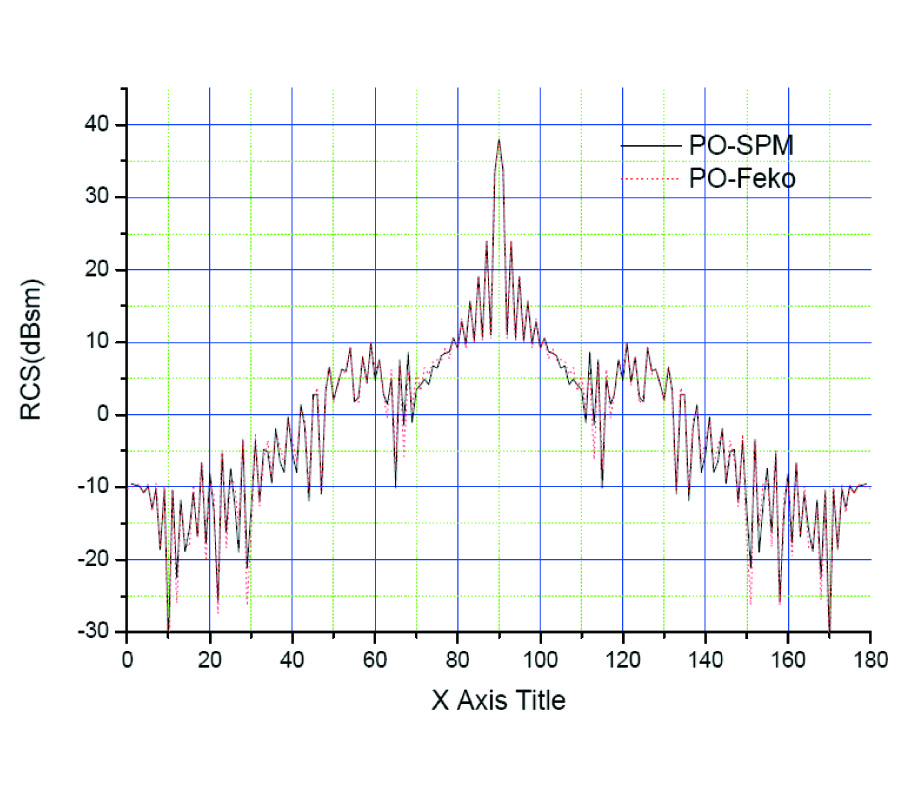
This paper focuses on the radar cross section (RCS) reduction for the three-dimensional object with anisotropic impedance coating. In this work, a genetic algorithm is adopted to optimize the RCS of the anisotropic impedance object in desired angle range. The surface impedances are considered as the optimized parameters and the scattering of the object is computed by the PO method. The optimization process is demonstrated by considering the RCS reduction of two typical targets: the cone and the cone/cylinder composite structure. It is found that the optimization process can reduce the RCS of the targets remarkably and the anisotropic impedance coating has better RCS reduced effect than the isotropic impedance coating.
USING GENETIC ALGORITHM TO REDUCE THE RADAR CROSS SECTION OF THREE-DIMENSIONAL ANISOTROPIC IMPEDANCE OBJECT
2008-10-07
PIER
Vol. 86, 155-168
Ultra Wideband Rose Leaf Microstrip Patch Antenna
Abbas Ali Lotfi-Neyestanak
In this paper a novel rose leaf shape microstrip antenna with capacitively coupled rectangular fed is presented. Various shapes of capacitive coupled fed are compared and optimized by successive iterations of a computer-aided analysis. The Ansoft HFSS is employed for analysis at the frequency band of 4.3 GHz-8.3 GHz. The antenna is fabricated and measurement results show a very good agreement with the simulation results. The proposed antenna is able to achieve an impedance bandwidth about 69%. Effects of varying the parameters on the performance of the antenna have also been studied. The proposed antenna can be used in wireless ultra-wideband (UWB) communication.
ULTRA WIDEBAND ROSE LEAF MICROSTRIP
 PATCH ANTENNA
2008-10-07
PIER
Vol. 86, 135-154
A Two-Slot Array Antenna on a Concentric Sectoral Cylindrical Cavity Excited by a Coupling Slot
Phairote Wounchoum , Denchai Worasawate , Chuwong Phongcharoenpanich and Monai Krairiksh
A two-slot array antenna on a concentric sectoral cylindrical cavity excited by a coupling slot is investigated. The electromagnetic fields and Q factors for the first few modes of a concentric sectoral cylindrical cavity are presented. It shows that the appropriate mode for a slot array antenna on a concentric sectoral cylindrical cavity is the TM110 mode. The correlations between each mode distribution and the magnetic field distributions inside the cavity are presented. The antenna design and the parametric study of a two-slot array antenna on a concentric sectoral cylindrical cavity for a single sector are illustrated. Simulated results are validated by measurements. The results provide useful information for the design of a switched-beam slot array antenna on the concentric sectoral cylindrical cavities.
A TWO-SLOT ARRAY ANTENNA ON A CONCENTRIC SECTORAL CYLINDRICAL CAVITY EXCITED BY A COUPLING SLOT
2008-10-07
PIER
Vol. 86, 111-134
A Symmetry-Based Formalism for the Electrodynamics of Nanotubes
Said Mikki and Ahmed Kishk
In this paper, a general symmetry-based approach to the electrodynamics of a class of low-dimensional structures, carbon nanotubes, is proposed. The contribution of the microscopic configuration is handled using the symmetry group of the structure under consideration. An explicit form of the electromagnetic field is derived starting from a general nonlocal linear susceptibility model expressed as a low-dimensional phenomenological response function. The general form of the field obtained is used to devise new theoretical insights by providing a framework for the computation of the nanotube Green's functions.
A SYMMETRY-BASED FORMALISM FOR THE ELECTRODYNAMICS OF NANOTUBES
2008-10-07
PIER
Vol. 86, 87-110
Radiation of a Horizontal Dipole in the Presence of a Three-Layered Region and Microstrip Antenna
Liang Liu , Kai Li and Yi Hui Xu
In this paper, we study in detail both the trapped surface wave and lateral wave excited by a dipole antenna parallel to the plane boundaries of a three-layered region in spherical coordinate. An approximate formula is obtained for the solution of the electrictype pole equation when a condition is satisfied by √k21-k20l≤0.6. Similarly, an approximate formula is obtained for the solution of the magnetic-type pole equation when a condition is satisfied by √ k21-k20l-π/2≤1. Furthermore, because of its useful applications in microstrip antenna, the radiation patterns of a patch antenna with specific current distributions are treated specifically. Analysis and computations are carried out in several typical cases. It is seen that, for the component E, the total field is determined primarily by the trapped surface wave of electric type, and, for the component E, the total field is determined primarily by the trapped surface wave of magnetic type.
RADIATION OF A HORIZONTAL DIPOLE IN THE PRESENCE OF A THREE-LAYERED REGION AND MICROSTRIP ANTENNA
2008-10-07
PIER
Vol. 86, 71-86
A Novel Microstrip Patch Antenna with Reduced Surface Wave Excitation
Samir Mahmoud and Ayed R. Al-Ajmi
A microstrip circular patch antenna with two shorting pins is proposed as an antenna with reduced surface wave and lateral wave excitation. Theoretical analysis of the cavity modes of the patch lead to a design procedure for the antenna. Simulation results using the IE3DZeland software support the theory and verify the reduced surface wave capability. By using four shorting pins instead of two, we demonstrate the possibility of achieving circular polarization with high polarization purity in addition to the reduced surface wave. It is demonstrated that a discrimination against the lateral wave of 30dB or more is achievable. Applications include design of large patch arrays with reduced coupling and GPS receiving antennas that reduce low angle interfering signals.
A NOVEL MICROSTRIP PATCH ANTENNA WITH REDUCED SURFACE WAVE EXCITATION
2008-10-07
PIER
Vol. 86, 53-70
Design and Construction of a Near Real-Time Advanced Automated C-Band Scatterometer System
Ka-Sing Lim and Voon Koo
This paper presents the design and construction of a complete near real-time scatterometer system for in-situ measurement. The full polarimetric system is comprised of inexpensive Frequency Modulated Continuous Wave (FMCW) radar that is efficiently constructed from a combination of commercially available components and in-house fabricated circuitry. An automated advanced antenna positioning system (AAPS) is included in the development of the system, giving rise for a more practical measurement. The backscattering matrices of a 4'' × 8'' dihedral corner reflector are rotated and measured at different angles to provide different sets of polarimetric data. The backscattering matrices of 8'' sphere, 12'' sphere and 16.5'' trihedral are also measured and the results are presented in this paper. In order to verify the effectiveness of the calibration technique, the results are compared with the theoretical values. Consideration on the challenges of measurement in outdoor environment is countered with external and internal calibration. As a result, the proposed scatterometer system has shown good correlation between measurement and theoretical results.
DESIGN AND CONSTRUCTION OF A NEAR REAL-TIME ADVANCED AUTOMATED C-BAND SCATTEROMETER SYSTEM
2008-10-07
PIER
Vol. 86, 39-51
Compact Full Ku-Band Triplexer with Improved E-Plane Power Divider
Jorge Ruiz-Cruz , Jose R. Montejo-Garai , Jesus M. Rebollar Machain and Santiago Sobrino
An improved E-plane power divider for compact waveguide triplexers with large separation between channels is presented. The configuration of the divider aims to exploit the different behavior of the device for frequency bands with large separation, leading to a very asymmetric E-plane junction. H-plane filters with inductive windows are used for each channel, in order to obtain reduced insertion losses and lower sensitivity than in metal-insert E-plane filters. The resultant triplexer configuration is very compact, and its design is analyzed and optimized by Mode-Matching. The experimental results of a full Ku-band prototype for communications satellite systems show a very good agreement with the expected simulated response.
COMPACT FULL KU-BAND TRIPLEXER WITH IMPROVED E-PLANE POWER DIVIDER
2008-10-07
PIER
Vol. 86, 19-37
Novel Blind Joint Direction of Arrival and Polarization Estimation for Polarization-Sensitive Uniform Circular Array
Xiaofei Zhang , Ying Shi and Dazhuan Xu
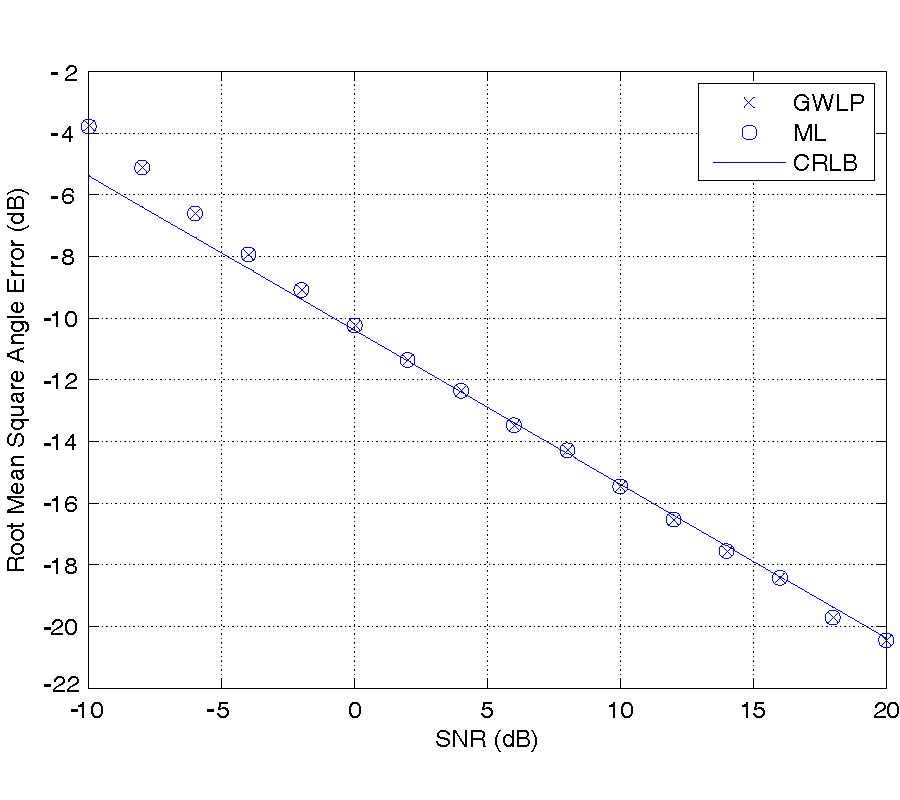
A novel blind Direction of arrival (DOA) and polarization estimation method for polarization-sensitive uniform circular array is investigated in this paper. An analysis of the received signal of the polarization-sensitive uniform circular array shows that the received signal has trilinear model characteristics, and hence trilinear decomposition-based blind DOA and polarization estimation for polarization sensitive uniform circular array is proposed in this paper. Our proposed algorithm has better DOA and polarization estimation performance. Our proposed algorithm can be thought of as a generalization of ESPRIT, and has wider application than ESPRIT method. The useful behavior of the proposed algorithm is verified by simulations.
NOVEL BLIND JOINT DIRECTION OF ARRIVAL AND POLARIZATION ESTIMATION FOR POLARIZATION-SENSITIVE UNIFORM CIRCULAR ARRAY
2008-10-07
PIER
Vol. 86, 1-18
An Impulse-Radio-Based Ultrawideband RF Front-End Module with a New Multilayered Microwave Sampler
Tzyh-Ghuang Ma , Chin-Jay Wu and Chin-Feng Chou
In this paper we develop a new impulse-radio-based RF front-end module for ultrawideband communications. The proposed transceiving module is designed based a novel compact microwave sampler. The microwave sampler consists of a multilayered magic-T and a balanced sampling bridge. By utilizing a wideband microstripto-slotline Marchand balun, the newly proposed magic-T features an improved bandwidth of 94.2%. The design concept, circuit topology, and experimental results of the magic-T and microwave sampler are investigated in the first half of this paper. By utilizing the equivalent time sampling theory, in the second half of this paper we investigate an impulse-radio-based ultrawideband transceiving front-end module. Two transmission data rates, 90 and 270 Kbps, are demonstrated with various bit patterns. The experimental results reveal that the transceiving module has a coverage range up to 4.5 m. The circuit configuration, modulation scheme, and system performance of the front-end module are discussed thoroughly. The tradeoff for increasing the data rate is discussed at the end of this paper as well.
AN IMPULSE-RADIO-BASED ULTRAWIDEBAND RF FRONT-END MODULE WITH A NEW MULTILAYERED MICROWAVE SAMPLER
2008-10-07
PIER
Vol. 85, 439-453
The Investigation of W Band Microstrip Integrated High Order Frequency Multiplier Based on the Nonlinear Model of Avalanche Diode
Minghua Zhao , Yong Fan , Dakui Wu and Jingkun Zhan
A research of W band microstrip integrated high order frequency multiplier based on avalanche diode is presented. The associated nonlinear model of avalanche diode driven by external RF signals for high order frequency multiplication is presented and analyzed according to the physical property of avalanche diode. Subsequently the circuit of microstrip integrated high order multiplier is analyzed. In experiment, maximum output power of 6.5 mW with the efficiency of about 0.62% is obtained at output frequency of 94.5 GHz with 15th multiplication order. The phase noise of output 94.5 GHz signal is about −90.83 dBc/Hz and −95.67 dBc/Hz at 10 KHz and 100 KHz offset.
THE INVESTIGATION OF W BAND MICROSTRIP INTEGRATED HIGH ORDER FREQUENCY MULTIPLIER BASED ON THE NONLINEAR MODEL OF AVALANCHE DIODE
2008-10-07
PIER
Vol. 85, 425-438
Analysis of Multilayered Cylindrical Structures Using a Full Wave Method
Noemen Ammar , Taoufik Aguili and Henri Baudrand
In this paper, Wave Concept Iterative Procedure (WCIP) is used to investigate scattering by multilayered cylindrical structures in free space and to calculate the diffracted far field by adopting a cylindrical coordinate formulation. The WCIP principle consists of alternating waves between the modal and space domains. Its iterative resolution process is always convergent in lossless media case. The proposed technique used for determining the electric far field diffracted by a multilayered cylindrical structure is validated and confronted to literature results.
ANALYSIS OF MULTILAYERED CYLINDRICAL STRUCTURES USING A FULL WAVE METHOD
2008-10-07
PIER C
Vol. 4, 205-211
Nonuniform Transmission Lines as Compact Uniform Transmission Lines
Mohammad Khalaj-Amirhosseini
In this paper, we propose a new way to compact the transmission lines, which has a general application to miniaturization of RF and microwave circuits. In this way, we use Nonuniform Transmission Lines (NTLs) instead of Uniform Transmission Lines (UTLs). To synthesize the desired Compact Length Transmission Lines (CLTLs), the characteristic impedance function of the NTLs is expanded in a truncated Fourier series. Then, the optimum values of the coefficients of the series are obtained through an optimization approach. The usefulness of the proposed structures is verified using some examples.
NONUNIFORM TRANSMISSION LINES AS COMPACT UNIFORM TRANSMISSION LINES
2008-10-07
PIER Letters
Vol. 4, 159-166
A New Method to Avoid Crowding Phenomenon in Extracting the Permittivity of Ferroelectric Thin Films
Yunqiu Wu , Zong-Xi Tang , Yuehang Xu and Xi He
In this paper, a new method is proposed to avoid crowding phenomenon in extracting the permittivity of ferroelectric thin films. Polynomial curve fitting technique is used to determine the filling factor while the thickness of the thin film is very small. Conformal mapping (CM) combining with partial capacitance approach (PTA) is used to obtain the relationshipb etween the effective permittivity of multiplayer coplanar waveguide (CPW) and the permittivity of each layer. A CPW with a thin film layer is simulated and the permittivity of thin film is extracted, the results show that, by using the proposed method, the crowding phenomenon can be avoided successfully and the permittivity of thin films can be extracted accurately.
A NEW METHOD TO AVOID CROWDING PHENOMENON IN EXTRACTING THE PERMITTIVITY OF FERROELECTRIC THIN FILMS