Search Results(13787)

2023-05-15
PIER B
Vol. 100, 55-71
Computation of Spectral-Domain Green's Functions of the Infinitesimal Current Source in a Planar Multilayer Medium
Slavko Vujević and Ivan Krolo
This paper presents a novel theoretical and numerical approach for an infinitesimal current source (ICS) located in a planar isotropic multilayer medium. Using the mixed-potential integral equation (MPIE) formulation for depicting the electromagnetic disturbance created by the ICS, a detailed definition of Green's functions of Lorenz potentials and fields is provided in this paper. The proposed Green's functions are valid for the considered multilayer isotropic medium, which can have arbitrary layer parameters. This paper also analyzes two commonly observed special cases of the multilayer medium - the multilayer soil including air and the multilayer lossless dielectric - and the proposed equations are modified to meet the requirements of the medium. Green's functions can be obtained from the systems of linear equations proposed in this study. In comparison to other approaches, the advantage of the proposed procedure is that the solutions of the equations are immediately obtained in any field layer of the multilayer medium. In addition, the proposed system of linear equations can be solved easily using well-known numerical computation methods. Furthermore, this paper offers an alternative way of obtaining Green's functions, which are closed-form expressions for the kernels of spectral-domain Green's functions.
Computation of Spectral-domain Green's Functions of the Infinitesimal Current Source in a Planar Multilayer Medium
2023-05-14
PIER M
Vol. 117, 1-12
Electromagnetic Field Safety Analysis of a 7.7 kW Wireless Power Transfer System for Electric Vehicles
Songtao Liu , Deguan Li , Chuanmin Chen , Wenbo Jia , Kai Che and Jinxing Yu
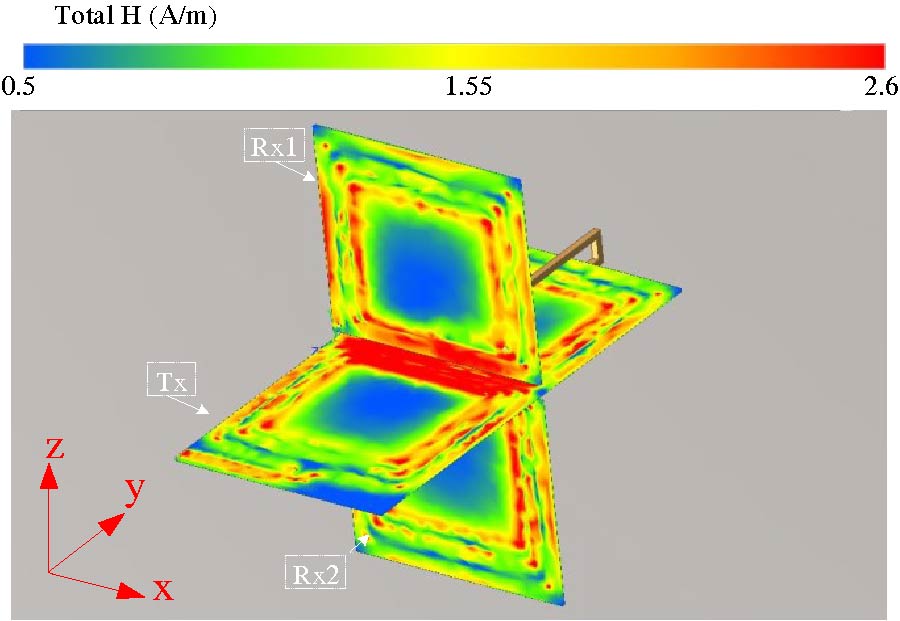
The safety of the electromagnetic environment of wireless power transfer (WPT) systems is one of the prerequisites for the application of wireless charging technology for electric vehicles (EVs). The electromagnetic characteristics of a wireless charging EV with a new 7.7 kW WPT system were modeled and analyzed in this paper. Firstly, a complete model of the magnetic coupler was built as a source of electromagnetic radiation, and an external excitation source was added by coupling the resonant coils to the double inductor-capacitor-capacitor (LCC-LCC) topology circuit model. Secondly, the finite element analysis software COMSOL Multiphysics was used to solve for the magneto-quasi-static values to verify the electromagnetic safety of the wireless charging process. Then, two charging scenarios were investigated when the GA and VA aligned and misaligned, involving lateral offset and longitudinal offset cases. Finally, the simulation results were compared and analyzed, showing that the values of electromagnetic fields become higher as the offset distance increases. In worst-case scenarios, the highest magnetic flux density (1.1 μT) is observed in the virtual plane of the test on the left side of the vehicle, which occupies only 17.6% of the limits specified in ICNIRP 1998 (6.25 μT), indicating a good EMF safety performance of the wireless charging system.
Electromagnetic Field Safety Analysis of a 7.7 kW Wireless Power Transfer System for Electric Vehicles
2023-05-14
PIER B
Vol. 100, 39-53
Equations of Motion of Interacting Classical Charged Particles and the Motion of an Electron Outside a Long Solenoid
Hanno Essén
The equation of motion for a test particle moving in given fixed external fields is analyzed and compared to the corresponding equation of motion derived from the Darwin Lagrangian for a system of interacting charged particles. The two approaches agree as long as the part of the electric field that arises from the partial time derivative of the vector potential is taken into account. It is, however, only via the Darwin approach that the origin of this field can be understood as arising from a breakdown of the test particle approximation. Applying the formalism to an electron moving outside a long solenoid results in a classical analog of the Aharonov-Bohm effect.
Equations of Motion of Interacting Classical Charged Particles and the Motion of an Electron outside a Long Solenoid
2023-05-11
PIER M
Vol. 116, 165-176
Hyperbolic Graded Index Biophotonic Cholesterol Sensor with Improved Sensitivity
Diptimayee Dash and Jasmine Saini
A novel approach is presented to achieve improved sensing performance using a one-dimensional (1D) hyperbolic graded photonic crystal (PC). The graded structure achieves refractive index modulation that varies hyperbolically with layer depth, due to its graded index geometry. Porous materials are employed to facilitate analyte infiltration. The reflectivity and sensing performance of the proposed graded and non-graded geometry is evaluated using the transfer matrix method (TMM). The Sensing capability of the graded structure is evaluated analytically by infusing different analytes within the cavity, considering various cavity widths and incidence angles. At a 40-degree angle of incidence, the analytical results demonstrate that the suggested graded structure exhibits a maximum sensitivity of 469 nm/RIU, along with a detection limit and FOM of 9.1×10⁻³ and 125 RIU-1, respectively. The detailed electric field confinement of the graded geometry is also carried out at the interface. The proposed structure outperforms conventional non-graded structures with a 114% higher sensitivity. The bio-photonic design can easily be implemented and provides high performance compared to previous works that employ exponentially graded structures. The suggested biosensor can detect even minor fluctuations in the refractive index of blood serum samples with different cholesterol concentrations.
Hyperbolic Graded Index Biophotonic Cholesterol Sensor with Improved Sensitivity
2023-05-11
PIER Letters
Vol. 110, 101-108
Ultracompact Mode-Division (DE)Multiplexer Based on Tilted Lithium Niobate Waveguide
Hua Liu , Fang Wang , Tao Ma , Shoudao Ma and Yufang Liu
We present an ultra-compact modular division (de) multiplexer [(de) MUX] based on the tilted lithium niobate waveguide, an asymmetric directional coupler (ADC) composed of silica-lithium niobate waveguide (SLNW) and lithium niobate waveguide (LNW) for the modular division multiplexer. The TE0 and TE1 modes were optimized by using the finite element method (FEM). By rationally designing the size of SLNW waveguide and LNW waveguide, TE0 mode light is injected into the In1 port of LNW waveguide, TE0 mode light is converted to TE1 mode in the coupling zone, and transmitted in the SLNW waveguide, output from the Out2 port. It show that the coupling length of this MUX is only 6 μm. At a working wavelength of 1.55 um, when TE0 enters the coupling area from port In1, the mode is coupled and converted to TE1; the TE1 mode is output from Out2; the value of IL is 0.87 dB; and the value of MCE is 99.5%. When TE0 enters from port In2, the TE0 mode is output from Out2, with 0.1 dB for IL, 99.7% for MCE, and -25 dB for CT.
Ultracompact Mode-division (de)Multiplexer Based on Tilted Lithium Niobate Waveguide
2023-05-11
PIER Letters
Vol. 110, 93-99
Compact Planer Dual Band Circular Shaped Polarization-Dependent Electromagnetic Band Gap Structure to Reduce the RCS
Rajesh Bhagwanrao Morey and Sunil Nilkanth Pawar
In this paper, a compact planar dual-band circular-shaped polarization-dependent electromagnetic band gap (DCS-PDEBG) structure operates at 2.97 GHz and 7.77 GHz in y-direction and 3.14 GHz and 10.90 GHz in the x-direction. A proposed DCS-PDEBG structure consists of a circular patch inside a square patch with a slot at the center, and the established arrangement gives additional capacitance and compact size. The simulation of the DCS-PDEBG is carried out using the Finite Element Method (FEM) of Ansys High-Frequency Simulator (HFSS) and experimentally validated. A truncated microstrip line (TML) method is used to measure the band gap of the proposed planar DCS-PDEBG structure. Experimental results agree well with simulation one. The periodic size of proposed DCS-PDEBG structure is 0.13λ2.97 GHz × 0.13λ2.97 GHz, which is a good candidate where compact size is highly desired.
Compact Planer Dual Band Circular Shaped Polarization-dependent Electromagnetic Band Gap Structure to Reduce the RCS
2023-05-09
PIER M
Vol. 116, 155-164
Design and Verification of Noninvasive Wearable Continuous Blood Glucose Monitoring System for Smartwatches
Pratik J. Mhatre and Manjusha Joshi
In this paper, we propose a noninvasive blood glucose monitoring system that can be easily integrated into smartwatches. This system makes use of dielectric properties of blood-flow in human blood vessels as well as frequency dependency of blood glucose. To prove the proposed design principle, authors have verified the system working with vector network analyser and a directional coupler. The entire system design is explained in this paper. At the time of final system integration, the vector network analyser and directional coupler can be replaced with other on-chip sensors. Authors have also compared the obtained results with finger pricking based blood-glucose measurement. The results agree and have been tabulated. Clarke error grid was also used to evaluate proposed system accuracy.
Design and Verification of Noninvasive Wearable Continuous Blood Glucose Monitoring System for Smartwatches
2023-05-09
PIER Letters
Vol. 110, 83-91
Design and Analysis of S-Shaped Broadside Coupled Metamaterial Unit Cell as a Sensor to Ease the Classification of Different Oil Samples
Jeyagobi Logeswaran and Rajasekar Boopathi Rani
This paper aims to classify oil samples using the Metamaterial (MTM) unit cell as a sensor. The S-shaped broadside coupled Split-Ring Resonator (SRR) acts as an MTM and is designed to operate at X-band (8-12.4 GHz). The proposed MTM unit cell was simulated through the High Frequency EM simulation tool, and then the MTM properties were extracted using the standard equations. The MTM behavior was studied through its negative permittivity and permeability characteristics in the X-Band. The simulated and extracted properties exhibit that the proposed MTM unit cell is suitable for the analysis at X-band. A sample container was designed to hold the different oil samples. The experimental analysis was carried out by filling the container with different oils without/with an MTM sensor. Mainly, the variations in S-parameters magnitude were studied for classification applications. This paper proposes the study of transmission coefficients phase response in addition to magnitude as an easy way to classify different oils. Further, the phase transition results were compared with the kinematic viscosity and refractive index properties of the oil sample. The comparison results proved that the classification of oil samples using the phase transition approach agrees well with the existing oil properties.
Design and Analysis of S-shaped Broadside Coupled Metamaterial Unit Cell as a Sensor to Ease the Classification of Different Oil Samples
2023-05-08
PIER C
Vol. 133, 1-13
Nonuniform Structured Waveguides. WKB Approach
Mykola I. Ayzatsky
The results of the development of an approximate approach for describing structured waveguides, which can be considered as an analogue of the WKB method, are presented. This approach gives possibility to divide the electromagnetic field in structured waveguides with slow varying geometry into forward and backward components and simplify the analysis of the field characteristics, especially the phase distribution. The accuracy of this method was estimated by comparing the solution of the approximate system of equations with the solution of the general system of equations. For this, a special code was written that combines the proposed approach with the more accurate one developed earlier. For the case of fast damping of evanescent waves, a simple solution of the matrix equations is obtained. Based on this approach, the possibility of correcting the phase distribution in a chain of coupled resonators has been studied.
Nonuniform Structured Waveguides. WKB Approach
2023-05-08
PIER Letters
Vol. 110, 73-81
Design of a Full Polarization Reconfigurable MIMO Antenna
Jiaying Guo , Yiwei Ping , Yajuan Zhao , Yufeng Liu and Liping Han
An aperture-coupled full polarization reconfigurable MIMO antenna is proposed in this letter. A cross-shaped slot loaded with PIN diodes is embedded on the ground plane, and ±45° linear polarization is realized by controlling the states of the diodes. Four slots integrated with PIN diodes are etched at the corners of the radiating patch, and then the left- and right-handed circular polarization modes are achieved by changing the ON/OFF states of the diodes. Experimental results show that the antenna can achieve good impedance matching in the range of 2.4-2.46 GHz in four modes with an isolation greater than 15 dB and an axial ratio less than -3 dB in the circular polarization modes.
Design of a Full Polarization Reconfigurable MIMO Antenna
2023-05-07
PIER C
Vol. 132, 255-269
Load Angle of Flux Modulated Magnetic Gears
Rong-Jie Wang , Stanley Robert Holm , Josh Scheepers and Stiaan Gerber
In this paper, the authors address the issue of the flux-modulated magnetic gear (FMMG), which offers many potential advantages over traditional mechanical gears for a wide range of applications. In the proposed FMMG model, two permanent magnet (PM) carriers are of different pole-pairs and rotate asynchronously, and their relative angular position with respect to the pole parts of the flux modulator is not as straightforward and simple as it may seem in conventional electrical machines. Therefore, this paper focuses on the details of the derivation of the FMMG load angle, which attempts to better express the angular relationship between the individual components of an FMMG. Finite element method (FEM) simulations and experiments are used to validate the load angle concept and corresponding results, and are complemented by experimental measurements. It is believed that the concept of loading angle can facilitate the design and simulation of FMMG and magnetically geared machines (MGM) based on the finite element method under different loading conditions.
Load Angle of Flux Modulated Magnetic Gears
2023-05-06
PIER C
Vol. 132, 241-253
Research and Design of a Polarization Multiplexed 1-Bit Reconfigurable Metasurface for Dynamic Focusing
Bo Yin , Zhu Xu , Shubin Wang and Maohai Ran
To solve the problems of traditional reflective metasurfaces that cannot change the focal position and have simple functions, a polarization multiplexed 1-bit reconfigurable metasurface is proposed. It can realize the independent focusing characteristics of the x-direction polarization and y-direction polarization incident waves. The metasurface unit consists of a layer of dielectric substrate with a thickness of 0.055λ, a metal element embedded with a pair of PIN diodes, and ground. Two diagonal slits on the ground can not only be used as a reflection ground to keep high reflection, but also behave as a bias control line to control the voltage to change the state of the PIN diodes. Optimizing the structure parameters of the metasurface unit, the reflection phase can be manipulated binarily between 0 and 180°, corresponding to ON and OFF states, respectively. Based on the principle of quasi-optical path, a polarization multiplexed 1-bit reconfigurable metasurface with independent dynamic focusing characteristics at 11GHz is designed. On this basis, by changing the polarization direction of the incident wave, the dual-focus distribution with different power ratio can be obtained. The proposed 1-bit reconfigurable metasurface has no multilayer metal elements and complex feeding structures, and has the characteristics of a simple structure, low profile, and multifunction. At the same time, it enhances the utilization of metasurface array and provides a higher degree of freedom for wireless power transmission applications in future.
Research and Design of a Polarization Multiplexed 1-bit Reconfigurable Metasurface for Dynamic Focusing
2023-05-06
PIER C
Vol. 132, 231-240
A High Gain, Wide Bandwidth and Low Cross-Polarization Compact Horn Antenna Fed by a Cavity-Backed Stacked Microstrip Antenna
Krishnendu Raha and Kamla Prasan Ray
A conical horn antenna fed by a cavity-backed two-layered suspended microstrip antenna has been proposed. The overall compact antenna with a length of 2.3λ0 yields a wide impedance bandwidth of 57% centred around 2.8 GHz with a very high gain of 19.9 dBi, an average gain of 17.5 dBi and a radiation efficiency of above 88%. In effect, the gain of the basic two-layered suspended microstrip antenna is enhanced by 8.4 dB when it is backed by the cavity and the conical horn. A good radiation characteristic is obtained throughout the impedance bandwidth with main beam stability, high isolation between two such antennas and low cross-polarization. Over the entire operating bandwidth cross-polarization lower than -30 dB with co-cross polarization isolation better than 50 dB is obtained in 45˚ plane. In comparison to conventional conical horn antennas yielding the same gain, the proposed antenna is more efficient with only 45% length. The prime contribution of the work is the concurrent yield of high 19.9 dBi gain, wide bandwidth, high efficiency and good radiation characteristics including unidirectional stable radiation patterns, low cross pol. and high isolation between antennas which has not been reported so far. The proposed antenna is designed for various S-band FMCW Radars.
A High Gain, Wide Bandwidth and Low Cross-polarization Compact Horn Antenna fed by a Cavity-backed Stacked Microstrip Antenna
2023-05-02
PIER C
Vol. 132, 217-229
Triple Band Dual Sense Circularly Polarized Slot Antenna for S and C Band Applications
Hirak Keshari Behera , Manas Midya and Laxmi Prasad Mishra
This paper proposes a microstrip-fed simple square slot patch antenna, which produces a triple band and is circularly polarized. The designed antenna consists of an L-shaped patch radiator in which the lower part of L is modified to a circle instead of a rectangle, and two rectangular strips are inserted from the opposite corners of the ground plane. Two small rectangular slits have also been used in the design to generate the triple band and widen the bandwidth too. The antenna has been fabricated and measured and it shows a good agreement between them. The measured impedance bandwidths (IBWs) are 44.06% (2.3-3.6 GHz) and 73.68% (4.8-10.4 GHz), and the axial ratio bandwidths (ARBWs) are 37.29% (2.4-3.5 GHz), 13.6% (4.8-5.5 GHz), and 32.35% (5.7-7.9 GHz) in the lower, middle and upper band respectively.
Triple Band Dual Sense Circularly Polarized Slot Antenna for S and C Band Applications
2023-05-02
PIER C
Vol. 132, 205-215
Electromagnetic Band Gap Antenna with E-Shaped Defected Ground Structure for Communication Systems
Sahil Thakur , Louis W. Y. Liu , Himanshi , Rohit Jasrotia , Pawan Kumar and Abhishek Kandwal
A compact wideband miniaturized electromagnetic band gap (EBG) antenna has been proposed for communication systems with E-shaped defected ground structure (DGS). The proposed EBG antenna operates in the frequency range from 7.3 GHz to 9.4 GHz which includes the X band uplink frequency band (for sending modulated signals) from 7.9 to 8.4 GHz and the ITU-assigned downlink frequency band (for receiving signals) from 7.25 to 7.75 GHz. With EBG layer on the top layer, an E-shaped DGS structure has been introduced in the ground plane which results in the enhancement of measured impedance bandwidth from 300 MHz to 2100 MHz with good radiation characteristics.
Electromagnetic Band Gap Antenna with E-shaped Defected Ground Structure for Communication Systems
2023-04-30
PIER C
Vol. 132, 187-203
Design of Miniaturized Tri-Band Wearable Antenna Based on Characteristic Mode Theory
Mingqing Wang , Zhonggen Wang , Ming Yang , Wenyan Nie and Han Lin
In this study, a tri-band wearable antenna with a metal frame of 36×36×6.6 mm3 is designed, fabricated, and measured based on the characteristic mode theory. By analyzing the current and electric field distribution of the characteristic mode, the antenna is determined to be fed by a T-coupled structure. Moreover, a circular ring ground structure is added to the initial elliptical model structure to generate a new resonance in the n78 band. On the other hand, the current's path is changed by etching a rectangular slot, allowing the high-frequency resonance mode to be shifted to the right. Simulated and measured results show that the proposed antenna covers Bluetooth/Wi-Fi (2.4G, 5.8G) and N78 frequency bands, which can be respectively used for connecting a watch to a mobile phone, accessing the Internet and making phone calls. Furthermore, the antenna has a maximum peak gain of 4.11 dBi in free space and 6.9 dBi when being placed on the wrist, with a Specific Absorption Rate (SAR) lower than international standards, making it suitable for wearable devices.
Design of Miniaturized Tri-band Wearable Antenna Based on Characteristic Mode Theory
2023-04-30
PIER M
Vol. 116, 145-154
A Triband Hexagonal Shaped Polarization Insensitive Absorber by Tuning Graphene Material in Terahertz Frequency Domain
Nagandla Prasad , Pokkunuri Pardhasaradhi , Boddapati Taraka Phani Madhav , Vysyaraju Lokesh Raju and Pucha Poorna Priya
Terahertz era is becoming a more prominent and expanding platform for a variety of applications. In this paper, we propose a triband absorber with a hexagon-shaped radiating patch for THz applications. The proposed structure has three layers: a hexagonal patch made of graphene as a radiating patch, a silicon layer as a dielectric substrate, and a bottom conductive layer made of gold to prevent EM wave transmission. The proposed structure operates at three resonant frequencies 0.38 THz, 1.23 THz, and 1.77 THz respectively. We may accomplish maximum absorption level (above 90%) and maximum absorption bandwidth by setting relevant chemical potential and relaxation times to 0.2 ev and 0.2 ps respectively. The proposed structure contains a lossy silicon substrate, which has a dielectric constant of 11.9 and a loss tangent of 2.5e-004. The proposed structure reveals a larger absorption [above 90%] for the operating frequencies, and the effect on absorbance for different modes is illustrated.
A Triband Hexagonal Shaped Polarization Insensitive Absorber by Tuning Graphene Material in Terahertz Frequency Domain
2023-04-28
PIER C
Vol. 132, 171-185
Study of Miniaturized SIW and RWG Limiters for S-Band Receiver Protector Radar and Communication Applications
Ahmed F. Miligy , Assem H. Elfeky , Hassan Nadir Kheirallah , Mohamed R. M. Rizk and Yasser M. Madany
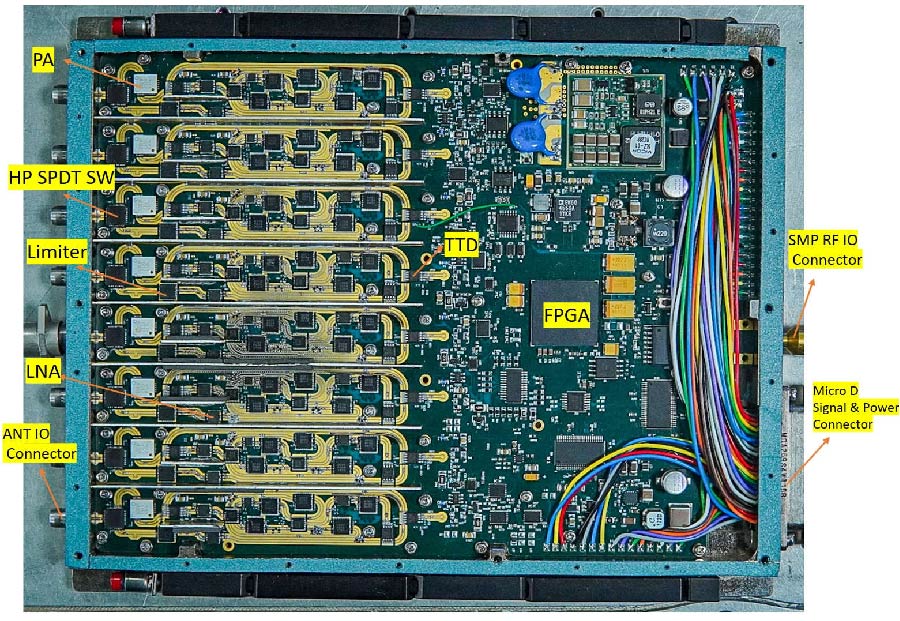
Limiter is a protective structure that is considered a vital device in microwave systems, especially radars. A limiter operates as a receiver protection against large input power for receiver microwave circuit component protection and allows the receiver to function normally when these large signals are not present. In this paper, the investigation and implementation of a miniaturized microwave substrate integrated waveguide power limiter (SIWL), approximately 43×20.5×135 millimeters cubed, for low power receiver protection in military S-Band portable radar applications are compared with a rectangular waveguide limiter (RWGL), approximately 72.14×64.04×178.05 millimeters cubed, and analyzed using commercial software. The proposed limiter design configurations for receiver protection have been designed, analyzed, and compared with samples of the other literature techniques. The proposed designs have been fabricated, and the microwave characteristics have been illustrated. The measured results of the proposed limiters have been analyzed, and the agreement between the measured and simulated results shows that the proposed limiters provide excellent protection and meet the needs of low power receiver portable radar and communication applications with a design that reduces SIWL size.
Study of Miniaturized SIW and RWG Limiters for S-band Receiver Protector Radar and Communication Applications
2023-04-28
PIER C
Vol. 132, 159-170
Realization of Broadband Negative Refractive Index in Terahertz Band by Multilayer Fishnet Metamaterial Approach
Sudarshan Kalel and Wei-Chih Wang
In the present study, a broad negative refractive index (NRI) performance is achieved in the terahertz frequency range (0.6-0.9 THz) through the design of multi-layered fishnet metamaterial (FMM). Herein, the conventional fishnet structure is modified by smoothing the sharp corners to reduce the electric field concentration and improve NRI. At corner radius, r = 30 µm, an effective refractive index of -11.14 is achieved with lower electric field concentration at the corners. A multilayer structure of up to 40 layers is studied to achieve a broad NRI frequency response. The frequency band of NRI response is improved from 0.034 THz for a single layer structure to 0.178 THz for 28 layers structure, almost 6 times the original bandwidth. With the increase in the number of layers, improvement in NRI and Figure of Merit (FOM) is observed, and maximum NRI and FOM values of -87.5 and 12.67 are achieved at 28 layers. This multilayer broadband design can surpass tunable response of available electro-optic materials. With an optimal combination of NRI and FOM, the presented multilayer approach can achieve a low-loss, broadband performance.
Realization of Broadband Negative Refractive Index in Terahertz Band by Multilayer Fishnet Metamaterial Approach
2023-04-26
PIER Letters
Vol. 110, 63-71
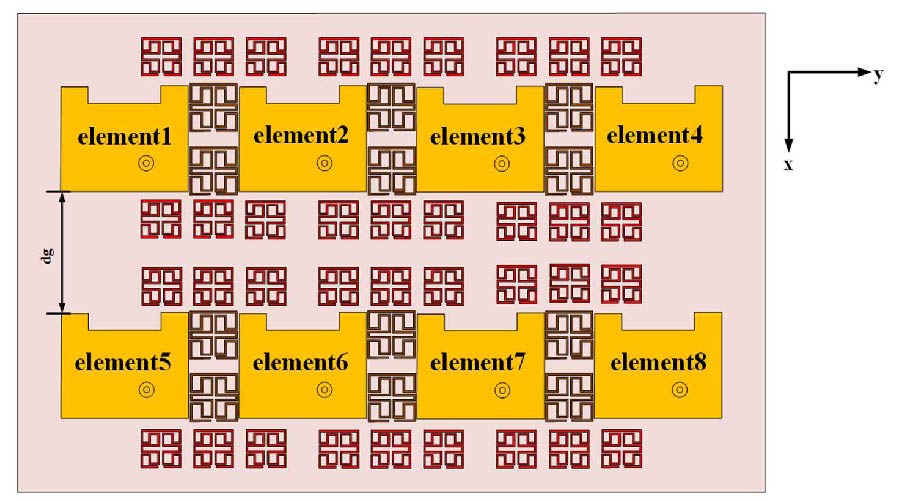
Isolation and Gain Improvement of Multiple Input Multiple Output Antenna Using Frequency Selective Surfaces
Anett Antony and Bidisha Dasgupta
This letter addresses a new approach to improve the gain and isolation of a multiple input multiple output (MIMO) antenna. A C-shaped printed antenna with both ends terminated by a small rectangular section is designed as the basic antenna element for a 2 element MIMO antenna of size 0.8λ×0.67λ×0.04λ (λ, corresponding to lowest operating frequency) which operates over the X band with peak gain of 3 dBi. By introducing a double layered frequency selective surface (FSS) of unit cell dimension 0.2λ×0.2λ×0.0375λ between the two antenna elements as an isolation wall and additionally by placing a 5×3 array of FSS geometry as a reflector below the antenna, the isolation and gain of the two element MIMO antenna are improved by 37 dB and 3 dBi, respectively. The proposed FSS loaded MIMO antenna provides very high isolation about -51 dB (measured) and a very low envelope correlation coefficient (ECC) of 0.000177282 (simulated) using far field approach and 0.000000033414 (calculated measured) using scattering (S) parameter approach. Further MIMO parameters like diversity gain (DG), total active reflection coefficient (TARC), mean effective gain (MEG) and channel capacity loss (CCL) have been evaluated. The radiation pattern is unidirectional in nature with a peak gain about 6 dBi. The letter also presents detailed design guidelines for the proposed FSS loaded MIMO antenna along with their verifications for Ku and K bands. The proposed structure can also be scaled up to a 4 element MIMO antenna.
Isolation and Gain Improvement of Multiple Input Multiple Output Antenna Using Frequency Selective Surfaces