Search Results(13787)

2023-06-19
PIER B
Vol. 100, 133-154
Independent Control Over Passbands in Highly Selective and Compact Triple-Band Bandpass Filter Based on Substrate Integrated Waveguide
Soumit Samadder Chaudhury , Seema Awasthi and Rajat Kumar Singh
This paper proposes a method of independent control over each passband in a high performance triple bandpass filter, which is an essential requirement in the field of microwave communication systems. Individual techniques are presented here to control the excited modes that are responsible for the generation of triple passbands based on substrate integrated waveguide loaded with semi-circular mushroom resonators. Initially, a circular substrate integrated waveguide (CSIW) loaded with two cascaded semi-circular mushroom resonators (ScMRs) with distinct modifications and orientations in the schematic is employed to generate three passbands. The fundamental mode and next higher order mode of the entire resonator structure are utilized to generate three passbands, and distinct techniques of mode perturbations and variation in coupling strength are introduced to independently control the excited modes. Subsequently, the methods established to control the excited modes are employed to independently control the center frequencies (CFs) of three passbands. All those methods established to control the CFs of the three passbands are verified with experimental results which show good agreement with the simulated ones.
Independent Control over Passbands in Highly Selective and Compact Triple-band Bandpass Filter Based on Substrate Integrated Waveguide
2023-06-18
PIER Letters
Vol. 111, 17-25
Ultra-Compact Band-Pass Filter at Low Frequency of Operation
Basil J. Paul and Shanta Mridula
An ultra-compact band-pass filter is presented in this paper. The filter is designed to operate in the medical implants communication service (MICS) band ranging from 401 MHz to 406 MHz. The filter is designed on a Rogers RT/duroid substrate with εr = 2.94 and tanδ = 0.0012. The overall size of the proposed filter is only 30.6 mm x 18.5 mm (0.058λg x 0.035λg), making it suitable for compact, portable devices. An equivalent circuit model is also proposed for the analysis of the filter geometry. From the circuit model, it can be concluded that the filter exhibits the characteristics of a dual-composite right left-handed (D-CRLH) transmission line. This is also confirmed from the dispersion characteristics. The salient features of the proposed filter include ultra-compactness at low operating frequency, harmonic suppression of 3.7 times of the passband frequency, fractional bandwidth of 4.45%, and good roll-off rate of 297.6 dB/GHz in the lower stopband and 116.4 dB/GHz in the upper stopband.
Ultra-Compact Band-Pass Filter at Low Frequency of Operation
2023-06-17
PIER Letters
Vol. 111, 9-16
Research on a New Miniaturization Method of Patch Antenna Based on Metal Strip
Yanwen Hu , Shoudong Li , Tingrong Zhang , Wenying Zhou and Xiufang Wang
A new miniaturized patch antenna based on a metal strip is proposed in this paper. The antenna is designed by adding a middle metal strip layer to the substrate of a traditional rectangular patch antenna. By increasing the length of the metal strip, the working frequency of the patch antenna can be continuously reduced without significantly impacting the radiation pattern. The simulation results indicate that as the metal strip length increases from 5 mm to 25 mm, the working frequency of the patch antenna decreases from 2.39 GHz to 1.84 GHz, and its gain decreases from 6.72 dBi to 5.4 dBi. Two antenna samples with metal strip lengths of 5 mm and 20 mm are fabricated. The experimental results indicate that their working frequencies are 2.64 GHz and 2.43 GHz, respectively. And the radiation patterns of two antennas are consistent with the simulated results. All results confirm the effectiveness of the proposed miniaturization method.
Research on a New Miniaturization Method of Patch Antenna Based on Metal Strip
2023-06-16
PIER C
Vol. 133, 233-249
A Control Method of Switched Reluctance Motor Based on Non-Unity TSF and Adaptive Overlapping Angle
Chaozhi Huang , Wensheng Cao , Yanwen Sun , Zhou Chen and Wenjin Zhang
Aiming at the problems of conventional torque sharing function (TSF) control method, such as large torque ripple, high peak current and high copper loss, a non-unity TSF control method with adaptive overlapping angle is proposed. Firstly, on the basis of explaining the conventional TSF control logic, according to the characteristics of inductance, the conduction region is re-divided, and the two-phase exchange region is subdivided into region 1 and region 2, which together with the single-phase conduction region form three regions in the winding conduction region. A non-unity TSF is designed in each region, which conforms to the torque variation trend. Then, an adaptive overlapping angle algorithm is designed, which can automatically adjust the overlapping angle under different speeds and load torques. Finally, taking a three-phase 6/20-pole switched reluctance motor as the control object, the simulation and experimental verification show that the control method can restrain torque ripple and reduce peak current and copper loss at the same time.
A Control Method of Switched Reluctance Motor Based on Non-unity TSF and Adaptive Overlapping Angle
2023-06-15
PIER Letters
Vol. 111, 1-7
Detection of Water Content in Honey by Electromagnetics Characterization Measurements
Floriane Sparma , Sarah Sennoun and Pierre Sabouroux
The quality of a honey can be affected by adulteration through the addition of often unauthorized substances such as sugar syrups or water. The water content in honeys is restricted to 20% according to CODEX ALIMENTARIUS. This research proposes a method which will allow to detect the water content in the honey directly in the jar. The method uses electromagnetic probing with several antennas around the jar. This method is based on the knowledge of the dielectric contrast between a pure honey and a honey containing different water contents. To validate this contrast, a campaign of dielectric measurements has been investigated on two different commercial honeys (H1 and H2) with arbitrary and controlled added water. The added water content in the honey has been varied from 0% to 15%. The experimental setup uses a coaxial transmission line with a sample holder. The frequency range extends from 100 MHz to 5000 MHz. The mixtures of honeys with water have been measured at an ambient temperature (25˚C).
Detection of Water Content in Honey by Electromagnetics Characterization Measurements
2023-06-13
PIER Letters
Vol. 110, 127-135
A Loaded Line 2-Bit Phase Shifter Using RF MEMS DC/Capacitive Switches
Niharika Narang , Pranav K. Shrivastava , Ananjan Basu and Pushpapraj Singh
This letter presents the fabrication and measurement of a novel loaded line phase shifter design providing four different phase shifts using only two RF MEMS switches. The flexibility of choosing DC or capacitive load depending upon the phase shift required in a single RF MEMS switch makes the phase shifter compact and requires less no. of proposed switches. The RF MEMS Switch has been designed to provide isolation better than 10 dB in both DC and capacitive states from 16 to 45 GHz. Due to the designed RF MEMS beam switching between DC and capacitive loading, the proposed phase shifter provides a 2-bit phase shift using only two switches. The measured phase shifter has the maximum insertion loss of 0.8 dB with a bandwidth of 8 GHz from 16 to 24 GHz. The return loss is better than 10 dB for all four states. The maximum Root-Mean-Square (RMS) insertion loss error is 0.28 dB, and the phase shift error is 0.98º. The proposed phase shifter is fabricated using the surface micromachining on the sapphire substrate and occupies an area of 3.931 mm2.
A Loaded Line 2-bit Phase Shifter Using RF MEMS DC/Capacitive Switches
2023-06-10
PIER C
Vol. 133, 219-231
Enhancement of the Peak Power Handling Capability in Microstrip Filters by Employing Smooth-Profiled Conductor Strips
Jamil Ahmad , Jabir Hussain , Ivan Arregui , Petronilo Martin-Iglesias , Israel Arnedo , Miguel Laso and Txema Lopetegi
This paper presents a design methodology that significantly increases the peak power handling capability (PPHC) of microstrip filters. The PPHC is limited in microstrip technology by the corona effect: a physical phenomenon caused by the ionization of the air under the presence of strong electric fields around the planar circuit. Microstrip filters with a low electric field strength in the air increases the corona threshold level, resulting in high PPHC. Conventional stepped impedance (SI) filters, which consist of cascaded step-shaped elements, exhibit sharp discontinuities. These geometric edges amplify the electric field strength in the air, consequently reducing the corona threshold. Our research group has recently reported a new synthesis technique that introduces a smooth-profile (SP) conductor strip. This SP strip eliminates any sharp discontinuities and significantly reduces the strength of the electric field. This paper focuses on the examination of the high power performance of 7th-order SP and SI low-pass filters. The cut-off frequency (fc) for both types of filters is set at 447.45 MHz, while the frequency for maximum stop-band rejection (fo) is 1 GHz. The findings indicate that the SP filter shows a notable enhancement in peak power handling capability (PPHC), with gains of 2.48 dB and 4.80 dB observed at critical pressure and ambient pressure, respectively.
Enhancement of the Peak Power Handling Capability in Microstrip Filters by Employing Smooth-profiled Conductor Strips
2023-06-09
PIER M
Vol. 117, 105-118
Design of High-Performance Parallel-Connected Filters Using Chained Filtering Functions
Francis Emmanuel Chinda , Socheatra Soeung , Muhammad Sani Yahya , Sovuthy Cheab and Huzein Fahmi Hawari
This paper presents a design of high-performance parallel-connected filters using the Chained filtering function. The filtering functions enable the placement of multiple return loss zeros at the same frequency, resulting in reduced sensitivity to fabrication tolerance and design complexity compared to traditional Chebyshev counterparts. To demonstrate the feasibility of this technique, a new filtering function (FN) based on Chained filtering function is derived, and prototypes of fourth and sixth-degree Chained function filters in a parallel-connected topology are designed and fabricated. The overall size of the filters is 2.5 cm x 4 cm (fourth degree) and 2.5 cm x 5 cm (sixth degree). The measured insertion and return losses are 2.833 dB and 16.150 dB (fourth degree), and 2.674 dB and 18.074 dB (sixth degree). The achievable selectivity of the filters is 78.17 (fourth degree) and 89.68 (sixth degree). This design technique can serve as a useful tool for filter design engineers in terms of implementation.
Design of High-performance Parallel-connected Filters Using Chained Filtering Functions
2023-06-07
PIER C
Vol. 133, 209-218
Ground Radiation Based Triple-Band MIMO Antenna with Wideband Characteristics for Wi-Fi and Wi-Fi 6E Applications
Muhammad Zeeshan Zahid , Ayesha Habib and Longyue Qu
The paper presents a ground radiation antenna (GradiAnt) based triple-band MIMO antenna with wideband characteristics for Wi-Fi 6E applications. The GradiAnt is a novel antenna element with a series combination of inductor and capacitor in the feed loop, and dual-band characteristics have been achieved by controlling the impedance level of the antenna. By introducing a parasitic resonator within the feed loop of GradiAnt, triple-band characteristic is achieved and significant bandwidth enhancement is realized, fully covering the Wi-Fi and Wi-Fi 6E operation bands. The resonator consists of a parasitic strip connected with the ground plane through an inductor. Two identical GradiAnts are symmetrically installed at the corners of the shorter edge of the 55 × 40 mm2 sized ground plane for MIMO scenarios. A loop-type isolator is installed between the antenna elements to decouple the lower Wi-Fi band where the higher bands are self-isolated. The measured bands with reference to -6 dB are 2.36-2.63 GHz and 4.768 GHz. The isolation in the lower and higher bands is greater than 22 dB and 17.5 dB, respectively. The ECC is less than 0.03 in the lower band and 0.16 in the higher bands.
Ground Radiation Based Triple-band MIMO Antenna with Wideband Characteristics for Wi-Fi and Wi-Fi 6E Applications
2023-06-06
PIER
Vol. 177, 75-84
Research on the Radiation Properties of Tapered Slot Magnetoelectric Antenna
Tianhao Han , Biao Dong , Yong Zhang , Yu Wang , Zhongming Yan , Hongcheng Zhou , Jinhua Feng and Yulong Liu
The advent of acoustically mediated magnetoelectric (ME) antennas offers a new idea for miniaturizing antennas. The ME antenna operates at mechanical resonant frequencies, so its dimension can be reduced by three orders of magnitude compared to an electric antenna counterpart. However, the poor directional radiation property of the reported magnetoelectric antennas, which is similar to an ideal magnetic dipole, limits the use of the ME antennas. In this paper, we propose a tapered slot magnetoelectric (TSME) antenna which is composited of PZT-5H and Metglas with dimensions of 50 mm × 30 mm × 0.596 mm and an operating frequency of around 30 kHz. Inspired by the structure of the slot-coupled antenna, the structure of the magnetostrictive layer of the ME antenna has been modified, and the front-back radiation difference in the near field has been improved by 7.9 dB compared to a normal ME antenna. The different operating principles between the TSME antenna and normal ME antennas have been analyzed and verified in the paper. In addition, we have successfully implemented amplitude modulation (AM) signals transmission using TSME antennas. This work provides new ideas for improving the radiation performance of ME antennas and lays the foundation for their practical application.
Research on the Radiation Properties of Tapered Slot Magnetoelectric Antenna
2023-06-06
PIER C
Vol. 133, 195-208
Miniaturized Pentagon-Shaped Planar Monopole Antenna for Ultra-Wideband Applications
Sapna Arora , Sharad Sharma , Rohit Anand and Garima Shrivastva
A pentagon shaped ultra-wideband (UWB) antenna with a high selective notch at wireless local area network (WLAN) band is presented. An inverted L-shaped stub is incorporated with a pentagon-shaped metallic patch fabricated on an FR4 substrate. Also, a partial ground plane with a slot has been used to achieve UWB operation. Two structures are embedded into a patch to realize a rectangular notch. An electromagnetic band gap (EBG) structure is placed on the opposite side of the patch, and a rectangular complementary split ring resonator(RCSRR) is embedded in the patch. With the coupling of two structures, their notch bands are adjusted to achieve a rectangular notch. The bandwidth, upper and lower frequencies of the notch can be adjusted by varying dimensions of RCSRR and EBG. The measured and simulated results show S11 ≤ -10 dB for 3.1 GHz-12.5 GHz with a notch at the WLAN band from 5 GHz to 5.91 GHz. Also, the proposed design has a stable radiation pattern and gain with a peak value of 3.5 dB at 9.5 GHz and -6 dB at 5.1 GHz. The miniaturized size of the proposed design (21.5 mm × 27.5 mm × 1.6 mm) with ultra wide bandwidth makes it suitable for wireless applications.
Miniaturized Pentagon-shaped Planar Monopole Antenna for Ultra-wideband Applications
2023-06-06
PIER M
Vol. 117, 95-104
Structural Design and Optimization of Optical Nano-Antenna Based on Bridge Structure
Guo Liu , Chi Zhao , Jingfei Jiang , Zhaozhao Gao and Jie Gu
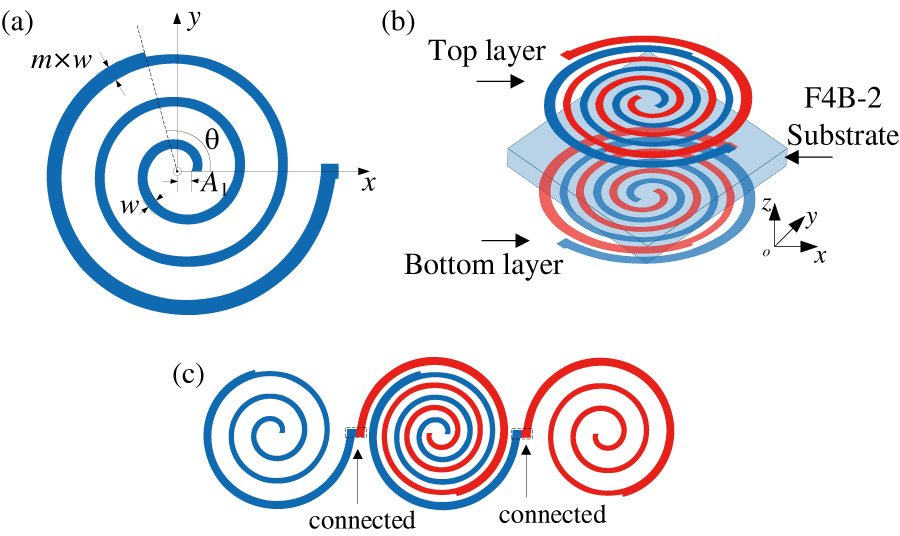
Optical nano-antenna offers a new scheme for solar energy collection by breaking through the band-gap limitation of semiconductor materials. However, complex structure, low efficiency, and narrow bandwidth remain major issues. To address these problems, we propose a novel helical optical nano-antenna based on the bridge structure. The antenna structure consists of two coplanar Archimedes spiral arms and a base layer. We analyze the influence mechanism of structural factors on its radiation efficiency and polarization characteristics. Our results show that the antenna structure achieves a total radiation efficiency of 83.13% in the wide wavelength range of 400 to 1600 nm, which is significantly higher than that of the previously proposed dipole nano-antenna. For different linearly polarized incident waves, the antenna structure obtains the same order electric field at the spiral gap, which indicates that the antenna structure can fully consider the polarization characteristics of sunlight. It fundamentally solves the problem that the linearly polarized antenna can only receive half of the solar energy, improving the absorption efficiency.
Structural Design and Optimization of Optical Nano-antenna Based on Bridge Structure
2023-06-04
PIER
Vol. 177, 53-73
The Effects of Obscuration in Passive 3-D Millimeter-Wave Imaging for Human Security Screening
Xuelei Sun , Neil Anthony Salmon , Xiaodong Zhuge and Jungang Miao
The possibility of near-field passive 3-D imaging using the aperture synthesis technique is theoretically proven and highlights the opportunity for imaging the entire human body by an antenna receiving array that surrounds the body. In these scenarios there will be partial obscuration of some regions of the body, by other parts of the body. This results in some receivers in the array being able to measure emission from certain parts of the body, while others are obscured from a measurement. A model is presented which enables the e ects of obscuration to be assessed for planar-like, cylindrical-like, and concave-like regions of the human body. The e ect the obscuration has on the spatial resolution of the imager is evaluated by examining the 3-D point spread function, as determined by a near-field aperture synthesis imaging algorithm. It is shown that over many areas of the human body, the Abbe microscope resolution of λ/2 (5 mm@30 GHz) in a direction transverse to the human body surface is achievable, an attractive proposition for security screening. However, the spatial resolution in a direction normal to the human body surface is shown to be close to λ(10 mm@30 GHz). In regions of greater obscuration, such as in the armpits, the resolution may fall to λ(10 mm@ 30 GHz) and 5λ (50 mm@30 GHz) in the directions transverse and normal to the human body surface respectively. It is also shown by simulation using a human body solid model and the 3-D aperture synthesis imaging algorithm how the image quality changes with the number of receiving antennas.
The Effects of Obscuration in Passive 3-D Millimeter-wave Imaging for Human Security Screening
2023-06-04
PIER C
Vol. 133, 181-194
Predictive Current Control of Permanent Magnet Synchronous Motor Based on Parameter Identification
Chengmin Wang and Aiyuan Wang
Aiming at the unsatisfactory accuracy and speed of traditional parameter identification methods for permanent magnet synchronous motors (PMSM), a parameter identification method based on an improved hunter prey optimization (HPO) algorithm (Tent chaotic initialization and firefly algorithm HPO (TF-HPO)) was proposed. Using the Tent chaotic map, the initial individuals are evenly distributed to enrich their diversity, and the population position is updated using the firefly perturbation algorithm. Simulation and practical experiments show that compared with unmodified algorithm, the improved algorithm has faster convergence speed and higher recognition accuracy, and can effectively identify the parameters of the motor. On this basis, deadbeat predictive current control is implemented, effectively eliminating current static errors and improving the accuracy and stability of the current control system, and can effectively suppress motor torque ripple and current harmonics caused by parameter deviations.
Predictive Current Control of Permanent Magnet Synchronous Motor Based on Parameter Identification
2023-06-03
PIER C
Vol. 133, 167-179
A Novel Miniaturized Dual Band Slotted Monopole Antenna for WLAN and WiMAX Applications
Omaima Benkhadda , Mohamed Saih , Kebir Chaji , Sarosh Ahmad and Abdelati Reha
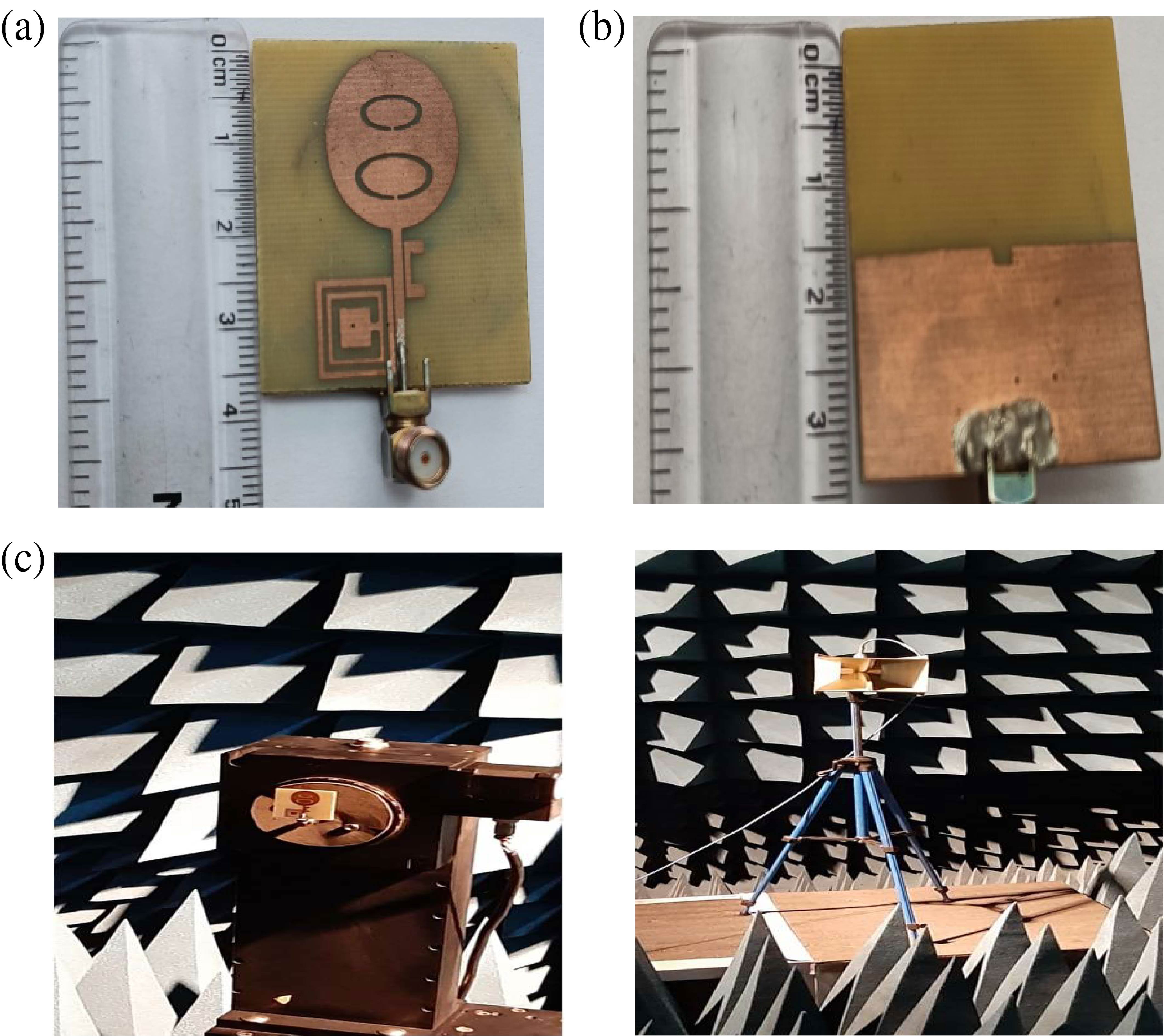
This study presents a novel design for a dual-band antenna that is compact, efficient, and suitable for both WLAN and WiMAX applications. The antenna features a circular patch with a Hilbert fractal structure and a coplanar waveguide feed line, resulting in a compact size of 24x34x1.6 mm3. By utilizing a Hilbert fractal slot and defected ground structure, the antenna can operate in two frequency bands, 2.39-2.47 GHz and 3-6.32 GHz, providing coverage for the desired WiMAX and WLAN bands. The experimental results demonstrate acceptable gains and high efficiency at the resonant frequencies, along with omnidirectional radiation patterns in the H-plane and bidirectional patterns in the E-plane. Notably, this design offers a nearly 50% reduction in size compared to comparable antennas and higher gain, representing a significant contribution to the field of dual-band antenna design.
A Novel Miniaturized Dual Band Slotted Monopole Antenna for WLAN and WiMAX Applications
2023-06-03
PIER C
Vol. 133, 151-165
Performance Analysis of 25 Gbps DP-QPSK Based Co-OFDM-FSO Link Incorporating Spatial Diversity Under Climate Conditions and Atmospheric Turbulence
Sandeep J. Rajput and Yashwant B. Acharya
Attenuation caused by various weather conditions and atmospheric turbulence significantly reduces the performance and reliability of free space optics (FSO) link. This paper employs simulations to analyze the signal quality of the proposed FSO link under various climate conditions. The performance analysis and parametric evaluation of the proposed 25 Gbps DP-QPSK based CO-OFDM FSO link with and without the spatial diversity technique is carried out. Also, we have compared the proposed FSO link with the 16-QAM-based OFDM FSO link for the vivid atmospheric conditions. The simulation results are analyzed in terms of key performance metrics such as bit error rate (BER), signal-to-noise ratio (SNR), link distance, received power and reliability. The results show that the FSO link with spatial diversity is more effective towards mitigating the adverse effects of atmospheric attenuation and turbulence in comparison with FSO link without diversity and 16-QAM OFDM-based FSO link. In total, this results in lower BER, higher SNR, improved received power and increased reliable distance for practical FSO communication system.
Performance Analysis of 25 Gbps DP-QPSK Based CO-OFDM-FSO Link Incorporating Spatial Diversity under Climate Conditions and Atmospheric Turbulence
2023-06-02
PIER M
Vol. 117, 83-93
Analytical Modeling of Metamaterial Absorbers with Low Cross-Polarized Reflected Field Under Oblique Incidence Using Equivalent Medium Approximation
Said Choukri , Hakim Takhedmit , Otman El Mrabet and Laurent Cirio
In this paper, we propose a new physical model to accurately estimate the absorption characteristics in Metamaterial Perfect Absorbers (MPAs). The proposed model, relying on the reflection and refraction theory of microwaves, explains the physical mechanism of absorption and how unit-cell constitutive parameters can contribute to control the absorption characteristics. By considering Floquet modes (TE and TM) as two incident cross-polarized waves, analytical expressions have been established to estimate the absorption at normal and oblique incidences from the extracted constitutive parameters of the unit-cell. Analytical predictions are in excellent agreement with numerical results, proving the validity of our model. Furthermore, it can give an idea behind the absorption characteristics of MPA unit-cells without passing through full-wave simulation which usually takes time. Compared to previous works reported in the literature, the proposed method is efficient and does not require time-consuming tests and processing steps. Finally, analytical findings in this work hold for the general shapes of MPA resonators.
Analytical Modeling of Metamaterial Absorbers with Low Cross-polarized Reflected Field under Oblique Incidence using Equivalent Medium Approximation
2023-06-02
PIER Letters
Vol. 110, 117-126
MIMO Antenna with Reduced Mutual Coupling Using Circular Ring Neutralization Structure
Kondapalli Venu Gopal and Yarravarapu Srinivasa Rao
In this article, a 15 × 20 mm2 arbitrary-shaped antenna is built. The same is extended to a 2 × 2 MIMO antenna with size 32 × 20 mm2. It covers two bands. Band-1 covers 3-4.44 GHz, and band-2 covers 5.32-11.1 GHz. In this case, a circular neutralization structure is used to lessen the mutual coupling between the two ports. The ECC, DG, CCL, and radiation pattern are used to demonstrate how well the MIMO antenna performs. Also, it has been noted that there is good agreement between simulated and measured outcomes.
MIMO Antenna with Reduced Mutual Coupling Using Circular Ring Neutralization Structure
2023-06-01
PIER C
Vol. 133, 135-149
A Shape-Based Approach for Recognition of Hidden Objects Using Microwave Radar Imaging System
Akhilendra Pratap Singh
Microwave imaging radar systems are often required for the recognition of hidden objects at various job sites. Most existing imaging methods that these systems employ, such as beamforming, diffraction tomography, and compressed sensing, which operate on synthetic aperture radar, produce highly distorted radar images due to the limitation of the frequency range, size of the array, and attenuation during the propagation, and thereby become hard to interpret the description of the object. Several methods explored for the recognition of hidden objects are based on deep neural network models with millions of parameters and high computational costs that render them unusable in portable devices. Moreover, most methods have been evaluated on datasets of microwave radar images of hidden objects with the same relative permittivity, orientation, size, and position. In real-time scenarios, objects may not have similar relative permittivity, orientation, size, and position. Due to variation in the object's relative permittivity, orientation, size, and position, there will also be variation in the reflectivity. Consequently, it is hard to say if those algorithms will be robust in real-world conditions. This paper presents a novel shape-based approach for recognizing hidden objects which combines delay-and-sum beamforming with an artificial neural network. The merit of this proposed method is its ability to simultaneously recognize and reconstruct the object's actual shape from distorted microwave radar images irrespective of any variation in relative permittivity, orientation, size, and position of hidden object. The performance of the developed technique was tested on a dataset of microwave radar images of various hidden objects having different relative permittivities, sizes, orientations, and positions. The proposed method yielded an average reconstruction rate of 91.6%. The proposed method is appropriate for evaluating occluded objects such as utility infrastructure, assets, and weapons detection and interpretation, which have regular shapes and sizes of the cross-section at various construction, archaeological and forensic sites.
A Shape-based Approach for Recognition of Hidden Objects Using Microwave Radar Imaging System
2023-05-31
PIER M
Vol. 117, 71-81
Dual-Band Metasurface Antenna Based on Characteristic Mode Analysis
Huawei Zhuang , Honghao Tan , Changyong Liu , Fei Li , Wei Ding , Changbin Tian and Fanmin Kong
A dual-band metasurface antenna is designed consisting of three-layer metal patches and two-layer dielectric substrates. To facilitate the modal analysis of the metasurface, Characteristic Mode Analysis (CMA) is used to analyze the metasurface antenna with 4×4 rectangular patches, and the performance of the antenna is optimized based on the Modal Significance (MS) curves. In order to excite the current of different characteristic modes at certain frequencies, the symmetric resonant arms and cross-shaped impedance matching converters are used in the feeding structure. The measured results are consistent with the simulated values, and the designed antenna can yield the gains of 7.67 dBi at 3.5 GHz and 7.28 dBi at 4.9 GHz, which provides the potential applications in 5G and other wireless communications.
Dual-band Metasurface Antenna Based on Characteristic Mode Analysis