Search Results(13787)

2023-04-24
PIER C
Vol. 132, 145-157
Concentric Circular Antenna Array Synthesis Using Advanced Marine Predator Algorithm
Eunice Oluwabunmi Owoola , Kewen Xia , Victor O. Adewuyi and Paul Shekonya Kanda
In antenna design, the low side lobe level (SLL) of the antenna radiation pattern plays a crucial role in communication systems as it reduces signal interference along the entire side lobes of the radiation pattern. This paper presents an effective technique to minimize the SLL and thus improve the radiation pattern of the concentric circular antenna array (CCAA) using an advanced marine predator algorithm (AMPA). The AMPA is inspired by the predator-prey relationship in aquatic ecosystems, and it incorporates an improved adaptive velocity update strategy and a chaotic sequence parameter. In this work, the AMPA is applied to synthesize two examples of CCAA (4, 6, 8-CCAA elements and 8, 10, 12-CCAA elements) under two different instances (without and with a centre element). The simulation results achieved a significant improvement in SLL minimization as compared to the uniform array, the standard marine predator algorithm (MPA), and some other nature-inspired metaheuristic algorithms.
Concentric Circular Antenna Array Synthesis Using Advanced Marine Predator Algorithm
2023-04-24
PIER C
Vol. 132, 129-144
A Novel Low Profile Turbinella Shaped Antenna for 5G Millimeter Wave Applications
Madhusudhanan Nair Ayyappan , Abhijeet Gaonkar and Pragati Patel
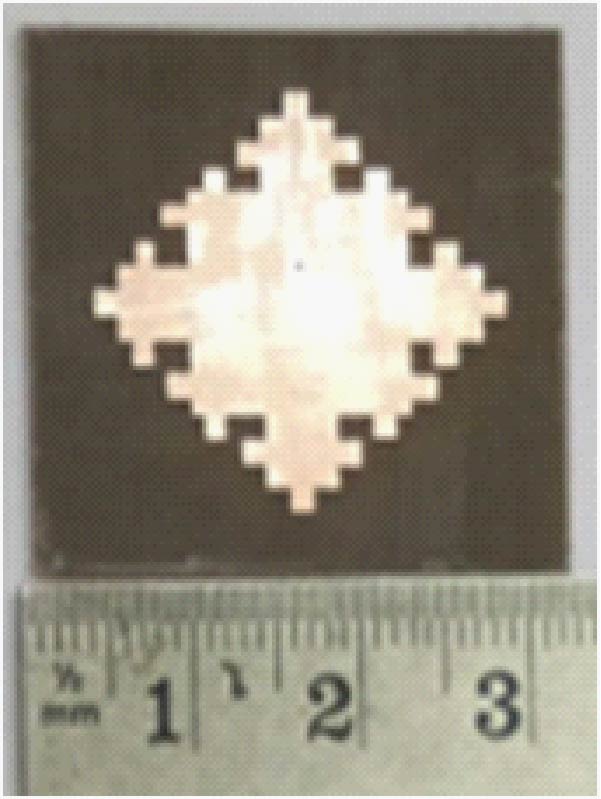
This article investigates a Turbinella-shaped super wideband monopole antenna designed to accommodate the attributes of the fifth-generation (5G) technology which is the enhanced Mobile Broadband (eMBB). The antenna is designed to work with the current millimetre wave bands, including n77, n78, and n258, and it provides the increased data rate needed for eMBB applications. The proposed antenna comprises a Turbinella-shaped patch, a 50 Ω tapered feed line, and a multi-slotted partial ground plane. The self-similarity and space-filling nature of circular geometrical fractal is employed in a novel way to acquire the antenna compactness and broadband performances. Further with the design of a tuning fork-shaped Defective Ground Structure (DGS), super wideband characteristics to incorporate 5G millimeter bands are obtained. The proposed antenna has a compact size of 0.25λ × 0.32λ along with a bandwidth of 173.33% along the frequency ranging from 3 to 41.97 GHz and has achieved a compactness of 81%. Moreover, the fundamental dimension limit theorem is used to demonstrate the antenna's compactness. Time domain analysis is also studied in this article.
A Novel Low Profile Turbinella Shaped Antenna for 5G Millimeter Wave Applications
2023-04-19
PIER C
Vol. 132, 117-127
Miniaturized Metamaterial Ultra-Wideband Antenna for WLAN and Bluetooth Applications
Gengliang Chen , Cong Guo , Jincheng Xue , Zhuopeng Wang and Mingxiang Pang
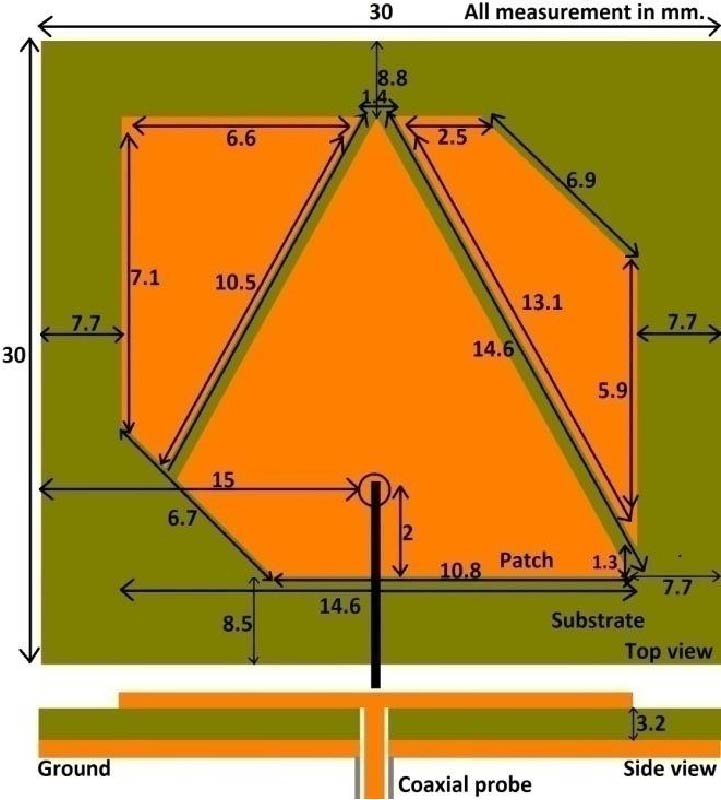
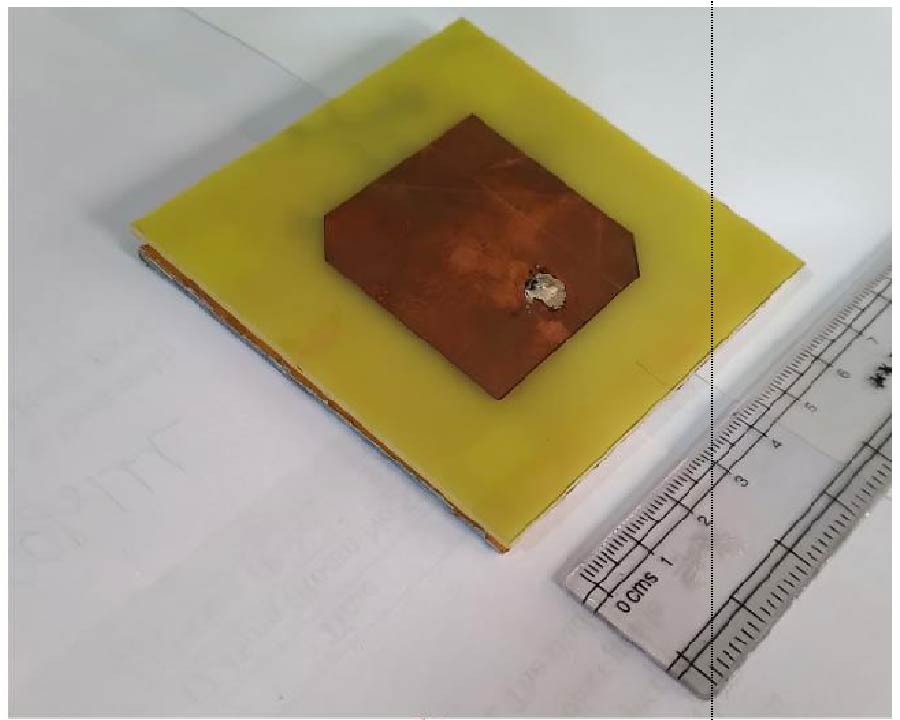
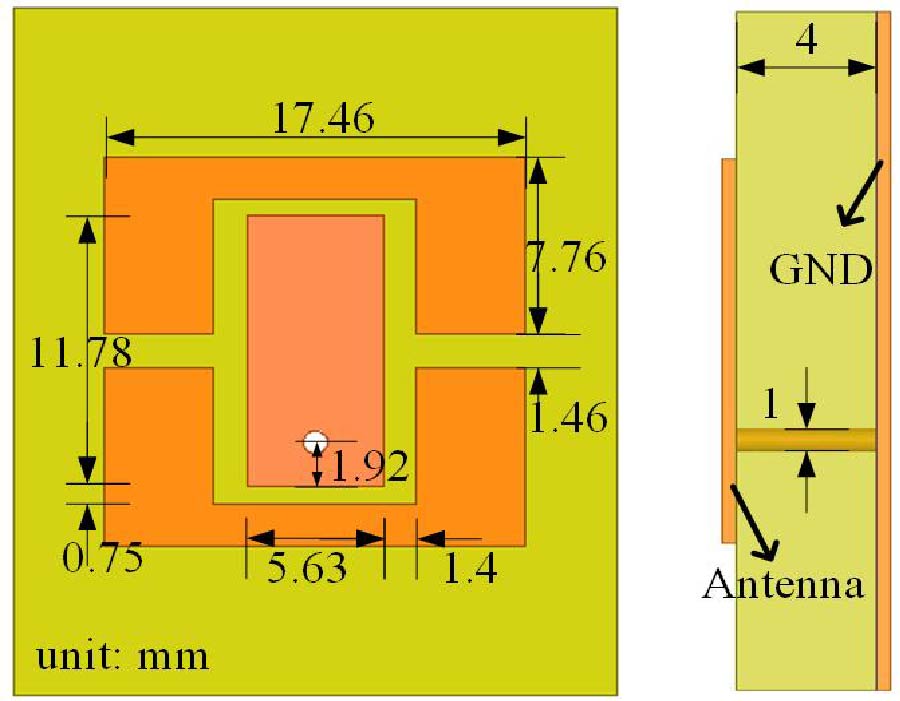
In this paper, a new type of defected ground structure (DGS) antenna based on metamaterial is presented. The proposed antenna has the performance of global bandwidth and gain improvements. The miniaturization of the antenna can be achieved by loading metamaterials on the DGS antenna to reduce the resonance frequency of the antenna. Due to the coupling effect between the metamaterial and the DGS, multiple resonant points are generated, thus extending the impedance bandwidth of the antenna. The impedance bandwidth of the proposed antenna ranges from 3.5 GHz to 6.32 GHz (56.6%). The degree of miniaturization is 37.9%, and the measured peak gain is 4.5 dB. The size of the antenna is only 0.35λ0 × 0.35λ0 × 0.011λ0, which has a highly stable antenna efficiency of greater than 90% over the entire operating bandwidth. The proposed antenna is suitable for WLAN and Bluetooth applications.
Miniaturized Metamaterial Ultra-wideband Antenna for WLAN and Bluetooth Applications
2023-04-19
PIER M
Vol. 116, 129-143
Multiphysics Analysis of High Frequency Transformers Used in SST with Different Magnetic Materials
Sherin Joseph , Shajimon Kalayil John , Kudilil Prasad Pinkymol , Jineeth Joseph and Kappamadathil Raman Muraleedharan Nair
Solid State Transformers (SSTs) are emerging as the major component of smart grid system. High Frequency Transformer (HFT) is the key element of SST. The optimum design of SST is a critical task due to the complex design of magnetic, electric and dielectric circuits of high frequency transformer and due to the design of power electronic circuits used at either sides of HFT. The most significant among above is the design of magnetic circuit and the possibility of using different magnetic materials for high frequency application. This paper discusses the performance analysis of HFT for different magnetic materials used for core construction. The magnetic materials considered in this analysis are amorphous, nanocrystalline and si-steel. Optimum HFT design is selected from a set of designs using an iterative algorithm, considering each core material separately. Validation of the design is done in Finite Element Method (FEM) analysis software. The design of a high frequency transformer, which is integrated in 1000 kVA 11 kV/415 V SST, is investigated both analytically and numerically, with optimum designs developed using three core materials.
Multiphysics Analysis of High Frequency Transformers Used in SST with Different Magnetic Materials
2023-04-18
PIER C
Vol. 132, 103-115
A Meandered Inductive Loop Based RFID Tag Antenna for Luggage Tracking
Amit Kumar Singh and Amit Kumar Singh
In this paper, a planar tag antenna for UHF band RFID composed of a spiral ending meandered line with meandered inductive loop is presented. The presented novel compact spiral ended meandered tag having double sided meandered inductive loop microstrip dipoles scales down the extent of tag antenna and provides an upgraded conjugate impedance matching between tag antenna and semiconductor ASIC. This tag antenna operates at 866 MHz. Here, a compact UHF tag having volume of 60 × 16 × 1.6 mm3 (0.173λ × 0.046λ × 0.0046λ) is testified. This antenna produces impressive reflection coefficient and is able to access detection territory of 12.6 m. The proposed RFID antenna layout is simulated in favor of reader having 4 W EIRP.
A Meandered Inductive Loop Based RFID Tag Antenna for Luggage Tracking
2023-04-17
PIER M
Vol. 116, 119-128
A Local Two-Port Interferometer to Detect Radio-Vortices at 30 GHz
Lorenzo Scalcinati , Bruno Paroli , Mario Zannoni , Massimo Gervasi and Marco Alberto Carlo Potenza
In this work we show a novel method based on a local two-port interferometer to distinguish the topological charge of radio-vortices at 30 GHz by using a small portion of the entire wavefront only. The experimental investigation of the amplitude and phase properties of the interference pattern with a pure Gaussian beam (l = 0) and a l = 1 radio vortex is carried out, and results are compared with the theory based on Laguerre-Gauss modes. Experiments were performed both with the interferometer and with single antenna to highlight the effective benefits of the interferometric approach, sensitive to the azimuthal phase of the vortex field. Method is also extendable at higher topological charges for applications to high-density millimetric communications.
A Local Two-Port Interferometer to Detect Radio-vortices at 30 GHz
2023-04-16
PIER C
Vol. 132, 89-102
Machine Learning Classification of Human Osseous Tissue through Microwave Sensing
Shilpi Ruchi Kerketta and Debalina Ghosh
Globally, microwave frequencies are being extensively employed in numerous biomedical implementations due to its high resolution, reasonable penetration through the human tissue, and cost-effectiveness. However, the quantization of human osseous tissue through microwave sensing is still not proficient. Therefore, this article provides an insight on the prediction of onset and progression of osteoporosis developed through the use of a microwave setup for the contactless evaluation of osteoporosis. This microwave setup comprises a human wrist model as a device under test which is illuminated through a pair of planar stubbed monopole antennas to characterize the different degrees of osteoporosis through frequency domain simulation analysis. By diversifying the wrist dimensions, we are collecting the dataset of the transfer characteristics. Furthermore, different machine learning algorithms are employed on this dataset to train, classify and eventually evaluate the different degrees of osteoporosis. Finally, an optimum machine learning algorithm was obtained to work at an optimum bandwidth and optimum frequency.
Machine Learning Classification of Human Osseous Tissue through Microwave Sensing
2023-04-16
PIER C
Vol. 132, 79-88
Reconfigurable Frequency Selective Surfaces for X Band Applications
Anett Antony , Sayantani Dutta , Bidisha Dasgupta and Anamiya Bhattacharya
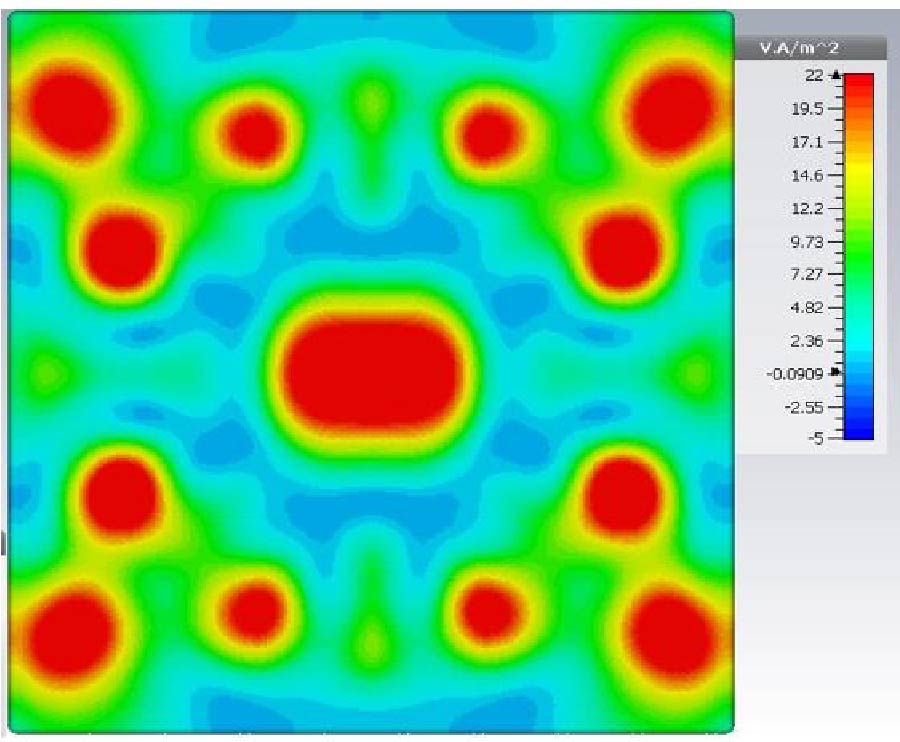
The paper presents a new technique for designing a reconfigurable frequency selective surface (RFSS) by mechanical means. The combination of triangular loop element and three-legged element has been used to design the proposed single substrate two sided frequency selective surface (FSS) structure which offers variable transmission coefficient characteristics over the X-band frequencies under TE polarization for different angles of incidence. Thus, the band stop characteristics can be reconfigured by changing incident angle which describes the structure as `reconfigurable reflector'. The proposed FSS geometry is polarization insensitive under both TE and TM polarizations. The simulated results are further cross verified by conducting measurement of the fabricated structure. The equivalent circuit model (ECM) of the proposed FSS geometry has been provided, and the equivalent circuit parameters of the proposed FSS geometry have also been extracted using the curve fitting techniques. The proposed FSS structure can be used as a frequency reconfigurable reflector surface/reconfigurable intelligent surface (RIS) for advanced wireless communication.
Reconfigurable Frequency Selective Surfaces for X Band Applications
2023-04-15
PIER B
Vol. 100, 19-38
A Metallic 3D Printed Modularized Dual-Stopband AMC-Loaded Waveguide Slot Filtering Antenna
Xingyu Cui and Bing Zhang
A 3D printing and printed circuit board (PCB) hybrid fabricated modularized dual-stopband artificial magnetic conductor (AMC)-loaded filtering antenna is proposed for an X-band high-power radar system.By loading low-cost microstrip AMCs of different frequency responses into a waveguide slot array, we achieve a modularized filtering antenna whose frequency response can be simply controlled by replacing different AMCs. The waveguide slot array only works as a fixture to host different AMCs to achieve various filtering antenna frequency responses. The interchangeable modularized design helps to reduce the difficulty and cost of component fabrication by eliminating the need for complex resonant cavities inside the waveguide filtering antenna, which is time-efficient at the stage of product prototyping when numerous iterations are needed on a trial-and-error base. A dual-stopband filtering antenna is designed and fabricated in the X-band to verify the design concept. The passband covers 9.25-10.6 GHz with the passband gain greater than 10 dBi. The antenna radiates frequency-dependent scanning beams in the passband. The stopbands are 8.1-9 GHz and 10.75-11.5 GHz, and the out-of-band rejection is larger than 35 dB. The proposed design concept provides a different thought to achieve a low-cost filtering antenna by using interchangeable modularized components. The fabricated antenna prototype is a capable candidate for high-power airborne radar applications.
A Metallic 3D Printed Modularized Dual-stopband AMC-loaded Waveguide Slot Filtering Antenna
2023-04-15
PIER B
Vol. 100, 1-18
A Metallic 3D Printed Dual Frequency Dual Circularly Polarized Cross-Slot Waveguide Array Antenna with Improved Grating Lobe
Xianyu Guo and Bing Zhang
A dual frequency dual circularly polarized cross-slot waveguide array working at 4.9 GHz and 5.8 GHz is proposed for wireless communication/airborne weather radar applications. Different from the traditional cross-slotted waveguide antenna, to improve space utilization, two sets of cross-slots are slit on both sides of the longitudinal axis of the waveguide's E-plane to realize dual-frequency operation. When the antenna operates in the TE10 mode, the cross-slots on each side radiate left-handed and right-handed circularly polarized electromagnetic waves at two different frequencies, respectively. To suppress grating lobes, phase perturbation structures are periodically loaded in the waveguide to tune the propagation phase constant, thereby changing the effective electric spacing between radiating elements while keeping the antenna a compact physical aperture. The proposed grating lobe suppression method avoids the dielectric loss caused by dielectric loading, eliminates the need for complex array arrangement, and achieves the grating lobe suppression at dual frequencies simultaneously. The metallic 3D printing technology, selective laser melting (SLM), is used to fabricate the antenna in one piece in one run using aluminum alloy. The proposed antenna has gains of 10 dBic and 14.5 dBic with 47% and 69% aperture efficiencies at 4.9 GHz and 5.8 GHz, respectively. It is a capable candidate for air-to-ground (ATG) communication applications.
A Metallic 3D Printed Dual Frequency Dual Circularly Polarized Cross-slot Waveguide Array Antenna with Improved Grating Lobe
2023-04-13
PIER B
Vol. 99, 179-195
Acceleration of the Primary Basic Functions Calculation from the EFIE-Characteristic Basis Function Method (CBFM) Combined with a New Physical Optics Approximation
Christophe Bourlier
This paper presents a new scheme to implement the iterative physical optics (IPO) approximation with edge diffraction for the scattering from large perfectly-conducting objects, for which, multiple reflections occur. The use of the electric field integral equation (EFIE) discretized by the Galerkin method of moments (MoM) with Rao-Wilton-Glisson basis functions leads to solving a linear system. The characteristic basis function method (CBFM) needs to invert the self-impedance sub-matrices to calculate the primary basis functions (PBFs). To accelerate this stage, these sub-linear systems are directly solved from the physical optics (PO) approximation. In addition, to improve the precision of PO, the EFIE-PO self-impedance matrix is derived analytically. This avoids to apply the magnetic field integral equation (MFIE), for which its principal value is related to PO. Numerical results showed that the resulting algorithm, CBFM-PO, predicts inherently the edge diffraction. A domain decomposition method is able to split up the geometry into blocks, for which either the PO or a LU decomposition is applied according to the sub-geometry. To accelerate the coupling steps, the adaptive cross approximation (ACA) is also implemented, and the resulting method is tested on different targets having a curvature and producing multiple reflections. The numerical results show that EFIE-CBFM-PO is more accurate than the conventional EFIE-CBFM-POJ (based on Jakobus et al. work), specially for objects with curvature.
Acceleration of the Primary Basic Functions Calculation from the EFIE-characteristic Basis Function Method (CBFM) Combined with a New Physical Optics Approximation
2023-04-13
PIER C
Vol. 132, 65-77
Differential Negative Group Delay Circuit Topology with Reverse Nested Double U-Shaped Defected Ground Structure
Zicheng Wang , Zhongbao Wang , Hongmei Liu and Shao-Jun Fang
A simple and flexible differential negative group delay (NGD) circuit topology based on defected ground structure (DGS) is proposed. The circuit consists of microstrip lines and reverse nested double U-shaped (RNDU) DGSs, in which differential transmission and common-mode suppression (CMS) are realized by microstrip lines, and the adjustment of NGD time and the center frequency is achieved by changing the RNDU DGSs. Besides, the bandwidth and NGD time can be increased by cascading double couples of RNDU DGSs. For demonstration, two circuit prototypes with single- and double-couple DGSs are fabricated and measured. The measured results show that the NGD time of the single-couple DGS circuit at the center frequency of 2.279 GHz is -0.57 ns; the insertion loss is 2.08 dB; and the NGD bandwidth is 28 MHz. The NGD time of the double-couple DGS circuit at 2.30 GHz is -2.13 ns; the NGD bandwidth is 41 MHz; and the insertion loss is 4.39 dB. The functions of increasing bandwidth and enhancing NGD are realized. The common-mode insertion loss can reach 43.2 dB, and excellent CMS characteristics are achieved.
Differential Negative Group Delay Circuit Topology with Reverse Nested Double U-shaped Defected Ground Structure
2023-04-13
PIER Letters
Vol. 110, 55-62
Design of Quasi-Equal Inductor Filter Based on Multilayer Substrate
Ke Cao and Kun Pan
A quasi-equal inductor filter and its corresponding multilayer realization are proposed in this paper. The circuit transformation is performed using the Norton transformation. In the proposed filter, ratio between the largest and smallest component values is reduced, which makes the design of components much easier. Meanwhile, by carefully selecting the transformation ratio, all grounding inductors are equal in value. As a result, the multilayer filter design is simplified because only one instance of grounding inductors needs to be designed instead of three. An experimental prototype is fabricated and measured. The measurement result agrees well with the desired one, which shows the effectiveness of proposed filter.
Design of Quasi-equal Inductor Filter Based on Multilayer Substrate
2023-04-12
PIER C
Vol. 132, 51-63
A High Gain CPW Fed Metamaterial Antenna for UWB Applications
Deepa Negi and Rajesh Khanna
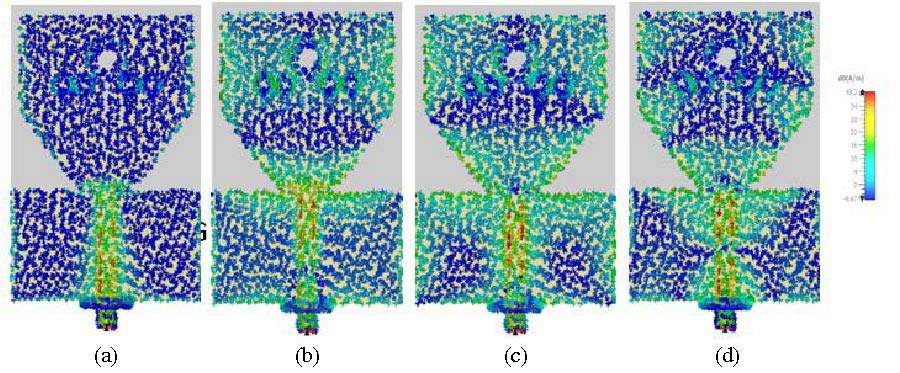
A multi-resonating coplanar waveguide (CPW) fed flexible antenna using metamaterial unit cell is designed for various UWB wireless communication systems. The designed unit cell has the total dimension of 14.8 mm × 14.8 mm × 0.25 mm. The top layer of the cell has a circular ring slot combined with four modified T shaped radiators giving metamaterial characteristics. The unit cell uses perfect boundary conditions along with y axis wave propagation, and it gives wide NRI region covering 2 to 16 GHz of frequency range. The overall gain of proposed CPW fed antenna is increased by using a 3 ×3 metamaterial array as reflector at the back of antenna. The metamaterial antenna has 2 to 16 GHz of total bandwidth and peak gain of 13.1 dB. Further the measured outcomes are in accordance with the simulated ones.
2023-04-12
PIER M
Vol. 116, 103-118
Structure of the Field Behind a Dielectric Circular Cylinder in the Lit Side of the Transition Region
Xin Du and Jun-Ichi Takada
Prediction in the transition region between lit and shadowed regions is important for maintaining stable mobile communication for the beyond 5th generation. In this paper, as the difference between the reflection and diffraction from a dielectric circular cylinder and an absorber screen, respectively, a novel additional term is derived by a uniform theory of diffraction (UTD) in the lit side of the transition region. The proposed model is validated by the UTD and exact solutions of a dielectric circular cylinder. Through the proposal, we can separate the contribution of the shadowed Fresnel zone (FZ) number and boundary conditions (i.e., the surface impedance and the polarization) to the total field. The frequency characteristics of the shadowed FZ and boundary conditions are theoretically analyzed. The analyzed results show that the contributions of the boundary conditions are weaker than the shadowed FZ in the lit region at a high frequency.
Structure of the Field behind a Dielectric Circular Cylinder in the Lit Side of the Transition Region
2023-04-11
PIER C
Vol. 132, 37-49
Propagation of Electromagnetic Waves Along a Compact Nerve Fiber in the Optical and Infrared Ranges
Vasiliy A. Es'kin , Sergey V. Leonov , Oleg M. Ostafiychuk and Alexander V. Kudrin
A study is made of the guiding properties of a nerve fiber consisting of myelinated axons as applied to electromagnetic waves in the optical and infrared ranges. Based on rigorous expressions for the electromagnetic field in the presence of a nerve fiber, the dispersion properties and field structures of eigenmodes guided by the fiber are analyzed for different values of the dielectric permittivity of myelin. It is shown that such a complex waveguide of natural origin can support the propagation of weakly attenuated eigenmodes in the considered ranges. It is shown that the dispersion properties and field structures of the modes of the nerve fiber can differ significantly from those of a single axon.
Propagation of Electromagnetic Waves along a Compact Nerve Fiber in the Optical and Infrared Ranges
2023-04-10
PIER Letters
Vol. 110, 47-53
Optimisation of Directed Energy Systems' Positions Subject to Uncertainty in Operations
Mitchell Kracman
Directed energy weapons (DEWs) have been identified as valuable assets in future land and joint combat. High-power radio frequency (HPRF) is a form of DEW which can neutralise robotic systems by discharging electromagnetic (EM) radiation over a region to couple system electronics. Its widespread effect enables the simultaneous disruption of groups of electronic systems, such as swarms of unmanned aerial systems (UASs). Since EM radiation is a distance-based effect, the arrangement of defensive HPRF systems with respect to their target is critical to understanding their utility and viability. Consequently, a mathematical model to assess the effectiveness of HPRF DEW positioned at a given location is formulated. Towards this, a combat scenario specialised to land operations is defined. The assumptions required to formulate the scenario geometrically and mathematically are also outlined. Provided with the position of an effector, it is then possible to quantify the vulnerability of a UAS swarm in terms of a disruption probability. This accounts for uncertainty stemming from UAS and swarm behaviour and assumes that UASs are independent and identically distributed. The model also draws upon work previously conducted at Defence Science Technology Group (DSTG) which derived an HPRF disruption probability function. An optimisation of the disruption probability is undertaken in terms of the position of a single narrowband HPRF effector. Under a hypothesised set of HPRF and threat parameters, maximal swarm defeat probabilities are examined in different swarm deployment regions and HPRF beam widths. This led to the discovery of various tradeoffs between aforementioned features. In particular, under a fixed beam width, proximity to the swam provided an increased defeat probability but reduced the beam's coverage of the swarm. Hence, numerous UASs might not be affected by EM radiation throughout the engagement, reflected in a reduction to the swarm defeat probability.
Optimisation of Directed Energy Systems' Positions Subject to Uncertainty in Operations
2023-04-09
PIER M
Vol. 116, 91-102
Design of Conformal Log Periodic Dipole Array Antennas Using Different Shapes of Top Loadings
Swetha Velicheti , Pavada Santosh , Prudhivi Mallikarjuna Rao and Mosa Satya Anuradha
Planar and conformal log periodic dipole array (LPDA) antennas are proposed in this paper with circular patch and hexagonal patch top loadings for multiband applications. Due to these top loadings, the size of the antennas is reduced, and the total dimensions of the two antennas are 44 mm x 40 mm. These antennas are fabricated on polyimide material with a dielectric constant of 3.3 and thickness of 0.1 mm. These two antennas resonate at 3.5 GHz, 5.7 GHz, 7.5 GHz and 9.3 GHz frequencies in both planar and conformal modes. The antenna characteristics of the proposed antenna models such as reflection coefficient, VSWR, radiation pattern, and gain are analyzed, and the measured results are in good agreement with simulation ones.
Design of Conformal Log Periodic Dipole Array Antennas Using Different Shapes of Top Loadings
2023-04-07
PIER C
Vol. 132, 23-35
Wideband Circularly Polarized Metasurface Based MIMO Antenna for Midband 5G Applications
Abhilash Achariparambil , Paulbert Thomas and Chandroth K. Aanandan
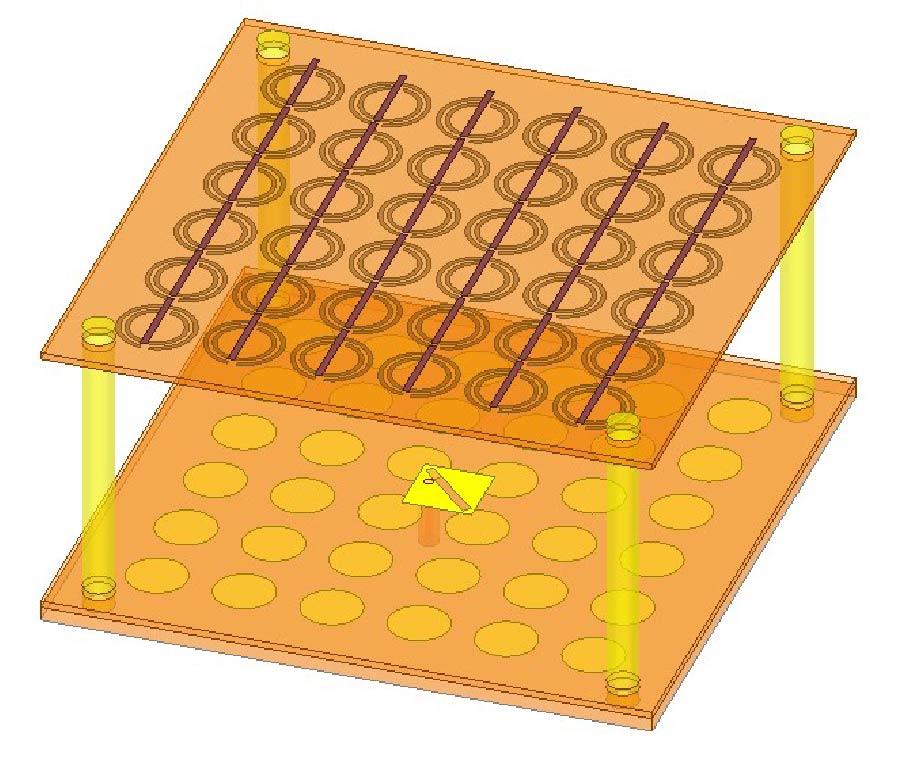
This work describes the design and analysis of a four-element wideband circularly polarized (CP) Multiple-Input-Multiple-Output (MIMO) antenna for mid-band 5G utilizations. The proposed MIMO antenna miniaturization is obtained by the implementation of composite right/left-handed (CRLH) transmission line (TL) and loading of octagonal shaped slotted rings inside the antenna ground plane. Further, the circular polarization radiation is obtained due to the sequence arrangement of two CRLH-TL based unit cells of opposite branches, inside a conventional square patch. The intended MIMO antenna encompasses two layers, the layer-1 consists of a four-element CRLH-TL based circularly polarized MIMO antenna placed in side-by-side configuration. The layer-2 consists of 3×3 square-shaped metasurface on one side and an octagonal slotted ring on another side. The combination of two layer results in wider bandwidths of 68.84% (2.21-4.53) and 3 dB axial ratio (AR) bandwidth of 30.4% (3.1-4.21 GHz). Furthermore, the antenna has better than 10 dB isolation, a maximum gain of 7.2 dBi at 4.04 GHz, radiation efficiency of more than 65%, and lower envelope correlation coefficient (ECC) values across the whole operating band. Diversity Gain (DG) values are high and near to 10 dB. Total Active Reflection Coefficient (TARC) and Channel Capacity Loss (CCL) values are also very much acceptable. As a result, the suggested four-element MIMO antenna is appropriate for midband 5G utilizations.
Wideband Circularly Polarized Metasurface Based MIMO Antenna for Midband 5G Applications
2023-04-07
PIER C
Vol. 132, 11-21
Simplified Design Procedure for Fourth-Order Coupled-Resonator Bandpass Filter
Mai A. Salah , Eman M. Eldesouki , Ahmed Attiya and Walid Saber El-Deeb
This paper presents a new simplified procedure to design a fourth-order coupled resonator filter. This procedure does not require the calculation of complicated Eigenvalues to develop the required coupling matrix. It starts with studying the effects of different coupling mechanisms on the performance of the overall filter structure. Then, these coupling mechanisms are combined to obtain the design of the required filter. This procedure may be more suitable for machine learning procedure to design coupled-resonator filters. The proposed method is used to design a substrate integrated waveguide (SIW) bandpass filter for sub-six GHz 5G applications. The designed SIW bandpass filter operates in the frequency range from 3.7 GHz to 3.98 GHz which covers the New C-band 5G network with a fractional bandwidth (FBW) of 28% and is centered at 3.84 GHz. This filter is fabricated and measured for verification.
Simplified Design Procedure for Fourth-order Coupled-resonator Bandpass Filter