2025-08-11["PIER_181_24111001.png","PIER_182_25012003.png","PIER_183_25052305.png","other\/special_issue_13.png"]
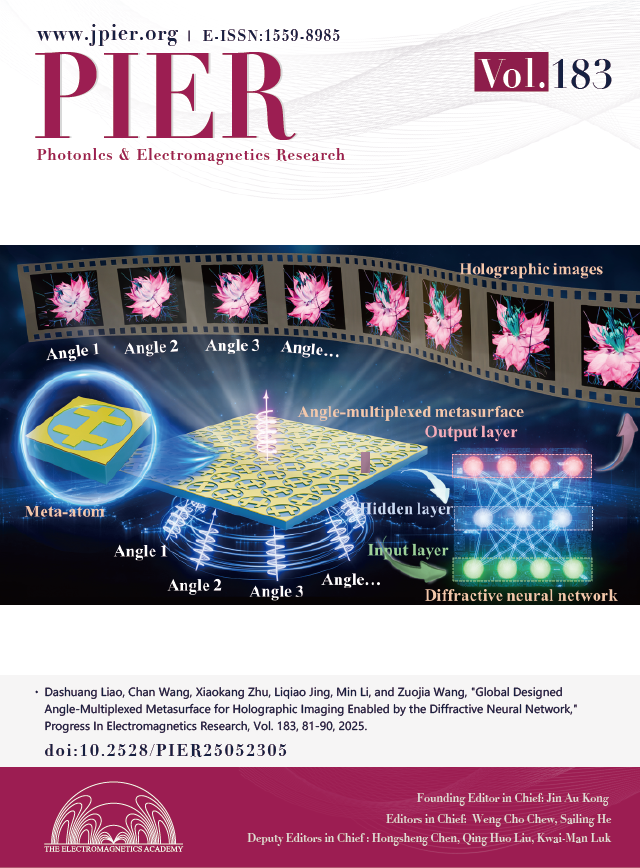
Global Designed Angle-Multiplexed Metasurface for Holographic Imaging Enabled by the Diffractive Neural Network
By Dashuang Liao
Chan Wang
Xiaokang Zhu
Liqiao Jing
Min Li
Zuojia Wang
Progress In Electromagnetics Research, Vol. 183, 81-90, 2025
Abstract
Diffractive optical elements, including holograms and metasurfaces, are widely employed in imaging, display, and information processing systems. To enhance information capacity, various multiplexing techniques such as wavelength, polarization, and spatial multiplexing have been extensively explored. However, the angular optical memory effect induces strong correlations in the diffracted output under varying angles of incidence, thereby fundamentally limiting the use of illumination angle as an independent degree of freedom in multiplexing strategies. Here, we propose and experimentally demonstrate a globally designed angle-multiplexed metasurface hologram enabled by a diffractive neural network (DNN). Angular multiplexing in the DNN is realized by harnessing illumination angle-dependent phase delays across local units, rather than relying on complex local designs with intrinsic angular dispersion. The DNN is trained using the complex electric field distributions and corresponding target images for each incident angle, enabling end-to-end optimization of the entire metasurface phase profile to encode multiple angular channels simultaneously. Besides, phase modulation of circularly polarized transmitted waves is achieved via geometric phase engineering, using a single-layer and fabrication-compatible meta-atom design without relying on multilayer stacking or inter-resonator coupling. Experimental measurements validate the high-fidelity reconstruction of both images at their respective angles, consistent with numerical simulations. Furthermore, robustness studies confirm that the proposed metasurface can tolerate reasonable variations in incident magnitude, angle, and frequency, as well as fabrication-induced phase errors, while preserving imaging fidelity. The proposed metasurface and design strategy offer a scalable platform for high-density information encoding and multiplexed optical systems, with potential applications in augmented reality, secure communication, and multi-view display technologies.