Search Results(13891)

2015-11-24
PIER
Vol. 154, 51-63
Maxwell Stress Induced Flow-Deformation and Optical Nonlinearities in Liquid Crystals (Invited Paper)
Iam Choon Khoo , Shuo Zhao , Chun-Wei Chen and Tsung-Jui Ho
We present a critical account of intense pulsed-laser field induced refractive index changes caused by flow, crystalline axis reorientation and distortion and other high order photonic processes in transparent liquid crystals. In particular, the optical nonlinearity associated with Maxwell Stress induced flow-reorientation in nematic liquid crystals is explicitly calculated, and their possibility for all-optical switching application is experimentally demonstrated. Similar flows processes have also been observed in Blue-Phase liquid crystals with nanosecond and picosecond pulsed-lasers.
MAXWELL STRESS INDUCED FLOW-DEFORMATION AND OPTICAL NONLINEARITIES IN LIQUID CRYSTALS (Invited Paper)
2015-11-23
PIER C
Vol. 60, 21-30
RF MEMS Based Half Mode Bowtie Shaped Substrate Integrated Waveguide Tunable Bandpass Filter
Muhammad Zaka Ur Rehman , Zuhairi Baharudin , Mohd Azman Zakariya , Mohd Haris Md. Khir , Muhammad Taha Jilani and Muhammed Talha Khan
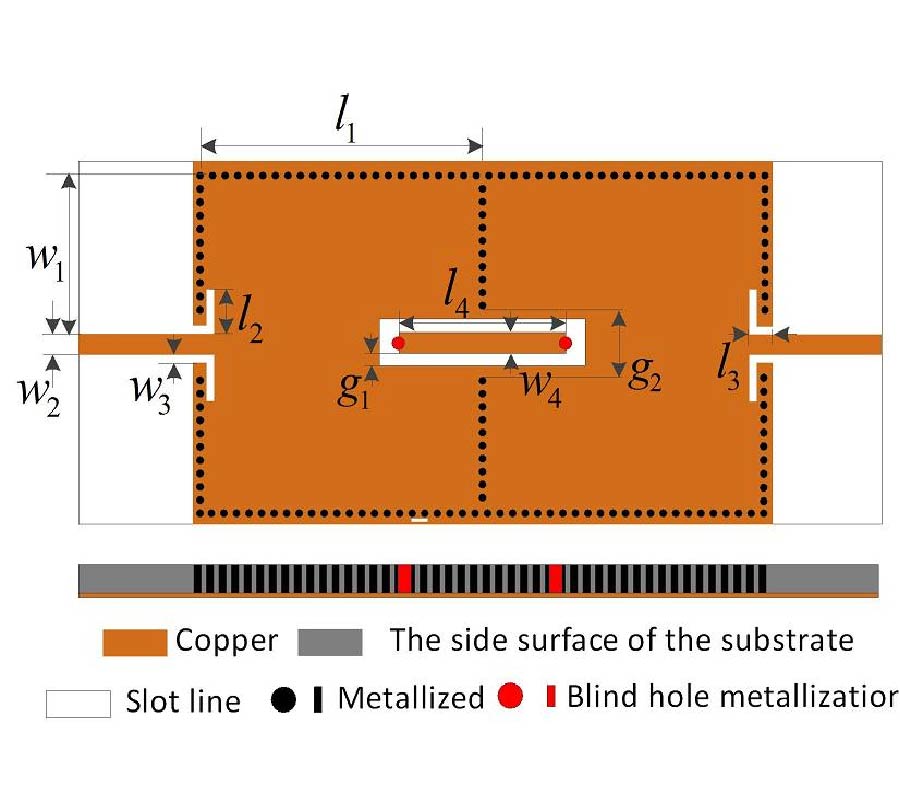
A tunable planar bandpass filter based on a technique that utilizes a half mode substrate integrated waveguide (HMSIW) and novel inter-resonator coupling is presented. The tunable HMSIW based bandpass filter is implemented using two half triangle shaped cavities coupled together through inter-resonator coupling forming half mode bowtie-shaped structure. The bowtie-shaped filter exhibits similar performance as found in rectangle- and circle-shaped SIW based bandpass filters. This concept reduces the circuit foot print, and miniaturization high quality factor is maintained by the structure. The tunable filter utilizes packaged RF MEMS switches; switching between different configurations of switches achieves four distinctive frequency states between 4.8-5.3 GHz. The filter maintains a constant absolute 1 dB bandwidth of 100±10 MHz for all frequency states.
RF MEMS BASED HALF MODE BOWTIE SHAPED SUBSTRATE INTEGRATED WAVEGUIDE TUNABLE BANDPASS FILTER
2015-11-23
PIER C
Vol. 60, 11-20
Low Profile UHF/VHF Metamaterial Backed Circularly Polarized Antenna Structure
Taulant Rexhepi , Igor Bendoym , Ada-Simona Popescu , Andrii Golovin , Johnny Daniels , Kate Duncan and David Crouse
In this work, a low-profile metamaterial backed planar antenna structure designed to work in the UHF/VHF range is presented. The antenna has right-hand circular polarization. It is ideal for satellite-based communications and radar systems. An artificial magnetic conductor was designed using a metamaterial composed of a split ring resonators to reduce the size of the planar antenna and ground plane system. The proposed artificial magnetic conductor has more confined surface waves at the reflecting plane than previous designs and is suitable for circular polarization. Through numerical simulations, performance characteristics including return-loss, and realized gain of the antenna systems are calculated and analyzed in the VHF range. The proposed antenna system is narrowband and is linearly scalable in the range of 100 MHz-1 GHz.
LOW PROFILE UHF/VHF METAMATERIAL BACKED CIRCULARLY POLARIZED ANTENNA STRUCTURE
2015-11-23
PIER C
Vol. 60, 1-10
Inverted Re-Entrant Turnstile Waveguide Circulator Using Prism Resonator with Arbitrary Orientation
Joe Helszajn , John Sharp , Alicia Casanueva , Angel Mediavilla Sanchez and Marco Caplin
The waveguide re-entrant or inverted re-entrant turnstile circulator relies for its operation on either a quarter wave long cylindrical or prism resonator mounted on either a circular or an equilateral platform with its open face separated from the top waveguide wall by a suitable gap. The adjustment of the prism geometry, the main endeavour of this paper, is characterized by two degrees of freedom. One degree of freedom is the orientation of the prism inside the junction with respect to a typical waveguide feed. The others are the aspect ratio of the gyromagnetic resonator and the choice of platform or piston. The agreement between some calculations based on a Finite Element (FE) engine and experiment is excellent. The work undertaken here indicates that the preferred geometry is that for which the platform has the crosshairs section of the resonator.
INVERTED RE-ENTRANT TURNSTILE WAVEGUIDE CIRCULATOR USING PRISM RESONATOR WITH ARBITRARY ORIENTATION
2015-11-20
PIER M
Vol. 44, 171-182
Reconstruction of Objects Buried in Layered Media Based on an Equivalent Current Source
Peng Zhang , Peng Fei , Xin Wen and Feng Nian
In this paper, a novel algorithm based on an equivalent current source is proposed to reconstruct objects buried in a multilayered medium. First, a radiating current source, one part of the equivalent current source, is obtained directly in closed-form from scattering data via the signal-subspace method. Secondly, a nonradiating current source, the other part of the equivalent current source, is represented with the linear superposition of vectors in the noise-subspace. Finally, the objects and equivalent current source are reconstructed efficiently by solving an optimization problem in a lower dimensional linear space with the conjugate gradient (CG) method. To test the new method, the effects of the frequency of incident wave, array aperture size, and SNR are studied in detail. Numerical results show that the proposed method has a high capacity to reconstruct objects buried in a multilayered medium.
RECONSTRUCTION OF OBJECTS BURIED IN LAYERED MEDIA BASED ON AN EQUIVALENT CURRENT SOURCE
2015-11-19
PIER M
Vol. 44, 161-170
A New Wideband Mutual Coupling Compensation Method for Adaptive Arrays Based on Cubic Hermite Interpolation
Jianhui Bao , Qiulin Huang , Xin Huai Wang , Guijie Dou , Peng Liu and Xiao-Wei Shi
A new mutual coupling compensation method for wideband adaptive arrays is proposed. The new method is developed by combining the element pattern reconstruction method and the cubic Hermit interpolation method to achieve wideband mutual coupling compensation. For the employment of this method, mutual coupling matrices at some frequencies obtained by element pattern reconstruction method are needed and stored. By employing the cubic Hermit interpolation method, all entries of mutual coupling matrix for any frequency within the entire frequency band can be obtained accurately and efficiently. A uniform circular array with eight wideband dipole antennas is designed to verify the validity and effectiveness of the proposed wideband compensation method by numerical examples.
A NEW WIDEBAND MUTUAL COUPLING COMPENSATION METHOD FOR ADAPTIVE ARRAYS BASED ON CUBIC HERMITE INTERPOLATION
2015-11-19
PIER
Vol. 154, 35-50
Squeezing Maxwell's Equations into the Nanoscale (Invited Paper)
Diego M. Solis , Jose Taboada , Luis Landesa , Jose Luis Rodriguez and Fernando Obelleiro
The plasmonic behavior of nanostructured materials has ignited intense research for the fundamental physics of plasmonic structures and their cutting edge applications concerning the fields of nanoscience and biosensing. The optical response of plasmonic metals is generally well-described by classical Maxwell's Equations (ME). Thus, the understanding of plasmons and the design of plasmonic nanostructures can therefore directly benefit from lastest advances achieved in classic research areas such as computational electromagnetics. In this context, this paper is devoted to review the most recent advances in nanoplasmonic modeling, related with the latest breakthroughs in surface integral equation (SIE) formulations derived from ME. These works have extended the scope of application of Maxwell's Equations, from microwave/milimeter waves to infrared and optical frequency bands, in the emerging fields of nanoscience and medical biosensing.
SQUEEZING MAXWELL'S EQUATIONS INTO THE NANOSCALE (Invited Paper)
2015-11-18
PIER B
Vol. 64, 119-143
Resonant States in Waveguide Transmission Problems
Yury V. Shestopalov
We prove the existence of complex eigenfrequencies of open waveguide resonators in the form of parallel-plate waveguides and waveguides of rectangular crosssection containing layered dielectric inclusions. It is shown that complex eigenfrequencies are finite-multiplicity poles of the analytical continuation of the operator of the initial diffraction problem and its Green's function to a multi-sheet Riemann surface, and also of the transmission coefficient extended to the complex plane of some of the problem parameters. The eigenfrequencies are associated with resonant states (RSs) and eigenvalues of distinct families of Sturm-Liouville problems on the line; they form countable sets of points in the complex plane with the only accumulation point at infinity and depend continuously on the problem parameters. The set of complex eigenfrequencies is similar in its structure to the set of eigenvalues of a Laplacian in a rectangle. The presence of a resonance domain in the form of a parallel-plane layered dielectric insert removes the continuous frequency spectrum and gives rise to a discrete set of points shifted to (upper half of) the complex plane.
RESONANT STATES IN WAVEGUIDE TRANSMISSION PROBLEMS
2015-11-18
PIER C
Vol. 59, 175-185
Investigation of a Low-Profile Planar Monolayer UWB Antenna with an Open Slot for Bandwidth Enhancement
Aliakbar Dastranj and Bijan Abbasi-Arand
A low-profile planar monolayer antenna for ultra-wideband (UWB) operation is presented. To achieve a UWB performance along with a compact size, a hybrid square-circular radiator and a rectangular open slotted ground plane with two symmetrical I-shaped tuning stubs are proposed. The antenna is fed by a coplanar waveguide line and has a small size of 44 × 32 × 1.6 mm3. The prototype of the proposed antenna was fabricated and tested in an anechoic chamber. The simulated and measured results show good agreement over the entire ultra-wide bandwidth. The measured results indicate that the proposed antenna can provide a wide impedance bandwidth of more than 154% from 1.7 to 13.3 GHz with -10-dB reflection coefficient. In addition, it is demonstrated that by introducing several antenna designs, the impedance bandwidth can be improved from 43% to 154%. Besides several mechanical advantages, such as compact in size, easy fabrication, and monolayer configuration without any back ground plane, the proposed antenna also shows a good performance in its radiation characteristics and time-domain behaviors. The measured results in both frequency and time domains prove that the proposed antenna can be used in a wide range of UWB applications.
INVESTIGATION OF A LOW-PROFILE PLANAR MONOLAYER UWB ANTENNA WITH AN OPEN SLOT FOR BANDWIDTH ENHANCEMENT
2015-11-17
PIER B
Vol. 64, 103-117
Modified Π-Shaped Slot Loaded Multifrequency Microstrip Antenna
Sudipta Das , Partha Pratim Sarkar and Santosh Kumar Chowdhury
A single layer, single feed microstrip antenna with multifrequency operation in compact size is proposed. A modified inverted π-shaped slot is introduced at the left side radiating edge of the patch to reduce the size of the antenna by reducing the resonant frequency. Multiple resonant frequencies with increased frequency ratio are also obtained by cutting the modified inverted π-shaped slot. The measured result shows that the proposed antenna resonates at 3.3, 4.55, 5.56 and 6.08 GHz in microwave S and C band. The size of the proposed patch is only 0.176λL×0.132λL at its lower operating frequency. The proposed patch antenna has achieved 68% size reduction as compared with the conventional rectangular microstrip antenna with same patch area. An extensive analysis of the reflection coefficient, voltage standing wave ratio, gain, radiation efficiency and radiation pattern of the proposed antenna is presented in this paper. The proposed antenna is suitable for WiMax and HiPERLAN wireless systems.
MODIFIED Π-SHAPED SLOT LOADED MULTIFREQUENCY MICROSTRIP ANTENNA
2015-11-17
PIER C
Vol. 59, 167-174
Design and Performance of a W-Band MMW/IR Compound Cassegrain Antenna System with a Hyperbolic Sub-Reflector Based on Frequency Selective Surface
Min Han , Guo-Qiang Zhao , Mang He , Pei Zheng , Zhang-Feng Li , Cheng Jin and Hou-Jun Sun
A MMW/IR compound Cassegrain antenna system for mono-pulse radar applications is presented in this paper. By comparing different modeling methods of conformal frequency selective surface (CFSS), a sub-reflector, with a good performance of reflection at 93 GHz and transparency at the wavelength of 1.06 μm, is achieved according to sputtering technique. At the wavelength of 1.06 μm, transmittance of the sub-reflector is 67%. Compared to a Cassegrain antenna system consisting of a metallic sub-reflector with identical size, the gain of the compound antenna system has a negligible loss (less than 0.4 dB) at 93 GHz. Compared with the patent in [13], the design can improve the limited size of receiving system and the utilization of aperture of the compound detection system at IR region, and can also enhance the heat dissipation.
DESIGN AND PERFORMANCE OF A W-BAND MMW/IR COMPOUND CASSEGRAIN ANTENNA SYSTEM WITH A HYPERBOLIC SUB-REFLECTOR BASED ON FREQUENCY SELECTIVE SURFACE
2015-11-17
PIER Letters
Vol. 57, 125-130
Waveguide Integrated High-Gain Amplifier Module for Millimeter-Wave Applications
Young Chul Lee
In this paper, a high-gain amplifier module has been presented for millimeter wave applications. In order to suppress oscillation of the high-gain amplification block, a rectangular waveguide (WG) is fully integrated into the metal case, on which a cascaded two-stage amplifier is mounted. Due to the integrated WG, additional WG-to-microstrip line (MSL) transitions are required. Therefore, a low-loss and wide-band WG-to-MSL transition is designed and fabricated on a 5 mil thick RT5880 substrate. Two sets of WG-to-MSL transitions in back-to-back structure are assembled in the metal case for the high-gain amplifier module and are characterized. The measured transition loss and operational returnloss (S11) bandwidth less than -10 dB are less than -0.44 dB/a transition and 15.9 GHz from 34.1 to 50 GHz, respectively. The fabricated high-gain amplifier module shows a high gain over 39.7 dB from 38 to 41 GHz. At 38.7 GHz, its maximum gain of 44.25 dB is achieved.
WAVEGUIDE INTEGRATED HIGH-GAIN AMPLIFIER MODULE FOR MILLIMETER-WAVE APPLICATIONS
2015-11-17
PIER M
Vol. 44, 149-160
Reduction of Simulation Times for High-Q Structures Using the Resonance Equation
Thomas Wesley Hall , Prabhakar R. Bandaru and Daniel Rees
Simulating steady state performance of high quality factor (Q) resonant RF structures is computationally difficult for structures with sizes on the order of more than a few wavelengths because of the long times (on the order of ~ 0.1 ms) required to achieve steady state in comparison with maximum time step that can be used in the simulation (typically, on the order of ~ 1 ps). This paper presents analytical and computational approaches that can be used to accelerate the simulation of the steady state performance of such structures. The basis of the proposed approach is the utilization of a larger amplitude signal at the beginning to achieve steady state earlier relative to the nominal input signal. The methodology for finding the necessary input signal is then discussed in detail, and the validity of the approach is evaluated.
REDUCTION OF SIMULATION TIMES FOR HIGH-Q STRUCTURES USING THE RESONANCE EQUATION
2015-11-13
PIER M
Vol. 44, 139-148
Study of the Effects of Eccentric Plasma Coating Over Metamaterial Cylinder
Tayyab Hussain Malik , Shakeel Ahmed , Aqeel Abbas Syed and Qaisar Abbas Naqvi
A plasma sheath can significantly alter the electromagnetic properties of an object, which leads to many practical applications. In this article, the electromagnetic scattering properties of a DB metamaterial cylinder coated with unmagnetized plasma are studied. The effects of layer thickness, non-uniform cladding (eccentric coating), electron number density, electron-neutral collision frequency and the frequency of incident wave on radar cross-section (RCS) of the object are discussed. It is found that the RCS of the DB metamaterial objects can be reduced or enhanced by appropriate values of plasma parameters, thickness or eccentricity. The anomalous behavior of backscattering crosssection of plasma coated DB cylinder has been observed at frequencies near plasma frequency. The results may serve as a noteworthy reference for experimentalists working in plasma stealth technology for metamaterials.
STUDY OF THE EFFECTS OF ECCENTRIC PLASMA COATING OVER METAMATERIAL CYLINDER
2015-11-13
PIER
Vol. 154, 23-33
Plane-Wave Propagation in Electromagnetic PQ Medium
Ismo Veikko Lindell
Two basic classes of electromagnetic medium, recently defined as P and Q medium, are generalized to define the class of PQ media. Plane wave propagation in the general PQ medium is studied and the quartic dispersion equation is derived in analytic form applying four-dimensional dyadic formalism. The result is verified by considering various special cases of PQ media for which the dispersion equation is either decomposed to two quadratic equations or is identically satisfied (media with no dispersion equation). As a numerical example, the dispersion surface of a PQ medium with non-decomposable dispersion equation is considered.
PLANE-WAVE PROPAGATION IN ELECTROMAGNETIC PQ MEDIUM
2015-11-12
PIER B
Vol. 64, 83-101
Definition for Polarization P and Magnetization m Fully Consistent with Maxwell's Equations
Carlo Andrea Gonano , Riccardo Enrico Zich and Marco Mussetta
Dealing with the project of metamaterials scientists often have to design circuit elements at a subwavelength (or ``microscopic'') scale. At that scale, they use the set of Maxwell's equations in free-space, and neither permittivity ε nor permeability μ are formally defined. However, the objective is to use the unit cells in order to build a bulk material with some desired ``macroscopic'' properties. At that scale the set of Maxwell's equations in matter is adopted. To pass from one approach to the other is not obvious. In this paper we analyse the classic definitions of polarization P and magnetization M, highlighting their limits. Then we propose a definition for P and M fully consistent with Maxwell's equations at any scale.
DEFINITION FOR POLARIZATION P AND MAGNETIZATION M FULLY CONSISTENT WITH MAXWELL'S EQUATIONS
2015-11-11
PIER Letters
Vol. 57, 117-123
Compact Four-Element Antenna Array Design for BeiDou Navigation Satellite System Applications
Jianxing Li , Hongyu Shi , Jianying Guo and Anxue Zhang
In this letter, a compact four-element microstrip patch antenna array for BeiDou navigation satellite system (BDS) operation at the B3 (1268 MHz) band is proposed. High permittivity dielectric substrate and slit-loaded microstrip patch are used to reduce the antenna element size down to 40 mm × 40 mm which implies an aperture size of only λ0/6 × λ0/6 at the B3 band. The right-handed circularly polarized (RHCP) radiation is achieved by connecting two coaxial probes to a 0°-90° stripline hybrid. Four identical antenna elements are distributed with the same polarity and an inter-element separation of 80 mm (λ0/3 at the B3 band). The overall size of the antenna array, including the stripline feeding network and supporting ground plane, is only 140 mm × 140 mm × 5.5 mm. A prototype was fabricated and measured to verify the design concept. Simulated and measured results will be presented and discussed, showing that the proposed BDS antenna array is suitable for BDS applications.
COMPACT FOUR-ELEMENT ANTENNA ARRAY DESIGN FOR BEIDOU NAVIGATION SATELLITE SYSTEM APPLICATIONS
2015-11-10
PIER B
Vol. 64, 63-81
Channel Based Design of Systems with Multiple Antennas
Tobias Mahler , Lars Reichardt , Christoph Heine , Mario Pauli and Thomas Zwick
In this article a method of optimizing wireless communication systems using multiple antennas is presented. This method focuses on the synthesis of antenna radiation patterns that are optimized in terms of mutual information, taking into account the specific limitations of the antenna design, such as the available space (for the antenna structure), polarization, number and arrangement of the antennas. The optimization focuses on volume based channel knowledge and on the theory of the intrinsic capacity. Based on this we developed algorithms that allow to determine optimized fixed radiation patterns also for time-variant channels.
CHANNEL BASED DESIGN OF SYSTEMS WITH MULTIPLE ANTENNAS
2015-11-10
PIER C
Vol. 59, 159-166
Broadband, Wide Beam Circularly Polarized Antenna with a Novel Matching Structure for Satellite Communications
Ling Sun , Bao-Hua Sun , He Wu , Jiangpeng Yuan and Wending Tang
A wide beam, circularly polarized (CP) antenna is presented for satellite communications. The antenna consists of two crossed bent dipoles, two baluns and two pairs of rectangular patches. The two dipoles are fed by the two baluns, respectively. The arms of the dipoles are bent to save the horizontal space and to broaden the beamwidth. The rectangular patches which are connected to the arms of the dipoles form the matching structure of the proposed antenna. The impedance bandwidth of the antenna is broadened by adjusting the length of the rectangular patches. A broadband 90° power divider is used to feed the proposed antenna and to realize circular polarization. The antenna has a -10-dB impedance bandwidths of 77% (1.73-3.89 GHz). The proposed antenna exhibits a measured 2-dB AR bandwidth of 76.3%, from 1.71 GHz to 3.8 GHz. The 3-dB beamwidth is greater than 88°over the whole working band. Results show that the proposed antenna is suitable for the application of satellite communications.
BROADBAND, WIDE BEAM CIRCULARLY POLARIZED ANTENNA WITH A NOVEL MATCHING STRUCTURE FOR SATELLITE COMMUNICATIONS
2015-11-09
PIER C
Vol. 59, 149-158
Dual-Band Planar Inverted-F Antenna with Enhanced Bandwidth by Adding a T-Shaped Slot and a Two Elements for Mobile Phone Applications
Mustapha El Halaoui , Abdelmoumen Kaabal , Hassan Asselman , Saida Ahyoud and Adel Asselman
In this article, a compact planar inverted-F antenna with a wide frequency band for WLAN, Bluetooth, HiperLAN, LTE2500, and WiMAX applications in mobile handsets is proposed. The designed PIFA provides two operating bands at 2.5 GHz with a bandwidth of 300 MHz (13%) and at 5.2 GHz with a bandwidth of 5700 MHz (76%). The dual-band performance and the improved bandwidths are realized by two techniques: the integration of a T-shaped slot in the radiating patch of the antenna and the addition of two elements in the side of the PIFA. The two operating bands of the antenna are controlled by adjusting the size of slot and the size of elements 1 and 2. The distribution of the specific absorption rate (SAR) of 1-g and 10-g in the head of human tissues for two positions of the antenna at 2.5 GHz and 5.2 GHz is also studied. The results of simulation and measurement of the proposed antenna are presented and discussed.
DUAL-BAND PLANAR INVERTED-F ANTENNA WITH ENHANCED BANDWIDTH BY ADDING A T-SHAPED SLOT AND A TWO ELEMENTS FOR MOBILE PHONE APPLICATIONS