Search Results(13797)

2015-08-30
PIER Letters
Vol. 56, 1-7
Bandpass Filters with Improved Selectivity Based on Dual-Mode Ring Resonators
Wenjie Feng , Xin Gao and Wenquan Che
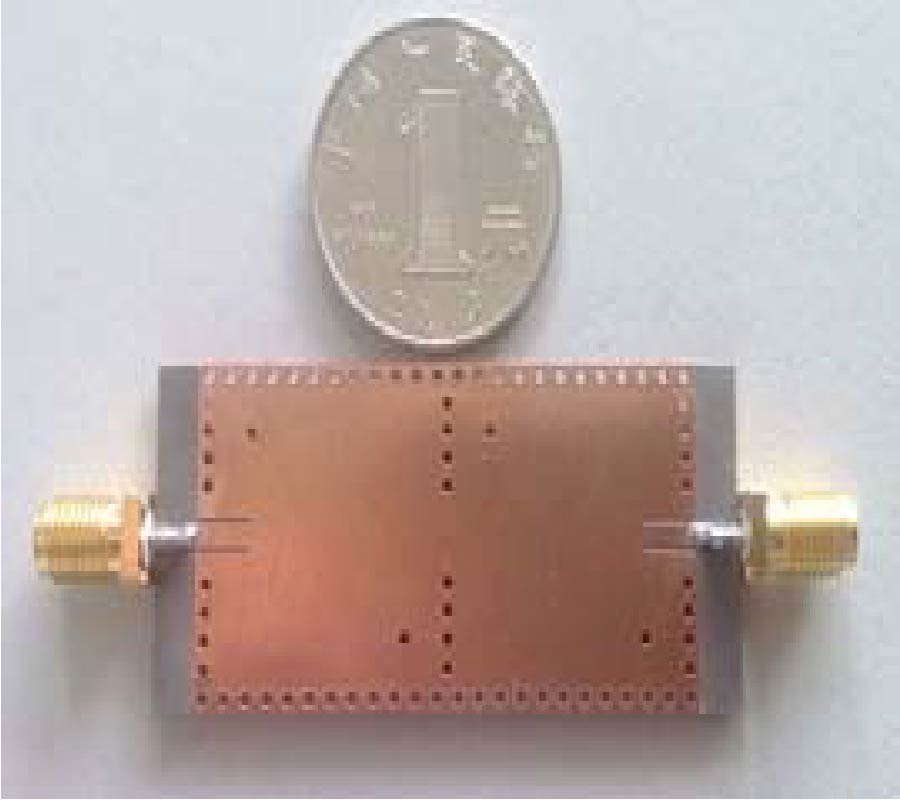
Two novel microstrip bandpass filters with improved selectivity based on dual-mode ring resonators are proposed. Tow and four transmission zeros close to the passband are realized to improve the selectivity for the passband. Sixth-order passband is realized with two open/shorted stubs and a dual-mode ring resonator. The transmission zeros near the passband can be adjusted conveniently by changing the characteristic impedances of the coupled lines. For demonstration, two planar bandpass filters (3-dB bandwidths 20.9%, 20.2%) are designed and fabricated.
BANDPASS FILTERS WITH IMPROVED SELECTIVITY BASED ON DUAL-MODE RING RESONATORS
2015-08-30
PIER Letters
Vol. 55, 145-151
A 60 GHz End-Fire High-Gain Tapered Slot Antenna with Side-Lobe Suppression
Ning Wang and Peng Gao
A simple end-fire high-gain antenna with side-lobe level suppression is proposed for 60 GHz technology in this paper. The antenna has a tapered slot radiation patch which is obtained by subtracting a quarter of ellipse from a bigger quarter. Two reflecting circle units (RCU) are located at both sides of radiant patch to suppress side-lobe level of radiation patterns. The antenna has a simple two-layered planar structure with on via and is fabricated on a Rogers 4350 substrate with a compact size of 15 mm × 15 mm. Simulated and measured results match well, and both show makes it fit 60 GHz wireless communication systems.
A 60 GHZ END-FIRE HIGH-GAIN TAPERED SLOT ANTENNA WITH SIDE-LOBE SUPPRESSION
2015-08-30
PIER
Vol. 152, 127-136
Adaptive Transmission Method for Alleviating the Radio Blackout Problem
Guolong He , Yafeng Zhan and Ning Ge
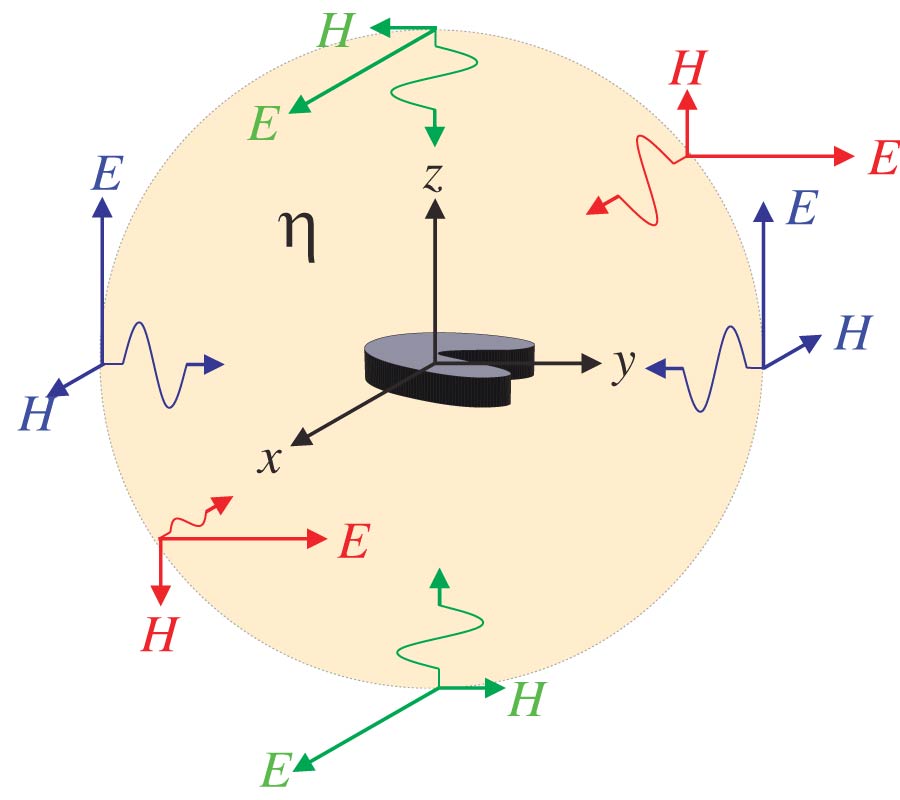
The radio blackout problem stands as one long obstacle for hypersonic flight and planetary atmosphere reentry. Rather than previous physical mitigation methods aiming to reduce the plasma electron density, this paper proposes a novel method which attempts to communicate at carrier frequency much higher than the plasma cutoff frequency. To overcome the highly dynamic channel characteristics, the reflected wave is used online to estimate the instantaneous channel states and enable adaptive transmission. According to the predicted channel states, the plasma sheath induced phase shift and amplitude attenuation are compensated by baseband modulation and power adaptation, respectively. Numerical simulations are presented and discussed, in order to illustrate the effectiveness of the proposed method.
ADAPTIVE TRANSMISSION METHOD FOR ALLEVIATING THE RADIO BLACKOUT PROBLEM
2015-08-28
PIER C
Vol. 59, 51-57
RFID Tag Antenna for Metallic or Non-Metallic Surfaces
Bo Tao , Hu Sun and Omar M. Ramahi
A capacitively fed rectangular patch antenna for anti-metal RFID tag was studied. It was found that by using capacitively feeding and a thin micro-strip line, the input impedance could be stabilized with respect to ground plane size. As a result, the reading range degradation was avoided, and the presented antennas have almost the same reading range when used on metal or non-metal objects. The mechanism was explained by a basic antenna design and a transmission line model. Then a more practical compact design having much smaller size was presented. Prototypes of both the basic design and the compact design were fabricated and tested. The testing results validated the effectiveness of the designing method.
RFID TAG ANTENNA FOR METALLIC OR NON-METALLIC SURFACES
2015-08-28
PIER Letters
Vol. 55, 137-143
Design of a Wideband Sleeve Antenna with Symmetrical Ridges
Peng Huang , Qi Guo , Zhi-Ya Zhang , Yang Li and Guang Fu
In this letter, a novel sleeve antenna with wideband characteristic is presented for wireless communication applications. By employing a sleeve structure, impedance bandwidth of the antenna is improved through exciting a new resonant point. To obtain an impedance bandwidth enhancement further, four symmetrical ridges are introduced between the sleeve and the main radiator. An excellent wideband impedance bandwidth for VSWR≤2 of 148.45% is achieved, covering the frequency range from 1.04 to 7.03 GHz, and good monopole-like radiation patterns are obtained where the un-roundness in the H-plane is less than 1.49 dB. It is very suitable for recent wireless communication services such as DCS, PCS1900, UMTS, IMT2000, WLAN, WiMAX2350/3500, WiBro, etc.
DESIGN OF A WIDEBAND SLEEVE ANTENNA WITH SYMMETRICAL RIDGES
2015-08-28
PIER Letters
Vol. 55, 129-136
Frequency Reconfigurable U-Slot Antenna for SDR Application
Sonia Sharma and Chandra Charu Tripathi
In this paper, a novel frequency reconfigurable U-slot microstrip antenna with T- shaped feed line for Software Defined Radio applications is proposed. The proposed antenna, indexed as A-I in this paper, operates at three different frequencies: 1.85 GHz, 1.9 GHz and 2.4 GHz depending on the switching states of PIN diodes. Furthermore, to strengthen the proposed design concept and strategy another improved antenna (A-II) is designed and tested. In comparison to antenna A-I, the improved antenna design (A-II) utilizes four slots/PIN diodes in order to increase the number of reconfigurable frequency states. Depending on the switch states of four PIN diodes, antenna A-II operates on five different reconfigurable frequency bands centered at: 1.5 GHz, 1.6 GHz, 1.8 GHz, 1.9 GHz and 2.24 GHz. The measured results show a return loss better than 22dB, maximum gain of 2.5 dB and maximum efficiency of 78%. Moreover, radiation pattern for the proposed antennas is stable at all operating frequencies.
FREQUENCY RECONFIGURABLE U-SLOT ANTENNA FOR SDR APPLICATION
2015-08-27
PIER C
Vol. 59, 41-49
A Novel WL-Integrated Low-Insertion-Loss Filter with Suspended High-q Spiral Inductor and Patterned Ground Shields
Tao Zheng , Mei Han , Gaowei Xu and Le Luo
A novel wafer level integrated low-insertion-loss filter working at 1.8 GHz (DCS LPF) with suspended inductors and patterned ground shields on the lossy silicon substrate is fabricated. Thick BCB interlayer is used as the supporting dielectric, and the backside cavity on Si wafer is formed by using a two-step back-etching process. The influence of patterned ground shields on the Q factor of the suspended inductors and the influence of low-resistivity silicon on the insertion loss of filters are analyzed by EM simulation. The fabricated 2.7 nH inductor has a maximum Q factor of 49 at 8.2 GHz and high Q factors more than 22 in the broadband frequency range from 1 GHz to 10 GHz. And the realized LPF in DCS band has the insertion loss of 0.35 dB and return loss of more than 15.5 dB at the pass band, with the second harmonic rejection being 23 dB and the third harmonic rejection being 38 dB respectively.
A NOVEL WL-INTEGRATED LOW-INSERTION-LOSS FILTER WITH SUSPENDED HIGH-Q SPIRAL INDUCTOR AND PATTERNED GROUND SHIELDS
2015-08-27
PIER Letters
Vol. 55, 121-128
Integrated Flexible UWB/Nb Antenna Conformed on a Cylindrical Surface
Nadjet Sahnoun , Idris Messaoudene , Tayeb Denidni and Abdelmadjid Benghalia
In this paper, an ultra-wideband (UWB) conformal monopole antenna integrated with a narrow-band (NB) rectangular slot antenna is designed and fabricated. The proposed structure consists of a circular disc monopole antenna printed on a cylindrical surface, and fed by a coplanar waveguide line (CPW). A rectangular slot antenna that is excited by a microstrip line, is integrated in the front of the UWB antenna. The simulations are performed using the CST Microwave Studio software. To validate the proposed antenna concept, an experimental prototype is fabricated and measured. The measured results show that the monopole antenna covers an ultra wideband from 2 GHz to 12 GHz with S11 < -10 dB and provides a very good isolation with a transmission coefficient below -20 dB across the operating band. Compared to planar integrated antennas, the proposed conformed structure possesses an important wideband, which can be used in many wearable electronic applications and communication systems.
INTEGRATED FLEXIBLE UWB/NB ANTENNA CONFORMED ON A CYLINDRICAL SURFACE
2015-08-27
PIER Letters
Vol. 55, 113-120
Design of Planar Dual-Band Branch-Line Coupler with Π-Shaped Coupled Lines
Yu Cao , Jincai Wen , Hui Hong and Jun Liu
In this paper, a planar microstrip branch-line coupler is designed to have dual-band operation. A Pi-typed structure is used in place of the conventional quarter wavelength transmission line for dual-band application. This structure consists of a pair of coupled line in which one has two ends while the other has open stubs attached to its two ends, and its circuit parameters are determined by the transmission line theory. Explicit design equations are derived using ABCD-matrix. For verification, a 3-dB branch line coupler with operating frequencies of 900 MHz and 3.5 GHz is fabricated and measured on an FR-4 printed circuit board (PCB). The simulated and measured results are in good agreement with each other.
DESIGN OF PLANAR DUAL-BAND BRANCH-LINE COUPLER WITH Π-SHAPED COUPLED LINES
2015-08-27
PIER M
Vol. 43, 135-145
Electromagnetic Characteristics of 1D Grapheme Photonic Crystal by Using SBC-FDTD Method of Oblique Incidence in THz
Lixia Yang , Lingling Li and Lunjin Chen
A modified 1D finite-difference time-domain method is analyzed by using the surface boundary condition (SBC-FDTD) for oblique incidence. The SBC-FDTD iterative formulas are deduced in oblique incidence by TEz and TMz wave. The reflection and transmission coefficients of electromagnetic wave in the 1D photonic crystal (PC) including a graphene sheet are calculated by the SBC-FDTD method. The method is also validated by comparison with the existed analytic methods. Finally, this modified method is applied to simulate 1D graphene photonic crystal (GPC). By changing the position of grapheme sheet in GPC, the electromagnetic gap characterizations of 1D GPC by an oblique incidence plane wave in THz spectral range are studied. The computational results show that the graphene sheet can enhance the absorption in THz because of the localization of light and the surface defect formed by graphene.
ELECTROMAGNETIC CHARACTERISTICS OF 1D GRAPHEME PHOTONIC CRYSTAL BY USING SBC-FDTD METHOD OF OBLIQUE INCIDENCE IN THZ
2015-08-27
PIER
Vol. 152, 105-125
Broadband Green's Function with Low Wavenumber Extraction for Arbitrary Shaped Waveguide and Applications to Modeling of Vias in Finite Power/Ground Plane
Leung Tsang and Shaowu Huang
In this paper we developed the method of broadband Green's function with low wavenumber extraction (BBGFL) for arbitrary shaped waveguide. The case of Neumann boundary condition is treated. The BBGFL has the advantage that when using it to solve boundary value problems in a waveguide, the boundary conditions have been satisfied already. The broadband Green's function is expressed in modal expansion of modes that are frequency independent. To accelerate the convergence of the Green's function, a low wavenumber extraction is performed. The singularity of the Green's function is also extracted by such low wavenumber extraction. Numerical results show that BBGLF and direct MoM are in good agreement. We next illustrate the application of BBGFL for broadband simulations of vias in printed circuit boards (PCB) by combining with the method of Foldy-Lax multiple scattering equation. The results show that BBGFL are in good agreement with MoM and HFSS. It is also shown that BBGFL is many times faster than direct MoM and HFSS. The computational efficiency in broadband simulations makes this technique useful for fast computer-aided design (CAD).
BROADBAND GREEN'S FUNCTION WITH LOW WAVENUMBER EXTRACTION FOR ARBITRARY SHAPED WAVEGUIDE AND  APPLICATIONS TO MODELING OF VIAS IN FINITE POWER/GROUND PLANE
2015-08-26
PIER Letters
Vol. 55, 105-111
Low Profile Pattern Diversity Antenna Using Quarter-Mode Substrate Integrated Waveguide
Kandasamy Krishnamoorthy , Basudev Majumder , Jayanta Mukherjee and Kamla Prasan Ray
In this paper, a pattern diversity antenna, capable of radiating broad side as well as conical radiation patterns using quarter mode substrate integrated waveguide sub-array, has been presented. The pattern diversity is achieved by in-phase and out-of-phase excitation of the sub-array using a rat-race coupler feed network. The overall profile height of the proposed antenna is 3.17 mm. The measured performance of the antenna, in terms of return loss, isolation, gain and diversity performance in the -10 dB impedance bandwidth, is in agreement with the simulated results. The proposed sub-array occupies 25% less area than the conventional microstrip antenna.
LOW PROFILE PATTERN DIVERSITY ANTENNA USING QUARTER-MODE SUBSTRATE INTEGRATED WAVEGUIDE
2015-08-25
PIER Letters
Vol. 55, 97-103
A Single-Layer Planar Monopole Dual-Band Coupled Line Antenna with Low Cross-Polarization for LTE Applications
Wanyi Li , Weimin Wang , Yongle Wu and Yuan'an Liu
In this paper, a novel dual-band antenna with coupled line and different impedance extension lines is presented and analyzed. This simple antenna is composed of three antenna radiations with symmetric coupled lines, and it occupies a compact space of 80 × 30 × 1 mm3. The achieved 10-dB bandwidths of the dual-band operation in free-space condition are 200 MHz and 100 MHz, respectively, which support the 1.8/2.6 GHz Long Term Evolution (LTE) operating bands. Furthermore, various parameters are investigated to examine the effects of the antenna parameters on return loss as well as the gain of the proposed antenna.
A SINGLE-LAYER PLANAR MONOPOLE DUAL-BAND COUPLED LINE ANTENNA WITH LOW CROSS-POLARIZATION FOR LTE APPLICATIONS
2015-08-23
PIER Letters
Vol. 55, 89-95
High Selectivity Balanced Bandpass Filter with Tunable Bandwidth Using Stub-Loaded Resonator
Ya-Lin Ma , Wenquan Che , Jian-Xin Chen and Wenjie Feng
A new balanced bandpass filter (BPF) with tunable bandwidth using tri-mode stub-loaded resonators is proposed. To tune the differential-mode bandwidth, the two even-mode resonance frequencies and two transmission zeros (TZs) are tuned while the odd-mode resonance frequency keeps unchanged. To realize high selectivity for differential mode, another two TZs are created by the source-load coupling and coupling sections. Furthermore, wideband common-mode (CM) suppression is achieved. The fabricated filter has 3-dB fractional bandwidth ranging from 20.0% to 26.0% centered at 1.71 GHz and wideband suppression (17 dB from 2 to 4.4 GHz) for the differential mode, as well as common-mode suppression better than 20 dB from 0 to 4.5 GHz.
HIGH SELECTIVITY BALANCED BANDPASS FILTER WITH TUNABLE BANDWIDTH USING STUB-LOADED RESONATOR
2015-08-23
PIER Letters
Vol. 55, 81-88
Compact 4-Port ACS-Fed UWB-MIMO Antenna with Shared Radiators
Jing-Yi Zhang , Fan Zhang and Wen-Peng Tian
A compact 4-port asymmetric coplanar strip (ACS)-fed MIMO antenna working in the ultra-wideband (UWB) frequency band with two shared radiators is presented in this paper. The proposed antenna is composed of two radiators, and each radiator is shared by two antenna elements in order to achieve a very compact size of 36×36 mm2. By etching two I-shaped slots in the radiators and attaching a rectangular patch on the back, the operating band width is broadened, and the isolation between any two antenna elements is enhanced. The stub of the ground also has great effect on the return loss and isolation. The working frequency band of the MIMO antenna covers 3.1-10.6 GHz with isolation over 15 dB between any two antenna elements. Furthermore, the proposed antenna with a simple feeding structure and compact size makes it possible to be used in portable devices.
COMPACT 4-PORT ACS-FED UWB-MIMO ANTENNA WITH SHARED RADIATORS
2015-08-22
PIER Letters
Vol. 55, 75-80
A Tri-Band MIMO Antenna for WLAN/WiMAX Application
Quan Fang , Dawei Mi and Ying-Zeng Yin
A tri-band multiple-input-multiple-output (MIMO) antenna that covers all frequency bands required for WLAN and WiMAX applications is presented. Three resonant bands are achieved by a folded monopole with a compact size of 11.5×15.6 mm2. The MIMO system consists of two symmetrically placed monopoles. A stepped slot ended with an ellipse on the ground plane is etched to reduce the mutual coupling between the two monopoles. The overall dimension of this MIMO system is 50×50 mm2. The prototype of the antenna is fabricated and measured. Measured results show that the antenna's impedance bandwidth is 450 (18%), 350 (10%), 1200 (21.8%) MHz at the three resonant frequency points (2.5 GHz, 3.5 GHz, 5.5 GHz) with mutual coupling between the antenna elements less than -18 dB in whole frequency band, making this antenna a good candidate for portable application.
A TRI-BAND MIMO ANTENNA FOR WLAN/WIMAX APPLICATION
2015-08-21
PIER Letters
Vol. 55, 67-74
Improvement of the Equivalent Circuit Method for Analysis of Frequency Selective Surfaces Using Genetic Algorithms and Rational Algebraic Models
Gilmara Linhares R. Araujo , Antonio Luiz Campos and Allan de Medeiros Martins
In this paper, we propose an enhancement of the Equivalent Circuit Method (ECM) for analysis of frequency selective surface (FSS) with square loop geometry of the unit cell. For this, genetic algorithms and rational algebraic models are used to obtain a more accurate value of the effective electrical permittivity (εeff). We use simulated data obtained with a commercial software to adjust some parameters. So, genetic algorithm is used to obtain a better value of an exponent that calculates εeff minimizing the rational algebraic models. In this paper, this is done for the square loop geometry, but the methodology can be extended to any geometry. Finally, prototypes are built and the technique is validated.
IMPROVEMENT OF THE EQUIVALENT CIRCUIT METHOD FOR ANALYSIS OF FREQUENCY SELECTIVE SURFACES USING GENETIC ALGORITHMS AND RATIONAL ALGEBRAIC MODELS
2015-08-19
PIER C
Vol. 59, 31-40
A New Conical Band-Reject UWB Antenna with Uniform Rejection and Stable Omnidirectional Behavior
Mohammadreza Khorshidi and Esmaeel Tahanian
This paper introduces a new volumetric conical notch-band antenna. Structure of this antenna is in contrast with planar and printed band rejection antennas currently existing in almost all of the literatures. The radiation pattern of the proposed antenna is symmetrical and stable against frequency variation, while planar and printed antenna types suffer from high variation of their radiation pattern with frequency, and consequently asymmetric and unstable omnidirectional behavior. The frequency band of the antenna is notched with two slots implemented on the antenna structure. Uniform various frequency band rejections are achieved by changing the slots dimensions and position. Both measured and simulation results of manufactured antenna show the frequency bandwidth of the antenna is from 3 to 4.9 GHz and from 6.2 to 11 GHz with reflection coefficient less than -10 dB. Moreover, the antenna notches the frequency band from 4.9 to 6.2 GHz with nearly uniform reflection coefficient level of approximately -3 dB. Stable radiation pattern and proper range of frequency band rejection make the designed antenna an appropriate candidate for the use in UWB and indoor communication systems.
A NEW CONICAL BAND-REJECT UWB ANTENNA WITH UNIFORM REJECTION AND STABLE OMNIDIRECTIONAL BEHAVIOR
2015-08-19
PIER Letters
Vol. 55, 61-66
A Novel Polarization Independent Chipless RFID Tag Using Multiple Resonators
Das Laila , Riny Thomas , Chakkanattu Nijas and Pezholil Mohanan
A novel polarization independent RFID tag employing multiple resonators is proposed. The prototype of the tag is fabricated on a low-cost substrate of dielectric constant 4.4 and loss tangent 0.02. Designing a reader for chipless RFID is a hard task since both the polarization and operating frequency agility have to be implemented. The new tag design proposed in this paper is polarization independent, making the design of the reader easier. A prototype of a 3 bit data encoded tag is demonstrated using single structure which can be extended to any order by cascading. This new design is experimentally validated in the frequency domain using monostatic measurement with magnitude response to decode the information.
A NOVEL POLARIZATION INDEPENDENT CHIPLESS RFID TAG USING MULTIPLE RESONATORS
2015-08-19
PIER Letters
Vol. 55, 53-60
Three-Step Molding Softlithographic Process for 1×2 Y-Branch POF Coupler
Mohd Shafiq Mat Ghazali and Abang Annuar Ehsan
A three-step molding softlithographic process has been developed for the construction of a sharp Y-junction structure formation in a 1x2 Y-branch plastic optical fiber (POF) coupler design. The 1x2 Y-branch POF coupler is based on a Y-junction splitter which requires that the splitting part is constructed with sharp infinitesimal junction. The softlithographic process enables a PDMS mold to be constructed which then allows mass replication of the polymer-based POF coupler. A standard master mold based on PMMA material is fabricated using CNC milling. A secondary or auxiliary-mold process step is then introduced in order to produce a sharp Y-junction structure which is then transferred to the final PDMS stamp prior to device replication. This step utilizes a free flowing, low viscosity casting-based resin, which after curing and hardening provide the auxiliary mold for PDMS mold fabrication. The result shows that a very fine and sharp Y-junction structure can be produced easily which cannot be produced via standard two step molding softlithographic process. Models for the Y-branch POF coupler produced with and without an auxiliary mold process are constructed which show that a 16% increased in optical performance with the device replicated with the auxiliary mold process.
THREE-STEP MOLDING SOFTLITHOGRAPHIC PROCESS FOR 1×2 Y-BRANCH POF COUPLER