Search Results(13802)

2011-09-05
PIER M
Vol. 20, 207-218
Diffraction Field Behavior Near the Edges of a Slot and Strip
Vladimir Serdyuk
The diffraction field asymptotics on the edges of a slot in the plane conducting screen and of a complementary strip is considered using the exact solutions of corresponding stationary diffraction problems, which have been derived before on the bases of the slot (strip) field expansions into discrete Fourier series. It is shown that as nearing the slot (strip) edges, the fields decrease or increase indefinitely in magnitude by the power law with an exponent of modulus less than unity, so the given exact diffraction solutions yield finite value of electromagnetic energy density in any point of space.
DIFFRACTION FIELD BEHAVIOR NEAR THE EDGES OF A SLOT AND STRIP
2011-09-05
PIER
Vol. 120, 195-213
RF Directional Modulation Technique Using a Switched Antenna Array for Communication and Direction-Finding Applications
Tao Hong , Maozhong Song and Yu Liu
A RF directional modulation technique using a switched antenna array is proposed for communication and direction-finding applications. The main idea is that a baseband modulation signal is transmitted by the switched antenna array. The phase center of the transmit signal is moved by the feeding line of each element from the left to the right. In this way, the data information and Doppler frequency shift information are modulated into a transmit signal constellation simultaneously. Therefore, this constellation is a scrambled constellation compared with traditional baseband modulation signal, which varies with the azimuth angle information of the receiver. For the receiver with a single antenna, a differential correlation algorithm is employed to demodulate the data information, and an azimuth angle estimation algorithm is also developed to extract the azimuth angle information from this scrambled constellation. Simulation results show that this RF directional modulation technique offers a comprehensive scheme for communication and direction-finding from the point view of RF modulation technique.
RF DIRECTIONAL MODULATION TECHNIQUE USING A SWITCHED ANTENNA ARRAY FOR COMMUNICATION AND DIRECTION-FINDING APPLICATIONS
2011-09-05
PIER
Vol. 120, 181-193
A Three-Dimensional Imaging Algorithm for Tomography SAR Based on Improved Interpolated Array Transform1
Xiao-Zhen Ren , Li Hong Qiao and Yao Qin
The imaging quality of tomography SAR is limited by the low number of flight tracks and their non-uniform distribution. In this paper, a new 3-D imaging algorithm is proposed for tomography SAR based on the improved interpolated array transform. The key point of the proposed algorithm is the introduction of the projection technique into the interpolated array transform, which can reduce the energy of the interference signal and improve the imaging quality. Performance analysis under different scenarios is carried out via the simulations. And the results demonstrate that the sidelobe performance can be significantly improved by the proposed algorithm.
A THREE-DIMENSIONAL IMAGING ALGORITHM FOR TOMOGRAPHY SAR BASED ON IMPROVED INTERPOLATED ARRAY TRANSFORM1
2011-09-04
PIER Letters
Vol. 26, 115-123
RCS Reduction for a FSS-Backed Reflectarray Using a Ring Element
Li-Shi Ren , Yong-Chang Jiao , Jin-Juan Zhao and Fan Li
A novel RCS (radar cross section) reduction configuration for a reflectarray antenna, employing the appropriate FSS (frequency-selective surface) as a ground, is proposed. The performance of a reflectarray element backed either by a solid metal ground plane or a frequency-selective surface is compared. To optimize the performance of the designed frequency-selective surface, a parametric study is carried out using Ansoft HFSS. Then, a prime-focus FSS-backed reflectarray is fabricated and tested. The measurements demonstrate that the gain of a FSS-backed reflectarray is about 0.5 dB lower than its counterpart backed by a solid ground plane. The RCS is nearly the same at the operating band of 10 GHz, while out of this band the FSS-backed reflectarray reduces the RCS strongly, especially at 1 GHz with the reduction up to 20 dB. Compared with the RCS reductions obtained in the other papers, the FSS-backed reflectarray using a ring element can also obtain a good result.
RCS REDUCTION FOR A FSS-BACKED REFLECTARRAY USING A RING ELEMENT
2011-09-03
PIER B
Vol. 34, 77-102
Wave Propagation in a Helical Waveguide with Slab and Rectangular Dielectric Profiles, and Applications
Zion Menachem and Saad Tapuchi
This paper presents a rigorous approach for the propagation of electromagnetic (EM) fields along a helical waveguide with slab and rectangular dielectric profiles in the rectangular cross section. The main objective is to develop a numerical method for the calculation of the output fields, for an arbitrary step's angle and the radius of the cylinder of the helical waveguide. The other objectives are to present the technique to calculate the dielectric profiles and their transverse derivatives in the cross-section and to demonstrate the ability of the model to solve practical problems with slab and rectangular dielectric profiles in the rectangular cross section of the helical waveguide. The method is based on Fourier coefficients of the transverse dielectric profile and those of the input wave profile. Laplace transform is necessary to obtain the comfortable and simple input-output connections of the fields. This model is useful for the analysis of helical waveguides with slab and rectangular dielectric profiles in the metallic helical waveguides in the microwave and the millimeter-wave regimes. The output power transmission and the output power density are improved by increasing the step's angle or the radius of the cylinder of the helical waveguide, especially in the cases of space curved waveguides.
WAVE PROPAGATION IN A HELICAL WAVEGUIDE WITH SLAB AND RECTANGULAR DIELECTRIC PROFILES, AND APPLICATIONS
2011-09-03
PIER B
Vol. 34,
Low-Loss Grounded Elevated Coplanarwaveguide for Sub-Millimeterwave MMIC Applications
Fatemeh Aghamoradi , Ian McGregor , Scott Roy and Khaled Elgaid
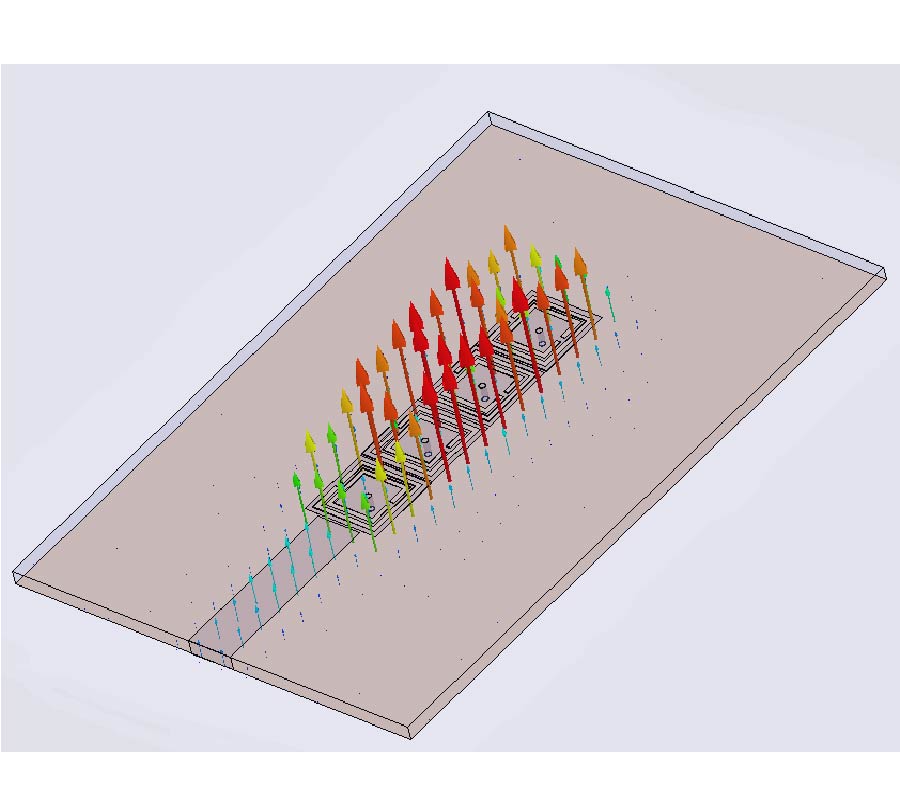
A new type of elevated coplanar waveguide structure is described which uses airbridge technology to suspend CPW traces above a ground plane resting on a high permittivity substrate. The transmission line is effectively shielded from the substrate and is equivalent to conductor backed CPW with an extremely thin, air substrate. It is, therefore, insensitive to parasitic substrate effects such as surface waves and the effect of dielectric loss tangent. In comparison with other forms of CPW with typical lateral dimensions, the structure exhibits no high frequency roll-off at frequencies of around 240 GHz and above. Measured results show 2.5 dB/mm insertion loss at 320 GHz for a 51 Ω line. In order to demonstrate the performance of the new line at mm-wave frequencies, several passive components have been fabricated, measured and their performance compared with CPW counterparts. The experimental results, which are in close agreement with simulation results, for short and open circuited matching stubs, and band-pass and band-stop filters, clearly show improvements in terms of loss and in the characteristics of the frequency response. Also, in order to make some qualitative assessment of the variation in performance with elevation, results for elevations of 6 μm and 13 μm are compared. Low loss and a simple, MMIC compatible, fabrication process make grounded elevated CPW a promising transmission media for MMIC applications at the very high end of the millimeter-wave frequency spectrum.
LOW-LOSS GROUNDED ELEVATED COPLANARWAVEGUIDE FOR SUB-MILLIMETERWAVE MMIC APPLICATIONS
2011-09-03
PIER
Vol. 120, 165-179
An Accurate Conformal Fourier Transform Method for 2D Discontinuous Functions
Chun-Hui Zhu , Qing Huo Liu , Yanhui Liu , Yi Shen and Li Jun Liu
Fourier transform of discontinuous functions are often encountered in computational electromagnetics. A highly accurate, fast conformal Fourier transform (CFT) algorithm is proposed to evaluate the finite Fourier transform of 2D discontinuous functions. A curved triangular mesh combined with curvilinear coordinate transformation is adopted to flexibly model an arbitrary shape of the discontinuity boundary. This enables us to take full advantages of high order interpolation and Gaussian quadrature methods to achieve highly accurate Fourier integration results with a low sampling density and small computation time. The complexity of the proposed algorithm is similar to the traditional 2D fast Fourier transform algorithm, but with orders of magnitude higher accuracy. Numerical examples illustrate the excellent performance of the proposed CFT method.
AN ACCURATE CONFORMAL FOURIER TRANSFORM METHOD FOR 2D DISCONTINUOUS FUNCTIONS
2011-09-03
PIER
Vol. 120, 143-164
Investigations of Cylindrical Ferrite Coupled Line Junction Using Hybrid Technique
Adam Kusiek , Wojciech Marynowski and Jerzy Mazur
In this paper, a novel longitudinally magnetized cylindrical ferrite coupled line (CFCL) junction is proposed. In comparison to planar ferrite coupled line (FCL) configurations, which are well known in literature, in such structure the higher gyromagnetic coupling occurs. This allows to obtain the required in FCL devices Faraday rotation angle π/4 for the ferrite with shorter length and lower value of magnetization. As a result the total insertion losses in the ferrite section can be reduced using the proposed topology. In the analysis of the proposed CFCL junction a hybrid technique combining method of moments and coupled mode method (MoM/CMM) is applied. The results are compared with the ones obtained from commercial software HFSS and a good agreement is obtained.
INVESTIGATIONS OF CYLINDRICAL FERRITE COUPLED LINE JUNCTION USING HYBRID TECHNIQUE
2011-09-02
PIER B
Vol. 34, 63-76
Reconfigurable Coplanar Inverted-F Antenna with Electronically Controlled Ground Slot
Ahmad Rashidy Razali and Marek Bialkowski
In this article, a coplanar inverted-F antenna with an electronically controlled ground slot enabling reconfigurability is proposed. Initially a quarter wavelength coplanar inverted-F radiator is designed to operate at 900 MHz. To minimize its size, the radiator is folded to occupy an area of about 10 × 40 mm2. Next, a ground slot is introduced to excite another resonance at around 1850 MHz without affecting the 900 MHz operation. The slot is loaded with three pairs of PIN diode switches with simple biasing circuits to vary its resonant frequency. The proposed reconfigurable antenna is fabricated and experimentally tested. A good agreement is achieved between the simulated and measured return loss of the antenna showing the experimental impedance bandwidth covering GSM900, PCS1900 and UMTS2100 services. In these frequency bands, the antenna offers nearly omni-directional radiation patterns with measured peak gain between 1.4 dBi to 3.45 dBi.
RECONFIGURABLE COPLANAR INVERTED-F ANTENNA WITH ELECTRONICALLY CONTROLLED GROUND SLOT
2011-09-02
PIER Letters
Vol. 26, 105-114
A Compact Fractal Dipole Antenna for 915mhz and 2.4ghz RFID Tag Applications
Hocine Kimouche and Hamadache Zemmour
A compact printed dipole antenna using fractal shape for Radio Frequency IDentification (RFID) is presented. The proposed antenna consists of a third iteration fractal tree structure with the aim of reducing the antenna size. It occupies a volume of 78 × 30 × 1.58 mm3 and the radiator is composed of two arms. The antenna has been designed and optimized to cover the bi-band for passive RFID tag at 915 MHz and 2.4 GHz. A parametric study of the proposed antenna was carried out in order to optimize the main parameters. Details of the proposed antenna design and measurement results are presented and discussed.
A COMPACT FRACTAL DIPOLE ANTENNA FOR 915MHz AND 2.4GHz RFID TAG APPLICATIONS
2011-09-02
PIER C
Vol. 24, 25-42
A Novel High Accuracy Indoor Positioning System Based on Wireless Lans
Yongxiang Zhao , Qiang Shen and Lianmeng Zhang
A novel indoor positioning system based on received signal strength (RSS) in wireless networks with high accuracy is presented in this paper. The three improvement mechanisms, called signal strength filter, user location filter and path tracking assistance, are employed to improve the positioning accuracy of the system. The comprehensive performance of the proposed system is analyzed in detail and compared with the Radar system. Experimental results demonstrate that the proposed system in this paper can improve 80% accuracy in 3 meters of Radar system to 93% in typical office building testbed. Therefore, the indoor positioning system presented in this paper has the advantages of high accuracy, low cost and easy expansibility, and it can be used to locate people and assets in the fields of logistics, healthcare, and manufacturing.
A NOVEL HIGH ACCURACY INDOOR POSITIONING SYSTEM BASED ON WIRELESS LANS
2011-09-02
PIER C
Vol. 24, 13-24
DOA Estimation Using Time-Frequency Conversion Pre-Processing Method
Sang-Tae Kim , Ji-Tae Kim and Y.-S. Choi
In many cases, the study of DOA estimation techniques is developed based on ideal condition of signal sources and array sensor antennas. But, there are much more errors as a result of signal shadow effects from noise contribution and interference of installation environment in real system. In this paper, the DOA estimation algorithm using the de-noising pre-processing based on time-frequency conversion analysis was proposed, and the performance was analyzed. This is focused on the improvement of DOA estimation at a lower SNR and interference environment.
DOA ESTIMATION USING TIME-FREQUENCY CONVERSION PRE-PROCESSING METHOD
2011-09-02
PIER C
Vol. 24, 1-12
Design and Development of a C-Band RF Transceiver for Uavsar
Yee Kit Chan , Voon Koo , Chin Yang Ang , Kuo Shen Yee and Chua Ming Yam
An experimental Unmanned Aerial Vehicle (UAV) Synthetic Aperture Radar (SAR) Sensor has been designed and developed at Multimedia University, Malaysia. This airborne system is an inexpensive C-band, single polarisation, linear FM airborne radar sensor. The system will be used for monitoring and management of earth resources such as paddy fields, oil palm plantation and soil surface. A series of field measurements and flight test has been conducted to verify the performance of the RF transceiver. This paper highlights the design and development of the SAR RF transceiver, as well as its evaluation result.
DESIGN AND DEVELOPMENT OF A C-BAND RF TRANSCEIVER FOR UAVSAR
2011-09-02
PIER C
Vol. 23, 265-275
Design of Tri-Band Printed Monopole Antenna for WLAN and WiMAX Applications
Jia Chen , Shou-Tao Fan , Wei Hu and Chang-Hong Liang
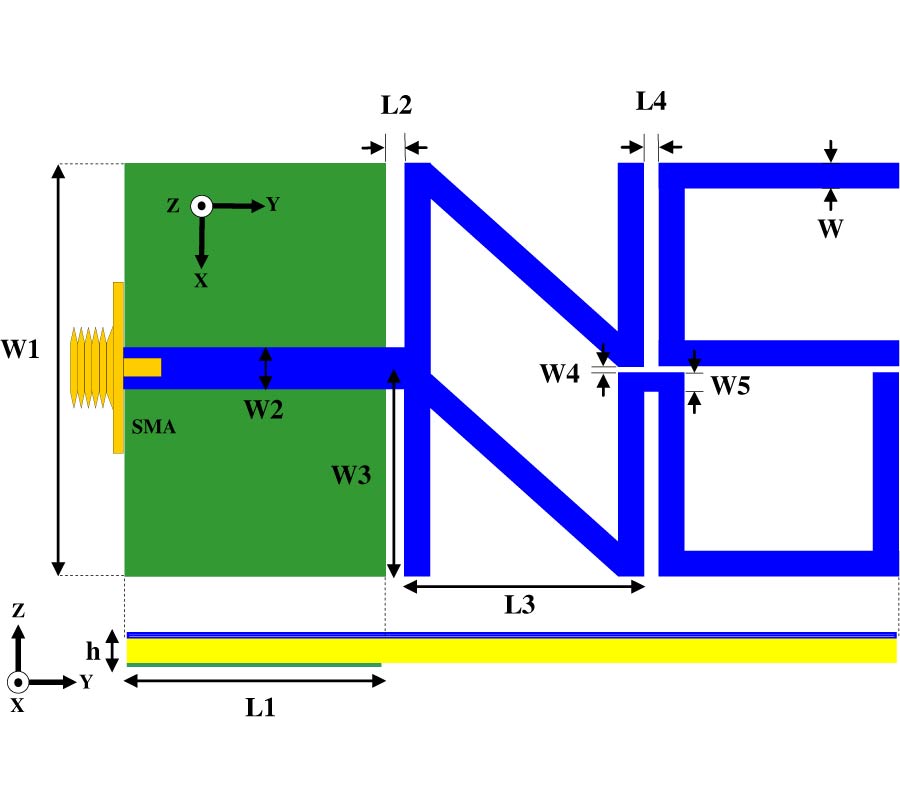
A novel printed monopole antenna with a pair of parasitic patches for wideband operation is proposed and studied. With the use of parasitic patches along the microstrip feed line, a good performance of bandwidth enhancement is obtained. The measured impedance bandwidth, defined by voltage standing wave ratio (VSWR) ≤ 2, can operate from 2.3 to 6.2 GHz. A tri-band printed monopole antenna is created by introducing two notched bands in the wideband antenna. Etching an n-shaped slot on the radiating element and embedding a U-shaped parasitic strip on the bottom, two notched bands from 2.78 to 3.34 GHz and from 3.78 to 5.1 GHz are achieved. The measured impedance bandwidths of the tri-band antenna are 410 MHz (2.37-2.78 GHz), 440 MHz (3.34-3.78 GHz) and 1000 MHz (5.1-6.1 GHz), which can meet the bandwidth requirements of 2.4/5.2/5.8 GHz wireless local area network (WLAN) and 2.5/3.5/5.5 GHz worldwide interoperability for microwave access (WiMAX) standards. In addition, the proposed antennas have good omnidirectional radiation characteristics and stable gains over the whole operating bands.
DESIGN OF TRI-BAND PRINTED MONOPOLE ANTENNA FOR WLAN AND WIMAX APPLICATIONS
2011-09-02
PIER M
Vol. 20, 191-205
Caustic Region Fields of a 3D Cassegrain System Placed in BI-Isotropic Homogeneous Chiral Medium
Arshad , Muhammad Qasim Mehmood and Muhammad Junaid Mughal
This paper presents the electromagnetic field expressions for 3D cassegrain system embedded in a bi-isotropic chiral medium. Mathematical formulation of Maslov is used to find the field expressions in the focal region. Effect of chirality (both the week and strong) on focal region fields is analyzed. It is seen that when the chirality effect is weak (i.e., κ < 1), chiral medium will support positive phase velocity (PPV) for both the left circularly polarized (LCP) and the right circularly polarized (RCP) modes. However for strong chiral medium (i.e., κ > 1), one mode travels with PPV and the other mode travels with negative phase velocity (NPV). The line plots are given to show the behavior of fields in the focal plane of 3D cassegrain system by changing the chirality parameter (κ).
CAUSTIC REGION FIELDS OF A 3D CASSEGRAIN SYSTEM PLACED IN BI-ISOTROPIC HOMOGENEOUS CHIRAL MEDIUM
2011-09-01
PIER C
Vol. 23, 249-263
Variable Coupling Ratio Y-Branch Plastic Optical Fiber (POF) Coupler with Suspended Waveguide Taper
Abang Annuar Ehsan , Sahbudin Shaari and Mohd Kamil Abd-Rahman
A variable coupling ratio Y-Branch plastic optical fiber (POF) coupler based on acrylic has been developed. This device utilized two optical designs: a Y-branch structure with a novel suspended waveguide taper and a simple attenuation technique based on lateral displacement of two fibers for the non-symmetrical coupling ratios. The high index contrast waveguide taper is constructed on the acrylic block itself where the area surrounding the waveguide taper has been designed in such a way that it is surrounded by an open air. A simple attenuation technique based on lateral displacement of two adjoining fibers for each of the two output ports has been proposed and presented for the non-symmetrical coupling ratios. Lateral displacement of the fiber is set from 4.4 mm down to 1.6 mm for output fiber 1 and 0.1 mm to 1.0 mm for output port 2. Numerical analysis has been done on the lateral displacement of the output fibers which shows the device is able to generate non-symmetrical coupling ratios. Device modeling has been performed using non-sequential ray tracing technique on the Y-branch coupler performing as a 3 dB coupler with an excess loss of 1.84 dB and a coupling ratio of 50:50. The designed coupling ratios vary from 1% to 45% for port 1 and 99% down to 55% for port 2 whereas in the simulated device, ratios vary from 7.65% to 39.85% for port 1 and from 92.35% down to 60.15% for port 2. Fabrication of the device is done by producing the device structures on an acrylic block using high speed CNC machining tool. The fabricated device has an excess loss of 5.85 dB while the coupling ratios are 56.86% and 43.14% when operating as a 3 dB coupler. In the variable coupling ratio mode, the coupling ratios are 10.09% to 32.88% for port 1 and 89.91% down to 67.12% for port 2. The excess loss of the fabricated device varies from 5.85 dB to 8.49 dB.
VARIABLE COUPLING RATIO Y-BRANCH PLASTIC OPTICAL FIBER (POF) COUPLER WITH SUSPENDED WAVEGUIDE TAPER
2011-09-01
PIER M
Vol. 20, 179-190
Near Field Focusing Effect and Hyperbolic Dispersion in Dielectric Photonic Crystals
Natesan Yogesh and Venkatachalam Subramanian
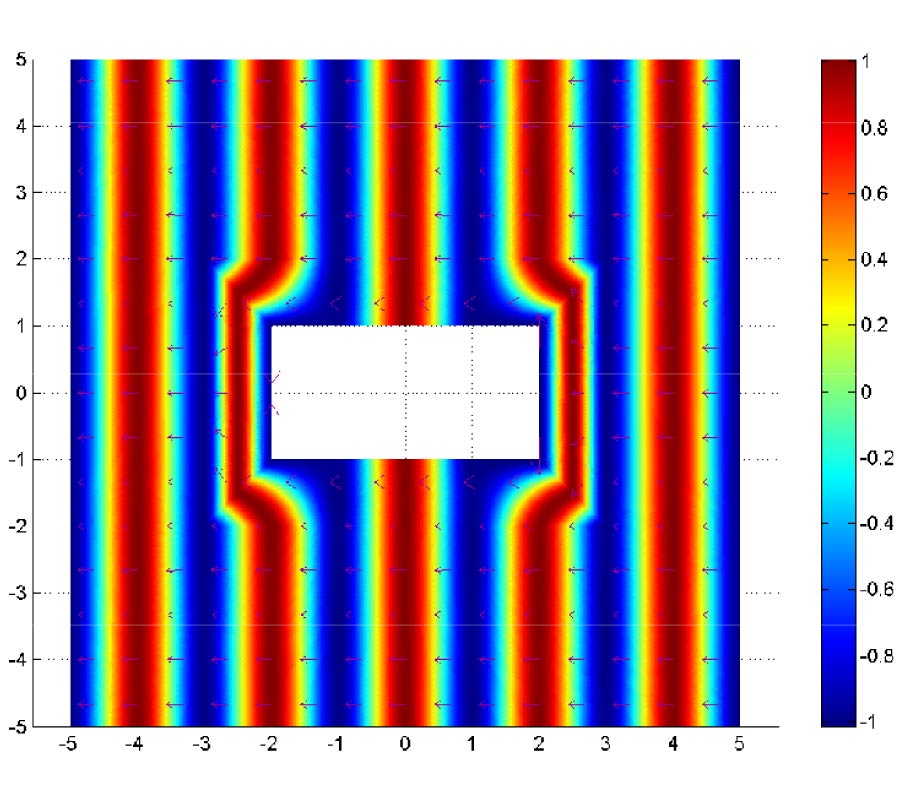
This paper investigates the near field focusing behavior corresponding to the hyperbolic dispersion regime at the second band of the square lattice photonic crystal (PC). Numerical studies reveal the influence of the corner part negative refraction in the observed focusing effect, though the major part of the refraction is divergent at this hyperbolic regime. It is further observed that the investigated dispersion shows the surface mode behavior when the effective index of the PC slab is higher than the air medium. This aspect may be implemented for the excitation and transfer of near fields for an evanescent wave microscopy.
NEAR FIELD FOCUSING EFFECT AND HYPERBOLIC DISPERSION IN DIELECTRIC PHOTONIC CRYSTALS
2011-09-01
PIER
Vol. 120, 127-141
A Switched-Beam Antenna Using Circumferential-Slots on a Concentric Sectoral Cylindrical Cavity Excited by Coupling Slots
Phairote Wounchoum , Denchai Worasawate , Chuwong Phongcharoenpanich and Monai Krairiksh
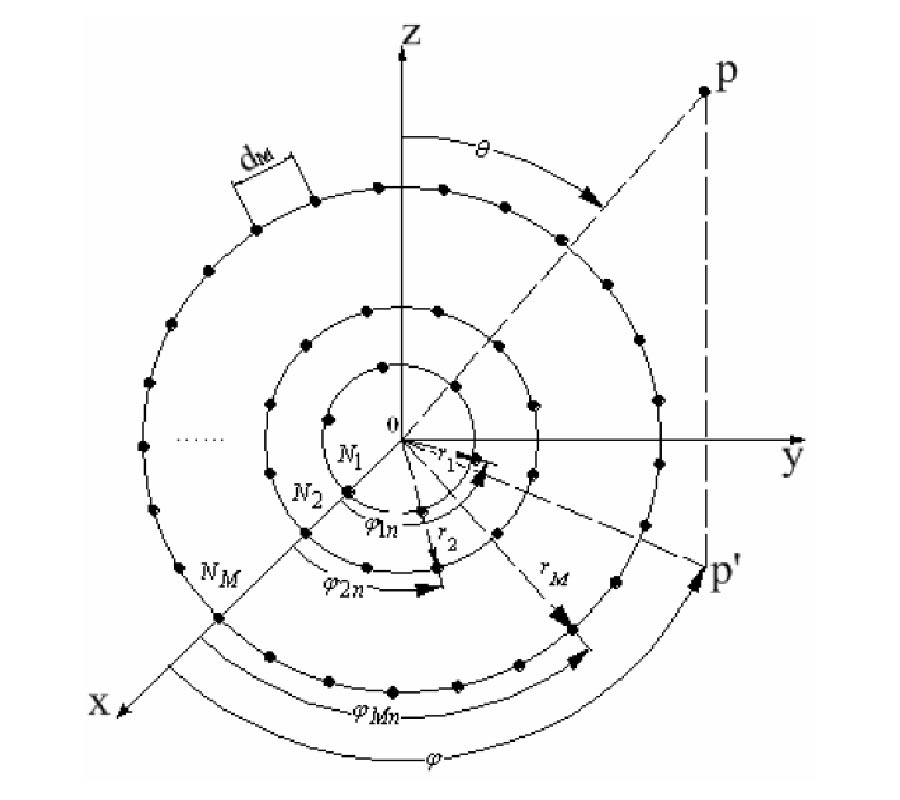
This paper presents a switched-beam antenna using circumferential-slot on a concentric sectoral cylindrical cavity excited by coupling slots to operate at 5.8 GHz. The advantages of this antenna are conformal structure, high directivity and capable of switched-beam pattern in six directions. The antenna design starts from a single sector which is capable of switching between radiating and non-radiating modes. The L-shaped coupling slots are proposed to accommodate the switching circuit. Each RF switch is made of two PIN diodes connected in a reverse series connection and placed across the slot at the appropriate location. Subsequently, the exciting probe is designed for matching TM01 mode of the circular waveguide. The measured results of the proposed antenna give a gain of 7 dBi and |S11| less than -20 dB at 5.8 GHz. This antenna is suitable for base station applications that require the switched-beam pattern in the azimuthal plane.
A SWITCHED-BEAM ANTENNA USING CIRCUMFERENTIAL-SLOTS ON A CONCENTRIC SECTORAL CYLINDRICAL CAVITY EXCITED BY COUPLING SLOTS
2011-09-01
PIER
Vol. 120, 99-125
FEM Modeling for Performance Evaluation of an Electromagnetic Oncology Deep Hyperthermia Applicator When Using Monopole, Inverted T, and Plate Antennas
Citlalli Jessica Trujillo-Romero , Lorenzo Leija-Salas and Arturo Vera-Hernandez
This study focuses on the evaluation of the performance of a rectangular waveguide for deep hyperthermia when different antennas are used. Although there are several models of hyperthermia applicators, there are no studies of the advantages of employing different antennas for waveguides used in deep seated tumor treatments. Monopole antennas are the most used radiating elements inside waveguides. Here, the modeling of a monopole and two new proposed antennas, inverted T and plate, in order to find their optimal performance is presented. Parameters like output power, SWR and transmission coefficient generated for each modeled antenna were calculated by using the finite element method. The antennas with the best performance were selected in order to model an applicator-phantom system, which was used to calculate the temperature distributions generated inside the muscle phantom. The models were based on Maxwell and bioheat equations. Finally, thermal distributions were obtained and compared. The results indicate that the plate antenna generated a better focusing. The SWR obtained was 1.25, the output power was 54.71 W of 66 W applied, and the 42°C isotherm had a size of 2 cm x 2 cm.
FEM MODELING FOR PERFORMANCE EVALUATION OF AN ELECTROMAGNETIC ONCOLOGY DEEP HYPERTHERMIA APPLICATOR WHEN USING MONOPOLE, INVERTED T, AND PLATE ANTENNAS
2011-08-31
PIER B
Vol. 34, 47-61
Dominant Factors Affecting Temperature Elevation in Adult and Child Models Exposed to Solar Radiation in Hot Environment
Ryuto Hanatani , Ilkka Laakso , Akimasa Hirata , Masami Kojima and Hiroshi Sasaki
The number of children suffering from heat-related illness has been increasing in recent years. Children are more susceptible to heat-related illness than adults, which is considered to be caused by morphological and functional differences between adults and children. In the present study, the temperature change and perspiration in adult and child models during a simultaneous exposure to solar radiation and a hot environment are evaluated computationally. First, the power absorbed in the human body due to solar radiation is computed by the FDTD method for the Maxwell equations. Then, the temperature distribution inside the human body is modeled by the bioheat equation taking into account the thermophysiological response. Anatomically-based Japanese adult male and 3-year-old child phantoms are used. An approximative analytical solution for the core temperature elevation is also derived to clarify the dominant factors affecting the temperature elevation. From our computational results, the core temperature elevation in the child phantom for both the solar and hot-environment exposures was larger than that in the adult phantom. The temperature elevation in the child was found to be mainly caused by the exposure to a hot environmental temperature while that in the adult was due to the environmental heat and solar radiation almost equally. This difference was mainly attributed to the difference in the surface area-to-mass ratio between the adult and child phantoms. This finding was confirmed by comparison with an approximative analytical solution.
DOMINANT FACTORS AFFECTING TEMPERATURE ELEVATION IN ADULT AND CHILD MODELS EXPOSED TO SOLAR RADIATION IN HOT ENVIRONMENT