Search Results(13802)

2011-05-04
PIER
Vol. 116, 271-296
Compression and Radiation of High-Power Short RF Pulses. II. a Novel Antenna Array Design with Combined Compressor/Radiator Elements
Kostyantyn Sirenko , Vadim Pazynin , Yuriy K. Sirenko and Hakan Bagci
The paper discusses the radiation of compressed high power short RF pulses using two different types of antennas: (i) A simple monopole antenna and (ii) a novel array design, where each of the elements is constructed by combining a compressor and a radiator. The studies on the monopole antenna demonstrate the possibility of a high power short RF pulse's efficient radiation even using simple antennas. The studies on the novel array design demonstrate that a reduced size array with lower pulse distortion and power decay can be constructed by assembling the array from elements each of which integrates a compressor and a radiator. This design idea can be used with any type of antenna array; in this work it is applied to a phased array.
COMPRESSION AND RADIATION OF HIGH-POWER SHORT RF PULSES. II. A NOVEL ANTENNA ARRAY DESIGN WITH COMBINED COMPRESSOR/RADIATOR ELEMENTS
2011-05-04
PIER
Vol. 116, 239-270
Compression and Radiation of High-Power Short RF Pulses. I. Energy Accumulation in Direct-Flow Waveguide Compressors
Kostyantyn Sirenko , Vadim Pazynin , Yuriy K. Sirenko and Hakan Bagci
Proper design of efficient microwave energy compressors requires precise understanding of the physics pertinent to energy accumulation and exhaust processes in resonant waveguide cavities. In this paper, practically for the first time these highly non-monotonic transient processes are studied in detail using a rigorous time-domain approach. Additionally, influence of the geometrical design and excitation parameters on the compressor's performance is quantified in detail.
COMPRESSION AND RADIATION OF HIGH-POWER SHORT RF PULSES. I. ENERGY ACCUMULATION IN DIRECT-FLOW WAVEGUIDE COMPRESSORS
2011-05-04
PIER
Vol. 116, 221-237
3D Experimental Detection and Discrimination of Malignant and Benign Breast Tumor Using Nn-Based UWB Imaging System
Saleh Ali AlShehri , Sabira Khatun , Adznan B. Jantan , Raja Syamsul Azmir Raja Abdullah , Rozi Mahmud and Zaiki Awang
This paper presents both simulation and experimental study to detect and locate breast tumors along with their classification as malignant and/or benign in three dimensional (3D) breast model. The contrast between the dielectric properties of these two tumor types is the main key. These dielectric properties are mainly controlled by the water and blood content of tumors. For simulation, electromagnetic simulator software is used. The experiment is conducted using commercial Ultrawide-Band (UWB) transceivers, Neural Network (NN) based Pattern Recognition (PR) software for imaging and homogenous breast phantom. The 3D homogeneous breast phantom and tumors are fabricated using pure petroleum jelly and a mixture of wheat flour and water respectively. The simulation and experimental setups are performed by transmitting the UWB signals from one side of the breast model and receiving from opposite side diagonally. Using discrete cosine transform (DCT) of received signals, we have trained and tested the developed experimental Neural Network model. In 3D breast model, the achieved detection accuracy of tumor existence is around 100%, while the locating accuracy in terms of (x,y,z) position of a tumor within the breast reached approximately 89.2% and 86.6% in simulation and experimental works respectively. For classification, the permittivity and conductivity detection accuracy are 98.0% and 99.1% in simulation, and 98.6% and 99.5% in experimental works respectively. Tumor detection and type specification 3D may lead to successful clinical implementation followed by saving of precious human lives in the near future.
3D EXPERIMENTAL DETECTION AND DISCRIMINATION OF MALIGNANT AND BENIGN BREAST TUMOR USING NN-BASED UWB IMAGING SYSTEM
2011-05-04
PIER
Vol. 116, 203-219
Hybrid TDIE-TDPO Method for Studying on Transient Responses of Some Wire and Surface Structures Illuminated by an Electromagnetic Pulse
Wei Luo , Wen-Yan Yin , Ming-Da Zhu and Jian-Yao Zhao
An efficient hybrid method, based on time-domain integral equation (TDIE) and time-domain physical optics (TDPO), is proposed for studying on transient electromagnetic responses of some wire and surface structures illuminated by an electromagnetic pulse (EMP), respectively. Two groups of triangular-type basis functions are used to expand the currents on both of them. The derived hybrid TDIE-TDPO equations are solved by marching-on-in-time (MOT) scheme. In comparison with the full TDIE-based MOT method, computational complexity of our developed method is reduced significantly, and at the same time, with high accuracy maintained. Numerical results of EMP responses of some typical wire and surface structures are presented to demonstrate its versatility, accuracy and efficiency, with proximity effects between them captured and discussed.
HYBRID TDIE-TDPO METHOD FOR STUDYING ON TRANSIENT RESPONSES OF SOME WIRE AND SURFACE STRUCTURES ILLUMINATED BY AN ELECTROMAGNETIC PULSE
2011-05-04
PIER
Vol. 116, 185-202
Characterization of Antenna Interaction with Scatterers by Means of Equivalent Currents
Cebrian Garcia-Gonzalez , Yuri Alvarez-Lopez , Aránzazu Domínguez Casas and Fernando Las Heras Andres
Antenna characterization in presence of obstacles requires removing multipath effects in order to retrieve the nondistorted antenna radiation pattern. In this contribution a new approach based on the Sources Reconstruction Method is proposed. The idea is to characterize the Antenna-Under-Test (AUT) and the region where the scatterers are located through a set of equivalent currents. Finally, the reconstructed equivalent currents on the contour enclosing the AUT can be used to recover the AUT radiation pattern, removing most of the distortion effect due to the presence of the scatterers.
CHARACTERIZATION OF ANTENNA INTERACTION WITH SCATTERERS BY MEANS OF EQUIVALENT CURRENTS
2011-05-04
PIER
Vol. 116, 171-184
Prediction of the Electromagnetic Field in Metallic Enclosures Using Artificial Neural Networks
Ming Luo and Kama Huang
In complex electromagnetic (EM) environment, EM field distribution inside a metallic enclosure is determined by the external EM radiation and emissions from internal contents. In the design of an electronic system, we usually need to estimate the EM field level in a concerned region inside the enclosure under various EM environments. In this paper, we use artificial neural network (ANN), rather than full wave analysis, combined with the numbered measurements to predict the EM field in the concerned region inside a metallic enclosure. To verify this method, a rectangular metallic enclosure with a printed circuit board (PCB) is illuminated by external incident wave. The measured electric fields inside the enclosure combined with ANN model based on back propagation (BP) training algorithm are used to estimate the values of electric field. The calculation is fast and predictions reveal good agreement with the measurements that validate this method.
PREDICTION OF THE ELECTROMAGNETIC FIELD IN METALLIC ENCLOSURES USING ARTIFICIAL NEURAL NETWORKS
2011-05-03
PIER C
Vol. 21, 129-141
Proposal and Development of Two Directional UWB Monopole Antennas
Marco Antonio Peyrot-Solis , Giselle M. Galvan-Tejada and Hildeberto Jardon-Aguilar
Two directional UWB monopole antennas are proposed. It is shown that a design methodology for omnidirectional UWB rectangular planar monopole antennas can be applied for directional ones. The directional features are taken by introducing a slanting angle between the radiator and the ground plane. The slanting angle also plays a role in the low cutoff frequency, and it is considered in a proposed equation to determine that frequency. For the two UWB antennas the radiators have a rectangular shape, and the bandwidth is extended by choosing beveling angle and an appropriate height-width ratio. The developed antennas have a bandwidth wider than 10 GHz for a reflection coefficient lower than -10 dB. The directional radiation pattern has an average gain of 5 dB.
PROPOSAL AND DEVELOPMENT OF TWO DIRECTIONAL UWB MONOPOLE ANTENNAS
2011-05-03
PIER
Vol. 116, 159-170
Artificial Magnetic Properties of Dielectric Metamaterials in Terms of Effective Circuit Model
Lingyun Liu , Jingbo Sun , Xiaojian Fu , Ji Zhou , Qian Zhao , Bo Fu , Jiaping Liao and Didier Lippens
An effective series RLC model for the electromagnetic response of weakly absorbing dielectric sphere near the first magnetic dipole resonance was developed, and the effective magnetic properties of Mie resonance-based dielectric metamaterials were obtained in terms of this model. In comparison with traditional effective medium theory such as extended Maxwell-Garnett (EMG) theory based on Mie model, this approach is more intuitive and can give an analytical dependence of the magnetic properties of the composite on the electromagnetic and geometric parameters of the constituting dielectric particles.
ARTIFICIAL MAGNETIC PROPERTIES OF DIELECTRIC METAMATERIALS IN TERMS OF EFFECTIVE CIRCUIT MODEL
2011-05-02
PIER Letters
Vol. 23, 129-135
A Novel Miniaturized Microstrip Six-Port Junction
Xin Tian Fang , Xu-Chun Zhang and Chuang-Ming Tong
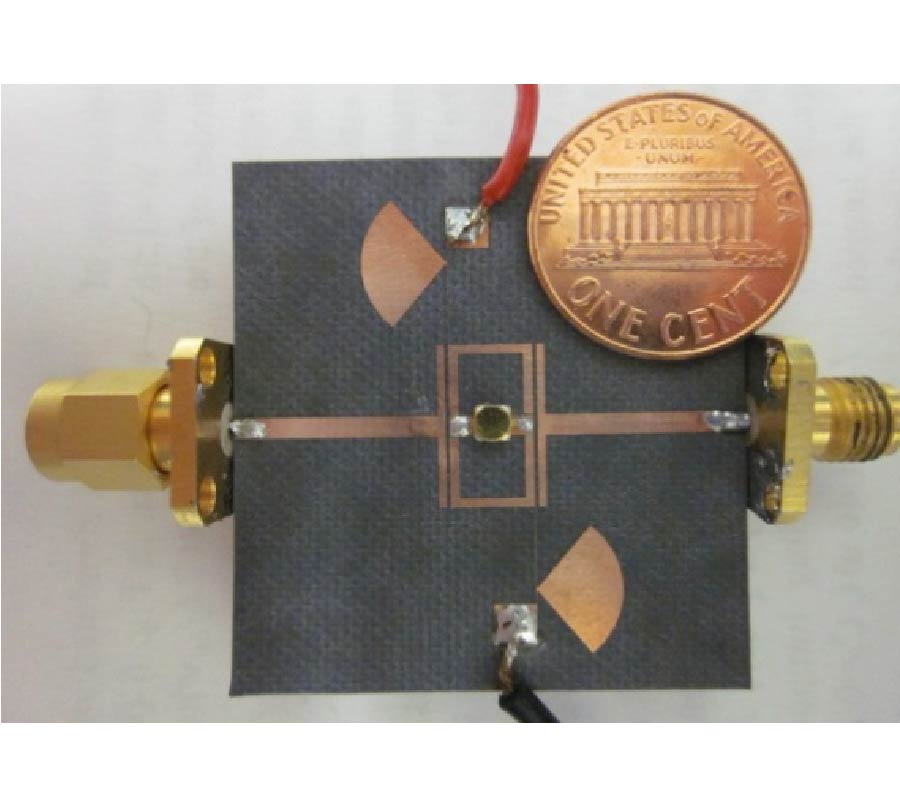
A novel miniaturized microstrip six-port junction is presented. The new structure effectively reduces the occupied area to 25% of the conventional six-port junction due to two open loaded stubs. The design is validated both by using momentum of Advanced Design System and by measurement.
A NOVEL MINIATURIZED MICROSTRIP SIX-PORT JUNCTION
2011-05-02
PIER M
Vol. 18, 89-101
Skin Effect in Inhomogeneous Euler-Cauchy Tubular Conductors
Jose Antonio Marinho Brandao Faria
This paper presents a novel contribution for the analysis of skin effect phenomena in inhomogeneous tubular conductors. For homogeneous tubular geometries the skin effect diffusion equation has an analytical solution described by a combination of Bessel functions, but, when the conductivity and magnetic permeability of the tubular conductor arbitrarily depend on the radial coordinate an analytical solution cannot be found. However, this work shows that closed form solutions for the electromagnetic field and conductor internal impedance do exist, provided that a specific type of radial variation of medium parameters is considered --- tubular structures like these are coined here Euler-Cauchy Structures (ECS). Analytic and computation results concerning general and particular ECS are presented, validated, and discussed. Besides its intrinsic theoretical importance, the simple closed form solutions that we have found can be of interest as benchmark tools for testing the accuracy and performance of EM field software solvers.
SKIN EFFECT IN INHOMOGENEOUS EULER-CAUCHY TUBULAR CONDUCTORS
2011-05-02
PIER
Vol. 116, 137-157
Use of High-Impedance Screens for Enhancing Antenna Performance with Electromagnetic Compatibility
Ming-Shing Lin , Chung-Hao Huang and Cheng-Nan Chiu
When developing a wireless communication system, a designer should consider the associated radiated power density, electromagnetic compatibility (EMC), and specific absorption rate (SAR). In this paper, high-impedance surfaces (HISs) are designed as an EM protection screen to reduce the interaction between an antenna and the user behind the screen. The effects of an HIS screen with a finite number of cells placed near a monopole antenna for the application of the 2.4 GHz WLAN band were thoroughly investigated. The screen is first-ever proposed not only to reduce the backward radiation from the antenna, but also to shift the impedance-matching band of the antenna and to adjust the corresponding bandwidth. As a result, the SAR behind the screen is noticeably lowered, and the out-of-band spurious emission from the antenna can be reduced. Two typical kinds of HIS structures, mushroom-shaped and Jerusalem Cross HISs (abbreviated as MSHIS and JCHIS, respectively), were investigated by numerical simulations and measurements. Three different measurement techniques were proposed for predicting the operating frequency band of an HIS. Some HIS-added antenna prototypes were constructed and studied. It was found that the MSHIS and JCHIS can adjust the impedance-matching band of the antenna, do not affect the radiation performance in the forward direction, and can significantly reduce the backward radiated power. In addition, the measured maximum SAR has been significantly reduced from 0.976 W/kg for the monopole antenna without an HIS to 0.037 and 0.038 W/kg, respectively, for the antenna with an MSHIS and a JCHIS.
USE OF HIGH-IMPEDANCE SCREENS FOR ENHANCING ANTENNA PERFORMANCE WITH ELECTROMAGNETIC COMPATIBILITY
2011-04-29
PIER B
Vol. 30, 71-82
Application of Super-SVA to Stepped-Chirp Radar Imaging with Frequency Band Gaps Between Subchirps
Wenshuai Zhai and Yunhua Zhang
It is well-known that the stepped-frequency chirp signal (SFCS) technique is one of the very effective approaches for achieving high range resolution in radar [1-5]. The SFCS is a train of subchirp pulses with up-stepped or down-stepped carrier frequencies. However, there exists a rang-Doppler coupling problem (RDCP) when applying this signal to practical radar system because longer time is needed for transmitting a complete burst compared with that needed for transmitting just a single chirp. In radar system design, if carrier frequency step (△f) can be larger than the bandwidth of subchirp (Bm), it will be very helpful for using less number of subchirps to obtain high resolution and at the same time the influence of RDCP on imaging quality can be reduced. However the spectrum of transmitted signal is not continuous but with bandwidth gaps existing when Δf > Bm, and it will finally lead to high grating lobes in range profile. In this paper, the Super-SVA technique is applied to radar signal processing to solve the grating lobe problem arisen from bandwidth gaps. Super-SVA has been proven to be a very effective method used for extrapolating signal spectrum. Simulation and experiment results for moving train imaging are presented to show that the algorithm works very well.
APPLICATION OF SUPER-SVA TO STEPPED-CHIRP RADAR IMAGING WITH FREQUENCY BAND GAPS BETWEEN SUBCHIRPS
2011-04-29
PIER B
Vol. 30, 47-70
Land Cover Classification of Palsar Images by Knowledge Based Decision Tree Classifier and Supervised Classifiers Based on SAR Observables
Pooja Mishra , Dharmendra Singh and Yoshio Yamaguchi
The intent of this paper is to explore the application of information obtained from fully polarimetric data for land cover classification. Various land cover classification techniques are available in the literature, but still uncertainty exists in labeling various clusters to its own class without using any a priori information. Therefore, the present work is focused on analyzing useful intrinsic information extracted from SAR observables obtained by various decomposition techniques. The eigenvalue decomposition and Pauli decomposition have been carried out to separate classes on the basis of their scattering mechanisms. The various supervised classification techniques were applied in order to see possible differences among SAR observables in terms of information that they contain and their usefulness in classifying particular land cover type. Another important issue is labeling the clusters, and this work is carried out by decision tree classification that uses knowledge based approach. This classifier is implemented by scrupulous knowledge of data obtained by empirical evidence and their experimental validation. It has been demonstrated quantitatively that standard polarimetric parameters such as polarized backscatter coefficients (linear, circular and linear 45°), co and cross-pol ratios for both linear and circular polarizations can be used as information bearing features for making decision boundaries. This forms the basis of discrimination between various classes in sequential format. The classification approach has been evaluated for fully polarimetric ALOS PALSAR L-band level 1.1 data. The classifier uses these data to classify individual pixel into one of the five categories: water, tall vegetation, short vegetation, urban and bare soil surface. The quantitative results shown by this classifier gives classification accuracy of about 88%, which is better than other classification techniques (supervised classification techniques based on SAR observables).
LAND COVER CLASSIFICATION OF PALSAR IMAGES BY KNOWLEDGE BASED DECISION TREE CLASSIFIER AND SUPERVISED CLASSIFIERS BASED ON SAR OBSERVABLES
2011-04-29
PIER Letters
Vol. 23, 119-128
The Support Vector Machine for Dielectric Target Detection through a Wall
Fang-Fang Wang and Ye-Rong Zhang
In this paper, a novel approach based on the support vector machine (SVM) for dielectric target detection in through-wall scenario is proposed. Through-wall detection is converted to the establishment and use of a mapping between backscattered data and the dielectric parameter of the target. Then the propagation effects caused by walls, such as refraction and speed change, are included in the mapping that can be regressed after SVM training process. The training and testing data for the SVM is obtained by finite-difference time-domain (FDTD) simulation. Numerical experiments show that once the training phase is completed, this technique only needs computational time in an order of seconds to predict the parameters. Besides, experimental results show that good consistency between the actual parameters and estimated ones is achieved. Through-wall target tracking is also discussed and the results are acceptable.
THE SUPPORT VECTOR MACHINE FOR DIELECTRIC TARGET DETECTION THROUGH A WALL
2011-04-28
PIER B
Vol. 30, 27-46
Dyadic Green's Functions for Unbounded and Two-Layered General Anisotropic Media
Ying Huang and Jay Kyoon Lee
The dyadic Green's functions (DGFs) for unbounded and layered general anisotropic media are considered in this paper. First, the DGF for unbounded problem is derived using the eigen-decomposition method. Two different approaches are proposed to obtain the DGF for layered problem when the source is located inside the anisotropic region. The first approach is to apply the modified symmetrical property of DGF to obtain the DGF for the field in the isotropic region when the source is located inside the anisotropic region, from the DGF for the field in anisotropic region when the source is in the isotropic region. This modified symmetrical property can be applied for the layered geometry with bounded anisotropic region being either reciprocal or non-reciprocal medium. However, this method can not give the DGF for the field inside the anisotropic region. Thus, the second approach is presented to obtain the complete set of DGFs for all the regions including the anisotropic region, by applying the direct construction method through eigen-decomposition together with matrix method.
DYADIC GREEN'S FUNCTIONS FOR UNBOUNDED AND TWO-LAYERED GENERAL ANISOTROPIC MEDIA
2011-04-28
PIER B
Vol. 29, 409-429
Redesign and Optimization of the Paving Algorithm Applied to Electromagnetic Tools (Invited Paper)
Javier Moreno , Ma Jesús Algar , Ivan Gonzalez-Diego and Felipe Catedra
To study any electromagnetic system, the geometry model must be discretized into elements with an appropriate size for the working frequency. The discretization of a system must be transparent to the user of electromagnetic computing tools. A mesher is presented based on the paving algorithm. The algorithm has been modified to allow triangular elements and has been accelerated by distributing the load on multiple processors simultaneously. Also, a multilevel mode has been implemented. With this tool, any geometry defined by NURBS (Non Uniform Rational B-Spline) surfaces can be decomposed into triangular and quadrangular curved elements.
REDESIGN AND OPTIMIZATION OF THE PAVING ALGORITHM APPLIED TO ELECTROMAGNETIC TOOLS (Invited Paper)
2011-04-28
PIER Letters
Vol. 23, 109-118
Ultra-Wide Bandwidth Microstrip Monopole Antenna by Using Electromagnetic Band-Gap Structures
Dalia Mohammed Nasha Elsheakh , Hala Elsadek , Esmat A. F. Abdallah , Hadia El-Hennawy and Magdy F. Iskander
A novel compact design for ultra-wide bandwidth (UWB) planar monopole antenna is presented in this paper. The basis for achieving the UWB operation is through using semicircular microstrip monopole antenna with modified ground plane in the form of semi circular umbrella like shape. This shape produces bandwidth ranging from 3 to 35 GHz with discontinuities from 7 GHz to 10 GHz, from 12.5 GHz to 17.5 GHz and from 22 GHz to 40 GHz. The antenna size is reduced by 27% relative to the size of conventional rectangular monopole patch antenna. Metamaterial structures are used for further antenna performance improvement. Two types of metamaterial namely EBG and DGS are studied. First, embedding metallo EBG (EMEBG) is used to eliminate ripples in the operating band and also further reducing the antenna size by more than 30% as compared to the proposed patch. The antenna design provides an impedance bandwidth of more than 33 GHz. Second, four arms spiral defected ground structure (SDGS) is used as a ground plane with four arms to further improve the antenna performance. The SAMC reduced the antenna size by more than 48% as compared to the proposed antenna patch, increased bandwidth, and decreased the cross polarization effect. Finally, embedded EBG together with SDGS ground plane are studied to take advantages of both techniques.
ULTRA-WIDE BANDWIDTH MICROSTRIP MONOPOLE ANTENNA BY USING ELECTROMAGNETIC BAND-GAP STRUCTURES
2011-04-28
PIER Letters
Vol. 23, 99-107
Circularly-Polarized Stacked Annular-Ring Microstrip Antenna
Monica Ramirez and Josep Parron
In this paper, we propose the aperture feeding as a technique for bandwidth enhancement of multi-band microstrip ring antennas. In particular, we present a dual-band stacked annular-ring microstrip antenna fed by four bow-tie apertures with circular polarization. Furthermore, we show that the size and shape of the substrate that supports the radiating elements of the antenna plays an important role in the quality of the axial ratio.
CIRCULARLY-POLARIZED STACKED ANNULAR-RING MICROSTRIP ANTENNA
2011-04-28
PIER
Vol. 116, 123-136
The Effect of Ply Orientation on the Performance of Antennas in or on Carbon Fiber Composites
Amir Galehdar , Wayne Rowe , Kamran Ghorbani , Paul J. Callus , Sabu John and Chun H. Wang
In this paper, the anisotropic conductivity effect of Quasi-Isotropic Carbon Fiber laminates on new type of conformal load-bearing antenna structure (CLAS), with slots being cut through a carbon fibre reinforced polymer (CFRP) laminate, is presented. The conductivity of a quasi-isotropic IM7/977-3 CFRP laminate is measured using the waveguide technique. The results show that orientation of the surface ply relative to the polarization of the E-field has a major influence on the reflectivity. This difference can be attributed to the fact that carbon fibres oriented parallel to the E-field plies behave as good conductors while off-axis plies as lossy dielectric layers with a finite conductivity. This anisotropic behavior of the ply layers is shown to have a distinctive influence on the operation of both microstrip patch and slot antennas.
THE EFFECT OF PLY ORIENTATION ON THE PERFORMANCE OF ANTENNAS IN OR ON CARBON FIBER COMPOSITES
2011-04-28
PIER
Vol. 116, 107-121
A Rigorous Treatment of Vertical Dipole Impedance Located Above Lossy Dps, Mng, Eng, and DNG Half-Space
Younes Radi , Saeid Nikmehr and Shahram Hosseinzadeh
In this paper, accurate analytical expressions for the impedance of vertical electric and magnetic dipoles which are located over the half-space materials of arbitrary permittivity and permeability are developed. In this regard, the impedance variations are expressed in integral forms. For metamaterial half-space, a proper expression for approximating the Fresnel reflection coefficient is proposed. Using this approximate expression, the impedance integrals are analytically solved, and exact formulas for impedance variations are obtained. The results for the metamaterial half-spaces are compared with the case of natural materials (positive permittivity and permeability), and key differences are explained. The in uences of sign changing in permeability of the half-space material on the impedance of vertical dipole are studied, and the results are validated by comparison with those of numerical solution of integrals. It is shown that for elevated dipoles over materials with high and/or low conductivities, the results of both methods are in complete agreement. For vertical dipoles above low loss materials, the results are somewhat identical. However, a better agreement could be obtained using higher order approximations for the integrand.
A RIGOROUS TREATMENT OF VERTICAL DIPOLE IMPEDANCE LOCATED ABOVE LOSSY DPS, MNG, ENG, AND DNG HALF-SPACE