Search Results(13802)

2011-05-10
PIER B
Vol. 30, 177-199
Measured Complex Permittivity of Walls with Different Hydration Levels and the Effect on Power Estimation of Twri Target Returns
Christopher Thajudeen , Ahmad Hoorfar , Fauzia Ahmad and Traian Dogaru
With recent advances in both algorithm and component technologies, through-the-wall sensing and imaging is emerging as an affordable sensor technology in civilian and military settings. One of the primary objectives of through-the-wall radar imaging (TWRI) systems is to detect and identify targets of interest, such as humans and cache of weapons, enclosed in building structures. Effective approaches that achieve proper target radar cross section (RCS) registration behind walls must exploit a detailed understanding of the radar phenomenology, in general, and more specifically, knowledge of the expected strength of the radar return from targets of interest. In this paper, we investigate the effects of various wall types on the received power of the target return through the use of a combined measurement and electromagnetic modeling approach. The RCS of material-exact rifle and human models are investigated in free-space using numerical electromagnetic modeling tools. A modified radar range equation, which analytically accounts for the wall effects, including multiple reflections within a given homogeneous or layered wall, is then employed in conjunction with wideband measured parameters of various common wall types, to estimate the received power versus frequency from numerically modeled aforementioned targets of interest. The proposed technique is, in principle, applicable to both bistatic and monostatic operations. The results for various wall types, including drywall, brick, solid concrete and cinder block, under both wet and dry conditions, are presented.
MEASURED COMPLEX PERMITTIVITY OF WALLS WITH DIFFERENT HYDRATION LEVELS AND THE EFFECT ON POWER ESTIMATION OF TWRI TARGET RETURNS
2011-05-10
PIER B
Vol. 30, 157-175
Automatic Threshold Selection in Os-CFAR Radar Detection Using Information Theoretic Criteria
Boualem Magaz , Adel Belouchrani and M'hamed Hamadouche
This paper proposes a new approach for efficiently determining the unwanted interfering samples in the reference window, for the ordered statistics constant false alarm rate detector, based on the application of the information theoretic criteria principle. The proposed processor termed as Forward Automatic Order Selection Ordered Statistics Detector (FAOSOSD) does not require any prior information about the number of interfering targets. The proposed design aims to improve the Ordered Statistics Constant False Alarm Rate detector performance under severe interference situations. The number of interfering targets is obtained by minimizing the information theoretic criteria. Simulation results that illustrate the performance of the proposed method versus the classical OS-CFAR, the AND-CFAR and the OR-CFAR detectors are presented and discussed.
AUTOMATIC THRESHOLD SELECTION IN OS-CFAR RADAR DETECTION USING INFORMATION THEORETIC CRITERIA
2011-05-10
PIER Letters
Vol. 23, 173-180
A Dual-Mode Dual-Band Bandpass Filter Using a Single Slot Ring Resonator
Sha Luo , Lei Zhu and Sheng Sun
A dual-mode dual-band bandpass filter is designed using a single stub-loaded slot ring resonator. This resonator is coupled to the two external feed lines at two positions spaced at 135° along the slot ring through a pair of microstrip-slotline Tjunctions. With a proper choice of the degree of external coupling, the first-order degenerate modes are split to make up the first passband with two transmission poles. The second passband is realized by the second-order degenerate modes, which are stimulated by symmetrically attaching four identical stubs along the slot ring. The center frequency ratio of the two operating passbands is controlled by the nature and strength of the external coupling, which is determined by the characteristics of the microstrip opencircuited stubs. Finally, a dual-band filter with center frequencies at 2.4 and 5.2 GHz is designed and fabricated. Measured results verify the design principle and predicted dual-passband performance. Benefiting from an additional transmission zero brought by the transitions, the upper stopband is expanded up to 12.75 GHz with at least 13 dB of rejection.
A DUAL-MODE DUAL-BAND BANDPASS FILTER USING A SINGLE SLOT RING RESONATOR
2011-05-10
PIER C
Vol. 21, 179-190
Gain Enhancement of Planar Monopole with Magnetodielectric Material
Wen-Cheng Lai , An-Cheng Sun , Nan-Wei Chen and Ching-Wen Hsue
A planar monopole antenna with reconfigurable radiation patterns is demonstrated. The radiation pattern reconfigurability is realized straightforwardly with an employment of a detached magnetodielectric slab placed in the vicinity of the antenna structure. It is shown the radiation patterns can be easily reconfigured through the adjustment of the spacing between the slab and the antenna structure. Technically, the radiated fields are redistributed owing to the inclusion of the magnetodielectric slab, which is of high permittivity, as well as permeability. As a result, the planar monopole gain with the slab is increased up to 4 dBi while the antenna resonant frequency remains almost unchanged.
GAIN ENHANCEMENT OF PLANAR MONOPOLE WITH MAGNETODIELECTRIC MATERIAL
2011-05-09
PIER B
Vol. 30, 135-156
Improved Spurious Free Performance of Multi-Layer Multipermittivity Dielectric Resonator in MIC Environment
Raghvendra Kumar Chaudhary , Vishwa V. Mishra , Kumar Vaibhav Srivastava and Animesh Biswas
In this paper, a novel approach has been suggested to obtain an improved spurious-free window for dielectric resonator in microwave integrated circuit environment. In microwave integrated circuit environment, the dielectric resonator placed on a thin dielectric substrate gets located asymmetrically with respect to its shielding enclosure. A reduced separation in frequencies (mode separation) is one of a consequence of this asymmetry that may become a cause of spurious modes. This adverse influence of asymmetry is sought to be compensated by proposing a multi-layer multi-permittivity dielectric resonator structure with several layers of differing permittivity. The suggested approach takes advantage of the fact that the mode separation of a dielectric resonator configuration can be correlated to relevant resonance mode fields. By perturbing the resonance mode fields through the suggested multi-layer multi-permittivity approach, the adverse influence of asymmetry is found to reduce considerably over a comparative conventional ring dielectric resonator in microwave integrated circuit configuration. Still more improvement in mode separation are shown when the shape of the multi-layer multi-permittivity ring dielectric resonator is further modified, suggesting a scope for optimization in present approach.
IMPROVED SPURIOUS FREE PERFORMANCE OF MULTI-LAYER MULTIPERMITTIVITY DIELECTRIC RESONATOR IN MIC ENVIRONMENT
2011-05-09
PIER Letters
Vol. 23, 165-172
A Novel Miniaturized Bandpass Filter Based on Complementary Split Ring Resonators (CSRRs) and Open-Loop Resonators
Mohammad Keshvari and Majid Tayarani
A microstrip bandpass filter is presented based on Complementary Split Ring Resonators (CSRRs) and a pair of open-loop resonators that has a single pair of transmission zeros at finite frequencies that causes an improvement at skirt response. An equivalent circuit is introduced to make analysis and optimization faster. Finally a filter is designed using the proposed cell and the simulation results with both equivalent model and full wave analysis are in very good agreement. The filter was fabricated and the measurement result was also in good agreement with simulation results. Besides, the size of the designed filter is very small and it occupies an area less than 0.23λg × 0.16λg, where λg is the guided wavelength at the midband frequency.
A NOVEL MINIATURIZED BANDPASS FILTER BASED ON COMPLEMENTARY SPLIT RING RESONATORS (CSRRs) AND OPEN-LOOP RESONATORS
2011-05-09
PIER C
Vol. 21, 169-177
High Performance Planar Sleeve Dipole Array Antenna with Directional Radiation
Yanfei Li , Bing-Hao Zeng , Cheng-Wei Chen , Dau-Chyrh Chang , Z. R. Li , J. B. Liu and Hsiao-Bin Liang
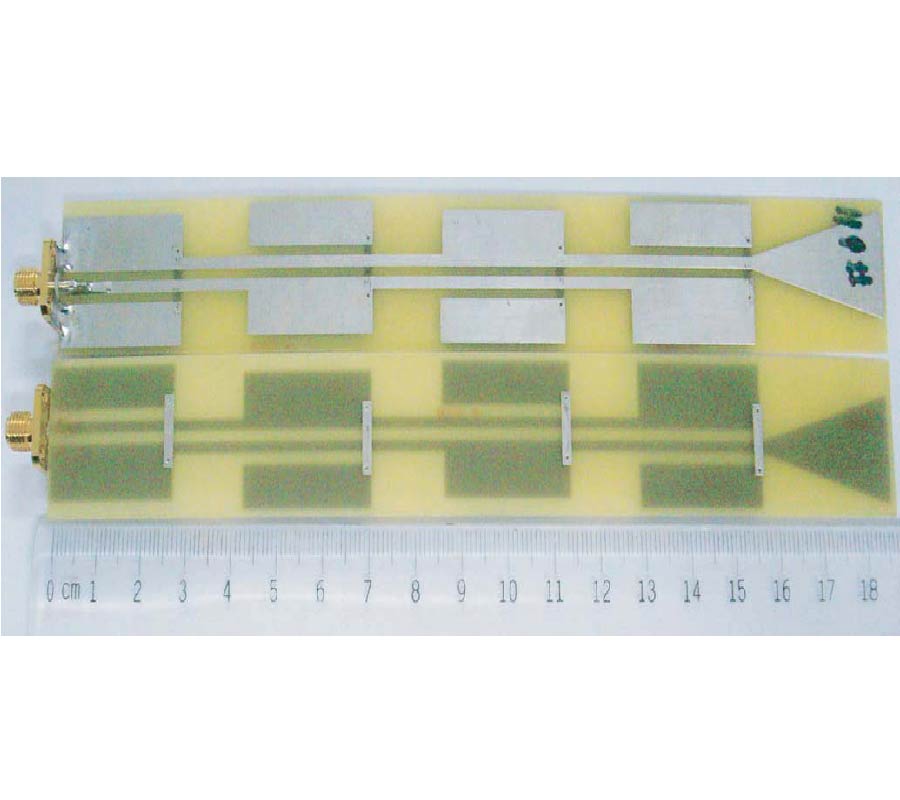
A planar sleeve dipole array antenna is analyzed and successfully implemented. The proposed antenna is designed for operation at 1800/1900 MHz band of basic station applications. To achieve sufficient bandwidth for the requirement of the PCS 1800 MHz band (1710-1880 MHz) and 1900 MHz band (1880-1930 MHz) for DECT (Digital Enhanced Cordless Telecommunications), the proposed antenna comprises of a 1 × 5 coplanar back-to-back sleeve dipole elements, we adopt the microstrip line to balanced transmission line feeding technique in this design. This structure is easily constructed by printing on both sides of a dielectric (FR4) substrate. The measured -10 dB return loss (VSWR 2 : 1) impedance bandwidth is around 13.2% (1690-1930 MHz). A reflector is put behind the dipole array to obtain directional radiation and high gain, and the measured antenna gain for operating frequencies across the 1800/1900 MHz band is about 7.2-9.1 dBi. The measured results of radiation efficiency, radiation pattern, antenna gain and return loss show the sleeve dipole array antenna has a good performance.
HIGH PERFORMANCE PLANAR SLEEVE DIPOLE ARRAY ANTENNA WITH DIRECTIONAL RADIATION
2011-05-09
PIER
Vol. 116, 363-379
RF Directional Modulation Technique Using a Switched Antenna Array for Physical Layer Secure Communication Applications
Tao Hong , Maozhong Song and Yu Liu
In this paper, we present a RF directional modulation technique using a switched antenna array for physical layer secure communication. The main idea is that a switching scheme of the switched antenna array is designed according to a spreading sequence for the purpose of spreading spectrum of the transmit signal. The transmit signal is associated with the spreading sequence and the direction of the desired receiver because of information data modulated both in the baseband and the antenna level. In this way, the desired receiver with a single antenna can demodulate the receive signal as traditional spread-spectrum signal, while eavesdroppers can not extract any useful information from the receive signal even if eavesdroppers know the spreading sequence of the RF directional modulation signal. Simulation results show that the proposed technique offers a more secure transmission method for wireless communication comparison with traditional spread-spectrum signal.
RF DIRECTIONAL MODULATION TECHNIQUE USING A SWITCHED ANTENNA ARRAY FOR PHYSICAL LAYER SECURE COMMUNICATION APPLICATIONS
2011-05-09
PIER
Vol. 116, 347-361
An Artificial Nerve Network Realization in the Measurement of Material Permittivity
Qian Chen , Kama Huang , Xiaoqing Yang , Ming Luo and Huacheng Zhu
E®ective complex permittivity measurements of materials are important in microwave engineering and microwave chemistry. Artificial neural network (ANN) computational module has been used in microwave technology and becomes a useful tool recently. A neural network can be trained to learn the behavior of an effective permittivity of material under microwave irradiation in a test system, and it can provide a fast and accurate result for the permittivity measurement of material. Thus, an on-line measurement has been realized. This paper presents a simple and convenient reconstruction algorithm for determining the dielectric properties of materials. First, a measurement system is designed, and the reflection coefficient is calculated by employing full-wave simulations. Second, an artificial nerve network has been applied, and adequate simulated materials are utilized to train the networks. Last, the trained network is employed to reconstruct the effective permittivity of several organic solvents using the measured scattering parameters, and the reconstructed results for several organic solvents agree well with reference data and the relative errors between them are less than 5%.
AN ARTIFICIAL NERVE NETWORK REALIZATION IN THE MEASUREMENT OF MATERIAL PERMITTIVITY
2011-05-09
PIER
Vol. 116, 333-346
Balanced Single- and Dual-Band BPFs Using Ring Resonators
Ching-Her Lee , Chung-I Hsu , Hsun-Hsiang Chen and Yu-Sen Lin
This paper presents new balanced single- and dual-band bandpass filters (BPFs), both of which are constructed using two ring resonators. For each BPF, opencircuited stubs are added to one of the two resonators so that the transmitted common-mode (CM) signals can be attenuated, and source-load coupling is established so that two transmission zeros are generated near the edges of each desired differential-mode (DM) passband to sharpen the passband selectivity. The measurement agrees well with the simulation. For the single-band BPF, the measured minimum DM insertion loss is 1.4 dB in the DM passband, in which the CM suppression is larger than 41.6 dB. For the dual-band BPF, the minimum DM insertion losses are 1 and 1.35 dB in the first and second passbands, respectively, in which the CM rejections are larger than 29 and 22 dB.
BALANCED SINGLE- AND DUAL-BAND BPFS USING RING RESONATORS
2011-05-08
PIER B
Vol. 30, 117-133
Effects of Geometry Configurations on Ambiguity Properties for Bistatic MIMO Radar
Hao-Wen Chen , Xiang Li , Jin Yang , Wei Zhou and Zhaowen Zhuang
Bistatic multiple-input multiple-output (MIMO) radar can improve the system performance for obtaining the waveform diversity and larger degrees of freedom (DoF), and effectively counteract the stealthy target for its transmit antennas and receive antennas separated placement. Similarly with the conventional bistatic radar, the geometry configurations of bistatic MIMO radar also play an important role in radar system's performance. Aimed at considering these effects of geometry configurations on the performance for bistatic MIMO radar, in this paper the extended ambiguity function is defined as the coherent cumulation of the matching output of all channels, where the information of the system geometry configuration is included in the received signal model. This new ambiguity function can be used to characterize the local and global resolution properties of the whole radar systems instead of only considering transmitted waveforms in Woodward's. In addition, some examples with the varying system configurations or target parameters are given to illustrate their effects, where the spatial stepped-frequency signal set (a quasi-orthogonal waveform set) is used. The simulation results demonstrate that the more approaching to monostatic MIMO radar case, the better ambiguity properties of time-delay and Doppler for bistatic MIMO radar.
EFFECTS OF GEOMETRY CONFIGURATIONS ON AMBIGUITY PROPERTIES FOR BISTATIC MIMO RADAR
2011-05-08
PIER C
Vol. 21, 155-167
A High-Gain CMOS LNA for 2.4/5.2-GHz WLAN Applications
Sen Wang and Bo-Zong Huang
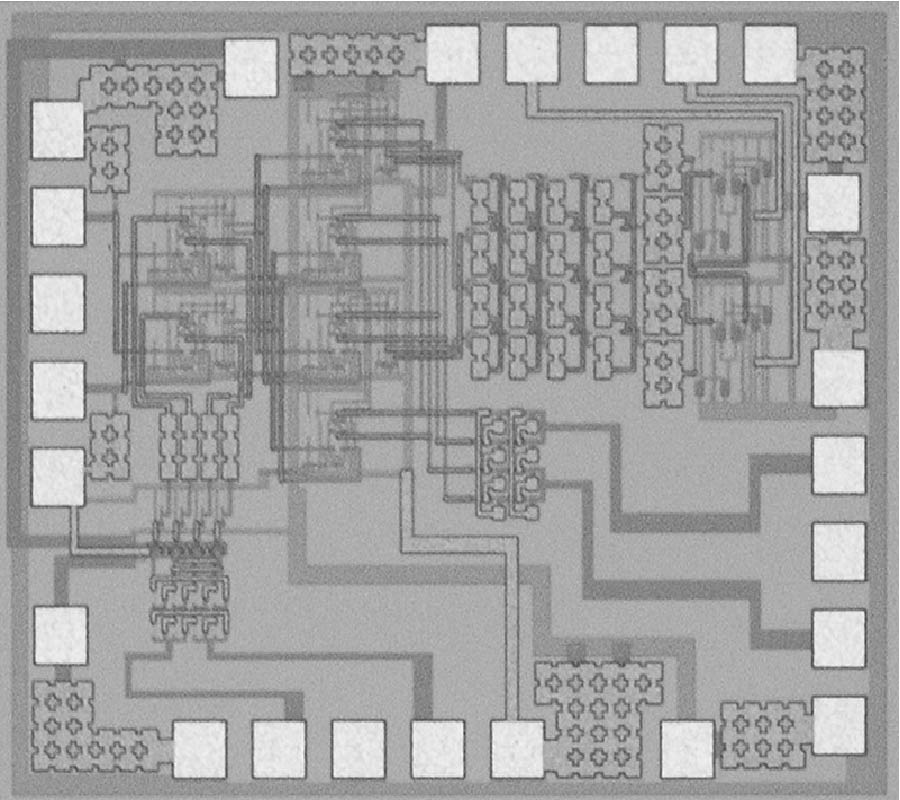
This paper describes a high-gain CMOS low-noise amplifier (LNA) for 2.4/5.2-GHz WLAN applications. The cascode LNA uses an inductor at the common-gate transistor to increase its transconductance equivalently, and therefore it enhances the gain effectively with no additional power consumption. The LNA is matched concurrently at the two frequency bands, and the input/output matching networks are designed with two notch frequencies to shape the frequency response. The dual-band LNA with the common-gate inductor is designed, implemented, and verified in a standard 0.18-μm CMOS process. The fabricated LNA which consumes 7.2 mW features gains of 14.2 dB and 14.6 dB, and noise figures of 4.4 dB and 3.7 dB at the 2.4-GHz and 5.2-GHz frequency bands, respectively. The proposed LNA demonstrates a 4.9-7.8 dB gain enhancement compared to conventional cascode LNAs, and the chip size is 1.06 mm × 0.79 mm including all testing pads.
A HIGH-GAIN CMOS LNA FOR 2.4/5.2-GHZ WLAN APPLICATIONS
2011-05-06
PIER B
Vol. 30, 103-116
H-Infinity Filter Based Particle Filter for Maneuvering Target Tracking
Qicong Wang , Jing Li , Meixiang Zhang and Chenhui Yang
In this paper, we propose a novel H-infinity filter based particle filter (H∞PF), which incorporates the H-infinity filter (H∞F) algorithm into the particle filter (PF). The basic idea of the H∞PF is that new particles are sampled by the H∞F algorithm. Since the H∞F algorithm can fully take into account the current measurements, when the new algorithm calculates the proposed probability density distribution, the sampling particles can take advantage of the system current measurements to predict the system state. The particles distribution we obtained approaches nearer to the state posterior probability distribution and the H∞PF alleviates the sample degeneracy problem which is common in the PF, especially when the maneuvers of the target tracking are large. Furthermore, the H∞F algorithm can adjust gain imbalance factor by adjusting disturbance decay factor, from that the new algorithm can get the compromise between the accuracy and robustness and we can obtain satisfied accuracy and robustness. Some simulations and experimental results show that the proposed particle filter performed better than the PF and the Kalman particle filter (KPF) in tracking maneuvering target.
H-INFINITY FILTER BASED PARTICLE FILTER FOR MANEUVERING TARGET TRACKING
2011-05-06
PIER B
Vol. 30, 83-102
A 3D Model to Characterize High-Frequency Scattering by Urban Areas for Monostatic and Bistatic Radar Configurations
Ngoc Truong Minh Nguyen , David Lautru and Helene Roussel
In this paper, we propose a 3D model to characterize the field scattered by an urban area, which is composed of a group of buildings, for both monostatic and bistatic radar configurations. This model is based on a ray-tracing technique combined with the Uniform Theory of Diffraction (UTD). It is useful not only in elucidating mechanisms of ray propagation through the observed area, but also in evaluating the amplitude and the phase of any point in the far-zone scattered field above the ground. In order to validate the model, some comparisons with the commercial software XGTD R are presented. In addition, our model is tested against 33-37 GHz indoor measurements conducted in the anechoic chamber of the "ElectroMagnetic Effects Research Lab" (EMERL) in Singapore. These latter comparisons have shown that the model can predict precisely the location of a target placed between two metallic plates representing walls.
A 3D MODEL TO CHARACTERIZE HIGH-FREQUENCY SCATTERING BY URBAN AREAS FOR MONOSTATIC AND BISTATIC RADAR CONFIGURATIONS
2011-05-06
PIER Letters
Vol. 23, 157-163
A Miniature UWB Semi-Circle Monopole Printed Antenna
Shu Lin , Run-Nan Cai , Guan-Long Huang and Jin-Xiang Wang
A semi-circle monopole printed antenna is proposed. Its radiation unit and the ground plane are in the same shape, and both of them are coplanar-printed. The antenna is fed by a microstrip line, which is connected to the radiation unit through a via-hole. The measured impedance bandwidth is about 3.1GHz-15.1GHz with VSWR<2, and the ratio bandwidth can reach 4.9:1. The omnidirectional characteristic is also excellent in H-plane. Moreover, because of the introduction of the semi-circle radiation unit and the ground plane, the length of the radiation unit can be miniaturized in polarization direction, which is only 14% of wavelength of the lowest operating frequency. The antenna size is just 29 mm×29.5 mm×1.0 mm, which can make it well integrate into UWB communication systems.
A MINIATURE UWB SEMI-CIRCLE MONOPOLE PRINTED ANTENNA
2011-05-06
PIER Letters
Vol. 23, 147-155
A Compact Multiband Monopole Antenna for WLAN/WiMAX Applications
Zhao-Ning Song , Yang Ding and Ke Huang
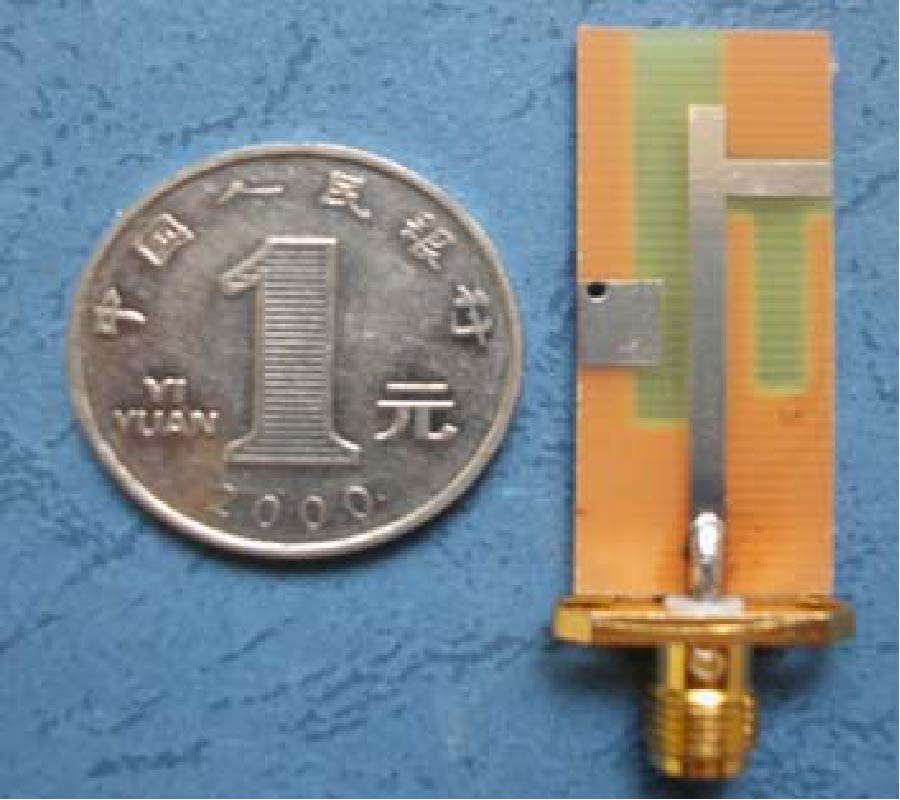
A compact paw-shaped multiband monopole antenna for Wireless local area network(WLAN) and worldwide interoperability for microwave access(WiMAX) applications is presented. The proposed antenna is composed of a paw-shaped monopole element and a rectangular ground plane with simple configuration. This antenna can easily be fed by using a 50ohm probe feed with SMA connector. By adjusting a few parameters of the three arms, the resonant frequencies can be easily tuned. The proposed antenna was analyzed and optimized to cover three bandwidths from 2.32 to 2.84, 3.39 to 4.34 and 5.11 to 5.91GHz that for WLAN and WiMAX applications respectively, with the return loss of better than 10 dB. The performances of the antenna are demonstrated along with measured and simulated results. Moreover, simulated and experimental results with different parameters of the antenna are given.
A COMPACT MULTIBAND MONOPOLE ANTENNA FOR WLAN/WIMAX APPLICATIONS
2011-05-06
PIER
Vol. 116, 313-331
Time-Domain Measurement of Time-Coded UWB Chipless RFID Tags
Angel Ramos , Antonio Lazaro , David Girbau and Ramon Villarino
Chipless ultra-wideband (UWB) has been proposed as a low-cost alternative for radiofrequency identification (RFID). In this paper, a comprehensible theoretical introduction to time-domain operation of a UWB RFID tag is described, and a circuit model is proposed. For commercial applications low-cost RFID readers are demanded. To this end, this paper addresses the measurement of time-coded UWB chipless tags for RFID in time domain. Two different setups to detect time-coded tags are presented, one based on a commercial UWB impulse radar (IR) and the other based on a vector network analyzer (VNA). The experimental results show the feasibility of using an IRUWB radar as a UWB RFID reader, achieving very good read ranges.
TIME-DOMAIN MEASUREMENT OF TIME-CODED UWB CHIPLESS RFID TAGS
2011-05-06
PIER
Vol. 116, 297-312
Optimum Design for Improving Modulating-Effect of Coaxial Magnetic Gear Using Response Surface Methodology and Genetic Algorithm
Linni Jian , Guoqing Xu , Jianjian Song , Honghong Xue , Dongfang Zhao and Jianing Liang
Coaxial magnetic gear (CMG) is a non-contact device for torque transmission and speed variation which exhibits promising potential in several industrial applications, such as electric vehicles, wind power generation and vessel propulsion. CMG works lying on the modulating-effect aroused by the ferromagnetic segments. This paper investigates the optimum design for improving the modulating-effect. Firstly, the operating principle and the modulating-effect is analyzed by using 1-D field model, which demonstrates that the modulatingeffect is essential for the torque transmission capacity of CMGs, and the shape of the ferromagnetic segments have impact on the modulatingeffect. Secondly, the fitted model of the relationship between the maximum pull-out torque and the shape factors including radial height, outer-edge width-angle and inner-edge width-angle is built up by using surface response methodology. Moreover, FEM is engaged to evaluate its accuracy. Thirdly, the optimum shape of the ferromagnetic segment is obtained by using genetical algorithm.
OPTIMUM DESIGN FOR IMPROVING MODULATING-EFFECT OF COAXIAL MAGNETIC GEAR USING RESPONSE SURFACE METHODOLOGY AND GENETIC ALGORITHM
2011-05-05
PIER Letters
Vol. 23, 137-145
A Circular Wide-Slot Antenna with Dual Band-Notched Characteristics for UWB Applications
Yi Yang , Ying-Zeng Yin , Yu-Qing Wei , Bo-Wen Liu and An-Feng Sun
A circular wide-slot UWB antenna with dual band-notched characteristics is proposed in this paper. The microstrip-fed antenna mainly consists of a calabash-shaped feeding patch and a metal ground with a circular slot etched. Dual notched bands are realized by introducing arc-shaped parasitic strip and slot on the ground plane. The measured results show that the proposed antenna can operate at the range of 2.91-11.45 GHz with VSWR < 2 for UWB applications, except the notched bands of 3.38-3.71 GHz and 5.39-6.27 GHz for the 3.5 GHz WiMAX and 5.8 GHz WLAN, respectively.
A CIRCULAR WIDE-SLOT ANTENNA WITH DUAL BAND-NOTCHED CHARACTERISTICS FOR UWB APPLICATIONS
2011-05-05
PIER C
Vol. 21, 143-153
Experimental Characterization of Nonlinear Pulses in Coupled Schottky Transmission Lines
Koichi Narahara
We experimentally investigate the properties of nonlinear pulses in coupled transmission lines with regularly spaced Schottky varactors. The c and π modes are different propagation modes that can be developed on a coupled line. Time-domain measurements show that both modes support soliton-like pulses due to the presence of the Schottky varactors; small c-mode pulses are generated by colliding two π-mode pulses traveling in opposite directions. Moreover, we discuss the relationship of the amplitude of the newly generated c-mode pulses with different bias voltages and π-mode-pulse amplitudes.
EXPERIMENTAL CHARACTERIZATION OF NONLINEAR PULSES IN COUPLED SCHOTTKY TRANSMISSION LINES