Search Results(13786)

2024-06-12
PIER Letters
Vol. 120, 89-93
Compact Double Layer Two via Electromagnetic Band Gap Structure for RCS Reduction
Rajesh Bhagwanrao Morey and Sunil Nilkanth Pawar
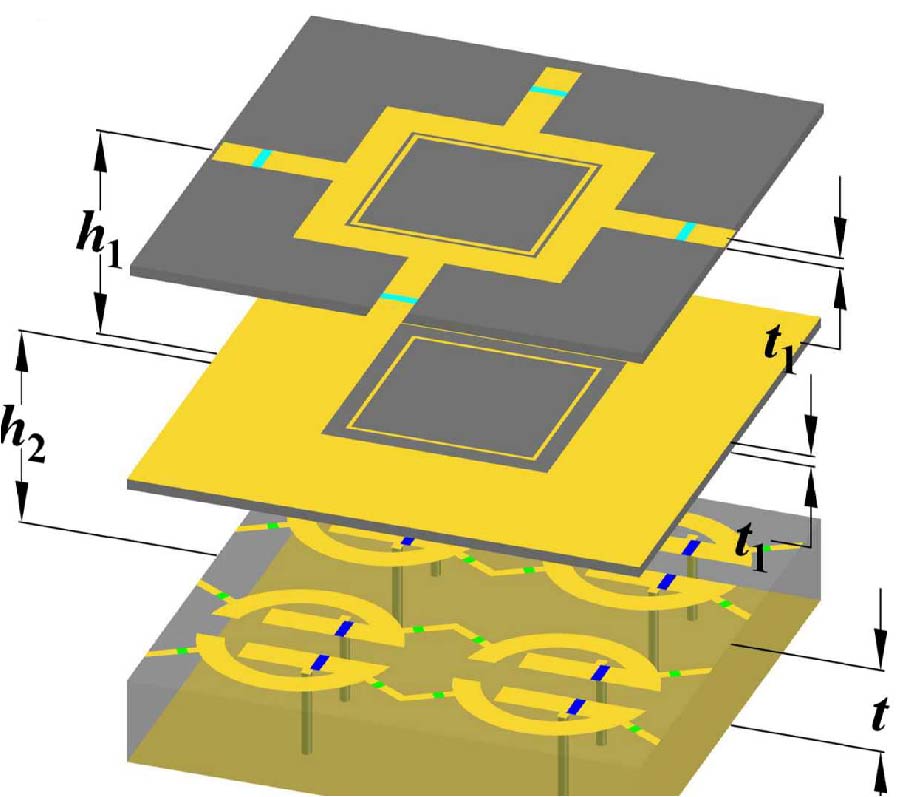
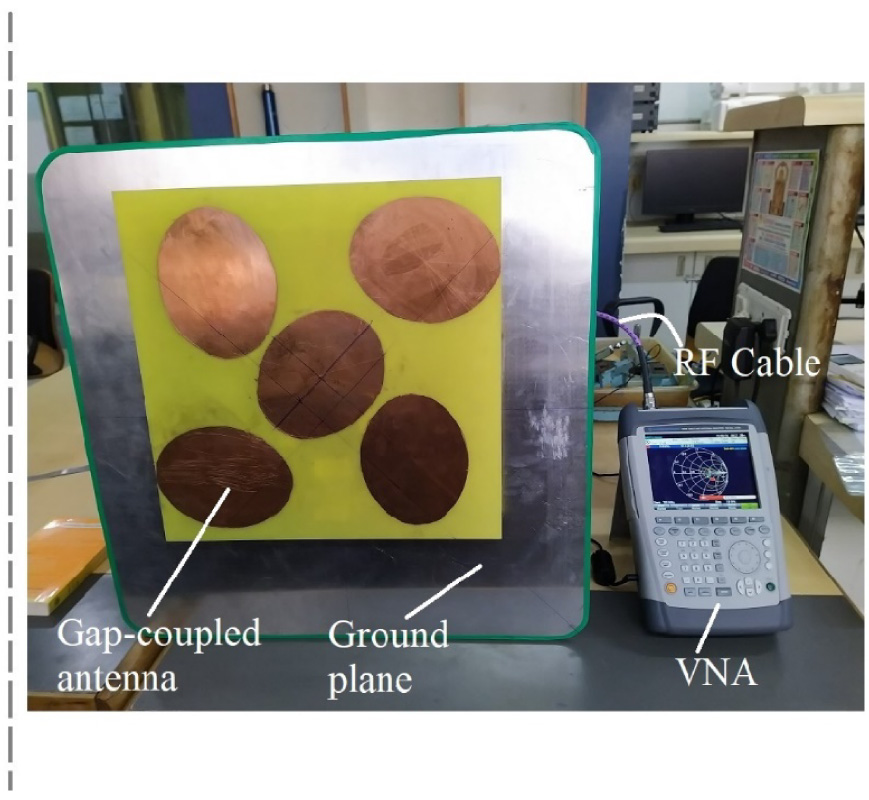
In this paper, a multi-layered mushroom-type electromagnetic band gap (EBG) structure is proposed. A double layer two via EBG (DLTV EBG) structure is designed at 1.65 GHz. The proposed DLTV-EBG structure consists of a two-layer dielectric substrate, which reduces the lateral sizes due to a multilayer topology. By adjusting the patch dimensions and positions of the vias, the center frequency, and equivalent L and C parameters meet design requirements. In a DLTV-EBG, layer-1 has a square ring patch; layer-2 has a circular ring; outer square ring patch with 2 edged located vias gives the additional capacitance and inductance to achieve compactness. The simulation of the DLTV-EBG structure is carried out using the Ansys high-frequency structure simulator (HFSS) and experimentally validated. The band gap of the DLTV-EBG structure is measured using suspended microstrip line (SML) method. The Experimental results agree well with simulation one. The periodic size of the proposed DLTV-EBG structure is 0.05λ1.65 GHz, which is a good candidate where compact size is highly desired.
Compact Double Layer Two via Electromagnetic Band Gap Structure for RCS Reduction
2024-06-12
PIER Letters
Vol. 120, 81-88
Analysis and Optimization of a Wavy Rotor FRM with Curved Stator Slots
Manru Shen , Libing Jing and Zeyu Min
Flux reversal machine (FRM) belongs to the stator permanent magnet (PM) machine, which has the advantages of high reliability, high efficiency, and simple structure. However, large torque ripple and low torque density limit the development prospect of FRMs. Therefore, a wavy rotor FRM (WR-FRM) with curved stator slots is proposed, which can reduce the torque ripple while improving the average torque. The top surface of the rotor tooth consists of three sinusoidal functions, and the stator slots are constructed with a spline curve. To obtain better electromagnetic performance, the multi-objective genetic algorithm is used to optimize the FRM and the WR-FRM. Finally, the electromagnetic performances of the two machines are analyzed and compared by the finite element method. The results show that compared with the FRM, the torque generated by the unit volume of PM is increased by 36.47%, and the torque ripple is reduced by 62.7%.
Analysis and Optimization of a Wavy Rotor FRM with Curved Stator Slots
2024-06-12
PIER Letters
Vol. 120, 73-79
Low-Profile Circularly Polarized Dual-Beam Holographic Antenna
Lanzheng Liu , Jincheng Xue , Ao Ni , Zhuopeng Wang and Mingxiang Pang
This paper presents the design of a low-profile circularly polarized dual-beam holographic antenna. Firstly, by employing a novel outer square inner circular (OSIC) structure as the basic unit of the hologram pattern, better performance is achieved for low-profile dielectric substrate holographic antennas. Secondly, a method of four-zone phase co-modulation is used to derive the impedance modulation formula of the hologram pattern. This formula was employed to model and generate a circularly polarized dual-beam holographic antenna, and the feasibility of theoretical analysis is verified through simulation and measurement. The antenna operates within the frequency range of 10.23 GHz to 16.59 GHz, with maximum gains of 16dBi and 15.8dBi for dual beams, respectively. The results indicate that this design method can realize circularly polarized dual-beam holographic antennas and provide some reference for satellite communication applications.
Low-profile Circularly Polarized Dual-beam Holographic Antenna
2024-06-12
PIER B
Vol. 106, 131-149
A Dual Band Eight Port MIMO Antenna with EBG Metamaterial for V2X Application
Maruti R. Jadhav and Uttam L. Bombale
Several communication systems use multiple input and multiple output (MIMO) antennas to rapidly broadcast and receive data streams. Several current research works on MIMO antennas for vehicle-to-everything (V2X) applications were detailed, along with some limitations such as significant mutual coupling and antenna isolation. To address these difficulties, the manuscript presented a novel metamaterial-based dual-band eight-port MIMO antenna for V2X applications. The proposed eight-port MIMO antenna could be applied to V2X applications in the frequency range of 5.6 GHz to 5.8 GHz. The antenna could resonate at two frequencies, namely 5.64 GHz and 5.73 GHz. The MIMO antenna was constructed with a polyimide substrate and a coplanar waveguide feed (CWF) line. To attain better isolation, a plus shape defected ground structure (Plus shape DGS) was used in this research. By using the binary waterwheel plant optimization algorithm, the antenna parameters are optimized. The proposed antenna was analyzed under different parameters such as gain, return loss, Voltage Standing Wave Ratio (VSWR), axial ratio, and other diversity performances of MIMO antenna like Envelope correlation coefficient (ECC), Total Active Reflection Coefficient (TARC), Mean Effective Coefficient (MEG), and Diversity Gain (DG). The proposed antenna is used in a binary waterwheel plant optimization algorithm for hyperparameter tuning. The proposed antenna obtained return loss values of -36.01 dB and -39 dB at the resonating frequencies of 5.64 GHz and 5.73 GHz, respectively. It achieved gain values of 12.41 dB, 10.7 dB, and ECC values of less than 0.025. The proposed model obtained better results than other models in this comparison analysis.
2024-06-11
PIER Letters
Vol. 120, 65-71
A Compact Wide-Band Circular Slot Quad-Port MIMO Antenna for 5G Wireless Applications
Purushothaman Janaki Ramal , Syed Nawab Syed Althaf , Kannan Vishnulakshmi , Palaniselvan Sundaravadivel and Rajeshkumar Dhandapani
This paper introduces a 4-port antenna tailored for 5G, operating in the 4.4 to 7.25 GHz (Fractional Bandwidth is 48.9%) range with a 10 dB impedance bandwidth. The operating bandwidth includes the n79 band (4.4-5 GHz), 5G WLAN band (5.125-5.825 GHz), and Wi-Fi 6E band (5.925 to 7.125 GHz). Constructed on a compact FR4 substrate (0.057λ × 0.057λ × 0.0018 λ (where λ is the wavelength at 4.4 GHz), it exhibits robust performance in fabrication and measurements. The single antenna covers a total area as small as 20 × 17.6 mm2, which enables the compactness of the MIMO antenna with a gain of up to 6 dBi and 85% radiation efficiency; it supports MIMO with a low correlation coefficient (< 0.02), high diversity gain (up to 9.98 dB), and minimal channel capacity loss (0.25 bps/Hz). The Total Active Reflective Coefficient (TARC) is computed to validate MIMO performance over the operating bandwidth. Featuring bidirectional radiation patterns in both E-plane and H-plane, the antenna is well suited for 5G applications, demonstrating potential for future wireless systems.
A Compact Wide-band Circular Slot Quad-port MIMO Antenna for 5G Wireless Applications
2024-06-10
PIER C
Vol. 144, 33-41
Design of Wider Impedance Bandwidth with Dual-Port CPW-Fed Slotted Patch Antenna for Wireless Communications
Prudhvi Raj Govathoti , Chirukuri Naga Phaneendra and Ketavath Kumar Naik
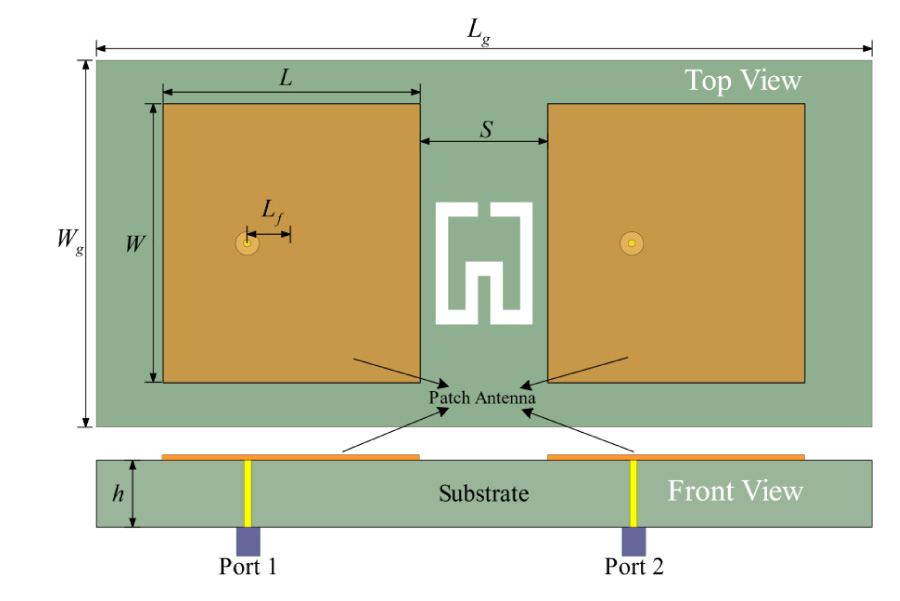
A Novel dual-port co-planar wave-guide (CPW)-fed rectangular patch antenna with L-shape and rectangular-shaped slots is proposed for wider impedance bandwidth for wireless communications applications. The dimensions of the overall proposed patch antenna are compact, with a size of 20 × 40 × 0.07 mm3. It operates from 14.6 GHz to 17.4 GHz with an impedance bandwidth of 2.8 GHz. The isolation between elements is greater than 15 dB within the band. A peak gain of 6.75 dBi and a reflection coefficient of -30 dB at operating frequency have been observed. The two-port (multiple-input and multiple-output) CPW-fed antenna parameters like envelope correlation coefficient (ECC), diversity gain (DG), total active reflection coefficient (TARC), channel capacity loss (CCL), and mean effective gain (MEG) are investigated. Simulated and measured characteristics are found to be satisfactory of proposed antenna model. The proposed antenna has utilized for wireless communication applications.
Design of Wider Impedance Bandwidth with Dual-port CPW-fed Slotted Patch Antenna for Wireless Communications
2024-06-09
PIER C
Vol. 144, 23-31
Design of Ultra-Wideband Antenna with Quadruple Band Notch Reconfigurability
Sadineni Ramesh Babu , Kosuri Srinivasa Rao , Thotakura Sushma , Paruchuri Venkata Krishna Kanth , Veeravalli Ramakoteswara Rao and Puttaraje Dinesha
A miniaturized ultra-wideband (UWB) antenna with quadruple reconfigurable characteristics is proposed in this paper. The first step involves the development of an elementary rectangular patch antenna of size 40 × 40 mm2, which is subsequently modified to demonstrate UWB properties. To incorporate quad-band notch features, the radiating surface of the patch antenna is etched with four U-shaped slots. The antenna has an impedance bandwidth ranging from 2.2 GHz to 12 GHz, with four specific notches located at 3.3 GHz (3.1-3.5 GHz), 3.8 GHz (3.6 GHz-4 GHz), 4.6 GHz (4.5 GHz-4.7 GHz), and 5.2 GHz (5.1 GHz-5.3 GHz). By incorporating four PIN diodes, the antenna is capable of attaining a range of sixteen reconfigurable states across the UWB spectrum. The design of this system successfully addresses the issue of interference caused by WiMAX, downlink C-band, Indian national satellite system, and Wireless LAN. A prototype is fabricated and tested. The simulated and experimental results are in good agreement.
Design of Ultra-Wideband Antenna with Quadruple Band Notch Reconfigurability
2024-06-09
PIER M
Vol. 127, 85-92
A Metamaterial Based Dual-Band UWB Antenna Design for 5G Applications
Jincheng Xue , Guolong Wang , Shuman Li , Zhuopeng Wang and Quanquan Liang
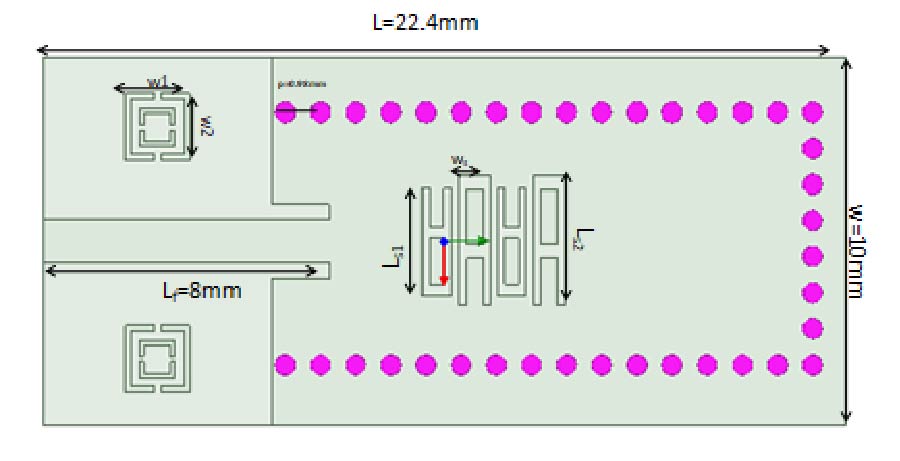
This paper presents the design of a novel ultra-wideband antenna for Internet of Things applications utilizing metamaterials. The antenna is fed by a coplanar waveguide and comprises several key components: two relatively connected co-directional split-ring resonators with an upper feeder, a ground plane featuring a complementary circular resonant slit, and a double C-shaped nested ring situated on the lower surface of the substrate constitutes the electric inductive capacitive (ELC) element. The antenna's overall dimensions are 0.408 × 0.35 × 0.018λ03, enabling it to operate within the dual-band frequencies of 2.79-4.22 GHz (40.8%) and 4.70-5.88 GHz (22.3%). The antenna exhibits a favorable directional pattern across its operating frequency range, with a measured peak gain of approximately 3.93 dBi. This performance makes it suitable for applications in Wi-Fi, 5G communication, IoT, and various other fields requiring reliable wireless connectivity.
A Metamaterial Based Dual-band UWB Antenna Design for 5G Applications
2024-06-08
PIER C
Vol. 144, 9-21
Design and Optimization of Reverse Series Triple Coil Structure with Simultaneous Offset and Load Fluctuation Resistance
Xiaohua Shu , Jianbin Wang , Chenxi Zhang and Zhongqi Li
In wireless power transfer (WPT) systems, the horizontal misalignment between coils and variations in the load result in significant fluctuations in the transmission efficiency of the system. In this paper, a reverse series triple coil (RTC) structure is proposed. The RTC structure offers improved resistance to deflection in the direction of vehicle motion because of the magnetic field interaction of the reverse series coils. This adjustment helps maintain a more stable system transmission efficiency when the coils are deflected. At the same time, when the load resistance varies within a certain range, the system's transmission efficiency remains almost unchanged. This is because the addition of relay coils makes the system more adaptable to load changes and improves the system's load compatibility. The experimental results indicate that the RTC structure corresponds to 300% of the load variation range of the conventional reverse series dual-coil structure, within the range where the system transmission efficiency is not less than 95%, in the load variation range that satisfies the load equivalent resistance from 15 Ω to 68 Ω. During the offset process, the maximum system transmission efficiency fluctuation rate is 1.19% for a distance of 55% of the core width of the offset transmitting coil on the horizontal Y-axis, and the maximum efficiency reaches as high as 97.26%.
Design and Optimization of Reverse Series Triple Coil Structure with Simultaneous Offset and Load Fluctuation Resistance
2024-06-08
PIER Letters
Vol. 120, 23-29
Design of Superconducting h-Shaped Microstrip Antennas on Anisotropic Substances Using Hybrid Cavity Model
Mohamed Bedra , Djemai Arar , Djamel Benatia , Sami Bedra and Akram Bediaf
This study investigates the effects of various antenna parameters, such as the substrate material, thickness of the superconducting patch, and operating temperature, on the resonance frequency and surface resistance/reactance of an H-shaped patch antenna printed on a uniaxial anisotropic substrate using a hybrid cavity model and fabricated with superconductor material. This model stands out for its simplified mathematical approach and cost effectiveness. Importantly, the numerical results demonstrate a high level of agreement with the experimental findings reported in the literature, reinforcing the reliability of our study. Additionally, other numerical results demonstrate the impact of the superconductivity materials on the resonant characteristics of the H-shaped compact microstrip antenna.
Design of Superconducting H-shaped Microstrip Antennas on Anisotropic Substances Using Hybrid Cavity Model
2024-06-07
PIER Letters
Vol. 120, 59-64
Broadband Cross-Coupled Filter Based on CPW Structure and Triangular SIW Resonant Cavity
Xiaohei Yan and Minjie Guo
This paper proposes a cross-coupled filter that utilizes a coplanar waveguide (CPW) resonator and triangular substrate-integrated waveguide (TSIW) resonant cavities. The filter consists of a CPW resonator etched on the upper metal surface of a second-order triangular SIW resonant cavity. By adjusting the dimensions of the CPW resonator and optimizing the width of the inductive coupling window, precise control can be achieved over cross-coupling between resonators, enabling fine-tuning of both filter bandwidth and transmission zero placement. Simulation and test results indicate that the filter has a center frequency of 11.85 GHz, a -3 dB bandwidth of 1.82 GHz, a relative bandwidth of 15.4%, an insertion loss of -0.9 dB in the passband, a return loss of over 15 dB, and a transmission zero point located at 15 GHz. The filter has a simple structure, wide bandwidth, low insertion loss, small circuit size, and a flexible and controllable transmission zero point, making it potentially valuable for various applications.
Broadband Cross-coupled Filter Based on CPW Structure and Triangular SIW Resonant Cavity
2024-06-07
PIER B
Vol. 106, 113-129
FFT-Acceleration and Stabilization of the 3D Marching-on-in-Time Contrast Current Density Volume Integral Equation for Scattering from High Contrast Dielectrics
Petrus Wilhelmus Nicolaas (Pieter) Van Diepen , Martijn Constant van Beurden and Roeland Johannes Dilz
An implicit causal space-time Galerkin scheme applied to the contrast current density volume integral equation gives rise to a marching-on-in-time scheme known as MOT-JVIE, which is accelerated and stabilized via a fully embedded FIR filter to compute the electromagnetic scattering from high permittivity dielectric objects discretized with over a million voxels. A review of two different acceleration approaches, previously developed for two-dimensional time-domain surface integral equations based on fast Fourier transforms (FFTs), leads to an understanding why these schemes obtain the same order of acceleration and the extension of this FFT-acceleration to a three-dimensional MOT-JVIE. The positive definite stability analysis (PDSA) for the MOT-JVIE shows that the number of voxels for a stable MOT-JVIE discretization is restricted by the finite precision of the matrix elements. The application of the PDSA provides the insight that stability can be enforced through regularization, at the cost of accuracy. To minimize the impact in accuracy, FIR-regularization is introduced, which is based on low group-delay linear-phase high-pass FIR-filters. We demonstrate the capabilities of the FFT-accelerated FIR-regularized MOT-JVIE for a number of numerical experiments with high permittivity dielectric scatterers.
FFT-acceleration and Stabilization of the 3D Marching-on-in-time Contrast Current Density Volume Integral Equation for Scattering from High Contrast Dielectrics
2024-06-06
PIER C
Vol. 144, 1-8
Triple Band Compact Textile Antenna Structure for Wearable Applications
Shankar Bhattacharjee and Monojit Mitra
A compact triple band antenna for wearable applications is presented in this paper. The antenna exhibits dual mode operation for ON/OFF body communication. The antenna has a patch like radiation pattern for OFF body communication and monopole like radiation pattern for ON body communication. Triple bands are achieved by incorporating an annular ring patch with the triangular patch. Tuning of the antenna and impedance matching has been done using two open ended rectangular slots and two shorting pins. As a result, the antenna has patch like radiation pattern at 2.5 GHz (ISM band), 3.5 GHz (Wi Max band) bands and monopole like radiation pattern at 5.5 GHz (WLAN band) band. The proposed antenna is compact in nature with a size of 70 × 70 × 2.1 mm3. User comfort has been taken into care with the use of all textile materials to fabricate the antenna except the SMA connector. A full ground plane in the proposed antenna ensures minimum coupling with human body and thereby a low SAR (specific absorption rate) value. Investigation of the antenna has been performed in both free space and on body scenarios.
Triple Band Compact Textile Antenna Structure for Wearable Applications
2024-06-06
PIER Letters
Vol. 120, 53-58
Broadband Generation Orbital Angular Momentum Beams Based on Uniform Phase Error Analysis of Uniform Circular Array
Na Li , Lingling Jiao , Guirong Feng , Ping Li and Xiao-Wei Shi
In this paper, we propose a method for generating broadband orbital angular momentum (OAM) beams, utilizing the two neighboring ports of the uniform circular array (UCA) excited with a phase difference of (2(π+δ)l)/N. This approach differs from current arrays used to generate an OAM beam with a phase difference of 2πl/N. We establish that the UCA can produce OAM beams covering 83% (7-17 GHz) of the bandwidth. The array antenna consists of three Vivaldi elements with a phase difference between adjacent ports, capable of generating OAM beams of mode 2 when being fed with equal amplitude and phase. In contrast to current OAM antenna arrays that require complex phase-shifting networks for feeding, our proposed antenna array offers simplicity in its feeding mechanism. Furthermore, the UCA-based Vivaldi antenna presents a novel approach for generating wideband OAM beams and holds significant potential for applications in broadband communication.
Broadband Generation Orbital Angular Momentum Beams Based on Uniform Phase Error Analysis of Uniform Circular Array
2024-06-05
PIER
Vol. 179, 61-69
Fabricated Magnetic-Dielectric Synergy FE@Carbon Microspheres by Spray-Pyrolysis with Excellent Microwave Absorption in C-Band
Hao Zhu , Zhuolin Li , Mengqiu Huang , Lei Wang , Yongsheng Liu , Yuxiang Lai and Renchao Che
The development of materials with excellent absorption properties in the C-band through the utilization of the magnetoelectric coupling effect holds great potential within the field of absorption research. However, there are still several challenges. To address these challenges, Fe@Carbon (Fe@C) microspheres were successfully fabricated using spray-drying followed by pyrolysis. The average size of the Fe@C microspheres is 3.6 µm with uniform dispersion, where iron nanoparticles (NPs) are tightly anchored with the carbon matrix to tune the microwave absorption properties. Synthesized Fe@C microspheres exhibit remarkable electromagnetic wave absorption capability within the C-band (4-8 GHz), covering a bandwidth of 2.8 GHz. Also, the Fe@C microsphere exhibits a minimum reflection loss of -48.11 dB at 4.5 mm thickness and 6.88 GHz. Systematic analysis has uncovered that the integration of large-sized magnetic carbon structures, high-density confinement of magnetic units, and robust magnetic coupling are crucial for enhancing the magnetic loss dissipation. This study introduces a novel approach for the preparation of electromagnetic absorbing materials, providing inspiration for further exploration of the mechanism behind low-frequency magnetic loss.
Fabricated Magnetic-dielectric Synergy Fe@Carbon Microspheres by Spray-Pyrolysis with Excellent Microwave Absorption in C-band
2024-06-05
PIER M
Vol. 127, 75-83
Exploitation of the Spectral Stochastic Finite Element Model for the Evaluation of Surface Defects of the CFRP Composite
Zehor Oudni and Thinhinane Mahmoudi
This article deals with the detection of defects of rectangular geometric shape, in a carbon fiber reinforced polymer (CFRP) composite material based on non-destructive testing by eddy current (ECT). For this, a stochastic finite element calculation code is developed in a Matlab environment. The main objective is to evaluate the ECT signal of a fault by determining the impedance variation for the two configurations, in the absence and presence of a fault. Additionally, the impact of the direction of the carbon fibers is exploited to evaluate the reliability of the material. The validation of our work is carried out using experimental data from the work of Takagi et al., provided for reference.
Exploitation of the Spectral Stochastic Finite Element Model for the Evaluation of Surface Defects of the CFRP Composite
2024-06-04
PIER C
Vol. 143, 199-207
Simplified Three-Vector Selection Model Predictive Current Control for PMSM Considering Fixed Switching Frequency
Dingdou Wen , Zhuoheng Li , Xiaorui Wei and Zhun Cheng
To address the insufficiency of large computation and unfixed switching frequency in permanent magnet synchronous motor (PMSM) of three-vector model predictive current control (TV-MPCC), simplified three-vector selection model predictive current control (STV-MPCC) for PMSM considering fixed switching frequency is proposed. Firstly, a novel voltage vector selection strategy is constructed by calculating the reference voltage in combination with the deadbeat control and re-dividing the sectors, reducing the number of optimizations from 11 to 5. Then, the current error is introduced in the calculation of the duty cycle to simplify the conventional control algorithm, The current ripple is reduced, and the system switching frequency is fixed. Finally, the experimental results indicate that compared with the conventional TV-MPCC, the d-q axis current ripple has been reduced by 13% and 18% respectively, and the torque ripple has been reduced by 6%, THD decreased from 4.70% to 4.25% and the steady-state performance of the motor is improved.
Simplified Three-vector Selection Model Predictive Current Control for PMSM Considering Fixed Switching Frequency
2024-06-04
PIER Letters
Vol. 120, 47-52
Interdigital Coupled Compact FSS Reflector for UWB Antenna Gain Enhancement
Gobinda Sen and Santanu Das
A compact UWB FSS reflector is presented based on an interdigital structure for gain enhancement of a UWB antenna. An equivalent circuit approach is proposed for the analysis of the FSS reflector. The reflector comprises a 6 × 6 array of unit cell dimension 6 mm × 6 mm and is very compact. The reflector gives a linear phase response over UWB. A UWB monopole antenna is designed with a half circular disc structure based on microstrip technology. A maximum of 5 dBi gain enhancement is achieved with this compact FSS reflector when it is placed at a distance below the antenna. The measured results closely follow the simulated ones which proves feasibility of this design.
Interdigital Coupled Compact FSS Reflector for UWB Antenna Gain Enhancement
2024-06-04
PIER B
Vol. 106, 101-112
Design and Optimization of a Circular Ring-Shaped UWB Fractal Antenna for Wireless Multi-Band Applications Using Particle Swarm Optimization
Rania Hamdy Elabd and Ahmed Jamal Abdullah Al-Gburi
This study introduces a groundbreaking circular ring-shaped fractal antenna optimized using particle swarm optimization (PSO) for wireless ultra-wideband (UWB) applications. The proposed fractal antenna design, featuring a central plus sign and an outer circular ring with eight smaller rings, enhances bandwidth for UWB response. The ground plane is modified with an etched curved slit to optimize antenna impedance. Utilizing PSO, we determine the fractal antenna's dimensions with optimization goals of minimizing size while ensuring |S11| < -10 dB. Experimental data demonstrates strong performance across the 2.05 GHz-14.5 GHz frequency range, covering diverse wireless standards like UWB from 3.1 up to 10.6 GHz, X-band from 8 up to 12.5 GHz, and lower band of Ku from 12.5 to 14.5 GHz. Consistent measured and simulated results validate our contribution's applicability. Additionally, a time-domain analysis underscores the antenna's adaptability to UWB applications, offering insights into its response to transient signals.
Design and Optimization of a Circular Ring-shaped UWB Fractal Antenna for Wireless Multi-band Applications Using Particle Swarm Optimization
2024-06-04
PIER B
Vol. 106, 85-99
Biomedical Telemetry Antenna Innovations: Progress, Uses, and Prospects for the Future
Vivek Gupta and Rajeev Kumar
Biomedical telemetry is, therefore, significant considering it facilitates prompt telecommunication as well as tracking of medical devices between centralized systems and patients. The availability and quality of communication of information are determined by the performance and selection of the telemetry antenna. This article analyzes the current state of BMA technology, aiming to extend the communication range and transmission speed of the data. The research article intends to contribute to the development of wireless technology. A plethora of antenna sizes are tackled from wearable to insertable antennas in addition to the improvements in materials and fabrication methods. The present review paper puts the thesis on only a few of the numerous biomedical telemetry antenna applications in healthcare, and these are the Internet of Medical Things (IoMT) and remote patient monitoring applications. it discusses case studies where better antennas had led to the creation of new therapeutic strategies, and diagnostic capacities, and had overall improved the quality of services. Therefore, the architectural problems of the existing designs are scrutinized, and this gives the other research areas the chance to be explored. A biological telemetry antenna is set to be the mobile edge computing solution that combines artificial intelligence, a 5G network, and edge computing. It also improves capital effectiveness over the transition period. Presentation makes it evident, why antennas are the essential component of the connected healthcare system and how antennas might redefine individualized care and the healthcare ecosystem. In conclusion, this research provides an extensive overview of the developments, uses, and future directions of biomedical telemetry antenna technology. It is an invaluable resource for academics, engineers, and medical professionals who seek to understand more about the evolving nature of this crucial component of modern healthcare systems.
Biomedical Telemetry Antenna Innovations: Progress, Uses, and Prospects for the Future