Search Results(13786)

2024-04-07
PIER C
Vol. 142, 173-181
Active Magnetic Bearing Three-Level Modulation Strategy Based on Mixed Logical Dynamical Model Prediction Controller
Yu Zou , Yongqiang Jiang , Fan Yang , Ye Yuan and Fuguang Wen
Active magnetic bearings feature advantages of frictionlessness, low loss, and high reliability, making them extensively utilized in fields such as flywheel energy storage, aerospace, and beyond. However, conventional modulation strategies applied to digital control systems suffer from control delays, reducing current control precision and resulting in increased current ripple. To address the aforementioned issues, firstly, the operating principle of the active magnetic bearing drive system is analyzed. Based on hybrid systems theory, a mix logical dynamic model of the drive system is established by introducing auxiliary logical variables and auxiliary continuous variables to achieve three-level modulation. Secondly, integrating model predictive control theory, the established model is utilized as a predictive model to forecast and compensate for control delays in controlling current. Finally, a cost function is established based on the error between predicted current and reference current, and optimal control signals are generated to achieve precise control of the active magnetic bearings. The simulation results demonstrate that under light load conditions, the modulation strategy proposed in this paper reduces current ripple by 49.94% compared to traditional modulation strategies. Under moderate load conditions, the proposed modulation strategy reduces current ripple by 49.96%, while under heavy load conditions, it reduces current ripple by 49.99%. This validates the effectiveness of the proposed modulation strategy in compensating for control delays while retaining the three-level modulation scheme.
Active Magnetic Bearing Three-level Modulation Strategy Based on Mixed Logical Dynamical Model Prediction Controller
2024-04-07
PIER M
Vol. 126, 89-98
Thermal Simulation for Magnetic Coupler of Wireless Power Transfer Electric Vehicles by Using Heat Sink and Thermoelectric Cooler
Umar Farooq , Shahryar Shafique , Muhammad Asif , Muhammad Arslan , Poramed Wongjom , Rizwan Ullah , Anton Zhilenkov , Saleh Mobayen and Wanchai Pijitrojana
In challenging operational environments such as underground buildings beneath roadways, the reliability and performance of wireless power transfer (WPT) systems for electric vehicles (EVs) heavily hinge on the operating temperature of the magnetic couplers. Addressing this, this study introduces a novel approach employing heat sink and thermoelectric cooler technologies to mitigate temperature rise in magnetic couplers, which is particularly crucial for high-power applications. Utilizing ANSYS simulation, the study evaluates a WPT high-power application coil model with a total output power of 2 KW and an 18 cm air gap, with a 3.5 cm adjacent alignment to enhance thermal performance on both transmitter and receiver sides. Results demonstrate significant thermal enhancement, reducing the temperature of coils from 63˚C to 54˚C solely with the heat sink and further down to 48˚C with the combined implementation of both heat sink and thermoelectric cooler. These measures effectively dissipate heat from the coils into the surrounding air, ensuring system efficiency and stability while facilitating optimal functionality of system components.
Thermal Simulation for Magnetic Coupler of Wireless Power Transfer Electric Vehicles by Using Heat Sink and Thermoelectric Cooler
2024-04-05
PIER Letters
Vol. 119, 27-33
A Compact MIMO Antenna with Wideband Charaecteristics for WiFi 6E/X-Band Applications
Janani Sasikumar and Kanmani Ruby Erode Dhanapal
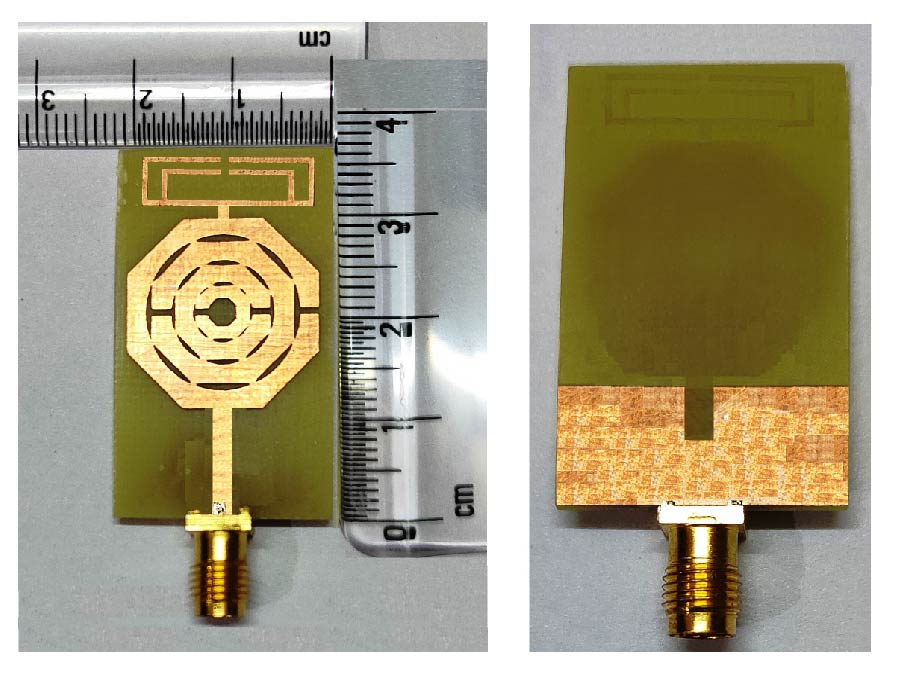
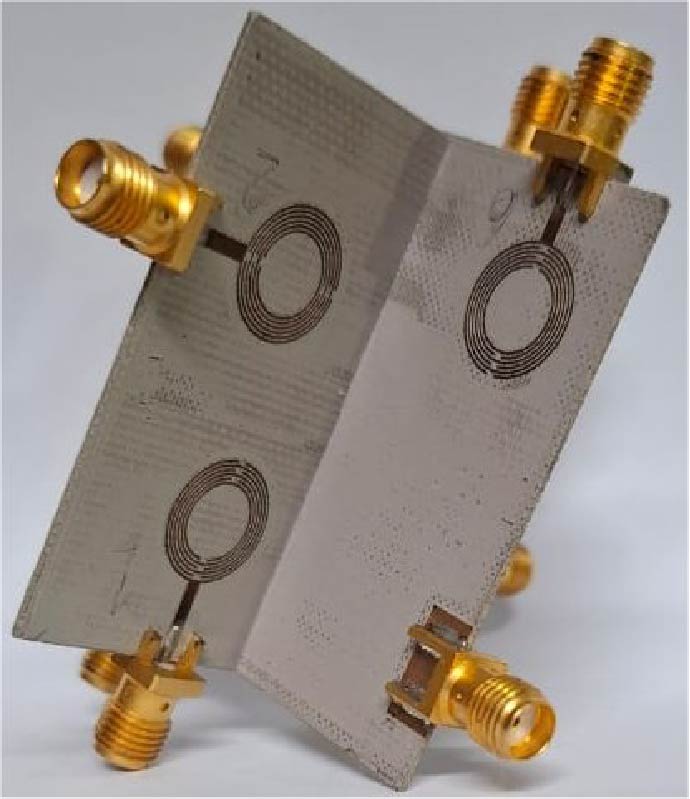
A novel proposal for upcoming wireless applications introduces a dual-band, highly decoupled, and compact microstrip patch co-planar waveguide (CPW)-fed MIMO antenna. This low-profile antenna exhibits narrow wide-band performance across the frequency bands of 6.2 to 11.2 GHz, with dimensions of 20 × 20 mm3 on a standard FR4 substrate. Through integration onto a printed circuit board (PCB) measuring 20 × 20 mm2, the antenna configuration is expanded to a 4 × 4 MIMO arrangement. Individual antennas within this setup maintain a significant isolation of around 20 dB in the absence of a decoupling mechanism. Fabrication of the designed four-port antenna allows for practical measurement of various antenna parameters. The measured results closely align with simulated outcomes, encompassing S parameters, far-field patterns, and MIMO characteristics such as envelope correlation coefficient, channel capacity loss, and total active reflection coefficient. These results suggest that the antenna design presented in this study holds promise for future wireless applications.
A Compact MIMO Antenna with Wideband Charaecteristics for WiFi 6E/X-band Applications
2024-04-03
PIER M
Vol. 126, 81-88
Ultra Thin Highly Sensitive Metamaterial Absorber Based Refractive Index Sensor for Detecting Adulterants in Alcohol
Sagnik Banerjee , Ishani Ghosh , Mazed Billah Fahad , Santosh Kumar Mishra , Rahul Yadav and Bhargav Appasani
This research provides a unique design of a terahertz-frequency metamaterial absorber. The absorber shows resonance at frequency 5.01THz where the peak absorption is 99.5%. A staggering quality factor of 125.25 is also discovered. Since the radiation is non-ionizing, the metamaterial absorber can function as a refractive index sensor and can be used for sensing applications. To support the chosen design parameter values, parametric analysis was performed. The resonance mechanism has been clearly explained using the surface current distribution plot, and the metamaterial nature of the sensor has also been justified using the impedance plot, followed by the plot showing the permeability and permittivity at the resonance frequency. By detecting changes in the refractive index of the surrounding medium, the proposed sensor finds application in detecting the percentage of water and percentage of methanol in alcohol solution. Methanol and water are two prominent contaminants of alcohol. It can detect the percentage of water in alcohol with a sensitivity of 2.105 THz/RIU and can detect percentage of methanol in alcohol with a sensitivity of 1.999 THz/RIU. This work can inspire future research on using THz metamaterial absorbers for quality assessment of food products and beverages.
Ultra Thin Highly Sensitive Metamaterial Absorber Based Refractive Index Sensor for Detecting Adulterants in Alcohol
2024-04-03
PIER Letters
Vol. 119, 21-26
Comparative Study of High-Resolution RCS Models of Motorcyclists in W-Band Extracted from Measurements
Sevda Abadpour , Mario Pauli , Jan Siska , Nils Pohl and Thomas Zwick
Reliably modeling vulnerable road users (VRUs) such as motorcyclists in the virtual environment is indispensable in developing over-the-air (OTA) validation test methods. However, there are still challenges arising from many possible variations of VRUs, which may participate in the traffic scenarios. Therefore, it is essential to model them precisely and demonstrate consistency between virtual evaluation and reality. To achieve this goal, the VRUs must be modeled based on their backscattering behavior which can be prepared based on high-resolution (HR) radar cross section (RCS) measurements. This work presents the backscattering behavior of motorcyclists as one of the critical VRUs in traffic scenarios. The extracted model of a motorcyclist is analyzed and compared based on HR-RCS measurements with different motorcycle variants. This evaluation is a prerequisite for developing a realistic model of VRUs and ensuring an adequate level of accuracy.
Comparative Study of High-resolution RCS Models of Motorcyclists in W-band Extracted from Measurements
2024-04-03
PIER Letters
Vol. 119, 15-19
A Simplified Extended Multilayer SIW Supporting TE01 Mode Integrated with a Feeding Structure
Tzichat M. Empliouk , Christos I. Kolitsidas and George Kyriacou
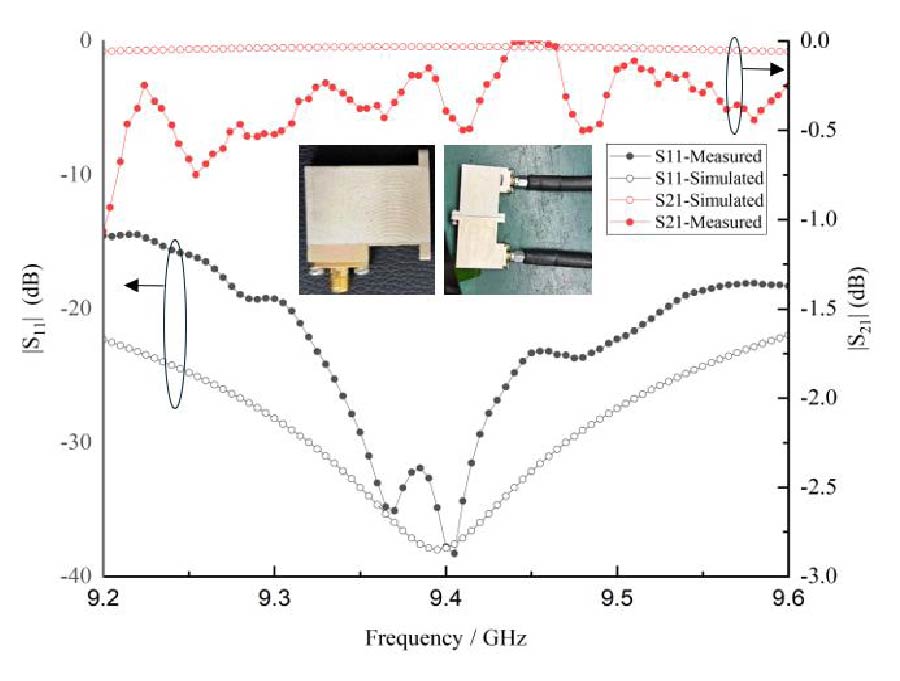
In this letter, a TE01 operation of a multilayered Substrate Integrated Waveguide (SIW) is presented. To enable the propagation of this typically unsupported mode, the SIW is integrated with feeding layer and with an Electromagnetic Band Gap (EBG) structure, exciting and confining the field within the proposed waveguide structure. The EBG is simply stacked on top and bottom of the proposed structure, allowing for ease of manufacturing. The overall proposed structure is simulated and measured, and the results indicate very low insertion loss in the passband of the waveguide.
A Simplified Extended Multilayer SIW Supporting TE<sub>01</sub> Mode Integrated with a Feeding Structure
2024-04-02
PIER C
Vol. 142, 161-171
Fuzzy Dynamic Sequential Predictive Control of Outer Rotor Coreless Bearingless Permanent Magnet Synchronous Generator Based on Prediction Error Compensation
Shuai Zhuang , Gai Liu and Huangqiu Zhu
Outer rotor coreless bearingless permanent magnet synchronous generator is a complex and strongly coupled nonlinear system. The stable suspension and voltage of generator are always the focus and difficulty of research. The fuzzy dynamic sequential model predictive torque control method based on prediction error compensation is proposed. Firstly, the basic structure and working principle of the outer rotor coreless bearingless permanent magnet synchronous generator are introduced in this paper, and the mathematical model of voltage and suspension force is established. Secondly, the mathematical model is carried out to obtain the prediction equation, and the prediction error compensation is carried out to the prediction equation, and then the number of the first output voltage vectorsis determined by fuzzy controller. Finally, the designed control system is simulated and experimentally studied. The simulated and experimental results show that this control method can obtain good voltage and suspension response, and the outer rotor coreless bearingless permanent magnet synchronous generator has good dynamic performance and stability.
Fuzzy Dynamic Sequential Predictive Control of Outer Rotor Coreless Bearingless Permanent Magnet Synchronous Generator Based on Prediction Error Compensation
2024-04-02
PIER M
Vol. 126, 73-80
An Antipodal Vivaldi Antenna with a Lower Cutoff Frequency Based on Spoof Surface Plasmon Polaritons and Corrugated Edges
Baoping Ren , Chenguang Zhao , Xuehui Guan and Shaopeng Wan
In this paper, an antipodal Vivaldi antenna (AVA) with lower cutoff frequency is proposed based on spoof surface plasmon polaritons (SSPPs) and corrugated edges. Firstly, the gradient slots are etched on the external edges of two radiation arms of the conventional antipodal Vivaldi antenna. As a result, the cutoff frequency at the low frequency side will decrease slightly because the surface current path of the antenna is increased. More importantly, the SSPPs structure with identical units is etched on the inner side of two radiation arms, resulting in a large reduction of the cutoff frequency for the larger propagation constant of the SSPPs structure compared with radiation arms of the conventional antipodal Vivaldi antenna. Additionally, SSPPs structure on the stripline ensures good momentum matching and mode matching between quasi-TEM mode and SSPPs mode. Besides, to improve the gain at the high frequency region of the operation band, the introduced SSPPs structure on the inner side of two radiation arms is further optimized by varying groove depths. Experimental results demonstrate that the designed antipodal Vivaldi antenna exhibits a good radiation performance with a low cutoff frequency of 2.8 GHz and a maximum gain of 9.3 dBi.
An Antipodal Vivaldi Antenna with a Lower Cutoff Frequency Based on Spoof Surface Plasmon Polaritons and Corrugated Edges
2024-04-01
PIER C
Vol. 142, 151-160
Analysis of MIMO Channel Capacity for Terahertz Communication Systems
Abdelmounim Hmamou , Jamal Mestoui , Tanvir Islam , Mohammed El Ghzaoui , Narayanan Gangatharan and Sudipta Das
The primary focus of this paper is to evaluate the channel capacity of a Terahertz (THz) communication system using a Multiple Input Multiple Output (MIMO) technique. By deriving mathematical expressions for channel capacity and considering practical constraints, the paper provides insights into the performance of such systems under various conditions. The channel model used in this work accommodates the channel accuracies and transceivers constraints. To validate the proposed channel capacity, some simulations by taking into account deferent parameters namely SNR (Signal to Noise Ratio), MIMO channel Matrix size and distance between transmitter and receiver are performed. These simulations are carried out for 3 cases which are: (1) Channel State Information CSI is known to both transmitter (Tx) and receiver (Rx), (2) CSI is known to Rx but unknown to Tx, (3) CSI is unknown to both Tx and Rx. In this study, we introduce a mathematical formulation for a communication channel tailored for Terahertz (THz) applications. Using this channel model, we analyze the capacity of the THz channel. The suggested research has the potential to be applied in the design and enhancement of Terahertz (THz) wireless communication systems, aiding in the advancement of robust and high-capacity wireless networks that can fulfill the requirements of contemporary multimedia applications.
Analysis of MIMO Channel Capacity for Terahertz Communication Systems
2024-04-01
PIER M
Vol. 126, 65-72
Metamaterials Photonic Filter Based on Electromagnetically Induced Transparency Resonance
Younes Errouas , Ilyass El Kadmiri , Youssef Ben-Ali , Abdelaziz Ouariach and Driss Bria
In this paper, we give an analytical demonstration of electromagnetic induced transparency (EIT) resonance by a simple photonic device consisting of two grafted resonators (metamaterials of type Epsilon Negative Gauchy (ENG)) of lengths d2 and d3. Then, we study theoretically the transmission spectrum and the dispersion relation of periodic photonic comb-like waveguides system built of periodic segments of length d1 (of right-handed material). The electrical permittivity, ε, of the two asymmetric resonators with lengths d2 and d3, depends on the frequency of the incident waves (ENG material). The presence of geometrical (ENG resonators) defects inside the perfect structure creates the defect modes inside the band gaps. Consequently, we demonstrate the existence of two filtered frequencies. This structure can be used as a new photonic filter in the microwave range with an important quality factor and a high transmission rate.
Metamaterials Photonic Filter Based on Electromagnetically Induced Transparency Resonance
2024-04-01
PIER M
Vol. 126, 37-63
Lasers Based on Periodic and Quasiperiodic Planar Feedback Cavities: Designs, Principle, and Potential Applications
Anwer Hayat , Alamgir , Yi Jin , Naeem Iqbal , Tianrui Zhai and Sailing He
Planar feedback micro-nanoscale cavities, shaped by advances in nanofabrication, have revolutionized laser technology, giving rise to chip-scale, low-threshold lasers with wide-ranging applications, spanning from atmospheric investigation to incorporation intocentral devices such as smartphones and computer chips. The complicated designs of these cavities, shaped by the physics of periodic and quasiperiodic structures, empower efficient manipulation of light-matter interaction and coherent light coupling, minimizing losses. This review thoroughly explores the underlying concepts and crucial parameters of planar feedback microcavities, shedding light on the photophysical behavior of recent gain materials pivotal for realizing optimal lasing properties. The examination extends to photonic crystal bandgap (PhC BG) microcavity lasers, specifically with periodic and quasiperiodic architectures. In-depth assessments probe into the principles and designs of each architecture, exploring features such as wavelength selectivity, tuneability, lasing patterns, and the narrow linewidth characteristics inherent in distributed feedback (DFB) microcavity lasers. The review highlights the intriguing characteristics of non-radiative bound states in the continuum (BIC) within periodic architectures, emphasizing trends toward high-quality factors, low thresholds, and directional and vortex beam lasing. It also explores the nascent field of Quasiperiodic (QP) microcavity lasers, addressing challenges related to disorder in traditional periodic structures. Comparative inquiries offer insights into the strengths and limitations of each architecture, while discussions on challenges and future directions aim to inspire innovation and collaboration in this dynamic field.
Lasers Based on Periodic and Quasiperiodic Planar Feedback Cavities: Designs, Principle, and Potential Applications
2024-03-31
PIER C
Vol. 142, 143-150
Design and Analysis of Printed Conformal Antenna System for Inter and Intra Vehicular (V2V) Communication Utilizations
Mudunuri Padmanabha Raju , Bathula Sadasiva Rao , Beulah Jackson , Tanvir Islam , Boddapati Taraka Phani Madhav , Sudipta Das and Usha Devi Yalavarthi
A multiple antenna placement system analysis for the improvement of efficiency and capacity for inter and intra vehicular communication is proposed in this article. Four antennas are placed in the four locations of the vehicular body which includes roof, side mirror, rear screen, and dashboard. The constituted antenna occu-pying the dimension of 40×38.5×0.2 mm3 on flexible substrate material of photo paper and the bending analysis of the model as per the conformal nature on vehicular body is also analyzed and presented in this work. The received power from each receiving antenna response with respect to the transmitter has been analyzed. The chan-nel capacity with respect to the antenna position for V2V communication is analyzed in different areas and in different environmental conditions.
Design and Analysis of Printed Conformal Antenna System for Inter and Intra Vehicular (V2V) Communication Utilizations
2024-03-31
PIER M
Vol. 126, 29-36
A Stable and Efficient Interpolation Method for Two-Dimensional Periodic Green's Functions
Lian Feng Ma , Qing Guang Zhao , Chong Guo and Yi Ren
This paper presents an efficient and stable interpolation method for calculating two-dimensional periodic Green's function and its gradient. The method consists of two steps: constructing an interpolation table in the first step and using linear interpolation to extract the desired Green's function from the interpolation table in the second step. In the construction of the interpolation table, several properties of the two-dimensional periodic Green's function are fully utilized, which minimize the size of the interpolation table. When the elements in the interpolation table are computed, all possible singular terms are removed, ensuring that the interpolation function maintains high linearity even under extreme skew periodic grids. This means that linear interpolation can guarantee sufficient accuracy. Numerical results demonstrate effectiveness of the proposed method, making it suitable for combining with numerical methods for electromagnetic field calculation and analysis of periodic structures.
A Stable and Efficient Interpolation Method for Two-dimensional Periodic Green's Functions
2024-03-30
PIER C
Vol. 142, 131-142
Research on Resonant Wireless Energy Supply Circular Reactive Shielding for Small Electronic Equipment
Jishen Peng , Sylla Tidiani , Heyi Cao , Yuepeng Liu and Weihua Chen
A reactive power shielding structure working under 150 kHz for small electronic equipment was proposed to reduce the electromagnetic leakage of WPT system. First, the model of LCC-LCC compensation circuit was established. By ensuring transmission efficiency, a comprehensive analysis of nine sets of computational data results was conducted to select the scheme with the best shielding effect. The experimental results showed that the magnetic flux density attenuation was 27.82% at 41 mm transmission distance from the center under the optimal structure of 3 rings and 7 turns, inner diameter of 23 mm and outer diameter of 35 mm. The transmission efficiency can reach 76.73%, which is only 1.32% lower than the situation without shielding. The proposed reactive power shielding structure can significantly reduce the magnetic flux density in the external area of the WPT system without affecting the transmission efficiency of the system.
Research on Resonant Wireless Energy Supply Circular Reactive Shielding for Small Electronic Equipment
2024-03-30
PIER Letters
Vol. 119, 7-13
A Novel Filter with Reconfigurable Bandwidth or Transmission Zeros Based on a Multiple-Mode Stub-Loaded Resonator
Liangzu Cao and Shouzhan Li
This paper presents a novel bandpass filter with reconfigurable bandwidth or transmission zeros. The proposed filter is based on a multiple-mode stub-loaded resonator. Three PIN diodes are utilized as switching elements to achieve four switchable operating states. The measurement results indicate that the 3 dB fractional bandwidth (FBW) of the filter can be varied from 32.3% to 70% at the centre frequency of 2.2 GHz, and the stopband attenuation is higher than 35 dB. The filter size is only about 0.28λg×0.19λg.
A Novel Filter with Reconfigurable Bandwidth or Transmission Zeros Based on a Multiple-mode Stub-loaded Resonator
2024-03-29
PIER Letters
Vol. 118, 99-105
A Dual-Mode Circular Antenna Array for Indoor Communication
Shen-Yun Wang , Meng-Ting Yang , Qing Zhang , Ling-Bing Kong and Wen Geyi
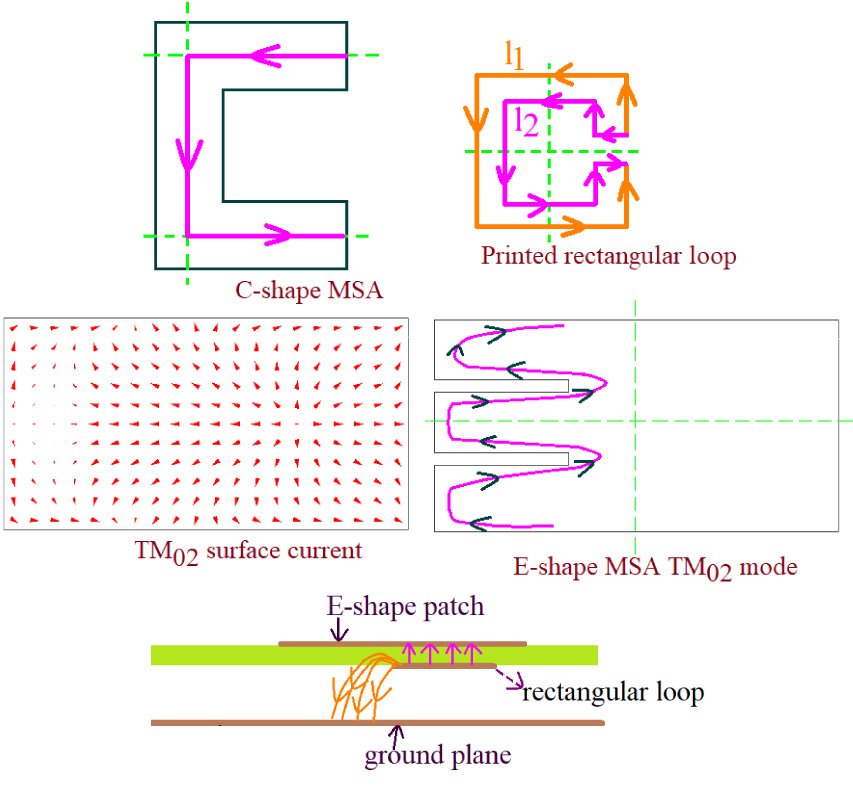
A circular antenna array with omnidirectional mode and 360° continuously directional beam-scanning mode operating in 5G indoor communication band is reported. The proposed circular antenna array is composed of 16 subarray elements, and each element consists of two back-to-back E-shaped patch antennas with a differential feeding network. The beam-scanning mode is achieved by controlling the exciting amplitudes and phases of consisting subarray elements, which is optimized by using the extended method of maximum power transmission efficiency, so as to guarantee the maximum possible gain value. The operating frequency of the circular array covers 3.3-3.6 GHz. The omnidirectional gain is about 4.7 dBi, while the directive gain reaches 16 dBi with 360° continuously beam-scanning performance and very slight gain fluctuation in the azimuth plane. The comparison with other state-of-the-art designs shows that the proposed circular array has both higher directional and omnidirectional gain values.
A Dual-mode Circular Antenna Array for Indoor Communication
2024-03-29
PIER B
Vol. 105, 107-121
Recent Advances in Parity-Time Symmetry-Enabled Electromagnetic Sensors
Minye Yang , Zhilu Ye , Pai-Yen Chen and Danilo Erricolo
Parity-time (PT) reversal symmetry, as a representative example in the field of non-Hermitian physics, has attracted widespread research interest in the past few years due to its extraordinary wave dynamics. PT-symmetry enables unique spectral singularities, including the exceptional point (EP) degeneracy where two or more eigenvalues and eigenvectors coalesce, as well as the coherent perfect absorber-laser (CPAL) point where laser and its time-reversal counterpart (i.e., coherent perfect absorber) can coexist at the same frequency. These singular points not only give rise to new physical phenomena, but also provide new plausibility for building the next-generation sensors and detectors with unprecedented sensitivity. To date, investigations into EPs and CPAL points have unveiled their great potential in various sensing scenarios across a broad spectral range, spanning optics, photonics, electronics, and acoustics. In this review article, we will discuss on going developments of EP- and CPAL-based sensors composed of PT-synthetic structures and offer a glimpse into the future research directions in this emerging field.
Recent Advances in Parity-time Symmetry-enabled Electromagnetic Sensors
2024-03-28
PIER M
Vol. 126, 19-27
A Triple Phase Shift Control Method for Bidirectional Inductive Power Transfer (BIPT) Systems with Fully-Compensated Series-Series (SS) Topology
Liujie Wan , Xiaohe Zhao , Jingkui Mao and Xiu Zheng
A bidirectional inductive power transfer (BIPT) system of full-compensated series-series (SS) topology with full bridge converters on both primary and secondary sides is analyzed in this paper. The steady-state electrical characteristics of the BIPT system under triple-phase-shift control are obtained, based on which, the conditions for achieving the maximum transfer efficiency of the intermediate circuit and zero voltage switching of all switches are derived. Triple Phase-Shift Control (TPSC) strategy was proposed for the control of the two inner phase shifted of the primary and secondary side full bridge converters and the fundamental excitation voltage phase shift, which achieved the maximum transfer efficiency of the intermediate circuit and zero voltage switching of all switches. The proposed control method was verified through simulation. The results showed that the control strategy can realize the bidirectional energy transfer of the IPT system, the efficiency optimization of the intermediate link, and the zero-voltage turn-on of all switching devices under various load conditions.
A Triple Phase Shift Control Method for Bidirectional Inductive Power Transfer (BIPT) Systems with Fully-compensated Series-Series (SS) Topology
2024-03-26
PIER C
Vol. 142, 119-130
A 4-Port Broadband High-Isolated MIMO Antenna for Wireless Communication
Ayyaz Ali , Maryam Rasool , Muhammad Zeeshan Zahid , Imran Rashid , Adil Masood Siddique , Moazzam Maqsood and Farooq Ahmad Bhatti
This article proposes a versatile Multiple Input Multiple Output (MIMO) antenna designed for contemporary wireless systems spanning frequencies from 3 to 20 GHz. It serves applications such as 5G mobile, WiFi, WiFi-6E, X-band, partial Ku, and K-band. The original single-element antenna evolves into a 4 × 4 MIMO configuration with optimized ground plane modifications for enhanced performance. A decoupling structure achieves over 20 dB isolation between inter-elements. The feeding structure, featuring a gradually changing design connected to the antenna's radiating structure, achieves wide bandwidth characteristics. This is further improved by a partial ground structure and slots on the radiating element. The lower frequency band of 3 to 7 GHz is attained with a rectangle-shaped radiator, while semi-circular microstrip lines atop the radiator enable the higher frequency bands of 8 to 15.4 and 18.7 to 20 GHz. The slots and ground structure enhance impedance bandwidth, and semicircles improve the radiation pattern. The MIMO antenna demonstrates measured peak gains of 4.4 dBi at 3.5 GHz, maintaining a radiation efficiency exceeding 80%. Validation through metrics like ECC, DG, CCL, and TARC confirms strong agreement between simulated and experimental results, positioning the MIMO antenna as a robust choice for various wireless communication applications.
A 4-port Broadband High-isolated MIMO Antenna for Wireless Communication
2024-03-26
PIER Letters
Vol. 119, 1-6
Scanned Antenna Arrays with Random Deactivated Elements
Noor Waadullah Yaseen and Jafar Ramadhan Mohammed
Usually inactive or also known as thinned elements are used to simplify the array design complexity by turning off some of the active elements in uniformly filled arrays. Consequently, the far-field radiation characteristics such as sidelobe level, beamwidth, and directivity may be negatively changed if no optimizer is used. Further, these radiation characteristics may be unavoidably deteriorated when the main beam is scanned to new directions other than the referenced broadside direction. In this paper, an efficient optimization method based on the genetic algorithm and a dynamic deactivation method is proposed to randomly deactivate a number of array elements to minimize the peak sidelobe level and at the same time maintain the array directivity undistorted, while scanning the main beam. The deactivation method chooses optimally the suitable number of elements and their locations that need to be deactivated such that the resulting radiation characteristics positively change according to the specified cost function. Also, the proposed scanned array uses binary coefficients to activate and deactivate the array elements, thus, the feeding network of the proposed array is very simple, and it can be easily implemented in practice. Through extensive simulation results, we show that the proposed optimization method has good performance under wide range of scanned main beam directions. It is also found that the number of deactivation elements (i.e., the optimization variables) increases with larger scan angle.
Scanned Antenna Arrays with Random Deactivated Elements