Search Results(13805)

2009-06-11
PIER
Vol. 93, 107-124
Direct Radiating Arrays for Satellite Communications via Aperiodic Tilings
Andrea Francesco Morabito , Tommaso Isernia , Maria Grazia Labate , Michele Durso and Ovidio Mario Bucci
This paper presents an innovative Direct Radiating Array (DRA) architecture exploiting aperiodic tilings of the plane. In particular, a pinwheel tiling has been selected in order to fix positions of the different radiating sources, which are constituted by properly shaped elements. Such a choice allows to achieve a good aperture efficiency and very low pseudo-grating lobes while using only two different kinds of radiating elements. Preliminary results are shown and discussed with reference to both cases wherein the single tiles are not fully populated and wherein ad-hoc sub-array radiators are used. The very encouraging results achieved leave open the way for further interesting possibilities.
DIRECT RADIATING ARRAYS FOR SATELLITE COMMUNICATIONS VIA APERIODIC TILINGS
2009-06-11
PIER Letters
Vol. 9, 9-18
Controllable Wavelength Channels for Multiwavelength Brillouin Bismuth/Erbium Based Fiber Laser
Harith Ahmad , Mohd Zamani Zulkifli , Siti Fatimah Norizan , Amirah Abdul Latif and Sulaiman Wadi Harun
We propose and demonstrate a Multiwavelength Brillouin Bismuth/Erbium Fibre Laser (MBBEFL) with the ability to control the number of wavelength channels generated. A multi-wavelength comb output is obtained using a 7.7 km DCF as a non linear gain medium to generate Stokes wavelengths through the process of Stimulated Brillouin Scattering (SBS). The DCF is pumped by a Raman pump source at 400 mW to lower the dispersion loss and promote the generation of the Stokes wavelengths. A 49 cm long Bismuth based Erbium Doped Fibre (Bi-EDF) is used as an optical amplifier to provide the necessary gain for the Brillouin Pump and also act as the gain medium for the generated Stokes signal.
CONTROLLABLE WAVELENGTH CHANNELS FOR MULTIWAVELENGTH BRILLOUIN BISMUTH/ERBIUM BASED FIBER LASER
2009-06-11
PIER Letters
Vol. 9, 1-8
Ellipsometry on a Planar S-Shape Metamaterial
Eric Verney and Frank Gambou
In this paper we present the results of ellipsometry on a grid of S-shape particles engraved on an epoxy substrate. We show the value of the ellipticity and the tilt angle of the principal axis of ellipsis of the transmitted wave as a function to the angle between the polarisation of the incident plane wave and the principal axis of the particles. The optical axes of the material are found, and the dependence of the absorption to the angle of polarisation is shown. Using a least squares method with the measurements, we calculate the dichroism and the birefringence of the material.
ELLIPSOMETRY ON A PLANAR S-SHAPE METAMATERIAL
2009-06-11
PIER C
Vol. 8, 83-94
Multi-Objective Optimization of UWB Monopole Antenna
Somayyeh Chamaani , Mohammad Abrishamian and Seyed Mirtaheri
This paper presents a novel multi-objective optimization of printed microstrip-fed monopole antenna for ultra wideband (UWB) applications. Two objective functions are minimized in this design: return loss and transient distortion. Using this method, a set of optimum antennas are achieved instead of a single design. Optimization is performed to reduce distortion in different scenarios. When distortion reduction only in E-plane or in both of E- and H-planes is considered, the obtained set of applying this algorithm dominates reported UWB antennas. Therefore, the obtained result provides a set of proper designs for UWB systems with random physical orientationt.
MULTI-OBJECTIVE OPTIMIZATION OF UWB MONOPOLE ANTENNA
2009-06-11
PIER M
Vol. 7, 123-133
Scattering from Perfectly Magnetic Conducting Surfaces: the Extended Theory of Boundary Diffraction Wave Approach
Ugur Yalcin
In this paper, the uniform scattered fields from a perfectly magnetic conducting (PMC) surface are studied with the extended theory of boundary diffraction wave (TBDW). The vector potential is described by considering the extended TBDW for the PMC surfaces. The extended TBDW is then applied to the problem of scattering from the PMC half plane. The total scattered fields are obtained and compared numerically with the exact solution for the same problem. The numerical results show that the solution of the extended TBDW is very close to the exact solution.
SCATTERING FROM PERFECTLY MAGNETIC CONDUCTING SURFACES: THE EXTENDED THEORY OF BOUNDARY DIFFRACTION WAVE APPROACH
2009-06-10
PIER
Vol. 93, 91-105
The Combination of Bcgstab with Multifrontal Algorithm to Solve Febi-MLFMA Linear Systems Arising from Inhomogeneous Electromagnetic Scattering Problems
Xue Wei Ping , Tie-Jun Cui and Wei Bing Lu
The hybrid finite-element/boundary-integral method (FEBI) combined with the multilevel fast multipole algorithm (MLFMA) has been applied to model the three-dimensional scattering problems of inhomogeneous media. The stabilized Bi-conjugate gradient (BCGATAB) iterative solver based on the inner-looking algorithm is proposed to solve the final FEBI linear system, and the multifrontal algorithm combined with the approximate minimal degree permutation (AMD) is used for the LU decomposition of the FEM matrix. The accuracy and efficiency of the combined algorithm has been validated in the final of the paper. Numerical results show that the proposed method can greatly improve the efficiency of FEBI for scattering problems of inhomogeneous media.
THE COMBINATION OF BCGSTAB WITH MULTIFRONTAL ALGORITHM TO SOLVE FEBI-MLFMA LINEAR SYSTEMS ARISING FROM INHOMOGENEOUS ELECTROMAGNETIC SCATTERING PROBLEMS
2009-06-10
PIER Letters
Vol. 8, 191-199
Compact Microstrip Antenna for RFID Applications
Giuseppina Monti , Luca Catarinucci and Luciano Tarricone
This work presents a planar antenna for Ultra-High-Frequency (UHF) Radio Frequency Identification (RFID) Tags to be applied on metallic surfaces. The proposed radiating structure consists of a short-circuited patch antenna designed with a fractal geometry, resulting in a very compact and cost effective Tag. Showing a very good platform tolerance, such a Tag is also suitable for application on different kinds of materials (metal, glass, etc.).
COMPACT MICROSTRIP ANTENNA FOR RFID APPLICATIONS
2009-06-10
PIER B
Vol. 15, 133-150
Scattering by Multilayered Structures Using the Extended Method of Auxiliary Sources Emas
Hichem Naamen and Taoufik Aguili
In this paper, an electromagnetic model based upon the method of auxiliary sources is developed around multilayered structures without any restriction of physical and geometrical macroscopic parameters. Thus, the multilayered structure is considered as a superposition of a finite number of strongly coupled and recovered layers. The extended method of auxiliary sources EMAS is tested for a dielectric shell, a multilayered dielectric cylinder for different medium conductivities and a conducting cylinder coated with a dielectric or a metamaterial. Furthermore, we validate that the coupling between far layers can be neglected for lossy mediums. Numerical results computed in this paper reveal the validity and the accuracy of the aforementioned model in comparison with moment and hybrid methods.
SCATTERING BY MULTILAYERED STRUCTURES USING THE EXTENDED METHOD OF AUXILIARY SOURCES EMAS
2009-06-08
PIER C
Vol. 8, 69-82
A Planar Antenna Array with Separated Feed Line for Higher Gain and Sidelobe Reduction
Mohd Tarmizi Ali , Tharek Bin Abdul Rahman , Muhammad Ramlee Kamarudin , Mohd Nor Md Tan and Ronan Sauleau
A new antenna structure with lower side lobe pattern and higher gain was designed by combining a microstrip rectangular planar antenna array with the separated feed network technique. In this paper, the side lobe behaviors of two different radiating structures have been studied and compared. The first antenna configuration ("Structure 1") is a 16-element planar antenna array whose feed line is printed on the same plane as the radiating elements. The second one ("Structure 2") is a 16-element planar antenna array whose feed network is separated from the radiating elements by an air gap. This technique enables one to reduce the unwanted spurious effects from the feed line. Both antennas are designed at 5.8 GHz. Compared to "Structure 1" we show that the optimization of "Structure 2" allows reducing the side lobe level and increasing the antenna gain. The experimental results are shown to be in very good agreement with the numerical simulations.
A PLANAR ANTENNA ARRAY WITH SEPARATED FEED LINE FOR HIGHER GAIN AND SIDELOBE REDUCTION
2009-06-08
PIER C
Vol. 8, 57-68
A Simple Four-Order Cross-Coupled Filter with Three Transmission Zeros
Jin-Song Zhan and Jia-Li Wang
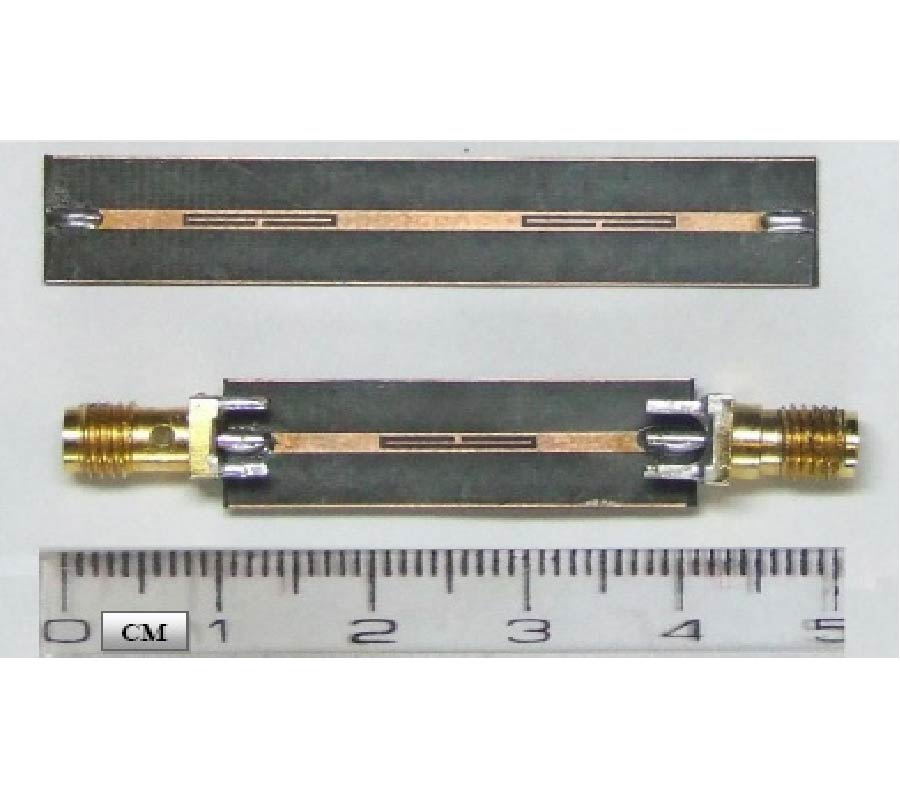
Generalized cross-coupled filters require implementation of both positive and negative cross-coupled elements. A positive element frequently uses inductive coupling, while a negative one uses capacitive coupling. Traditional methods for realizing capacitive couplings, which are difficult to adjust in practice, have included the use of capacitive probes in coaxial cavity. And this kind of n-order cross-coupled filters without the coupling between input and output ports can only produce 2-n transmission zeros at most. In this paper, we present a convenient method for capacitive coupling. Based on the method a four-order cross-coupled filter is realized, and the measured results match well with the theoretical prediction. Especially, there are three transmission zeros near the pass band.
A SIMPLE FOUR-ORDER CROSS-COUPLED FILTER WITH THREE TRANSMISSION ZEROS
2009-06-08
PIER B
Vol. 15, 113-131
Varactor Loaded Tunable Printed PIFA
Jing Liang and Hung Yu Yang
varactor tuned printed planar inverted F antennas (PIFA) are investigated. The lowprofile printed antennas are fabricated together with the layouts of its DC control circuits and other RF/base-band circuit footprints. A surface mounted (SMT) varactor is applied as a frequency-tuning element at the middle of the long radiating arm in PIFA. Passive lumped DC bias circuits are implemented with good isolation. Both single and dual-band varactor tuned PIFA antennas are investigated. For a single-band PIFA, prototype designs show the in-band frequency (return loss is <10 dB) is tunable from 1.6 GHz to 2.3 GHz when the bias voltage varies from 0 V to 9.5 V. Measured results show about 70~75% efficiency and 2~3 dB maximum gain. For a dual band PIFA with two varactor loadings, both the 800~900 MHz and 1.7~2.2 GHz bands are tuned individually by a varactor. By varying low-band capacitance, the operation frequency is tuned from 780 MHz to 1020 MHz, with little change on the higher frequency band. By varying high-band capacitance, the operation frequency is tuned from 1700 MHz to 2140 MHz, with little change on the lower frequency. Measurement shows antenna radiation efficiencies within operation bands are about 55% at the low band and about 45% at the high band. The proposed frequency reconfigurable antennas could be useful for personal mobile terminal applications.
VARACTOR LOADED TUNABLE PRINTED PIFA
2009-06-04
PIER
Vol. 93, 71-90
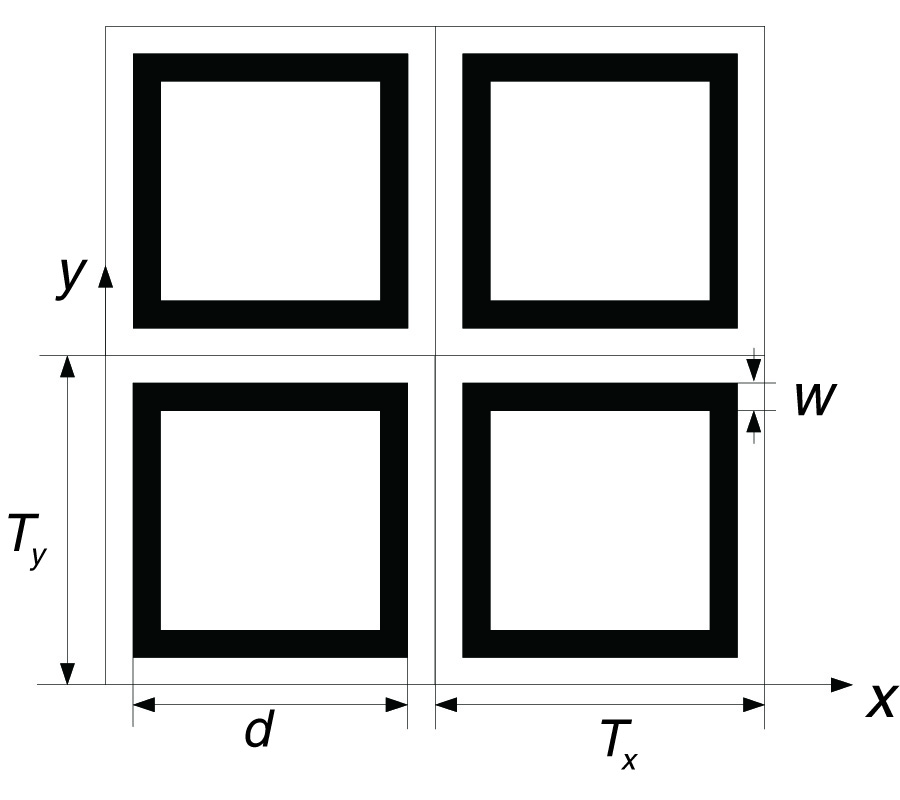
Filtering Lens Structure Based on Srrs in the Low THz Band
Belen Andres-Garcia , Luis Enrique Garcia-Munoz , Vicente Gonzalez-Posadas , Francisco Javier Herraiz-Martinez and Daniel Segovia-Vargas
A filtering lens for conical horns based on Metamaterials is presented. The paper focuses on a millimeter wave application. The metamaterial structure is composed of a printed layer of Split Ring Resonators (SRRs) on a substrate. The structure is used as a superstrate on the horn aperture. When the SRRs are excited, a filter performance arises preventing radiation in the desired frequency bands. Besides the filtering property, also a lens behavior is achieved. In this way larger gain can be achieved in both E and H planes, reducing the 3 dB beamwidth. A 6% -3 dB stop band is achieved from 73.3 GHz to 85.7 GHz. Symmetrisation of the radiation pattern up to 3 dB is accomplished and the focalization effect is achieved by emulating a hyperbolical-plane lens. Thus, a simplified system based on a conical horn can be designed by unifying the filter and lens in one electromagnetic element.
FILTERING LENS STRUCTURE BASED ON SRRS IN THE LOW THZ BAND
2009-06-04
PIER C
Vol. 8, 43-55
The Study of Structure-Dependent Properties of Thin Magnetic Films at Microwaves by Field-Domain Resonance Technique
Sergey Nickolaevich Starostenko and Konstantin Rozanov
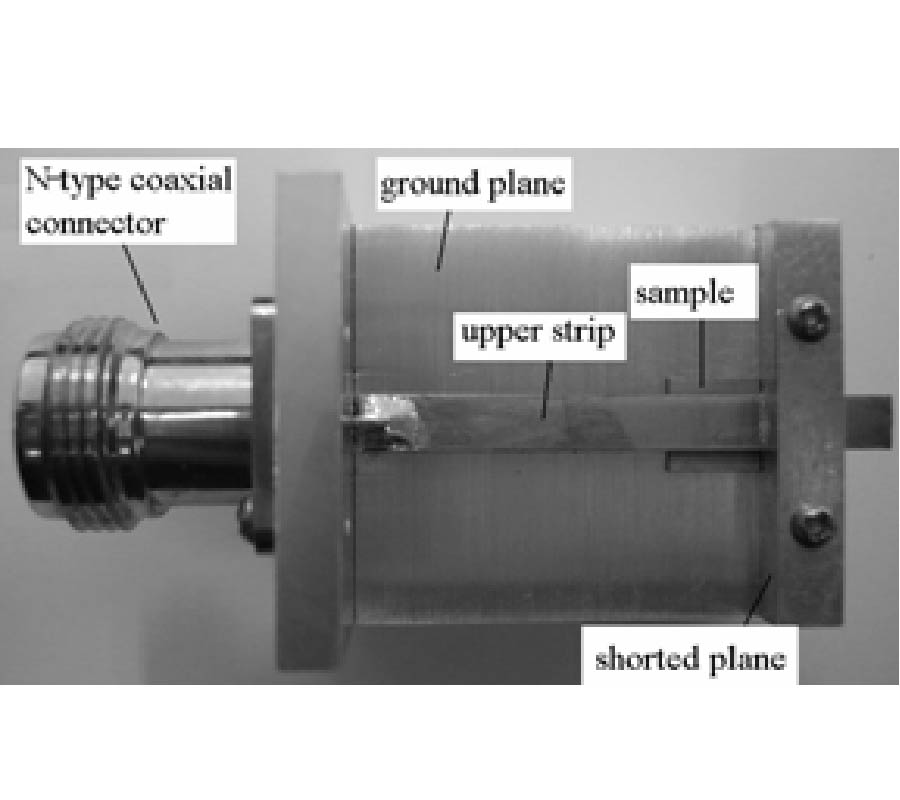
The strip-line frequency-domain technique for permeability measurement is compared to the field domain technique. The combined setup for microwave measurement of thin film permeability with both techniques is proposed. The field-domain technique is less affected by inhomogeneity of measurement strip cell and has significantly higher signal-to-noise ratio, but the obtained parameters are affected by film thickness and may differ from that of the frequency-domain technique. Analysis of the field-domain data obtained at a set of frequencies makes it possible to determine the saturation magnetisation, the anisotropy field and the damping factor without the knowledge of the amount of substance under study. In case of a simple permeability spectrum the data on metal thickness make it possible to estimate the effective skin-depth as well. The technique is tested by simulation and is applied to determine permeability of Fe-based films vacuum-sputtered on glassceramic and polymer substrates.
THE STUDY OF STRUCTURE-DEPENDENT PROPERTIES OF THIN MAGNETIC FILMS AT MICROWAVES BY FIELD-DOMAIN RESONANCE TECHNIQUE
2009-06-04
PIER M
Vol. 7, 109-122
A Simple Numerical Method to Compute the Signal-to-Noise Ratio of a Magnetic Resonance Imaging Surface Coil
Rafael Rojas Rodriguez and Alfredo O. Rodriguez Gonzalez
The quality of a magnetic resonance image can be reliably measured by the signal-to-noise ratio. This widely accepted parameter is a function of the magnetic field generated by the coil and the electric field produced by the sample to be imaged. A simple numerical method is proposed to calculate the coil signal-to-noise ratio of a circular-shaped coil and a spherical phantom. The phantom is composed of two-concentric sphere simulating a brain-skull model. The electromagnetic fields produced were then numerically computed by solving Maxwell's equations with the finite element method implemented in a commercial software tool. The electric and magnetic fields were used to numerically determine the signal-to-noise ratio using the quasi-static approach. The numerical results demonstrated that this simple method is able to calcualte the signal-to-noise ratio of surface coils with simple coil geometries involving a simulated phantom.
A SIMPLE NUMERICAL METHOD TO COMPUTE THE SIGNAL-TO-NOISE RATIO OF A MAGNETIC RESONANCE IMAGING SURFACE COIL
2009-06-04
PIER B
Vol. 15, 95-112
Design and Analysis of Wideband Planar Monopole Antennas Using the Multilevel Fast Multipole Algorithm
Yikai Chen , Shiwen Yang , Shiquan He and Zai-Ping Nie
Two planar monopole antennas with wide impedance bandwidth are designed. A full-wave method of moment (MoM) based on the electric field integral equation (EFIE) is applied to analyze the impedance bandwidth and radiation performance of the monopoles. Meanwhile, the multilevel fast multipole algorithm (MLFMA) is employed to reduce the memory requirements and computational time. Experimental results such as the impedance bandwidth and radiation patterns are also presented. The good agreement between the experimental and numerical results well demonstrates the efficiency and accuracy of the MLFMA code. Both the experimental and numerical results show that the two planar monopole antennas possess good input impedance and radiation performance over the AMPS, GSM900, and DCS band. As the proposed antennas can achieve such wide impedance bandwidth with relatively low profile, they are very suitable for multi-band mobile communication systems.
DESIGN AND ANALYSIS OF WIDEBAND PLANAR MONOPOLE ANTENNAS USING THE MULTILEVEL FAST MULTIPOLE ALGORITHM
2009-06-04
PIER B
Vol. 15, 77-94
Rigorous Expressions for the Equivalent Edge Currents
Yusuf Ziya Umul
An exact form for the equivalent edge current is derived by using the axioms of the modified theory of physical optics and the canonical problem of half-plane. The edge current is expressed in terms of the parameters of incident and scattered rays. The analogy of the method with the boundary diffraction wave theory is put forward. The edge and corner diffracted waves are derived for the problem of a black half-strip.
RIGOROUS EXPRESSIONS FOR THE EQUIVALENT EDGE CURRENTS
2009-06-03
PIER
Vol. 93, 57-70
A Breast Imaging Model Using Microwaves and a Time Domain Three Dimensional Reconstruction Method
Hui Zhou , Takashi Takenaka , Jessi Johnson and Toshiyuki Tanaka
An iterative reconstruction algorithm for three-dimensional (3-D) microwave tomography by using time-domain microwave data is applied to detect breast tumor. A numeric breast model with randomly distributed glandular tissues (random size and permittivity) with a tumor is designed for the calculation of synthetic microwave data. An "air phantom" consisting of a section of polyvinyl chloride (PVC) pipe filled with styrofoam and a thin glass cylinder is constructed for collecting microwave data in laboratory. The "breast" and "air phantom" are reconstructed. Reconstruction results show that the "tumor" in the breast is clearly reconstructed, and the glass cylinder is successfully reconstructed too.
A BREAST IMAGING MODEL USING MICROWAVES AND A TIME DOMAIN THREE DIMENSIONAL RECONSTRUCTION METHOD
2009-06-03
PIER B
Vol. 15, 57-76
Field Around the Focal Region of a Paraboloidal Reflector Placed in Isotropic Chiral Medium
Tariq Rahim , Muhammad Junaid Mughal , Qaisar Abbas Naqvi and Muhammad Faryad
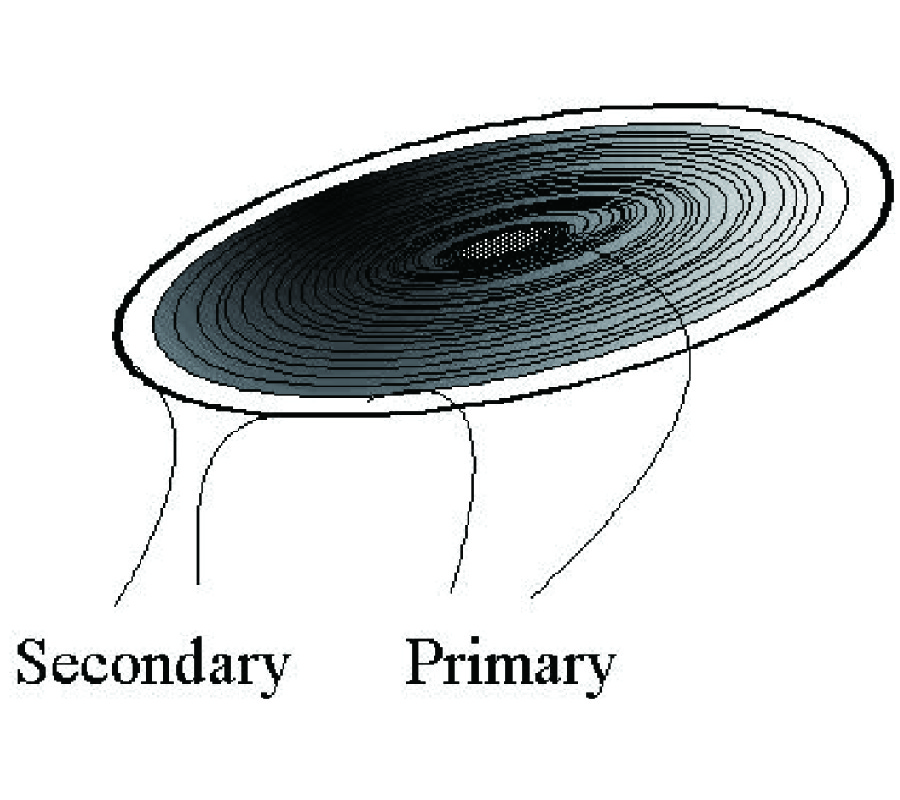
High frequency field expressions are derived at the focal points of a paraboloidal reflector placed in a homogenous and reciprocal chiral medium. Firstly Geometrical Optics (GO) field expressions are derived for the paraboloidal reflector placed in chiral medium. As the GO fails at the focal points, so Maslov's method has been used to find the field expressions which are also valid around the focal point. By using hybrid space, Maslov's method combine the simplicity of ray theory and the generality of Fourier Transform method. Some numerical results including contour plots and line plots around the focal region of paraboloidal reflector placed in chiral medium are obtained using the derived expressions.
FIELD AROUND THE FOCAL REGION OF A PARABOLOIDAL REFLECTOR PLACED IN ISOTROPIC CHIRAL MEDIUM
2009-06-01
PIER
Vol. 93, 41-56
Microstrip Square Ring Antenna for Dual-Band Operation
Subhrakanta Behera and Kalarickaparambil Vinoy
This paper presents a generalized approach to design an electromagnetically coupled microstrip ring antenna for dual-band operation. By widening two opposite sides of a square ring antenna, its fractional bandwidth at the primary resonance mode can be increased significantly so that it may be used for practical applications. By attaching a stub to the inner edge of the side opposite to the feed arm, some of the losses in electrical length caused by widening can be regained. More importantly, this addition also alters the current distribution on the antenna and directs radiations at the second resonant frequency towards boresight. It has also been observed that for the dual frequency configurations studied, the ratio of the resonant frequencies (fr2/frr) can range between 1.55 and 2.01. This shows flexibility in designing dual frequency antennas with a desired pair of resonant frequencies.
MICROSTRIP SQUARE RING ANTENNA FOR DUAL-BAND OPERATION
2009-05-29
PIER
Vol. 93, 29-40
Geometry Based Preconditioner for Radiation Problems Involving Wire and Surface Basis Functions
Marta Gomez Araujo , Jose Manuel Bertolo , Fernando Obelleiro , Jose Luis Rodriguez , Jose Taboada and Luis Landesa
An innovative preconditioner has been developed in this work. It significantly improves the convergence of the iterative solvers applied to electromagnetic radiation problems by a renormalization of the matrix equation. The preconditioner balances the disparities in terms of magnitude and units caused by the strong self-coupling of the antennas, the non-uniformity of the meshes and also by the coexistence of wire and surface basis functions. It can be easily integrated into different electromagnetic solvers with a negligible impact on the computational cost on account of its simple implementation.
GEOMETRY BASED PRECONDITIONER FOR RADIATION PROBLEMS INVOLVING WIRE AND SURFACE BASIS FUNCTIONS