Search Results(13805)

2009-02-10
PIER Letters
Vol. 6, 149-156
Planar Monopole Antenna with Band-Notch Characterization for UWB Applications
Xin Zhang , Tian-Ling Zhang , Yu-Yin Xia , Ze-Hong Yan and Xiao-Ming Wang
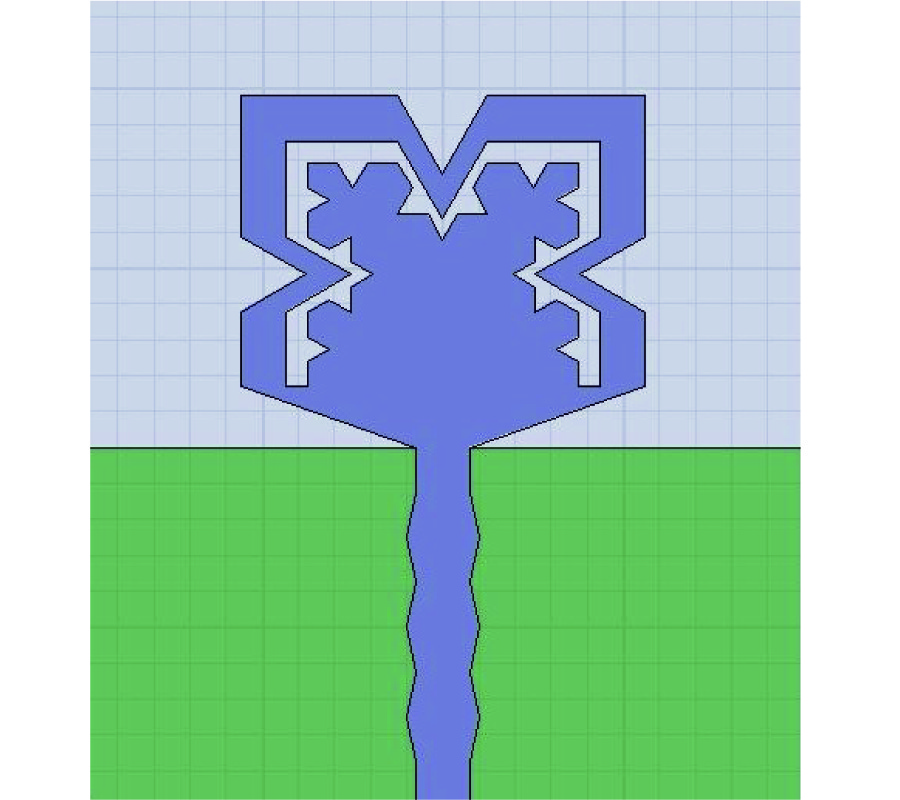
A novel CPW-fed antenna having a frequency band-notched function for UWB applications is proposed and studied. By inserting a pair of inverted-T-shaped slots on the radiation element, the narrow frequency band notch has been created to cover the desired frequency varying from 3.4 to 3.69 GHz and the required UWB bandwidth is also acquainted. Good monopole-like radiation patterns and antenna gains have also been obtained.
PLANAR MONOPOLE ANTENNA WITH BAND-NOTCH CHARACTERIZATION FOR UWB APPLICATIONS
2009-02-10
PIER Letters
Vol. 6, 139-148
Design of Narrowband Bandpass Filter on Coplanar Waveguide Using Spiral Slots
Kalarickaparambil Vinoy and P. Umamaheshwara Reddy
A configuration for a miniaturized band-pass filter on a coplanar waveguide (CPW) is proposed in this communication. Parametric studies conducted for various geometrical parameters suggest that the frequency response of the filter is strongly related to that of the spiral slots. But a series gap on the center conductor of the CPW changes the overall response of the device For validation of these concepts, a bandpass filter operating at about 3.5 GHz has been designed, fabricated and tested. Experimental results show good agreement with electromagnetic simulations. The design for a microwave laminate shown here requires an area of approximately 0.1λ0 x 0.1λ0.
DESIGN OF NARROWBAND BANDPASS FILTER ON COPLANAR WAVEGUIDE USING SPIRAL SLOTS
2009-02-10
PIER C
Vol. 6, 79-92
Efficient Detection of Landmines from Acoustic Images
H. Kasban , Osama Zahran , M. El-Kordy , Sayed M. S. Elaraby , El-Sayed M. El-Rabaie and Fathi Abd El-Samie
The Laser Doppler Vibrometer (LDV)-based Acoustic to Seismic (A/S) landmine detection system is one of the reliable and powerful landmine detection techniques. The interpretation of LDV-based A/S data is performed off-line, manually, depending heavily on the skills, experience, alertness and consistency of a trained operator. This takes a long time. The manually obtained results suffer from errors, particularly when dealing with large volumes of data. This paper proposes some techniques for the automatic detection of objects from the acoustic images which are obtained from the LDV-based A/S landmine detection system. These techniques are based on color image transformations, morphological image processing and the wavelet transform. The results obtained are optimized to select the best image type and the best morphological operation used in terms of the higher probability of detection, the lower false alarm rate, the accuracy and the processing speed.
EFFICIENT DETECTION OF LANDMINES FROM ACOUSTIC IMAGES
2009-02-10
PIER C
Vol. 6, 67-78
Combined Interleaving and Companding for Papr Reduction in OFDM Systems
Hefdhallah Sakran , Mona Mohammed Shokair and Atef Elazm
Peak to Average Power Ratio (PAPR) is one of the serious problems in any wireless communication systems using multi carrier modulation technique like OFDM, which reduces the efficiency of transmit high power amplifier. In this paper, proposed scheme will be introduced that combines interleaving technique and companding technique to reduce PAPR. This scheme will be compared with the system that uses other technique for reduction which is the clipping method. By using proposed scheme, the PAPR of OFDM signal can be reduced by 6.3 dB over the original system, i.e., without PAPR reduction. Also, SNR decreases by more than 5 dB for Bit Error Rate(BER) of 10-3 over the original system. Moreover, the proposed method gives improvement more than 4.5 dB for BER of 10-3 over the system that uses clipping. All these systems will be evaluated in the presence of nonlinear power amplifier.
COMBINED INTERLEAVING AND COMPANDING FOR PAPR REDUCTION IN OFDM SYSTEMS
2009-02-09
PIER B
Vol. 13, 75-110
Diffraction by a Semi-Infinite Parallel-Plate Waveguide with Sinusoidal Wall Corrugation: Combined Perturbation and Wiener-Hopf Analysis
Jian-Ping Zheng and Kazuya Kobayashi
The diffraction by a semi-infinite parallel-plate waveguide with sinusoidal wall corrugation is analyzed for the E-polarized plane wave incidence using the Wiener-Hopf technique together with the perturbation method. The problem is formulated in terms of the simultaneous Wiener-Hopf equations by introducing the Fourier transform for the unknown scattered field and applying approximate boundary conditions in the transform domain. Employing the factorization and decomposition procedure together with a perturbation series expansion, the zero- and first-order solutions of the Wiener-Hopf equations are obtained. Explicit expressions of the scattered field inside and outside the waveguide are derived analytically by taking the inverse Fourier transform and applying the saddle point method. Far field scattering characteristics of the waveguide are discussed in detail via representative numerical examples.
DIFFRACTION BY A SEMI-INFINITE PARALLEL-PLATE WAVEGUIDE WITH SINUSOIDAL WALL CORRUGATION: COMBINED PERTURBATION AND WIENER-HOPF ANALYSIS
2009-02-09
PIER B
Vol. 13, 59-74
TEM Horn Antenna for Ultra-Wide Band Microwave Breast Imaging
Reza K. Amineh , Aastha Trehan and Natalia K. Nikolova
A novel TEM horn antenna placed in a solid dielectric medium is proposed for microwave imaging of the breast. The major design requirement is that the antenna couples the microwave energy into the tissue without being immersed itself in a coupling medium. The antenna achieves this requirement by: 1) directing all radiated power through its front aperture,and 2) blocking external electromagnetic interference by a carefully designed enclosure consisting of copper sheets and power absorbing sheets. In the whole ultra-wide band the antenna features: 1) good impedance match, 2) uniform field distribution at the antenna aperture, and 3) good coupling efficiency.
TEM HORN ANTENNA FOR ULTRA-WIDE BAND MICROWAVE BREAST IMAGING
2009-02-09
PIER B
Vol. 13, 41-58
Modified Incomplete Cholesky Factorization for Solving Electromagnetic Scattering Problems
Tingzhu Huang , Yong Zhang , Liang Li , Wei Shao and Sheng-Jian Lai
In this paper, we study a class of modified incomplete Cholesky factorization preconditioners LLT with two control parameters including dropping rules. Before computing preconditioners, the modified incomplete Cholesky factorization algorithm allows to decide the sparsity of incomplete factorization preconditioners by two fillin control parameters: (1) p, the number of the largest number p of nonzero entries in each row; (2) dropping tolerance. With RCM reordering scheme as a crucial operation for incomplete factorization preconditioners, our numerical results show that both the number of PCOCG and PCG iterations and the total computing time are reduced evidently for appropriate fill-in control parameters. Numerical tests on harmonic analysis for 2D and 3D scattering problems show the efficiency of our method.
MODIFIED INCOMPLETE CHOLESKY FACTORIZATION FOR SOLVING ELECTROMAGNETIC SCATTERING PROBLEMS
2009-02-09
PIER B
Vol. 13, 21-40
Dispersion Flattened Optical Fiber Design for Large Bandwidth and High-Speed Optical Communications Using Optimization Technique
Somaye Makouei , Morteza Savadi-Oskouei , Ali Rostami and Zia Koozekanani
In this paper, design of the RII triple-clad structure as a dispersion flattened optical fiber including small pulse broadening factor as well as small dispersion and its slope applicable in broadband and fast communication is considered. The proposed optimization technique is based on the Genetic Algorithms (GA) consisting suitable fitness function for each application. The putting forward design method introduces the pulse broadening factor (?/?0) about 1.0016 after 200 Km propagation at the zero dispersion wavelength that is so excellent compared to the structure (1.2794) reported in [2] recently. Meanwhile, the proposed structure provides high bit rate (more than 197.8 Gb/Sec at 100 km), large dispersion length (larger than 17400 km), uniform dispersion slope ([0.04,-0.08] ps/km/nm2) and broad bandwidths as well as small and uniform dispersion (smaller than 2.02 ps/km/nm) at [1.55-1.7] μm wavelength interval even for core diameter larger than 4.62 μm. Another important thing discussed in this paper is a proposal for optimization of the broadening factor on large wavelength duration, which is necessary for large bandwidth applications. The suggested technique is capable to minimize the pulse broadening factor over duration of wavelengths that is necessary for large bandwidth applications such as dense wavelength division multiplexing (DWDM) and optical time division multiplexing (OTDM). Our calculation for extracting optical properties of the proposed structure is evaluated analytically. For this purpose modal analysis of these fibers for obtaining possible wave vectors for given system parameters are done using Transfer Matrix Method (TMM) in cylindrical coordinate.
DISPERSION FLATTENED OPTICAL FIBER DESIGN FOR LARGE BANDWIDTH AND HIGH-SPEED OPTICAL COMMUNICATIONS USING OPTIMIZATION TECHNIQUE
2009-02-09
PIER B
Vol. 13, 1-20
Magnetic Field Produced by a Tile Permanent Magnet Whose Polarization Is Both Uniform and Tangential
Romain Ravaud , Guy Lemarquand , Valerie Lemarquand and Claude Depollier
This paper presents the exact 3D calculation of the magnetic field produced by a tile permanent magnet whose polarization is both tangential and uniform. Such a calculation is useful for optimizing magnetic couplings or for calculating the magnetic field produced by alternate magnet structures. For example, our 3D expressions can be used for calculating the magnetic field produced by a Halbach structure. All our expressions are determined by using the coulombian model. This exact analytical approach has always proved its accuracy and its usefulness. As a consequence, the tile permanent magnet considered is represented by using the fictitious magnetic pole densities that are located on the faces of the magnet. In addition, no simplifying assumptions are taken into account for calculating the three magnetic field components. Moreover, it is emphasized that the magnetic field expressions are fully three-dimensional. Consequently, the expressions obtained are valid inside and outside of the tile permanent magnet, whatever its dimensions. Such an approach allows us to realize easily parametric studies.
MAGNETIC FIELD PRODUCED BY A TILE PERMANENT MAGNET WHOSE POLARIZATION IS BOTH UNIFORM AND TANGENTIAL
2009-02-06
PIER
Vol. 90, 51-62
A Stable Design of Coaxial Adaptor for Radial Line Slot Antenna
Omid Beheshti-Zavareh and Mohammad Hakkak
A new design of feed for radial line slot antenna (RLSA) is presented. For better impedance match to the waveguide the effect of the various feed parameters is analyzed and their design sensitivity is studied. This paper emphasizes the advantages of using feed with a funnel below the connector entry and a conical segment over the entering probe.
A STABLE DESIGN OF COAXIAL ADAPTOR FOR RADIAL LINE SLOT ANTENNA
2009-02-06
PIER
Vol. 90, 31-49
System Level Integration of Simulation Methods for High Data-Rate Transmission Circuit Design Applications
Heng-Shou Hsu and Heng-Tung Hsu
A system level integration of simulation methods for high data-rate transmission circuit design applications is developed in this paper. While the elementary circuit theory was responsible for designing the circuits to meet the required performance specifications, three dimensional full-wave electromagnetic simulation technique was adopted to characterize the off-chip parasitic effects induce from the packages. The developed technique was applied for the design of optical Pick-Up Head (PUH) driver circuitry and a data transmission rate up to 640Mega bits per second (Mb/s) was achieved with standard 0.35 μm CMOS technology, showing the promising feature of applying such technique in successful design for high data-rate transmission circuits.
SYSTEM LEVEL INTEGRATION OF SIMULATION METHODS FOR HIGH DATA-RATE TRANSMISSION CIRCUIT DESIGN APPLICATIONS
2009-02-06
PIER Letters
Vol. 6, 131-137
Spherical Resonator with dB-Boundary Conditions
Ismo Veikko Lindell and Ari Sihvola
A novel set of boundary conditions requiring vanishing of the normal components of the D and B vectors at the boundary surface was introduced recently and labeled as the DB-boundary conditions. Basic properties of a resonator structure defined by the spherical DB boundary are studied in this paper. It is shown that the resonance modes polarized TE and TM with respect to the radial direction coincide with those of the respective PEC and PMC resonators. Modes in the DB resonator show higher degree of degeneracy than those of the PEC resonator which may find application in materials research.
2009-02-06
PIER Letters
Vol. 6, 123-130
Back Radiation Reduction in Patch Antennas Using Planar Soft Surfaces
Eva Rajo-Iglesias , Luis Inclán-Sánchez and Oscar Quevedo-Teruel
In this work, we propose to use a type of periodic structures, the soft surfaces in their planar version, to reduce the back radiation of patch antennas. A key aspect of these surfaces when compared to other periodic structures is their anisotropy which provides different behaviour for different field polarization (horizontal or vertical). This make them especially convenient for this application, as the soft surfaces force the field intensity for any polarization to be zero on the surface for waves propagating along the surface. In this paper, a design example is presented and the back radiation reduction by using planar soft surfaces is demonstrated.
BACK RADIATION REDUCTION IN PATCH ANTENNAS USING PLANAR SOFT SURFACES
2009-02-06
PIER M
Vol. 6, 23-34
Study on Shimming Method for Open Permanent Magnet of MRI
Ziyan Ren , Dexin Xie and Huixiang Li
The shimming method used for producing high field homogeneity of the open permanent main magnet for magnetic resonance imaging (MRI) is researched in this paper. The central shimming method based on integer programming is proposed, which fulfills the combination of optimal theory and the practical manual shimming. The formulation of shimming is solved by using Lingo software and the numerical analysis method is used to compute the contribution of small shim arrays. The homogeneity of imaging region is eventually advanced nearly by 50%.The validity of the method is validated by using simulation test of shimming. The efficiency of shimming is improved through experiment corporated with the manufacturing enterprise.
STUDY ON SHIMMING METHOD FOR OPEN PERMANENT MAGNET OF MRI
2009-02-06
PIER M
Vol. 6, 9-22
Dyadic Green Functions for a Dielectric Layer on a PEMC Plane
Javad Komijani , Jalil Rashed-Mohassel and Ali Mirkamali
Perfect electromagnetic conductor (PEMC) is a medium where certain linear combinations of electromagnetic fields are required to vanish. Since PMC has found important applications in antenna design, one may expect that PEMC will also have potential for similar applications; therefore it is important to investigate its radiation properties. In this paper, dyadic Green functions in integral forms have been derived for a structure with a dielectric layer on a PEMC plane. Whereas electric and magnetic dyadic Green functions is required to satisfy the dyadic mixed boundary condition on PEMC surface, a new classification of the electric and magnetic dyadic Green functions has been introduced based on parameter M of PEMC boundary. This classification is general and contains classes of dyadic Green functions which satisfy Dirichlet and Neumann boundary conditions.
DYADIC GREEN FUNCTIONS FOR A DIELECTRIC LAYER ON A PEMC PLANE
2009-02-06
PIER M
Vol. 6, 1-8
A Formal Approach for Calculating the Radiation Fields of a Linear Wire Antenna
Alfonso Jose Zozaya
In classical antenna books, the field radiated by a filamentary antenna is calculated integrating the electrical current induced over the wires as if it was a primary (impressed) source. This is no technically incorrect, but is not rigorous. In this paper some formal steps are added to the classical procedure to do it more rigorous.
A FORMAL APPROACH FOR CALCULATING THE RADIATION FIELDS OF A LINEAR WIRE ANTENNA
2009-02-05
PIER
Vol. 90, 15-30
Simulation and Experimental Evaluation of the Radar Signal Performance of Chaotic Signals Generated from a Microwave Colpitts Oscillator
Tao Jiang , Shan Qiao , Zhi-Guo Shi , Liang Peng , Jiangtao Huangfu , Wan-Zhao Cui , Wei Ma and Li-Xin Ran
The ambiguity function of a kind of chaotic signal radar using Colpitts oscillator is investigated and compared in several aspects. The Colpitts oscillator with specific value of capacitance, inductance and resistance can generate chaotic signal with frequency band from direct current to several gigahertz. The chaotic signal is obtained from simulation and experiment. The auto-ambiguity functions of the chaotic signal show that the chaotic signal of such oscillator is ideal for radar application with both high range and range rate resolution. The cross-ambiguity function also indicates the chaotic signal has excellent capabilities in the electronic countercountermeasures (ECCM).We also present the resolution of range with the spectrum from experiment.
SIMULATION AND EXPERIMENTAL EVALUATION OF THE RADAR SIGNAL PERFORMANCE OF CHAOTIC SIGNALS GENERATED FROM A MICROWAVE COLPITTS OSCILLATOR
2009-02-05
PIER
Vol. 90, 1-13
Broadband Experimental Characterization of Artificial Magnetic Materials Based on a Microstrip Line Method
Leila Yousefi , Hussein Attia and Omar M. Ramahi
A broadband method is introduced to measure the effective constitutive parameters of artificial magnetic materials. The method is based on the microstrip line topology, thus making it easy to retrieve the constitutive parameters over a wide band of frequencies. To demonstrate the effectiveness of this method, artificial magnetic materials with Fractal Hilbert inclusions are fabricated and characterized. Good agreement between the experimental and numerical simulation results verifies the accuracy of the proposed method.
BROADBAND EXPERIMENTAL CHARACTERIZATION OF ARTIFICIAL MAGNETIC MATERIALS BASED ON A MICROSTRIP LINE METHOD
2009-02-05
PIER
Vol. 89, 339-357
Ssor Preconditioned Inner-Outer Flexible GMRES Method for MLFMM Analysis of Scattering of Open Objects
Da-Zhi Ding , Ru-Shan Chen and Zhenhong Fan
To efficiently solve large dense complex linear system arising from electric field integral equations (EFIE) formulation of electromagnetic scattering problems, the multilevel fast multipole method (MLFMM) is used to accelerate the matrix-vector product operations. The inner-outer flexible generalized minimum residual method (FGMRES) is combined with the symmetric successive overrelaxation (SSOR) preconditioner based on the near-part matrix of the EFIE in the inner iteration of FGMRES to speed up the convergence rate of iterative methods. Numerical experiments with a few electromagnetic scattering problems for open structures are given to demonstrate the efficiency of the proposed method.
SSOR PRECONDITIONED INNER-OUTER FLEXIBLE GMRES METHOD FOR MLFMM ANALYSIS OF SCATTERING OF OPEN OBJECTS
2009-02-05
PIER
Vol. 89, 325-338
Analysis of Shadowing Processing Technique Based on Modeling Using NURBS
Yun-Xue Xu , Ying Guan , Feng-Tao Zha , Wen Jiang and Shu-Xi Gong
The shadowing relationship between facet elements can be determined rapidly through analytical expressions. On the basis of modeling using curved surfaces, an effective shadowing processing algorithm is proposed which is in combination with that used in the shadowing judgement of facet elements. Firstly several sampling points are taken on the ergodic curved surface element to construct a group of facet elements, which can replace the curved surface element. Then the shadowing processing between the stationary phase point and the ergodic curved surface element is converted to that between the stationary phase point and several facet elements, thus avoiding utilizing optimization method and can increase the computation speed. Similarly, the shadowing processing between the stationary phase segment and the ergodic curved surface element is converted to that between the stationary phase segment and several facet elements. And the trimming algorithm is used to accurately find the visible part of the stationary phase segment, which gets rid of the rough shadowing processing technique that determines the visibility of the whole stationary phase segment through the visibility of the center of the stationary phase segment. Therefore, the computation precision is greatly improved. When there exists a huge number of curved surfaces, maximum-minimum preprocessing is utilized to increase the computation speed. Examples show that this novel algorithm is superior to the traditional one in both computation speed and precision.
ANALYSIS OF SHADOWING PROCESSING TECHNIQUE BASED ON MODELING USING NURBS