Search Results(13902)

2008-04-03
PIER B
Vol. 6, 81-92
FSS Comprised of One- and Two-Turn Square Spiral Shaped Conductors on Dielectric Slab
Kemal Delihacioglu , Savas Uckun and T. Ege
The scattering of electromagnetic waves from a Frequency Selective Surfaces (FSSs) composed of a new one- and two-turn square spiral shaped periodic structures are investigated by using modal expansion method for a linearly polarized transverse electric (TE) and transverse magnetic (TM) incident waves. The Moment Method (MM) of Galerkin type is employed by expressing the current induced on the metallic surfaces in terms of Piecewise Sinusoidal (PWS) basis functions to determine the FSS structure reflection and transmission coefficients.
FSS COMPRISED OF ONE- AND TWO-TURN SQUARE SPIRAL SHAPED CONDUCTORS ON DIELECTRIC SLAB
2008-04-03
PIER B
Vol. 6, 65-79
Switchable Split-Ring Frequency Selective Surfaces
Mustafa H. B. Ucar , Adnan Sondas and Yunus Emre Erdemli
Tunable frequency selective surfaces (FSSs) based on split ring resonators (SRRs) are presented. Tuning performance is achieved by means of several on/off switches placed between the rings of each SRR element. The band-stop FSS response is dynamically tuned to different frequency bands at different switching states. In addition, loadings placed at the corners of outer ring elements, forming a fan-like shape, with additional switches are shown to offer rather fine-tuning capability. A dual-layer FSS is also introduced to demonstrate a filter response over a larger frequency band, and also offers tunable dualband operation via switching. By using complementary SRR elements, a tunable band-pass response instead can be obtained using a similar switching configuration. Practical switch modeling is also examined in the paper along with the scanning performance of the SRR-FSS. The numerical analysis of the FSS designs is accomplished using a fast periodic array simulator, and the measurements demonstrate preliminary validation of the proposed switching configuration.
SWITCHABLE SPLIT-RING FREQUENCY SELECTIVE SURFACES
2008-04-03
PIER B
Vol. 6, 37-64
Electromagnetic Pulse Propagation Over Nonuniform Earth Surface: Numerical Simulation
Alexei Popov and Vladimir Kopeikin
Computational aspects of EM pulse propagation along the nonuniform earth surface are considered. For ultrawide-band pulses without carrier, the exact wave equation in a narrow vicinity of the wave front is reduced to a time-domain version of the Leontovich- Fock parabolic equation. To solve it by finite differences, we introduce a time-domain analog of the impedance BC and a nonlocal BC of transparency. Numerical examples are given to demonstrate the influence of soil conductivity on the received pulse waveform. For a high-frequency modulated EM pulse, we develop an asymptotic approach based on the ray structure of the monochromatic wave field calculated at the carrier frequency. As an example, a problem of target altitude determination from overland radar data is considered.
ELECTROMAGNETIC PULSE PROPAGATION OVER NONUNIFORM EARTH SURFACE: 
NUMERICAL SIMULATION
2008-04-02
PIER
Vol. 82, 271-285
Trapped Surface Wave and Lateral Wave in the Presence of a Four-Layered Region
Yi Hui Xu , Wang Ren , Liang Liu and Kai Li
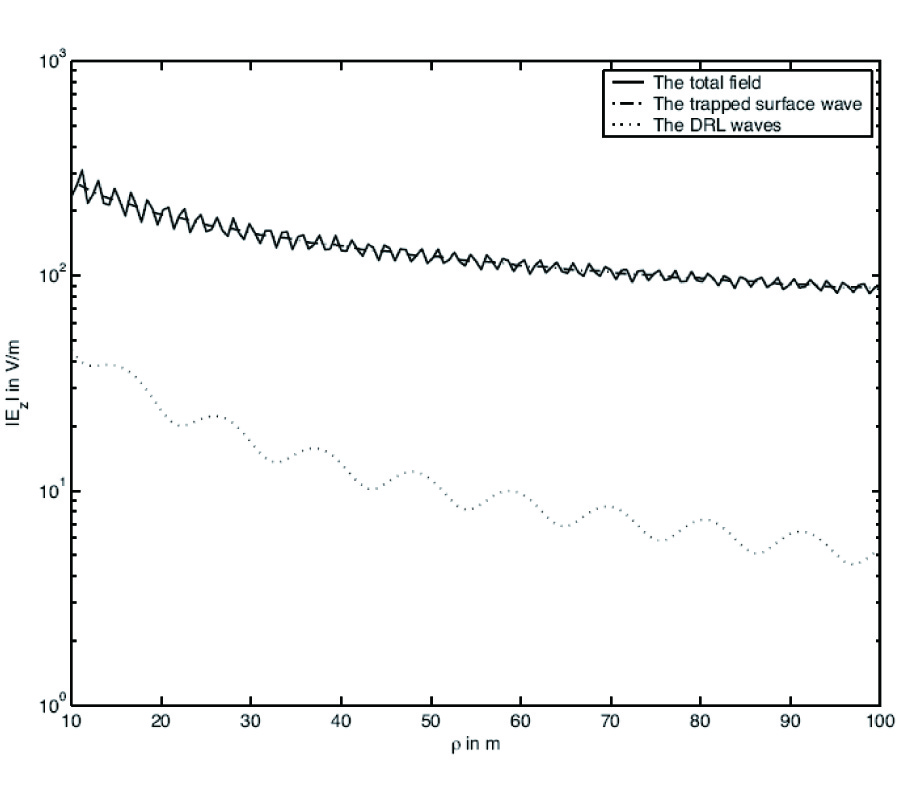
In this paper, propagation model considers the region as a perfect conductor, covered by the two layer dielectrics, and air above. Propagation of the electromagnetic field in the presence of a four-layered region is examined in detail when a vertical electric dipole and observation point are located in the air. Similar to the three-layered case, analytical results are found for the electromagnetic field, which includes four wave modes: a direct wave,an ideal reflected wave, trapped surface waves, and lateral waves. The wave number of the trapped surface wave, which is contributed by the sums of residues of the poles, is between the wave numbers k0 in the air and k2 in the lower dielectric layer. The lateral wave is evaluated by the integrations along the branch cut. Analysis and computations shows that the trapped surface wave play a major role in communication at large distance when both the source point and observation point are on or close to the boundary between the air and the upper dielectric layer.
TRAPPED SURFACE WAVE AND LATERAL WAVE IN THE PRESENCE OF A FOUR-LAYERED REGION
2008-04-02
PIER C
Vol. 2, 117-125
Analysis of a Rectangular Waveguide Using Finite Element Method
Arti Vaish and Harish Parthasarathy
The characteristics impedance of the fundamental mode in a rectangular waveguide is computed using finite element method. The method is validated by comparison with the theoretical results. In addition to this, we have considered the problem of determining the modes of propagation of electromagnetic waves in a rectangular waveguide for the simple homogeneous dielectric case. The starting point is Maxwell's equations with an assumed exponential dependence of the fields on the Z-coordinates. From these equations we have arrived at the Helmholtz equation for the homogeneous case. Finite-element- method has been used to derive approximate values of the possible propagation constant for each frequency.
ANALYSIS OF A RECTANGULAR WAVEGUIDE USING FINITE ELEMENT METHOD
2008-04-02
PIER C
Vol. 2, 109-116
A Note on Radiation Loss of Zeroth Order Resonators
Dong Hoon Shin and Tatsuo Itoh
A composite right/left-handed transmission line resonator with 3 unit cells is fabricated and its radiation loss is investigated. At the zeroth order resonance state, the resonator shows radiation loss, which is dominant over other conductor and dielectric losses. This paper investigates the radiation loss of zeroth order resonators from a quality-factor point of view. With the use of a metal shield, the quality factor is considerably increased through a reduction of the radiation loss. The increase in the quality factor is explained by means of the extracted parameters of the equivalent circuit model.
A NOTE ON RADIATION LOSS OF ZEROTH ORDER RESONATORS
2008-04-02
PIER C
Vol. 2, 95-107
Exact Performance Measures for Direct-Sequence Code Synchronization in Fading Channels
Young-Hwan You
This paper presents an exact performance analysis for the evaluating a mean acquisition time in a cellular code division multiple access system. New expressions for the probabilities of detection, miss, and false alarm are derived in a frequency-selective Rician fading channel. From the numerical results, it is shown that our formula gives the accurate results of the mean acquisition time in the performance analysis of the parallel acquisition system with the reference filter.
EXACT PERFORMANCE MEASURES FOR DIRECT-SEQUENCE CODE SYNCHRONIZATION IN FADING CHANNELS
2008-04-01
PIER Letters
Vol. 3, 151-160
Wideband Differential Phase Shifter Using Microstrip Nonuniform Transmission Lines
Mohammad Khalaj-Amirhosseini
A new structure is proposed for wideband differential phase shifter. The proposed structure consists of a microstrip Nonuniform Transmission Line (NTL) and a microstrip Uniform Transmission Line (UTL). To optimally design the NTL, its strip width is expanded in a truncated Fourier series, firstly. Then, the optimum values of the coefficients of the series are obtained through an optimization approach to have low phase shift error and low reflection coefficient in desired frequency bandwidth. The usefulness of the proposed structure is studied using two examples.
WIDEBAND DIFFERENTIAL PHASE SHIFTER USING MICROSTRIP NONUNIFORM TRANSMISSION LINES
2008-04-01
PIER C
Vol. 2, 65-94
Analysis of CFAR Detection of Fluctuating Targets
Mohamed El Mashade
Our scope in this paper is to provide a complete analysis of CFARdetection of fluctuating targets when the radar receiver incoherently integrates M returned pulses from a chi-squared fluctuating targets with two and four degrees of freedom and operates in a multitarget environment. Since the Swerling models of fluctuating targets represent a large number of such type of radar targets, we restrict our attention here to this interesting class of fluctuation models. There are four categories of such representation; namely SWI, SWII, SWIII, and SWIV. SWI and SWIII represent scan-to- scan fluctuating targets, while SWII and SWIV represent fast pulse-to-pulse fluctuation. Exact expressions are derived for the probability of detection of all of these models. A simple and an effective procedure for calculating the detection performance of both fixed-threshold and adaptive-threshold algorithms is obtained. The backbone of this procedure is the ω-domain representation of the cumulative distribution function of the test statistic of the processor under consideration. In the CFARcase, the estimation of the noise power levels from the leading and the trailing reference windows is based on the OS technique. The performance of this detector is analyzed in the case where the operating environment is ideal and where it includes some of extraneous targets along with the target under test. The primary and the secondary outlying targets are assumed to be fluctuating in accordance with the four Swerling's models cited above. The numerical results show that, for large SNR, the processor detection performance is highest in the case of SWIV model while it attains its minimum level of detection in the case of SWI model. Moreover, SWII model has higher performance than the SWIII representation of fluctuating targets. For low SNR, on the other hand, the reverse of this behavior is occurred. This observation is common either for fixed-threshold or for adaptive-threshold algorithm.
ANALYSIS OF CFAR DETECTION OF FLUCTUATING TARGETS
2008-04-01
PIER C
Vol. 2, 47-64
Experimental Studies and Simulations Based Prediction of a Better MIMO-OFDM Combined System for Broadband Wireless Mobile Communication
Nirmalendu Sinha , Debadatta Kandar , Rabindra Nath Bera and Subir Sarkar
Wireless technology offers new found freedom and the potential for 'anytime, anyplace' communications. Communication technology requires being sustainable in the sense of efficiency, not only to preserve the information within the quality requirements, but also to express the same contents with the minimum resources. The Code Division Multiple Access (CDMA) is an emerging technology for next generation multimedia information of real-time and non real-time traffic and various multi-source multi-traffic communication environments. Multiple inputs multiple output (MIMO) as an adaptive antenna based technology which can improves the capacity of wireless mobile communication. The combined technique has both the advantages of CDMA and MIMO systems. Below the jamming margin CDMA alone works up to satisfactory level but above jamming margin CDMA along with MIMO may be a better proposition for anytime-anywhere communication.
EXPERIMENTAL STUDIES AND SIMULATIONS BASED PREDICTION OF A BETTER MIMO-OFDM COMBINED SYSTEM FOR BROADBAND WIRELESS MOBILE COMMUNICATION
2008-04-01
PIER C
Vol. 2, 31-45
A DSP Based Study of Pattern Nulling and Pattern Shaping Using Transform Domain Window Technique.
Quazi Alfred , Kousik Bishayee , Tapas Chakravarty and Salil Sanyal
This article aims to provide a novel and efficient technique for pattern shaping and null steering in the environment of unwanted interferences. This paper presents a DSP based method, where at first DFT coefficients are obtained from spatial domain sampling and then operating by suitable window function gives new set of DFT coefficients. IFFT(IDFT) over these coefficients provide complex weights which adaptively introduces null in the direction interference while keeping the main beam toward desired signal.
A DSP BASED STUDY OF PATTERN NULLING AND PATTERN SHAPING USING TRANSFORM DOMAIN WINDOW TECHNIQUE.
2008-03-30
PIER
Vol. 82, 257-270
Analysis of the Surface Magnetoplasmon Modes in the Semiconductor Slit Waveguide at Terahertz Frequencies
Fanmin Kong , Kang Li , Hui Huang , Bae-Ian Wu and Jin Au Kong
The propagation properties of surface plasmon polaritons (SPP) modes and surface magnetoplasmon polaritons (SMP) modes in a semiconductor slit waveguide are analyzed by the effective dielectric constant approach, and the interaction of the external magnetic field with the dispersion properties and field distributions of SMP modes in the Voigt configuration are emphasized in our analysis. Both the symmetric structure and the asymmetric structure are discussed in details. In contrast to the SPP modes which have one propagation band below the plasmon frequency only, the SMP modes have both the low-frequency propagation band below the plasmon frequency and the high-frequency propagation band above the plasmon frequency. When the external magnetic field increases, the two bands of the SMP modes will separate further in frequency, and the even symmetric distribution of the fundamental mode, which usually associates with the SPP mode, will be destroyed. These results can provide some guidance for the design of the tunable semiconductor waveguide in the terahertz regime.
ANALYSIS OF THE SURFACE MAGNETOPLASMON MODES IN THE SEMICONDUCTOR SLIT WAVEGUIDE AT TERAHERTZ FREQUENCIES
2008-03-30
PIER
Vol. 82, 241-255
Efficient Electrically Small Prolate Spheroidal Antennas Coated with a Shell of Double-Negative Metamaterials
Ming Da Huang and Soon Yim Tan
An efficient, electrically small prolate spheroidal antenna coated with confocal double-negative (DNG) metamaterials (MTMs) shell is presented. The radiation power of this antenna-DNG shell system excited by a delta voltage across an infinitesimally narrow gap around the antenna center is obtained using the method of separation of the spheroidal scalar wave functions. Our results show that this electrically small dipole-DNG shell system has very high radiation efficiency comparing with the normal electrically small antenna due to the inductive effect of the MTMs shell that cancel with the capacitive effect of the electrically small antenna. It is found that the spheroidal shell can achieve more compact structure and higher radiated power ratio than the corresponding spherical shell. This dipole-DNG shell systems with different sizes are analyzed and discussed.
EFFICIENT ELECTRICALLY SMALL PROLATE SPHEROIDAL ANTENNAS COATED WITH A SHELL OF DOUBLE-NEGATIVE METAMATERIALS
2008-03-30
PIER
Vol. 82, 227-240
Tracking Airborne Targets Hidden in Blind Doppler Using Current Statistical Model Particle Filter
Zhi-Guo Shi , Shao-Hua Hong and Kang Chen
This paper aims at finding an algorithm featuring good estimation performance and easy hardware implementation for tracking airborne target hidden in blind Doppler. Incorporating the current statistical model which is effective in dealing with the maneuvering motions that most blind Doppler issues are caused, a current statistical model particle filter (CSM-PF) is presented in this paper for tracking airborne targets hidden in blind Doppler. Simulation results demonstrate that the proposed CSM-PF shows similar performance with the interacting multiple model particle filter (IMM-PF) in terms of tracking accuracy and track continuity, but it avoids the difficulty of model selection for maneuvering targets. In addition, when hardware implementation is considered, the proposed CSM-PF has lower processing latency, fewer resource utilization and lower hardware complexity than the IMM-PF.
TRACKING AIRBORNE TARGETS HIDDEN IN BLIND DOPPLER USING CURRENT STATISTICAL MODEL PARTICLE FILTER
2008-03-30
PIER C
Vol. 2, 13-30
Adaptive Turbo-Equalizer Design for Multi-User Mobile Communication Channel
Anindya Kundu , Binay Sarkar and Ajay Chakraborty
Broadband single carrier modulated signals experience severe multipath distortion scrambling & ISI when propagating through physical medium. Correcting the distortion with channel equalization is the foremost task of the detector. Prior information about the transmitted signals in the form of channel decoder feedback can significantly enhance equalization accuracy. An algorithm that iteratively performs channel decoding and equalization with prior information is generally denoted turbo-equalizer. Turbo-Equalizer uses prior information & the principle of interference cancellation by MMSE criterion. Here we have tested Adaptive Turbo Equalization with least Mean Square Algorithm (LMS) & modified normalized LMS algorithm & Turbo-Decoding with a Log-Map. Consequently the Mean Square Error analysis, Stability analysis and convergence analysis are provided and its shown if the system is sparse, then the system will converge faster for a given total asymptotic MSE, though the choice of initialization is important. Here all the Implementation concepts have been verified in MATLAB platform and evaluation of the proposal is presented. The measurement for the performance is displayed as bit error rates (BER) in comparison to SNR of the Channel.
ADAPTIVE TURBO-EQUALIZER DESIGN FOR MULTI-USER MOBILE COMMUNICATION CHANNEL
2008-03-30
PIER C
Vol. 2, 7-12
Ultra Wideband Fractal Microstrip Antenna Design
Abolfazl Azari and Javad Rowhani
New fractal geometry for microstrip antennas is presented in this paper. This fractal structure is implemented on hexagonal and several iteration is applied on initial shape. This antenna has lowprofile, lightweight and is easy to be fabricated and has successfully demonstrated multiband and broadband characteristics. The simulated results showthat proposed antenna has very good performance in impedance bandwidth and radiation pattern.
ULTRA WIDEBAND FRACTAL MICROSTRIP ANTENNA DESIGN
2008-03-30
PIER C
Vol. 2, 1-6
Designs on CPW-Fed Aperture Antenna for Ultra-Wideband Applications
Zhong Li , Chen-Xin Zhang , Guang-Ming Wang and Wen-Ran Su
A novel co-planar waveguide (CPW) ultra-wideband (UWB) aperture antenna is presented. The antenna consists of a rectangular aperture on a printed circuit board ground plane and a mushroom-shaped exciting stub. The mushroom-shaped stub is simple and has less parameter, which is convenient to analyze and optimize. The antenna has a compact aperture size 22 × 13mm2, fabricated on FR4 substrate with dielectric constant of 4.3, thickness of 1.5 mm. The antenna is successfully implemented and measured, which has 8.3 GHz match bandwidth (VSWR < 2), and stable radiation patterns.
DESIGNS ON CPW-FED APERTURE ANTENNA FOR ULTRA-WIDEBAND APPLICATIONS
2008-03-26
PIER
Vol. 82, 203-226
The Methods of External Excitation for Analysis of Arbitrarily-Shaped Hollow Conducting Waveguides
Sergiy Reutskiy
A new numerical technique is proposed for analyzing arbitrary shaped hollow waveguides. The method is based on mathematically modelling of physical response of a system to excitation over a range of frequencies. The response amplitudes are then used to determine the resonant frequencies. The results of the numerical experiments justifying the method are presented. The method is validated by circular waveguide,rectangular waveguide an equilateral triangular waveguide. We apply the method for multi connected domains and for waveguides with boundary singularities like the Lshaped waveguide. Good agreements between the simulated and the published results have been obtained. The method does not generate spurious eigenfrequencies.
THE  METHODS OF EXTERNAL  EXCITATION FOR ANALYSIS OF ARBITRARILY-SHAPED HOLLOW CONDUCTING WAVEGUIDES
2008-03-26
PIER B
Vol. 5, 303-321
Uplink Carrier-to-Interference Improvement in a Cellular Telecommunication System When a Six-Beam Switched Parasitic Array Is Implemented
Apostolos Sotiriou , P. Trakadas and Christos N. Capsalis
Mobile broadband communication is experiencing rapid growth in the following sections: technology,range of services and marketing target groups. This growth has driven research and development activities towards advanced high-data-rate wireless systems, with improved network performance. A typical example of technology thrust in wireless communications is the use of adaptive antennas at the transceivers, in association with advanced array signal processing. Although the mass deployment of adaptive array systems has not achieved the desired levels yet,there are many examples of improved cell coverage, link quality and system capacity at several networks. The performance of a six-beam switched parasitic array, in terms of carrier-to-interference ratio (CIR) measurement at the uplink direction, is presented in this paper. The switched parasitic array is designed with the aid of the method of genetic algorithms and the simulation results are compared with respect to those obtained when an omni directional antenna is used instead. The calculated CIR improvement reveals the superiority of the adaptive system compared to the conventional one.
UPLINK CARRIER-TO-INTERFERENCE IMPROVEMENT IN A CELLULAR TELECOMMUNICATION SYSTEM WHEN A SIX-BEAM SWITCHED PARASITIC ARRAY IS IMPLEMENTED
2008-03-25
PIER
Vol. 82, 189-202
Transient Analysis of Microstrip – Like Interconnections Guarded by Ground Tracks
Rohit Y. Sharma , Tapas Chakravarty and A. Bhushan Bhattacharyya
Guarded ground tracks are extensively used in high density routing for mitigation of crosstalk. However, these ground tracks can influence the electrical properties of the interconnect line also. We present a novel analytical model for extraction of line parameters of high-speed interconnect lines guarded by ground tracks. Based on the proposed model, transient response of such interconnect structures is presented. It is seen ground tracks can significantly affect the time-domain response of the interconnect lines. The computed interconnect circuit parameters are compared with finite-difference time-domain simulations. The proposed model can be practically used for time-domain analysis of microstrip lines also. The results obtained would be useful in design of high-speedin terconnections for MCM, RF and MIC related applications.
TRANSIENT ANALYSIS OF MICROSTRIP – LIKE INTERCONNECTIONS GUARDED BY GROUND TRACKS