Search Results(13790)

2020-02-19
PIER M
Vol. 90, 27-35
Terahertz Beam Splitter Based on I-Shaped Metasurface
Wu Pan , Xueyin Wang , Qi Chen , Xinyu Ren and Yong Ma
A linear polarization beam splitter operating in terahertz band is proposed and experimentally verified in this paper. The unit cell of beam splitter is composed of the top ``I'' type metal pattern, the middle dielectric layer, and the bottom metal layer. Each subarray structure of the device consists of four unit cells that rotate progressively at an angle of 45˚. The horizontal and vertical sub-arrays form the gradient metasurface of 4×4. The incident linear polarized terahertz wave is reflected by the device and divided into four beams with approximately equal power, while having different propagating directions in the 0.18-0.30 THz band. The proposed terahertz beam splitter has the advantages of small size, low cost, and easy processing, and it can be applied to terahertz stealth and terahertz imaging.
TERAHERTZ BEAM SPLITTER BASED ON I-SHAPED METASURFACE
2020-02-19
PIER C
Vol. 100, 45-57
Logarithmic Similarity Measure Based Cooperative Spectrum Sensing Under Impulsive Noise
Wenkai Zhang , Changqing Zhang , Gang An and Jin Li
Spectrum sensing is one of the key functionalities in cognitive radios which enables opportunistic spectrum access. In this paper, a cooperative spectrum sensing (CSS) algorithm is developed to alleviate the problems of hidden terminals under impulsive noise environments. Firstly, the logarithmic similarity measure detector (LSMD) is constructed to solve the problem of outliers caused by impulsive noise. On the one hand, LSMD contains no free parameters, which is easy to implement. On the other hand, logarithmic similarity measure (LSM) converts logarithmic operations into multiplication operations, and then the computational cost can be greatly reduced. Moreover, original data fusion strategy is designed to reduce the amount of computation of CSS, while the accuracy of CSS is noticeably improved compared with the ``OR'' rule CSS. Besides, the solution of the unknown parameter of LSMD is directly given by theoretical analysis, and then the CSS exhibits higher efficiency. Simulation results show that the proposed method achieves much higher detection probability than the existing techniques under various scenarios.
LOGARITHMIC SIMILARITY MEASURE BASED COOPERATIVE SPECTRUM SENSING UNDER IMPULSIVE NOISE
2020-02-19
PIER C
Vol. 100, 31-43
Investigation of Wideband Multi-Element Multi-Segment Half-Sectored Cylindrical Dielectric Resonator Antenna for Wireless Applications
Pinku Ranjan and Ravi Kumar Gangwar
This paper presents the design and development of a multi-element multi-segment half-sectored Cylindrical Dielectric Resonator Antenna (MEMSh-CDRA) with coaxial probe feed. The input and radiation characteristics of the proposed MEMS h-CDRA are investigated through the Ansoft HFSS simulation software. To validate the antenna performance, the proposed h-CDRA is fabricated and experimentally investigated. The simulation results are compared with measured data, and they are in good agreement with each other. The proposed MEMS h-CDRA is excited with coaxial probe feed, which excites TM01δ dominant mode fields in the h-CDRA elements. The proposed MEMS h-CDRA provides wide bandwidth (≈ 120.3%) with gain of 6.45 dBi at resonant frequency (6.4 GHz). The measured gain is more than 4.0 dBi in entire operating frequency band (5.3 GHz-13.0 GHz) with monopole type radiation pattern. The bandwidth as well as gain enhancement is experimentally observed in the proposed structure. The proposed antenna has found suitable application for WLAN and WiMAX as well as X-band wireless applications.
INVESTIGATION OF WIDEBAND MULTI-ELEMENT MULTI-SEGMENT HALF-SECTORED CYLINDRICAL DIELECTRIC RESONATOR ANTENNA FOR WIRELESS APPLICATIONS
2020-02-18
PIER C
Vol. 100, 17-30
High-Precision Inversion of Buried Depth Inurban Underground Iron Pipelines Based on AM-PSO Algorithmfor Magnetic Anomaly
Pan Wu and Zhiyong Guo
Buried iron pipeline is an important part of urban infrastructure. In order to accurately obtain the location information of buried iron pipeline, here, we establish a forward model of magnetic anomaly in buried iron pipeline based on magnetic dipole reconstruction (MDR) method that determine four inversion parameters and two inversion objective functions. The vertical magnetic field data with different proportion noises are taken as observation values respectively to invert the parameters of underground pipeline and its location (buried depth) by using the adaptive mutation particle swarm optimization (AM-PSO) inversion algorithm. The errors of inversion and observation of vertical magnetic field are compared by substituting the inversion parameters into forward formulas. The results show that the AM-PSO inversion algorithm can accurately invert the pipeline depth, and the inversion error of the pipeline depth is less than 5%, which is acceptable in practical engineering. The inversion of the vertical magnetic field can basically coincide with the observed vertical magnetic field of the original model. At the same time, it is verified that the AM-PSO inversion algorithm is insensitive to magnetic anomaly noise data. In this study, the effectiveness of AM-PSO inversion algorithm method for pipeline depth inversion is analyzed, and an effective optimization inversion method is provided for underground iron pipeline depth inversion.
HIGH-PRECISION INVERSION OF BURIED DEPTH INURBAN UNDERGROUND IRON PIPELINES BASED ON AM-PSO ALGORITHMFOR MAGNETIC ANOMALY
2020-02-18
PIER C
Vol. 100, 1-16
An Integrated Shark-Fin Reconfigurable Antenna for V2X Communications
Dimitris Rongas , Anastasios Paraskevopoulos , Leonidas Marantis and Athanasios G. Kanatas
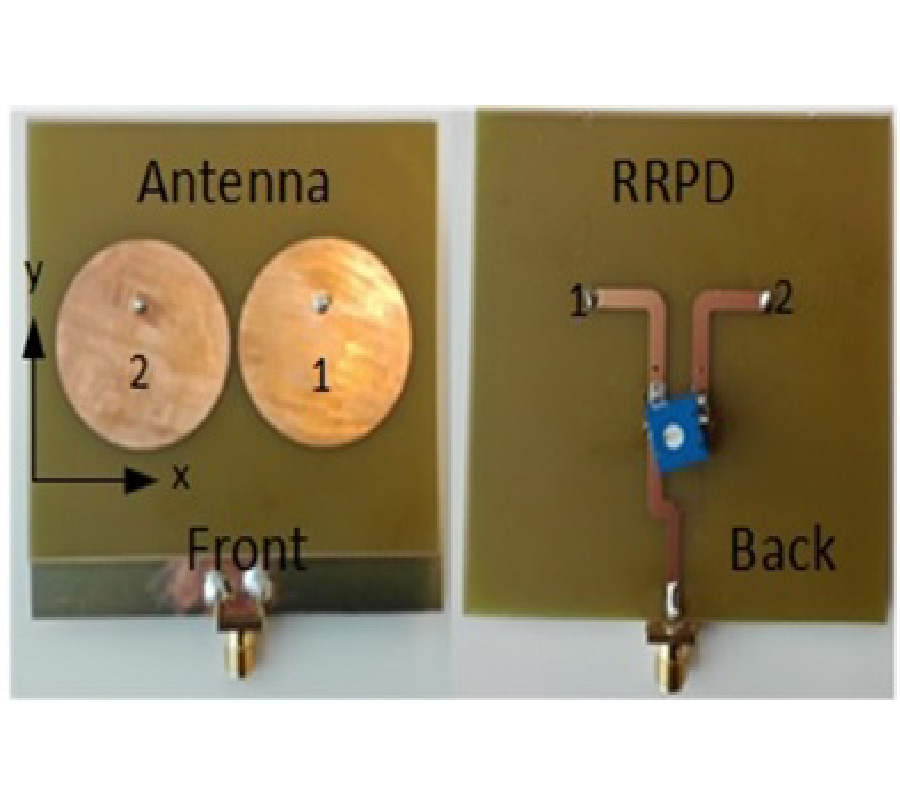
This paper focuses on the design, development, and integration of a V2X shark-fin antenna. A novel planar Electronically Switched Parasitic Array Radiator (ESPAR) antenna, operating at 5.9 GHz, is proposed. The antenna exhibits pattern reconfigurability i.e. one quasi-omni and two directive beams, low cost, reduced complexity and small dimensions. Therefore, it is considered as an ideal candidate for integrating inside a shark-fin casing. The ESPAR antenna prototype is fabricated and tested in three different measurement scenarios: (a) free-space, (b) inside shark-fin, and (c) shark-fin with ground plane. A good correlation between simulated and experimental results has been obtained. The proposed antenna involves a reconfigurable impedance matching network that is integrated in the antenna design, and thus, it demonstrates a satisfactory impedance matching for all antenna states. A considerable gain enhancement (3-4 dB) is also recorded between the omnidirectional and two directive patterns.
AN INTEGRATED SHARK-FIN RECONFIGURABLE ANTENNA FOR V2X COMMUNICATIONS
2020-02-17
PIER Letters
Vol. 90, 21-28
A Novel Dual Band-Notched CPW-Fed UWB MIMO Antenna with Mutual Coupling Reduction Characteristics
Jingjing Zhang , Lingye Wang and Wen Zhang
A novel dual band-notched CPW-fed UWB MIMO antenna with mutual coupling reduction characteristics is presented in this paper. The proposed antenna uses CPW feeding to expand the antenna bandwidth. The measured impedance bandwidth with S11 < -10 dB is 137% from 3 GHz to 16 GHz. The overall size of the antenna is 46 mm × 32 mm × 1.6 mm. In order to achieve the dual band-notched characteristics, a cup-shaped branch is added to the grounding plate, and a step impedance resonator (SIR) is added to the microstrip line.By adding periodic strip branches on the back of the antenna, the mutual coupling between the two antennas is significantly reduced, which meets the requirements of practical applications. In addition, the proposed antenna has a compact size and can provide a stable radiation pattern, which is suitable for UWB communication systems.
A NOVEL DUAL BAND-NOTCHED CPW-FED UWB MIMO ANTENNA WITH MUTUAL COUPLING REDUCTION CHARACTERISTICS
2020-02-17
PIER M
Vol. 89, 189-197
A Real-Time Automatic Method for Target Locating Under Unknown Wall Characteristics in through-Wall Imaging
Hua-Mei Zhang , Sheng Zhou , Cheng Xu and Ye-Rong Zhang
To solve the real-time through-wall detection problem in the presence of wall ambiguities, an approach based on the kernel extreme learning machine (KELM) is proposed in this paper. The wall ambiguity and propagation effect are included in the single-hidden-layer feedforward networks, and then the technique converts the through-wall problem into a regression problem. The relationship between the scattered data and the target properties is determined after the KELM training process. Numerical results demonstrate the good performance in terms of the effectiveness, generalization, and robustness. Compared with the support vector machine (SVM) and least-squares support vector machine (LS-SVM), the KELM provides almost the same estimated accuracy but at a much faster learning speed, which greatly contributes to solving the real-time detection problem. In addition, the situations of two targets, different target radiuses, and noisy circumstances are discussed.
A REAL-TIME AUTOMATIC METHOD FOR TARGET LOCATING UNDER UNKNOWN WALL CHARACTERISTICS IN THROUGH-WALL IMAGING
2020-02-17
PIER
Vol. 167, 11-17
Generating Picosecond Pulses with the Largest Number of Lasing Wavelengths by an All-Fiber Optical Parametric Oscillator
Xiaogang Jiang , Feihong Chen , Yi Lu , Taoce Yin and Sailing He
An all-fiber parametric oscillator which is pumped by a mode-locked Er-doped picosecond fiber laser is proposed for the generation of multi-wavelength picosecond lasing pulses. The length of a fiber-coupled optical delay line is adjusted so that the first signal wavelength is tuned closer to the pump wavelength to facilitate the generation of more lasing wavelengths. 10 orders of cascaded four-wave-mixing processes are achieved and picosecond pulses at 17 lasing wavelengths from 1264.7 nm to 1842.4 nm are demonstrated. To the best of our knowledge, this is the largest number of lasing wavelengths reported so far from a fiber optical parametric oscillator pumped with an ultrashort-pulse laser.
GENERATING PICOSECOND PULSES WITH THE LARGEST NUMBER OF LASING WAVELENGTHS BY AN ALL-FIBER OPTICAL PARAMETRIC OSCILLATOR
2020-02-12
PIER C
Vol. 99, 251-267
Space-Borne Compressed Sensing Based Receiver for Accurate Localization of Ground-Based Radars
Esmaeil Ramezani , Mohammad Farzan Sabahi and Seyyed Mohammad Saberali
Space borne accurate emitter localization has become an important and indispensable part of electronic warfare (EW) systems. In this paper, a system-level approach to design space borne receiver for accurate localization of long range co-channel radars (e.g. a network of similar surveillance radars) is presented. Due to the wide frequency range of modern radar signals, the receiver should have wide instantaneous bandwidth and requires high sampling rate analog-to-digital converters (ADCs). To address this issue, we propose a receiver structure with an appropriate sub-Nyquist sampling scheme and fast sparse recovery algorithm. The proposed sub-Nyquist sampler employs a three dimensional uniform linear array (ULA), followed by a modulated wideband converter (MWC). To accurately estimate the location of the co-channel radars from sub-Nyquist samples, a novel quad-tree variational Bayesian expectation maximization (QVBEM) algorithm is proposed. The QVBEM algorithm minimizes the computational load and grid mismatch error by iteratively narrowing the search area. This is done by smart grid refinement around radars' locations. To evaluate the performance of the proposed receiver, location finding of pulsed radars is studied through numerical simulations in various scenarios. The results show that the proposed QVBEM method has a significantly lower estimation error than conventional deterministic and Bayesian approaches, with a reasonably computational complexity.
SPACE-BORNE COMPRESSED SENSING BASED RECEIVER FOR ACCURATE LOCALIZATION OF GROUND-BASED RADARS
2020-02-11
PIER C
Vol. 99, 239-250
Thermal Analysis of Bearingless Switched Reluctance Motor
Binbin Zhang and Zewei He
A bearingless switched reluctance motor (BSRM) has the same body structure as a switched reluctance motor (SRM), but the winding method is different. The accurate analysis of thermal characteristics is especially important for the service life and safety performance of the two motors. According to the initial design parameters, the initial size calculation equations of SRM and BSRM are given, and the ontology design parameters are obtained according to the same design goal. The two-dimensional finite element model is established, and the stator rotor iron loss is analyzed. The distribution characteristics of iron loss of SRM and BSRM are summarized. Secondly, the three-temperature field model of the motor is built, and the reasonable boundary conditions are set. The temperature distribution law of the two motors is analyzed. It is concluded that the BSRM components have lower loss and lower temperature rise under the same design target.
THERMAL ANALYSIS OF BEARINGLESS SWITCHED RELUCTANCE MOTOR
2020-02-10
PIER C
Vol. 99, 221-238
A Miniature Implanted Antenna for UHF RFID Applications
Van Hieu Nguyen , Aliou Diallo , Philippe Le Thuc , Robert Staraj , Stephane Lanteri and Georges F. Carle
In this paper, the design of a miniature antenna dedicated to be implanted in a small animal and intended to work in the European UHF RFID (865-868 MHz) band is presented. One of the goals of this work is the miniaturization of the radiating element while preserving its efficiency to allow a reliable communication between an external interrogating reader and the implanted device. The radiating element is a small rectangular loop antenna associated with a dipole allowing impedance matching. The antenna has dimensions of 2.4 mm x 25.4 mm x 0.5 mm and integrates an Impinj Monza 4 chip presenting an impedance of 5.5-j74 Ohms at 868 MHz. The antenna is designed and optimized by using the ANSYS HFSS software. The obtained results show a simulated radiation efficiency of 0.7% and simulated total gain of -17.5 dBi. A prototype is realized, and RSSI measurements have demonstrated the possibility of reliable wireless communications between the implanted antenna and an external reader. In addition, Specific Absorption Rate (SAR) calculation indicates that this implanted antenna meets the required safety regulations.
A MINIATURE IMPLANTED ANTENNA FOR UHF RFID APPLICATIONS
2020-02-10
PIER C
Vol. 99, 209-219
A Novel Broadband Double Whip Antenna for Very High Frequency
Hengfeng Wang , Chao Liu , Huaning Wu and Xu Xie
In this paper, a new type of single loaded broadband double-whip antenna is designed for very high frequency (VHF). The simulation model by moment method is established to analyze the influence of antenna spacing on the performance of a double-whip antenna. The location of antenna loading and the parameters of loading network and broadband matching network are optimized by grasshopper optimization algorithm, and the voltage standing wave ratio (VSWR), gain, pattern and roundness of double-whip antenna are calculated. In fact, a fabricated prototype of the proposed antenna is realized. The measured VSWR is consistent with the simulation results, which is less than 3 at all frequencies, with an average value of 1.89; the maximum directional gain is greater than 2.01 dB, with a maximum of 6.44 dB and average value of 3.79 dB; the minimum roundness of antenna gain is 0.03 dB (at 30 MHz), and the maximum roundness is 1.87 dB (at 300 MHz); the efficiency is all over 51%, with a maximum value of 79% and an average value of 60.71%.
A NOVEL BROADBAND DOUBLE WHIP ANTENNA FOR VERY HIGH FREQUENCY
2020-02-10
PIER C
Vol. 99, 193-208
Gain Enhancement of an UWB Antenna Based on a FSS Reflector for Broadband Applications
Avula Swetha and Kurukundu Rama Naidu
In this paper, a novel semi-circular ultra wide-band antenna inspired by a complementary split ring resonator for enhancement of bandwidth and a frequency selective surface reflector for gain enhancement is proposed for broadband applications. Initially, an ultra wide-band antenna employing a pair of L-shaped resonators and complementary split ring resonators is proposed which provides a wide impedance bandwidth of 130.3% from 3.16 to 15 GHz with -10 dB return loss. Finally, a frequency selective surface reflector is employed below the suggested ultra wide-band antenna to enhance the gain. The dimensions of the coplanar waveguide fed ultra wide-band antenna are 35 × 30 × 1.6 mm3 and those of the ultra wide-band antenna with a frequency selective surface reflector, which consists of 10 × 10 array of elements located at a distance of 17 mm below the proposed antenna, are 53.15 × 53.15 × 1.6 mm3. A parametric analysis of substrate dimensions of ultra wide-band antenna and the distance between ultra wide-band antenna and frequency selective surface reflector is performed. The average peak gain of the proposed antenna increases from 4.9 dB to 10.9 dB, which operates at 3.79 GHz, 4.44 GHz, 7.89 GHz, 9.01 GHZ, and 11.15 GHz proposed for broadband applications. With the help of ANSYS, the signal correlation of the proposed antenna is analysed by time domain analysis using similar antennas in face-to-face and side-to-side scenarios. The simulated results of the proposed model are in correlation with experimental ones of the prototype model.
GAIN ENHANCEMENT OF AN UWB ANTENNA BASED ON A FSS REFLECTOR FOR BROADBAND APPLICATIONS
2020-02-10
PIER M
Vol. 90, 19-26
A Novel Approach Using an Inductive Loading to Lower the Resonant Frequency of a Mushroom-Shaped High Impedance Surface
Minyu Gu , Daniel Vorobiev , Woo Seok Kim , Hung-Ta Chien , Hyun-Myung Woo , Sungcheol Hong and Sung Il Park
This paper reports a novel approach using an inductive loading to reduce the resonant frequency of a mushroom-shaped high impedance surface. The current path is extended on the mushroom-shaped structure's vias and additional traces, which introduces a three-dimensional inductor to the unit cell and leads to an increase in total inductance. As a result, the resonant frequency of the high impedance structure decreases, and a smaller unit cell size can be achieved at the low gigahertz frequency range. Finite element electromagnetic simulation, equivalent circuits modeling, and experimental measurements suggest the feasibility of the proposed approach.
A NOVEL APPROACH USING AN INDUCTIVE LOADING TO LOWER THE RESONANT FREQUENCY OF A MUSHROOM-SHAPED HIGH IMPEDANCE SURFACE
2020-02-07
PIER C
Vol. 99, 179-191
Design of Sub-THz Beam Scanning Antenna Using Luneburg Lens for 5G Communications or Beyond
Thevaruparambil Abdulnazer Nisamol , Kunnath Kodakkat Ansha and Parambil Abdulla
This work presents the design and simulation of a beam scanning antenna at 300 GHz using Luneburglens for 5th generation communication applications or beyond. The basic antenna consists of a highly directional Yagi-Uda antenna with lens shaped configuration (substrate lens antenna - SLA) and designed using multiple parallel elements such as one reflector and one driven element with 6 directors. The SLA is focused by Luneburg lens, which is modeled using a unique foam material AirexR82 with relative dielectric constant of 1.12, and it is pressed to realize different dielectric constants in order to obey the index law inside the lens. The final nine - element array of SLA integrated with Luneburg lens provides a 50% increase in bandwidth compared with conventional Yagi-Uda antenna along with an increase in the gain of 31.3% compared with single SLA. The designed model can achieve a beam scan coverage up to 146˚ with a maximum gain of 17.1 dBi and an estimated efficiency of 92.9%. The beam scanning antenna provides a wide bandwidth of 83 GHz starting from 289 GHz to 372 GHz. The analysis of the proposed antenna is done in CST suite and is validated using HFSS software.
DESIGN OF SUB-THZ BEAM SCANNING ANTENNA USING LUNEBURG LENS FOR 5G COMMUNICATIONS OR BEYOND
2020-02-07
PIER C
Vol. 99, 167-178
Phase-Only Nulling with Limited Number of Controllable Elements
Ahmed Jameel Abdulqader , Jafar Ramadhan Mohammed and Raad H. Thaher
In this paper, the required array patterns with controlled nulls are obtained by optimizing only the excitation phases of a small number of elements on both sides of the array. A genetic algorithm is used to appropriately find which elements of the array to be optimized and also to find the required number of the excitation phases. The performance of the proposed phase-only method is compared with some other exciting methods, and it is found to be competitive, fulfill all the desired radiation characteristics, and represent a good solution for interference mitigation. Moreover, the proposed phase-only array is designed and validated under realistic electromagnetic effects using CST full wave modeling. Experimental results are found in a good agreement with the theoretical ones and show realistic array patterns with accurate nulls.
PHASE-ONLY NULLING WITH LIMITED NUMBER OF CONTROLLABLE ELEMENTS
2020-02-07
PIER C
Vol. 99, 157-165
Dual-Band MIMO Antenna Array for Compact 5G Smartphones
Guobo Wei and Quanyuan Feng
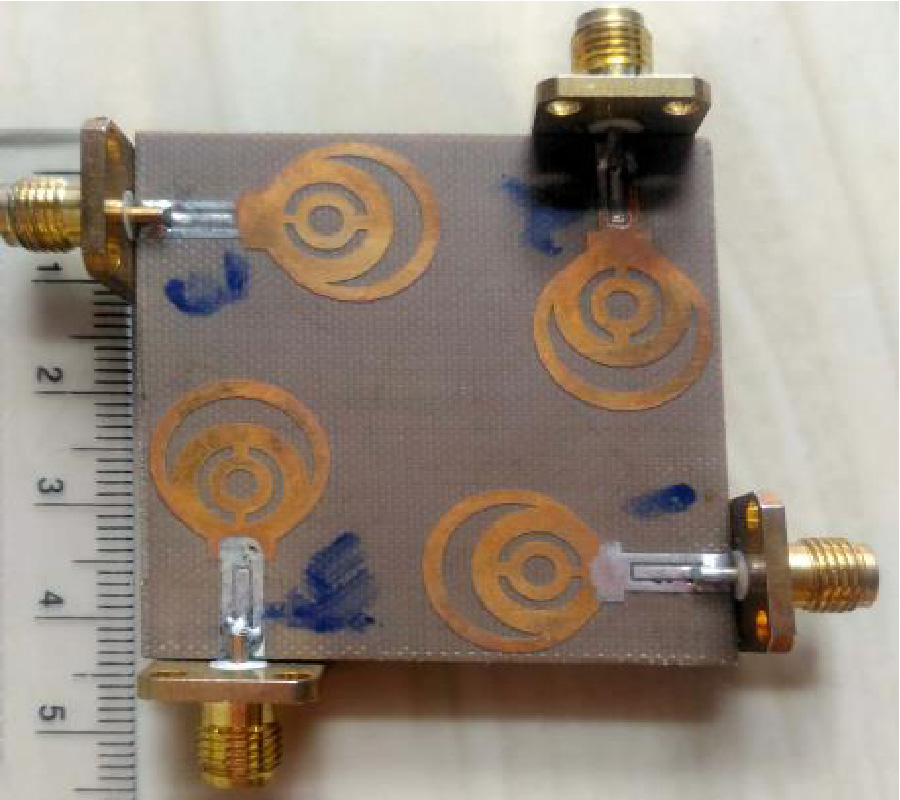
An eight-port antenna system for fifth-generation (5G) multi-input multi-output (MIMO) mobile communication in smartphones is proposed, working in 3.5 GHz frequency band (3400-3600 MHz) and 5 GHz frequency band (4800-5100 MHz). The presented eight-port antenna array consists of four vertical structure antennas placed at four corners and four horizontal structure antennas etched along the two long sides of the circuit board. The height of vertical structure is only 4 mm, which is suitable for ultra-thin smartphones. The design of eight-port antenna array was fabricated and measured. According to the test results, an ideal impedance matching (superior to 10 dB), preeminent isolation (superior to 17 dB) and excellent efficiency (superior to 61%) are obtained over the 3.5 GHz frequency band and 5 GHz frequency band. In order to evaluate MIMO performance, the ergodic channel capacities and envelope correlation coefficients (ECC) are also investigated.
DUAL-BAND MIMO ANTENNA ARRAY FOR COMPACT 5G SMARTPHONES
2020-02-07
PIER M
Vol. 90, 1-8
Analysis of ``False Non Reciprocity'' in 2-Port VNA Measurements of Reciprocal Devices
Leonardo Zappelli
The effect of measurement errors in the S-matrix of a reciprocal 2-port device is recognized in the (usually low) difference between S12 and S21, as the device were nonreciprocal. This ``false non-reciprocity'' is analyzed in the present paper, and it is verified that, for low loss device, the difference acts principally on the phases of S12 and S21. This anomaly can be removed if a numerical correction is applied to the experimental S-matrix. In doing so, it is proved that the residual measurement errors have comparable amplitudes on all scattering parameters.
ANALYSIS OF ``FALSE NON RECIPROCITY'' IN 2-PORT VNA MEASUREMENTS OF RECIPROCAL DEVICES
2020-02-06
PIER B
Vol. 86, 103-119
Novel MRA-Based Sparse MIMO and SIMO Antenna Arrays for Automotive Radar Applications
Ashish Patwari and Ramachandra Reddy Gudheti
Automotive radars make use of angle information obtained from antenna arrays to distinguish objects that lie in the same range-Doppler cell (relative to the ego vehicle). This paper proposes novel ways of using presently known minimum redundancy arrays (MRAs) in single-input multiple-output (SIMO) and multiple-input multiple-output (MIMO) automotive radars. Firstly, an MRA-based sparse MIMO array is proposed as a novel modification to the nested MIMO array. The proposed sparse MIMO array uses MRAs as the transmitting and receiving modules, unlike the nested MIMO array, which uses two-level nested arrays (TLNAs) at the transmitting and receiving blocks. Upper bounds for the virtual array aperture and the overall attainable degrees of freedom (DOF) offered by the MIMO radar have been derived in terms of the number of sensors. Secondly, the suitability of large Low-Redundancy Linear Arrays (LRLAs) in SIMO automotive radars is also studied. A long-range automotive radar driving scenario was assumed for DOA estimation and simulations were carried out in MATLAB using the Co-array MUltiple SIgnal Classification (co-array MUSIC) algorithm. Simulation results confirm that the proposed MRA-based MIMO array provides better angular resolutions than the nested MIMO array for the same number of sensors and that LRLAs can serve as a handy replacement for ULAs in SIMO radars owing to their acceptable performance. As MIMO and SIMO radars designed from currently known MRAs were sufficient to satisfy the angular resolution requirements of modern automotive radars, a need to synthesize new MRAs did not arise.
NOVEL MRA-BASED SPARSE MIMO AND SIMO ANTENNA ARRAYS FOR AUTOMOTIVE RADAR APPLICATIONS
2020-02-05
PIER M
Vol. 90, 9-18
BI-Functional Antenna Coating for Cloaking and Directivity Enhancement Made of Isotropic Materials
Mohammad Hosein Fakheri , Ali Abdolali , Zohreh Moradinia , Homayoon Oraizi and Ali Keivaan
In this paper, using quasi-conformal mapping, a bi-functional coating layer is designed with the intention of both cloaking and directivity enhancement of an omnidirectional antenna. For TM external waves coming from a certain direction, the proposed coating layer conceals the inner objects. In addition to the cloaking performance, the designed coating layer plays the role of a metamaterial-based lens that dramatically enhances the directivity level of inner omnidirectional loop-family antennas. To reach this goal, a proper coordinate transformation is elaborately utilized to transform the cylindrical wavefronts radiated from the antenna into semi-pure plane waves. With appropriate simplifications, the proposed coating layer turns into an isotropic meta-device, which is more suitable to be fabricated. To prove the feasibility of the implementation, an SRR-meander line meta-atom is designed to locally realize the required permittivity and permeability distribution of the bi-functional layer. Full-wave simulations are performed via COMSOL finite element solver to validate the cloaking effect and directivity enhancement of the proposed coating layer, at the same time.
BI-FUNCTIONAL ANTENNA COATING FOR CLOAKING AND DIRECTIVITY ENHANCEMENT MADE OF ISOTROPIC MATERIALS