Search Results(13790)

2020-01-30
PIER M
Vol. 89, 93-100
Non-Reciprocal Antenna Array Based on Magnetized Graphene for THz Applications Using the Iterative Method
Aymen Hlali , Zied Houaneb and Hassen Zairi
An effective and precise approach to the Wave Concept Iterative Process method modeling of magnetized graphene sheet as an anisotropic conductive surface is used to analyze the anisotropy of magnetostatically biased graphene and for studying an electrically doped magnetically biased graphene non-reciprocal antenna array for THz applications. The tuning of the performance of the array antenna is possible by varying the magnetic field and the chemical potential of graphene material. The return loss value decreases by increasing the magnetostatic bias and increases when the chemical potential increases.
NON-RECIPROCAL ANTENNA ARRAY BASED ON MAGNETIZED GRAPHENE FOR THZ APPLICATIONS USING THE ITERATIVE METHOD
2020-01-30
PIER M
Vol. 89, 83-92
Miniaturized Quintuple Band Antenna for Multiband Applications
Fouad Fertas , Mouloud Challal and Khelil Fertas
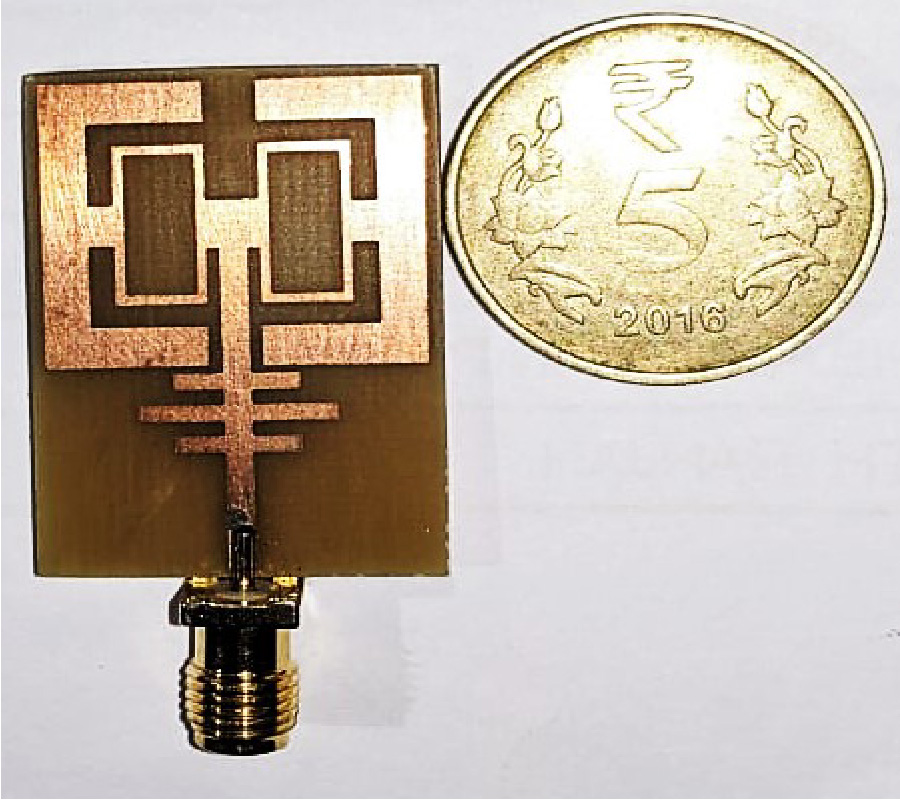
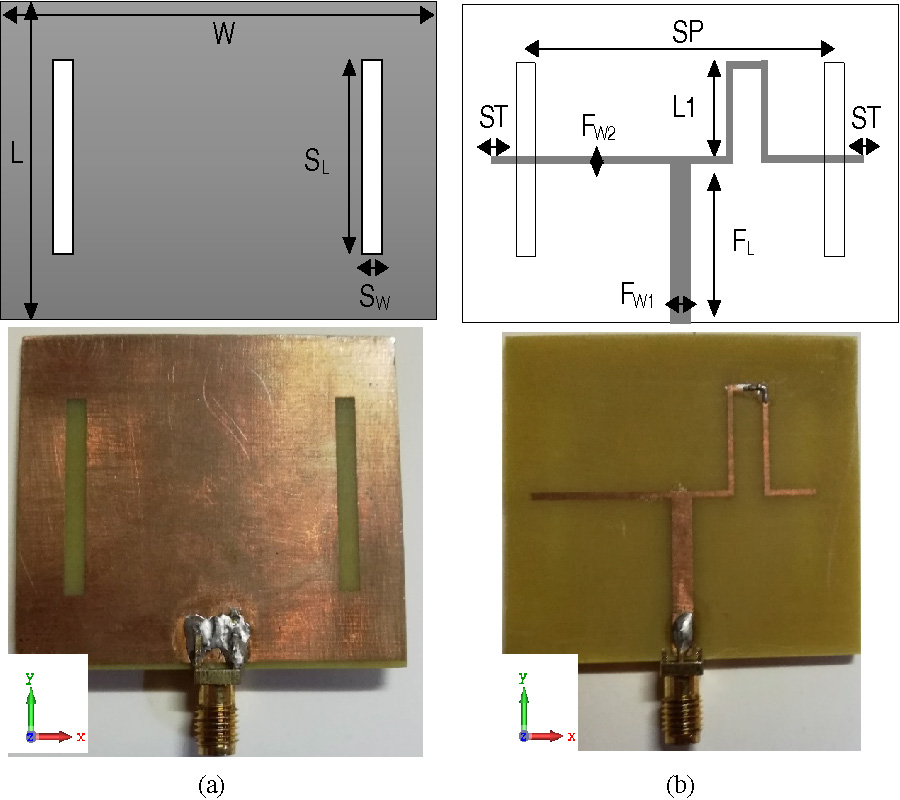
This paper presents a miniaturized quintuple band antenna for multiband operation with the aim of developing a small and simple structure antenna that can operate at multiband frequency. The proposed antenna contains a rectangular microstrip patch, a transmission line with 50 Ω coplanar wave guide (CPW) and six L-slots. By introducing these L-slots along the X and Y axis, in the radiating element, the antenna yields five resonance modes at 2.4, 3.5, 4.4, 6.09, and 7.7 GHz while keeping the size of 27.4 x 24 mm2. The prototype of the proposed antenna is constructed and experimentally studied. The measured and simulated results prove that the proposed multiband antenna is suitable for Bluetooth, WLAN, WIMAX, LTE, and X band applications. The antenna is designed using FR4 lossy substrate material with relative permittivity εr of 4.4 and thickness of 1.6 mm.
MINIATURIZED QUINTUPLE BAND ANTENNA FOR MULTIBAND APPLICATIONS
2020-01-30
PIER M
Vol. 89, 73-82
CPW Fed Flexible Graphene Based Thin Dual Band Antenna for Smart Wireless Devices
Ronak Vashi and Trushit K. Upadhyaya
A coplanar waveguide (CPW)-fed flexible dual-band antenna using graphene as conducting material and Kapton polyimide as a substrate is proposed. The antenna shows increased impedance bandwidth due to the use of CPW-feed having the values of 80.29% (1.64-3.84 GHz) and 6.31% (5.52-5.88 GHz), respectively. The antenna has an overall size of 0.38λ × 0.43λ at center frequency of 3.4 GHz. The proposed flexible antenna has gain values of 1.82 dBi and 1.68 dBi with efficiency values more than 86% which makes the antenna commercially viable for smart wireless products having space constraints.
CPW FED FLEXIBLE GRAPHENE BASED THIN DUAL BAND ANTENNA FOR SMART WIRELESS DEVICES
2020-01-29
PIER C
Vol. 99, 87-98
Dual Polarized UWB MIMO Antenna with Elliptical Polarization for Access Point with Very High Isolation Using EBG and MSR
Gnanaharan Irene and Anbazhagan Rajesh
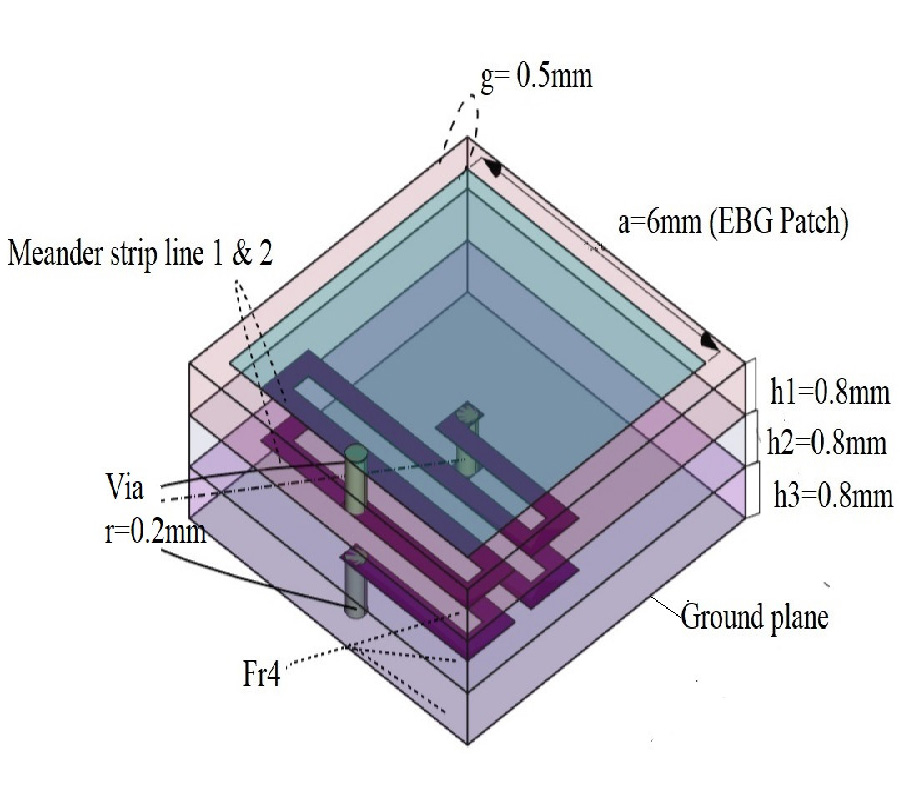
A compact microstrip fed dual polarized Ultra Wide Band (UWB) monopole Multiple Input Multiple Output (MIMO) antenna for access point application in Wireless Body Area Networks (WBAN) is proposed. The antenna is elliptically polarized in the 6 to 10.6 GHz band. The proposed structure possesses high isolation with the introduction of Modified Serpentine Structure (MSS) that behaves as a decoupling unit (DU). To further reduce the coupling and to improve the impedance bandwidth, an Electromagnetic Band Gap (EBG) structure is introduced. The proposed antenna has a wide impedance bandwidth with S11 < -10 dB in the UWB from 3.1-10.6 GHz and has a high isolation S21 < -25 dB. The antenna has a fractional bandwidth of 106%. The radiation pattern of the antenna is omnidirectional. The Envelope Correlation Coefficient (ECC) is equal to zero, and the capacity loss is 0.264 which proves the diversity characteristics of the proposed antenna.
DUAL POLARIZED UWB MIMO ANTENNA WITH ELLIPTICAL POLARIZATION FOR ACCESS POINT WITH VERY HIGH ISOLATION USING EBG AND MSR
2020-01-29
PIER Letters
Vol. 89, 133-139
Crosstalk Cancellation Method in a Complex Interconnection Structure
Yafei Wang , Huifang Sun and Xuehua Li
Complex interconnection structure is a common structure on printed circuit board (PCB). Herein, the paper proposes a method of crosstalk cancellation point at the crosstalk problem between microstrip lines in a complex interconnection structure. First, a model of the coupled transmission lines-channel transmission matrix (CTL-CTM) of the complex interconnection structure is established. Second, the CTL-CTM is simplified through the equivalence of crosstalk-coupling coefficient of parallel coupling microstrip lines to that of the complex interconnection structure. The eigenvalue of the simplified CTL-CTM is then decomposed, based on which the construction of crosstalk cancellation circuit is performed. Simulation results show that the proposed method can effectively improve the quality of eye patterns on complex interconnection structures.
CROSSTALK CANCELLATION METHOD IN A COMPLEX INTERCONNECTION STRUCTURE
2020-01-28
PIER Letters
Vol. 89, 127-132
Evaluation of the Flux Linkage Between Equally Sized Circular Loops Placed on a Layered Soil
Mauro Parise
This paper presents an efficient method for evaluating the flux linkage between two circular loops located on the top surface of a plane multilayer soil. The method consists of a rigorous procedure, which leads to expressing the flux as a sum of products of Bessel functions. First, the integral representation for the mutual inductance is cast into a form where the integration range is continued to the negative real axis. Subsequently, the non-oscillating part of the integrand is replaced with a rational approximation, arising from using a well-known least squares-based fitting algorithm. Finally, analytical integration is performed by applying the theorem of residues. As a result of the proposed method, the flux linkage between the loops is expressed as a finite sum of products of Bessel functions. Since no assumptions are made in the mathematical derivation, the obtained explicit expression is valid regardless of the operating frequency. Numerical tests are performed to show the advantages of the proposed method with respect to standard numerical integration techniques. In particular, it is seen how the use of the derived series representation for the inductance with 50 terms permits to achieve the same accuracy as conventional Gauss-Kronrod numerical integration technique, with the advantage of reducing the computation time by at least 8 times.
EVALUATION OF THE FLUX LINKAGE BETWEEN EQUALLY SIZED CIRCULAR LOOPS PLACED ON A LAYERED SOIL
2020-01-27
PIER M
Vol. 89, 63-71
A Filtering Dielectric Resonator Antenna with High Band-Edge Selectivity
Yang Gao , Yong-Chang Jiao , Zibin Weng , Chi Zhang and Yi-Xuan Zhang
A filtering rectangle dielectric resonator antenna (DRA) with high band-edge selectivity is proposed in this paper. The DRA is fed by a simple hybrid feeding structure consisting of a microstrip-coupled slot on the bottom and a thin metallic strip on the side of DRA to excite the fundamental TEy1δ1 mode. The feeding structure establishes a cross-coupled mechanism which includes electric and magnetic coupling; thus, introducing two radiation nulls at the band edge without any filtering circuits. By using the designed hybrid feeding structure, a bandpass filtering response is obtained. For enhancing band-edge selectivity, a shorted stub is introduced to weaken the coupling between the two microstrip stubs of the feeding structure. A wide impedance bandwidth of 19% and a flat gain of around 5.6 dBi are realized. To validate the design, a prototype is fabricated and measured, showing a favorable agreement with the simulated results.
A FILTERING DIELECTRIC RESONATOR ANTENNA WITH HIGH BAND-EDGE SELECTIVITY
2020-01-27
PIER M
Vol. 89, 53-62
Reconfigurable Graphene Annular Ring Antenna for Medical and Imaging Applications
Hamza Ben Krid , Zied Houaneb and Hassen Zairi
In this article, we design a reconfigurable bandwidth based on a concentric ring slot antenna using graphene. The developed antenna has good agreement between simulated and experimental results. The use of graphene in Terahertz (THz) has shown better performance than metal, and the variation in the chemical potential of graphene provides excellent performance properties, good return loss reaching -33.288 dB, bandwidth reconfiguration from 255 GHz to 406 GHz, and a good gain. These results are promising for THz applications and particularly for the application of medical imaging. The modeling and validation are performed using the CST Simulator.
RECONFIGURABLE GRAPHENE ANNULAR RING ANTENNA FOR MEDICAL AND IMAGING APPLICATIONS
2020-01-26
PIER C
Vol. 99, 77-86
Indium Tin Oxide Based Wideband Dielectric Resonator Antenna for Wireless Communication
Vivek Parimi , Sajal Biring , Chia Hao Ku , Abhirup Datta and Somaditya Sen
In this paper, a novel dielectric resonator antenna has been numerically simulated and experimentally demonstrated. The proposed design, comprising an Indium Tin Oxide (ITO) coated glass slide placed on a microstrip transmission line, is intended for WLAN and Wi-Max applications. The antenna shows a maximum bandwidth of 2.15-7.65 GHz and 10.36-11.78 GHz and a gain ranging from 2.21 to 6.44 dB. The novelty of the design lies in the use of ITO coating on glass to enhance as well as regulate the antenna bandwidth. Parametric variations have been investigated to analyse the topology for understanding the effect of the design parameters on gain, bandwidth, and reflection coefficient. A prototype has also been fabricated, where different ITO sheets have been mounted to measure the response. The proposed geometry has been found to be better and competent enough with respect to antenna parameters than existing Ultrawide Band antennas.
INDIUM TIN OXIDE BASED WIDEBAND DIELECTRIC RESONATOR ANTENNA FOR WIRELESS COMMUNICATION
2020-01-26
PIER Letters
Vol. 89, 121-125
A Compact Wideband 24 GHz End-Fire Helix Antenna with High Gain Turn Ratio in Planar Technology
Yanfei Mao and Shiju E
A wideband end fire antenna architecture in planar technology with fewer turns: helix antenna in planar technology adopting thickness of quarter wavelength is suggested. A wideband 24 GHz helix antenna with 2.25 turns in Rogers compressed RT 4350 technology is presented. The antenna has a bandwidth of 6.2 GHz for S11, gain of 9.3 dBi, half power width of 39.5° and 39° respectively in X-Z and X-Y planes. This helix antenna is characterized by wide bandwidth, high gain, high half power width, compactness and high gain turn ratio. It could also be utilized in antenna design for other frequency bands with compressed PCB technology, as well for on-chip THz antenna design.
A COMPACT WIDEBAND 24 GHZ END-FIRE HELIX ANTENNA WITH HIGH GAIN TURN RATIO IN PLANAR TECHNOLOGY
2020-01-26
PIER M
Vol. 89, 43-51
Printed Multiband Monopole Antenna for Smart Energy Meter/WLAN/WiMAX Applications
Hitesh Patel and Trushit K. Upadhyaya
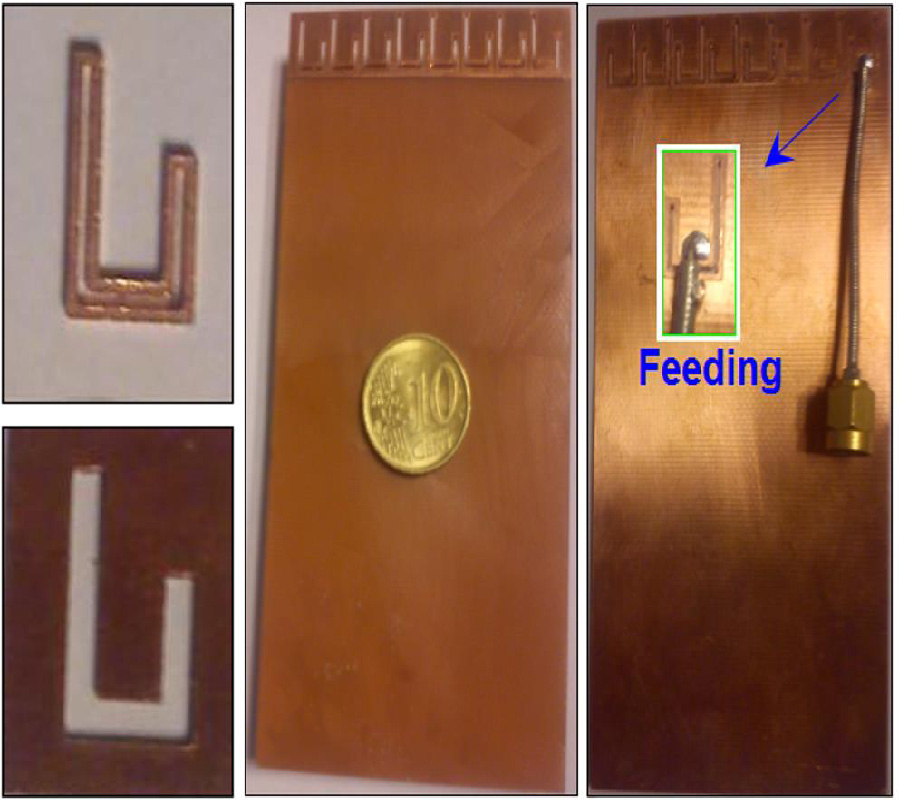
The proposed antenna structure is excited for multiple operational modes by means of meandered strips. The compact planar monopole antenna is demanded enormously for handheld devices especially automatic meter reading and tablet devices. Due to Chu limit, it is extremely vital to miniaturize an antenna by balancing tradeoff between bandwidth and radiation efficiency. The designed antenna is formed by two interconnected broad monopole open slots which covers multi-bands for smart energy meter and tablet computer applications. The cost effective FR4 laminate of size 50 x 200 mm2 (0.4λ x 1.6λ) is employed to match standard tablet computer communication module dimensions. The impedance bandwidth, for all excited resonant modes, is above typical requirement of 2%, and the VSWR is well below the necessary requirement of 1.5. The peak gain ranges from 0.94 dBi to 1.92 dBi. Radiation patterns along with other antenna parameters are satisfactorily meeting the demand of Wireless Energy Meter and Tablet Devices. The effects of varying dimensions of a monopole on the radiation characteristics have also been presented. The return loss and radiation patterns computed through simulations are validated through experimental measurements in an anechoic chamber environment.
PRINTED MULTIBAND MONOPOLE ANTENNA FOR SMART ENERGY METER/WLAN/WIMAX APPLICATIONS
2020-01-26
PIER M
Vol. 89, 31-41
Impedance Synthesis of Plane Diffraction Vibrator Arrays
Yuriy M. Penkin , Viktor A. Katrich , Mikhail Nesterenko , Sergey L. Berdnik and Svetlana V. Pshenichnaya
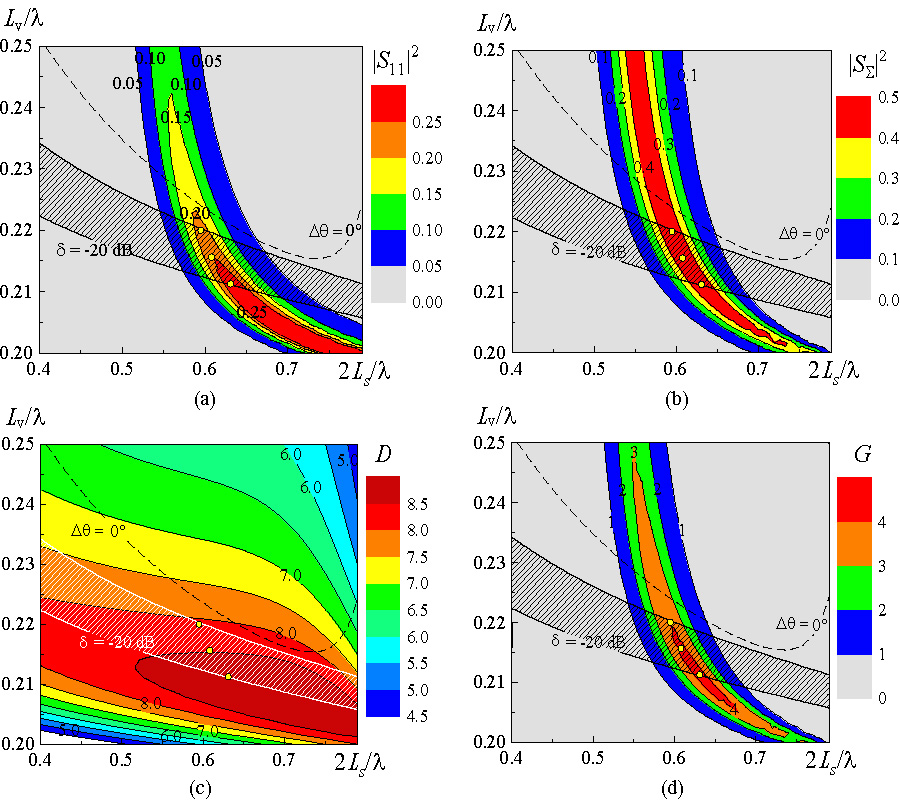
The problem of impedance synthesis of two-dimensional diffraction arrays of thin linear vibrators, whose geometric centers are located at the nodes of a flat rectangular grid with double periodicity is solved analytically. The problem is formulated as follows: the complex surface impedances of the vibrators should be determined which allows to steer the diffraction radiation maximum of the array to any predefined direction. The problem is solved under following assumptions: array is excited by a polarized plane wave, and the radiation pattern (RP) of each vibrator element in the array coincides with that of an isolated radiator. The correctness of the solution is verified by simulations using the formulas for the vibrator impedances for the 5 by 5 antenna array.
IMPEDANCE SYNTHESIS OF PLANE DIFFRACTION VIBRATOR ARRAYS
2020-01-25
PIER C
Vol. 99, 61-75
Synthesis of Chained-Elliptic Function Waveguide Bandpass Filter with High Rejection
Guan Shen Ng , Sovuthy Cheab , Peng Wen Wong and Socheatra Soeung
This paper describes the synthesis of a bandpass filter to achieve high selectivity and rejection properties using a new class of filter functions called chained-elliptic function filters. Chained-elliptic filters have higher selectivity than Chebyshev function filters and have the property of sensitivity to manufacturing tolerance reduction in chained-function filters. The proposed design has high selectivity and reduced sensitivity, enabling easier and faster filter fabrication. The characteristic polynomials of chained-elliptic function filters are derived through chaining elliptic filtering function and extracted to form a coupling matrix of the bandpass filter. The novel transfer polynomials are given in detail, and a thorough investigation of the filter characteristics is performed. A theoretical comparison with Chebyshev and elliptic filters of the same order is performed to ascertain the demonstrated advantages of this proposed filter class. A high frequency narrow-band fourth-order chained-elliptic function waveguide filter centred at 28 GHz with a fractional bandwidth of 1.61% is fabricated to validate the proposed design concept. A good match among the measured, simulated and ideal filter responses is shown where the overall responses between measurement and simulation have a difference of approximately 2% which is within the acceptable limit. The chained-elliptic function concept will be useful in designing low-cost high-performance microwave filters with various fabrication technologies for millimetre-wave applications.
SYNTHESIS OF CHAINED-ELLIPTIC FUNCTION WAVEGUIDE BANDPASS FILTER WITH HIGH REJECTION
2020-01-25
PIER Letters
Vol. 89, 113-119
Design of a Reflectarray Antenna Using Graphene and Epsilon-Near-Zero Metamaterials in Terahertz Band
Sahereh Sahandabadi , Seyed Vahab Al-Din Makki and Shahpour Alirezaee
In this paper, a graphene-based reflectarray antenna using ENZ (Epsilon-Near-Zero) metamaterial at terahertz (THz) band is proposed, and the performance of its unitcell is investigated. Then, the phase distribution and radiation pattern of the antenna are examined. Benefiting from exceptional complex surface conductivity of graphene which is a novel 2-d material, the size reduction of reflectarray has been facilitated as a result of plasmonic mode propagation within the structure which in turn leads to an increase in propagation constant. Moreover, tunneling phenomenon in ENZ material, a kind of metamaterial which has a relative permittivity under 1, helps reduce the loss. Taking advantage of these outstanding features of both materials, the proposed reflectarray is designed to function at 2.5 THz and is composed of 150×150 elements with square-shape configuration. We have achieved 40 dB of gain using the combination of graphene and ENZ material in reflectarrays, and also it is the first that time they are used together in the reflectarray. This work mainly focuses on the impact of using ENZ material and graphene simultaneously which is not done before, then the results demonstrate that it has a considerable effect on increasing the reflectarray gain.
DESIGN OF A REFLECTARRAY ANTENNA USING GRAPHENE AND EPSILON-NEAR-ZERO METAMATERIALS IN TERAHERTZ BAND
2020-01-24
PIER C
Vol. 99, 49-59
Eight-Port MIMO Antenna System for 2.6 GHz LTE Cellular Communications
Naser Ojaroudi Parchin , Haleh Jahanbakhsh Basherlou , Yasir I. A. Al-Yasir , Ahmed M. Abdulkhaleq , Raed A. Abd-Alhameed and Peter S. Excell
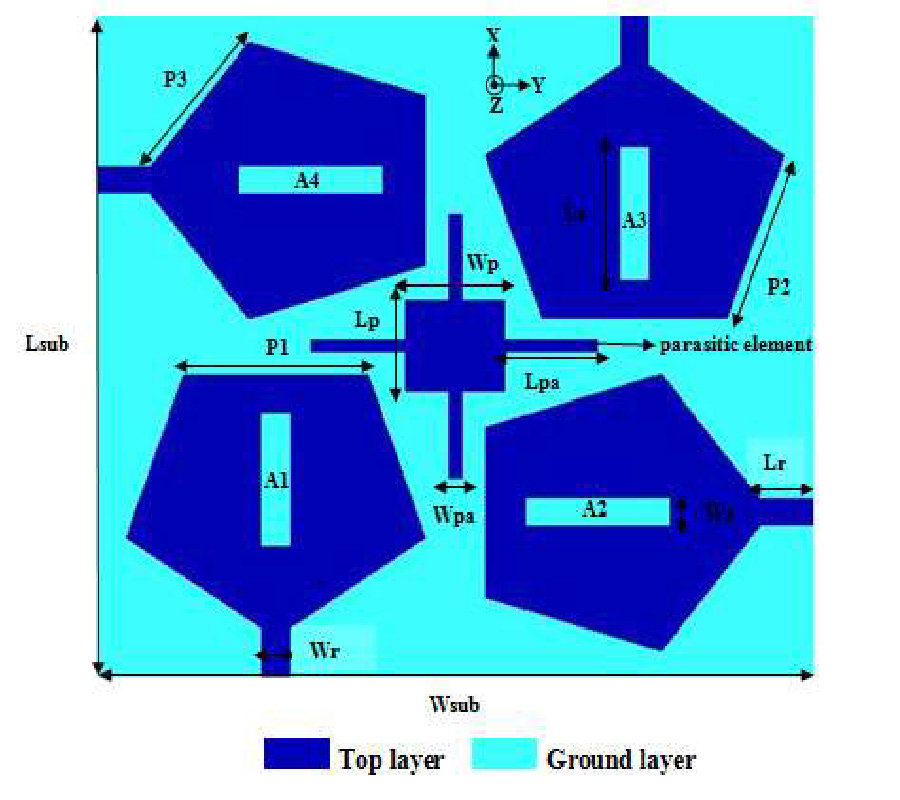
In this paper, an eight-port antenna array operating in the 2.6 GHz band (2550-2650 MHz) for a multi-input multi-output (MIMO) mobile terminal is presented. The design is composed of four pairs of compact dual-polarized slot antennas that are symmetrically placed at the corners of a mobile-phone mainboard. Each antenna pair consists of miniaturized petal-shaped slot resonators fed by two independent microstrip-feeding lines, thus facilitating radiation pattern and polarization diversity: when acting together, they facilitate multi-channel MIMO operation. The design offers good isolation, dual polarization and full radiation coverage in a smartphone sized package. A low-cost FR-4 dielectric (ε = 4.4, δ = 0.02, and h = 0.8 mm) with a dimension of 75×150 mm2 is used as the PCB substrate. The characteristics of the smartphone antenna are examined using both simulations and measurements.
EIGHT-PORT MIMO ANTENNA SYSTEM FOR 2.6 GHZ LTE CELLULAR COMMUNICATIONS
2020-01-23
PIER C
Vol. 99, 35-48
Microstrip Defected Ground Structure for Determination of Blood Glucose Concentration
Yee See Khee , Soon Chong Johnson Lim , Pih Shyan Pong and Samsul Haimi Dahlan
This work reports the application of a microwave sensor in measuring human blood glucose concentration. The main contribution of this work lies on the blood glucose profile which is collected from 69 random patients regardless of their gender, age, and haematology properties, instead of using water as the base or focusing on a single person. Hence the blood glucose profile is more realistic. Blood is extracted from the participants and dropped at the center of the dumbbells section of a microstrip defected ground structure to gather the notch frequency shifting data. On the other hand, the blood samples are measured using Omron Freestyle Glucometer to collect their associated blood glucose readings. Five predicting models have been proposed in this work. Based on the cross-validation, it is found that the blood glucose level can be correlated very well with shifted notch frequency by using a linear model. It introduces least root mean square error (RMSE) of 0.0592 and shows good correlation (R2 = 0.9356) between the reading from commercial glucometer and microwave sensor in the range up to 12 mmol/L. The reliability of this microwave sensor is proven once again when the predicted blood glucose data are all falling in Zone A of Clarke Error Grid. The outcome of this work shows the capability of this microwave sensor in measuring the blood glucose level. Since this microwave sensor can be reused under a proper cleaning procedure, it improves the sustainability of conventional blood glucose testing by reducing the disposal of testing strips and cost. It is believed that this sensor will be suitable for extensive blood glucose testing conducted in the laboratory.
MICROSTRIP DEFECTED GROUND STRUCTURE FOR DETERMINATION OF BLOOD GLUCOSE CONCENTRATION
2020-01-23
PIER Letters
Vol. 89, 105-111
Linear Phase SIW Filter with Good Selectivity
Weimin Hou and Qingshan Tang
This letter presents an approach to design a linear phase substrate integrated waveguide (SIW) bandpass filter with good selectivity. The topology of the proposed filter is implemented based on cross and bypass coupling schemes, which simultaneously introduce a linear phase response and good selectivity, respectively. According to the proposed topology, a multilayer SIW filter is presented to realize the two kinds of couplings and preserve a compact size. Then, the defected ground structure is adopted to further improve the out-of-band rejection. To demonstrate the proposed design method, one double-layered SIW bandpass filter is fabricated and measured. Measured results show that the proposed filter has a linear phase response and good out-of-band rejection, as well as a good agreement between simulated and measured results.
LINEAR PHASE SIW FILTER WITH GOOD SELECTIVITY
2020-01-22
PIER Letters
Vol. 89, 99-104
A Broadband Microstrip-to-Waveguide End-Wall Probe Transition and Its Application in Waveguide Termination
Cong Tang , Xiaofeng Pan , Fei Cheng and Xianqi Lin
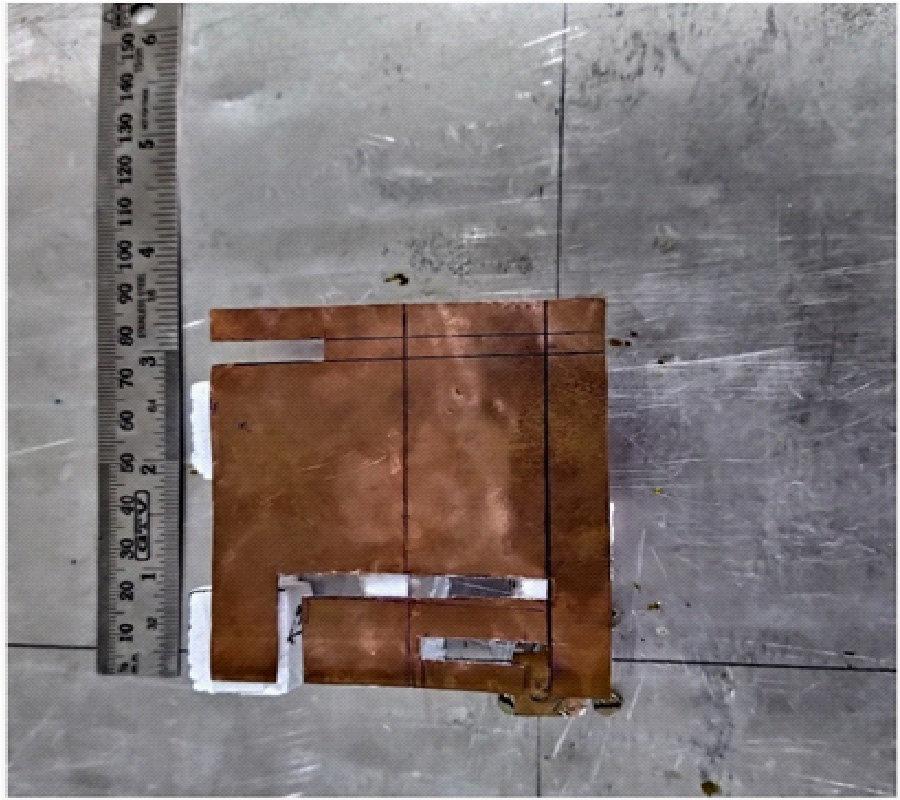
A broadband microstrip-to-waveguide end-wall probe transition using a semicircular loop is proposed in this letter. The simulated 20-dB fractional bandwidth for this transition is 48.3% which could cover the whole Ka-band. Then, a compact broadband waveguide termination is developed by combination of this microstrip-to-waveguide transition and a 50 Ω microstrip termination. To reduce parasitic effects, the microstrip termination is grounded by a microstrip radial stub. The fabricated waveguide termination shows a compact size and has a return loss better than 16.6 dB from 26 to 40.8 GHz.
A BROADBAND MICROSTRIP-TO-WAVEGUIDE END-WALL PROBE TRANSITION AND ITS APPLICATION IN WAVEGUIDE TERMINATION
2020-01-22
PIER Letters
Vol. 89, 91-97
Monitoring the Dielectric Properties and Propagation Conditions of Mortar for Modern Wireless Mobile Networks
Mohammed A. Jawad , Mohammed Ahmed Elwi , Ethar Y. Salih , Taha Ahmed Elwi and Zulkifly Abbas
Recently, modern wireless communication applications are extended to call high frequency bands including millimeter waves for 5G systems. Therefore, the propagation properties of such waves in different media have attracted many researchers. In this work, the results of the S-parameters measurements of mortar with four thicknesses are obtained using a nondestructive free space measurement technique for the frequency bands from 8 GHz up to 32 GHz. The obtained results of the dielectric properties and loss factors for the prepared mortar samples are realized. The variation in both the reflection and transmission coefficients and the dielectric properties with curing time conditions of mortar structure is examined. The dielectric properties of water are realized using the proposed method to subtract the effects of water contents from the prepared mortar samples. The effects of the sample thickness and relaxation frequency are considered. The obtained measurements are compared to the simulated results based on a full wave simulation software package of CSTMWS algorithms. Finally, excellent agreements are achieved between the simulated and measured results.
MONITORING THE DIELECTRIC PROPERTIES AND PROPAGATION CONDITIONS OF MORTAR FOR MODERN WIRELESS MOBILE NETWORKS
2020-01-22
PIER Letters
Vol. 89, 85-90
Fast Multiplication of Matrix-Vector by Virtual Grids Technique in AIM
Mingxuan Zheng , Huiling Zhao and Zhonghui Zhao
In order to accelerate the speed of matrix-vector product (MVP) in iteration process for adaptive integral method (AIM), a virtual grids technique (VGT) with the multi-dimensional fast Fourier transform (FFT) is proposed. By adding some uniform virtual grids outside the original region, the indexes of nonzeros in the projection matrix are modified so as to eliminate the padding and unpadding procedures in MVP. The advantages of this method are that first it will not occupy any extra memory, and second it makes the Green's function vector compressed from (2Nx - 1)(2Ny - 1)(2Nz - 1) to 8(Nx - 1)(Ny - 1)(Nz - 1) because of its symmetrical block-Toeplitz property. Numerical results show that per iteration time could be reduced more than 30% by applying this method in comparison with the conventional AIM, without losing accuracy. In addition, the peak memory consumption could also be reduced because the intermediate vectors are eliminated.
FAST MULTIPLICATION OF MATRIX-VECTOR BY VIRTUAL GRIDS TECHNIQUE IN AIM