Search Results(13790)

2020-02-04
PIER C
Vol. 99, 145-156
Design of a Miniaturized Multilayer Tunable Super Wideband BPF
Aditi Sengupta , Somdotta Roychoudhury and Santanu Das
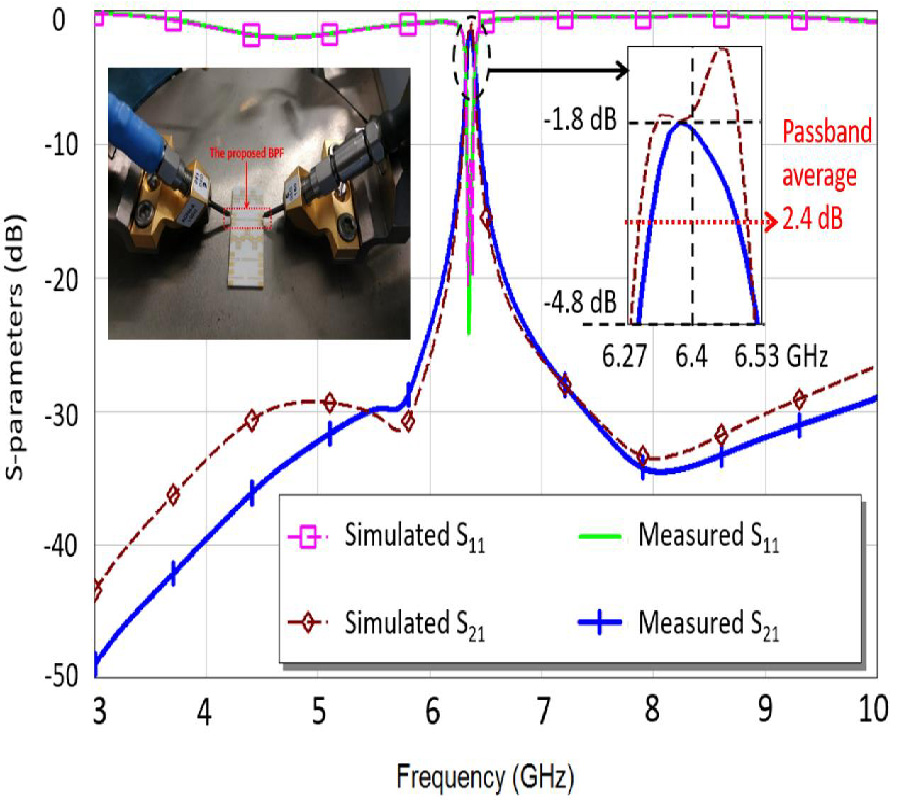
A miniaturized multilayer tunable super wideband (SWB) bandpass filter (BPF) is presented based on a microstrip structure. A pair of transmission line is coupled with the aid of three defected ground structures (DGS) at ground to improve the coupling and provide ultra wide band pass response. One of the transmission line is placed at the top plane of the upper layer, and the other transmission line is at bottom plane of the lower layer with defected microstrip structures (DMS) to improve the return loss. Bandwidth can be tuned by properly selecting the resonator size. Circuit model for the microstrip resonator and mathematical analysis are given and studied. Finally, the proposed vertical connection with slotline structures and a three pole UWB filter is designed, simulated, fabricated, and the results are well vindicated by an exemplary circuit centered at 6.5 GHz with the measured fractional bandwidth (FBW) of 135%. The filter exhibits a constant group delay of 0.3 ns in the pass band and the size of the resonator is 13.67 mm×17.58 mm×3.2 mm.
DESIGN OF A MINIATURIZED MULTILAYER TUNABLE SUPER WIDEBAND BPF
2020-02-04
PIER Letters
Vol. 90, 15-20
High Power Transmission Using Contactless Microwave Transition on an EMDrive Setup
Hugo Peyre , Olivier Pascal , Jérôme Sokoloff , Kevin Elis , Olivier Pigaglio and Nathalie Raveu
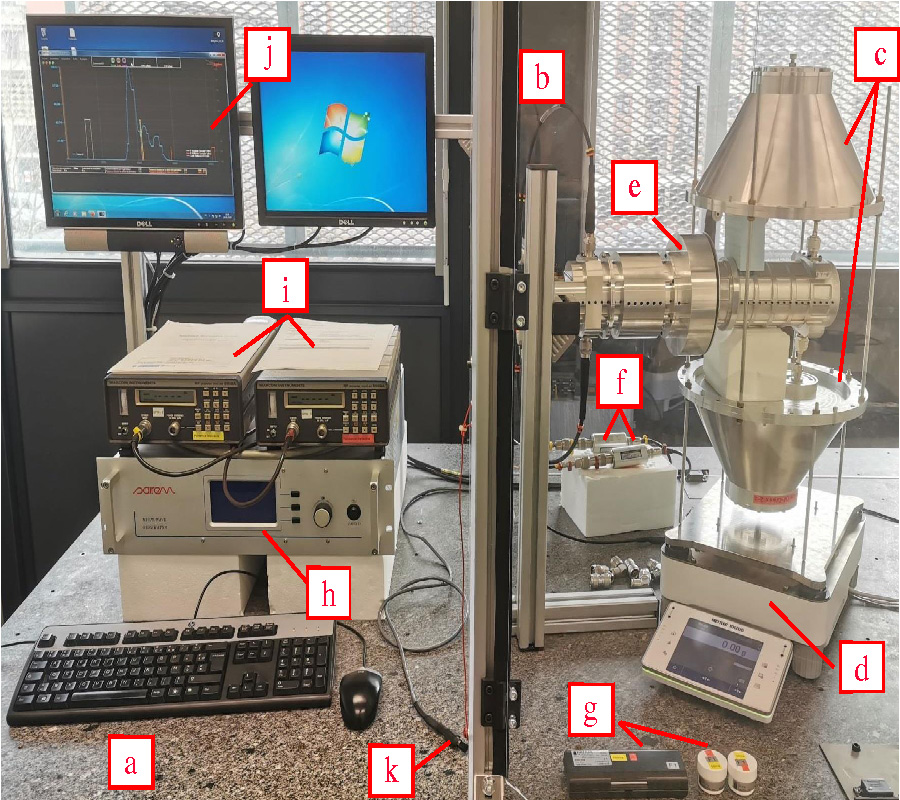
In this paper, a contactless microwave transition is described and characterized. In our ``ElectroMagnetic Drive'' (EMDrive) measuring setup, it will be dedicated to transmit high Radio Frequency (RF) powers without any mechanical effort. It exhibits very good matching and transmission performances. It is found to transmit 100 W microwave power range at 2.45 GHz without any visible mechanical effect on a 10 mg precision balance, contrary to a previous coaxial cable. This device appears useful to every EMDrive setup and can be easily implemented.
HIGH POWER TRANSMISSION USING CONTACTLESS MICROWAVE TRANSITION ON AN EMDRIVE SETUP
2020-02-04
PIER M
Vol. 89, 179-187
Mutual Coupling Reduction in Microstrip Array Antenna by Employing Cut Side Patches and EBG Structures
Bahare Mohamadzade , Ali Lalbakhsh , Roy B. V. B. Simorangkir , Alireza Rezaee and Raheel M. Hashmi
This paper presents the simultaneous application of Minkowski fractal geometry and EBG structures for mutual coupling reduction in microstrip array antennas for the first time. In this approach, a modified version of Minkowski fractal geometry is applied on the patch elements, and at the same time 1D electromagnetic bandgap (EBG) structures, composed of 4 EBG elements, are placed between the array elements in a very close distance. Unlike many other coupling reduction methods, which have at least one of the issues of gain reduction or complex fabrication, the proposed method does need any via or double-sided etching and slightly increases the gain of the antenna, while an excellent reduction level of 23 dB has been achieved. To verify the concept, 2 array antennas with the spacing of λ0 and λ0/3 were fabricated and tested, showing very good agreement between predicted and measured results.
MUTUAL COUPLING REDUCTION IN MICROSTRIP ARRAY ANTENNA BY EMPLOYING CUT SIDE PATCHES AND EBG STRUCTURES
2020-02-03
PIER C
Vol. 99, 133-143
Multi-Band mm-Wave Antenna for 5G-WiGig Communication Systems
Nada Abdelatif , Hany Mahmoud Zamel , Ahmed Attiya and Amr Awamry
In this paper, we develop a multi-band circularly polarized planar antenna operating at 28 GHz and 60 GHz for 5G and WiGig applications. The antenna is composed of a square slot antenna fed by a proximity coupled microstrip line and loaded by grounded square loop and three tilted angle strips. Grounded square patch introduces resonance at 60 GHz frequency while the strips introduce resonances at 28 GHz. The square slot is designed as a wide-band antenna which can support these two resonances.
MULTI-BAND MM-WAVE ANTENNA FOR 5G-WIGIG COMMUNICATION SYSTEMS
2020-02-03
PIER Letters
Vol. 90, 7-13
Eight-Element with h-Shaped Slot MIMO Antenna for 5G Applications
Zhong Yu , Yuqing Chen , Yongbin Xie and Nan Guo
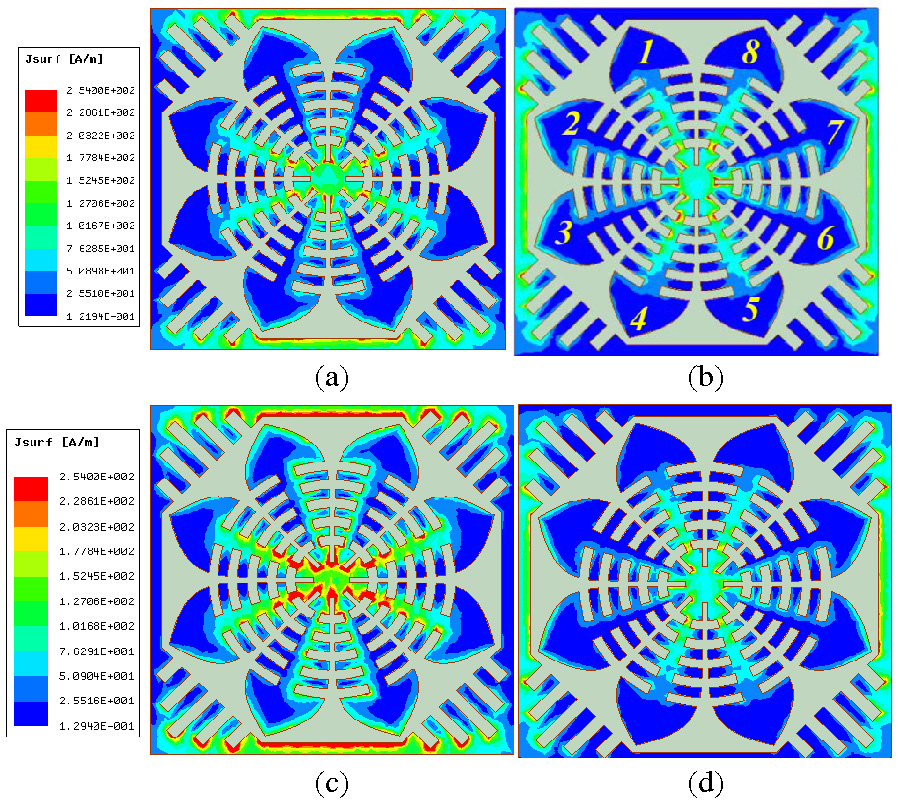
An eight-element multiple-input-multiple-output antenna system which consists of H-shaped slot antennas is presented around the handset frame for 5G applications. Each antenna element consists of a H-shaped radiating surface and an L-shaped microstrip feeder. In the frequency bands of 3.4-3.6 GHz and 4.7-5.1 GHz, the isolation is lower than -15 dB by introducing the ladder-shaped defect ground structure. The antenna efficiency is 50%-81%, and the envelope correlation coefficient is lower than 0.02 among antenna elements. The measurement results agree well with the simulation ones, indicating that the proposed antenna can satisfy the requirements of 5G communication.
EIGHT-ELEMENT WITH H-SHAPED SLOT MIMO ANTENNA FOR 5G APPLICATIONS
2020-02-03
PIER M
Vol. 89, 171-177
Wide Bandwidth High Gain Circularly Polarized Millimetre-Wave Rectangular Dielectric Resonator Antenna
Abdulmajid A. Abdulmajid , Salam Khamas and Shiyu Zhang
A wideband high gain circularly polarized (CP) rectangular dielectric resonator antenna (RDRA) having a frequency range of 21 to 31 GHz is proposed. The RDRA consists of two layers with different dielectric permittivities and has been excited using a cross slot aperture. The proposed antenna offers wide impedance and CP bandwidths of ~36.5% and 13.75% respectively, in conjunction with a high gain of ~12.5 dBi. Close agreement has been achieved between simulated and measured results.
WIDE BANDWIDTH HIGH GAIN CIRCULARLY POLARIZED MILLIMETRE-WAVE RECTANGULAR DIELECTRIC RESONATOR ANTENNA
2020-02-03
PIER M
Vol. 89, 161-169
An ADE-TLM Modeling of Biological Tissues with Cole-Cole Dispersion Model
Mohammed Kanjaa , Khalid Mounirh , Soufiane El Adraoui , Otman El Mrabet and Mohsine Khalladi
In this paper, an auxiliary differential equation (ADE) transmission line method (TLM) is proposed for broadband modeling of electromagnetic (EM) wave propagation in biological tissues with the Cole-Cole dispersion Model. The fractional derivative problem is surmounted by assuming a linear behavior of the polarization current when the time discretization is short enough. The polarization current density is approached using Lagrange extrapolation polynomial, and the fractional derivation is obtained according to Riemann definition of a fractional α-order derivative. Reflection coefficients at an air/muscle and air/fat tissues interfaces simulated in a 1-D domain are found in good agreement with those obtained from the analytic model over a broad frequency range, demonstrating the validity of the proposed approach.
AN ADE-TLM MODELING OF BIOLOGICAL TISSUES WITH COLE-COLE DISPERSION MODEL
2020-02-03
PIER M
Vol. 89, 151-159
Non-Stationary Statistics with Amplitude Probability Density Function for Exposure and Energy Density Reporting Near a Mobile Phone Running 4G Applications
Simona Miclaus and Paul Bechet
Present contribution introduces, for the first time, the description of human exposure dynamics to mobile phone radiation by implementing the use of in-air integrated energy density (IED) evolution in time. Using the amplitude probability density (APD) function capability of a real-time spectrum analyzer, we demonstrate the differences in exposure due to five different mobile applications running in Long Term Evolution (LTE) standard, based on energy deposited in air: voice call; voice over LTE (VoLTE); video call, file download and live streaming. This exposimetric method will be of great interest also for the new 5G communication standard. The superiority of the approach has three branches: a) integrated APD allows a sample rate of the order of 0.6 x 10⁸/s which is equivalent to an extremely agile tracing of the power level change in LTE communication standard (happening at every 6.67 μs); b) momentary and mean IED accumulation rate can be computed, and minute differences between mobile applications may be observed during their running time; c) the superficial tissue temperature increase may be rapidly estimated after the period of use of one specific wireless application in the GHz frequency range. The method implemented here also provides the means for rapid usage profile expectancy assessment of a mobile phone user.
NON-STATIONARY STATISTICS WITH AMPLITUDE PROBABILITY DENSITY FUNCTION FOR EXPOSURE AND ENERGY DENSITY REPORTING NEAR A MOBILE PHONE RUNNING 4G APPLICATIONS
2020-02-03
PIER Letters
Vol. 89, 141-149
Design of a Compact 5.7-5.9 GHz Filter Based on CRLH Resonator Units
Shanwen Hu , Yiting Gao , Xinlei Zhang and Bo Zhou
A compact substrate integrated waveguide (SIW) filter based on composite right/left-handed (CRLH) resonator units is implemented in this paper. The filter is composed of two CRLH resonator units serially connected by a SIW transmission line unit. The structure of the filter and equivalent circuit transmission behavior are analyzed, and a novel design method by optimizing the length and width of the interdigital metal slots to decrease the filter operation frequency is proposed. To further demonstrate the design theory and performance of the proposed filter, the filter was designed and fabricated on an RT6010 dielectric material. The measurement results show that the proposed filter works at a center frequency of 5.8 GHz with 200 MHz bandwidth. The insertion loss is 2.3 dB, and the filter size is only 10 mm × 7.4 mm.
DESIGN OF A COMPACT 5.7-5.9 GHZ FILTER BASED ON CRLH RESONATOR UNITS
2020-02-02
PIER M
Vol. 89, 141-149
T-Shaped I/O Feed Based Differential Bandpass Filter with Symmetrical Transmission Zeros and High Common Mode Rejection Ratio
Rida Gadhafi , Dan Cracan , Ademola Akeem Mustapha and Mihai Sanduleanu
A T-shaped feed based differential microstrip bandpass filter (BPF) with high common-mode (CM) rejection ratio is presented. The filter comprises two magnetically coupled conventional square open-loop resonators (SOLR), with capacitive coupled T-shaped input-output (I/O). The choice of the T-shaped I/O coupling feed enables a higher common-mode suppression of -57 dB at f0d that extends up to 4.1f0d with a value better than -30 dB. Frequency f0d is the cutoff frequency of the differential-mode (DM) passband. Moreover, this feed can symmetrically position two transmission zeros (TZs) at the upper and lower stopbands. This yields a highly selective and compact filter. Additionally, a T-shaped feed only excites the odd mode of the filter resulting in a wide stopband with high out of band rejection. The upper and stopband rejection of the filter is better than -50 dB. To demonstrate the design, DM and CM lumped models of the filter are proposed and studied. The filter operates at 1.263 GHz with a fractional bandwidth (FBW) of 3.9%. The design is validated experimentally by characterizing DM, CM, common-mode to differential-mode (CD), and differential-mode to common mode (DC). Moreover, the group delay (GD) response of the filter is measured, and a significantly flat response is observed with a maximum delay variation of only 0.88 ns in the 3 dB bandwidth.
T-SHAPED I/O FEED BASED DIFFERENTIAL BANDPASS FILTER WITH SYMMETRICAL TRANSMISSION ZEROS AND HIGH COMMON MODE REJECTION RATIO
2020-02-02
PIER B
Vol. 86, 77-102
Assessment of Scattering of Plane Waves on Optically Illuminated Area of Rough Surface
Hanaa Helmy Qamar , Asmaa Elsayed Farahat , Khalid Fawzy Ahmed Hussein and Mohamed Bakry El Mashade
In this paper, a new robust computational method that applies the geometrical theory of diffraction (GTD) in conjunction with the ray tracing (RT) technique is developed to evaluate the electromagnetic scattering pattern due to a plane wave incident on a rough surface of quite arbitrary statistical parameters. The Fresnel reflection model is applied under the assumption of arbitrary electrical and optical properties of the rough surface material to obtain the scattering patterns for both the power reflected to the upper half-space and the power transmitted into the medium covered by the rough surface. Also, the polarization of the plane wave primarily incident on the rough surface is taken into consideration. The algorithm developed in the present work accounts for multiple bounces of an incident ray and, hence, it can be considered arbitrary higher-order GTD-RT technique. The accuracy of the obtained results is verified through the comparison with the experimental measurements of the scattering pattern of a light beam incident on rough sheets with specific statistical properties. Also, some of the obtained results are compared to other published results using the geometrical optics (GO) and the second-order Kirchhoff's approximation. The numerical results of the present work are concerned with investigating the dependence of the scattering pattern on the surface roughness, refractive index, angle of incidence, and the resolution of the geometric model of the rough surface. Also, it is shown that, for limited resolution of the rough surface model, the accuracy of the calculated scattered field depends on the angle of incidence of the primary beam and the surface roughness.
ASSESSMENT OF SCATTERING OF PLANE WAVES ON OPTICALLY ILLUMINATED AREA OF ROUGH SURFACE
2020-02-01
PIER Letters
Vol. 90, 1-5
Compact Microstrip Lowpass Filter with Ultra-Wide Stopband Characteristic Using Square Ring Loaded Resonators
Zhiqiang Li and Sung-Jin Ho
A novel compact microstrip lowpass filter with ultra-wide stopband characteristic using square ring loaded resonators is proposed. A microstrip high impedance main transmission line loaded with five square ring loaded resonators is adopted in the design of the filter. Owing to the adoption of the square ring structure, the filter achieves compact size and ultra-wide stopband. A demonstration filter with 3 dB cutoff frequency at 0.72 GHz has been designed, fabricated and measured. Results indicate that the proposed filter is able to suppress the 19th harmonic response referred to a suppression degree of 15 dB, together with a small size of 0.054λg×0.070λg, where λg is the guided wavelength at 0.72 GHz.
COMPACT MICROSTRIP LOWPASS FILTER WITH ULTRA-WIDE STOPBAND CHARACTERISTIC USING SQUARE RING LOADED RESONATORS
2020-02-01
PIER M
Vol. 89, 131-139
Singular Points Meshing Direct Method for Computing the Chaff Radar Cross Section
Chuan Yin , Pengquan Zhang and Zhonghai Zhang
An applicable and convenient method is critical for calculating the RCS (Radar Cross Sections) of chaff clouds. An improved method based on direct method [18] is proposed in this paper to promote efficiency, which is called SPMDM (Singular Points Meshing Direct Method). The tanh-sinh method is applied in SPMDM to compute the complex singular function in which the integral domain is meshed by the singular points. The practicability and accuracy of the SPMDM are confirmed through comparison with direct method. Results indicate that the SPMDM can significantly decrease calculation time and increase computing efficiency, especially in large-scale case or small relative error region.
SINGULAR POINTS MESHING DIRECT METHOD FOR COMPUTING THE CHAFF RADAR CROSS SECTION
2020-01-31
PIER M
Vol. 89, 121-130
Reflectometry on Asymmetric Transmission Line Systems
Mashad Uddin Saleh , Joel B. Harley , Naveen Kumar Tumkur Jayakumar , Samuel Kingston , Evan Benoit , Michael A. Scarpulla and Cynthia Furse
Time domain reflectometry is frequently used to localize faults in electrical systems. Most existing literature on reflectometry in transmission lines considers symmetric faults that are either shorts between the two conductors or open circuits where both conductors are disconnected at the same location. This paper investigates spread spectrum time domain reflectometry (SSTDR) applied to asymmetric twin-lead transmission lines in which either only one conductor is disconnected or the reflectometry instrument itself is asymmetric. For asymmetric faults, we observe not only the expected dominant reflection corresponding to the location of the disconnection, but also an additional reflection from the end of the transmission line. In the second case, we leverage the asymmetric response of the SSTDR instrument to identify which of the two otherwise identical conductors has been disconnected.
REFLECTOMETRY ON ASYMMETRIC TRANSMISSION LINE SYSTEMS
2020-01-31
PIER M
Vol. 89, 111-120
Pattern Diversity MIMO 4G and 5G Wideband Circularly Polarized Antenna with Integrated LTE Band for Mobile Handset
Prashant Chaudhary , Ashwani Kumar and Avanish Yadav
The present work describes a unique planar wideband circularly polarized MIMO antenna for 4G and sub-6 5G band (1.35-2.6 GHz), with pattern diversity over the entire axial-ratio bandwidth. The design consists of two tri-branch planar inverted-F antenna (PIFA) antennas with a ground T-stub between the antennas, which is used to realize circular polarization and high isolation. The third antenna is an integrated sub-6 5G (4.45-4.7 GHz) and LTE band (786.7-807.7 MHz) antenna, which is folded above the ground and placed vertically around the side. It also provides circular polarization at LTE band. The 3 dB axial ratio bandwidth (ARBW) of the MIMO antenna is 1.05 GHz (1.47-2.52 GHz); impedance matching bandwidth (IMBW) is 1.25 GHz (1.35-2.6 GHz); and its isolation is better than 13.4 dB in the whole band. It has fabricated on an FR-4 substrate and is suitable for mobile handset.
PATTERN DIVERSITY MIMO 4G AND 5G WIDEBAND CIRCULARLY POLARIZED ANTENNA WITH INTEGRATED LTE BAND FOR MOBILE HANDSET
2020-01-31
PIER M
Vol. 89, 101-109
A Novel Wideband Microstrip Patch Antenna with Non-Uniform Feed Based on Model Predictive
Maryam Farahani and Sajad Mohammad-Ali-Nezhad
A novel wideband microstrip patch antenna with nonuniform transmission line feed is presented using model predictive control. Nonlinear model predictive control (NMPC) is used to achieve a nonuniform transmission line that matches with the microstrip patch antenna. The transmission line is extended using cosine expansion with the impedance differential equation then being used as the dynamic NMPC equation to find the unknown coefficients of that cosine expansion. The transmission line is designed such that the impedance of the input port matches the impedance of the microstrip antenna at the resonance frequency and its adjacent frequencies. The proposed antenna's impedance is 5.15-5.85 GHz. In this bandwidth, the radiation pattern is stable; the cross polarization and back lobe are -30 dB and -20 dB respectively. The error in the impedance bandwidth is about 4.2%. The simulation and measurement results are considered satisfactory.
A NOVEL WIDEBAND MICROSTRIP PATCH ANTENNA WITH NON-UNIFORM FEED BASED ON MODEL PREDICTIVE
2020-01-31
PIER B
Vol. 86, 59-76
Modal Analysis Based on an Integral Equation Method for Characterizing Wireless Channels in a Fully-Enclosed Environment
Xin Wang , Han Cheng , Xuemei Cao , Chen Chen and Mingyu Lu
Wireless communication and/or wireless power transmission are highly desired in some of the practical environments fully enclosed by conducting walls. In this paper, a semi-analytical modal analysis is conducted for the purpose of characterizing wireless channels in a fully-enclosed space. The modal analysis is based upon an integral equation method. The cavity Green's function in the spectral domain (that is, expressed in term of cavity modes) is employed in the integral equation. The analysis results indicate that, when a transmitter and a receiver are symmetric to each other with respect to a certain cavity mode, the load of the receiver could be coupled to the transmitter with little dispersion, leading to excellent wireless channels with the potential of accomplishing efficient wireless communication and/or wireless power transmission. A cubic cavity with a side length of 1 meter is analyzed as a specific example, and the modal analysis results are verified by experiments. Measurement data agree with the theoretical analysis very well. As predicted by the theoretical analysis, excellent wireless channels associated with the TM220 mode (with a bandwidth of 40 MHz), TM310 mode (with a bandwidth of 10 MHz), and TM311 mode (with a bandwidth of 20 MHz) are demonstrated inside a cubic box with side length of 1 meter.
MODAL ANALYSIS BASED ON AN INTEGRAL EQUATION METHOD FOR CHARACTERIZING WIRELESS CHANNELS IN A FULLY-ENCLOSED ENVIRONMENT
2020-01-30
PIER C
Vol. 99, 123-132
A Novel Patch Array Antenna with Wideband and Dual Sense Circular Polarization Characteristics for WiMAX & WLAN Applications
Yaqiang Zheng , Min Gao and Xiaohu Zhao
A wideband patch array antenna with dual sense circular polarization (CP) is investigated in this paper. Four rotated hexagonal patches are sequentially distributed on the upper surface of substrate 1 to form a patch array. In order to widen impedance bandwidth, an annular feeding network with four rectangular branches is designed. At the bottom of the antenna, two orthogonally placed microstrip baluns are introduced to obtain the characteristics of left-hand circular polarization (LHCP) and right-hand circular polarization (RHCP). Meanwhile, four coaxial probes, passing through substrate 2 and substrate 3, are used to transmit the feeding signal between microstrip balun and the annual feeding network. The proposed patch array antenna is fabricated for verifying the feature of wideband and dual circular polarizations. The measured results show that the antenna has an impedance bandwidths of 70.2% (1.72-3.58 GHz) with an axial ratio (AR) bandwidth of 61% (1.85-3.48 GHz) and over 6.2 dBi gain at two ports. Moreover, the measured port isolation remains below -15 dB over the entire impedance bandwidth, and the measured radiation patterns with excellent directionality and symmetry at two ports indicate that the proposed antenna can be used for wireless applications.
A NOVEL PATCH ARRAY ANTENNA WITH WIDEBAND AND DUAL SENSE CIRCULAR POLARIZATION CHARACTERISTICS FOR WIMAX & WLAN APPLICATIONS
2020-01-30
PIER C
Vol. 99, 111-122
Truncated Circular Microstrip Ultra Wideband Antenna Exhibiting Wideband Circular Polarization
Kollannore Ukru Sam and Parambil Abdulla
Circular polarization is manifested by means of truncations on basic circular radiating patch with precisely designed asymmetric feed. The proposed truncated circular microstrip antenna (TCMA) yields impedance bandwidth (IBW) of 7.6 GHz, almost covering the FCC approved ultra wideband (UWB) frequency and 3-dB axial ratio bandwidth (ARBW) of 5.05 GHz spreading over two bands, enabling the antenna to be used for multiple applications in ultra wideband frequency range. A peak gain of 5.73 dBi is documented at 5 GHz which is within the circular polarization (CP) band. This single feed antenna is very simple to design and compact in size.
TRUNCATED CIRCULAR MICROSTRIP ULTRA WIDEBAND ANTENNA EXHIBITING WIDEBAND CIRCULAR POLARIZATION
2020-01-30
PIER C
Vol. 99, 99-110
Early Brain Stroke Detection Using Flexible Monopole Antenna
Md. Ashikur Rahman , Md. Foisal Hossain , Manjurul Ahsan Riheen and Praveen Kumar Sekhar
In this paper, an inkjet printed slotted disc monopole antenna is designed, printed and analyzed at 2.45 GHz ISM band on a polyethylene terephthalate (PET) substrate for early detection of brain stroke. PET is used as a substrate due to its low loss tangent, flexible, and moisture-resistant properties. By the implementation of slotting method, the size of this antenna is reduced to 40×38 mm2. The printed antenna exhibits 480 MHz (19.55%) bandwidth ranging from 2.25 GHz to 2.73 GHz frequency. It shows a radiation efficiency of 99% with a realized gain of 2.78 dB at 2.45 GHz frequency. The Monostatic Radar (MR) approach is considered to detect brain stroke by analyzing the variations in reflected signals from the head model with and without stroke. The maximum specific absorption rate (SAR) distribution at 2.45 GHz frequency is calculated. The compact size and flexible properties make this monopole antenna suitable for early detection of brain stroke.
EARLY BRAIN STROKE DETECTION USING FLEXIBLE MONOPOLE ANTENNA