Search Results(13790)

2020-01-14
PIER M
Vol. 88, 133-144
Time-Domain Analysis of Overhead Line in Presence of Stratified Earth
Ayoub Lahmidi and Abderrahman Maaouni
The presence of the ground affects the propagation on overhead lines through a magnetically induced earth return current. Numerous researches have been conducted to study this influence by considering a homogeneous earth. In the current paper, the transient response of Multi-conductor transmission Lines (MTL) considering a lossy stratified earth is presented. Based on the finite difference time-domain (FDTD) and an improvement of the convolution integral arising from time-domain modeling of frequency-dependent conductors' parameters through the Vector Fitting (VF) algorithm, a novel numerical procedure for solution of a system of telegraph equations is presented. Many simulations are introduced to highlight the effect of soil stratification on the response of the line for a given excitation. The efficiency of an equivalent model, using an equivalent single-conductor, of a multiple conductor system is also established in this work.
TIME-DOMAIN ANALYSIS OF OVERHEAD LINE IN PRESENCE OF STRATIFIED EARTH
2020-01-13
PIER M
Vol. 88, 121-131
An Iterative Threshold Algorithm Based on Log-Sum Norm Regularization for Magnetic Resonance Image Recovery
Linyu Wang , Ming Qi He , Jianhong Xiang and Peng Fei Ye
This paper considers the class of Iterative Shrinkage Threshold Algorithm (ISTA) to solve the linear inverse problem that occurs in magnetic resonance (MR) image recovery. The ISTA algorithm adheres to the principle of minimizing the L1 norm. This method can be considered as an extension of the classical gradient algorithm. However, it is known that the ISTA algorithm converges slowly, and the accuracy of the algorithm is not sufficient. In many MR image recovery problems, using non-convex log-sum norm minimization can often obtain better results than the l1-norm minimization. In this paper, we firstly transform the MR image recovery into a non-convex optimization problem with log-sum norm regularization and combine it with a faster global convergence method. Then a Log-sum generalized iterated shrinkage threshold algorithm (LISTA) for solving the MR image recovery problem is proposed. Finally, numerical experiments are conducted to show the superiority of our algorithm.
AN ITERATIVE THRESHOLD ALGORITHM BASED ON LOG-SUM NORM REGULARIZATION FOR MAGNETIC RESONANCE IMAGE RECOVERY
2020-01-12
PIER Letters
Vol. 89, 37-44
Research on Eccentric Magnetic Harmonic Gear with Halbach Array
Libing Jing and Jun Gong
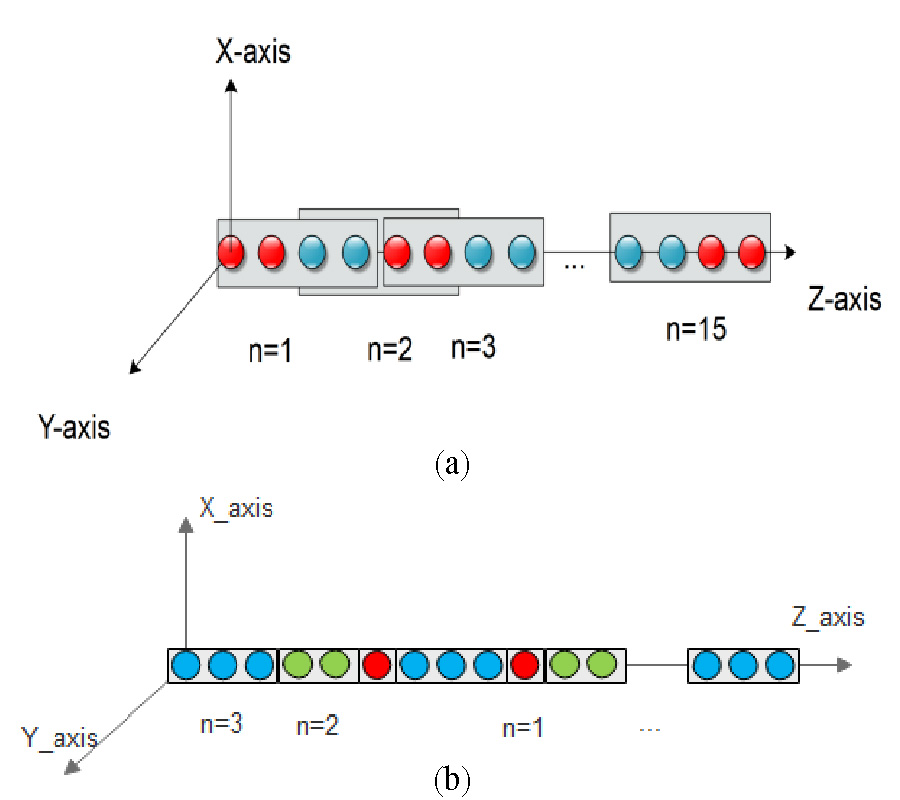
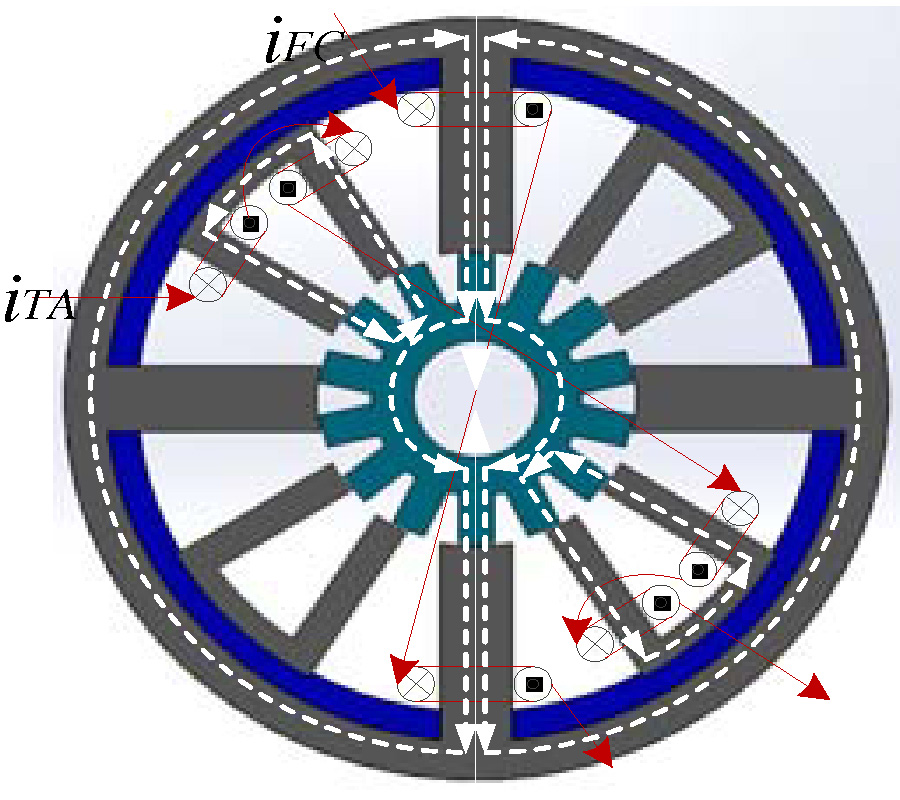
An eccentric harmonic magnetic gear (EHMG) with Halbach array is proposed in this paper. According to the theory of magnetic field modulation and one-side effect, the permanent magnets (PMs) on the inner rotor and outer stator are arranged in a Halbach array. The PMs of inner rotor are divided into three segments per pole, and the PMs on the outer stator are divided into two segments per pole. The proposed EHMG with 15 pole pairs on inner rotor PMs and 16 pole pairs on outer stator PMs is established. The finite element analysis (FEA) is used for simulating the proposed model. The corresponding magnetic field and static torque of the EHMG are calculated. Compared with the conventional EHMG, the results show that the torque density of the proposed EHMG is substantially improved.
RESEARCH ON ECCENTRIC MAGNETIC HARMONIC GEAR WITH HALBACH ARRAY
2020-01-10
PIER C
Vol. 98, 239-255
Design and Analysis of Millimeter Wave Dielectric Resonator Antenna for 5G Wireless Communication Systems
Muhammad Anab , Muhammad Irfan Khattak , Syed Muhammad Owais , Abbas Ali Khattak and Asif Sultan
Today, worldwide more than five billion of wireless devices are directly communicating for voice and data transmission. The amount of data utilization has increased remarkably and here comes 5G technology with more prominent features, offering high data rate, low latency rate, efficient EM spectrum utilization, an immense machine-2-machine communication, etc. The efficient implementation of 5G technologies requires efficient and compact antennas. This work presents a novel multiband rectangular dielectric resonator antenna for future 5G wireless communication system, having stacked radiator with semi-circular slots etched on the left and right sides of an upper radiator. Additionally, a semi-elliptical slots rectangular microstrip patch antenna of the same dimensions for the purpose of comparison is designed. 28 and 38 GHz, which are the proposed 5G bands by most researchers, are the core target of this work. Alumina with a high relative permittivity of 9.8 is used as a radiator in the design of DRA, while common in the design of both proposed antennas, Rogers RT/DUROID 5880 with a relative permittivity of 2.2 having standard thickness is used as substrate material. Both the proposed antennas have an overall same size of 13 x 11.25 mm2. The proposed dielectric antenna resonates at 25.4, 34.6, and 38 GHz with a 7.34, 4.04 and 3.30 GHz of wide impedance bandwidth covering the targeted 5G, 28 and 38 GHz bands, having a good return loss of -34.7, -31.8 and -33.5 dB, respectively. Further, the proposed dielectric antenna has a maximum radiation efficiency of 97.63%, with overall radiation efficiency greater than 90%, and maximum gain of 7.6 dBi is also noted. On the other hand, the proposed microstrip antenna resonates at 28 and 38 GHz with a 1.49 and 1.01 GHz of moderate impedance bandwidth, having -23.6 and -27.1 dB of satisfactory return loss. Further, the proposed patch antenna has a maximum radiation efficiency of 90.33% at 28 GHz, with overall radiation efficiency of greater than 84%, and moderate gain of 5.45 dBi is also noted. Both the proposed antennas have a nearly omnidirectional radiation pattern at resonance frequencies, with VSWR less than 2. Comparative study of the two proposed antennas regarding radiation efficiency, return loss, gain, data rate and impedance bandwidth evidently shows that performance of DRA over MPA at millimeter wave is very good. The proposed antennasare simulated in CST Microwave studio v18.
DESIGN AND ANALYSIS OF MILLIMETER WAVE DIELECTRIC RESONATOR ANTENNA FOR 5G WIRELESS COMMUNICATION SYSTEMS
2020-01-10
PIER M
Vol. 88, 111-119
Modelling of Electric Field Strength Amplification at the Tips of Thin Conductive Rods Arrays
Marina Rezinkina
Degree of the electric field (EF) amplification at the tips of thin and long conductive rods array has been calculated. It is shown that such amplification depends on the rods height (H) and radius (R), as well as on distance between separate rods in the array. For simulation, an approach to numerical calculation of the EF near conductive rods with a large ratio of height to radius: H/R>102-104 has been proposed. Rods with such parameters may represent carbon nanotubes, channels of breakdowns in insulation, lightning leader channels, lightning rods, etc. The proposed approach is based on the finite integration technique. It uses also the analytical law of decrease of the EF strength and potential of a conductive ellipsoid under potential in the directions perpendicular to the ellipsoid axis and above its tip. As a result, numerical calculations of the EF distribution in systems with such rods were carried out applying calculation grids with steps proportional to the rods length, not their diameters. It permits substantial decrease of the required computational resources such as memory and time.
MODELLING OF ELECTRIC FIELD STRENGTH AMPLIFICATION AT THE TIPS OF THIN CONDUCTIVE RODS ARRAYS
2020-01-09
PIER C
Vol. 98, 225-238
Wide-Narrow Switchable Bands Microstrip Antenna for Cognitive Radios
Ros Marie C. Cleetus and Gnanadhas Josemin Bala
We introduce a six-switch integrated ultra wideband (UWB) - frequency reconfigurable system for cognitive radio applications. With respect to the requirements of the cognitive radio, this proposed design incorporates a UWB section for sensing the frequency spectrum, and the same design is frequency reconfigured using switches to get narrow bands for communicating within the spectrum. The proposed design has a compact size of 40 mm x 40 mm x 1.6 mm and is printed on an FR4 substrate with relative permittivity 4.4. The first configuration of switches allows the antenna to have UWB characteristics from 3.10 to 12 GHz and beyond as per simulations and 3.13 to 12 GHz and beyond as per measurements. Configurations II to V cover the ultrawide band from 3.54 to 12 GHz through five narrow bands. Measured results match well with the simulated one. The comparative analysis of the antenna in terms of frequency reconfigurability is also included in this work which proves that the proposed design is an effective candidate for Cognitive Radio applications.
WIDE-NARROW SWITCHABLE BANDS MICROSTRIP ANTENNA FOR COGNITIVE RADIOS
2020-01-09
PIER C
Vol. 98, 213-224
Port Decoupling Vs Array Elements Decoupling for Tx/Rx System at 7-Tesla Magnetic Resonance Imaging
Ashraf Abuelhaija , Sanaa Salama and Tarik Baldawi
Symmetrically excited meandered microstrip line RF coil elements are widely utilized in multichannel approaches which have been proposed to be integrated in ultra-high field MRI system (i.e., 7T and higher). These elements have demonstrated strong magnetic field in the deep areas in the object under imaging. Designing a radio frequency (RF) coil array that employs these elements without decoupling networks might cause non-optimized driving performance of coil array which in turn result in non-clear image. In this paper, two different methods of decoupling have been studied: port decoupling and array elements decoupling. For port decoupling, the coil elements have been designed at Larmor frequency (297.3 MHz) whereas for array elements decoupling, the coil elements have been designed at higher frequencies but matched at Larmor frequency. Port decoupling does not always mean element decoupling. Conventional decoupling methods, such as single capacitor or inductor, face challenges to realize the coil element decoupling for meandered microstrip arrays. An optimized reactive (T-shaped) network is needed in order to achieve element decoupling which in turn prevents distortion of the EM field. All simulation results have been obtained using the CST time domain solver (CST AG, Darmstadt, Germany).
PORT DECOUPLING VS ARRAY ELEMENTS DECOUPLING FOR TX/RX SYSTEM AT 7-TESLA MAGNETIC RESONANCE IMAGING
2020-01-09
PIER Letters
Vol. 89, 29-36
An Ultra-Wideband Polarization Conversion Meta-Surface and Its Application in RCS Reduction
Jian Yong Yin , Hou-Jun Sun and Lei Zhang
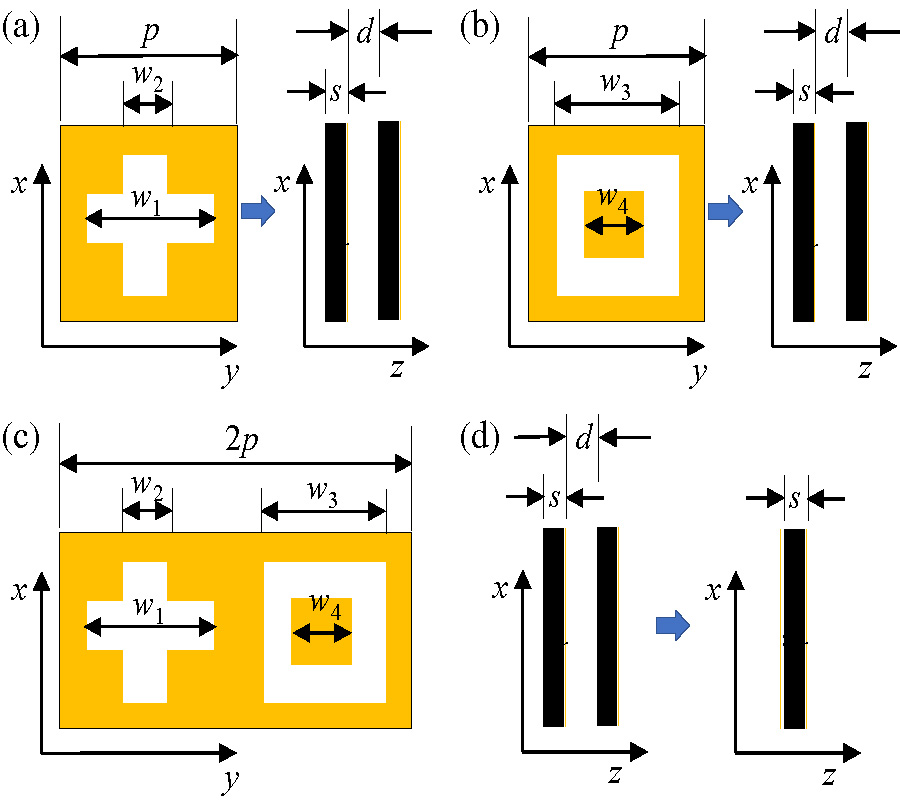
In this paper, a novel meta-surface with polarization conversion characteristic in an ultra-wide band is proposed. Based on the principle of the reflected wave cancelation, the proposed meta-surface is distributed as a checkerboard to obtain an ultra-wideband radar cross section (RCS) reduction, resulting from the out-of-phase difference in normal incidence. The relationship between the polarization conversion ratio (PCR) and RCS reduction is investigated and verified by the simulation. Finally, a sample is fabricated and measured in an anechoic chamber. Compared to the metal board with same size, a 5 dB RCS reduction is achieved ranging from 3.7 GHz to 15.9 GHz, which indicates a fractional bandwidth of 124.5%. Moreover, the size of the unit cell is only 0.125λ0×0.125λ0×0.059λ0, where λ0 is corresponding to the lowest frequency, namely 3.7 GHz, indicating the merits of miniaturization and low profile. Experiment results are in good agreement with the simulated ones, which demonstrates the validity of the proposed strategy.
AN ULTRA-WIDEBAND POLARIZATION CONVERSION META-SURFACE AND ITS APPLICATION IN RCS REDUCTION
2020-01-08
PIER Letters
Vol. 89, 21-28
Design of a Compact 4-Way Power Divider Using 1/64Th Mode Elliptically Curved SIW Resonators
Muquaddar Ali , Kamalesh Kumar Sharma and Rajendra Prasad Yadav
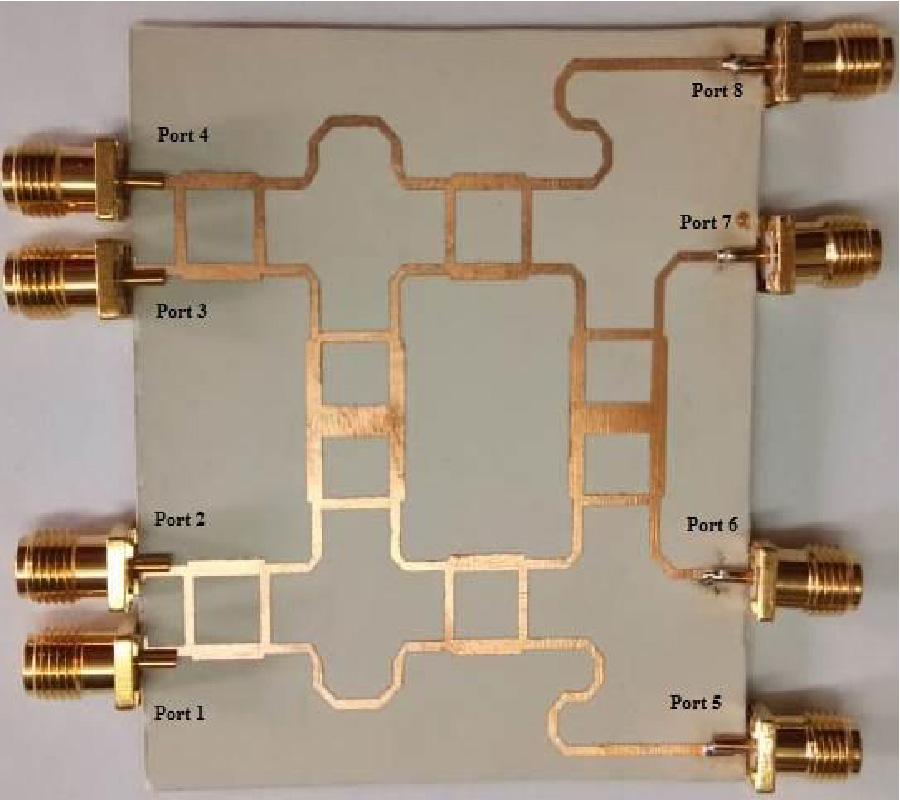
A novel compact 4-way power divider is presented here, which consists of 1/64th mode elliptically curved substrate integrated waveguide (SIW) resonators and radial transmission lines. A direct coaxial fed circular patch acting as the radial transmission line is connected with four elliptically curved 1/64th mode SIW resonators, and these resonators are then connected to output terminals. An equivalent circuit model is developed to understand its behavior. It is designed to operate at 3.6 GHz covering the frequencies assigned for 5G in sub-6 GHz band. Conventional PCB techniques are used to fabricate the prototype. The measured bandwidth is 2.2 GHz, ranging from 2.5 GHz to 4.7 GHz, for which the return loss is less than -10 dB. Also, the transmission coefficient between input and each output for the above-mentioned frequency band is -6.4±0.5 dB. It has a very compact footprint of 0.32λg2, which is at least 40% smaller than various SIW based state of the art power dividers.
DESIGN OF A COMPACT 4-WAY POWER DIVIDER USING 1/64<sup>th</sup> MODE ELLIPTICALLY CURVED SIW RESONATORS
2020-01-08
PIER Letters
Vol. 88, 143-149
Compact Four-Element MIMO Antenna System Based on Substrate-Integrated-Waveguide Cavities
Bingjian Niu and Jie-Hong Tan
A compact four-element multiple-input-and-multiple-output (MIMO) antenna system is proposed based on substrate-integrated-waveguide (SIW) cavities. By bisecting a square SIW cavity, two rectangle half-mode cavities with opened edges are formed. They are arranged side by side sharing a row of metallic vias. Then two narrow T-shaped slots are etched along symmetry planes to divide these two cavities into four quarter-mode sub-cavities. Excited by feeding ports, four antenna elements with compact size are constructed, which radiate incident wave through opened cavity edges and etched slots. Moreover, antenna isolation can be easily improved by adjusting slot length though these elements interconnect. A prototype with the cavity size of 0.22λ0 × 0.86λ0 has been fabricated. The fabricated MIMO antenna system exhibits the center frequency of 3.51 GHz, port isolation of 14 dB, envelope correlation coefficient of 0.03, peak gain of 4.9 dBi, and high efficiency of 77.4%. The compact size and effective isolation improvement make the proposed design attractive for practical applications.
COMPACT FOUR-ELEMENT MIMO ANTENNA SYSTEM BASED ON SUBSTRATE-INTEGRATED-WAVEGUIDE CAVITIES
2020-01-08
PIER M
Vol. 88, 101-110
The Diffraction by the Half-Plane with the Fractional Boundary Condition
Eldar I. Veliyev , Vasil Tabatadze , Kamil Karaçuha and Ertuğrul Karaçuha
The electromagnetic plane wave diffraction by the half-plane with fractional boundary conditions is considered in this article. The theoretical part is given based on that the near field, pointing vector and energy density distribution are calculated for different values of the fractional order. The results are compared with classical cases for marginal values of the fractional order. Interesting results are obtained for fractional orders between marginal values. Results are analyzed.
THE DIFFRACTION BY THE HALF-PLANE WITH THE FRACTIONAL BOUNDARY CONDITION
2020-01-08
PIER M
Vol. 88, 91-100
Ground Plane Effect Suppression Method to Design a Low-Profile Printed UWB Antenna
Aliakbar Dastranj and Faezeh Bahmanzadeh
This paper presents a technique to design a very small planar antenna for ultra-wideband (UWB) communication applications. To cover UWB frequency range by a small-size antenna, the ground plane influence on the antenna impedance bandwidth is suppressed at middle and higher frequencies. To accomplish this purpose, a rectangular and several stepped slots are etched on the conventional radiator. Also, a tuning stub is printed in the rectangular slot, and its length is optimized. This technique decreases current distribution on the ground plane at higher frequencies, and the impedance matching of the antenna is significantly influenced by the radiating patch. The antenna has a compact size of 25 × 25 × 1.6 mm3. It can provide a wide impedance bandwidth from 2.8 to 15.4 GHz (|S11| < -10 dB) which covers the entire UWB spectrum (3.1-10.6 GHz). Two prototypes of the antenna were fabricated and measured. The impedance matching, group delay, fidelity factor, and the antenna radiation characteristics, including co- and cross-polarized far-field patterns and realized gain were analyzed with numerical simulation and experimental measurement. Measured data are in good agreement with the simulated ones. Based on the obtained frequency- and time-domain characteristics, the designed antenna is an excellent candidate for UWB wireless devices.
GROUND PLANE EFFECT SUPPRESSION METHOD TO DESIGN A LOW-PROFILE PRINTED UWB ANTENNA
2020-01-07
PIER C
Vol. 98, 199-212
Investigation on Plasmon Induced Transparency and Its Application in an MIM Typecompound Plasmonic Waveguide
Jinping Tian and Jiejin Li
In this paper, the investigation about a metal-insulator-metal (MIM) compound plasmonic waveguide is reported, which possesses the transmission property of plasmon induced transparency (PIT) and exhibits the potential application of refractive index sensing. The waveguide structure consists of an MIM-type bus waveguide, a horizontally placed asymmetric H-type resonator (AHR), and a circular ring resonator (CRR). The AHR is directly coupled with the bus waveguide, whilethe CRR is directly coupled to the AHR, but is indirectly coupled to the bus waveguide. Due to the destructive interference between two different transmission paths, PIT effect can be observed in the transmission spectrum. The finite element method (FEM) is used to study the PIT effect in detail. The results show that the transmission characteristics can be flexibly adjusted by changing the geometric parameters of the structure, and the proposed waveguide structure has potential application prospects in the area of temperature and refractive index sensing with higher sensitivity, better figure of merit, and in the area of slow light photonic devices.
INVESTIGATION ON PLASMON INDUCED TRANSPARENCY AND ITS APPLICATION IN AN MIM TYPECOMPOUND PLASMONIC WAVEGUIDE
2020-01-07
PIER Letters
Vol. 89, 13-20
Compact Monopole UWB Antenna with Quad Notched Band Characteristics Using Quad-Mode Stepped Impedance Resonator
Xiaoxia Wang and Hai Zhang
In this communication, a new planar monopole ultra-wideband (UWB) antenna with quad notched band characteristics using quad-mode stepped impedance resonator (QMSIR) is investigated. The proposed antenna is composed of a circular-shaped radiating element, a 50 Ω microstrip feed line, a QMSIR, and a partially truncated ground plane. By coupling a QMSIR with an additional outer line beside the microstrip feedline, band-rejected filtering properties around the (5.2/5.8 GHz) WLAN bands and the (7.4/8.2 GHz) satellite communication bands are generated. The measurement of voltage standing wave ratio (VSWR) is in agreement with simulation. The results show that proposed antenna not only retains an ultra-wide bandwidth but also owns quad band-rejections capability. The UWB antenna demonstrates omnidirectional radiation patterns across nearly whole operating bandwidth that is suitable for UWB applications.
COMPACT MONOPOLE UWB ANTENNA WITH QUAD NOTCHED BAND CHARACTERISTICS USING QUAD-MODE STEPPED IMPEDANCE RESONATOR
2020-01-07
PIER M
Vol. 88, 83-89
Thermography at Millimetre Wavelengths for Security Inspection of Footwear
Stuart William Harmer , Christopher I. Johnson , Dana E. Wheeler and Hashim Bhabha
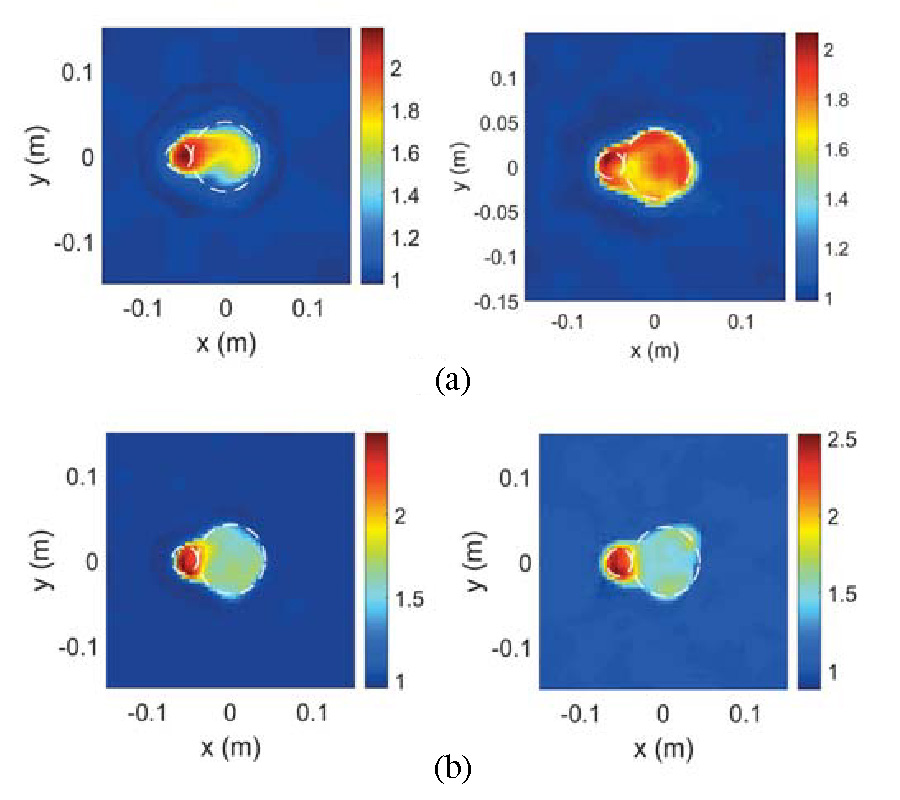
Millimetre-wave thermography is used to image through the soles of shoes as proof of principle study into the application of such an approach for security inspection. Current airport security screening practice necessitates the removal of shoes prior to x-ray screening for potential threats or other concealments, for example explosive or explosive precursor materials; narcotic substances or small weapons. The authors demonstrate that thermography at ~250 GHz is able to reveal a variety of objects concealed within the soles of typical shoes, and that such an approach might be applied to rapidly screen passengers without necessitating the removal of their footwear.
THERMOGRAPHY AT MILLIMETRE WAVELENGTHS FOR SECURITY INSPECTION OF FOOTWEAR
2020-01-06
PIER C
Vol. 98, 187-198
Stepped Slot Patch Antenna with Copper Ground Plane and Solar Cell Ground Plane for Future Mobile Communications
Thandullu Naganathan Suresh Babu and Dhandapani Sivakumar
A new structure design of a multi-band suspended stepped slot microstrip patch antenna with copper ground plane for future mobile communications is proposed and presented. A parametric study for the effect on the proposed antenna is done on a par with the integration of a polycrystalline silicon solar cell. The compact low profile proposed antenna is developed using Printed Circuit Board (PCB) technology on a substrate, FR4 with physical size of 50×50 mm2. Simulated and measured results are presented to validate the usefulness of the proposed antenna structure for Wi-Max and future mobile communications. The measured result reveals that the presented stepped slot patch antenna with copper ground plane offers impedance bandwidth of 3.94% (covering 5.46 GHz-5.68 GHz band), 3.06% (covering 7.08 GHz-7.3 GHz band), and 9.26% (covering 8.34 GHz-9.15 GHz band). The same radiating patch with solar ground plane offers impedance bandwidth of 4.58% (covering 5.12 GHz-5.36 GHz band) and 3.06% (covering 7.32 GHz-8.02 GHz band) for future mobile communications. Good VSWR and radiation pattern characteristics are obtained in the frequency band of interest.
STEPPED SLOT PATCH ANTENNA WITH COPPER GROUND PLANE AND SOLAR CELL GROUND PLANE FOR FUTURE MOBILE COMMUNICATIONS
2020-01-06
PIER M
Vol. 88, 73-82
Oversized Circular Corrugated Waveguides Operated at 42 GHz for ECRH Application
Amit Patel , Pujita Bhatt , Keyur Mahant , Alpesh D. Vala , Krishnamachari Sathyanarayan , Sanjay V. Kulkarni and Dharmesh Rathi
The design, analysis, and manufacturing of an oversized circular metallic corrugated waveguide with rectangular and square grooves for transmitting power from gyrotron to tokamak or dummy load have been carried out. To carry high power at millimeter wave with lower transmission loss, a corrugated waveguide is preferred. A corrugated waveguide with HE11 mode gives lower attenuation than a smooth circular waveguide with TE11 mode. The theory behind the depth and width selection of corrugations required to carry the linearly polarized (HE11) mode is explained in this paper. The proposed structures are designed and simulated in CST microwave studio software. Rectangular and square groove circular corrugated waveguides each having a length of 500\,mm were fabricated and tested using ZVA50 vector network analyzer. Based on the performance results, it is derived that the square groove corrugated waveguide gives lower insertion loss of 0.08 dB/meter than rectangular groove corrugated waveguide which gives insertion loss of 0.11 dB/meter.
OVERSIZED CIRCULAR CORRUGATED WAVEGUIDES OPERATED AT 42 GHZ FOR ECRH APPLICATION
2020-01-05
PIER C
Vol. 98, 171-186
Computation of the Fields and Potentials for Particle Tracing Under the Effect of Electromagnetic Forces
Christos Tsironis
In this work we describe a model for the computation of the scalar and vector potentials associated with known electric and magnetic fields, as well as for the inverse problem. The formulation is general, but the applications motivating our study are related to the requirements for advanced modeling of charged particle dynamics in plasma-driven electromagnetic environments. The dependence of the electromagnetic field and its potentials in space and time is assumed to be separable, where the spatial part is connected to established solutions of the static problem, and the temporal part is derived from a phenomenological description based on time-series of measurements. We benchmark our model in the simple problem of a finite current-carrying conductor, for which an analytical solution is feasible, and then present numerical results from simulations of a magnetospheric disturbance in geospace.
COMPUTATION OF THE FIELDS AND POTENTIALS FOR PARTICLE TRACING UNDER THE EFFECT OF ELECTROMAGNETIC FORCES
2020-01-05
PIER Letters
Vol. 89, 7-12
Ultra-Wideband Mitigation of Differential to Common Mode Conversion for Bended Differential Lines by Periodic Interdigital Structure
Hao-Ran Zhu , Fan Li and Yufa Sun
In this paper, a periodic interdigital structure for wideband mitigation of differential-to-common mode conversion at the bend discontinuity of differential lines is proposed. A hybrid inductance and capacitance compensation property is exhibited to suppress the common-mode noise of asymmetric transmission lines. An equivalent circuit model is given to explain the working principle of the presented periodic interdigital structure for differential pairs. In comparison with the traditional methods, steep and wideband suppression performances are both observed with the proposed design. Moreover, no additional area is required at the bend discontinuity for compensation. From the measured result, the differential-to-common mode conversion of the differential signals can be mitigated from DC to 10 GHz with a rejection level of -20 dB. The measurements agree well with the simulation predictions.
ULTRA-WIDEBAND MITIGATION OF DIFFERENTIAL TO COMMON MODE CONVERSION FOR BENDED DIFFERENTIAL LINES BY PERIODIC INTERDIGITAL STRUCTURE
2020-01-04
PIER Letters
Vol. 89, 1-6
Rumsey's Reaction Concept Generalized
Ismo Veikko Lindell and Ari Sihvola
The reaction concept, introduced by Rumsey in 1954, describes interaction between time-harmonic electromagnetic sources through the fields radiated by the sources. In the original form the concept was a scalar quantity defined by three-dimensional field and source vectors. In the present paper, the representation is extended to four dimensions applying differential-form formalism. It turns out that, in a coordinate-free form, the reaction concept must actually be a one-form, whose temporal component yields Rumsey's scalar reaction. The spatial one-form component corresponds to a three-dimensional Gibbsian-vector reaction which consists of electromagnetic force terms. The medium is assumed homogeneous and isotropic in this paper.