Search Results(13790)

2019-12-25
PIER C
Vol. 96, 73-85
Trident Shape Ultra-Large Band Fractal Slot EBG Antenna for Multipurpose IoT Applications
Pankaj Kumar Goswami and Garima Goswami
Wireless technology has significant improvement in features enhancement of device applications. It is highly desirable to operate multiple applications from a single device. A compact size antenna is presented for a variety of IoT based applications, such as home automation, surveillance, satellite communication, vehicle tracking, and medical instruments. This article explores an analytical solution of ultra-large band frequency characteristics of a compact size, trident shape, fractal patch antenna. The overall structure has dimension 18x12x1.6 mm3. This antenna exhibits the multi-edge radiating effects of fractal structure with the help of ground optimization technique. The design evolution consists of a performance measure of the antenna with varying characteristics of the EBG patterns with respect to fractal structure. The design is validated by fabricating the antenna on an FR4 (4.2) substrate, and the return loss & radiation characteristics are measured. The measured |S11| has the impedance bandwidth of 1.59-13.31 GHz and sustainable radiation characteristics. This miniaturized antenna is compatible with the GSM, GPS, Bluetooth, Wi-Fi, WLAN, Wi-MAX, ISM, and other UWB spectrums. The gain of the antenna is 2.52 dBi for the complete operating range. Therefore, the proposed antenna is highly compatible with various wireless devices associated with IoT applications.
TRIDENT SHAPE ULTRA-LARGE BAND FRACTAL SLOT EBG ANTENNA FOR MULTIPURPOSE IOT APPLICATIONS
2019-12-25
PIER C
Vol. 96, 59-71
Design of Dual-Mode Band-Pass Filter with Novel Perturbation Elements
Yong Cheng , Chengjun Mei and Lei Zhu
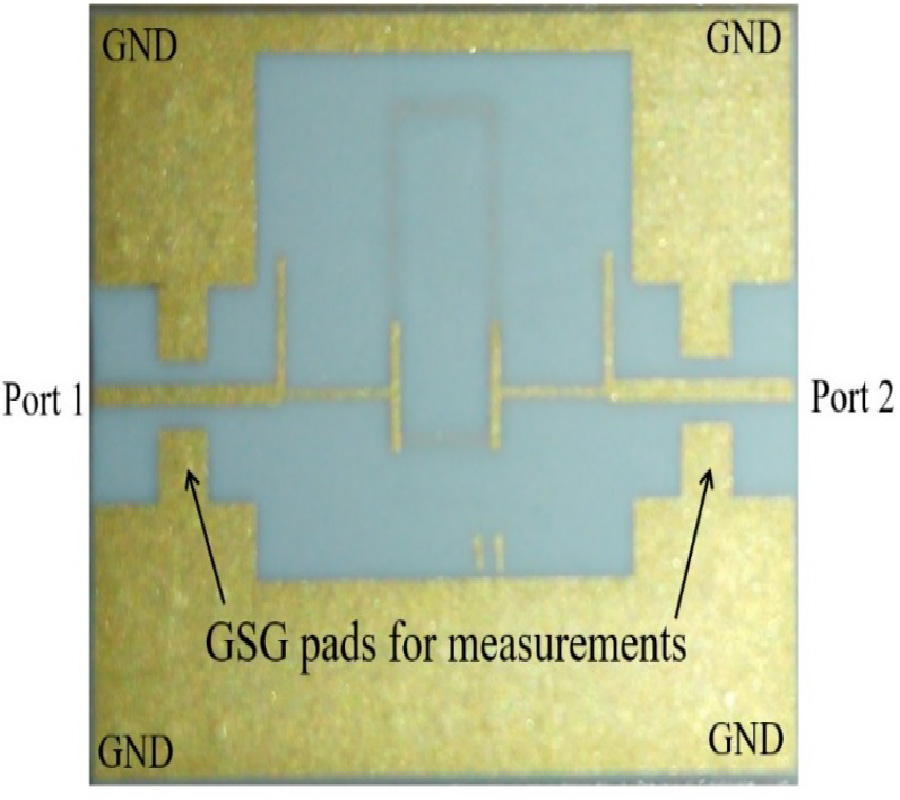
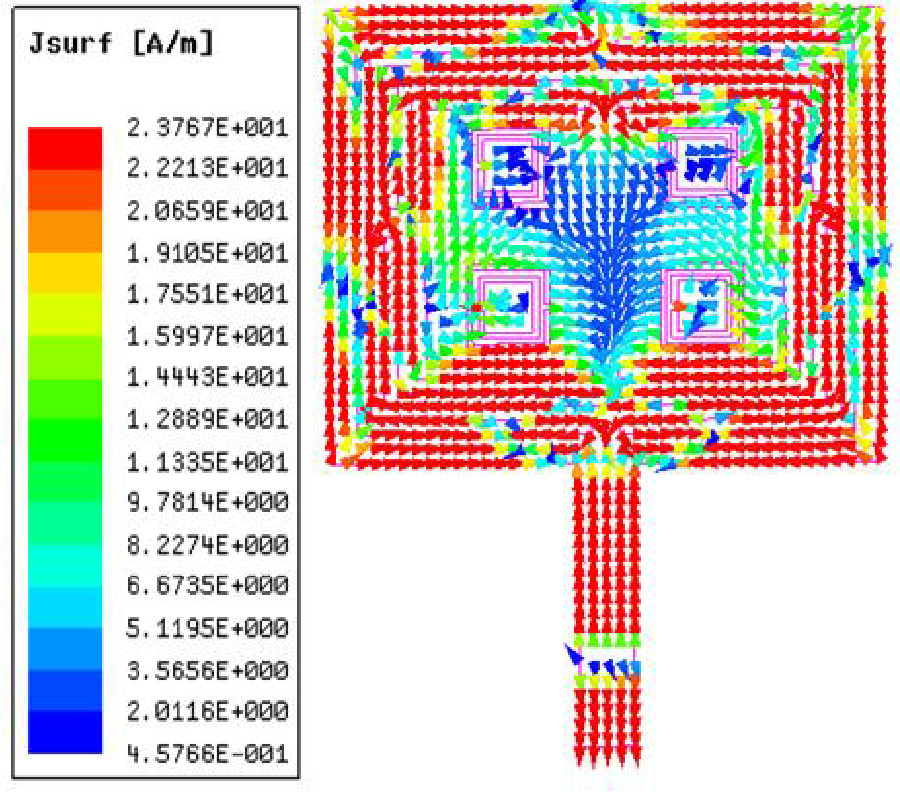
A compact square patch band-pass filter is proposed in this paper. The dual-mode filter is designed based on a square patch resonator with a complementary split ring resonator (CSRR) split to be used as a perturbation element. The CSRR split is properly embedded in the square patch resonator to perturb electric current distribution on this patch and thus to simultaneously excite a pair of degenerate modes. Using the proposed CSRR elements, the band-pass filter is designed with miniaturized size, and two transmission zeros in stopbands are achieved to improve the selectivity of the filter. The influence of the CSRR elements on the band-pass filter is analyzed in detail. The proposed dual-mode filter is then fabricated and measured. Good agreement over a wide frequency range is achieved between the simulated and measured results. Moreover, in order to further investigate the characteristic of the dual-mode patch filters with CSRR perturbation, a dual-mode filter with a rectangular ring slot is presented for comparative study.
DESIGN OF DUAL-MODE BAND-PASS FILTER WITH NOVEL PERTURBATION ELEMENTS
2019-12-23
PIER C
Vol. 98, 69-81
Mask-Constrained Power Synthesis of Large and Arbitrary Arraysas a Few-Samples Global Optimization
Giada Maria Battaglia , Andrea Francesco Morabito , Gino Sorbello and Tommaso Isernia
With reference to the mask-constrained power synthesis of shaped beams through fixed-geometry antenna arrays, we elaborate a recently proposed approach and introduce an innovative effective technique. In particular, the proposed formulation, which can take into account mutual coupling and mounting platform effects, relieson a nested optimization where the external global optimization acts on the field's phase shifts over a minimal number of `control points' located into the target region whereas the internal optimization acts instead on excitations. As the internal optimization of the ripple is shown to result in a Convex Programming problem and the external optimization deals with a reduced number of unknowns, a full control of the shaped beam's ripple and sidelobe level is achieved even in the case of arrays having a large size and aimed at generating large-footprint patterns. Examples involving comparisons with benchmark approaches as well as full-wave simulated realistic antennas are provided.
MASK-CONSTRAINED POWER SYNTHESIS OF LARGE AND ARBITRARY ARRAYSAS A FEW-SAMPLES GLOBAL OPTIMIZATION
2019-12-23
PIER M
Vol. 87, 199-207
Embeddable Miniature UHF RFID Near-Field Antenna for Healthcare Applications
Prabakar Parthiban
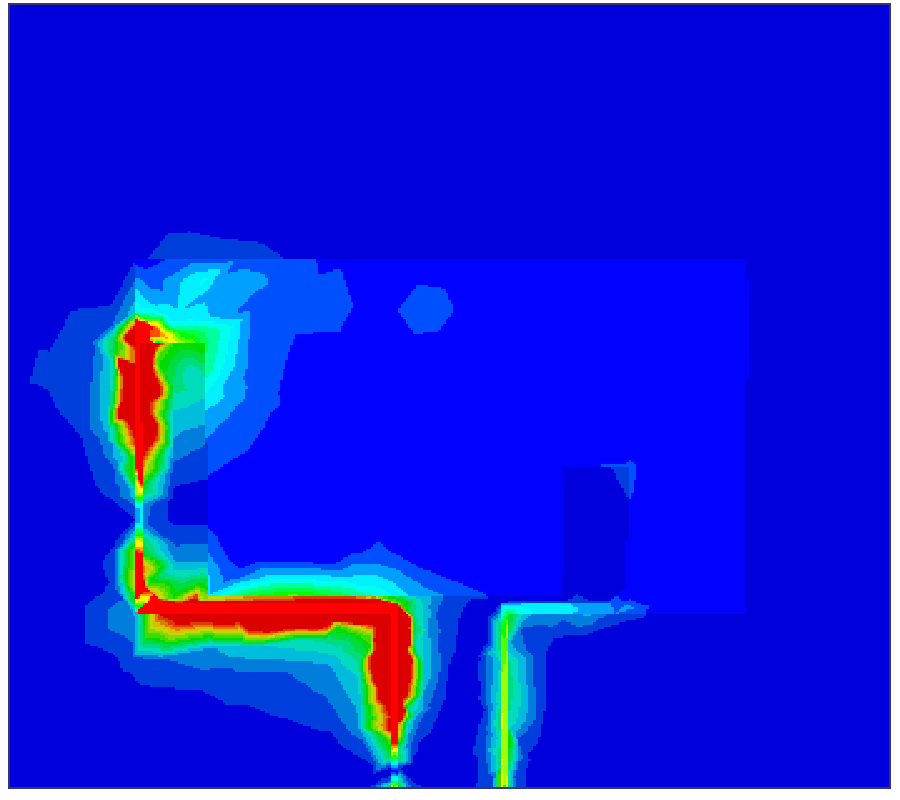
A novel embeddable miniature near-field reader antenna is designed for Ultra-High Frequency (UHF) Radiofrequency Identification (RFID) applications in the healthcare sector. The antenna spans 45 mm (length) x 20 mm (width) x 1.6 mm (thick) in size. The antenna is tuned for UHF RFID region-2 frequencies, 902 to 928 MHz. The antenna's -15 dB return loss bandwidth is 140 MHz. The antenna has very low far-field gain, and thus false reads of undesired tags are eliminated. The antenna can read both near-fields, and far-field tags as its magnetic field distribution on its surface are uniform with no dead zones. This miniature, light weight antenna is easy to embed and suitable for niche applications like surgical instrument tracking, dental instrument inventory, etc. The antenna's immunity towards proximity metal assets makes it more suitable for healthcare applications.
EMBEDDABLE MINIATURE UHF RFID NEAR-FIELD ANTENNA FOR HEALTHCARE APPLICATIONS
2019-12-23
PIER
Vol. 166, 119-145
Modulation on Silicon for Datacom: Past, Present, and Future (Invited Review)
Binhao Wang , Qiangsheng Huang , Kaixuan Chen , Jianhao Zhang , Geza Kurczveil , Di Liang , Samuel Palermo , Michael R. T. Tan , Raymond G. Beausoleil and Sailing He
Datacenters become an important part of technical infrastructure. The Datacom traffic grows exponentially to satisfy the demands in IT services, storage, communications, and networking to the growing number of networked devices and users. High bandwidth and energy efficient optical interconnects are critical to improve overall productivity and efficiency in data centers. Mega-data centers are expected to address the power consumption and the cost in which optical interconnects contribute quite a large part. Silicon photonics is a promising platform to offer savings in power and potential increase in bandwidth for Datacom. Several modulation techniques are developed in silicon photonics to reduce the optical mode volume or enhance the light matter effectto further improve the modulation efficiency. Many other materials such as III-V and LiNbO3 are integrated on silicon photonics to maximize the optical link performance. This paper reviews several modulation techniques for Datacom, from VCSEL direct modulation to silicon photonics modulators then to hybrid silicon modulators.
MODULATION ON SILICON FOR DATACOM: PAST, PRESENT, AND FUTURE (INVITED REVIEW)
2019-12-23
PIER
Vol. 166, 107-117
Two-Photon Luminescence and Second Harmonic Generation of Single Layer Molybdenum Disulphide Nanoprobe for Nonbleaching and Nonblinking Optical Bioimaging
Qiuqiang Zhan , Xin Zhang , Baoju Wang , Nana Li and Sailing He
Layered molybdenum disulphide (MoS2) can efficiently emit photoluminescence (PL) excited by visible light. However, one-photon PL of MoS2 for bioimaging purposes suffers from strong autofluorescence and ion-induced PL quenching. Herein, we report single layer chitosan decorated MoS2 nanosheets as nonbleaching and nonblinking optical nanoprobes under near infrared femtosecond laser excitation and their applications for two photon luminescence (TPL) and second harmonic generation (SHG) bioimaging. The TPL can resist the ion-induced quenching by the cellular membrane. The proposed TPL and SHG of singlelayer MoS2 show great potential for real-time, deep and multiphoton bioimaging.
TWO-PHOTON LUMINESCENCE AND SECOND HARMONIC GENERATION OF SINGLE LAYER MOLYBDENUM DISULPHIDE NANOPROBE FOR NONBLEACHING AND NONBLINKING OPTICAL BIOIMAGING
2019-12-22
PIER C
Vol. 98, 57-67
Three-Port Pattern Diversity Antenna Module for 5.2 GHz Ceiling-Mounted WLAN Access Points
Somanatha Pai Swapna , Gulur Sadananda Karthikeya , Shiban Kishen Koul and Ananjan Basu
In this paper, a three-port pattern diversity antenna with a Fabry-Perot cavity (FPC) using a partially reflective surface (PRS) for 5.2 GHz Wireless Local Area Network (WLAN) access points is proposed. The topology of three coaxial-fed circular patch antennas provides an initial beam tilt of 15˚. The PRS aperture, at a height of approximately λ/2, is then shaped in such a way for the antenna to radiate at 0˚, +25˚, -25˚, which results in total coverage of 90˚. The antenna system has an impedance bandwidth of 2% ranging from 5.16 GHz-5.25 GHz (90 MHz bandwidth), covering the IEEE 802.11a band, for a gain of 10 dBi throughout the band and across the ports. The shaped PRS structure provides a gain enhancement of 4.5 dB. The mutual coupling between any two ports in the three-port antenna system is less than 17 dB for a port-to-port distance of 0.67λ.
THREE-PORT PATTERN DIVERSITY ANTENNA MODULE FOR 5.2 GHZ CEILING-MOUNTED WLAN ACCESS POINTS
2019-12-22
PIER C
Vol. 98, 45-55
Step-Shaped Cavity-Backed Antenna and Wideband Wide-Angle Impedance Matching in Planar Phased Array
Yaqing Wen , Guoming Gao and Wenjun Chen
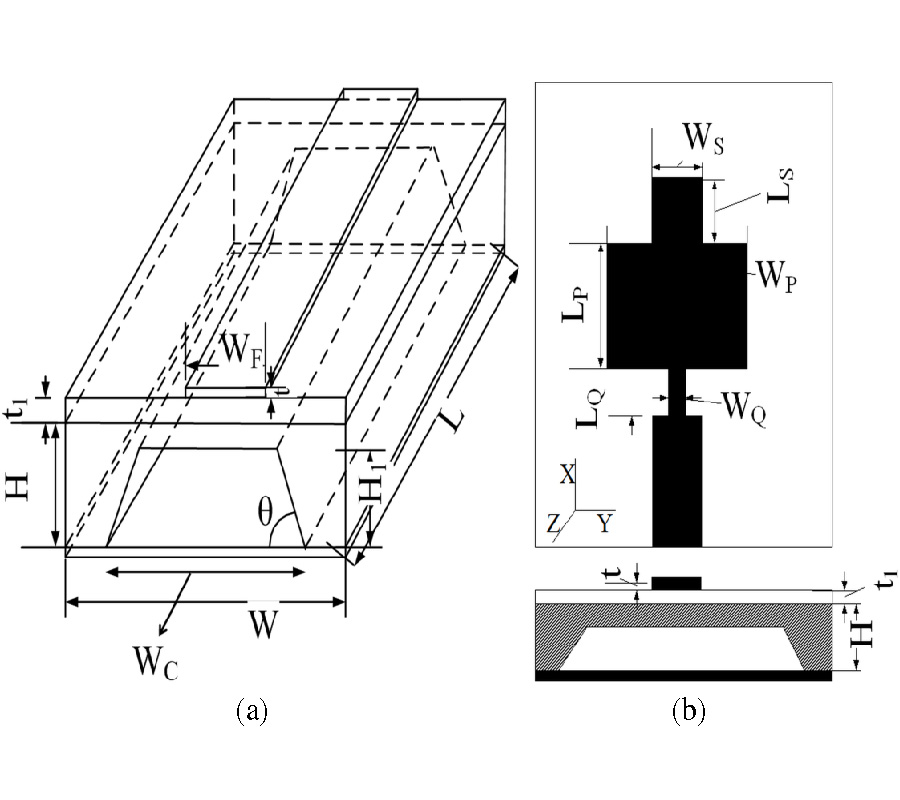
An improved wideband cavity-backed antenna and a planar phased array with wideband wide-angle impedance matching (WAIM) are provided in this paper. A step-shaped cavity is applied in the antenna, so the relative bandwidth of VSWR < 2 can be improved to more than 52% without increasing the cavity profile. Furthermore, a planar phased array constructed by the cavity-backed antenna can work with a wide-angle scanning range of ±60° at both E- and H-planes. Due to the wide-angle scanning range, the impedance matching for the phased array will be unstable in the required wideband. Consequently, the matching layer with metamaterials has been loaded on the phased array. The VSWR is controlled within 2 in E-plane and 3.5 in H-plane during the scanning range of ±60° in wide bandwidth.
STEP-SHAPED CAVITY-BACKED ANTENNA AND WIDEBAND WIDE-ANGLE IMPEDANCE MATCHING IN PLANAR PHASED ARRAY
2019-12-22
PIER M
Vol. 87, 189-197
Shift Operator-TLM Method for Modeling Gyroelectric Media
Soufiane El Adraoui , Khalid Mounirh , Mohamed Iben Yaich and Mohsine Khalladi
In this paper, an efficient Transmission Line Matrix (TLM) approach based on the shift operator (SO) has been developed to model electromagnetic wave interactions with gyroelectric media. The main idea of this technique is to formulate the electric current density vector components by introducing the equivalence between time differential operator ϑ/ϑt and discrete time shift operator z. A concise formulation of voltage sources modeling the frequency dispersive properties of gyroelectric media is then deduced and implemented. Numerical simulations illustrate the Faraday rotation phenomenon in time domain, and in the frequency domain, reflection and transmission coefficients of left hand circular polarization and right-hand circular polarization waves are also calculated. A comparison of SO-TLM scheme with five other approches according to the criteria of accuracy and CPU time is presented. Numerical experiments show that SO-TLM provides the most accurate and fastest results.
SHIFT OPERATOR-TLM METHOD FOR MODELING GYROELECTRIC MEDIA
2019-12-21
PIER C
Vol. 97, 255-265
Investigation of the Effect of Bonding Points on Metal Surface-Mounted FBG Sensors for Electric Machines
Belema P. Alalibo , Wen-Ping Cao , Adenowo Gbadebo , Lassi Aarniovuori and Kewei Cai
Fibre Bragg Gratings (FBGs) offer several advantages including their immunity to electromagnetic fields making them excellent in situ sensors for feature extraction in electrical machines condition monitoring. However, the pre-requisite of bonding FBGs circumferentially on either the machine cast frame or stator windings can introduce undesired sensing characteristics. This is because the FBG relies on adhesives as the transfer medium for any sensed parameter between the machine and sensor. Whilst FBG sensors rely mainly on wavelength shift, an intolerably low signal-to-noise ratio will result in difficulty in measuring such shifts. As a complementary signature, differential optical power can be combined with wavelength shift to broaden the feature extraction capability of FBG sensors. This makes power level (dBm) an important sensing parameter for FBG sensors. The effect of varying number of bonding points on transmitted optical power is investigated using unstripped and stripped bare fibres as well as an actual FBG sensor. Increasing the number of bonding points beyond an optimum number has been observed to significantly attenuate the optical signal power level and quality for a given dynamic range. Hence, as the number of bonding points is increased, the level of attenuation should be closely monitored to ensure that the optimum number is not exceeded if excellent and accurate FBG sensing characteristics are to be realised.
INVESTIGATION OF THE EFFECT OF BONDING POINTS ON METAL SURFACE-MOUNTED FBG SENSORS FOR ELECTRIC MACHINES
2019-12-21
PIER C
Vol. 96, 43-58
A Fast Deterministic Algorithm for Side Lobe Level Reduction of Open Loop Coplanar Distributed Antenna Arrays in WSNs
Haythem Hussein Abdullah , Heba Soliman Dawood and Amr H. Hussein
Distributed beamforming (DBF) is an efficient technique for reliable communications in wireless sensor networks (WSNs). In DBF based networks, the randomly distributed nodes cooperate together to form a randomly distributed antenna array (RAA) which has a main beam directed towards the intended receiver. Due to the nodes randomness, the DBF results in poor pattern characteristics such as high side lobe level (SLL) and pattern asymmetry around the main beam sides. In this paper, a fast deterministic algorithm for SLL reduction of open loop distributed antenna arrays is introduced. Unlike the existing state of the art optimization techniques for SLL reduction, the proposed algorithm provides a fast deterministic solution for energy transmission or the weight of each node without changing its location. Consequently, the exhaustive search burden of the optimization based techniques for the optimum weights is avoided. The simulation results reveal that the proposed algorithm has superior performance to the optimization techniques in terms of execution time, synthesized SLL, and half power beam width (HPBW).
A FAST DETERMINISTIC ALGORITHM FOR SIDE LOBE LEVEL REDUCTION OF OPEN LOOP COPLANAR DISTRIBUTED ANTENNA ARRAYS IN WSNS
2019-12-21
PIER Letters
Vol. 88, 113-119
A Dual-Band Antenna for LTE-R and 5G Lower Frequency Operations
Ashwini Kumar Arya , Seong Jin Kim and Sanghoek Kim
The goal of this paper is to design a dual band antenna for the integration of LTE-R 700-MHz band along with 5G (3.5 GHz) band applications for future advanced railway communication. A design study of the dual band antenna is proposed and discussed in detail. An ellipse-shaped ring patch is designed for the LTR-R 700-MHz band, and the 5G (3.5 GHz) band is added by keeping the circular patch in proximity to the feed line of the antenna to make it a stacked antenna configuration. Circular patches with varying dimensions are used to increase the bandwidth at 3.5-GHz band. The antenna has a size of 180 mm x 60 mm and is fabricated on an FR4 substrate with dielectric constant 4.4 (tanδ = 0.025). The observed bandwidth is approximately 100 MHz and 500 MHz for each frequency band respectively.
A DUAL-BAND ANTENNA FOR LTE-R AND 5G LOWER FREQUENCY OPERATIONS
2019-12-21
PIER M
Vol. 87, 179-187
Integrated Model for Design of SWS and Beam-Wave Interaction Analysis of a Planar THz Sheet-Beam TWT
Aakash Bansal , Vishnu Srivastava and Richa Gupta
A computationally efficient, integrated and dynamic model has been developed for the design of a planar Slow Wave Structure (SWS) and beam-wave interaction analysis of a planar THz Traveling Wave Tube (TWT) with sheet beam. A Staggered Double Vane-Slow Wave Structure (SDV-SWS) is used for its numerous advantages over other types of SWSs. The integrated model determines RF performance of a planar TWT directly from the given beam voltage and center frequency by performing three different tasks, (i) determining geometrical parameters of a SDV-SWS of maximum possible bandwidth and high interaction impedance, (ii) determining RF circuit parameters of a SDV-SWS, and (iii) performing beam-wave interaction analysis of a planar TWT. The model was developed by adopting numerically computing environment, MATLAB. Also, highly accurate numerical techniques with double precision were used, e.g. Sixth Order Runge Kutta Method was used for electron beam dynamic. The model was used to design and simulate a 0.22 THz Sheet Beam TWT of 100W output power. The energy balance factor was achieved within ±0.001% over a very wide dynamic range from even 100 dB below saturation to more than 10 dB above saturation. The power growth of the forward wave was achieved with exactly 1 dB/dB. The program is fast enough for interactive use on a standard computer with a basic configuration. The model has been compared with the published works using 3D electromagnetic field simulator for demonstrating its accuracy.
INTEGRATED MODEL FOR DESIGN OF SWS AND BEAM-WAVE INTERACTION ANALYSIS OF A PLANAR THZ SHEET-BEAM TWT
2019-12-20
PIER C
Vol. 98, 31-44
Low-Cost Inkjet-Printed Multiband Frequency-Selective Structures Consisting of U-Shaped Resonators
Özgür Eris , Hande Ibili and Özgür Ergül
We present design and computational simulation of multiband, polarization-independent, and thin frequency-selective structures for microwave frequencies, and their fabrication via a very low-cost inkjet-printing procedure. The structures are constructed by periodically arranging unit cells that consist of U-shaped resonators, while polarization-independency is achieved by applying rotational arrangements. Various configurations are obtained by considering double and single U-shaped resonators, as well as rotational and complementary relationships between the corresponding unit cells on the top and bottom surfaces. We observe that complementary arrangements provide resonances with better quality, particularly by allowing the smaller resonators to operate as desired. Measurements on the fabricated samples demonstrate the feasibility of both effective and very low-cost inkjet-printed frequency-selective structures with multiband and polarization-independent characteristics.
LOW-COST INKJET-PRINTED MULTIBAND FREQUENCY-SELECTIVE STRUCTURES CONSISTING OF U-SHAPED RESONATORS
2019-12-20
PIER M
Vol. 87, 171-178
Two-Frequency Operating Mode of Antenna Arrays with Radiators of Clavin Type and Switching Vibrator and Slot Elements
Yuriy M. Penkin , Viktor A. Katrich and Mikhail Nesterenko
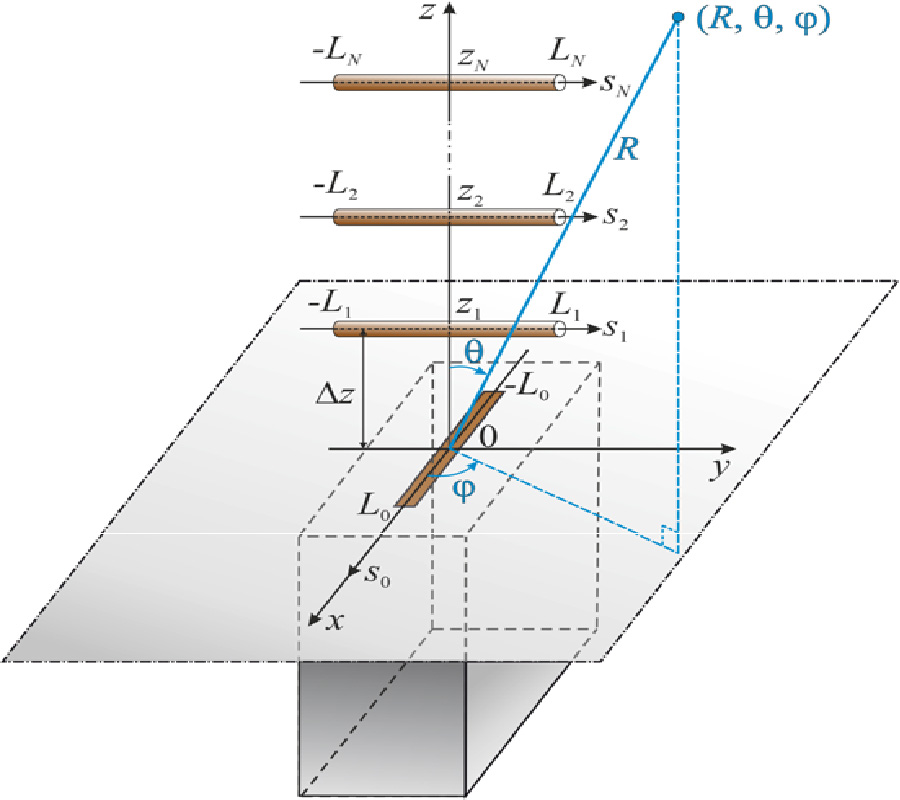
The possibility of application Clavin type radiators in combined two-frequency antenna arrays with diode switching of vibrator and slot elements is validated. The conventional Clavin elements with passive monopoles operating at the main frequency and two active monopoles operating at the alternative frequency are used as the combined array radiator. Radiation fields of combined arrays at both frequencies are analyzed. It is shown that the alternative wavelength should not exceed the main wavelength by more than 25%.
TWO-FREQUENCY OPERATING MODE OF ANTENNA ARRAYS WITH RADIATORS OF CLAVIN TYPE AND SWITCHING VIBRATOR AND SLOT ELEMENTS
2019-12-19
PIER C
Vol. 98, 17-30
Direct Suspension Control Based on Second Order Sliding Mode for Bearingless Brushless DC Motor
Baohua Yue , Ye Yuan and Tianyue Tao
For direct suspension force control (DSFC) strategy of Bearingless Brushless DC Motor (BBLDCM), combined with super-twisting algorithm, a second-order sliding mode (SOSM) controller is designed by direct suspension force. The control precision, robustness, and jitter suppression of the suspension subsystem are improved. The direct suspension force control based on the second-order sliding mode (SOSM-DSFC) controller solves the influence of external disturbance on the self-stabilizing suspension, effectively suppresses the rotor jitter problem, and improves the robustness of the rotor suspension.
DIRECT SUSPENSION CONTROL BASED ON SECOND ORDER SLIDING MODE FOR BEARINGLESS BRUSHLESS DC MOTOR
2019-12-19
PIER C
Vol. 98, 1-16
An Efficient Paradigm for Evaluating the Channel Capacity of Closed-Loop Massive MIMO Systems
Abbas Al-Wahhamy , Nicholas E. Buris , Hussain M. Al-Rizzo and Samer Yahya
Aparticular challenge encountered in designing massive MIMO systems is how to handle the enormous computational demands and complexity which necessitates developing a new highly efficient and accurate approach. Considering the large antenna array employed in the Base-Station (BS), in this work, we present a new paradigm to significantly reduce the simulation runtime and improve the computational efficiency of the combined rigorous simulations of the antenna array, 3-D channel model, and radiation patterns of the User Equipment (UE). We present an approach for evaluating a closed-loop massive MIMO channel capacity using 3-D beamforming to take advantage of spatial resources. The approach subdivides an M×N array at the BS into columns, rows, rectangular, or square subarrays, each consisting of a sub-group of antenna elements. The coupling is rigorously taken into account within each subarray; however, it is ignored among the subarrays. Results are demonstrated for a dual-polarized microstrip array with 128 ports. We consider simulation runtimes with respect to two different propagation environments and two different Signal-to-Noise-Ratios (SNRs). It is shown that the maximum difference in the closed-loop capacity evaluated using rigorous electromagnetic simulations and our proposed approach is 2.4% using the 2×(8×4) approach for both the 3-D Channel Model in the 3rd Generation Partnership Project (3GPP/3D) and the 3-D model in the independent and identically distributed (i.i.d/3D) model with a 46% reductional in computational resources compared with the full-wave antenna array modeling approach.
AN EFFICIENT PARADIGM FOR EVALUATING THE CHANNEL CAPACITY OF CLOSED-LOOP MASSIVE MIMO SYSTEMS
2019-12-19
PIER C
Vol. 96, 27-41
Analysis and Experiment of a Ridged Horn Antenna with Metallic Grid Sidewalls
Shu Lin , Shoulan Liu , Yuwei Zhang and Jianlin Jiao
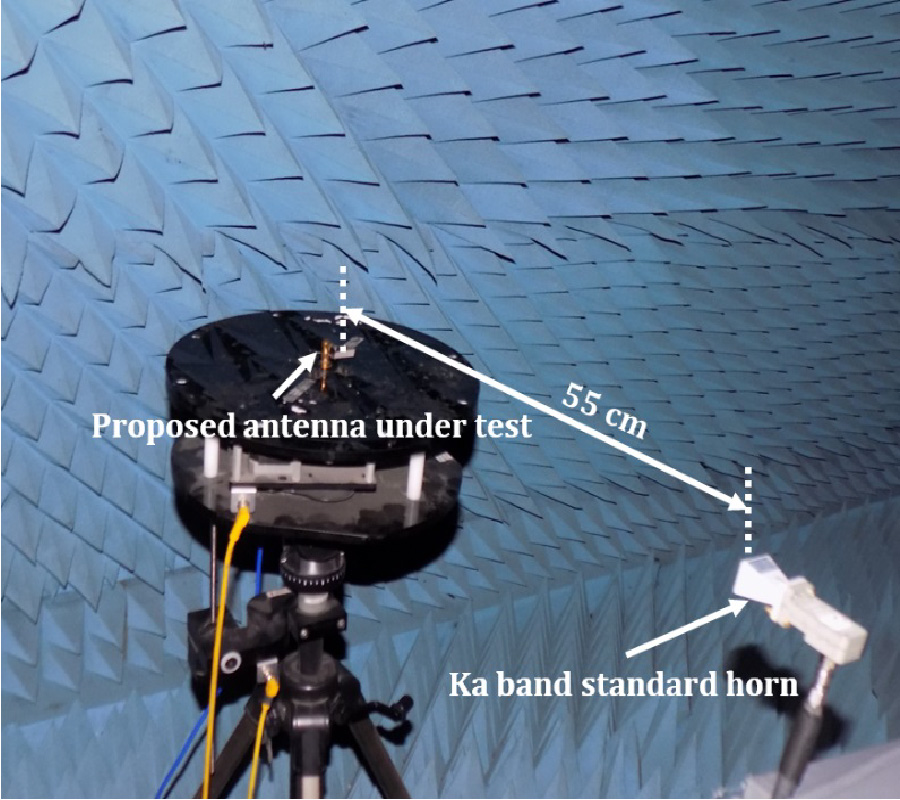
A ridged horn antenna with metallic grid sidewalls is proposed and quantitatively analyzed. Simulated and measured results indicate that the operating band is from 1.0 to 20.0 GHz with the reflection coefficient less than -10 dB, and the relative bandwidth is as high as 180.95%. The gains are greater than 10 dBi in the frequency band of 2.6-20 GHz, greater than 16 dBi in the frequency band of 10-20 GHz with the gains fluctuation less than 1 dB. In the whole operating band, the radiation patterns radiate directionally along the normal direction of the horn aperture and do not split. In this paper, the ridged horn antenna with metallic girds is analyzed quantitatively. A modified equivalent traveling wave current model of the ridged horn antenna is proposed, which matches better to the patterns of the ridged horn antenna in high frequency band. The working mechanism of metallic grid sidewalls is also analyzed quantitatively, and the reason that metal strips can improve the matching performance of ridged horn antenna in low frequency band, restrain the patterns splitting in high frequency band and improve the antenna gains is explained. The proposed antenna has the characteristics of ultra-wideband, stable gains, miniaturization, and directional radiation patterns with no splitting main lobe in ultra-wideband. The proposed ridged horn antenna can be used for the measurement in a microwave anechoic chamber.
ANALYSIS AND EXPERIMENT OF A RIDGED HORN ANTENNA WITH METALLIC GRID SIDEWALLS
2019-12-19
PIER C
Vol. 96, 1-11
Estimation of the Number of Signal Sources in Presence of Mutual Coupling
Ching S. Yu , Helio Augusto Muzamane and Hsin-Chin Liu
The estimation of the direction of arrival (DOA) and the estimation of the number of signal sources are very important techniques in modern communications. The effect of mutual coupling can degrade the performance of the estimation algorithms. Mutual coupling compensation is used to mitigate this effect. However, errors remain when the compensation is carried out with such methods as minimum description length (MDL) to estimate the number of signal sources. This work presents a new method based on threshold decision to estimate the number of signal sources in presence of mutual coupling. The results of computer simulations demonstrate that the proposed method outperforms the MDL method.
ESTIMATION OF THE NUMBER OF SIGNAL SOURCES IN PRESENCE OF MUTUAL COUPLING
2019-12-18
PIER C
Vol. 96, 13-26
A Novel Reconfigurable Bandpass Filtering Antenna for IoT Communication Applications
Vamsee Krishna Allam , Boddapati Taraka Phani Madhav , Tirunagari Anilkumar and Suman Maloji
This paper presents a novel reconfigurable filtering antenna with three tunable states used for IoT applications. The frequency reconfigurability is achieved using the combination of a hairpin filter and an open loop filter in the structure with the switching of p-i-n diodes. The open-loop filter structure provides two narrow band states at 2.4 GHz and 7.8 GHz, and the hairpin filter provides a single narrow band state at 10.4 GHz. The frequency reconfiguration is obtained without compromising the compact size of the designed circuit along with the targeted frequency bands at lower WLAN (2.47 GHz), WiMAX (3.42 GHz), INSAT C-band (7.18 GHz), fixed/mobile satellite service in X-band (8.4 GHz), direct broadcast service in Ku-band (12.14 GHz) applications. The prototype is constructed on an FR4 substrate and tested for validation in an anechoic chamber. The designed antenna provides excellent radiation characteristics and considerable gain at resonant frequencies. The proposed reconfigurable antenna is also tested using the CDAC Cmote device in the real-time environment and found more suitable for the IoT based communication applications.
A NOVEL RECONFIGURABLE BANDPASS FILTERING ANTENNA FOR IOT COMMUNICATION APPLICATIONS