Search Results(13790)

2020-04-08
PIER B
Vol. 87, 39-60
On the Design and Fabrication of Chained-Function Waveguide Filters with Reduced Fabrication Sensitivity Using CNC and DMLS
Yuan Ping Lim , Sovuthy Cheab , Socheatra Soeung and Peng Wen Wong
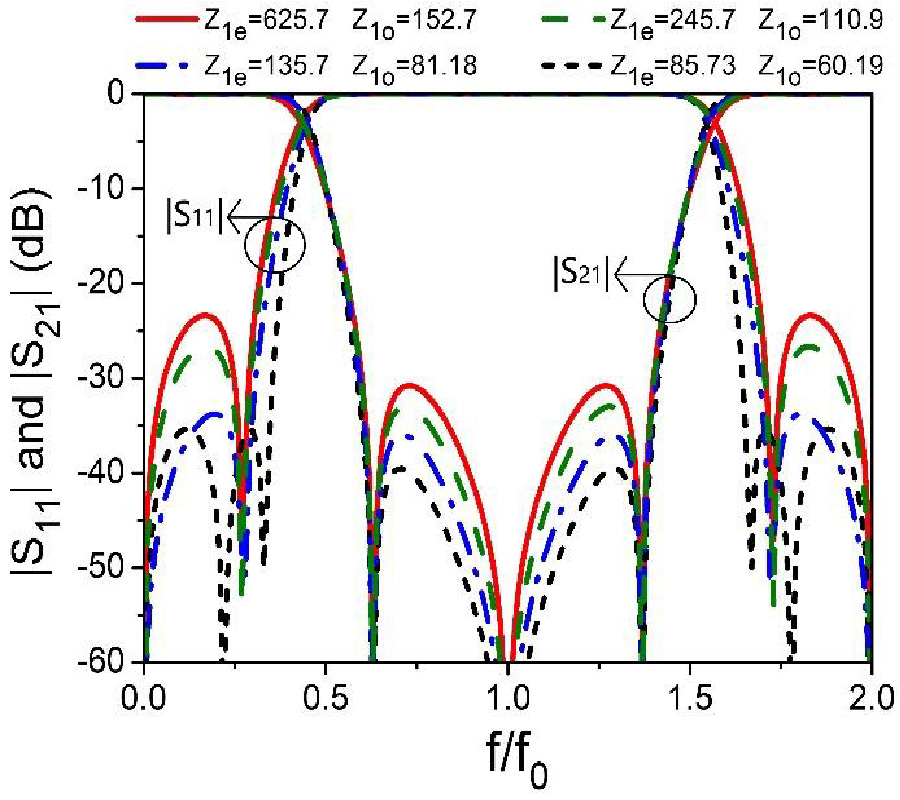
In this paper, we present the design and fabrication of a novel class of emerging waveguide filters based on chained-functions at the millimeter-wave band. The derivation of chained-functions by chaining of prescribed generalized Chebyshev seed functions based on the partition theory is presented in details, and the implementation to waveguide technology is proposed and evaluated. The waveguide filter is fabricated through two different technologies, namely the Computer Numerical Control (CNC) milling technology and the Direct Metal Laser Sintering (DMLS) based additive manufacturing technology. The chained-function filters, which lie in between the Butterworth and Chebyshev filters, inherit the salient properties of both Butterworth and Chebyshev filters. Therefore, the chained-function waveguide filter exhibits filtering responses that have a superior rejection property and a lower loss with reduced sensitivity to fabrication tolerance than the standard Chebyshev waveguide filter. The efficiency of the proposed waveguide filter is confirmed both theoretically and empirically, using the CNC and DMLS processes. The issues of a higher manufacturing tolerance and apparent surface roughness associated with the DMLS method are found to be electrically insignificant when the chained-function concept is adopted in waveguide filter design. In general, the measured results of all the realized waveguide filters agree well to those of the simulation models. These results positively demonstrate that the chained-function concept has robust properties for rapid, high-performance, low-cost, and sustainable filter design and implementation, particularly for higher millimeter-wave frequency bands and for narrow-band applications.
ON THE DESIGN AND FABRICATION OF CHAINED-FUNCTION WAVEGUIDE FILTERS WITH REDUCED FABRICATION SENSITIVITY USING CNC AND DMLS
2020-04-07
PIER M
Vol. 91, 59-67
A Compact Tri-Band Frequency Reconfigurable Antenna for LTE/Wi-Fi/Its Applications
Shreyas S. Bharadwaj , Deepika Sipal , Dinesh Yadav and Shiban Kishen Koul
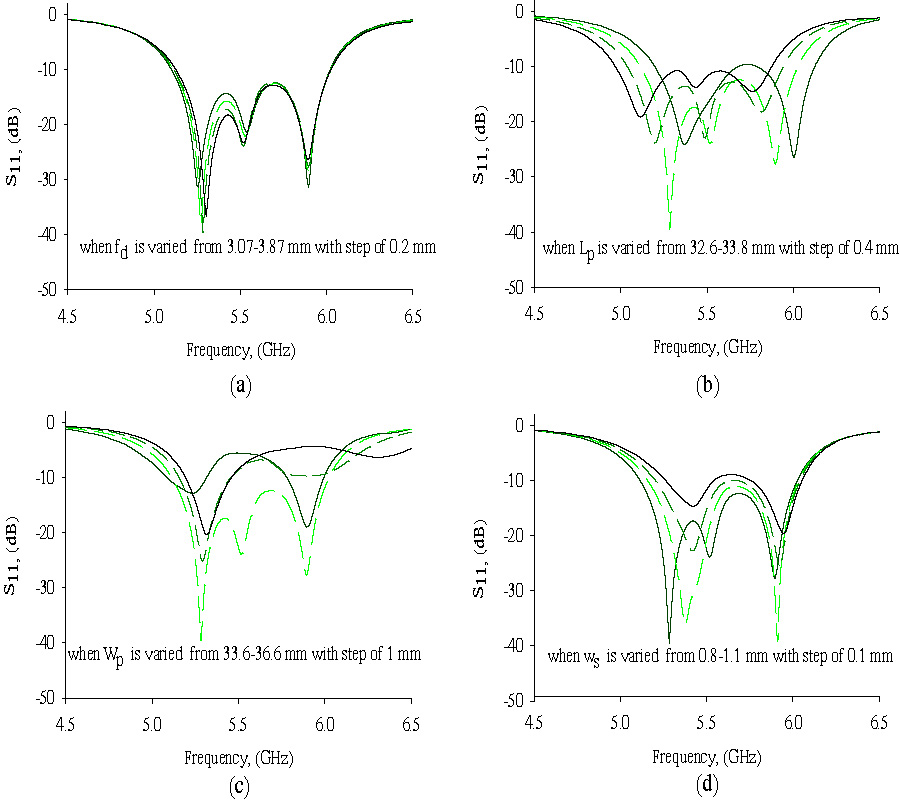
In this work, a Tri-Band frequency reconfigurable antenna for LTE (Long Term Evolution)/WiFi (Wireless Fidelity)/ITS (Intelligent Transportation Systems) applications is presented. The proposed design consists of a wine glass shaped slotted radiating patch along with a switchable rectangular ring type slot on the ground plane. This structure operates in three different states viz. state-1, state-2, and state-3 at 4.5 GHz (LTE band), 5.9 GHz (ITS band), and 3.8 GHz (LTE band)/5 GHz (Wi-Fi band), respectively, with an overall compact size of 30 × 30 × 0.762 mm3. Multi-band resonances are obtained by incorporating slots in the main radiating element and ground plane. Moreover, switching among these bands is achieved by placing two PIN diodes at optimized positions on the rectangular ring slot in the ground plane. For the proposed design, good agreement between simulated and measured results is obtained in all the three operating states of the design, which makes it suitable for compact reconfigurable systems.
A COMPACT TRI-BAND FREQUENCY RECONFIGURABLE ANTENNA FOR LTE/WI-FI/ITS APPLICATIONS
2020-04-07
PIER M
Vol. 91, 49-58
Parameter Trade-off Between Electric Load, Quality Factor and Coupling Coefficient for Performance Enrichment of Wireless Power Transfer System
Sushree Sangita Biswal , Durga Prasanna Kar and Satyanarayan Bhuyan
Accomplishing high efficiency with acceptable output load power is a formidable design challenge in resonant wireless power transfer (WPT) system employed for charging Electric Vehicle (EV). This necessitates a trade-off among the assorted parameters like coil quality factor, coupling coefficient and electric load for performance enrichment of resonant WPT system. It is realized that the high value of quality factor does not ensure higher power transfer efficiency but it is largely influenced by the electric load. For each coupling coefficient there exists an optimum load for which maximum power can be delivered. It is also perceived that for a fixed vertical separation gap of the coils, increasing receiver coil quality factor has no profound effect on the output load power as well as efficiency. The circuit model based analytical results agree well with the comprehensive experimental results and elucidate the strategic design guidelines for a competent wireless electric vehicle charging system.
PARAMETER TRADE-OFF BETWEEN ELECTRIC LOAD, QUALITY FACTOR AND COUPLING COEFFICIENT FOR PERFORMANCE ENRICHMENT OF WIRELESS POWER TRANSFER SYSTEM
2020-04-04
PIER M
Vol. 91, 39-48
Exact Non-Reflecting Boundary Conditions with an FDTD Scheme for the Scalar Wave Equation in Waveguide Problems
William Alexander Mulder
Modeling wave propagation often requires a truncation of the computational domain to a smaller subdomain to keep computational cost reasonable. The mere volume of papers on absorbing boundary conditions indicates that a perfect solution is not available. A method is proposed that is exact, at least in the case of a time-domain finite-difference scheme for the scalar wave equation. The word `exact' is used in the sense that there is no difference between a computation on the truncated domain with this method and one on an enlarged domain with reflecting boundaries that are placed so far away that their reflections cannot reach the original domain within the modeled time span. Numerical tests in 1D produce stable results with central difference schemes from order 2 to 24 for the spatial discretization. The difference with a reference solution computed on an enlarged domain with the boundary moved sufficiently far away only contains accumulated numerical round-off errors. Generalization to more than one space dimension is feasible if there is a single non-reflecting boundary on one side of a rectangular domain or two non-reflecting boundaries at opposing sides, but not for a corner connecting non-reflecting boundaries. The reason is that the method involves recursion based on translation invariance in the direction perpendicular to the boundary, which does not hold in the last case. This limits the applicability of the method to, for instance, modeling waveguides.
EXACT NON-REFLECTING BOUNDARY CONDITIONS WITH AN FDTD SCHEME FOR THE SCALAR WAVE EQUATION IN WAVEGUIDE PROBLEMS
2020-04-03
PIER M
Vol. 91, 29-37
Tuning Electromagnetically Induced Transparency of Superconducting Metamaterial Analyzed with Equivalent Circuit Approach
Yonggang Zhang , Chun Li and Xuecou Tu
We analyzed the effect of loss and coupling to EIT metamaterials using circuit approach, giving the effect of two parameters: coupling and loss on the resonant property of the EIT metamaterials. To verify the results of the circuit analysis, simulations and experiments were performed. The structures were fabricated with superconducting NbN and varied temperature to verify the effect of loss. The distances were adjusted to observe the effect of the coupling strength. The results of simulations and experiments were consistent with the circuit analysis.
TUNING ELECTROMAGNETICALLY INDUCED TRANSPARENCY OF SUPERCONDUCTING METAMATERIAL ANALYZED WITH EQUIVALENT CIRCUIT APPROACH
2020-04-03
PIER C
Vol. 101, 13-28
Tuneable Frequency Selective Surface
Yukti Anand and Ashok Mittal
This paper is presented to provide an overview on frequency selective surfaces and techniques to achieve tune-ability in frequency selective surface (FSS). FSS array element with specific arrangement on the dielectric surface either transmits (pass-band) or reflects (stop-band) partially or completely with resonance of the structure in tune with the frequency of electromagnetic wave. Tuning devices like PIN or Varactor incorporated in the structure tune the performance. The recent researches on FSS structures classifying them into structural classification and mechanisms to change the operating resonance frequency dynamically by changing the bias of the tuning devices like PIN or Varactor diode have been studied and detailed in this review article. Tune-ability allows the FSS layer filter to adapt to spectral changes and to compensate for the best performance in terms of bandwidth, gain, and directivity. We also focused important performance parameters, particularly on how development in this field could facilitate invention in advanced electromagnetics.
TUNEABLE FREQUENCY SELECTIVE SURFACE
2020-04-03
PIER C
Vol. 100, 263-273
Dual-Band Low Profile SIW Cavity-Backed Antenna by Using Bilateral Slots
Bollavathi Lokeshwar , Dorai Venkatasekhar and Alapati Sudhakar
In this paper, a design of a low profile cavity backed antenna consisting of bilateral slots is developed for generating two frequencies. Here, the whole antenna including substrate integrated waveguide (SIW) cavity is constructed from only one substrate with the height of 0.026λ0. The long transversal slot at the ground plane is excited by TE210 mode of the cavity and produces one hybrid mode resonance at 9.85 GHz. When the short transversal slot cut is incorporated in the top portion of the cavity, TE310 mode is perturbed, which results in generating an additional hybrid mode resonance at 14 GHz. Both these hybrid modes help to create a dual-band response. A sample of the proposed design is fabricated, and it has been verified experimentally that the bandwidths of the proposed design are 530 MHz (5.48%) and 440 MHz (3.15%) at lower and higher resonant frequencies, respectively. The antenna renders measured peak gains of 6.62 dBi and 6.44 dBi at 9.85 GHz and 14 GHz, respectively. The cross-polarization level of maximum -20 dB and same polarization planes are obtained at both the operating frequencies.
DUAL-BAND LOW PROFILE SIW CAVITY-BACKED ANTENNA BY USING BILATERAL SLOTS
2020-04-02
PIER Letters
Vol. 90, 99-104
Rain Attenuation for 5G Network in Tropical Region (Malaysia) for Terrestrial Link
Kesavan Ulaganathen , Tharek Bin Abdul Rahman , Islam Md. Rafiqul and Khaizuran Abdullah
Millimeter wave (mm-Wave) is today's breakthrough frontier for emerging wireless mobile cellular networks, wireless local area networks, personal area networks, and vehicular communications. In the near future, mm-Wave products, systems, theories, and devices will come together to deliver mobile data rates thousands of times faster than today's existing cellular and Wi Fi networks for an example from the era of 3G, 4G towards 5G mobile communication in near future. This paper presents studies on rain attenuation at 6 GHz and 28 GHz, which is widely used for local multipoint distribution service deployment by using the measured and prediction methods for terrestrial microwave links point to point in tropical regions. Besides this, discussion and comparison of five different reduction factor models have been presented. Several models have been proposed by researchers to account for the horizontal variation of rain fall. Five rain attenuation prediction models at tropical region are analyzed. The models are ITU-R model, revised Moupfouma model, revised Silva Mello model, Abdul Rahman model, and Lin model which have been analyzed. The objective of these studies to identify rain attenuation using prediction model for 5G network in tropical region for country like Malaysia. This study been carried out with setting of an experimental test bed. A link of path length 0.2 km was set up in Johor Bahru, Malaysia. Both the transmitter and receiver operate at frequencies of 6 GHz and 28 GHz. A tipping bucket rain rate used, and all the data have been recorded using data logger. At the end of the analysis, it is found that all the five models predict rain attenuation at less than 1 dB and 11 dB for operating microwave frequency at 6 GHz and 28 GHz for 5G Network, This findings will be useful for future 5G network designers to consider the effect of rain impairments especially in tropical region.
RAIN ATTENUATION FOR 5G NETWORK IN TROPICAL REGION (MALAYSIA) FOR TERRESTRIAL LINK
2020-04-01
PIER M
Vol. 91, 19-28
Circularly Polarized Two-Port MIMO Dielectric Resonator Antenna
Gaurav Varshney , Rakesh Singh , Vinay Shanker Pandey and Rajveer Singh Yaduvanshi
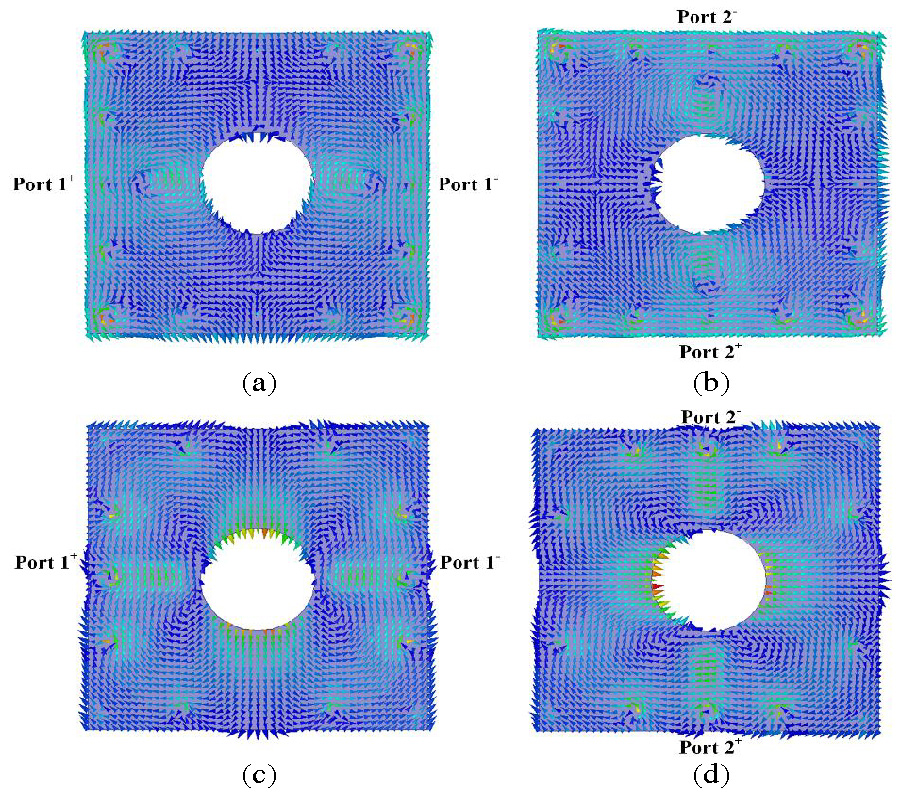
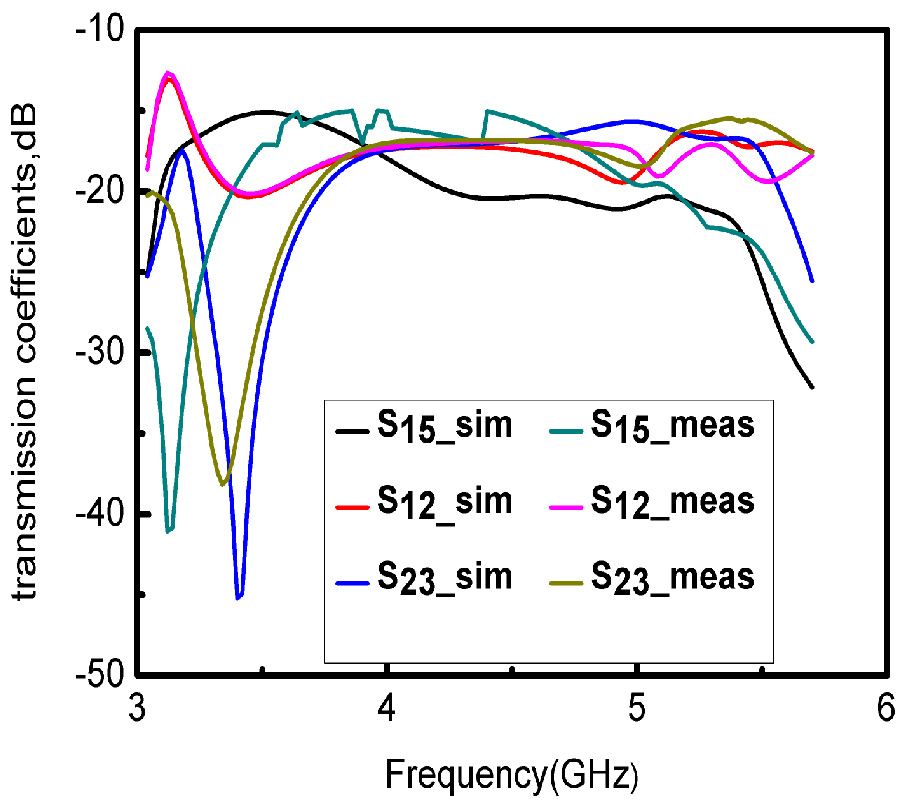
A two port multi-input-multi-output (MIMO) dielectric resonator (DR) antenna (DRA) is proposed with circularly polarized radiation. The antenna geometry allows to find circular polarization and improved impedance bandwidth by reducing the separation between the DR elements. The isolation between the ports of the antenna remains more than 15 dB in the operating passband even after reducing the separation between the radiating elements. The antenna provides the 10-dB impedance and 3-dB axial ratio bandwidth of 34.85% and 4.55%, respectively. The MIMO performance of the proposed antenna is confirmed by calculating the parameters like envelop correlation coefficient, diversity gain, mean effective gain, channel capacity loss, and the total active reflection coefficient. The proposed antenna can be utilized for C-band applications.
CIRCULARLY POLARIZED TWO-PORT MIMO DIELECTRIC RESONATOR ANTENNA
2020-04-01
PIER M
Vol. 90, 195-203
Development of Circular Loop Frequency Selective Surface Using 3-D Printing Technique
Deepika Singh , Abhinav Jain and Rana Pratap Yadav
This paper discusses a circular loop frequency selective surface (FSS) using a 3-D (three dimensional) printed technique. The proposed FSS design consists of a metallic patch having a circular loop printed on one side of Acrylonitrile Butadiene Styrene (ABS) material. This design is used for harmonic radar applications at 5 GHz resonant frequency. Various FSS parameters are discussed to show the effect on the resonant frequency. To make fabrication process easier and cost-effective, transmitting and receiving antennas are also printed using a 3-D printing material. 3-D printing offers cost-effective fabrication technique compared with other conventional techniques and helps in rapid prototyping. The fabricated prototype is validated with the experimental results that show good agreement between simulated results and the measured ones.
DEVELOPMENT OF CIRCULAR LOOP FREQUENCY SELECTIVE SURFACE USING 3-D PRINTING TECHNIQUE
2020-03-31
PIER B
Vol. 86, 177-193
Theory of Nonsinusoidal Small Antennas for Near-Field Communication System Analysis
Said Mikki
We provide a conceptual and theoretical analysis of nonsinusoidal antennas with emphasis on how electromagnetics and communication theories can be integrated to propose ideas for near-field (NF) communications systems utilizing future antennas. It is shown through rigorous analysis that in nonsinusoidal antennas it is possible to derive and solve ordinary differential equations giving specialized time-domain excitation signals that lead to exact cancellation of the near field at specific radiation spheres. This opens the door to building NF communications systems with far-field-like communication receiver infrastructures utilized if the receive antenna is placed at the special sphere where the NF component is made to vanish. We deploy exact current Green's function analysis method and completely avoid the use of any frequency-domain method. Complete expressions of the electromagnetic near- and far-field contributions to all signals propagating from the source to the receiver are then derived and their physical content discussed. The distortion effects and signal-to-noise rations due to the near-field are also identified and derived theoretically. It is found that using this specialized pulse excitation method in nonsinusoidal antennas, distortion caused by near-field components can be eliminated at critical distances between the source and the receiver. Realization issues of this system are briefly discussed together with some potential applications.
THEORY OF NONSINUSOIDAL SMALL ANTENNAS FOR NEAR-FIELD COMMUNICATION SYSTEM ANALYSIS
2020-03-31
PIER C
Vol. 100, 247-261
Improved Isolation Metamaterial Inspired mm-Wave MIMO Dielectric Resonator Antenna for 5G Application
Nimmagadda Murthy
A rectangular Dielectric Resonator Antenna (DRA) four element Multiple in Multiple Out (MIMO) is proposed for 5G application, and each element is supplied with slot-coupled microstrip feed. The entire construction has a dimension of 20 mm × 40 mm. Four Dielectric Resonators are mounted exactly above the slot. In order to improve the isolation, metamaterial is printed on top of the dielectric resonators, which move away the solidest coupling fields. As the metamaterial structure interacts with the electromagnetic fields, field distributions are disturbed which results in reduction of coupled fields. Since the metamaterials are printed on top of the dielectric resonator, the proposed antenna structure has simplest and compact design. The proposed structure is operating with an impedance bandwidth of 2.23 GHz with operating range from 26.71 GHz to 28.91 GHz, which covers the 28 GHz (27.5 GHz-28.35 GHz) band allotted by Federal Communications Commission (FCC) for 5G application. With all four-port excitation, the proposed structure shows a broadside radiation pattern with gain above 7 dBi in the entire operating bands. The Envelope Correlation Coefficient (ECC) for operating bands is within the target value. They are designed and fabricated to validate the proposed antenna. The simulated and measured values are nearly equal, which means that the proposed MIMO DRA is the right choice for mm-Wave 5G implementation.
IMPROVED ISOLATION METAMATERIAL INSPIRED MM-WAVE MIMO DIELECTRIC RESONATOR ANTENNA FOR 5G APPLICATION
2020-03-31
PIER C
Vol. 100, 233-245
Dual-Layer Dual-Patch EBG Structure for Isolation Enhancement and Correlation Reduction in MIMO Antenna Arrays
Oludayo Sokunbi and Hussein Attia
This paper proposes a novel electromagnetic band gap (EBG) structure based on a dual-layer dual-patch unit (DLDP-EBG) cell to improve isolation and decrease envelope correlation between MIMO slot antenna array elements. A wideband MIMO slot antenna array operating in the frequency range of 4.2-6.5 GHz (43%) is deployed. The antenna array is based on slotted rectangular microstrip radiating elements printed on the top surface of two stacked FR4 substrates to widen the array impedance bandwidth. A 2 x 7 dual-layer DLDP-EBG unit cell is inserted between the array elements to reduce the mutual coupling and detect the individual beams of each antenna in opposite directions. An isolation improvement of up to 56 dB is maintained throughout the working bandwidth of the antenna, when the EBG is inserted. Also, the DLDP-EBG unit cells reduce the envelope correlation coefficient by 5-30 dB across the whole operating bandwidth by detecting the radiation beams of the individual antenna elements in opposite directions. The MIMO array gain and radiation eciency have been improved after using the EBG structure due to the reduction in mutual coupling and surface wave mitigation between the array elements. The proposed low-pro le MIMO slot antenna array is the fi rst in literature to exhibit such wideband isolation improvement, gain enhancement, and correlation reduction behavior simultaneously.
DUAL-LAYER DUAL-PATCH EBG STRUCTURE FOR ISOLATION ENHANCEMENT AND CORRELATION REDUCTION IN MIMO ANTENNA ARRAYS
2020-03-30
PIER C
Vol. 100, 219-232
Chlorophyll-Inspired Tunable Metamaterials with Multi-Negative Refractive Index Bands: the Porphyrin Ring and Hydrophobic Tail Effect
Nantakan Wongkasem
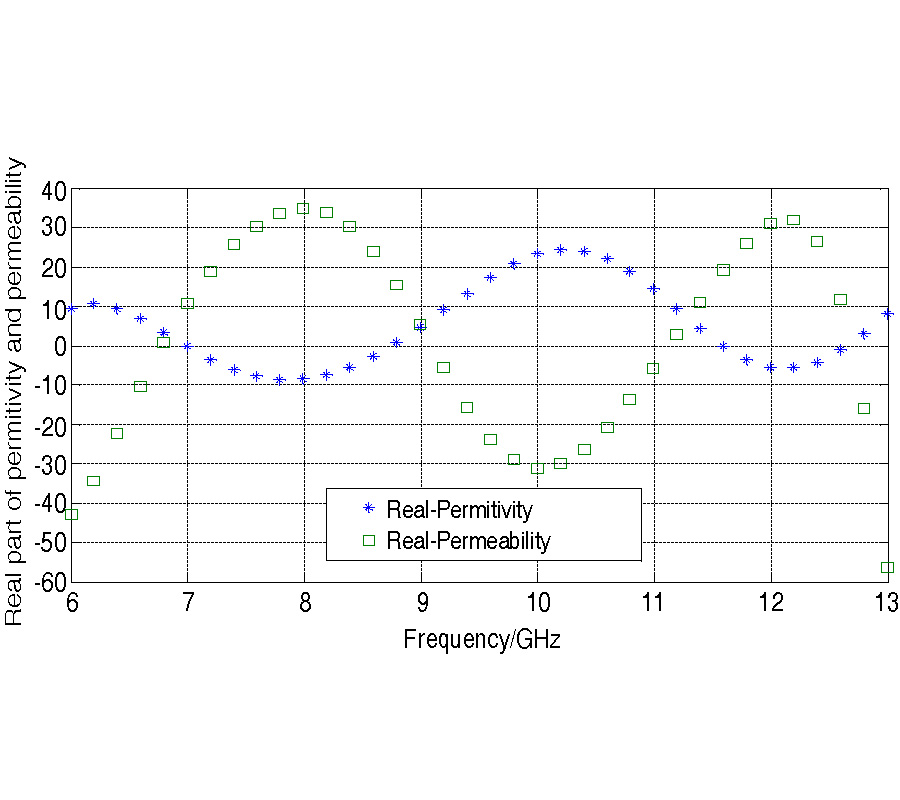
Tunable negative electromagnetic properties: permittivity, permeability, and refractive index, in mimic Chlorophyll metamaterial structures in the X- and Ku-band regimes are theoretically and numerically demonstrated. A very broad negative permeability covering the majority of the X- and Ku bands, from 8 GHz to 16 GHz, is observed, while five negative permittivity bands are found within the same range. The two aforementioned properties result in a broad, greater than 25% bandwidth, low-loss negative-refractive index transmission band. These negative electromagnetic properties can be effectively tailored within the low-loss multi-transmission and the high-loss multi-absorption bands in the operating frequency range by modifying the structure's tiller part or the artificial hydrophobic or Phytol tail. By focusing either on the transmission or the absorption bands, these passive always-on bio-inspired metamaterials could be utilized in microelectronic, communication and photonic, and optic devices.
CHLOROPHYLL-INSPIRED TUNABLE METAMATERIALS WITH MULTI-NEGATIVE REFRACTIVE INDEX BANDS: THE PORPHYRIN RING AND HYDROPHOBIC TAIL EFFECT
2020-03-26
PIER M
Vol. 91, 1-10
The Diffraction by Two Half-Planes and Wedge with the Fractional Boundary Condition
Vasil Tabatadze , Kamil Karaçuha , Eldar I. Veliyev and Ertuğrul Karaçuha
In this article, the diffraction of plane electromagnetic waves by double half-planes with fractional boundary conditions is considered. As particular cases, the diffractions by wedges and corners are considered for different values of fractional orders. The results are compared to the analytical ones. The interesting properties of wedge diffraction are outlined for intermediate fractional orders.
THE DIFFRACTION BY TWO HALF-PLANES AND WEDGE WITH THE FRACTIONAL BOUNDARY CONDITION
2020-03-26
PIER C
Vol. 100, 205-218
HEMP Excited Shield Residual Electric Field Modeling Method Based on NARX Neural Network
Zhizhen Zhu , Jing Yang , Yuewu Shi , Xin Nie , Linshen Xie and Wei Wang
To predict the residual electric field inside an electromagnetic (EM) shield under illumination of different HEMP waveforms, a method based on NARX neural network is proposed in this paper. The model can be established from input-output data of EM shield without knowing enclosure and internal structural details. To evaluate the precision of the prediction method, two error criteria based on energy and field amplitude are provided in this paper. As a numerical example, the double exponential pulse with 10% to 90% rise time of 2.5 ns, the pulse width at half maximum of 23 ns, and the corresponding residual electric field are taken as the training data. The EM simulation is used to establish the model of residual electric field inside the shield. The NARX neural network is then built and trained. Other double exponential pulses, with different rise times and pulse widths, and their residual field are taken as the checking data. The results show that the error of the prediction method is sufficiently small for actual use.
HEMP EXCITED SHIELD RESIDUAL ELECTRIC FIELD MODELING METHOD BASED ON NARX NEURAL NETWORK
2020-03-25
PIER C
Vol. 100, 187-203
A Metamaterial Loaded Hybrid Fractal Hepta-Band Antenna for Wireless Applications with Reconfigurability Characteristics
Santosh Kumar Dwivedi , Mithilesh Kumar and Lokesh Tharani
In this article, the authors present a hepta band metamaterial inspired hybrid fractal octagonal shape antenna for wireless applications. Multiband characteristics in the proposed design are achieved by hybrid fractal form of Moore curve and Koch curve with metamaterial loading. A well matched impedance bandwidth (S11 ≤ -10 dB) is accomplished at seven microwave frequency bands Upper L band (1.93~2.08 GHz), S band WiMAX (3.3~3.7 GHz), C band WLAN (5.4~5.9 GHz), C band IEEE INSAT application (6.5~7.2 GHz), X band terrestrial broadband, space communication and Radio Navigation (RN) application (8.51~11.05 GHz), Lower Ku band direct broadcast satellite service (12.2~12.7 GHz), and Middle Ku band satellite communication operating band (14.73~15.84 GHz) covering various wireless applications. The antenna achieves hexa/penta band characteristics during switching ON/OFF state of PIN diode placed between the Moore curve structure (attached with centered SRR cell) and feedline. Radiation patterns are found in stable forms at all the resonant frequencies. Measured results of the proposed design are compared with simulated ones indicating good agreement between them.
A METAMATERIAL LOADED HYBRID FRACTAL HEPTA-BAND ANTENNA FOR WIRELESS APPLICATIONS WITH RECONFIGURABILITY CHARACTERISTICS
2020-03-24
PIER M
Vol. 91, 11-18
Ferromagnetic Resonance Spectroscopy of CoFeZr-CaF2 Granular Nanocomposites
Tomasz N. Kołtunowicz , Vitalii Bondariev , Pawel Zukowski , Julia Sidorenko , Vadim Bayev and Julia A. Fedotova
Results of the study of magnetic properties of nanocomposite samples (CoFeZr)x(CaF2)(100 - x) (31 at.% ≤ x ≤ 47 at.%) produced in argon (Ar) and argon with oxygen (Ar with O2) sputtering atmosphere are presented in this paper. The magnetic resonance spectroscopy at room temperature using continuous wave X-band electron spin resonance (ESR) was used for analysis of samples magnetic properties. After analysis it is established that in the case of samples produced in argon sputtering atmosphere the value of g increases with the rise of metal content and for samples produced in argon with oxygen atmosphere the value g decrease with the rise of x. Such a behavior of g(x) is explained by the presence of core-shell structure of NPs represented by ferromagnetic core and antiferromagnetic core that results in quenching of orbital motion of electrons.
FERROMAGNETIC RESONANCE SPECTROSCOPY OF COFEZR-CAF<sub>2</sub> GRANULAR NANOCOMPOSITES
2020-03-20
PIER M
Vol. 90, 185-193
Scattering and Coupling Reduction of Dipole Antenna Using Gradient Index Metamaterial Based Cloak
Mahesh Singh Bisht and Kumar Vaibhav Srivastava
A gradient index metamaterial (GIM) based conformal cloak is utilized to reduce the overall scattering of a dipole antenna and its blockage effect when being placed in close proximity of a horn antenna. The reduction in scattering is attributed to wave conversion properties of GIM cover, by virtue of which the propagating waves get converted to surface waves and vice versa, thus reducing the scattering signature of the dipole. The GIM cover also has the advantage of larger bandwidth than single metasurface based cloaks (mantle cloak). The proposed GIM based cloak proves to be effective in reducing the mutual interference between dipole and horn antenna without disrupting the performance of individual antennas in their respective frequency band of interest. The Ansys HFSS simulation results are presented to demonstrate the effectiveness of GIM based cover to reduce mutual blockage effect between a low band dipole and an S-band horn antenna.
SCATTERING AND COUPLING REDUCTION OF DIPOLE ANTENNA USING GRADIENT INDEX METAMATERIAL BASED CLOAK
2020-03-19
PIER M
Vol. 90, 167-184
Printed 5G MIMO Antenna Arrays in Smartphone Handset for LTE Bands 42/43/46 Applications
Haneen Sobhi Aziz and Dhirgham Kamal Naji
In this paper, a dual-band 4-, 6- and 8-element multiple-input multiple-output (MIMO) antenna arrays operating at the sub-6-GHz (LTE 42/43 and 46) bands for the fifth-generation (5G) smartphones are proposed. To realize these three MIMO applications in two LTE bands, miniaturized spiral and meander line-shaped strips coupled-fed patch antenna elements are printed on the front side of an FR4 system circuit board and are able to excite two resonance modes. Polarization and spatial diversity techniques are applied to these elements so that the enhanced isolation and reduced coupling effects can be attained. The proposed single antenna element besides 8-element antenna array has been fabricated and experimentally measured. Desirable simulated and measured S-parameters (reflection and transmission coefficients) are obtained for the antenna arrays over the working dual frequency bands. The diversity performance, such as the envelope correlation coefficient (ECC) and diversity gain (DG), has also been simulated and analyzed. Moreover, the performance results, antenna gain and efficiency over the bands, and radiation patterns at the specified resonant frequencies are also presented.
PRINTED 5G MIMO ANTENNA ARRAYS IN SMARTPHONE HANDSET FOR LTE BANDS 42/43/46 APPLICATIONS