Search Results(13790)

2018-08-01
PIER Letters
Vol. 77, 123-128
A Balanced Bandpass Filter with Ultra-Wide Stopband and Common-Mode Suppression
Zhi-Jie Yang , Yang-Yang Shan , Xin-Tong Zou , Feng Wei and Bin Li
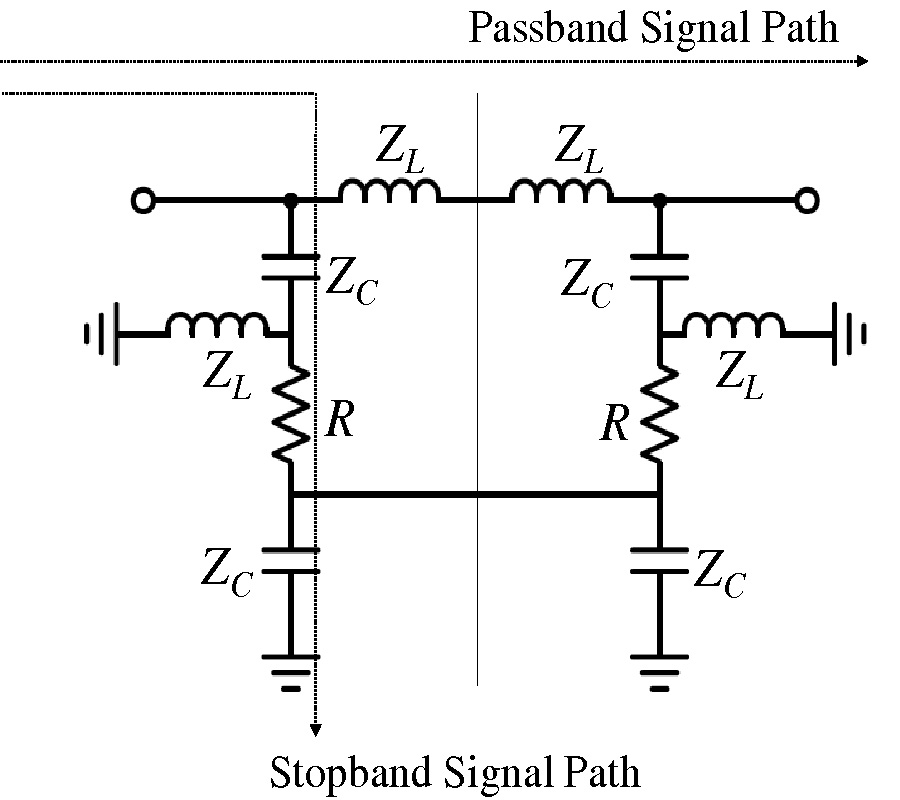
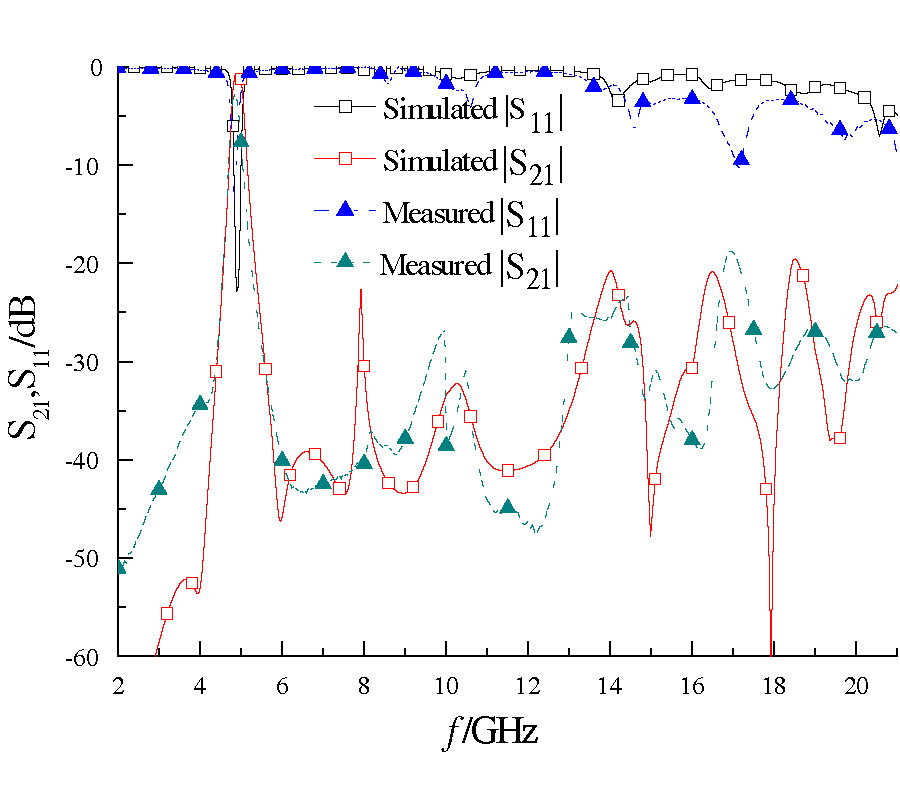
A balanced-to-balanced (BTB) bandpass filter (BPF) with an ultra-wide upper stopband is proposed in this letter. The proposed BPF is fed by balanced stepped-impedance microstrip-to-slotline transition structures. Good differential-mode (DM) transmission and common-mode (CM) suppression can be achieved intrinsically. To achieve good quality in DM passband and out-of-band suppression, a pair of dual-mode resonators has been designed and adopted. Meanwhile, the proposed balanced BPF exhibits an ultra-wide upper stopband of 162.7%. In order to verify the feasibility of the design method, a balanced BPF with a centre frequency of 1.57 GHz has been fabricated and measured. Measured results indicate that the designed filter achieves an out-of-band rejection better than 15 dB from 1.85 to 18 GHz, and the insertion loss (IL) inside the passband less than 1.4 dB. A good agreement between the simulation and measurement results demonstrates the validity of the design.
A BALANCED BANDPASS FILTER WITH ULTRA-WIDE STOPBAND AND COMMON-MODE SUPPRESSION
2018-08-01
PIER M
Vol. 71, 127-136
Dual-Band UHF RFID Tag Antenna Using Two Eccentric Circular Rings
Bidisha Barman , Sudhir Bhaskar and Amit Kumar Singh
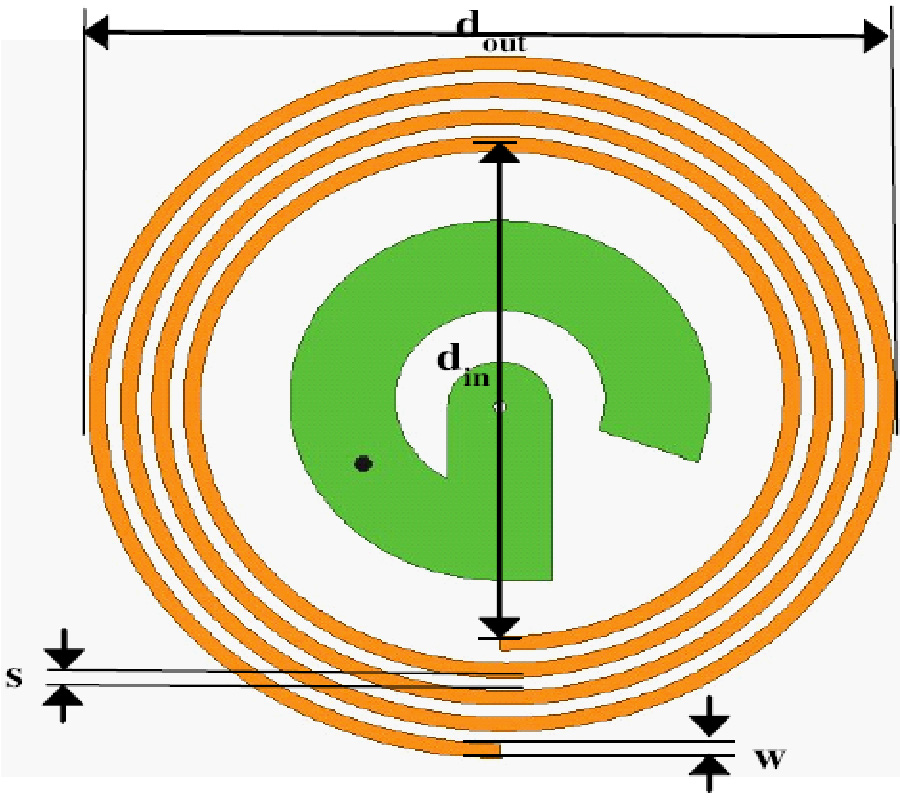
A low profile dual-band passive Ultra High Frequency Radio Frequency Identification (UHF RFID) tag antenna designed to operate at two RFID bands allocated for use in Europe (865-868 MHz) and Japan (950-956 MHz) is proposed. The antenna has two eccentric circular rings of different radii to provide dual band response. An arc-shaped strip with Impinj Monza-4 IC chip is used to feed the two rings simultaneously by microstrip-line coupling-feed technique. The proposed design is simulated using Ansoft HFSS, and the prototype is fabricated. The return losses at 866 MHz and 952 MHz are measured to be -12.25 dB and -12.99 dB, respectively, which are in good agreement with the simulated results. The proposed antenna exhibits a 10 dB bandwidth of 9 MHz from 862 to 870 MHz and an 8 MHz 10 dB bandwidth from 949 to 956 MHz covering the UHF RFID bands in Europe and Japan. The maximum read ranges are measured to be around 3 m in the 865-868 MHz band and 2.6 m in the 950-956 MHz band.
DUAL-BAND UHF RFID TAG ANTENNA USING TWO ECCENTRIC CIRCULAR RINGS
2018-07-31
PIER Letters
Vol. 77, 117-122
Printed Frequency Scanning Antenna Array with Wide Scanning Angle Range
Liaori Jidi , Xiang-Yu Cao , Xuewen Zhu and Bowen Zhu
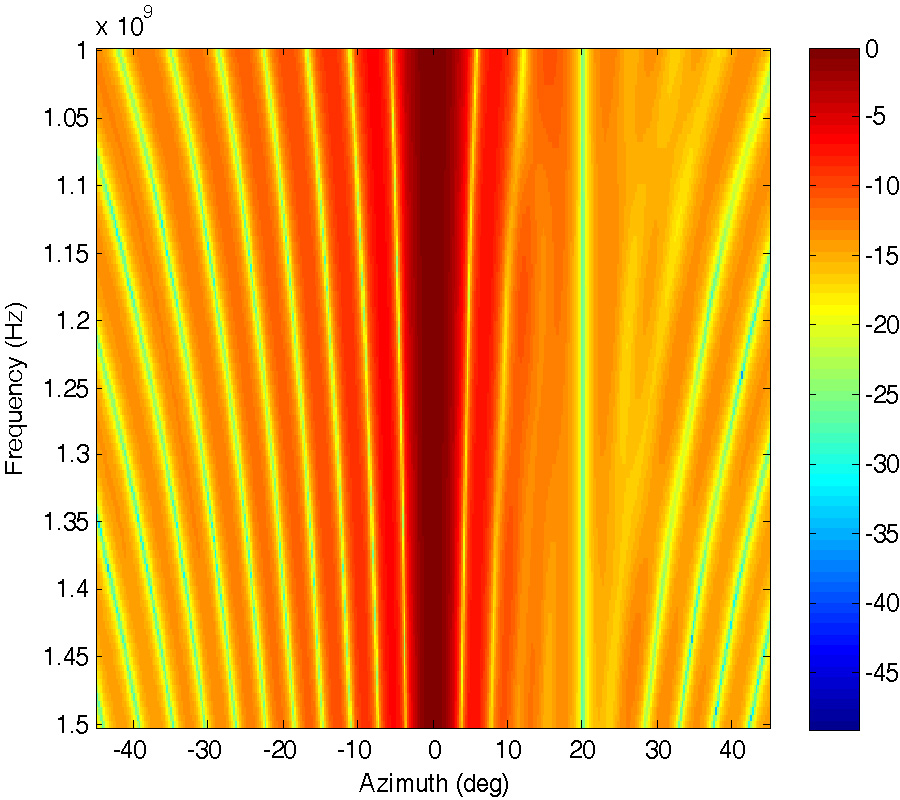
Leaky-wave radiations are usually generated by leaking the electromagnetic energy gradually over a structure. By using the coupling effect and leaky-wave properties, this paper designs a novel 1-D frequency scanning antenna array. The antenna is intended for the direct imaging radar sensors. The simulated results show that the scanning angle can stay in the range from -60˚ to 30˚. The proposed 1-D antenna array was manufactured, and the measured results are consistent with the simulated ones.
PRINTED FREQUENCY SCANNING ANTENNA ARRAY WITH WIDE SCANNING ANGLE RANGE
2018-07-31
PIER M
Vol. 71, 117-125
UCA-NW Algorithm for Space-Time Antijamming
Fulai Liu , Miao Zhang , Xianchao Wang and Ruiyan Du
Space-time antijamming problems cause widespread concern recently in global navigation satellite system. Space-time adaptive procession (STAP) is an effective method to suppress interference signals, which contains two adaptive filters, i.e., spatial filter and temporal filter, and the array pattern can be automatically optimized by adjusting the weights obtained from a prescribed objective function. However, mismatch may occur between adaptive weights and data, due to the change of the interference location when receiver is shaking. In this case, the performance of STAP will degrade dramatically. To solve this problem, an effective nulling widen method based on uniform circular array (named as UCA-NW algorithm) is proposed for space-time antijamming. Through this method, an extension matrix is given to modify the covariance matrix and the formed null can be broadened from azimuth angle and pitch angle, respectively. Thus, this algorithm can suppress interference signals effectively when the receiver is shaking, and the width of nulls can be controlled easily. Simulation results are presented to verify the feasibility and effectiveness of the proposed algorithm.
UCA-NW ALGORITHM FOR SPACE-TIME ANTIJAMMING
2018-07-31
PIER M
Vol. 71, 107-115
High Sensitivity Refractive Index Sensor Based on Metamaterial Absorber
Wei Zhang , Jian-Ying Li and Jian Xie
A metamaterial sensor is designed in this paper which can be used to detect the refractive index of an unknown dielectric loaded on the top surface of a metamaterial absorber. The resonant frequency of the absorber will be changed with various refractive indexes of the loaded dielectrics. Especially, the resonant frequency of the sensor is uniquely related to the refractive index of the unknown dielectric with the constant thickness, the linear relation of which is obtained by simulation fitting. A prototype of the absorber is manufactured and measured, which testify the design theory and simulation results. The Sfre of the proposed sensor is 0.3537GHz/RIU, and the FoM can reach 11.0531RIU-1.
HIGH SENSITIVITY REFRACTIVE INDEX SENSOR BASED ON METAMATERIAL ABSORBER
2018-07-31
PIER
Vol. 162, 109-121
An UWB Antenna Array for Flexible IoT Wireless Systems
Haider Khaleel Raad
In this paper, a flexible compact antenna array operating in the 3.2-13 GHz which covers the standard Ultra-Wide Band (UWB) frequency range is presented. The design is aimed at integration within Multiple Input Multiple Output (MIMO) based flexible electronics for Internet of Things (IoT) applications. The proposed antenna is printed on a single side of a 50.8 μm Kapton Polyimide substrate and consists of two half-elliptical shaped radiating elements fed by two Coplanar Waveguide (CPW) structures. The simulated and measured results show that the proposed antenna array achieves a broad impedance bandwidth with reasonable isolation performance (S12 < -23 dB) across the operating bandwidth. Furthermore, the proposed antenna exhibits a low susceptibility to performance degradation caused by the effect of bending. The system's isolation performance along with its flexible and thin profile suggests that the proposed antenna is suitable for integration within flexible Internet of Things (IoT) wireless systems.
AN UWB ANTENNA ARRAY FOR FLEXIBLE IOT WIRELESS SYSTEMS
2018-07-30
PIER Letters
Vol. 77, 109-115
Terahertz Polariton Dispersion in Uniaxial Optical Crystals
Seiji Kojima
Phonon-polariton is the coupled excitation between optical phonon and photon. The remarkable frequency vs. wavevector dispersion relation of phonon-polariton contributes to important technological applications such as tunable terahertz radiation sources and basic materials science to clarify the terahertz dynamics of condensed matter such as lattice instability in ferroelectrics. This paper studies the broadband dispersion relation of phonon-polariton between 10 cm-1 and 1200 cm-1 in uniaxial ferroeletric crystals, LiNbO3 (LN) and LiTaO3 (LT) with polar trigonal system on the basis of the observed results using THz-Raman spectroscopy, THz time domain spectroscopy, and far-infrared spectroscopy. The dispersion on the lowest-frequency TO mode with A1(z) symmetry of LN and LT crystals, which are assigned as ferroelectric soft modes, is discussed.
TERAHERTZ POLARITON DISPERSION IN UNIAXIAL OPTICAL CRYSTALS
2018-07-30
PIER M
Vol. 71, 95-105
Chip-Package Co-Design for Optimization of 5.8 GHz LNA Performance Based on Embedded Inductors
Haiyan Sun , Wenjun Sun , Ling Sun , Jicong Zhao , Yihong Peng , Jiaen Fang , Xiaoyong Miao and Honghui Wang
This paper presents the design and demonstration of an optimized land grid array (LGA) structure for low noise amplifier (LNA). In order to achieve better circuit performance, the novel chip-package co-design method based on embedded inductors is used. The optimized structure is accurately modeled by ANSYS software. S-parameter is utilized to help in understanding the contributing to the optimized LGA structure. The simulation results for the novel LNA co-design structure show the gain 14.35 dB (> 10 dB), input reflection coefficient -15.63 dB (< -10 dB), output reflection coefficient -24.43 dB (< -10 dB), reverse-isolation -44.7 dB (< -20 dB), and noise figure 2.99 dB (< 4 dB), and indicate that the optimized LGA structure based on embedded inductors is fully capable of supporting 5.8 GHz LNA application.
CHIP-PACKAGE CO-DESIGN FOR OPTIMIZATION OF 5.8 GHZ LNA PERFORMANCE BASED ON EMBEDDED INDUCTORS
2018-07-30
PIER M
Vol. 71, 85-94
A T-Matrix Solver for Fast Modeling of Scattering from Multiple PEC Objects
Lin E. Sun
T matrix characterizes the scattering property of a single PEC object and does not depend on the incidence. In this work, we propose a method to derive a reduced-order T matrix for a single 3D PEC object with arbitrary shape. The method is based on the vector addition theorem and the conventional EFIE, MFIE or CFIE methods. Given the T matrix for a PEC object, the scattered fields can be directly calculated from any incidence. For multiple objects, a matrix equation system is built based on the T-matrix and the position of each object. Finally, numerical examples show the accuracy and efficiency for solving the scattering of both spherical and non-spherical arrays. Compared to the moment methods, the computational cost of solving the final matrix equation is reduced by several orders of magnitude.
A T-MATRIX SOLVER FOR FAST MODELING OF SCATTERING FROM MULTIPLE PEC OBJECTS
2018-07-30
PIER M
Vol. 71, 75-84
A Novel Omnidirectional Triangular Patch Antenna Array Using Dolph Chebyshev Current Distribution for C-Band Applications
Bhupendra Bhadoria and Sumit Kumar
In this paper the design and implementation of a patch antenna array using Dolph Chebyshev current distribution operating in C-Band is demonstrated. The proposed novel omnidirectional triangular patch antenna array is a nonuniform array type with equal or uniform spacing between the antenna elements, but having the nonuniform amplitude excitation with Dolph-Chebyshev current distribution. Dolph-Chebyshev amplitude excitation suppresses the side lobes as well as the designed antenna works like an omnidirectional antenna. The proposed antenna array has a gain of 0.52 dB and return loss of -35.0649 dB which works as an omnidirectional antenna. This proposed antenna is suitable for C-band applications such as Wi-Fi devices, cordless phones, and keyless entry systems.
A NOVEL OMNIDIRECTIONAL TRIANGULAR PATCH ANTENNA ARRAY USING DOLPH CHEBYSHEV CURRENT DISTRIBUTION FOR C-BAND APPLICATIONS
2018-07-30
PIER
Vol. 162, 95-108
A Nanostructure-Based High-Temperature Selective Absorber-Emitter Pair for a Solar Thermophotovoltaic System with Narrowband Thermal Emission
Zhipeng Hu , Yuan Zhang , Liu Liu , Liu Yang and Sailing He
Using absorber-emitter modules, solar thermophotovoltaic (STPV) systems could potentially break through the Shockley-Queisser limit. Efficient spectral selectivity and high temperature endurance are the keys to this technology. In this paper, a high-efficiency selective absorber-emitter module based on refractory material nanostructures is designed for solar thermophotovoltaic applications. Our numerical simulations show that the proposed absorber-emitter module could provide a specified narrowband emission spectrum above the bandgap with optimal bandwidth, and its performance is robust and independent of incident angle and polarization. According to detailed balance calculations, over a broad range of module temperatures, the solar cell efficiency of our design could suprass the Shockley-Queisser limit by 41%.
A NANOSTRUCTURE-BASED HIGH-TEMPERATURE SELECTIVE ABSORBER-EMITTER PAIR FOR A SOLAR THERMOPHOTOVOLTAIC SYSTEM WITH NARROWBAND THERMAL EMISSION
2018-07-29
PIER C
Vol. 86, 55-67
A Broadband Crossed-Slot Circularly Polarized Antenna with Stable Phase Center for GNSS Applications
Hongliang Zhang , Yuanyue Guo , Wenjuan Zhang and Gang Wang
A broadband circularly polarized microstrip antenna with stable phase center is proposed for multi-mode GNSS applications. The proposed antenna consists of two crossed slots on one side of PCB and a Γ-shaped microstrip feeding structure on the other side of PCB. Measurement of the designed antenna demonstrates a -10-dB impedance bandwidth of 76.7% and a 3-dB axial ratio bandwidth of 64% are realized, which cover all GPS, BeiDou, Galileo, and GLONASS bands ranging from 1.164 GHz to 1.612 GHz. In addition, stable phase center for orientation in the region above 10˚ elevation is realized for high-precision positioning. For each GNSS band, phase center variation with respect to its own mean phase center can be retained within 5˚. Over the whole GNSS bands, phase center variation with respect to the common mean phase center is retained within 6˚.
A BROADBAND CROSSED-SLOT CIRCULARLY POLARIZED ANTENNA WITH STABLE PHASE CENTER FOR GNSS APPLICATIONS
2018-07-29
PIER C
Vol. 86, 41-53
Design of Triple-Band MIMO Antenna with One Band-Notched Characteristic
Amit Kumar , Abdul Quaiyum Ansari , Binod Kanaujia , Jugul Kishor and Nidhi Tewari
A microstrip-fed two-port multiple-input-multiple-output (MIMO) antenna has been designed for triple-band applications covering the entire ultra-wideband (UWB) with one band-notched characteristic. A defected ground structure (DGS) has been used to obtain a wideband resonance. A crescent ring has been etched on each of the two circular patch antennas to produce a band-notch characteristic centered at 5 GHz, ranging from 3.96 to 6.2 GHz. These introduce notches at 5.2/5.8 WLAN, 5.5 WiMAX, LMI C-Band and also reject the large capacity microwave relay trunk network, ranging from 4.40 to 4.99 GHz, such as in the Indian national satellite (INSAT) system operating between 4.5 and 4.8 GHz, thus making our MIMO antenna immune to many unlicensed bands. The proposed MIMO antenna elements have been isolated by more than 16 dB throughout the operating band using a modified inter-digital capacitor (MIDC) placed between the circular patch antennas. The MIDC also helps in achieving a center-band, ranging from 6.2 to 8.93 GHz, and is useful in IEEE INSAT/Super Extended C-band. The lower-band ranges from 3.08 to 3.96 GHz and covers 3.5 GHz WiMAX while the upper-band, ranging from 10 to 16 GHz, is useful for X-band and Ku-band applications. Finally, the MIMO antenna has been fabricated on an FR-4 substrate of dimensions 50×30×1.6 mm3 with a compact antenna area of 0.158λ02. All results along with the diversity performance have been experimentally verified.
DESIGN OF TRIPLE-BAND MIMO ANTENNA WITH ONE BAND-NOTCHED CHARACTERISTIC
2018-07-29
PIER Letters
Vol. 77, 103-107
High-Order FDTD with Exponential Time Differencing Algorithm for Modeling Wave Propagation in Debye Dispersive Materials
Wei-Jun Chen and Jun Tang
A high-order (HO) finite-difference time-domain (FDTD) method with exponential time differencing (ETD) algorithm is proposed to model electromagnetic wave propagation in Debye dispersive material in this paper. The proposed method introduces an auxiliary difference equation (ADE) technique which establishes the relationship between the electric displacement vector and electric field intensity with a differential equation in Debye dispersive media. The ETD algorithm is applied to the displacement vector and auxiliary difference variable in time domain, and the fourth-order central-difference discretization is used in space domain. One example with plane wave propagation in a Debye dispersive media is calculated. Compared with the conventional ETD-FDTD method, the results from our proposed method show its accuracy and efficiency for Debye dispersive media simulation.
HIGH-ORDER FDTD WITH EXPONENTIAL TIME DIFFERENCING ALGORITHM FOR MODELING WAVE PROPAGATION IN DEBYE DISPERSIVE MATERIALS
2018-07-28
PIER C
Vol. 86, 29-39
Wideband High-Efficiency Fresnel Zone Plate Reflector Antennas Using Compact Subwavelength Dual-Dipole Unit Cells
Xin Liu , Yin-Yan Chen and Yuehe Ge
In this paper, wideband high-efficiency Fresnel zone plate (FZP) reflector antennas are investigated and developed. Two simple dual-dipole unit cells with different periodicity sizes are first characterized for the design of Fresnel zone plate reflector antennas. The gain bandwidth of the FZP reflector antennas is then theoretically investigated using the two unit cells. Based on the results, a wideband high-efficiency FZP reflector containing 15 correcting zones is designed using the unit cell with a smaller size and quarter-wavelength correction phases. A standard pyramidal horn and a slot-fed patch antenna are applied to feed the FZP reflector alternately. With a feed horn, the wideband high-efficiency radiation performance including a peak gain of 32.1 dBi and an aperture efficiency of 58.2% can be achieved. By using the designed planar feeder, a compact FZP reflector antenna can be obtained with compromised radiation performance. All are demonstrated by experiments.
WIDEBAND HIGH-EFFICIENCY FRESNEL ZONE PLATE REFLECTOR ANTENNAS USING COMPACT SUBWAVELENGTH DUAL-DIPOLE UNIT CELLS
2018-07-27
PIER C
Vol. 86, 17-28
A Broadband 3D Printed Fractal Tree Monopole Antenna
Kathryn Smith and Ryan S. Adams
A broadband monopole antenna is presented, with a radiating body consisting of a fractal tree with three-dimensional conical branches. The effect on polarization and return loss of varying the number of branches, as well as the number of fractal iterations, is explored and presented. The best-case antenna, having five branches and three fractal iterations, was fabricated using a 3D-printed form covered in conductive spray paint. The return loss of this antenna was shown in both simulation and measurement to be better than -10 dB from 1.22 GHz to 24.1 GHz, a bandwidth of more than 180%.
A BROADBAND 3D PRINTED FRACTAL TREE MONOPOLE ANTENNA
2018-07-26
PIER C
Vol. 85, 247-257
Dual-Band Modified Circular Slot Antenna for WLAN and WiMAX Applications
Som Pal Gangwar , Kapil Gangwar and Arun Kumar
In this article, design and analysis of a modified circular slot antenna is discussed. The proposed antenna design is attractive because of two important reasons: (i) modified circular slot creates dual operating bands; (ii) stable radiation characteristics over the operating frequency bands. The complete analysis of proposed radiator has been done on Ansys HFSS simulation software. For verifying the simulated outcomes, a prototype of antenna structure is fabricated and tested. Measured results show that the proposed antenna operates over two frequency bands i.e., 2.88-3.92 GHz and 5.26-6.28 GHz with the fractional bandwidths of 31% and 17% respectively. Experimentally measured average gain of the proposed radiator is 3 dBi and 6 dBi in lower and upper frequency bands, respectively. All these features of the proposed antenna make it appropriate for WiMAX (3.5 GHz) and WLAN (5.8 GHz) applications.
DUAL-BAND MODIFIED CIRCULAR SLOT ANTENNA FOR WLAN AND WIMAX APPLICATIONS
2018-07-26
PIER C
Vol. 85, 235-246
Investigation of Wideband Two Elements Dual Segment Half-Cylindrical Dielectric Resonator Antenna (DS h-CDRA) with RCS Analysis
Pinku Ranjan , Ravi Kumar Gangwar , Abhishek Pratap Singh and Ayush Varshney
In this paper dual segment half Cylindrical Dielectric Resonator Antennas (DS h-CDRA), deploying homogenous elements, are designed and analyzed for wide-band applications. At first a single element is analyzed followed by two element DS h-CDRA. Further, Radar Cross Section (RCS) analysis is performed for different angles and frequencies. The proposed antennas are excited from the center of the ground plane using a coaxial probe feed, which results in TM01δ as a mode of excitation in cylindrical DRA. The input impedance and radiation characteristics are determined and compared with measured results, which shows good agreement. The proposed DS h-CDRA provides measured wide bandwidth (≈ 98%) from 5.0 GHz to 11.5 GHz with gain of 4.85 dBi, and it is found constant throughout the operational band (with omnidirectional radiation pattern). The designed antennas performance has also been compared with two element h-CDRA and found even better for the same volume and effective radiation area. The RCS analysis has been performed for monostatic and bistatic mode at different frequencies and angles. The proposed antenna has been found suitable for 5.0 GHz WLAN and WiMAX wireless application.
INVESTIGATION OF WIDEBAND TWO ELEMENTS DUAL SEGMENT HALF-CYLINDRICAL DIELECTRIC RESONATOR ANTENNA (DS H-CDRA) WITH RCS ANALYSIS
2018-07-26
PIER M
Vol. 71, 63-74
Determination of Power Line Transfer Functions by a Method of Impedance Transfer and Voltage Spread
Thanakorn Khongdeach , Wachira Chongburee and Nattaka Homsup
A novel method to determine the transfer functions of power line networks is presented. Although a number of the evaluation methods have been proposed, the major drawbacks are on approximation, complexity and intuitiveness. The presented method overcomes those by making use of backward impedance transfer and forward voltage transfer techniques. Additionally, the novel method offers an extra feature that transfer functions at any points throughout the network can be simultaneously determined in one implementation. This paper first reviews some major existing methods. Then, the method of impedance and voltage transferring is derived and fulfilled with an implementation algorithm and mathematic description. Lastly, an implementation of the method on a sample network for the transfer function is demonstrated. Channel capacity is adopted as the measure for the quality of the channels.
DETERMINATION OF POWER LINE TRANSFER FUNCTIONS BY A METHOD OF IMPEDANCE TRANSFER AND VOLTAGE SPREAD
2018-07-26
PIER
Vol. 163, 1-13
A Reconfigurable Broadband Dual-Mode Dual-Polarized Antenna for Sectorial/Omnidirectional Mobile Base Stations
Ahmed Alieldin , Yi Huang , Stephen J. Boyes and Manoj Stanley
This paper proposes a new design of reconfigurable three-sector dual-mode dual-polarized antenna for use primarily in mobile communication base stations. The design offers the flexibility to be used as a sectorial (directive) or omnidirectional base station antenna whenever required. The two different radiating modes (omnidirectional and sectorial) depend only on the excitation scenario. The proposed antenna has the advantages of offering broadband, stable radiation pattern and high polarization purity within the desired frequency band, and a simple feeding structure with a remarkable compact size (less than 800 cm3) and low profile. The achieved fractional bandwidth is 55.3% (1.7-3 GHz). The antenna design principle is validated by constructing and testing a prototype with the two modes of operation. An eight-element linear array is then constructed and synthesized as a reconfigurable base station. Results demonstrate how the design may be packaged in a compact size to offer excellent omnidirectional or sectorial performance which makes this new design an ideal candidate for reconfigurable dual-mode mobile base stations.
A RECONFIGURABLE BROADBAND DUAL-MODE DUAL-POLARIZED ANTENNA FOR SECTORIAL/OMNIDIRECTIONAL MOBILE BASE STATIONS