Search Results(13797)

2016-04-13
PIER M
Vol. 47, 171-180
Properties and Applications of Error Coefficient Matrix in Linear Antenna Array Design
Bhargav Appasani
This paper presents the theoretical framework for a new technique in the field of linear antenna arrays with amplitude control called error coefficient matrix. First of all, the array factor is expressed as a summation of contribution from the elements of the array. It will be shown that for small errors in excitation amplitude, the error in the overall radiation pattern at a given angle is a summation of errors contributed by the individual elements of the array at that angle. An error coefficient matrix is proposed, and its properties are discussed in great detail. The accuracy of the proposed method is investigated for varying levels of errors in weights and for varying number of error elements, using Monte-Carlo simulation. Finally, the applications of this new technique in the field of antenna arrays are presented.
PROPERTIES AND APPLICATIONS OF ERROR COEFFICIENT MATRIX IN LINEAR ANTENNA ARRAY DESIGN
2016-04-13
PIER
Vol. 156, 1-12
Metamaterial Antenna Arrays for Improved Uniformity of Microwave Hyperthermia Treatments
David Vrba , Dario Rodrigues and Paul R. Stauffer
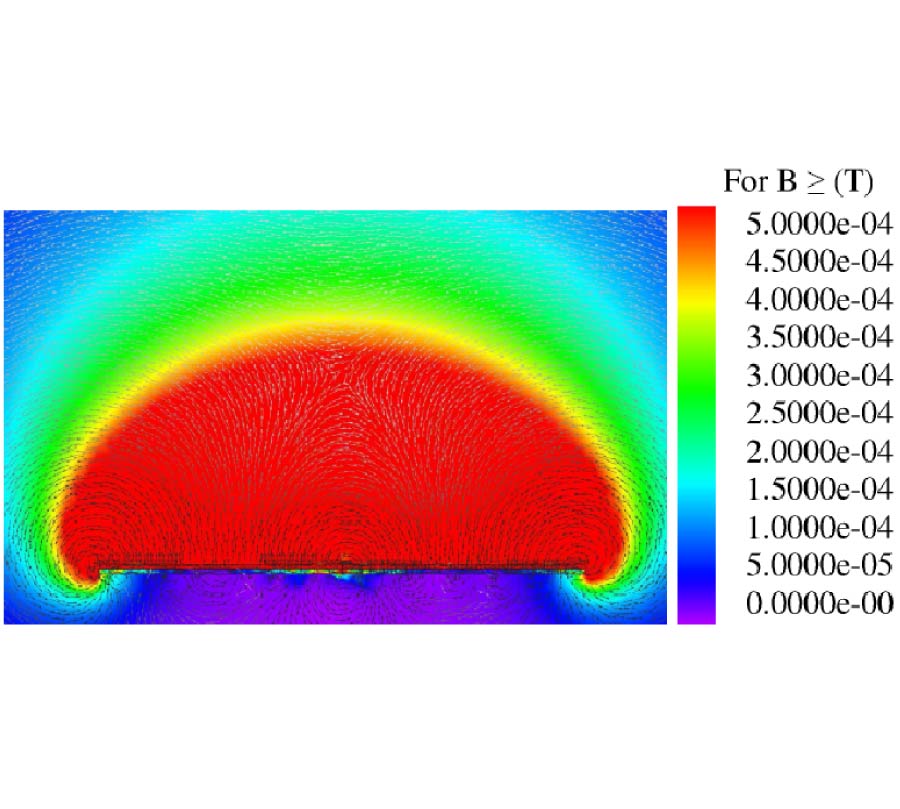
Current microwave hyperthermia applicators are not well suited for uniform heating of large tissue regions. The objective of this research is to identify an optimal microwave antenna array for clinical use in hyperthermia treatment of cancer. For this aim we present a novel 434 MHz applicator design based on a metamaterial zeroth order mode resonator, which is used to build larger array configurations. These applicators are designed to effectively heat large areas extending deep below the body surface and in this work they are characterized with numerical simulations in ahomogenous muscle tissue model. Their performance is evaluated using three metrics: radiation pattern-based Effective Field Size (EFS), temperature distribution-based Therapeutic Thermal Area (TTA), and Therapeutic Thermal Volume (TTV) reaching 41-45°C. For 2×2 and 2×3 array configurations, the EFS reaching > 25% of maximum SAR in the 3.5 cm deep plane is 100% and 91% of the array aperture area, respectively. The corresponding TTA for these arrays is 95% and 86%, respectively; and the TTV attaining > 41°C is over 85% of the aperture area toa depth of over 3 cm in muscle, using either array configuration. With theoretical heating performance exceeding that of existing applicators, these new metamaterial zero order resonator arrays show promise for future applications in large area superficial hyperthermia.
METAMATERIAL ANTENNA ARRAYS FOR IMPROVED UNIFORMITY OF MICROWAVE HYPERTHERMIA TREATMENTS
2016-04-11
PIER Letters
Vol. 59, 109-114
Additive Manufacturing of a Dual-Ridged Horn Antenna
Budhaditya Majumdar , David Baer , Sudipta Chakraborty , Karu P. Esselle and Michale Heimlich
A 3D printed dual-ridged horn antenna (DRHA) is presented. The antenna design is optimized for additive manufacturing and is 3D printed using acrylonitrile butadiene styrene (ABS) and then painted with nickel based aerosol spray. The coaxial transition is also included in the 3D printed prototype. The antenna was manufactured with the intention of improving learning and education of electromagnetism and antennas for undergraduate students using a low-cost personal desktop 3D printer. The painted DRHA has a 10 dB return-loss bandwidth of 6621 MHz (1905 MHz-8526 MHz) with a peak gain of 11 dBi. This prototype is the first known ABS based horn antenna with the coaxial transition embedded into it.
ADDITIVE MANUFACTURING OF A DUAL-RIDGED HORN ANTENNA
2016-04-09
PIER M
Vol. 47, 161-169
Planar Arrangement of Modified Concentric Rings with Defected Ground for Mobile and Wireless Communication Systems
Neelam Choudhary , Ajay Tiwari , Jaswant Singh Saini , Virender Kumar Saxena and Deepak Bhatnagar
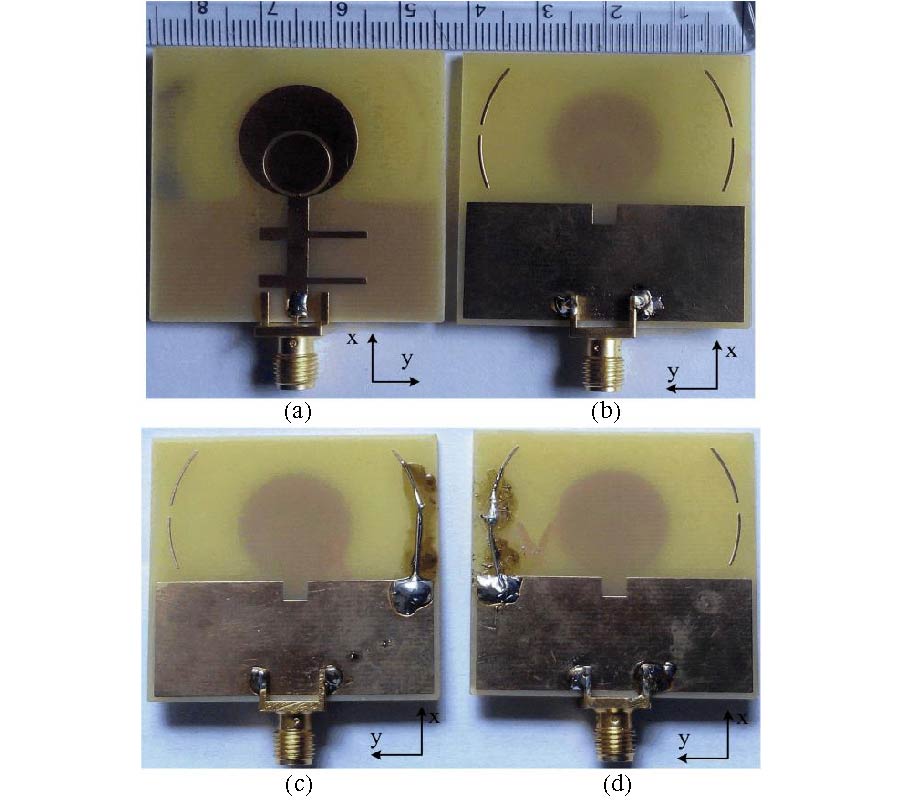
This paper reports the design and performance of a compact planar arrangement of concentric rings designed with defected ground plane. The radiating circular patch and ground plane of antenna are modified in several steps to achieve a broadband circularly polarized antenna. In each stage of modification, antenna is simulated by applying CST Microwave Studio simulator, and finally, a prototype is developed and tested in free space. The developed prototype efficiently operates at frequencies 2.34 GHz and 4.41 GHz, and provides an overall impedance bandwidth close to 2.31 GHz or 67.45% with respect to central frequency 3.425 GHz. This antenna provides nearly flat gain in the desired frequency band with maximum measured gain close to 2.94 dBi at frequency 3.02 GHz. It also provides circularly polarized radiations in the frequency bands extended from 2.67 to 3.05 GHz and 3.44 to 3.57 GHz. The co-polar and cross-polar radiation patterns of the antenna in azimuth and elevation planes are obtained at frequencies 2.316 GHz and 4.41 GHz. The proposed antenna can be used for mobile and lower bands of Wi-Max and UWB communication systems.
PLANAR ARRANGEMENT OF MODIFIED CONCENTRIC RINGS WITH DEFECTED GROUND FOR MOBILE AND WIRELESS COMMUNICATION SYSTEMS
2016-04-09
PIER M
Vol. 47, 151-159
Design of a Compact Patch Antenna Loading Periodic Jerusalem Crosses
Siya Mi and Yee Hui Lee
A compact microstrip antenna loaded with periodic patterns etched in the ground plane is proposed. The etched patterns are Jerusalem crosses which look the same as one of the common electromagnetic band gap structures, uni-planar electromagnetic band gap. In this paper, the dielectric backed with etched ground plane is analysed in terms of metamaterial. The permittivity and permeability are derived from the simulated reflection and transmission coefficients. Then a patch is stacked on the metasubstrate, and the antenna is designed to operate at 2.4 GHz. The proposed antenna has a small dimension in comparison to two other published compact antennas. Compared to the conventional patch antenna, the proposed antenna achieves a 68.38% miniaturization of the patch, and a 2.84 times impedance bandwidth broadening. Furthermore, the operating frequency of the proposed antenna can be tuned over a large range of frequencies by physically adjusting the length of the surrounding slots or by voltage adjusting of the voltage controlled tunable inductive elements. The proposed antenna is fabricated and measured. The measurement results are found to agree well with the simulation ones.
DESIGN OF A COMPACT PATCH ANTENNA LOADING PERIODIC JERUSALEM CROSSES
2016-04-09
PIER M
Vol. 47, 141-149
Wander and Spreading of Gaussian-Schell Model Beams Propagating through Anisotropic Marine-Atmospheric Turbulence
Yuqian Wu , Yixin Zhang and Zhengda Hu
The effects of anisotropic turbulence on the wander and spreading of Gaussian-Schell model beams propagating in non-Kolmogorov marine-atmospheric channel are investigated. Expressions for beam wander and long-term beam spreading are derived in all conditions of marine-atmospheric turbulence. Our results indicate that the beam wander and spreading of Gaussian-Schell model beams are lower in the anisotropic turbulence than the beam in isotropic turbulence. This model can be evaluated ship-to-ship/shore optical laser communication system performance.
WANDER AND SPREADING OF GAUSSIAN-SCHELL MODEL BEAMS PROPAGATING THROUGH ANISOTROPIC MARINE-ATMOSPHERIC TURBULENCE
2016-04-08
PIER Letters
Vol. 59, 101-107
A Novel Compact Feeding Network for Array Antenna
Pejman Mohammadi , Asrin Piroutiniya and Mohamad Hosein Rasekhmanesh
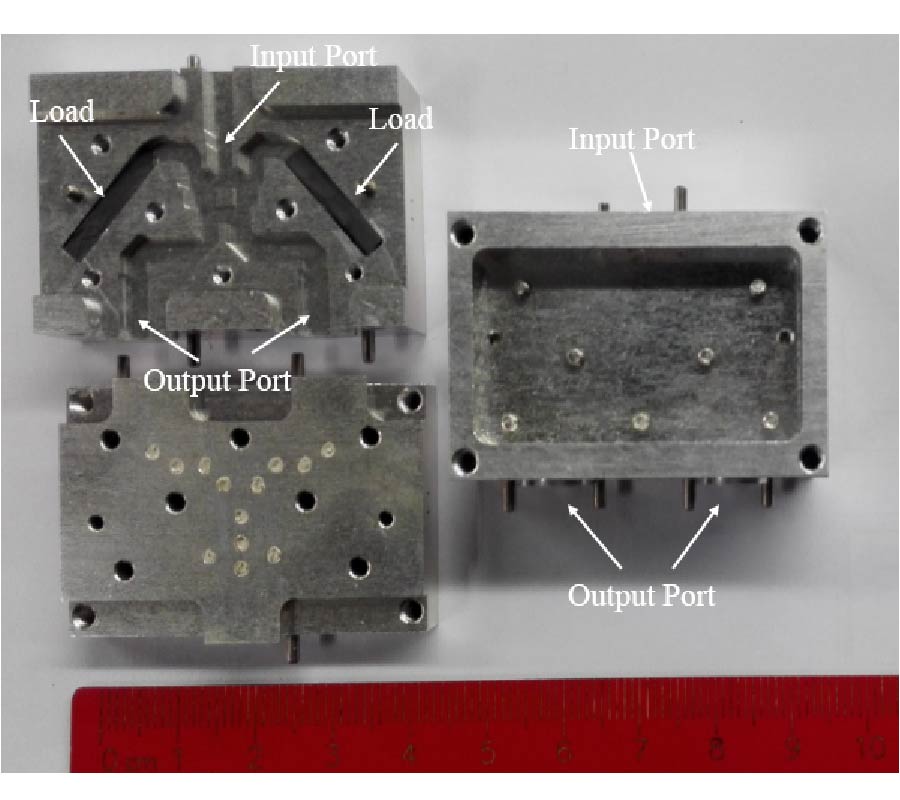
A novel feeding network is investigated both theoretically and experimentally. The proposed system with combination of a Wilkinson power divider and two branch-Line couplers is established. The output signals of the system have the same amplitude and 900 phase difference with each other. The size reduction technique is applied to minimize the physical size of the proposed network. In this technique, the ground of the structure is defected, and distributed capacitors and inductors are added to empty space of the branch-line couplers. Moreover, meandered lines are used in order to match the output impedance of the Wilkinson power divider arms and reduce its size. The initial design realized in 2.5 GHz shows the fractional bandwidth of 24%. Then a miniaturized structure is fabricated with 42% smaller size than the main structure while it shows similar electrical performance. For both cases, measurement and simulation results are in good agreement with each other.
A NOVEL COMPACT FEEDING NETWORK FOR ARRAY ANTENNA
2016-04-07
PIER B
Vol. 67, 59-70
MIMO Antennas for a Terrestrial Point-to-Point Wireless Link: from the Optimum Antenna Spacing to a Compact Array
Xuan Hui Wu , Douglas Smith and Thomas Yang
Multiple-input-multiple-output antennas are investigated for terrestrial point-to-point wireless link. The lack of rich scatters in a terrestrial wireless channel results in an ill-conditioned channel matrix for a long range link with compact arrays, which can cause a high bit error rate. This paper demonstrates that the channel matrix can be improved by carefully selecting the antenna spacing. Unfortunately, an optimum antenna spacing that guarantees a good channel matrix is too large to implement for most long range terrestrial wireless links. On the other hand, a channel capacity study of an 8×8 link reveals that multiple antennas do provide more capacity even with small antenna spacing. Constellation multiplexing is then applied to the compact array configuration to solve the unreliable communication problem. In addition, a multilevel maximum ratio combining technique is introduced to improve detection efficiency.
MIMO ANTENNAS FOR A TERRESTRIAL POINT-TO-POINT WIRELESS LINK: FROM THE OPTIMUM ANTENNA SPACING TO A COMPACT ARRAY
2016-04-07
PIER B
Vol. 67, 45-58
Pattern Synthesis Using Hybrid Fourier-Neural Networks for IEEE 802.11 MIMO Application
Elies Ghayoula , Ridha Ghayoula , Mohamed Haj-Taieb , Jean-Yves Chouinard and Ammar Bouallegue
In this paper, the application of Artificial Neural Network (ANN) with back-propagation algorithm and weighted Fourier method are used for the synthesis of antenna arrays. The neural networks facilitate the modelling of antenna arrays by estimating the phases. The most important synthesis problem is to find the weights of the linear antenna array elements that are optimum to provide the radiation pattern with maximum reduction in the side lobe level. This technique is used to prove its effectiveness in improving the performance of the antenna array. To achieve this goal, antenna array for Wi-Fi IEEE 802.11a with frequency at 2.4 GHz to 2.5 GHz is implemented using Hybrid Fourier-Neural Networks method. To verify the validity of the technique, several illustrative examples of uniform excited array patterns with the main beam are placed in the direction of the useful signal. The neural network synthesis method not only allows to establish important analytical equations for the synthesis of antenna array, but also provides a great flexibility between the system parameters in input and output which makes the synthesis possible due to the explicit relation given by them.
PATTERN SYNTHESIS USING HYBRID FOURIER-NEURAL NETWORKS FOR IEEE 802.11 MIMO APPLICATION
2016-04-06
PIER B
Vol. 67, 31-44
Broadband UHF RFID Tag Antenna for Bio-Monitoring
Daniel Marques , Matthieu Egels and Philippe Pannier
This paper presents the design and fabrication of a broadband UHF RFID tag for bio-monitoring applications. The proposed tag is realized with a thin FR4 substrate of 200 μm, which can be considered as flexible. It shows good performances both in free space and placed on human body. For instance, in free space, the tag can be read at 14 m in the UHF RFID band and at an average distance of 4.6 m when it is placed on the human body. The overall tag size is only 80 mm × 50mm × 200 μm.
BROADBAND UHF RFID TAG ANTENNA FOR BIO-MONITORING
2016-04-06
PIER Letters
Vol. 59, 93-99
Ka-Band Radiation Pattern Reconfigurable Antenna Based on Microstrip MEMS Switches
Zhongliang Deng , Jun Gan , Hao Wei , Hua Gong and Xubing Guo
This paper presents the use of micro-electromechanical systems (MEMS) switches to realize the radiation pattern reconfiguration of microstrip antenna, which works in Ka-band. The antenna was fabricated on a silicon substrate and designed to reconfigure radiation pattern at the operation frequency of 35 GHz. The simulation results show that by controlling the states of MEMS switches between the driven element and two parasitic elements, the antenna can achieve reconfigure into three maximum radiation directions in the H-plane (θ=0°, ψ=90°, θ=14°, ψ=90°, and θ=-14°, ψ=90°, respectively). The measured maximum radiation directions of modes-1, modes-2, modes-3, modes-4 are θ=17°, -25°, 3.5°,0.7° and gains of four modes at the maximum radiation direction are 5.78 dBi, 6.49 dBi, 7.24 dBi, 6.31 dBi, respectively. The measured results are closely consistent with the simulation ones. The proposed antenna can be applied to satellite communication.
KA-BAND RADIATION PATTERN RECONFIGURABLE ANTENNA BASED ON MICROSTRIP MEMS SWITCHES
2016-04-05
PIER B
Vol. 67, 17-30
Polarization Transformation by a Hyperbolic Metamaterial on a Metal Substrate
Illia V. Fedorin
In the present paper we focus on the study of polarization properties of biaxial metamaterial, which consist of alternate ferrite and semiconductor layers, located on an ideally conducted metal substrate. The system is placed into an external magnetic field along the boundaries of the layers. The effective medium theory is applied. Effective linear-to-elliptic polarization conversion has been shown, by means of physical and geometrical parameters of the system under consideration.
POLARIZATION TRANSFORMATION BY A HYPERBOLIC METAMATERIAL ON A METAL SUBSTRATE
2016-04-04
PIER B
Vol. 67, 1-16
Categorized UWB on-Body Radio Channel Modeling for WBANs
Timo Kumpuniemi , Matti Hamalainen , Kamya Yekeh Yazdandoost and Jari Iinatti
A categorized radio channel modeling for wireless ultra-wideband on-body body area networks is discussed. Measurements in an anechoic chamber at fourteen antenna locations are conducted in a 2-8 GHz band. The dipole and double loop antenna types are used. Six link classes are formed based on the antenna spots on the torso, head or limb. The limb-limb and the head-limb links have the lowest and highest path losses, respectively. The head-limb links have the shortest channel impulse responses (CIRs) and limb-limb links the longest ones. The CIR amplitudes follow the inverse Gaussian distribution. The tap indexes and the total excess delays are modeled with the negative binomial distribution. In most cases, the CIRs decay faster for the dipole. Otherwise no major differences exist between the antennas.
CATEGORIZED UWB ON-BODY RADIO CHANNEL MODELING FOR WBANS
2016-04-04
PIER Letters
Vol. 59, 85-91
Compact Broadband Bandpass Filter on Quarter-Mode Substrate Integrated Waveguide Loaded with CRLH Interdigital Slots
Zhihua Wei , Jie Huang , Yanhui Geng , Jing Li and Guoqing Xu
A compact broadband bandpass filter (BPF) on Composite right/left-handed (CRLH) Quarter-Mode Substrate Integrated Waveguide (QMSIW) is presented and analyzed in this paper. A size reduction is implemented by etching the CRLH interdigital slots (CRLH-IS) in the compact QMSIW cavity to introduce a lower resonant frequency less than that of the QMSIW. The influence of the rotation angle of the CRLH-IS on the frequency response of the CRLH QMSIW BPF is analyzed, and the optimal rotation angle is used to implement a BPF with good out-band rejection. The proposed CRLH QMSIW shows the characteristics of low quality factor and high coupling coefficient that make it a good solution to design a broadband bandpass filter. The measured insertion loss is less than 1.8 dB at 4.43 GHz with a fractional bandwidth (FBW) of around 22%. The measured results agree well with the simulated ones.
COMPACT BROADBAND BANDPASS FILTER ON QUARTER-MODE SUBSTRATE INTEGRATED WAVEGUIDE LOADED WITH CRLH INTERDIGITAL SLOTS
2016-04-04
PIER Letters
Vol. 59, 77-84
A New Design Method for Patch Antenna with Low RCS and High Gain Performance
Li-Li Cong , Xiang-Yu Cao , Wenqiang Li and Yi Zhao
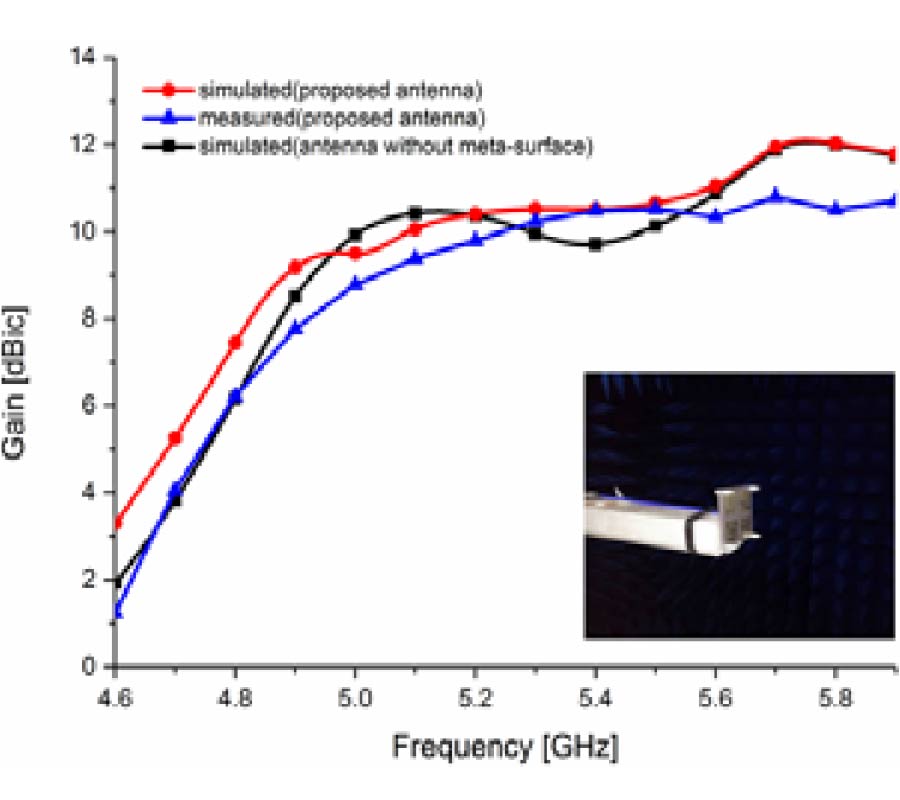
In this letter, a new design for patch antenna, which can obtain low radar cross section (RCS) and high gain performance simultaneously, is proposed on the basis of a metamaterial (MTM) superstrate. The superstrate consists of two metallic layers with different patterns on both sides of a dielectric substrate. Low reflection and transmission are obtained from the upper surface which can absorb most of the incident wave to reduce the antenna RCS. The bottom surface, which has partial reflectivity, is used to construct a Fabry-Perot resonance cavity with the ground plane of the patch antenna to improve its directivity. Measured results show that the proposed antenna can achieve RCS reduction in a broad frequency band ranging from 2 to 14 GHz with maximum RCS reduction value of 28.3 dB, and high gain performance is enhanced by 4.3 dB at most compared with the original antenna in the working frequency band extending from 10.9 GHz to 12 GHz. The measured results agree well with the simulated ones.
A NEW DESIGN METHOD FOR PATCH ANTENNA WITH LOW RCS AND HIGH GAIN PERFORMANCE
2016-04-04
PIER Letters
Vol. 59, 71-75
The Research of Reciprocal Relations for Nonlinear Quadripole in the Magnetic Field
Vyacheslav Ignatjev , Andrey Orlov and Sergey Perchenko
This paper deals with experimental verification of reciprocity relations for nonlinear quadripole, such as Hall transducer. We suppose that the matrix of quadripole resistances can be decomposed into the sum of matrices: linear and nonlinear. We experimentally confirmed the classical reciprocity relations for linear part of matrix of resistances.
THE RESEARCH OF RECIPROCAL RELATIONS FOR NONLINEAR QUADRIPOLE IN THE MAGNETIC FIELD
2016-04-03
PIER Letters
Vol. 59, 63-69
Mutual Coupling Reduction Between Printed Dual-Frequency Antenna Arrays
Lin Li , Yantao Yu and Lijun Yi
A new defected ground structure (DGS) is designed to reduce the mutual coupling of a dual-frequency printed monopole array. The designed dual-frequency DGS consists of two concentric split ring slots. Each split ring slot produces band rejection characteristics at one resonant frequency of the antennas. An effective equivalent circuit model of the DGS section is proposed with the circuit parameters successfully extracted. Good agreement exists among the circuit simulation, EM simulation and experimental results. With the inclusion of the DGS, the measured mutual coupling of the dual-band array has been effectively reduced by 10 dB and 20 dB at two resonant frequencies, respectively.
MUTUAL COUPLING REDUCTION BETWEEN PRINTED DUAL-FREQUENCY ANTENNA ARRAYS
2016-04-02
PIER M
Vol. 47, 129-139
Device-Free Electromagnetic Passive Localization with Frequency Diversity
Wei Ke , Yanan Yuan , Xiunan Zhang and Jianhua Shao
As an emerging wireless localization technique, the electromagnetic passive localization without the need of carrying any device, named device-free passive localization (DFPL) technique has drawn considerable research attentions. The DFPL technique detects the shadowed links in the monitored area and realizes localization with the received signal strength (RSS) measurements of these links. However, the current RSS-based DFPL techniques have two major challenges: one is that the RSS signal is particularly sensitive to noise and another one is that it needs the large number of nodes to provide enough RSS measurements of wireless links to guarantee good performance. To overcome these problems, in this paper we take advantage of compressive sensing (CS) theory to handle the spatial sparsity of the DFPL problem for reducing the number of nodes required by DFPL systems and exploit the frequency diversity technique to deal with the problem of the RSS sensitivity. Meanwhile, inspired by the fact that the target's movement is continuous and the target's current location must be around the last location, we add prior information on the support region into the sparse reconstruction process for enhancing sparse reconstruction performance. The effectiveness and robustness of the proposed scheme are demonstrated by experimental results where the proposed algorithm yields substantial improvement for localization performance.
DEVICE-FREE ELECTROMAGNETIC PASSIVE LOCALIZATION WITH FREQUENCY DIVERSITY
2016-04-01
PIER M
Vol. 47, 121-128
The Age-Dependence of Personal Exposure to Electromagnetic Fields of Wireless Communications in Indoor Environments
Enver Hamiti , Mimoza Ibrani , Luan Ahma , Doruntinё Berisha , Vesa Broja and Rreze Halili
The ever-growing usage of new information and communication technology devices by different age groups is followed with public concerns of exposure induced biological effects. The aim of this paper is to assess and compare personal exposure levels to electromagnetic fields of wireless communications for different age-groups, including children, under the same exposure conditions.Assessment of personal exposure of the following age groups: 08-15, 16-20, 21-35 and 36-60 years old is conducted with sophisticated tri-axial E-field frequency selective personal exposure meters, enabling measurements of electric field strength in 14 pre-defined frequency bands in the range of 80 MHz-6 GHz. Participants are selected to be with similar social conditions and occupation, including children, students and administrative employees. The measurements were conducted in typical residential environments collecting 161 280 measurement samples. The mean value of power density of different wireless technologies is presented for each age-group, including the contribute of specific wireless technology to the total personal exposure. The highest personal exposure values per frequency band for all age groups are in GSM and Wi-Fi 2G. The results show a difference in mean power density levels between different age groups for the same exposure environment. Ultimately, all measured values were far below international safety guidelines and exposure limits.
THE AGE-DEPENDENCE OF PERSONAL EXPOSURE TO ELECTROMAGNETIC FIELDS OF WIRELESS COMMUNICATIONS IN INDOOR ENVIRONMENTS
2016-03-31
PIER M
Vol. 47, 111-120
Calculation of the Image of Extended Objects Placed Behind Metamaterial Slabs
Arnold Kalvach and Zsolt Szabo
The image produced by metamaterial slabs is discussed in a number of papers in terms of the electromagnetic field distribution. In this paper a procedure is proposed to efficiently calculate the image of an extended object placed behind a metamaterial slab as it will be seen by an observer - which can greatly differ from the image formed by the intensity maxima. The first step of the procedure retrieves the dispersion relation of a periodic metamaterial slab from the S parameters calculated with full wave electromagnetic simulation of the unit cell. The second step of the procedure utilizes the retrieved dispersion relation in the transfer matrix method to calculate the image of a point source placed behind the metamaterial slab as a function of the observation angle. Knowing the image distance of the point source for all observation angles, the image of an extended object can be efficiently calculated. The procedure is demonstrated with a Fishnet type metamaterial.
CALCULATION OF THE IMAGE OF EXTENDED OBJECTS PLACED BEHIND METAMATERIAL SLABS