Search Results(13796)

2016-05-05
PIER C
Vol. 63, 209-217
A Slim Composite Antenna with Polarization and Pattern Diversity for WLAN Router Applications
Li Sun , Bao-Hua Sun , Guanxi Zhang and Xiao-Le Zhang
A slim tri-port antenna with polarization diversity and pattern diversity characteristics is presented for 2.45 GHz WLAN router applications. By compositing a J-pole antenna and two perpendicularly crossed dipoles, the proposed antenna achieves available vertical and horizontal polarizations covering the whole horizontal plane. Besides, the two crossed dipoles generate two orthogonal radiation patterns, making it an attractive solution for pattern diversity applications. The three antennas are integrated by sharing the bottom structure of J-pole antenna and the top structure of dipoles, resulting in a slim and compact structure. The proposed antenna is made by copper, with overall volume of only 25.5×25.5×126.5 mm3. Measure results show that return losses of three ports are all better than 10 dB and isolations between each two ports are better than 20 dB from 2.39 GHz to 2.49 GHz. Besides, simple structure, slim size, and light weight make it easy to install vertically on the WLAN routers.
A SLIM COMPOSITE ANTENNA WITH POLARIZATION AND PATTERN DIVERSITY FOR WLAN ROUTER APPLICATIONS
2016-05-05
PIER C
Vol. 63, 193-207
Design Analysis and Modeling of Directional UWB Antenna with Elliptical Slotted Ground Structure for Applications in C- & X-Bands
Madan Lal Meena , Mithilesh Kumar , Girish Parmar and Ram Swaroop Meena
A modified technique to design directional ultra-wideband (UWB) antenna with slotted ground structure approach on the ground plane has been presented for applications in C- and X-bands. Initially, elliptical slot is inserted into ground and thereafter, the axis of ellipse is rotated 45 degrees in direction of the substrate. Minor axis of the ellipse is optimized to locate it symmetrically around the circular patch in order to obtain the full C- and X-band operations and also to enhance directivity. Thereafter, for further improvement in the directivity as well as gain, an elliptical slot in circular patch has also been introduced. The impedance bandwidth approximates about 95% covering the frequency ranging from 4.18-11.50 GHz. The return losses (S11) are -38 dB and -43 dB through simulation, which are -24 dB and -32 dB by measurement at 6.3 GHz, 9.3 GHz resonant frequencies, respectively. Simulated gain and half power beam width (HPBW) are 2.5-8.4 dB and 49-22 degrees in 4.18-11.50 GHz band, respectively. Gain and half power beam width (HPBW) of the proposed antenna improves by 1-2 dB and 5-10 degrees, respectively compared with previously designed antennas. Simulation of the antenna has been carried out on Computer Simulation Technology (CST) software on an FR-4 substrate having dielectric constant 4.3 of thickness 1.6 mm. The measured results show good agreement with equivalent circuit model and CST simulation.
DESIGN ANALYSIS AND MODELING OF DIRECTIONAL UWB ANTENNA WITH ELLIPTICAL SLOTTED GROUND STRUCTURE FOR APPLICATIONS IN C- & X-BANDS
2016-05-05
PIER M
Vol. 48, 87-94
Range Distance Requirements for Large Antenna Measurements for Linear Aperture with Uniform Field Distribution
Sergey P. Skulkin , Victor I. Turchin and Nikolay I. Kascheev
Gain reduction on measurement of distance and on sizes of test and probe antennas are discussed. We consider only the case of linear antenna with uniform field distribution. The analysis is based on time-domain (TD) physical optics (PO) method of field calculation [1]. We show that in determining the level of the side lobe there are two competing effects: (i) the decrease in the amplitude of the signal in the direction of the side lobe and (ii) reducing the maximum signal level in the direction of zero-angle. We show the optimal measurement distance with respect to the acceptable small errors of antenna gain. It is shown that optimal relation β=b/a is about ~0.4 (a and b are the sizes of the antenna under test and the probe antenna). For this optimal relation, the well-known far-field distance criterion R0=2D2/λ can be reduced by 2 times (D is the diameters of the antenna under test and λ is wavelength). Note that when b is optimal, the errors in determining of the sidelobe levels are also small and do not exceed 0.5 dB.
RANGE DISTANCE REQUIREMENTS FOR LARGE ANTENNA MEASUREMENTS FOR LINEAR APERTURE WITH UNIFORM FIELD DISTRIBUTION
2016-05-05
PIER
Vol. 156, 37-46
Meta-Loaded Circular Sector Patch Antenna
Sen Yan and Guy Vandenbosch
A circular sector patch antenna loaded with a periodic metamaterial topology is presented. Several shapes of the circular sector patch are analyzed, and the input impedances and radiation patterns are compared. The topology reveals a nearly constant resonant frequency at zeroth-order resonance (ZOR) while the radiation performance approaches the one of the ZOR full circular patch antenna. Compared with rectangular and circular patch antennas, the sector patch offers more tuning possibilities. A matching network can be easily introduced to enhance the impedance bandwidth. Apart from the ZOR characteristics, this topology can also support a quasi-monopolar pattern at multiple modes. A semicircular patch operating at 4.1 GHz together with an impedance matching network and a dual-band semicircular patch antenna are fabricated and measured.
META-LOADED CIRCULAR SECTOR PATCH ANTENNA
2016-05-04
PIER C
Vol. 63, 183-191
Miniaturized Single-Feed Cross-Aperture Coupled Circularly Polarized Microstrip Patch Antenna
Jianxing Li , Jianying Guo , Anxue Zhang , William Joines and Qing Huo Liu
A novel miniaturized single-feed cross-aperture coupled circularly polarized (CP) microstrip patch antenna loaded by four identical shorting strips is proposed and discussed. Each shorting strip underneath the edges of the radiating patch is connected to the ground plane via an array of three identical and equidistant shorting pins. With the assistance of the capacitance offered by the radiating patch and the shorting strips, and the inductance induced by the shorting pins, the patch size and overall size of the proposed antenna have been significantly reduced by 75% and 69%, respectively, compared with the conventional antenna. An antenna prototype with an overall size of 50 mm×50 mm×7.548 mm (0.317λ0×0.317λ0×0.048λ0) and a patch size of 29.43 mm×27.85 mm (0.186λ0×0.176λ0) has been fabricated and measured, which shows a measured 10-dB return loss bandwidth of 92 MHz (4.76%) from 1.886 to 1.978 GHz with a maximum right-handed CP (RHCP) gain of 4.9 dBic. The measured 3-dB axial ratio (AR) bandwidth is 28 MHz (1.46%) from 1.899 to 1.927 GHz with a 3-dB AR beamwidth of more than 140º across the operating bandwidth.
MINIATURIZED SINGLE-FEED CROSS-APERTURE COUPLED CIRCULARLY POLARIZED MICROSTRIP PATCH ANTENNA
2016-05-04
PIER M
Vol. 48, 77-85
A Dual-Polarized Switchable Active Frequency Selective Surface for LTE-d Band
Chenchen Yang , Huangyan Li , Qunsheng Cao and Yi Wang
A dual-polarized active frequency selective surface (AFSS) with switch function at LTE-D band is proposed in this paper. Double coupled metallic meandered structures on a one-layer substrate loaded PIN diodes are designed carefully to realize the band-pass characteristic at 2.6 GHz when PINs are OFF and the rejection characteristic when PINs are ON. The proposed model requires no additional biasing lines, and the amount of PINs is acceptable and affordable, which contribute to the simplicity and practicality of this AFSS in real applications. A simple equivalent circuit model (ECM) is given to better understand the design. Through full-wave simulation results, the polarization characteristics under TE and TM are almost the same, and the angle-stability stays well till 45˚. For necessary verification, one finite FSS prototype was fabricated, which was changed to one switchable AFSS by welding PINs and external feeder lines. The measured results of transmission coefficient are obtained by free space test method in the microwave anechoic chamber and agree well with the simulated ones.
A DUAL-POLARIZED SWITCHABLE ACTIVE FREQUENCY SELECTIVE SURFACE FOR LTE-D BAND
2016-05-03
PIER B
Vol. 67, 71-90
Topology Measurement of Substation's Grounding Grid by Using Electromagnetic and Derivative Method
Aamir Qamar , Fan Yang , Wei He , Ammad Jadoon , Muhammad Zeeshan Khan and Naidong Xu
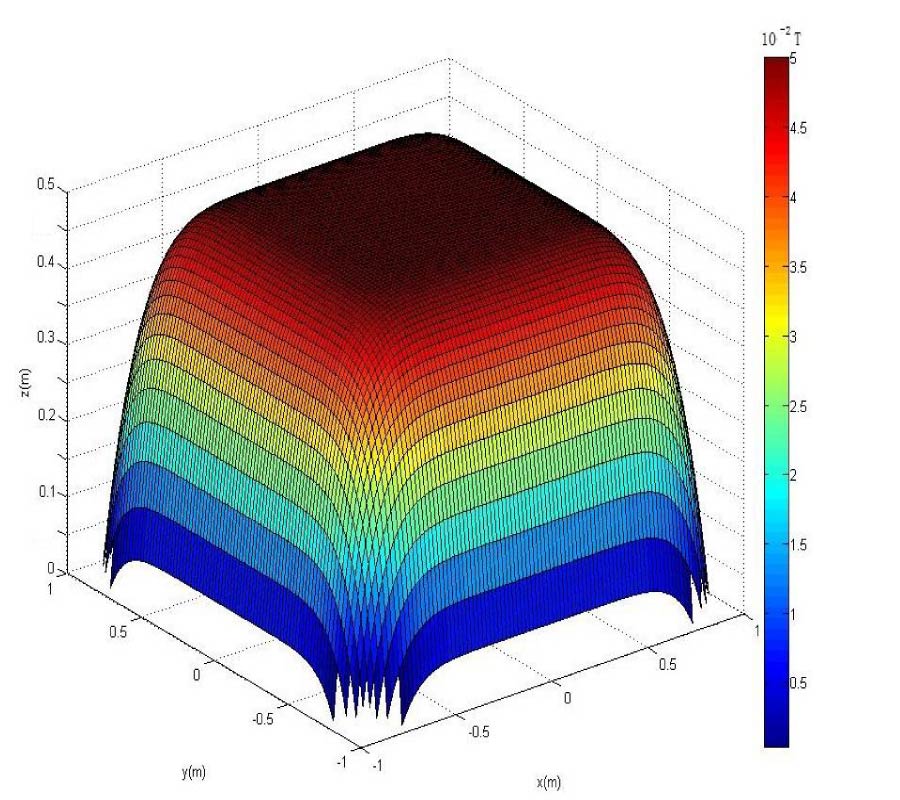
The topology of grounding grid is important for diagnosing its status, which plays a critical role in the safety of personnel and stable operation of power system. The electromagnetic field method and derivative of surface magnetic flux density on the line has been used to measure the branch position in case the grid is parallel to the plane of earth surface that in practice is unknown while the node points and connections were not discussed. This paper introduces a method that uses derivative of surface flux density on circles and lines in a systematic order to find the position of the grid in the plane of the earth surface and connecting the nodes to measure the full topology. This method even identifies any angled branch present in the mesh of a grid. Software simulations and experimental tests verify that the method is feasible and can be applied to identify the topology of a grounding grid.
TOPOLOGY MEASUREMENT OF SUBSTATION'S GROUNDING GRID BY USING ELECTROMAGNETIC AND DERIVATIVE METHOD
2016-05-03
PIER B
Vol. 66, 157-169
Strain and Dispersion Dependence of High Frequency Electromagnetic Properties of Carbon Nanotube/Epoxy Nanocomposites
Gaurav Pandey
An experimental setup and data reduction method has been developed for noninvasive high frequency electromagnetic impedance measurements of carbon nanotube (CNT)/epoxy nanocomposites. Using time domain reflectometry and parallel plate transmission lines, dielectric properties can be measured with the specimen under tensile loading. Good dispersion and addition of CNTs lead to an increase in high frequency dielectric constant of the nanocomposites. A strong strain dependence of the impedance is observed for the well dispersed nanocomposite while the baseline epoxy showed no strain dependence. A mechanism, based on an increase in CNT-CNT tunneling capacitance with applied tensile strain has been suggested. This research is expected to introduce a noninvasive characterization technique for studying electromagnetic properties of conductive nanocomposites.
STRAIN AND DISPERSION DEPENDENCE OF HIGH FREQUENCY ELECTROMAGNETIC PROPERTIES OF CARBON NANOTUBE/EPOXY NANOCOMPOSITES
2016-05-03
PIER C
Vol. 63, 173-182
The Image Phase Approach for the Design of RF MEMS Shunt Switches
Giancarlo Bartolucci , Giorgio De Angelis , Andrea Lucibello , Romolo Marcelli and Emanuela Proietti
In this paper a new method to solve the microwave matching problem of MEMS shunt connected switches is proposed, as an extension of a previously presented approach based on the image parameter formulation. The image phase concept is used to impose the matching condition in the ``on'' state of the device, which is the most critical one. Two different configurations are investigated: a single basic cell and double basic cell topologies. For both of them an analytic modeling procedure is developed, and the equations for the synthesis of the structures are derived. In order to provide some examples, the method has been applied to a previously realized MEMS shunt variable capacitor.
THE IMAGE PHASE APPROACH FOR THE DESIGN OF RF MEMS SHUNT SWITCHES
2016-05-03
PIER C
Vol. 63, 163-171
Influence of Environmental Conditions on EMF Levels in a Span of Overhead Transmission Lines
Oleksandr Okun , Yurii Kravchenko and Leena Korpinen
The paper is devoted to the investigation of electromagnetic field distribution in the vicinity of overhead transmission lines under different environmental conditions, taking into account the wire sag curve in a span. A wire state equation is utilized, which allows one to calculate stresses in the wire and sags based on the known stresses and temperatures in the initial state. The results of the electric and magnetic field distribution on sample 330 kV and 110 kV transmission lines are presented. We show that the highest electromagnetic field levels are associated with the most severe environmental conditions, resulting in the highest sag.
INFLUENCE OF ENVIRONMENTAL CONDITIONS ON EMF LEVELS IN A SPAN OF OVERHEAD TRANSMISSION LINES
2016-05-02
PIER M
Vol. 48, 67-76
Highly Coherent Supercontinuum Generation in the Normal Dispersion Liquid-Core Photonic Crystal Fiber
Zheng Guo , Jinhui Yuan , Chongxiu Yu , Xinzhu Sang , Kuiru Wang , Binbin Yan , Lixiao Li , Shuai Kang and Xue Kang
In this paper, a liquid-core photonic crystal fiber (LCPCF) with small hollow-core filled by chalcogenide material CS2 is designed. The supercontinuum (SC) generation in such a LCPCF with nonlinear coefficient of 3327 W-1•km-1 at 1550 nm and wide normal dispersion regime spanning from 1200 to 2500 nm is numerically studied by solving the generalized nonlinear Schrödinger equation. The influences of the pump pulse parameters on the SC spectral width and coherence are demonstrated, and the optimum pump condition for the SC generation is determined. Our study work can provide an alternative way for obtaining highly coherent SC, which is important for the applications in optical coherence tomography, frequency combs, and ultrashort pulse generation.
HIGHLY COHERENT SUPERCONTINUUM GENERATION IN THE NORMAL DISPERSION LIQUID-CORE PHOTONIC CRYSTAL FIBER
2016-04-29
PIER C
Vol. 63, 153-161
A Compact Dual Band Polyimide Based Antenna for Wearable and Flexible Telemedicine Devices
Haider Khaleel Raad , Hussain M. Al-Rizzo , Ayman Abbosh and Ali I. Hammoodi
Recent wearable health monitoring systems use multiple biosensors embedded within a wireless device. In order to reliably transmit the desired vital signs in such systems, a new set of antenna design requirements arise. In this paper, we present a flexible, ultra-low profile, and compact dual band antenna. The proposed design is suitable for wearable and flexible telemedicine systems and wireless body area networks (WBANs). The antenna is inkjet printed on a 50.8 μm Polyimide Kapton substrate and fed by a Coplanar Waveguide (CPW). The proposed design has the merits of compactness, light weight, wide bandwidth, high efficiency, and mechanical stability. The performance of the antenna is also characterized against bending and rolling effects to assess its behavior in a realistic setup since it is expected to be rolled on curved surfaces when operated. The antenna is shown to exhibit very low susceptibility to performance degradation when tested against bending effects. Good radiation characteristics, reduced fabrication complexity, cost effectiveness, and excellent physical properties suggest that the proposed design is a feasible candidate for the targeted application.
A COMPACT DUAL BAND POLYIMIDE BASED ANTENNA FOR WEARABLE AND FLEXIBLE TELEMEDICINE DEVICES
2016-04-29
PIER C
Vol. 63, 143-152
A Novel Ultra-Wide Band Magneto-Electric Dipole Antenna with Cavity Reflector
Neetu , Ganga Prasad Pandey , Vivekanand N. Tiwari and Sarabjot Singh Marwah
A magneto-electric dipole antenna with novel feed design with rectangular cavity is proposed, fabricated and analyzed. Due to this new feeding structure, the antenna has been able to achieve wide impedance bandwidth of 68.8% to accommodate various wireless communication applications. The stable peak gain of 10.45 dBi with unidirectional radiation pattern has also been reported for the entire range of operation. The antenna has also been able to achieve low cross polarization levels lower than -30 dB. The antenna exhibits low side lobe radiations and almost identical E plane and H plane radiation patterns in the operating frequency range of 2.0 GHz-4.1 GHz. Due to its good electrical characteristics, the antenna is suitable for various S-band wireless communication applications.
A NOVEL ULTRA-WIDE BAND MAGNETO-ELECTRIC DIPOLE ANTENNA WITH CAVITY REFLECTOR
2016-04-28
PIER C
Vol. 63, 131-142
An Experimental Study on the Effect of Commercial Triple Junction Solar Cells on Patch Antennas Integrated on Their Cover Glass
Taha Yekan and Reyhan Baktur
A patch antenna integrated on the cover glass of a commercial space-certified solar cell is examined. Test fixtures were fabricated to study the antenna designed at 4.9 GHz when there was an active solar cell under the antenna. It is found that the solar cell affects the input impedance of the antenna and causes a 2-3 dB gain reduction. Repetitive tests were performed to confirm that the effect from solar cells on the antenna remained the same regardless of the working status of the solar cell, type of cover glass, or the assembly of the solar panel.
AN EXPERIMENTAL STUDY ON THE EFFECT OF COMMERCIAL TRIPLE JUNCTION SOLAR CELLS ON PATCH ANTENNAS INTEGRATED ON THEIR COVER GLASS
2016-04-28
PIER C
Vol. 63, 119-129
A Low Complexity Direction of Arrival Estimation Algorithm by Reinvestigating the Sparse Structure of Uniform Linear Arrays
Fenggang Sun , Peng Lan , Bin Gao and Lizhen Chen
In this paper, we present a new computationally efficient method for direction-of-arrival (DOA) estimation in uniform linear arrays (ULAs). A sparse uniform linear array (SULA) structure is firstly extracted from the conventional ULA to exploit its advantage in high resolution. By performing the multiple signal classification (MUSIC), the noise subspace of the SULA is simultaneously orthogonal to the steering vectors corresponding to the true DOAs and several virtual DOAs, where all the true and virtual DOAs for each source are uniformly distributed in the sine domain. Then we divide the total angular field into several small sectors and search over an arbitrary sector. Finally, the true DOAs can be distinguished by the noise subspace of the original ULA. Since the proposed method involves a limited spectral search and a reduced-dimension noise subspace, hence it is quite computationally efficient. Simulation results are provided to verify the effectiveness of the proposed method in terms of computational complexity, estimation accuracy, and resolution performance.
A LOW COMPLEXITY DIRECTION OF ARRIVAL ESTIMATION ALGORITHM BY REINVESTIGATING THE SPARSE STRUCTURE OF UNIFORM LINEAR ARRAYS
2016-04-28
PIER Letters
Vol. 60, 9-16
A Very Wideband Dipole-Loop Composite Patch Antenna with Simple Feed
Kai He , Peng Fei and Shu-Xi Gong
By combining a horizontal bowtie electric dipole and a vertical rhombic loop antenna which is realized by a pair of folded shorted patches, a very wideband dipole-loop composite patch antenna is designed. Four tuning stubs are attached to the edges of the bowtie dipole to improve the impedance matching. The bowtie dipole and the rhombic loop antenna are excited simultaneously by a simple feed structure which not only forms a folded balun but also makes the antenna itself be direct current grounded. Results show that a wide impedance bandwidth of 121.6% for |S11|<-10 dB from 3.5 to 14.35 GHz is obtained. Good radiation patterns, low back radiation, low cross polarization level, and a peak antenna gain of 7.7 to 9.8 dBi are achieved over the operating bands.
A VERY WIDEBAND DIPOLE-LOOP COMPOSITE PATCH ANTENNA WITH SIMPLE FEED
2016-04-27
PIER C
Vol. 63, 105-117
Design of Flexible Passive Antenna Array on Kapton Substrate
Yvon Georges Rabobason , Greg P. Rigas , Srijittra Swaisaenyakorn , Bobur Mirkhaydarov , Blaise Ravelo , Maxim Shkunov , Paul R. Young and Nabil Benjelloun
Recently, the RF/microwave electronic technology evolved with the consideration of plastic and organic substrates. Such a technology offers two-folded benefits: in one side for lowering the fabrication cost and in another side for the possibility to bend electronic devices. Such a technology is particularly interesting for the implementation of antenna system. This paper is dealing with the design of flexible microstrip antenna 1:2 array. Theoretical approach on the typically symmetrical antenna 1:2 array is proposed. The design methodology of microstrip antenna combined with 1:2 T-power divider (T-PWD) is described. Based on the transmission line theory, the S-parameter model of the antenna system with non-standard reference load is established. Then, the microstrip antenna passive system is theoretical analysed in function of the physical dimensions of the designed structure. The feasibility of the flexible antenna passive system is investigated with the proof-of-concept (POC) designed on Kapton substrate. The POC prototype consisted of microstrip antenna 1:2 array is designed to operate at about 5.8 GHz. Comparisons between the full wave simulated and measured return losses were performed. Then, simulated radiation pattern highlights the efficiency of the fabricated prototype of passive antenna array.
DESIGN OF FLEXIBLE PASSIVE ANTENNA ARRAY ON KAPTON SUBSTRATE
2016-04-27
PIER Letters
Vol. 60, 1-7
Broadband Epsilon Negative Transmission Line Resonant Antenna with AIS Loading
Liang-Yuan Liu and Bing-Zhong Wang
A metamaterial-based broadband antenna loaded with artificial impedance surface (AIS) is presented in this letter. Two metallic vias connect a Y-shaped patch to the ground plane. The patch, two metallic vias, and the AIS compose an epsilon negative (ENG) transmission line (TL). The asymmetry Y shaped patch and the AIS bring about the first-order resonance (FOR) and second-order resonance (SOR) modes, which can be merged into one passband to yield a wideband property. The proposed ENG-TL resonant antenna has the advantages of compact size, wide bandwidth, and high gain, which can be applied to portable and handheld communication system.
BROADBAND EPSILON NEGATIVE TRANSMISSION LINE RESONANT ANTENNA WITH AIS LOADING
2016-04-27
PIER Letters
Vol. 59, 137-143
Transformation-Based Flexible Thermal Hose with Homogeneous Conductors in Bilayer Configurations
Tiancheng Han and Yuhang Gao
Thermal hose is capable of transferring the thermal energy of a finite source to arbitrary long distance. This is achieved by using stretching transformation and can be ideally constructed by using a material with a highly anisotropic thermal conductivity. For practical realization, such a thermal hose can be made of homogeneous conductors in bilayer configurations, employing only copper and expanded polystyrene. It is shown that the thermal energy can be well confined and almost perfectly transferred in an arbitrarily bending hose, demonstrating excellent flexibility. More interestingly is that, when a point heat source is placed at the opening of a split-ring-shaped hose, the temperature of the inner region becomes uniform and reaches nearly as high as the heat source. These novel properties of the proposed flexible thermal hose have been numerically validated in time-dependent case, showing excellent transfer and configuration of thermal energy.
TRANSFORMATION-BASED FLEXIBLE THERMAL HOSE WITH HOMOGENEOUS CONDUCTORS IN BILAYER CONFIGURATIONS
2016-04-27
PIER M
Vol. 48, 55-66
Decreasing the Extremely Low-Frequency Electric Field Exposure with a Faraday Cage During Work Tasks from a Man Hoist at a 400 kV Substation
Herkko Pirkkalainen , Jarmo Elovaara and Leena Korpinen
Earlier studies have shown that the occupational exposure of electric fields at 400 kV substations can be higher than the low action level of 10 kV/m set by the Directive 2013/35/EU. One possibility for decreasing the occupational exposure is to surround the worker with a Faraday cage. The objective of the study was to investigate how effective a Faraday cage is in decreasing the ELF electric field exposure during work tasks from a man hoist at a 400 kV substation. First, we measured the electric field exposure while performing maintenance tasks from a man hoist. We then constructed a Faraday cage around the man hoist and measured the exposure again, with hopes that the exposure would be sufficiently reduced to create a safe working environment. The Faraday cage was constructed from a steel net 0.5 m in width with 19-mm meshes. The net was made of hotdip galvanized steel wire, 1.0 mm in diameter. The net and the man hoist were then grounded. The maximum electric field without the cage was 28.8 kV/m, and with the cage, it was 0.5 kV/m. The electric field, therefore, was decreased by 96.8-99.9%, validating the efficacy of Faraday cages.
DECREASING THE EXTREMELY LOW-FREQUENCY ELECTRIC FIELD EXPOSURE WITH A FARADAY CAGE DURING WORK TASKS FROM A MAN HOIST AT A 400 KV SUBSTATION