Search Results(13798)

2013-07-13
PIER
Vol. 141, 219-231
Dual-Band Polarization Independent Metamaterial Absorber Based on Omega Resoanator and Octa-Star Strip Configuration
Furkan Dincer , Muharrem Karaaslan , Emin Unal and Cumali Sabah
Dual-band metamaterial absorber (MA) with polarization independency based on omega (Ω) resonator with gap and octa-star strip (OSS) configuration is presented both numerically and experimentally. The suggested MA has a simple configuration which introduces flexibility to adjust its metamaterial (MTM) properties and easily re-scale the structure for other frequencies. In addition, the dual-band character of the absorber provides additional degree of freedom to control the absorption band(s). Two maxima in the absorption are experimentally obtained around 99% at 4.0 GHz for the first band and 79% at 5.6 GHz for the second band which are in good agreement with the numerical simulations (99% and 84%, respectively). Besides, numerical simulations validate that the MA could achieve very high absorption at wide angles of incidence for both transverse electric (TE) and transverse magnetic (TM) waves. The proposed MA and its variations enable myriad potential applications in medical technologies, sensors, modulators, wireless communication, and so on.
DUAL-BAND POLARIZATION INDEPENDENT METAMATERIAL ABSORBER BASED ON OMEGA RESOANATOR AND OCTA-STAR STRIP CONFIGURATION
2013-07-12
PIER
Vol. 141, 201-217
Signal Integrity and Electromagnetic Broadband Packaging Model Extraction of Full Differential Bandpass Filter on IPD with BGA Packaging
Sung-Mao Wu , Ren-Fang Hsu and Po Hui Yu
Since the system-level package was proposed, the electronics industry has increasingly attached importance to both directly relevant and related issues, and the scope of system-level package use has increased. Creating more complex system-level package structures, thereby leading to the design of overall electrical effects, requires more electromagnetic simulation resources, and therefore a great deal of time in the design process. The main purpose of this paper is to analyze the effects of system-level packaging, and to establish systems-in-package in accordance with electrical specifications. Using a segmented approach, this paper also builds an overall model for designers to predict electrical characteristics, thus shortening the product development schedule. In this paper, the transmission effects of a substrate are analyzed by changing the length of the substrate transmission line, with or without a thermal ground ball and ground ring. Previously established package IP are cascaded to establish the model of the package substrate, which verifies the feasibility of the package IP. We then analyze the characteristics of the interference between chips and package using an integrated passive device, and propose a complete package equivalent circuit model.
SIGNAL INTEGRITY AND ELECTROMAGNETIC BROADBAND PACKAGING MODEL EXTRACTION OF FULL DIFFERENTIAL BANDPASS FILTER ON IPD WITH BGA PACKAGING
2013-07-12
PIER
Vol. 141, 185-200
Artifact Removal Algorithms for Microwave Imaging of the Breast
Muhammad Adnan Elahi , Martin Glavin , Edward Jones and Martin O'Halloran
One of the most promising alternative imaging modalities for breast cancer detection involved the use of microwave radar systems. A critical component of any radar-based imaging system for breast cancer detection is the early-stage artifact removal algorithm. Many existing artifact removal algorithms are based on simplifying assumptions about the degree of commonality in the artifact across all channels. However, several real-world clinical scenarios could result in greater variation in the early-stage artifact, making the artifact removal process much more difficult. In this study, a range of existing artifact removal algorithms, coupled with algorithms adapted from Ground Penetrating Radar applications, are compared across a range of appropriate performance metrics.
ARTIFACT REMOVAL ALGORITHMS FOR MICROWAVE IMAGING OF THE BREAST
2013-07-12
PIER
Vol. 141, 161-183
Dual-Band Implantable Antennas for Medical Telemetry: A Fast Design Methodology and Validation for Intra-Cranial Pressure Monitoring
Asimina Kiourti , Konstantinos A. Psathas , Jorge R. Costa , Carlos A. Fernandes and Konstantina Nikita
In this study, we suggest and experimentally validate a methodology for fast and optimized design of dual-band implantable antennas for medical telemetry (MICS, 402-405 MHz, and ISM, 2400-2480 MHz). The methodology aims to adjust the design of a parametric dual-band antenna model towards optimally satisfying the requirements imposed by the antenna-fabrication procedure and medical application in hand. Design is performed in a systematic, fast, and accurate way. To demonstrate its effectiveness, the proposed methodology is applied to optimize the parametric antenna model for intra-cranial pressure (ICP) monitoring given a specific antenna-fabrication procedure. For validation purposes, a prototype of the optimized antenna is fabricated and experimentally tested. The proposed antenna is further evaluated within a 13-tissue anatomical head model in terms of resonance, radiation, and safety performance for ICP monitoring. Extensive parametric studies of the optimized antenna are, finally, performed. Feasibility of the proposed parametric antenna model to be optimally re-adjusted for various scenarios is demonstrated, and generic guidelines are provided for implantable antenna design. Dual-band operation is targeted to ensure energy autonomy for the implant. Finite Element (FE) and Finite Difference Time Domain (FDTD) simulations are carried out in homogeneous rectangular and anatomical head tissue models, respectively.
DUAL-BAND IMPLANTABLE ANTENNAS FOR MEDICAL TELEMETRY: A FAST DESIGN METHODOLOGY AND VALIDATION FOR INTRA-CRANIAL PRESSURE MONITORING
2013-07-12
PIER
Vol. 141, 149-160
An Alternative Model for Wave Propagation in Anisotropic Impedance-Matched Metamaterials
Consuelo Bellver-Cebreros and Marcelo Rodriguez-Danta
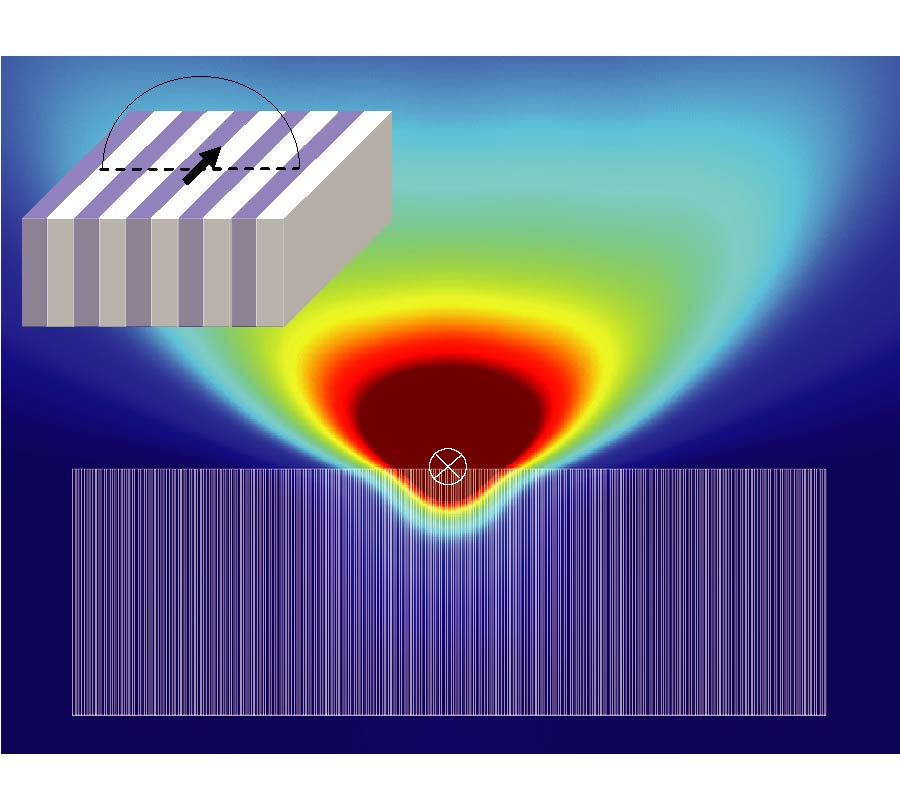
The propagation of light in an anisotropic impedance-matched metamaterial is studied in the frame of geometrical optics. We prove that directions of fields D, B and v (ray velocity) are a triad of conjugate directions with respect to the inverse relative dielectric permittivity tensor and constitutes a local basis, whose reciprocal one is formed by directions of E, H fields and wave-vector k. Consequently, both dual bases are intrinsically related to the physical properties of medium. We have identified these bases with direct and reciprocal bases of a curvilinear coordinates system, showing that physics defines geometry. This identification provides a powerful tool to solve two kinds of problems (direct and inverse ones) that currently arise: In direct problems, medium properties are given and it suffices to know ε = μ tensor at every point, to obtain the wave structure. In inverse problems, medium properties must be found for the rays to propagate along prescribed trajectories. The procedure is applied to an illustrating example.
AN ALTERNATIVE MODEL FOR WAVE PROPAGATION IN ANISOTROPIC IMPEDANCE-MATCHED METAMATERIALS
2013-07-12
PIER
Vol. 141, 135-148
Application of the "Equivalent Cable Bundle Method" for Modeling Crosstalk of Complex Cable Bundles Within Uniform Structure with Arbitrary Cross-Section
Liang Liang Liu , Zhuo Li , Jian Yan and Chang Qing Gu
In this paper, the equivalent cable bundle method (ECBM), an efficient simplified modeling method of the complex cable bundles, is modified for crosstalk prediction of complex cable bundles within uniform structure with arbitrary cross section. The foremost attributes of the modified method are a) the cable bundle within uniform structure with arbitrary cross section can be mapped to equivalent cable bundle above an infinite perfect electric conductor ground plane during the equivalence procedure, b) the culprit and victim conductors are divided into two groups separately during the grouping process, denoted as the culprit group and victim one, which do not participate in the equivalence procedure compared with the original ECBM for crosstalk problem, c) an effective eight-phase procedure is established to define the electrical and geometrical characteristics of the reduced cable bundle model. Numerical simulations performed on a selected cable bundle surrounded by a rectangular cavity illustrate the efficiency and the advantages of the method. This method is considered as a key step for the ECBM to find wide applications in real systems.
APPLICATION OF THE
2013-07-12
PIER
Vol. 141, 117-133
In-Situ Large Area Fabrication of Metamaterials on Arbitrary Substrates Using Paint Process
Pramod Singh , Christopher Mutzel , Samuel MacNaughton and Sameer Sonkusale
This paper proposes a novel method to make large area metamaterials on arbitrary planar hard or flexible substrates, in-situ. The method is based on painting the desired substrate with metallic and dielectric paints through a patterned stencil mask. We demonstrate this painting approach to fabricate ultra-thin perfect electromagnetic absorbers based on metamaterials at X-band frequencies (8-12 GHz) with paper based stencils, silver ink and latex paint. Measurement results on absorber samples made with this process shows absorption of 95%-99%, in close agreement with simulation results. The proposed painting approach is a simple low cost additive manufacturing process that can be used to realize metamaterial based frequency selective surfaces and filters, radar absorbers, camouflage screens, electromagnetic sensors and EMI protection devices.
IN-SITU LARGE AREA FABRICATION OF METAMATERIALS ON ARBITRARY SUBSTRATES USING PAINT PROCESS
2013-07-12
PIER
Vol. 141, 99-116
Direction Finding for Bistatic MIMO Radar Using EM Maximum Likelihood Algorithm
Hao Wen Chen , Degui Yang , Hong-Qiang Wang , Xiang Li and Zhaowen Zhuang
In this paper, we investigate an expectation-maximization (EM) maximum likelihood (ML) algorithm of direction finding (DF) for bistatic multiple-input multiple-output (MIMO) radar, where it is shown that the DF problem can be described as a special case of ML estimation with incomplete data. First, we introduce the signal and the noise models, and derive the ML estimations of the direction parameters. Considering the computational complexity, we make use of the EM algorithm to compute the ML algorithm, referred to EM ML algorithm, which can be applied to the arbitrary antenna geometry and realize the auto-pairing between direction-of-departures (DODs) and direction-of-arrivals (DOAs). Then the initialization is considered. In addition, both the convergence and the Cramer-Rao bound (CRB) analysis are derived. Finally, simulation results demonstrate the potential and asymptotic efficiency of this approach for MIMO radar systems.
DIRECTION FINDING FOR BISTATIC MIMO RADAR USING EM MAXIMUM LIKELIHOOD ALGORITHM
2013-07-12
PIER
Vol. 141, 79-98
Fluctuating Target Detection in Low-Grazing Angle with MIMO Radar
Jincan Ding , Hao Wen Chen , Xiang Li and Zhaowen Zhuang
This paper focuses on the fluctuating target detection in low-grazing angle using Multiple-input Multiple-output (MIMO) radar systems with widely separated antennas, where the multipath effects are very abundant. The performance of detection can be improved via utilizing the multipath echoes, which is equivalent to improve the signal-to-noise ratio (SNR) by using multipath echoes. First, the reflection coefficient considering the curved earth effect is derived. Then, the general signal model for MIMO radar is introduced for fluctuating target in low-grazing angle. Using the Neyman-Pearson sense, the detectors of fluctuating targets, i.e., Swerling 1-4, with multipath are analyzed. Finally, the simulation results show that the performance can be enhanced markedly when the multipath effects are considered.
FLUCTUATING TARGET DETECTION IN LOW-GRAZING ANGLE WITH MIMO RADAR
2013-07-11
PIER B
Vol. 53, 107-125
One-Dimensional Photonic Crystal Selective Filters Design Using Simulated Annealing Optimization Technique
Hadjira Abri Badaoui and Mehadji Abri
During the last decade, selective photonic crystal filters have received much research interest in the fields of nanotechnology and optical interconnection network. The main focus of this paper consists of an analysis and a synthesis of one-dimensional photonic crystal selective filters. The optimization is performed by employing the simulated annealing algorithm. The filters synthesis is obtained by acting on the Bragg grating layer widths. Simulated annealing is applied to solve the PhC-1D filters synthesis problem in order to reduce the quadratic error and to obtain a desired transmission according to a Gaussian function defined in advance by the user. Starting from the Maxwell's equations for dielectric nonmagnetic structure, we show the derivation of the Helmholtz equation and find its solution for 1D layered structure. In addition, the boundary conditions and equation transformation to set of linear equations which are solved using Cramer‟s method are described thoroughly. This mathematical technique is then applied for computation of the transmission spectra of 1D perfectly periodic structure and structures with different defects. These results can be easily applied for design of selective filters.
ONE-DIMENSIONAL PHOTONIC CRYSTAL SELECTIVE FILTERS DESIGN USING SIMULATED ANNEALING OPTIMIZATION TECHNIQUE
2013-07-11
PIER B
Vol. 53, 89-106
Design of Linearity Improved Asymmetrical GaN Doherty Power Amplifier Using Composite Right/Left-Handed Transmission Lines
Yunxuan Feng , Yuan'an Liu , Cuiping Yu , Shulan Li , Jiuchao Li and Xuan Zheng
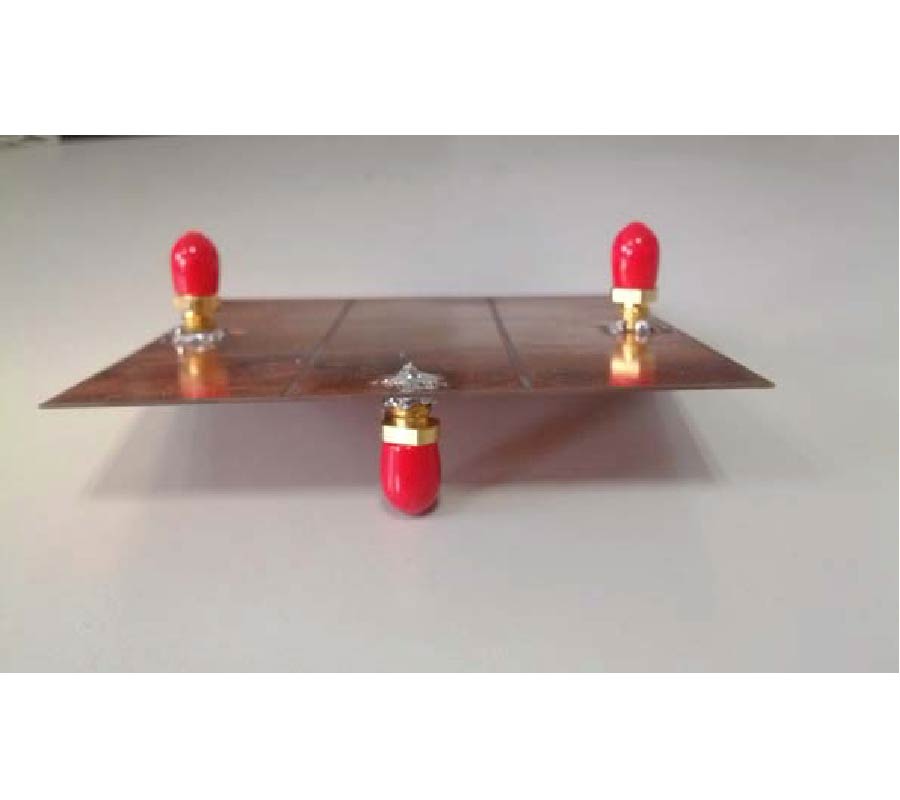
A highly efficient asymmetrical GaN Doherty power amplifier using traditionalλ/4 transmission line and an asymmetrical GaN Doherty power amplifier(DPA) using composite right/left-handed transmission lines(CRLH-TL) for linearity improvement are presented in this paper.The CRLH-TL is designed to suppress the second harmonic of the output of the carrier amplifier. This DPA using CRLH-TL is designed for 3.5 GHz LTE-Advanced Application with 100 MHz bandwidth and 37 dBm average output power, the carrier and peaking amplifiers are fabricated with the same 30 W GaN HEMT and unevenly driven in purpose of maintaining high efficiency at back-off power (BOP) region. At 9-dB and 6-dB BOP, the DE achieves 30% and 40.1%, respectively, and the adjacent channel power ratio(ACPR) are less than-37.1 dBc for 40 MHz 16 QAM signal at 37 dBm. In addition, the further linearization of the DPA is realized by using digital pre-distortion(DPD), the ACPRs are improved to-49.6 dBc for 40 MHz 16 QAM signal.The measured results show linearity improvement compared with the traditional DPA.
DESIGN OF LINEARITY IMPROVED ASYMMETRICAL GAN DOHERTY POWER AMPLIFIER USING COMPOSITE RIGHT/LEFT-HANDED TRANSMISSION LINES
2013-07-11
PIER C
Vol. 41, 239-254
A Compact Wideband Bandpass Filter Using Novel CSRR Loaded QMSIW Resonator with High Selectivity
Hailin Cao , Sijia He , Hao Li and Shizhong Yang
A novel quarter-mode substrate integrated waveguide (QMSIW) resonator with back-to-back triangular complementary split-ring resonators (CSRRs) etched on the waveguide surface is proposed in this paper. The proposed CSRR structures allow the implementation of a forward-wave passband propagating with high selectivity below the characteristic cutoff frequency of the conventional QMSIW. Utilizing the property of flexible open structure on QMSIWs' two sides, a cascaded quadruplet (CQ) bandpass filter (BPF) using the proposed QMSIW resonator and proximity coupling structure is presented. Compared with some other reported BPFs with SIW technique, the presented BPF using the novel QMSIW resonator has great improvements on size reduction and selectivity, simultaneously, with simple geometry. At the center frequency of 3.7 GHz, the designed BPF filter achieves a wideband with a fractional bandwidth up to 24.3% and a high selectivity with a shape factor of 1.23. The compact dimension of this filter is as small as 0.36λg×0.36λg, where λg is the guide wavelength at the center frequency. The proposed filter is simulated, fabricated and tested. The measured results are in good agreement with the simulation.
A COMPACT WIDEBAND BANDPASS FILTER USING NOVEL CSRR LOADED QMSIW RESONATOR WITH HIGH SELECTIVITY
2013-07-11
PIER C
Vol. 41, 227-238
Candidate for Tissue Mimicking Material Made of an Epoxy Matrix Loaded with Alginate Microspheres
Irena Zivkovic , Redouan Mahou , Klaus Scheffler and Christine Wandrey
We present a new composite material containing calcium alginate microspheres incorporated into an epoxy matrix. The new material is mechanically stable and does not degrade over time. Its di-electric properties are extracted by model calculations and compared to the properties of some selected human tissues. Good agreement is observed, which identi es the proposed composite material as a good candidate for the use as a phantom material. The presented material is a two component composite and it is shown how its effective properties can be predicted by using appropriate mixing formulas.
CANDIDATE FOR TISSUE MIMICKING MATERIAL MADE OF AN EPOXY MATRIX LOADED WITH ALGINATE MICROSPHERES
2013-07-10
PIER B
Vol. 53, 73-88
MRI Brain Classification Using Texture Features, Fuzzy Weighting and Support Vector Machine
Umer Javed , Muhammad Mohsin Riaz , Abdul Ghafoor and Tanveer Ahmed Cheema
A technique for magnetic resonance brain image classification using perceptual texture features, fuzzy weighting and support vector machines is proposed. In contrast to existing literature which generally classify the magnetic resonance brain images into normal and abnormal classes, classification with in abnormal brain which is relatively hard and challenging problem is addressed here. Texture features along with invariant moments are extracted and the weights are assigned to each feature to increase classification accuracy. Multi-class support vector machine is used for classification purpose. Results demonstrate that the classification accuracy of the proposed scheme is better than the state of the art existing techniques.
MRI BRAIN CLASSIFICATION USING TEXTURE FEATURES, FUZZY WEIGHTING AND SUPPORT VECTOR MACHINE
2013-07-10
PIER M
Vol. 31, 279-293
A 3-D Unconditionally Stable Laguerre-Rpim Meshless Method for Time-Domain Electromagnetic Computations
Feijiao Liu , Donglin Su and Yilong Zhang
In this paper, a 3-D unconditionally stable meshless method is introduced to simulate time-domain electromagnetic problems. It combines the conventional radial point interpolation method (RPIM) and weighted decaying Laguerre polynomials together to discrete Maxwell's differential equations. The new method called Laguerre-RPIM retains the advantages of both the node-based meshless method and the unconditionally stable scheme of weighted Laguerre polynomials. The accuracy and efficiency of the proposed method are verified through two numeral examples. It can be seen from the computational results that the proposed method has a high accuracy and still remains stable when time step is 10 times of the Courant stability condition. Computational cost can be saved by more than 70% compared with the conventional RPIM method.
A 3-D UNCONDITIONALLY STABLE LAGUERRE-RPIM MESHLESS METHOD FOR TIME-DOMAIN ELECTROMAGNETIC COMPUTATIONS
2013-07-09
PIER C
Vol. 41, 217-226
A Wideband Magneto-Electric Dipole Antenna Using CPW Structure
Jiao-Jiao Xie , Shengliang Deng and Ying-Zeng Yin
A new wideband magneto-electric dipole antenna using coplanar waveguide (CPW) structure is proposed in this paper. The proposed antenna consists of a pair of horizontal triangular patches and two vertically oriented L-shaped strips. By introducing triangular patches working as an electric dipole, the antenna can operate in a wide band. With the use of L-shaped strips equivalent to a magnetic dipole, the antenna is low in profile. A microstrip feed line is located between the two L-shaped strips to form a coplanar waveguide structure and excite the antenna. By carefully adjusting the gap between the feed line and the strips, the impedance bandwidth can be improved largely. A parametric study is performed to provide information for designing and optimizing such an antenna. A prototype is fabricated and measured. The simulated and measured results show that the impedance bandwidth for SWR less than 2 of the proposed antenna is 58.7% (1.95-3.57 GHz). Due to the complementary nature of the antenna, the proposed antenna has a unidirectional radiation pattern with low-polarization and low back-lobe radiation over the whole operating band. Furthermore, the gain of the antenna is stable across the entire bandwidth.
A WIDEBAND MAGNETO-ELECTRIC DIPOLE ANTENNA USING CPW STRUCTURE
2013-07-09
PIER C
Vol. 41, 201-215
A Functional Antenna Tuner for Slot Patch Antenna
Chia-Ching Chu , Lih-Shan Chen , Hsien-Chiao Teng and Shen Cherng
In this paper, without using external power and active components, a design of pin coupled functional antenna tuner is presented. The tuner consists of two parts, a coupling pin and a tuning circuit. It is used to tune the bandwidth and antenna gain of the proposed slot patch antenna. The prototype, including a slot patch antenna and the tuner, was constructed and excited through a T-shape microstrip feed circuit resonated at 2.6 GHz. The impedance bandwidth BW (-10 dB return loss) of the slot patch antenna without coupling to the tuner was 3% referred to the operation frequency at 2.6 GHz. When the tuner was matched with the impedance 75 Ω through the coupling pin to the proposed antenna, the BW of the antenna was increased to 11% operated at 2.6 GHz. However, if the tuner was matched with the impedance 25 Ω to the proposed slot patch antenna, the impedance bandwidth of the antenna was increased 21% at operation frequency. Relatively uniform antenna gain was obtained when the matching impedance was decreased from 75 Ω to 20 Ω. In the meantime, the lower matching impedance corresponds to more reducing cross-polarization of the proposed slot patch antenna can be observed in the measured field patterns.
A FUNCTIONAL ANTENNA TUNER FOR SLOT PATCH ANTENNA
2013-07-09
PIER C
Vol. 41, 189-200
A 6.0 GHz Small Printed Monopole Antenna for Wireless Implantable Body Area Network (Wiban) Applications
Nur Hidayah Ramli , Muhammad Ramlee Kamarudin , Noor Asmawati Binti Samsuri , Ezla Najwa Ahyat , Amuda Yusuf Abdulrahman and Mohd Faizal Bin Jamlos
Wireless implantable body area network (WiBAN) is useful for monitoring vital human parameters in medical diagnosis such as breast cancer, heart attack and high blood pressure. The main objective of this paper is to design a small printed monopole antenna for WiBAN applications at 6.0 GHz. The small implantable antenna was tested in a lossy environment by being submerged into canola oil that mimics the dielectric properties of human breast fat tissue. The antenna performances were measured by using vector network analyzer (VNA) in order to evaluate the return loss and operating bandwidth of the antenna. The other parameters such as efficiency, radiation pattern and gain are evaluated by simulation of CST Studio 2012 software. When compared, there is good agreement between the simulation and measurement results. The simulated antenna gain and efficiency are 5.8 dBi and 97%, respectively, when submerged into canola oil. The antenna radiation pattern is directional, and it has 6 lobes implying its coverage in more directions which is of good benefit due to body movement. The antenna's polarization was tested by placing a wideband antenna at several degrees around the proposed antenna. The value of S21 was also analyzed to investigate the path gain of the selected links.
A 6.0 GHZ SMALL PRINTED MONOPOLE ANTENNA FOR WIRELESS IMPLANTABLE BODY AREA NETWORK (WIBAN) APPLICATIONS
2013-07-09
PIER C
Vol. 41, 175-188
A Homogenous Reference Cells Selector for CFAR Detector in Highly Heterogeneous Environment
Lingjiang Kong , Xin Yi Peng and Tianxian Zhang
This paper considers the radar scenes which contain numerous rapidly changing terrains, i.e., there are more than one clutter-edge in the environment. This kind of radar scenes incurs sharply degradation in the performance of the present adaptive constant false alarm rate (CFAR) detectors as the statistical characteristic of reference cells is highly heterogeneous. To solve this problem, we propose a homogenous reference cells selector to improve the performance of CFAR detector in highly heterogeneous environment. The selector is comprised of an M-N clutter-edge detector cascading a terrain classifier. The M-N clutter-edge detector is used to obtain multiple clutter-edges in heterogeneous environment. With the detected clutter-edges, the terrain classifier is derived to obtain identical distributed range cells. Based on the selector, a modified Log-t-CFAR detector is suggested. Finally, the performance of the proposed selector and CFAR detector is evaluated by measured data and computer simulation.
A HOMOGENOUS REFERENCE CELLS SELECTOR FOR CFAR DETECTOR IN HIGHLY HETEROGENEOUS ENVIRONMENT
2013-07-09
PIER Letters
Vol. 41, 97-104
A Monolayer Multi-Octave Bandwidth Log-Periodic Microstrip Antenna
Fang Lei , Zengrui Li , Qing-Xin Guo , Hui Zhang , Xueqin Zhang , Jie Wang , Guosheng Liu , Jun-Hong Wang and Yaoqing Lamar Yang
In this paper, a novel monolayer multi-octave bandwidth log-periodic microstrip antenna (LPMA) is presented. This antenna consists of a 50 Ω microstrip feed-line and fourteen rectangular patch elements. Twelve rectangular patch elements are fed by edge-coupling from the microstrip feed-line and two other patch elements are directly connected with the microstrip feed-line. A mixed microstrip line feed is applied to expand the bandwidth. Our measured results closely agree with the simulated results. These results show that the proposed antenna lends itself well to operation in the impedance bandwidth from 2 GHz to 8 GHz with a voltage standing-wave ratio (VSWR) less than 2.
A MONOLAYER MULTI-OCTAVE BANDWIDTH LOG-PERIODIC MICROSTRIP ANTENNA