Search Results(13798)

2013-07-09
PIER M
Vol. 31, 263-278
Simulation of SAR Under Ultra-Wide Band Electromagnetic Pulse in Human Tissue
Teng Jiao , Xiao Yu , Hao Lv , Yang Zhang , Hui Jun Xue , Yan Wang and Jianqi Wang
In this study, a three-dimensional (3-D) structural model of an adult male body, including 12 kinds of tissues and organs, was analyzed using a 3-D model design application (i.e., 3ds Max). The standard model of Asians was used as reference. The electrical parameters of brain tissues at different electromagnetic frequencies were introduced to obtain the electromagnetic model. Computational electromagnetic software based on the finite-difference time-domain was used to calculate the model absorption of electromagnetic waves under ultra-wide band electromagnetic irradiation. The specific absorption rates (SARs) of the ensemble average and the model human tissue were also obtained. This study aims to provide a parameter for the development of electromagnetic radiation protection standards, and to discuss related research.
SIMULATION OF SAR UNDER ULTRA-WIDE BAND ELECTROMAGNETIC PULSE IN HUMAN TISSUE
2013-07-09
PIER
Vol. 141, 47-78
Multiband Multimode Arched Bow-Shaped Fractal Helix Antenna
Daotie Li and Jun-Fa Mao
A novel circular arc fractus named Arched Bow-shaped Fractal Curve (ABFC) is originally proposed. Four ABFCs are connected end-to-end, forming so called Arched Bow-shaped Fractal Loop (ABFL). The loop antenna peculiarly presents multiband multimode characteristics with resonance compression. The normal mode, which is pertinent to the loop area and circumference, is found improved with the iterative procedure. Thus, an eight-turned wire helix of small pitch angle (α=3 °) with a circular disc ground called Arched Bow-shaped Fractal Helix (ABFH) antenna is shaped from K2 ABFLs. It can unprecedentedly operate in multiband of axial and off-axial modes with dual-sensed circular polarizations and high gain. Four matched bands (|S11|≤-10 dB) are obtained within 2 GHz-8 GHz, of which f1=2.34 GHz (400 MHz, 17.09%; G=10.63 dBi; RHCP), f2=4.24 GHz (770 MHz, 18.16%; G=12.43 dBi; LHCP), f3=5.48 GHz (300 MHz, 5.47%; G=8.13 dBi; RHCP), and f4=6.98 GHz (960 MHz, 13.75%; G=15.89 dBi; RHCP). The unique multiband multimode property has been theoretically analyzed with illustrations and can be attributed to existence of the fractal boundary, which particularly encloses multiple equivalent loops with considerable areas. These peculiarities make K2 ABFH antenna a very attractive candidate for multiband circularly polarized antennas, especially for space applications, such as spacecrafts communication, remote sensing, and telemetry, where reduction of quantity, height and weight of antennas are urgently wanted. It can also be configured into large array for higher gain service like radars and radio astronomy.
MULTIBAND MULTIMODE ARCHED BOW-SHAPED FRACTAL HELIX ANTENNA
2013-07-09
PIER
Vol. 141, 33-45
A Tri-Band Impedance Transformer Using Stubbed Coupling Line
Xin Huai Wang , Li Zhang , Yin Xu , Yan Fu Bai , Cheng Liu and Xiao-Wei Shi
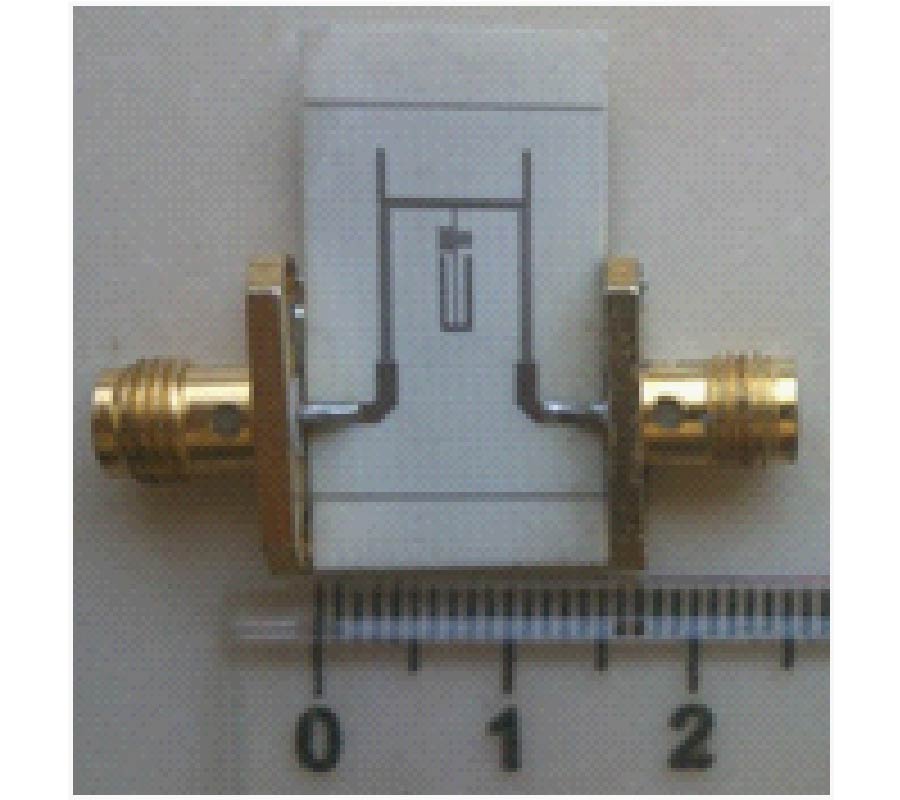
In this paper, a compact tri-band impedance transformer by utilizing stubbed coupling line for matching a load at three arbitrary frequencies is proposed. The transformer is composed of two parts, and each part is constructed from parallel-coupled transmission lines. Two structures with different configurations of the proposed transformer have been given and analyzed. Then, the close-form equations for the transformer parameters are derived analytically, and the corresponding analytical design approach is verified by numerical examples. To certify the validity of design formulas, an impedance transformer is fabricated and measured at 0.9/1.8/3.2 GHz. Good experimental performances at each frequency are obtained, which are in good agreement with the simulated results.
A TRI-BAND IMPEDANCE TRANSFORMER USING STUBBED COUPLING LINE
2013-07-08
PIER B
Vol. 53, 47-71
Wide-Band Secure Compressed Spectrum Sensing for Cognitive Radio Systems
Mostafa El-Khamy , Mohammed Farrag and Mohamed El-Sharkawy
Cooperative wide-band spectrum sensing has been considered to enable cognitive radio operation of wireless regional area networks (WRAN) in the UHF and VHF TV broadcasting bands. In this paper, cooperative compressed spectrum sensing is considered to enable fast sensing of the wide-band spectrum. The speed and accuracy of spectrum sensing are improved by further optimization of the compressed sensing receiver, which is done blindly without any prior knowledge of the sensed signal. Enhanced compressed spectrum sensing algorithms are proposed for the cases of individual spectrum sensing and cooperative spectrum sensing (CSS). The cooperative signal reconstruction process is modified to optimally combine the received measurements at the fusion center. A low complexity authentication mechanism, which is inherent to cooperative compressed spectrum sensing, is proposed to make the cognitive radio system immune to adversary attacks.
WIDE-BAND SECURE COMPRESSED SPECTRUM SENSING FOR COGNITIVE RADIO SYSTEMS
2013-07-08
PIER B
Vol. 53, 25-46
Time-Domain Distributed Parameters Transmission Line Model for Transient Analysis
Luis de Andrade , Helder Leite and Maria Teresa Ponce de Leao
This article describes a time-domain transmission line model based on distributed parameters for transient analysis. This model is based directly on the differential equations for the basic transmission line without any previous simplification. The solution presented here for these differential equations results in a more detailed time-domain model than others models currently in use, and with certain structural similarities with the distributed parameter frequency-domain model for long transmission lines. The deduction of a general time-domain transmission line model for fundamental frequencies parameters and single-phase line are presented in this article, but the model can also be extended to cases with multiconductor and frequency-depended parameters. In order to validate the model, a comparative test is presented to facilitate the analysis about the main similarities and differences between this and other models.
TIME-DOMAIN DISTRIBUTED PARAMETERS TRANSMISSION LINE MODEL FOR TRANSIENT ANALYSIS
2013-07-08
PIER B
Vol. 53, 1-24
Effects of Local Phase Errors in Multi-Look SAR Images
Oleksandr O. Bezvesilniy , Ievgen M. Gorovyi and Dmytro M. Vavriv
The synthetic aperture radar (SAR) is a widely used instrument for high-resolution imaging from aircraft or satellite platforms. In the paper, the problem of the defocusing of multi-look SAR images by uncompensated phase errors presented in the received data is analyzed. It is shown that the phase errors on a multi-look processing interval can be effectively described in terms of local quadratic and local linear phase errors. Approximate analytical expressions are derived to describe the azimuth resolution degradation. Criteria for acceptable phase errors are given. The obtained results are verified by numerical simulations. The approach is illustrated by two typical motion errors: slow deflections of a SAR platform trajectory from a reference flight line and periodic trajectory deviations.
EFFECTS OF LOCAL PHASE ERRORS IN MULTI-LOOK SAR IMAGES
2013-07-08
PIER M
Vol. 31, 247-262
Analysis and Modeling of Power MOSFET Radiation
Sofiene Saidi and Jaleleddine Ben Hadj Slama
This paper deals with the modeling the radiation of the power electronics component: the MOSFET. First, the magnetic near field measurements are made to characterize the radiation of the component. The MOSFET under test is referenced by IRF640 used in DC-DC converter. Second, we have applied the electromagnetic inverse method based on the measured field at 20 MHz to create a model of radiation sources of the MOSFET. The obtained results show a good agreement between the magnetic near field cartography obtained by the developed model and those measured. Finally, the developed model was used to predict the magnetic field in another distance and it wasvalidated with measured cartography.
ANALYSIS AND MODELING OF POWER MOSFET RADIATION
2013-07-08
PIER M
Vol. 31, 231-246
Realization of Linear-to-Circular Polarization Conversion by a Single Bifilar Particle
Alexei Balmakou , Igor V. Semchenko and Masaaki Nagatsu
In this paper, we provide a new theoretical model describing mechanism of electromagnetic radiation (and scattering) by passive single- and double-stranded (bifilar) helices. The proposed model is derived from basic physical principles till the end formulas which were computer processed for predicting a polarization type of the wave scattered by a helix. Comparison of the two types of helical oscillators revealed radical differences in their scattering performance (intensity and polarization). Optimal parameters of the bifilar helix for transformation of the polarization state from linear to circular were found for a non-axial direction of the incident and scattered field. Key features of the proposed model were confirmed by computer simulations.
REALIZATION OF LINEAR-TO-CIRCULAR POLARIZATION CONVERSION BY A SINGLE BIFILAR PARTICLE
2013-07-07
PIER
Vol. 141, 17-32
Automatic Design of Broadband Gradient Index Metamaterial Lens for Gain Enhancement of Circularly Polarized Antennas
Fan-Yi Meng , Rui-Zhi Liu , Kuang Zhang , Daniel Erni , Qun Wu , Li Sun and Joshua Le-Wei Li
A broadband gradient index (GRIN) metamaterial lens for gain enhancement of circularly polarized antennas has been automatically designed, fabricated and investigated. The GRIN metamaterial lens consists of an isotropic dielectric plate with a corresponding distribution of deep-subwavelength drill holes each with the same diameter. Such drill holes have a negligible influence on both the polarization state and the spectral response of the electromagnetic wave transmitting through the resulting GRIN metamaterial lens. Therefore, the GRIN metamaterial lens is polarization-insensitive and can efficiently transform spherical waves into planar waves over a very broad frequency range keeping the initial polarization states (e.g. linear or circular) scarcely changed. In the following we have derived analytical formulas that enable the setup of distribution rules for the drill holes on the plate. Based on these formulas, the GRIN metamaterial lens can be automatically designed and easily fabricated using circuit board engraving machines. The proposed GRIN metamaterial lens has been tested by placing it on the aperture of a circularly polarized conical horn antenna. The agreement between simulation and measurement results shows that the gain of the horn antenna has been significantly increased within the whole X-band (i.e. from 8 GHz to 12 GHz) and the largest gain enhancement reaches up to 5.7 dB. In particular, the axial ratio of the horn antenna with the GRIN metamaterial lens is less than 1.6 dB.
AUTOMATIC DESIGN OF BROADBAND GRADIENT INDEX METAMATERIAL LENS FOR GAIN ENHANCEMENT OF CIRCULARLY POLARIZED ANTENNAS
2013-07-07
PIER
Vol. 141, 1-15
High Definition Electrical Capacitance Tomography for Pipeline Inspection
Marianthe Evangelidis , Lu Ma and Manuchehr Soleimani
Pipelines made of dielectric materials such as Polyethylene (PE) are becoming increasingly popular. With no suitable inspection technique for dielectric pipes, there is an urgent need to develop new technology for their inspection. This paper presents a novel pipe inspection technique using Electrical Capacitance Tomography (ECT) imaging. Traditionally ECT is used for industrial process tomography as a low resolution but fast tomographic imaging technique. Typically commercial ECT can provide a resolution of approximately 10 percent of the imaging region. In this paper a limited region tomography technique is developed take into account prior knowledge about the geometry of the pipe. This has signicantly enhanced the imaging resolution of the ECT system, making it a viable pipe inspection solution. The experimental results in this study demonstrate an interior wall loss area as small as 0.195 percent of the ECT cross sectional imaging region is repeatable and can be reliably detected. A narrowband pass filter method (NPFM) is used as a means to limit the region for the ECT algorithm. This results in an unprecedented resolution, making ECT a viable non-destructive evaluation (NDE) technique for plastic pipes. The NDE application of the ECT for PE pipes is demonstrated in this paper with several experimental results. A wall loss of depth of 1.5 mm could be detected for an ECT sensor array of 150 mm in diameter, showing a high resolution and high definition ECT (HD-ECT) imaging that has not been reported before.
HIGH DEFINITION ELECTRICAL CAPACITANCE TOMOGRAPHY FOR PIPELINE INSPECTION
2013-07-05
PIER
Vol. 140, 813-831
A Unified Fast Solution for the Single/Interferometer/Stereo SAR Geolocation Equation Based on the Rdpc Model
Haifeng Huang and Qingsong Wang
The model based on range and Doppler equations (RD model) is the most precise model for SAR geolocation, and therefore SAR geolocation based on this RD model has become more and more popular. Unfortunately, the RD method requires iterative solution, in most case, which is time-consuming and prone to poor optimization due to observation errors of parameters. In face of the huge mass of measured data from global SAR measurements, how to improve processing speed while maintaining geolocation accuracy is an important problem. This paper examines how to solve the RD geolocation equations for single, interferometric, and stereo SAR. First, the RD geolocation equations for the three kinds of systems are abstracted into a unified equation form. Second, it is determined that the RD geolocation equation can be approximated as a mapping relationship using polynomials. Then a fast solution method for the unified geolocation equation is proposed based on the Range Doppler Polynomial Coefficient Model (RDPC). Third, the accuracy loss of the RDPC model is analyzed, and the precision differences among the three kinds of system are compared. Finally, several groups of TerraSAR-X measured data for the three modes are processed using the fast algorithm. The results show that the fast algorithm greatly reduces the amount of calculation while the geolocation accuracy loss is small. Performance evaluation demonstrates that the proposed method is efficient and correct.
A UNIFIED FAST SOLUTION FOR THE SINGLE/INTERFEROMETER/STEREO SAR GEOLOCATION EQUATION BASED ON THE RDPC MODEL
2013-07-03
PIER Letters
Vol. 41, 87-95
Multi-Band Rectangular Microstrip Antenna Using a Metamaterial-Inspired Technique
Xi-Wang Dai , Zhen-Ye Wang , Long Li and Chang-Hong Liang
A new design methodology for multi-band rectangular microstrip antenna using a metamaterial-inspired technique is proposed. The methodology uses the metal disk with SRR-shaped slot placed horizontally between the patch and the ground plane. With the introduction of the split ring, sub-wavelength resonance can be achieved while the dominant mode of patch cavity remains the same, so the antenna can operate at multi resonant frequencies. Construction of the multi-band antenna requires only the sandwiching of two etched circuit boards. The antenna has the properties of low profile, easy fabrication and low cost. Dual-band and tri-band antennas are fabricated and measured, which validate the design methodology.
MULTI-BAND RECTANGULAR MICROSTRIP ANTENNA USING A METAMATERIAL-INSPIRED TECHNIQUE
2013-07-03
PIER
Vol. 140, 795-812
Experimental Determination of the Performance of Rice Husk-Carbon Nanotube Composites for Absorbing Microwave Signals in the Frequency Range of 12.4-18 GHz
Yeng Seng Lee , Mohd Fareq Bin Abd Malek , Ee Meng Cheng , Wei Wen Liu , You Kok Yeow , Muhammad Nadeem Iqbal , Fwen Hoon Wee , Shing Fhan Khor , Liyana Zahid and Mohd Fariz bin Haji Abd Malek
Composites of rice husks and carbon nanotubes (RHCNTs) are an innovation in improving the absorption of microwave signals. Rice husks, which are an agricultural waste material, have been found to possess a significant propensity for absorbing microwave signals. Studies have shown that both rice husks and carbon nanotubes (CNTs)have high percentages of carbon. Thus, in this paper, we present the results of our experimental study in which we varied the ratios of rice husks and CNTs in the composite materials and determined the dielectric properties of the composites and measured their abilities to absorb microwave signals. The experimental microwave absorber was fabricated using rice husks and CNTs, which increased the dielectric constant and the loss factor.Complex permittivity was measured using an Agilent dielectric probe.The RHCNT compositeswere investigated to determine their reflection loss and absorption performance as microwave absorbers. For the fabricated microwave absorber,we used the rectangular waveguide measurement technique to study reflection loss, transmission loss, and absorption performance in the frequency range of12.4 - 18 GHz. Carbon has an essential role in the absorber due to its ability reflect/absorb microwave signals.Thus, we compared the abilities of a pure rice-husk (PRH) absorber and RHCNT composites absorbers to absorb microwave signals.
EXPERIMENTAL DETERMINATION OF THE PERFORMANCE OF RICE HUSK-CARBON NANOTUBE COMPOSITES FOR ABSORBING MICROWAVE SIGNALS IN THE FREQUENCY RANGE OF 12.4-18 GHZ
2013-07-03
PIER
Vol. 140, 781-794
Millimeter Wave Subharmonic Mixer Implementation Using Graphene Film Coating
George Roberto Hotopan , Samuel Ver-Hoeye , Carlos Vazquez-Antuna , Andreea Hadarig , Rene Camblor-Diaz , Miguel Fernandez-Garcia and Fernando Las Heras Andres
In this work, a subharmonic frequency mixer for millimeter wave applications has been designed. The mixing and multiplication phenomena are simultaneously achieved via a nonlinear component consisting in a microstrip line gap covered by a graphene film coating. The circuit structure is made up of various filters, which have been optimized to ensure high port-to-port isolation. The nonlinear behavior of the subharmonic frequency mixer has been experimentally evaluated within the 39-40.5 GHz RF frequency band. The frequency downconversion is achieved by mixing the RF signal with the second harmonic component of a 17.9 GHz LO signal. Conversion losses are minimized by generating a return path for IF, through the use of a quarter wavelength open-ended stub.
MILLIMETER WAVE SUBHARMONIC MIXER IMPLEMENTATION USING GRAPHENE FILM COATING
2013-07-02
PIER C
Vol. 41, 163-174
Design of a Compact Wideband MIMO Antenna for Mobile Terminals
Xing-Xing Xia , Qing-Xin Chu and Jian-Feng Li
A new broadband multiple-input multiple-output (MIMO) antenna with good isolation and compact size is proposed. The proposed antenna consists of two G-shaped elements in the upper layer and two inverted L protrude branches and a T slot etched in ground which is used to reduce the mutual coupling. This planar antenna has a bandwidth of 100% with |S11| ≤ -10 dB from 2.26 to 6.78 GHz. The value of isolation between the two antenna elements is more than 22.5 dB in the whole band. The experimental results verify the simulations.
DESIGN OF A COMPACT WIDEBAND MIMO ANTENNA FOR MOBILE TERMINALS
2013-07-02
PIER
Vol. 140, 761-779
Body-of-Revolution-Enhanced Imaging in Ultra-Wideband SAR
Fu-Lai Liang , Qian Song , Hanhua Zhang , Tian Jin and Zhi-Min Zhou
For ultra-wideband synthetic aperture radar (UWB SAR), there often exist a lot of clutters in the image, and the weak targets are easy to be masked by them. However, using the prior scattering knowledge of targets, enhanced imaging can be realized and beneficial improvements in image quality and detection performance can be expected. In this paper, an enhanced imaging method for body of revolution (BOR) has been researched. Since the BOR target has the unique feature of aspect-invariant characteristic, the aspect scattering entropy (ASE) is proposed to describe the diversity of aspect scattering and used in the BOR-enhanced imaging method. Then the application of the proposed method in landmine detection is discussed. The experimental results show that the BOR targets are effectively enhanced and the clutters are surpressed and thus the probability of landmine detection increases under the same false alarm rate.
BODY-OF-REVOLUTION-ENHANCED IMAGING IN ULTRA-WIDEBAND SAR
2013-07-02
PIER
Vol. 140, 733-759
Three-Dimensional Micromotion Signature Extraction of Rotating Targets in OFDM-LFM MIMO Radar
Ying Luo , Qun Zhang , Cheng-Wei Qiu , Song Li and Tat Yeo
In monostatic radars systems, only the micromotion signatures projected onto the radar line-of-sight (LOS) can be observed from echoes. As a result, the obtained micromotion signatures (e.g., the radius length of rotation) are sensitive to the radar LOS. In this paper, we propose a method for the accurate estimation of three-dimensional (3-D) micromotion signature with the orthogonal frequency division multiplexing - linear frequency modulation (OFDM-LFM) multi-input multi-output (MIMO) radar technique, which makes use of the advantages of the multi-view of MIMO radar systems and the broad bandwidth of the OFDM-LFM signals. In the proposed method, the Hough transform and Orthogonal Matching Pursuit (OMP) algorithm are introduced to extract the m-D curve features from echoes, and then the 3-D micromotion signatures of the rotating targets are obtained by solving nonlinear multivariable equation systems. The extracted 3-D micromotion signatures are no longer sensitive to the radar LOS, and can provide realistic feature information for target recognition. Simulations are given to validate the effectiveness of the proposed method.
THREE-DIMENSIONAL MICROMOTION SIGNATURE EXTRACTION OF ROTATING TARGETS IN OFDM-LFM MIMO RADAR
2013-07-02
PIER
Vol. 140, 719-732
Far-Field Reconstruction from Near-Field Data Acquired via a Fast Spherical Spiral Scan: Experimental Evidences
Francesco D'Agostino , Flaminio Ferrara , Claudio Gennarelli , Rocco Guerriero and Massimo Migliozzi
A probe-compensated near-field - far-field (NF-FF) transformation with spherical spiral scanning, which makes possible to lower the number of needed measurements, as well as the time required for the data acquisition when characterizing quasi-planar antennas, is experimentally verified in this paper. Such a technique, based on the nonredundant representation of electromagnetic fields, has been achieved by properly applying the unified theory of spiral scans for nonspherical antennas and adopting a very flexible source modelling, formed by two circular "bowls" with the same aperture diameter but different bending radii. A two-dimensional optimal sampling interpolation formula allows one to reconstruct the NF data at any point on the measurement sphere and, in particular, at those required by the classical NF-FF transformation with spherical scanning. The reported NF and FF reconstructions, obtained from the nonredundant samples acquired on the spiral, assess the accuracy of the proposed technique.
FAR-FIELD RECONSTRUCTION FROM NEAR-FIELD DATA ACQUIRED VIA A FAST SPHERICAL SPIRAL SCAN: EXPERIMENTAL EVIDENCES
2013-07-01
PIER B
Vol. 52, 405-423
Scattering Analysis for Ship Kelvin Wakes on Two-Dimensional Linear and Nonlinear Sea Surfaces
Rong-Qing Sun , Min Zhang , Chao Wang and Xiao-Feng Yuan
The ship Kelvin-wake models on two-dimensional (2-D) linear and nonlinear sea surfaces are combined with the second-order small-slope approximation method (SSA-II) to comparatively study the corresponding electromagnetic (EM) scattering characteristics. The nonlinear sea-surface models include the Choppy Wave Model (CWM) and the second-order Creamer model (Creamer (2)). Considering the limitations of using the ideal plane EM wave incident upon a rough sea surface of the limited size, the expressions of the scattered field and scattering amplitude are derived by utilizing the modified tapered incident field. Due to the fact that the nonlinear effects of Creamer (2) surfaces is obviously stronger than those of CWM surfaces, the bistatic normalized radar cross section (NRCS) calculated from Creamer (2) surfaces is significantly greater than that of its linear and CWM surfaces for scattering angles departing from the specular direction, and the backscattering coefficients from Creamer (2) surfaces are also the greatest except within quasi-specular (near vertical incidence) region. In addition, for the linear and nonlinear sea surfaces, the influences of different wind speeds and directions on scattering characteristics are also calculated and analyzed in detail. However, taking the ship Kelvin wakes into account, the corresponding scattering features are obviously distinct from those of the single linear and nonlinear sea surfaces. This helps to provide a basis to extract the related ship information through the scattering characteristics of ship Kelvin wakes. Also it shows that the small-slope approximation method is a very effective analysis method to deal with the EM scattering from the rough sea surface.
SCATTERING ANALYSIS FOR SHIP KELVIN WAKES ON TWO-DIMENSIONAL LINEAR AND NONLINEAR SEA SURFACES
2013-07-01
PIER C
Vol. 41, 151-161
Novel Method to Detect and Recover the Keystrokes of Ps/2 Keyboard
Yu-Lei Du , Ying-Hua Lu and Jinling Zhang
Computer keyboards are often used to transmit confidential data such as passwords. The sensitive information such as keystrokes could be recovered by using the electromagnetic (EM) waves from the electronic components of the keyboard. In this paper, we have investigated the information leakage on the ground line of the PS/2 serial cable due to crosstalk and radiative coupling. The coupling principles are analyzed firstly. And then, through the experiments we found that the signals of keystrokes could leak to the ground line network which could then be detected on the other power outlets whose share the same electric line. Lastly, the eavesdropping experiments demonstrated that the keystrokes could be reproduced on the other places of the ground line network with no trace.
NOVEL METHOD TO DETECT AND RECOVER THE KEYSTROKES OF PS/2 KEYBOARD