Search Results(13786)

2024-10-31
PIER Letters
Vol. 123, 47-54
A Dual-Band High-Isolated MIMO Antenna Based on Compensation Network for 5G Coal Mine Applications
Yanhong Xu , Nanyue Li , Can Cui , Xuhui Fan , Jianqiang Hou and Anyi Wang
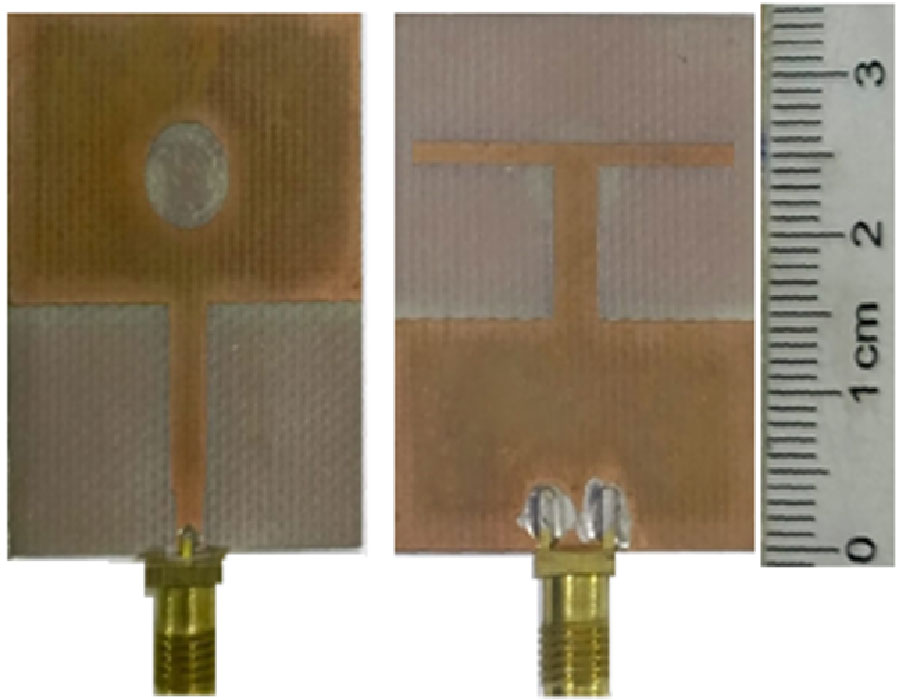
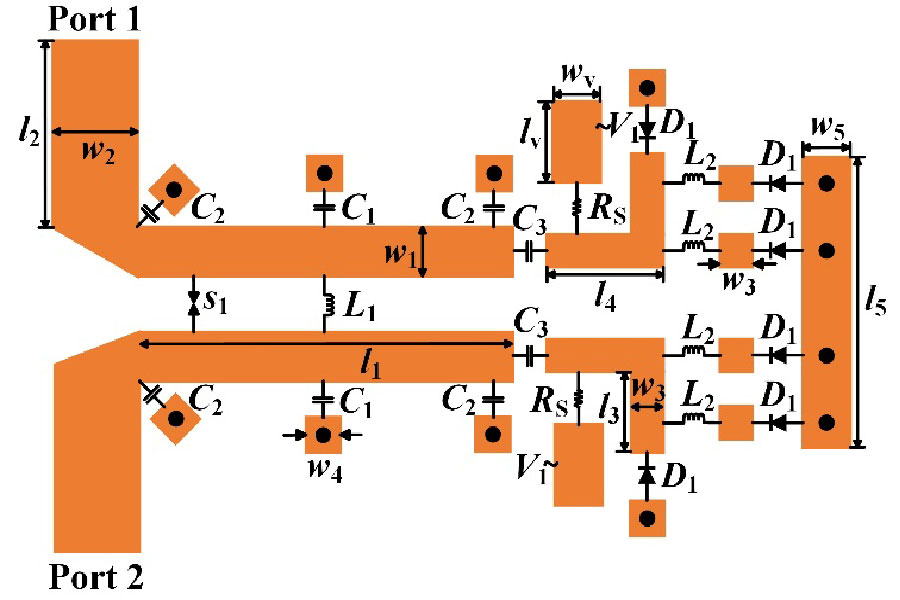
A dual-band MIMO antenna with high isolation is designed in this paper for coal mine applications. Each of the two elements in the designed MIMO antenna is composed of a bident-shaped monopole structure which is designed to cover the 5G NR frequency region (2.51-2.67 GHz, 3.4-3.6 GHz) allocated for coal mine scenario. The two elements are symmetrically placed to achieve high isolation at lower frequency region with an element spacing of 0.09λ at the lowest operating frequency. To further reduce the mutual coupling between the two elements, the decoupling network technique is utilized. In particular, a neutralization line is loaded with an adjustable capacitor and two adjustable inductors on the ground. In this way, an isolation of higher than 20 dB is achieved over the two operating frequency bands for the MIMO antenna, i.e., the isolation is increased by more than 11 dB and 10 dB for the lower and higher bands, respectively. Besides, the good performance of the designed MIMO antenna in terms of correlation values and diversity gain makes it a suitable candidate for 5G MIMO applications under coal mine scenarios.
A Dual-band High-isolated MIMO Antenna Based on Compensation Network for 5G Coal Mine Applications
2024-10-30
PIER C
Vol. 149, 131-141
Digital Non-Foster Impedance Design for Wideband Electrically Small Antennas Beyond the Chu Limit
Christopher Daniel Jr. and Thomas Weldon
Although initial results for the digital implementation of non-Foster impedances showed promise for increasing the bandwidth of electrically small antennas beyond the Chu limit, earlier approximate design methods were inadequate to fully describe the complexity of digital impedance circuits. Recently, the input impedance of such digital impedance circuits was discovered to be dependent on the external source impedance of the driving source. Furthermore, this dependence on the driving source impedance was shown to be extraordinarily complicated, even for a purely resistive driving source. Consequently, the digital non-Foster impedance match of an antenna is considerably more complicated, even with a lumped-element antenna model. In this paper, we present a method for designing a stable wideband digital non-Foster circuit to match the impedance of an electrically small dipole antenna. Simulation results confirm the theoretical predictions and the efficacy of the design method in producing VSWR bandwidth beyond the Wheeler-Chu limit. An RLC model of a 10 MHz electrically small dipole with Q of 215 and passive-tuned bandwidth of 46.5 kHz is chosen to demonstrate the proposed method. For this antenna with Wheeler-Chu bandwidth limit of 442 kHz and size parameter ka = 0.42 rad, the proposed method results in achieving an impedance bandwidth of 2.3 MHz, or more than five times the Wheeler-Chu limit and 48 times the passive-tuned bandwidth. Lastly, the mid-band noise figure is 12.7 dB when the proposed design is combined with a receiver having 3 dB noise figure.
Digital Non-Foster Impedance Design for  Wideband Electrically Small Antennas Beyond the Chu Limit
2024-10-29
PIER C
Vol. 149, 123-130
Research on the Combination of IE3-IE5 Series Energy-Efficient Three-Phase Induction Motor
Chaohui Zhao , Huoda Hu and Wendong Zhang
Motor energy efficiency has gradually become a research hotspot. In this paper, the optimization analysis of motor energy efficiency is carried out for the widely used three-phase induction motors. Based on keeping the stator and rotor structure parameters unchanged, a reasonable combination of motor steel material, winding type, and bar conductor material can realize the change in motor energy efficiency class. Firstly, the influence of stator and rotor steel materials on iron consumption is analyzed using the triple equation of iron consumption. And the loss distribution and efficiency of DW540, DW470, DW360, DW310, DW270, 1J22, and amorphous alloy materials are discussed. Secondly, the effect of different winding types on the no-load reverse electromotive force is analyzed and discussed, and its simulation model is constructed. The corresponding motor efficiency is summarized. Then, the impact of cast copper and aluminum rotors on energy efficiency is compared and analyzed. Finally, the steel material combinations, winding type, and bar conductor material are classified according to the IE3, IE4, and IE5 energy-efficiency classes. The results show that by choosing the right combination, the motor's energy efficiency can be increased by up to 95.3%.
Research on the Combination of IE3-IE5 Series Energy-efficient Three-phase Induction Motor
2024-10-29
PIER C
Vol. 149, 111-121
Multi-Objective Optimization Design of PMa-BSynRM Rotor Structure Based on Macroscopic Parameters and DPCA
Bo Mao , Xiaoyan Diao , Huangqiu Zhu and Jintao Ju
The rotor of PMa-BSynRM, with its multi-layer barriers and permanent magnet, poses a challenge in the design process as both torque system and suspension force system performance need to be considered comprehensively. To solve this problem, a multi-objective optimization method for the rotor structure of PMa-BSynRM is proposed in this paper. Firstly, the harmonic characteristics of PMa-BSynRM air gap magnetic field are analyzed based on the magnetic potential and magnetic permeability method. The expression for suspension force under the coupled magnetic field is derived by combining Maxwell tensor method. This analysis reveals the relationship between magnetic field characteristics and suspension force, providing guidance for subsequent optimization design. Secondly, through the analysis of the rotor structure, the macroscopic parameters related to the micro and detailed geometric optimization of the PMa-BSynRM rotor are proposed. Based on these macroscopic parameters, the response surface method and dual-population-based co-evolutionary algorithm (DPCA) are applied to realize a compromise among the optimization objectives. Finally, the proposed optimization method is comprehensively analyzed through simulation analysis and prototype experiment. The simulation and experimental results demonstrate a reduction of 51% in optimized torque ripple and 74% in suspension force ripple, as well as a decrease of 3.2˚ in the suspension force error angle. After optimization, the performance of the motor torque and suspension force system is significantly improved, thus verifying the effectiveness and superiority of the proposed optimization method.
Multi-objective Optimization Design of PMa-BSynRM Rotor Structure Based on Macroscopic Parameters and DPCA
2024-10-29
PIER C
Vol. 149, 105-109
A Low Profile 20-Bit Frequency-Coded L-Shape Multi-Slot Resonator for Chipless RFID Applications
Narayanan Saranya , Thangarasu Deepa , Periyasamy Raja , Kumar Paayal , Arunagiri Sofiya and Raju Swetha
This research work investigates the performance of a novel low profile 20-bit frequency coded L-shape slot loaded resonator for chipless RFID applications. The proposed chipless RFID comprises a CPW-fed UWB radiator and an L-shaped multi-slot resonator to achieve 20-bit data capacity. CPW technique is implemented to enhance antenna bandwidth and radiation characteristics. The designed UWB radiator covers the entire band from 3 to 12 GHz with better return loss. Also, the peak gain is measured as 6 dBi in the respective frequency spectrum. The proposed L-shaped frequency-coded multi-slot resonator is developed with a compact size of 23.6×14.1×1.6 mm3. Moreover, the frequency coding technique allows for a wide range of frequency combinations for data representation, as well as contributes to reducing the RFID tag size. The research holds significance in propelling RFID technology forward and ushering in a new era of small, efficient, and flexible data encoding solutions.
A Low Profile 20-bit Frequency-coded L-shape Multi-slot Resonator for Chipless RFID Applications
2024-10-28
PIER C
Vol. 149, 95-103
A Compact UHF RFID Tag Antenna with Tunable Double Interdigitated Structures
Luoxin Cai , Zibin Shi , Yanwei Qiu and Jiade Yuan
A compact and tunable ultra-high frequency (UHF) radio frequency identification (RFID) tag antenna is proposed. The antenna comprises a rectangular ring, two symmetrical radiating arms formed by multiple L-shaped stubs, and two interdigitated structures. By adjusting the parameters of double interdigitated structures, the resonant frequency of the antenna can be tuned coarsely and finely, while maintaining a nearly constant maximum power transmission coefficient. The proposed tag antenna has a size of 28 mm x 16 mm (0.086λ x 0.049λ at 920 MHz). Measurement results show that the proposed antenna can achieve the maximum reading distance of 6.8 m at 920 MHz under the condition of 3.28 W effective isotropic radiated power. The proposed RFID tag antenna offers several advantages, including compact size and frequency tunability, making it well-suited for various RFID system applications.
A Compact UHF RFID Tag Antenna with Tunable Double Interdigitated Structures
2024-10-28
PIER C
Vol. 149, 87-94
Small Size Radially Embedded Probe-Fed Dielectric Resonator Antenna for Ultra-Wideband Applications
Abinash Thakur and Satyajib Bhattacharyya
Radially embedded probe-fed circular disc dielectric resonator antenna (DRA) for ultrawideband applications is investigated. Initially, a single-layer probe fed DRA is developed. The probe length is adjusted to optimize S11 performance. For a probe length of 10 mm, a measured -10 dB bandwidth of 47.8% (4.75-7.74 GHz) is obtained. The design is modified with two concentric rings of different dielectric materials with a hollow center. The modified configuration improves the matching from an S11 value of -18 dB at 5.23 GHz to -24.2 dB at 4.56 GHz. However, the measured -10 dB bandwidth reduces to some extent to 38.4% (4.2-6.2 GHz). In another modified design, an air gap is introduced between two inner discs of Alumina supported by a solid outer ring of Teflon. The radially embedded feeding probe, therefore, protrudes into the circular air pocket sandwiched between the two Alumina discs. An improved measured bandwidth of 55.9% (6.66-11.83 GHz) is obtained. Measured S11 of -24.1 dB is similar to that obtained for the concentric ring design but at a higher frequency of 9 GHz. All the three antenna designs feature a reduced size having a volume of approximately 1963.5 mm3, wider bandwidth and consistent radiation pattern over the operating frequency band. It makes the proposed designs suitable for ultra-wideband (UWB) applications.
Small Size Radially Embedded Probe-fed Dielectric Resonator Antenna for Ultra-Wideband Applications
2024-10-27
PIER M
Vol. 130, 19-27
Designing Fabric-Based Broadband Metamaterial Absorbers for Radar Operating Frequency Bands
Baojun Chen , Hao Yuan , Yanjie Ju , Yanbing Xue , Tianyu Jiao , Qinghua Liu and Mengqiu Qian
With the increasing use of radar technology across various fields, electromagnetic pollution has become a growing concern, posing significant risks to human health. Consequently, there is a rising interest in developing wearable, flexible fabric-based absorbers that can efficiently absorb electromagnetic waves. However, the low dielectric constant of fabrics makes it challenging to achieve high absorption rates and broad bandwidth at low frequencies. To address this issue, in this study, we introduce a fabric-based broadband metamaterial absorber using felt as the dielectric substrate. The absorber features a centrosymmetric square block array design, incorporating a PU conductive film as the surface resonant material. By fine-tuning the parameters of each component in the absorber's equivalent circuit and optimizing structural parameters, the absorber achieves an extended bandwidth from 3.92 to 15.25 GHz, with a relative absorption bandwidth of 118.21%. Impressively, in the lower frequency C-band, the absorber maintains an efficiency of over 95%. The absorber was fabricated using the ``cut-transfer-paste patterning method.'' Testing results demonstrate that it is insensitive to incident angle and polarization and retains excellent absorption performance even when being bent.
Designing Fabric-based Broadband Metamaterial Absorbers for Radar Operating Frequency Bands
2024-10-26
PIER C
Vol. 149, 81-86
Dual-Band RF Rectifier Using Stepped Microstrip Line Matching Network for IoT Sensors Application
Meghdad Khodaei , Halim Boutayeb , Larbi Talbi and Alireza Ghayekhloo
RF rectifier circuits are critical to powering IOT sensors through energy harvesting process, allowing devices to operate without conventional batteries. This paper presents an efficient and dual-band RF rectifier circuit working at 0.915 GHz and 2.45 GHz frequencies which could be used in IOT power sensor devices. The design of a dual-band matching circuit, which is a key element of the RF rectifier, is discussed, and closed-form expressions are derived to extract the most significant parameters. In order to simplify the matching circuit, only three microstrip line sections are required in this design. The first line makes the structure independent of frequency, and the second and third lines are used to transfer the desired impedance to 50 Ohm of the source. For validation, a dual-band RF rectifier circuit using SMS7621-079LF Schottky diode is fabricated. The measured results show that the fabricated rectifier can achieve power conversion efficiency (PCE) around 65.7% and 62.4% (with a load resistance of 2500 Ohm and 5 dBm input power) at 0.915 GHz and 2.45 GHz, respectively. The dual-band and high-efficiency features of the proposed rectifier make it suitable for energy harvesting (EH) systems to power IOT sensor devices.
Dual-band RF Rectifier Using Stepped Microstrip Line Matching Network for IOT Sensors Application
2024-10-26
PIER B
Vol. 109, 1-16
Ultrawideband High-Gain Stacked Microstrip Antenna with Modified E-Shaped Active Exciter and Four Single-Sided Bowtie Passive Elements
Mikhail S. Shishkin
The article presents a method that allows for the high gain of a stacked microstrip antenna on an air substrate in an ultrawide frequency range. The method uses an active exciter in the form of a modified E-shaped patch, as well as four single-sided bowtie passive elements placed in the corners above the active one. The active element can match an antenna in an ultra-wide frequency range (up to 100%) with an impedance bandwidth matching of 10 dB or better, whereas passive elements are able to produce unidirectional radiation in the range of approximately 70-80% with a gain of more than 10 dBi. Based on the method under study, an ultrawideband antenna design was made which operates in a frequency band of 3,915 to 11,046 MHz (95.3%) with an impedance bandwidth matching of 10 dB and a bandwidth about 83% with |S11| ≤ -15 dB; the usable bandwidth with a gain of more than 10 dBi in the normal direction to the antenna plane with a cross-polar discrimination more than 55 dB is 77% (3,925-8,837 MHz). At frequencies below 4 GHz and above 9 GHz, the phase center shifts, and accordingly, the main lobe of the radiation pattern (radiation maximum) deflects. All antenna elements (one active and four passives) are made of sheet metal (e.g., stainless steel) and are connected to the conductive screen by steel or dielectric racks. The antenna dimensions are 1.05λmax × 1.2λmax × 0.1λmax (1.7λ0 × 1.9λ0 × 0.2λ0). Owing to its high performance, the antenna may be used as a measuring device in radio monitoring systems or in laboratories.
Ultrawideband High-gain Stacked Microstrip Antenna with Modified E-shaped Active Exciter and Four Single-sided Bowtie Passive Elements
2024-10-25
PIER C
Vol. 149, 67-79
Multi Resonant Gap-Coupled Designs of E-Shape Microstrip Antenna for Wideband Response
Venkata A. P. Chavali and Amit A. Deshmukh
The wideband gap-coupled configuration of an E-shape microstrip antenna, with two C-shape microstrip patches and loaded with a parasitic printed rectangular loop element, is proposed. In 1200 MHz frequency range and on a substrate thickness of 0.11λg, with an optimum inter-spacing between the frequencies of TM10 and TM02 resonant modes of the rectangular patch along with TM20 resonant mode frequencies on the parasitic C-shape and printed rectangular loop element, the maximum reflection coefficient bandwidth of 945 MHz (68.11%) is achieved. The gap-coupled antenna offers broadside radiation characteristics across the complete bandwidth with a peak broadside gain of 9 dBi. Design methodology to realize wideband gap-coupled configuration in different frequency ranges is presented which yields similar result. The antenna response is experimentally verified, which yields close agreement against the simulated result.
Multi Resonant Gap-coupled Designs of E-shape Microstrip Antenna for Wideband Response
2024-10-25
PIER C
Vol. 149, 59-65
Research on Wireless Signal Coverage Enhancement in Mine Tunnels with Different Turning Angle Based on PRIS
Bo Yin , Xiaoliang Li , Yun Li and Xiangdong Fu
Wireless communication is an essential part of future smart mines. However, the complex structure of mines, especially curved mine tunnels, makes the coverage of wireless signals drastically reduced compared to the ground, which increases the difficulty of wireless communication inside the mine. In order to improve the transmission characteristics of wireless signals in the underground non line of sight (NLOS) region, a new passive reconfigurable intelligent metasurface (PRIS) is proposed, which realises the reconfigurable characteristics of the PRIS beam through the principles of passive coding and splicing, and can be applied to different turning angle tunnels. Finally, the PRIS with different radiation directions is designed and simulated in the simulation software, and loaded into different turning angle tunnels for the simulation of tunnel power distribution. By comparing with the simulation results of unloaded PRIS, the PRIS is the most effective when the turning angle is 50˚. The overall power intensity of the tunnel is improved by 25 dBm, and the overall power intensity of the tunnel is improved by 14~17 dBm at other turning angles, which proves the effectiveness of passive splicing metasurface in the application of underground wireless communication blindness mending scenarios.
Research on Wireless Signal Coverage Enhancement in Mine Tunnels with Different Turning Angle Based on PRIS
2024-10-25
PIER Letters
Vol. 123, 41-46
Design of X-Band Vertical Non-Standard Coaxial-Waveguide Converter
Bo Yan , Zibin Weng , Dalei Yuan and Youqian Su
A non-standard rectangular waveguide-to-coaxial converter designed for the X-band (9.3-9.5 GHz) is presented. This converter builds upon traditional coaxial probe coupling and stepped contact feeds by integrating a Chebyshev impedance transformer and stepped impedance matching technique. The proposed improved converter features a coupling probe combined with a stepped contact, enabling a vertical feed configuration from the bottom. This design offers an effective option for optimizing array antenna layouts. Simulation results indicate that within the operational frequency range, the rectangular waveguide-to-coaxial converter achieves |S11| less than -27 dB and |S21| greater than -0.04 dB. Practical measurements for non-standard rectangular waveguides show a VSWR below 1.1 across the working frequency band.
Design of X-band Vertical Non-standard Coaxial-waveguide Converter
2024-10-25
PIER Letters
Vol. 123, 37-39
Broadside-Incidence Extinction Measurements of Thin Copper Circular Discs and the Extinction Paradox at 35 GHz
Charles W. Bruce and Sharhabeel Alyones
This article presents millimeter wavelength measurements of the mass normalized extinction cross section (extinction efficiency) of thin copper circular discs at broadside incidence. The extinction efficiencies of the discs were measured as a function of diameter and thickness at a fixed frequency of 35 GHz. The measurements cover a wide range of diameters and thicknesses and were compared with the approximate numerical solution of the problem provided by the CWW code. A good agreement between the measurements and CWW code was achieved after applying the extinction paradox for small particles with high index of refraction to the CWW code calculations.
Broadside-incidence Extinction Measurements of Thin Copper Circular Discs and the Extinction Paradox at 35 GHz
2024-10-23
PIER B
Vol. 108, 121-137
Implementation of Fractal Metamaterial Inspired Antenna for Multi-Standard Wireless Applications
Hareetaa Mallani , Archana Agrawal and Ritesh Kumar Saraswat
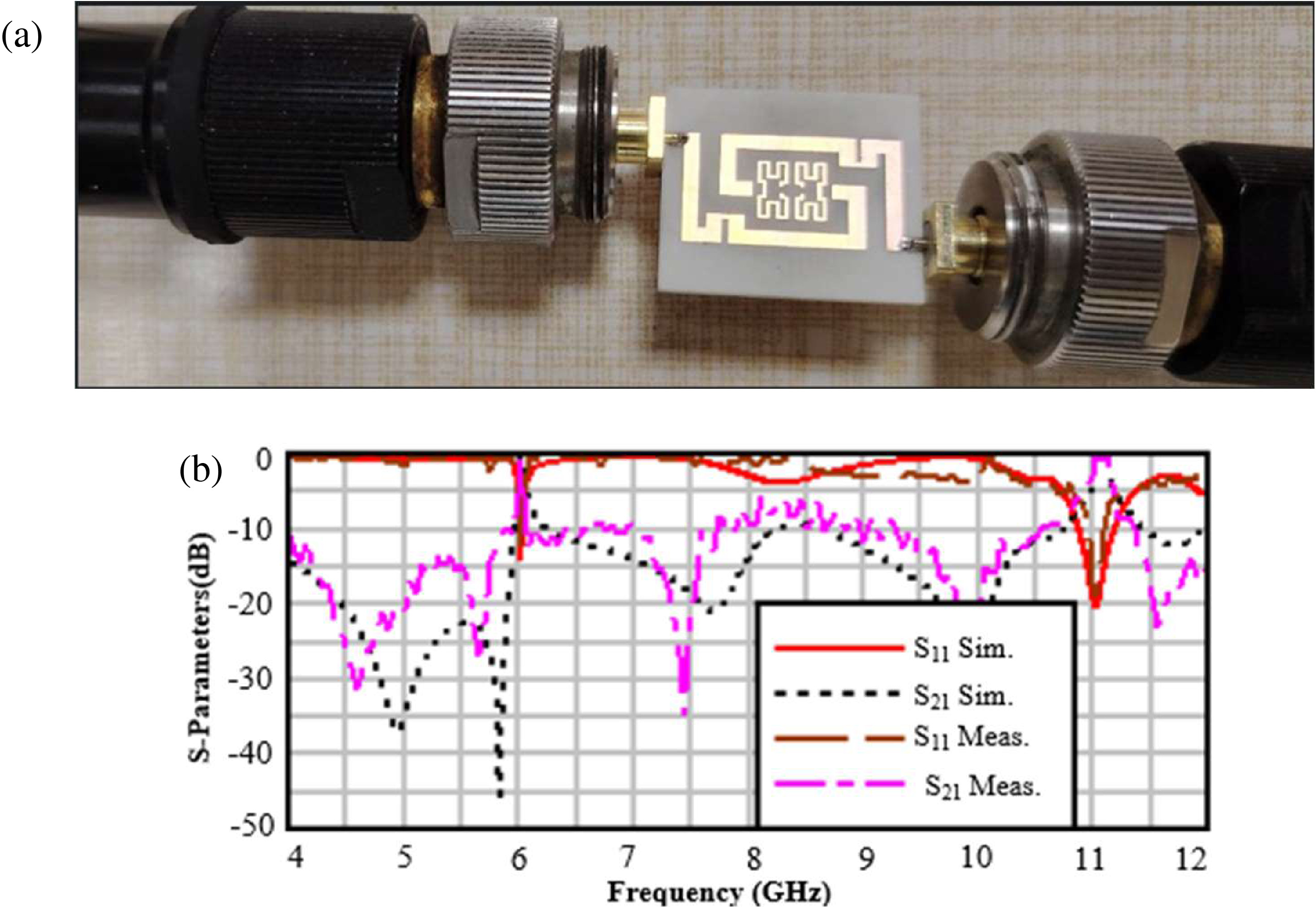
In this article, a fractal slotted metamaterial inspired multiband antenna for wireless communication applications is presented. The proposed structure incorporates the fractal formation of a radiating patch attached with metamaterial SRR cell and rectangular slotted partial ground plane to cover multiple wireless standards. The antenna is printed on FR4 epoxy substrate material having the thickness of 1.6 mm and relative permittivity of 4.4. The antenna has compactness in size as 37×22×1.6 mm3 and achieves five wireless communication modes, including S band (2.4 GHz; WLAN: IEEE 802.11g), S band (3.65 GHz; WiMAX: IEEE 802.16e), C band (5.0/5.8 GHz; WLAN: IEEE 802.11a/j), X-Band (Satellite communication, radar, terrestrial broadband, space communication), 5G NR bands (n41: 2.496-2.690 GHz, n46: 5.15-5.925 GHz, n47: 5.855-5.925 GHz, n53: 2.483-2.495 GHz, n102: 5.925-6.425), and Lower Ku band (Molecular rational spectroscopy). The antenna also showcases consistent radiation characteristics, gain, and efficiency across resonant bands crucial for obtained resonant bands regarding multi-standard wireless applications. It attains an optimized peak gain of 4.38 dBi and a radiation efficiency of 86.23%.
Implementation of Fractal Metamaterial Inspired Antenna for Multi-standard Wireless Applications
2024-10-22
PIER M
Vol. 130, 11-17
Compact 8-Port MIMO Antenna for Hot-Spot Applications Based on Embedded Double-Negative Metamaterial Split Ring Resonators
José Alfredo Tirado-Méndez , Arturo Rangel-Merino and Luis Alberto Vasquez-Toledo
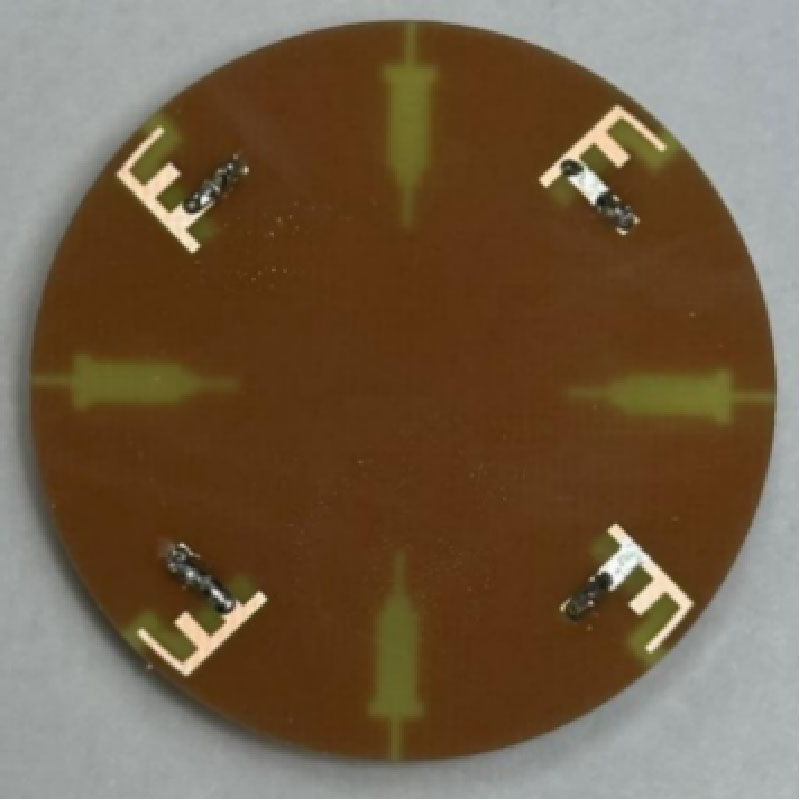
This article proposes an 8-port MIMO antenna based on double-negative metamaterial Split Ring Resonators (SRRs) for three-dimensional (3D) non-planar applications, such as hotspots. The antenna features eight radiators arranged orthogonally to each other, placed in two perpendicular planes, operating at 3.5 GHz. Each resonator incorporates six embedded SRRs to enhance the metamaterial behavior, achieving a 40% size reduction compared to a conventional disc monopole at the same frequency. Simulated and measured results demonstrate excellent performance for MIMO applications, with Envelope Correlation Coefficient (ECC) values below 0.001 and Diversity Gain (DG) around 20 dB. The Total Active Reflection Coefficient (TARC) bandwidth is approximately 930 MHz at the -10 dB threshold. The S-parameters indicate excellent electromagnetic isolation between radiators exceeding 20 dB, and a very low cross-polarization level below -30 dB. However, the main limitation of this design is a reduction in gain, an expected result.
Compact 8-port MIMO Antenna for Hot-spot Applications Based on Embedded Double-negative Metamaterial Split Ring Resonators
2024-10-22
PIER B
Vol. 108, 105-119
A Multifunctional Antenna with High Isolation for Interweave and Underlay Operation in Cognitive Radio
Praveen Singh Rathore , Ravi Mali , Rajkumar Jatav and Manoj Kumar Meshram
This paper presents a multifunctional antenna with high isolation for interweave and underlay cognitive radio (CR) applications. The proposed antenna consist of an ultra-wideband (UWB) antenna (ANT1) for sensing and communication in UWB spectrum range and a frequency reconfigurable antenna (ANT2) for communication over frequency ranges from 3 to 3.7 GHz and 3.8 to 5.6 GHz. The proposed antenna is designed on an FR-4 substrate 50 × 65 × 1.6 mm3 with a shared ground plane. A square slot and a rectangular stub is introduced in the ground plane to achieve -10 dB wide impedance bandwidth and good isolation over the frequency range of 1.8 to 12 GHz. An underlay CR operation is attained with a UWB ANT1 with reconfigurable band notch of 2.76 to 3.7 GHz by introducing a U-shaped slot. The interweave operation is obtained by incorporating ANT1 and ANT2 in a same substrate. ANT1 without notch band is used for sensing spectrum and ANT2 with reconfigurable frequency is used for communication. The proposed antenna attains both interweave and underlay operations with inter-port isolation greater than 17 dB all over the proposed UWB and communication band.
A Multifunctional Antenna with High Isolation for Interweave and Underlay Operation in Cognitive Radio
2024-10-21
PIER C
Vol. 149, 47-58
Double Closed-Loop Model-Free Super-Twisting Terminal Sliding Mode Control Algorithm of IPMSM Based on Third-Order Super-Twisting Observer
Qianghui Xiao , Zhi Wang , Xiaorui Wei , Yuxin Yang , Yushuang Zhang and Zhun Cheng
To solve the problem of poor control performance of internal permanent magnet synchronous motors (IPMSM) due to parameter perturbations and external perturbations when adopting mode-free sliding mode control (MFSMC) algorithm, a double-closed-loop model-free super-twisting terminal sliding mode control (MFSTTSMC) algorithm of IPMSM based on third-order super-twisting observer (TOSTO) is proposed. Firstly, according to the new model-free control (MFC) algorithm, an ultra-local expansion model of IPMSM speed-current double closed-loop is established. Secondly, based on the ultra-local expansion model, a double closed-loop MFSTTSMC is designed to achieve global rapid convergence of system state errors. At the same time, a TOSTO is designed to estimate the disturbance in real time and carry out feedforward compensation, which enhances system robustness. Finally, the viability and superiority of the proposed control algorithm is demonstrated through simulation and experiments.
Double Closed-loop Model-free Super-twisting Terminal Sliding Mode Control Algorithm of IPMSM Based on Third-order Super-twisting Observer
2024-10-21
PIER C
Vol. 149, 37-45
Research on Ultra Narrow Size Microstrip Multiband Antenna Suitable for Wireless Repeaters in Mine Tunnels with Different Cross-Sections
Yun Li , Peng Chen and Bo Yin
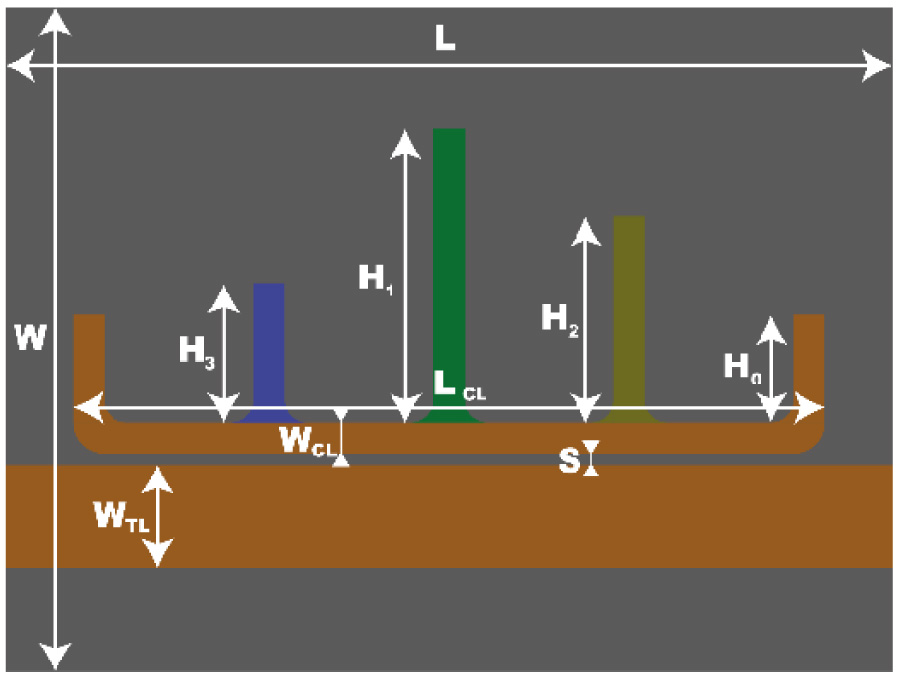
Through the analysis of experimental data, it is found that the optimal communication frequencies of mine tunnels with different cross-sections are different. These optimal operating frequency bands (580-600 MHz, 806-826 MHz, 1427.9-1447.9 MHz, 2401.5-2481.5 MHz, 5150-5600 MHz) are not only numerous, but also wide-ranging. Meanwhile, because the wireless repeater in the mine tunnel has great restrictions on the antenna size, the antenna has to be designed in a very small range of transverse size. In this paper, an ultra-narrow sized multi-frequency dipole (0.41λ × 0.04λ) is proposed to cover the optimal communication bands of underground mine tunnels with different cross-sections. This multibranch dipole consists of three main parts: lateral long branch, middle short branch, and end-loaded reverse branch. By adjusting the length of the two lateral long branches and utilizing the high harmonics, the antenna covers the lowest and highest operating bands that differ by a factor of seven. The middle short branch is one of the contributors to 1.4 GHz band. Meanwhile, the performance of the antenna at high frequencies is optimized by adjusting the distance between branches. The bandwidth of 1.4 GHz band is expanded by the loaded reverse branches. The test results are in good agreement with the simulation data, and the antenna covers all the optimal communication frequencies of underground mine tunnels with different cross-sections. Its peak gain at the resonance point is greater than 0 dBi, and the structure is simple.
Research on Ultra Narrow Size Microstrip Multiband Antenna Suitable for Wireless Repeaters in Mine Tunnels with Different Cross-sections
2024-10-21
PIER C
Vol. 149, 25-35
Design of Compensated PLL for Position Sensorless Drives of PMSMs
Han Lin , Shanshan Wang , Zhonggen Wang , Xiaobing Zhu and Wenyan Nie
To filter out the high harmonic content of the back electromotive force (EMF) in the conventional sliding mode observer (SMO), a novel flux SMO (FSMO) is designed in this paper. The feedback matrix is designed to replace the external filter or other modules, and its higher-order feedback characteristics further enhance the convergence of the FSMO. The Lyapunov function is used to assess the stability of the FSMO. Importantly, a compensated phase-locked loop (CPLL) with an angular compensation strategy is used to extract both position and speed information, resulting in less speed fluctuation and lower position estimation error. Furthermore, the simulation model and experimental platform are developed to evaluate the reliability of the proposed method. Both simulated and experimental results confirm that the proposed hybrid control algorithm performs well in both steady state and dynamic one, high or low speed of the system, with suppressed harmonics of 50.1% and 7.3%, respectively, and an improved response time of 54.1%, providing a concrete program for sensorless control of permanent magnet synchronous motors (PMSMs).
Design of Compensated PLL for Position Sensorless Drives of PMSMs