Search Results(13800)

2012-08-01
PIER Letters
Vol. 33, 167-175
Dual-Band Frequency Selective Surface with Miniaturized Element in Low Frequencies
Yuan Yang , Xu-Hua Wang and Hang Zhou
In this paper, we propose a dual-band frequency selective surface (FSS) in low frequencies with miniaturized element. A dual-concentric square element with two different slot sizes is constructed to realize dual-band passband responses. Each passband is realized by a square slot structure. Besides, we reduce the slot sizes to make the element miniature and compact. Based on this technique, a dual-band FSS with miniaturized element in low frequencies is designed. Both the simulation and experiment results show that such a FSS owes its advantages to miniature element, stable performance with various incident angles and different polarizations, which is suitable for dual-band shipboard communication.
DUAL-BAND FREQUENCY SELECTIVE SURFACE WITH MINIATURIZED ELEMENT IN LOW FREQUENCIES
2012-08-01
PIER M
Vol. 25, 157-172
On Relativistic Polarization of a Rotating Magnetized Medium
Alexander L. Kholmetskii , Oleg V. Missevitch and Tolga Yarman
We consider the relativistic polarization of a rotating magnetized medium in the framework of the approach suggested earlier (A L Kholmetskii and T Yarman 2010 Eur. J. Phys. 31 1233), which is based on the charge conservation law and relativistic generalization of the first Kirchhoff law to a closed moving circuit carrying steady current. We show that the polarization of a magnet brought to a rotation differs, in general, from the relativistic polarization of a translationary moving magnet, and on this way we give one more explanation to the familiar Wilson & Wilson experiment, with the explicit demonstration of the implementation of the charge conservation law.
ON RELATIVISTIC POLARIZATION OF A ROTATING MAGNETIZED MEDIUM
2012-07-30
PIER C
Vol. 31, 241-253
A Modified Hair-PIN Resonator for the Design of Compact Bandpass Filter with Suppression of Even Harmonics
Ker Chia Lee , Hieng Tiong Su and Manas Kumar Haldar
A new design consideration is explored for a hair-pin resonator. A grounding via at the mid-point of the resonator acts as a perturbation to split the resonant frequencies. The via also suppresses even harmonics of the fundamental. The principle operation of the hair-pin resonator with a via is analyzed and verified by measurement. It is shown that such a hair-pin resonator can be made more compact using stepped impedance line. A compact 4-pole bandpass filter using the modified compact hair-pin resonator with a via is demonstrated. Simulation and measured results showed good agreement.
A MODIFIED HAIR-PIN RESONATOR FOR THE DESIGN OF COMPACT BANDPASS FILTER WITH SUPPRESSION OF EVEN HARMONICS
2012-07-27
PIER C
Vol. 31, 229-240
A Second-Order BPF Using a Miniaturized-Element Frequency Selective Surface
Omid Manoochehri , Seyyedpayam Abbasiniazare , Amir Torabi and Keyvan Forooraghi
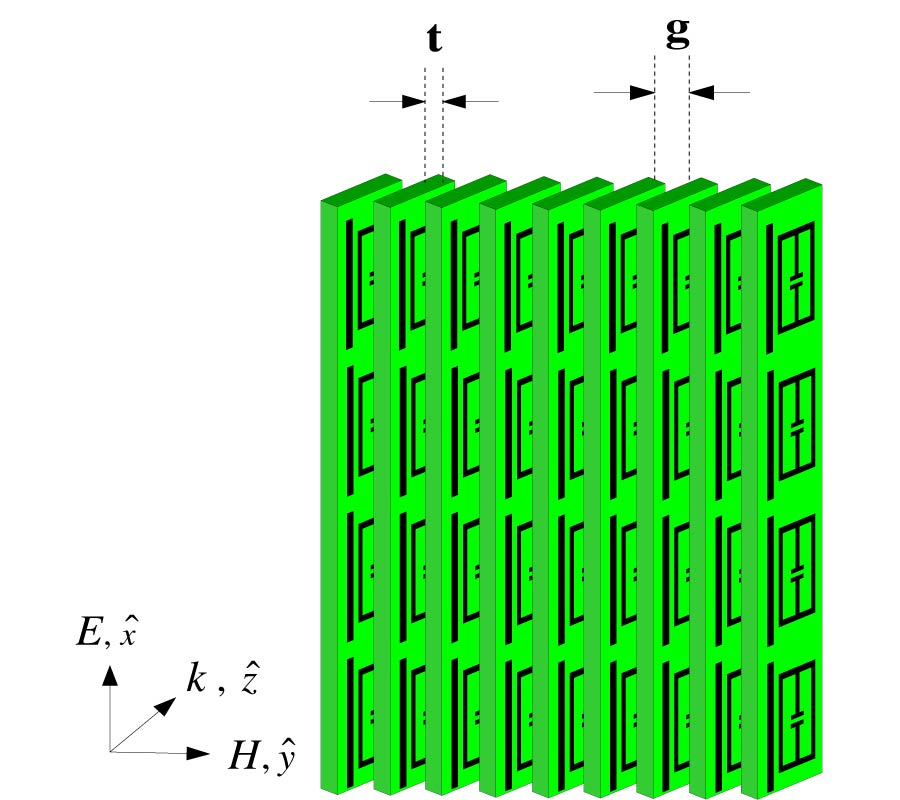
A new type of low-profile frequency selective surface (FSS) with an overall thickness of λ/40 and a second-order band pass frequency response is presented. The proposed FSS is composed of two metal layers, separated by a thin dielectric substrate. Each layer is a two-dimensional periodic structure with sub-wavelength periodic unit cells. By printing the same topology on each side of the substrate, a second-order frequency response is realized. To provide a physical insight into the operating mechanism, equivalent circuit networks are also investigated in each step of design procedure. Using the proposal technique, low profile and reduced sensitivity to angle of incident wave for both TE and TM polarizations are obtained and the overall thickness of the substrate is fairly thin. FSS samples are designed, fabricated, and installed in waveguide operating at X-band and a good agreement between the simulated and measured results is achieved.
A SECOND-ORDER BPF USING A MINIATURIZED-ELEMENT FREQUENCY SELECTIVE SURFACE
2012-07-27
PIER
Vol. 130, 105-130
Polarimetric SAR Tomography Using L2,1 Mixed Norm Sparse Reconstruction Method
Shiqi Xing , Dahai Dai , Yongzhen Li and Xuesong Wang
The growing interest of Radar community in retrieving the 3D reflectivity map makes both polarimetric SAR interferometry and SAR tomography hot topics in recent years. It is expected that combining these two techniques would provide much better discriminating ability for scatterers lying in the same pixel. Generally, this is about reconstruction of scattering profiles from limited and irregular polarimetric measurements. As an emerging technique, Compressive Sensing (CS) provides a powerful tool to achieve the purpose. In this paper, we propose a l2,1 mixed norm sparse reconstruction method for jointly processing multibaseline PolInSAR data based on multiple measurement vector compressive sensing (MMV-CS) model, and also address the signal leakage problem with MMV-CS inversion by presenting a window based iterative algorithm. The results obtained by processing simulated data show that the proposed method possesses superior performance advantage over existing methods.
POLARIMETRIC SAR TOMOGRAPHY USING <I>l</I><sub>2,1</sub> MIXED NORM SPARSE RECONSTRUCTION METHOD
2012-07-26
PIER B
Vol. 42, 405-424
Nonsynchronous Noncommensurate Impedance Transformers
Vitaliy Zhurbenko and Kseniya Kim
Nonsynchronous noncommensurate impedance transformers consist of a combination of two types of transmission lines: transmission lines with a characteristic impedance equal to the impedance of the source, and transmission lines with a characteristic impedance equal to the load. The practical advantage of such transformers is that they can be constructed using sections of transmission lines with a limited variety of characteristic impedances. These transformers also provide comparatively compact size in applications where a wide transformation ratio is required. This paper presents the data which allows to estimate the achievable total electrical length and in-band reflection coefficient for transformers consisting of up to twelve transmission line sections in the range of transformation ratios r=1.5 to 10 and bandwidth ratios χ=2 to 20. This data is obtained using wave transmission matrix approach and experimentally verified by synthesizing a 12-section nonsynchronous noncommensurate impedance transformer. The measured characteristics of the transformer are compared to the characteristics of the conventional tapered line transformer.
NONSYNCHRONOUS NONCOMMENSURATE IMPEDANCE TRANSFORMERS
2012-07-26
PIER C
Vol. 31, 215-228
Maximum Eirp and EMF Estimation Based on Over-the-Air Measurements of Wcdma Pilot Channel
Byung-Jun Jang , Sung-Won Moon and Hyungoo Yoon
This paper presented an estimation method of maximum effective isotropic radiated power (EIRP) and electro-magnetic field (EMF) strength of a wideband code-division multiple-access (WCDMA) base station based on over-the-air measurements of a pilot channel in a code domain. To verify the feasibility of the proposed method, we estimated the maximum EIRP and EMF strengths of the self-designed test base station, and compared them with EIRP and EMF values measured by the traditional test scheme. Then, we applied our estimation scheme to the inspection test for a commercial base station. The maximum difference between the estimated EIRP values from our method and the reported values is 1.3 dB. The estimated EMF results show more than 90% agreement with both the traditional EMF measurement value under a full-traffic load condition and the theoretical value. Therefore, it can be concluded that our proposed estimation method should be an effective inspection test for domestic base stations.
MAXIMUM EIRP AND EMF ESTIMATION BASED ON OVER-THE-AIR MEASUREMENTS OF WCDMA PILOT CHANNEL
2012-07-26
PIER
Vol. 130, 85-104
Higher Order Method of Moments for Bistatic Scattering from 2D PEC Rough Surface with Geometric Modeling by NURBS Surface
Anqi Wang , Li-Xin Guo , Yi-Wen Wei and Jing Ma
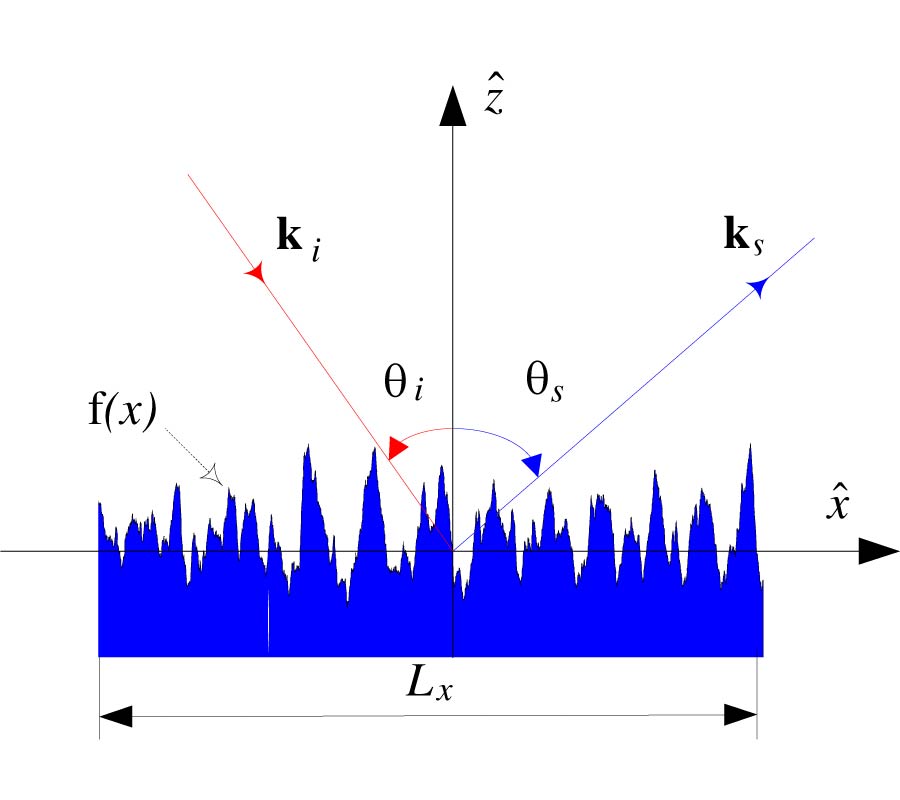
The higher order method of moments (HMOM) has been proposed to calculate the bistatic scattering from two-dimensional (2D) perfectly electric conducting (PEC) rough surface in this paper. The electric field integral equation (EFIE) is solved through the HMOM with the hierarchical higher order basis functions which are the modified Legendre polynomials. The non-uniform rational B-spline (NURBS) surface is applied to model the plane surface related to the rough surface. Validity of this approach is shown by comparing the bistatic scattering coefficient (BSC) to that of lower order MOM (LMOM) with the Rao-Wilton-Glisson (RWG) or rooftop basis function. This approach has fewer segments in the parametric directions than the LMOM with rooftop basis, and is more efficient for the fewer unknowns and requires less memory than the LMOM with RWG basis. Properties of EM scattering from a 2D Gaussian rough surface are also exhibited and analyzed.
HIGHER ORDER METHOD OF MOMENTS FOR BISTATIC SCATTERING FROM 2D PEC ROUGH SURFACE WITH GEOMETRIC MODELING BY NURBS SURFACE
2012-07-25
PIER B
Vol. 42, 381-403
Microwave Contrast Imaging of Breast Tissue from Local Velocity Estimation
Jean-François Deprez , Mantalena Sarafianou , Maciek Klemm , Ian J. Craddock and Penny J. Probert-Smith
This paper proposes a new method to display microwave images of breast tissue, based on estimation of local microwave velocity from time of flight measurements. Its computational demands are low compared with tomography. It has two major components: 1) the estimation of the travel time of microwaves across the tissue between a set of antennae using a wavelet decomposition, and 2) the estimation of the microwave velocity field from the set of travel times using a low dimensional set of radial basis functions to model local velocity. The technique is evaluated in 2-D on clinical MR-based numerical breast phantoms incorporated in Finite-Difference Time-Domain simulations. The basis functions, used with a regularisation scheme to improve numerical stability, reduce the dimensionality of the inverse problem for computational efficiency and also to improve the robustness to error in velocity estimation. The results support previously published findings that the wavelet transform is suitable for robust measurement of time of flight even in clinically significant simulations, and shows that the velocity contrast images can be constructed so different regions of breast tissue type can be distinguished. In particular, the presence of a tumour is clearly detected, demonstrating the potential of this approach for breast screening. Keywords: Biomedical signal processing; Microwave imaging; Image reconstruction.
MICROWAVE CONTRAST IMAGING OF BREAST TISSUE FROM LOCAL VELOCITY ESTIMATION
2012-07-25
PIER B
Vol. 42, 363-380
A Multi-Objective Memetic Optimization Approach to the Circular Antenna Array Design Problem
Abhronil Sengupta , Tathagata Chakraborti , Amit Konar and Atulya K. Nagar
The paper describes a novel approach to the design of non-uniform planar circular antenna arrays for achieving maximal side lobe level suppression and directivity. The current excitation amplitudes and phase perturbations of the array elements are determined using an Adaptive Memetic algorithm resulting from a synergy of Differential Evolution (DE) and Learning Automata that is able to significantly outperform existing state-of-the-art approaches to the design problem. However, existing literature considers the design problem as a single-objective optimization task that is formulated as a linear sum of all the performance metrics. Due to the conflicting nature of the various design objectives, improvements in a certain design measure causes deterioration of the other measures. Following this observation, the single-objective design problem is reformulated as a constrained multi-objective optimization task. The proposed memetic algorithm is extended to the multi-objective framework to generate a set of nondominated solutions from which the best compromise solution is selected employing a fuzzy membership based approach. An instantiation of the design problem clearly depicts that the multi-objective approach provides simultaneous side lobe level suppression and directivity maximization in comparison to the single-objective scenario.
A MULTI-OBJECTIVE MEMETIC OPTIMIZATION APPROACH TO THE CIRCULAR ANTENNA ARRAY DESIGN PROBLEM
2012-07-25
PIER Letters
Vol. 33, 151-166
Design and Optimization of High Sensitivity Photonic Interferometric Biosensors on Polymeric Waveguides
Giovanna Calo , Antonio Farinola and Vincenzo Petruzzelli
The design criteria of integrated optical biosensors based on the Mach-Zehnder Interferometer and on the Michelson Interferometer are proposed. Sensitive performance has been evaluated for different optical polymeric waveguiding structures such as channel, inverted-rib and strip waveguides. For all the configurations of the examined optical waveguiding interferometric biosensors maximum linearity and sensitivity have been obtained. In particular, the achieved sensitivity, expressed as the ratio between the normalized output power and the protein concentration, is about equal to 1.6 (g/ml)-1 which, for a maximum variation of the output power equal to 100 mW, leads to a non-normalized sensitivity equal to 160 mW/(g/ml).
DESIGN AND OPTIMIZATION OF HIGH SENSITIVITY PHOTONIC INTERFEROMETRIC BIOSENSORS ON POLYMERIC WAVEGUIDES
2012-07-24
PIER B
Vol. 42, 335-362
Comprehensive Solution to Scattering by Bianisotropic Objects of Arbitrary Shape
Chong Mei , Moamer Hasanovic , Jay Kyoon Lee and Ercument Arvas
This paper presents a method of moments (MoM) solution for the problems of electromagnetic scattering by inhomogeneous three-dimensional bianisotropic scatterers of any shape. The electromagnetic response of bianisotropy has been described by the constitutive relations of the most general form composed of four 3 x 3 matrices or tensors. The volume equivalence principle is used to obtain a set of mixed potential formulations for a proper description of the original scattering problem. Here, the total fields are separated into the incident fields and the scattered fields. The scattered fields are related to the electric and magnetic potentials which are excited by electric and magnetic bound charges and polarization currents. The body of the scatterer is meshed through the use of tetrahedral cells with face-based functions used to expand unknown quantities. At last, the Galerkin test method is applied to create a method of moments (MoM) matrix from which the numerical solution is obtained. Implemented in a MATLAB program, the numerical formulation is evaluated and verified for various types of scatterers. The results are compared with those of previous work, and a good agreement is observed. Finally, a scattering from a two-layered dispersive chiroferrite sphere is presented as the most general example.
COMPREHENSIVE SOLUTION TO SCATTERING BY BIANISOTROPIC OBJECTS OF ARBITRARY SHAPE
2012-07-24
PIER B
Vol. 42, 311-333
Experimental Performance Comparison of Six-Port and Conventional Zero-IF/Low-IF Receivers for Software Defined Radio
Cristina de la Morena-Álvarez-Palencia and Mateo Burgos-Garcia
This paper presents an experimental performance comparison among three RF architectures that are very suitable for Software Defined Radio (SDR) implementation: zero-IF, low-IF, and six-port network. A six-port receiver and a dual zero-IF/low-IF receiver have been developed for this purpose. Six-port receiver is a very promising and flexible RF architecture for the low-cost implementation of integrated microwave and millimeter-wave systems. Competitive advantages such as ultra-broadband behavior, low-cost, reconfigurability, and low power consumption, point to the six-port architecture as a good candidate to implement a SDR. However, two issues on broadband six-port receivers require intensive research: dynamic range extension, and miniaturization. In this paper, two solutions are proposed to solve these problems: the use of biased detector diodes for dynamic range extension, and the use of low temperature co-fired ceramic (LTCC) technology for six-port reduction. The measurement results indicate that the six-port receiver shows high potential benefits and advantages compared to conventional zero-IF and low-IF receivers. In addition, the capability of the six-port architecture to operate as both zero-IF and low-IF receivers has been experimentally demonstrated for the first time.
EXPERIMENTAL PERFORMANCE COMPARISON OF SIX-PORT AND CONVENTIONAL ZERO-IF/LOW-IF RECEIVERS FOR SOFTWARE DEFINED RADIO
2012-07-24
PIER B
Vol. 42, 291-309
CSRRs for Efficient Reduction of the Electromagnetic Interferences and Mutual Coupling in Microstrip Circuits
Xiaoke Han , Habiba Hafdallah-Ouslimani , Tao Zhang and Alain C. Priou
This paper proposes an efficient microstrip isolator filter which suppresses the surface and lateral waves (SW and LW) in planar antenna arrays. The structure consists in a double or triple row of periodic and flipped array of subwavelength Complementary Split Ring Resonators (CSRRs). The array of CSRRs is etched on a dielectric substrate backed by a metallic ground plane. These structures can both block the electromagnetic (EM) energy in one direction and guide it along the other transverse direction. In particular, the flipped array of CSRRs presents wider bandgap characteristic (stopband ≥20%) than periodic array of CSRRs (~16%) and conventional array of SRRs (≥12%). Then, the metamaterial filter is inserted between two 6.1 GHz probe-fed patch antenna elements separated by a distance of 0.8 λ0. Excellent agreements between the simulated and the experimental results are obtained. In fact, a significant reduction of the EM mutual coupling is achieved, more than 24 dB, over a wide frequency bandwidth. Moreover, the proposed CSRR structures are compact, low complex and, as printed antennas, are very easy to manufacture. They have numerous applications in MIMO systems and directive phased arrays.
CSRRS FOR EFFICIENT REDUCTION OF THE ELECTROMAGNETIC INTERFERENCES AND MUTUAL COUPLING IN MICROSTRIP CIRCUITS
2012-07-24
PIER C
Vol. 31, 199-213
Joint Estimation of Amplitude, Direction of Arrival and Range of Near Field Sources Using Memetic Computing
Fawad Zaman , Ijaz Mansoor Qureshi , Aqdas Naveed and Zafar Ullah Khan
In this paper, we propose a method based on evolutionary computations for joint estimation of amplitude, Direction of Arrival and range of near field sources. We use memetic computing in which the problem starts with a global optimizer and ends up with a local optimizer for fine tuning. For this, we use Genetic algorithm and Simulated annealing as a global optimizer while Interior Point Algorithm as a rapid local optimizer. We set up Mean Square Error as a fitness evaluation function which defines an error between actual and estimated signal. This fitness function is optimum and is derived from Maximum likelihood. It requires only single snapshot to converge and does not require any permutations to link it with the angles found in the previous snapshot as in some other methods. The efficiency and reliability of the proposed scheme is tested on the basis of Monte-Carlo simulations and its inclusive statistical analysis.
JOINT ESTIMATION OF AMPLITUDE, DIRECTION OF ARRIVAL AND RANGE OF NEAR FIELD SOURCES USING MEMETIC COMPUTING
2012-07-21
PIER Letters
Vol. 33, 141-150
Design of Quad-Band Filter Based on the Improved Versions of Dcrlh Cell
Ke Lu , Tong Xu and Xiang-qiang Yao
In this article, one realization version of quad-band filter is firstly proposed, and it is the cascaded structure composed of the shunt open-circuit DCRLH (dual composite right/left-handed) cell and the shunt short-circuit DCRLH cell. The above two cells are initially proposed here in order to improve the inherent limitations of the microstrip DCRLH cell. It is demonstrated that the matching performance and frequency selectivity of these two cells are both better than those of the microstrip DCRLH cell. What is more important, these two cells both exhibit three transmission zeros within the given frequency band and any of them is of great potential to be applied in the design of quad-band filters. In order to get sufficient design freedom, we utilize the cascade connection version based on the shunt open/short-circuit DCRLH cells. Whereas, only the first and second transmission zeros of both the shunt open/short-circuit DCRLH cells are explored. Both the simulated and measured results indicate that the proposed design method is right and effective.
DESIGN OF QUAD-BAND FILTER BASED ON THE IMPROVED VERSIONS OF DCRLH CELL
2012-07-21
PIER C
Vol. 31, 185-197
An Ultra Wideband Monopole Antenna with Multiple Fractal Slots with Dual Band Rejection Characteristics
Anirban Karmakar , Shashank Verma , Manimala Pal and Rowdra Ghatak
A compact dual band notched Ultra-wideband (UWB) antenna with the multiple Hilbert curve slots is proposed that exhibits an impedance bandwidth from 2.5 GHz to 12 GHz. Hilbert curve slots result in band notch in the frequency range 5.15-5.5 GHz assigned to IEEE 802.11a and HYPERLAN/2 as well as 7.9-8.4 GHz band assigned to X-band uplink satellite communication systems. The antenna gain varies from 3 dBi to 5 dBi over the operating frequency. Stable radiation patterns throughout its operating frequency are obtained. Over all antenna size is 25 mm by 45.75 mm including the ground plane. Simulation and measured result of the proposed antenna are in good agreement.
AN ULTRA WIDEBAND MONOPOLE ANTENNA WITH MULTIPLE FRACTAL SLOTS WITH DUAL BAND REJECTION CHARACTERISTICS
2012-07-20
PIER Letters
Vol. 33, 131-140
Frequency-Tunable Bandpass Filters with Constant Absolute Bandwidth and Improved Linearity
Feng Lin Yu , Xiu Zhang and Yi Bin Zhang
This paper presents a frequency-tunable bandpass filter with constant absolute bandwidth and improved linearity. The proposed resonator is composed of an open-ended transmission line with back-to-back varactor diodes loaded at one end. The back-to-back varactor diodes are used to enhance the linearity of the filter, which is better than that of the single varactor counterparts. A mixed electric and magnetic coupling scheme is utilized to control the overall coupling coefficients so that the absolute bandwidth can be kept constant when the frequency is tuned. For validation, two frequency-tuning filters with 30-MHz and 44-MHz absolute bandwidth are implemented. The experimental and simulated results are presented to verify the proposed design.
FREQUENCY-TUNABLE BANDPASS FILTERS WITH CONSTANT ABSOLUTE BANDWIDTH AND IMPROVED LINEARITY
2012-07-20
PIER M
Vol. 25, 141-155
Time-Dependent Nonlinear Theory and Numerical Simulation of 94 GHz Complex Cavity Gyrotron
Jun Jian Ma , Xiao Fang Zhu , Xiao Lin Jin , Yu Lu Hu , Zhong-Hai Yang , Jian-Qing Li and Bin Li
A time-dependent nonlinear theory for complex cavity gyrotron is presented in this paper. The theory includes generalized telegrapher's equations and electron motion equations, which are deduced in detail. A calculation code for the self-consistent nonlinear beam-wave interaction is developed based on the presented theory. Using the code, a 94 GHz complex cavity gyrotron operating in TE021-TE031 modes is thoroughly studied. Numerical results show that an output power of 180 kW, about 36% efficiency is achieved with a 50 kV, 10 A electron beam at a focused magnetic field of 1.78 T and a beam velocity ratio of 1.65. The results from MAGIC simulation are also given and an output power of 192 kW, 38.4% efficiency is obtained. This tells the agreement with these two simulation codes.
TIME-DEPENDENT NONLINEAR THEORY AND NUMERICAL SIMULATION OF 94 GHZ COMPLEX CAVITY GYROTRON
2012-07-18
PIER B
Vol. 42, 263-289
A Synthesis Method for Time-Domain Passive Filters Compensating for Waveform Distortion
Ushio Sangawa
A novel synthesis method for a class of time-domain passive filters that compensates for waveform distortion caused by frequency dependencies of the transmission properties of signal propagation paths, is formulated. The method is based on the linear response theory and mathematical properties of scattering matrices for passive circuits. This paper focuses on the formulation and theoretical consistency of the method. The causal transfer functions for the filters can be extracted by "regularizing" the inverse of a transfer function of the path. To fulfill the necessary restrictions imposed on the causal functions, regularization is realized by multiplying the function of linear phase filters comprising a sufficient number of resonators by the inverse. The filter circuits are easily derived from the regularized transfer functions through numerical optimization techniques and the coupling matrix synthesis method to determine transmission poles and extract each lumped element value, respectively. The method is then applied to practically designing a filter that compensates for the frequency dependencies of a two-port radio propagation path having a pair of wideband antennas. In addition, applications of the filter and the scope of further developments of this technology are discussed.
A SYNTHESIS METHOD FOR TIME-DOMAIN PASSIVE FILTERS COMPENSATING FOR WAVEFORM DISTORTION