Search Results(13800)

2012-07-18
PIER Letters
Vol. 33, 119-129
Modified Directional Wide Band Printed Monopole Antenna for Use in Radar and Microwave Imaging Applications
Javad Jangi Golezani , Mehmet Abbak and Ibrahim Akduman
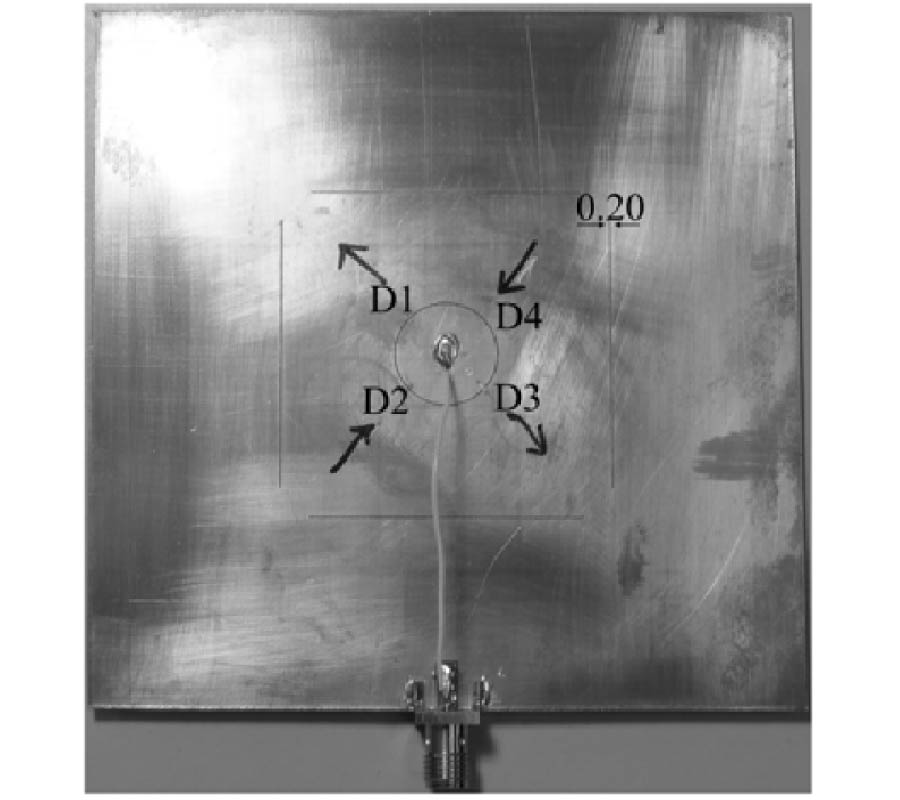
This paper presents a modified design of directional monopole antenna with parabolic-shaped ground plane. To increase the directivity, axis of parabola in the ground plane is rotated 45 degrees (in comparison with the previous antenna) to extend throughout the direction of the substrate's diagonal. Consequently, vertex of the parabola is placed at the optimum point in the corner of the substrate. The aim of this attempt is to design an extended and symmetrical ground plane around the patch, with more clarity, to maximize its capability as a reflector. Directivity is further improved by inserting parabolic-shaped slots at the corners of the ground plane. Simulation and measurements show that the proposed antenna has stable directional radiation pattern and higher gain compared to the previous directional monopole antennas. Impedance bandwidth of the antenna covers the frequency range of 4-9 GHz. Measured HPBW is among the degrees 54-22 between 4 and 9 GHz. Gain and HPBW of the antenna are improved 1.3-3.1 dB and 5-15 degrees, respectively among the bandwidth in comparison with previous antenna. Results confirm the good characteristics of the antenna for use in microwave imaging, where high resolution is required.
MODIFIED DIRECTIONAL WIDE BAND PRINTED MONOPOLE ANTENNA FOR USE IN RADAR AND MICROWAVE IMAGING APPLICATIONS
2012-07-18
PIER Letters
Vol. 33, 109-117
Design of CPW-Fed Circularly Polarized Antenna with Two Orthogonal Slots
Mao-Ze Wang , Fu-Shun Zhang , Yang Zhu and Liu-Tao Ma
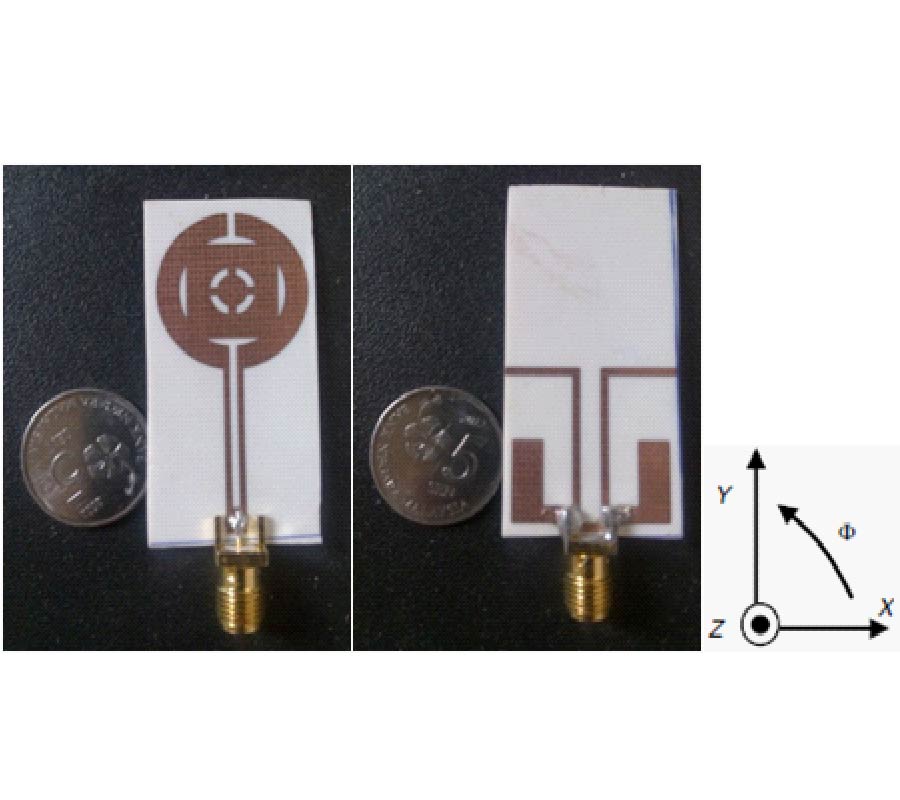
A design of coplanar waveguide (CPW)-fed circularly polarized slot antenna is presented. The proposed antenna consists of two orthogonal slots. By making use of the symmetric current and electric-field distributions of the two gaps of CPW-fed, a simple power divider is easily achieved. By adjusting the length of the two orthogonal slots and CPW-fed bent slot, a circularly polarized wave of two orthogonal modes with equal amplitude and phase difference of 90 degree is excited. The numerical results show that the 10 dB return loss bandwidth and 3 dB axial ratio (AR) bandwidth are 50.8 % and 11.2 % respectively. A prototype antenna is fabricated and measured, the measured results show that the proposed antenna achieves a good performance of circularly polarization.
DESIGN OF CPW-FED CIRCULARLY POLARIZED ANTENNA WITH TWO ORTHOGONAL SLOTS
2012-07-18
PIER C
Vol. 31, 169-183
A Miniature Real-Time Re-Configurable Radar Waveform Synthesizer for UAV Based Radar
Chua Ming Yam , Huey Shen Boey , Chot Hun Lim , Voon Koo , Heng Siong Lim , Yee Kit Chan and Tien Sze Lim
Radar waveform synthesizer is a key component in radar system as it determines the best achievable resolution. A popular approach in radar waveform synthesis is the Direct Digital Synthesis approach where the signal is first generated in digital domain and converted into analog signal using a High Speed Digital-to-Analog Converter (HS-DAC). In this paper, a miniature and low cost radar waveform synthesizer is proposed. The synthesizer is targeted for Unmanned Aerial Vehicle (UAV) based radar system applications that require miniaturized equipment due to limited space in aircraft's fuselage. The signal synthesizer has been developed using Altera DE3 development board (Stratix III FPGA) and a custom made dual-channel 420 MSPS HS-DAC board. The proposed system is capable of generating various types of radar waveforms: a) Linear Frequency Modulated (LFM) or chirp pulse, b) Frequency Modulated Continuous Wave (FMCW), and c) Calibration Tone (Cal-Tone), for use in different types of radar applications. The distinguishing feature of the proposed synthesizer is its capability in reconfiguring the signal properties in real-time. The performance of the synthesizer has been benchmarked with commercially available radar waveform signal synthesizer and comparable performance has been observed.
A MINIATURE REAL-TIME RE-CONFIGURABLE RADAR WAVEFORM SYNTHESIZER FOR UAV BASED RADAR
2012-07-18
PIER C
Vol. 31, 153-168
Dynamic Basestation Antenna Design for Low Energy Networks
Weisi Guo , Jonathan M. Rigelsford , Kenneth Lee Ford and Tim O'Farrell
A challenge faced by the information and communications technology (ICT) industry is the growing data volume and associated energy consumption. How to both meet a dynamic traffic demand at a consistently low energy consumption level is of importance from both commercial and climate change perspectives. This paper proposes a dynamic basestation concept that allows the number of active sectors to be adjusted in accordance with the traffic load. This is achieved through a novel switchable antenna design that can adjust the azimuth beam-width by using a tuneable reflector. Simulation and theoretical results show that the dynamic basestation can reduce the total operational energy of a cellular network by a peak of 75% and a mean of 38%.
DYNAMIC BASESTATION ANTENNA DESIGN FOR LOW ENERGY NETWORKS
2012-07-18
PIER C
Vol. 31, 137-151
Design of Compact Lowpass Filter with Ultra-Wide Stopband Using Thin Slots
Jyun-Yi Wu , Yu-Hsiang Tseng and Wen-Hua Tu
This paper presents a compact microstrip stepped-impedance lowpass filter with ultra-wide stopband by using back-to-back C-shaped and triple C-shaped thin slots. The properties of several thin slots in the ground plane have been investigated in this paper. With the full-wave simulation results and a simplified equivalent model, the total equivalent inductance of the thin slots can be extracted at cutoff frequency for lowpass filter design purpose. On the other hand, the thin slots work as bandstop filter at the stopband of the lowpass filter for a better stopband rejection. The proposed lowpass filter with a cutoff frequency of 2 GHz shows a wide stopband with an over 25-dB attenuation up to 17.5 GHz. From dc to 2 GHz, the insertion loss is less than 0.3 dB and the return loss is greater than 20 dB. In comparison to the conventional stepped-impedance lowpass filter with the same passband performance, the proposed lowpass filter shows not only a 24.3% size reduction but also a better stopband rejection.
DESIGN OF COMPACT LOWPASS FILTER WITH ULTRA-WIDE STOPBAND USING THIN SLOTS
2012-07-18
PIER
Vol. 130, 67-84
A Novel Multiport Matching Method for Maximum Capacity of an Indoor MIMO System
Xinhua Yu , Li Wang , Hao-Gang Wang , Xidong Wu and Yong-Heng Shang
In this manuscript, a novel multiport matching method is devised to directly maximize the mean capacity with rigorous consideration of the mutual coupling effects of the matching network. In the RF front end of the real communication circuits, the mutual couplings always exist. In this paper, 1) a theoretical capacity upper bound of the 2-by-2 MIMO system with a matching network using the water-filling as the power allocation rule is analytically derived for the first time, 2) the Genetic Algorithm is employed to optimize the parameters of the matching network for the maximization of the mean capacity, 3) a coupled microstrip lines structure is devised to implement the matching network of the real MIMO receiving circuits by this matching method. The numerical results in the last section demonstrate that an optimized matching network obtained using our novel MPM method is capable to enhance the performance of the MIMO systems in a range of different indoor environments. This verifies that our method is not only effective but also practical.
A NOVEL MULTIPORT MATCHING METHOD FOR MAXIMUM CAPACITY OF AN INDOOR MIMO SYSTEM
2012-07-17
PIER B
Vol. 42, 245-262
Space-Time Adaptive Processing Based on Weighted Regularized Sparse Recovery
Zhaocheng Yang , Xiang Li and Hongqiang Wang
In this paper, novel space-time adaptive processing algorithms based on sparse recovery (SR-STAP) that utilize weighted l1-norm penalty are proposed to further enforce the sparsity and approximate the original l0-norm. Because the amplitudes of the clutter components from different snapshots are random variables, we design the corresponding weights according to two different ways, i.e., the Capon's spectrum using limited snapshots and the Fourier spectrum using the current snapshot. Moreover, we apply the weighted idea to both the direct data domain (D3) SR-STAP and SR-STAP using multiple snapshots from adjacent target-free range bins. Simulation results illustrate that our proposed algorithms outperform the existing SR-STAP and D3SR-STAP algorithms.
SPACE-TIME ADAPTIVE PROCESSING BASED ON WEIGHTED REGULARIZED SPARSE RECOVERY
2012-07-17
PIER Letters
Vol. 33, 101-108
Dual-Band Circularly Polarized Slot Antenna for WiMAX/WLAN Application
Wei-Mei Li , Yongchang Jiao and Dong Li
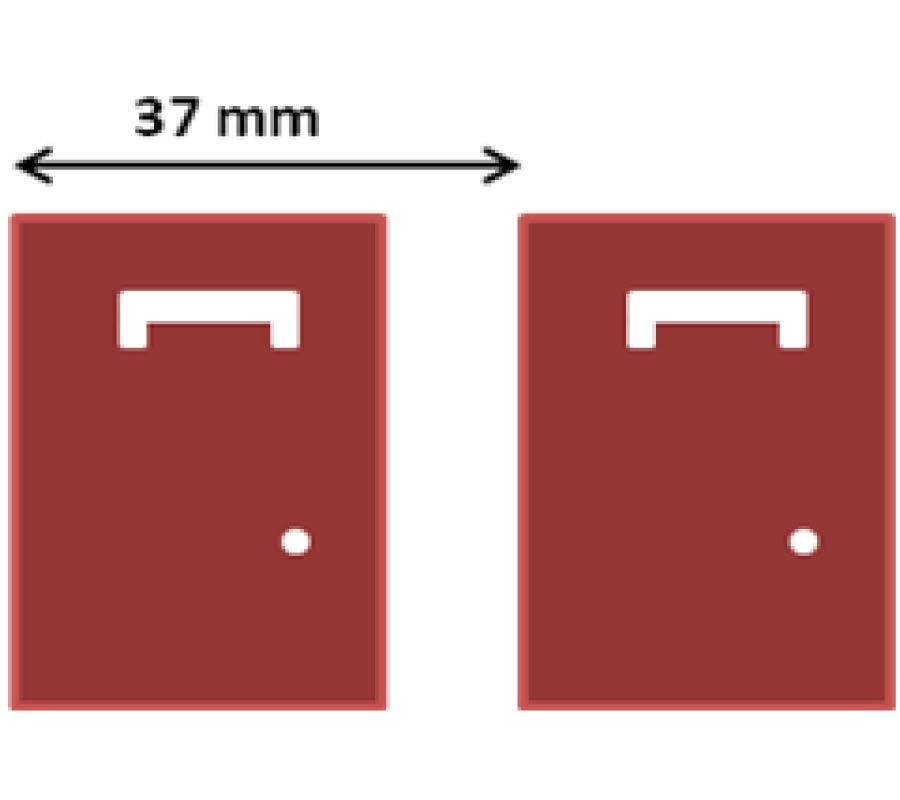
A new antenna with dual-band circular polarization for the reception of WiMAX and WLAN is presented in this article. The circular polarization is achieved by a symmetrical U-slot together with an L-slot. The width of the signal strip is narrowed at the end of the feed point to widen the 3-dB axial ratio (AR) bandwidth and create a good impedance matching for the proposed antenna. A parametric study is conducted using a commercial simulation software based on the method of moments, and the antenna prototype is constructed and measured for providing the simulation validation. Experimental results show that the measured AR bandwidths are about 16.6% and 16.2% with respect to the center frequency at 3.5GHz and 5.3GHz. The radiation characteristics of the proposed antenna are also presented.
DUAL-BAND CIRCULARLY POLARIZED SLOT ANTENNA FOR WIMAX/WLAN APPLICATION
2012-07-17
PIER Letters
Vol. 33, 91-100
Nonlinear Subprofile Space for Radar HRRP Recognition
Daiying Zhou , Xiaofeng Shen and Yangyang Liu
In this paper, a novel approach, namely nonlinear subprofile space (NSS), is proposed for radar target recognition using high-resolution range profile (HRRP). First, the HRRP samples are mapped into a high-dimensional feature space using nonlinear mapping. Second, the nonlinear features, namely nonlinear subprofiles, are extracted by nonlinear discriminant analysis. Then, for each class, the nonlinear subprofile space is formed using all the training nonlinear subprofiles of class. Finally, the minimum hyperplane distance classifier (MHDC) is used for classification. The aim of NSS method is to represent the feature area of target using nonlinear subprofile space, and effectively measure the distance between the test HRRP and feature area via minimum hyperplane distance (MHD) metric. The experimental results of measured data show that the proposed method has better performance of recognition than KPCA and KFDA.
NONLINEAR SUBPROFILE SPACE FOR RADAR HRRP RECOGNITION
2012-07-17
PIER Letters
Vol. 33, 83-89
Design and Synthesis of Quasi-Elliptic Triple Mode Filter
Sovuthy Cheab and Peng Wen Wong
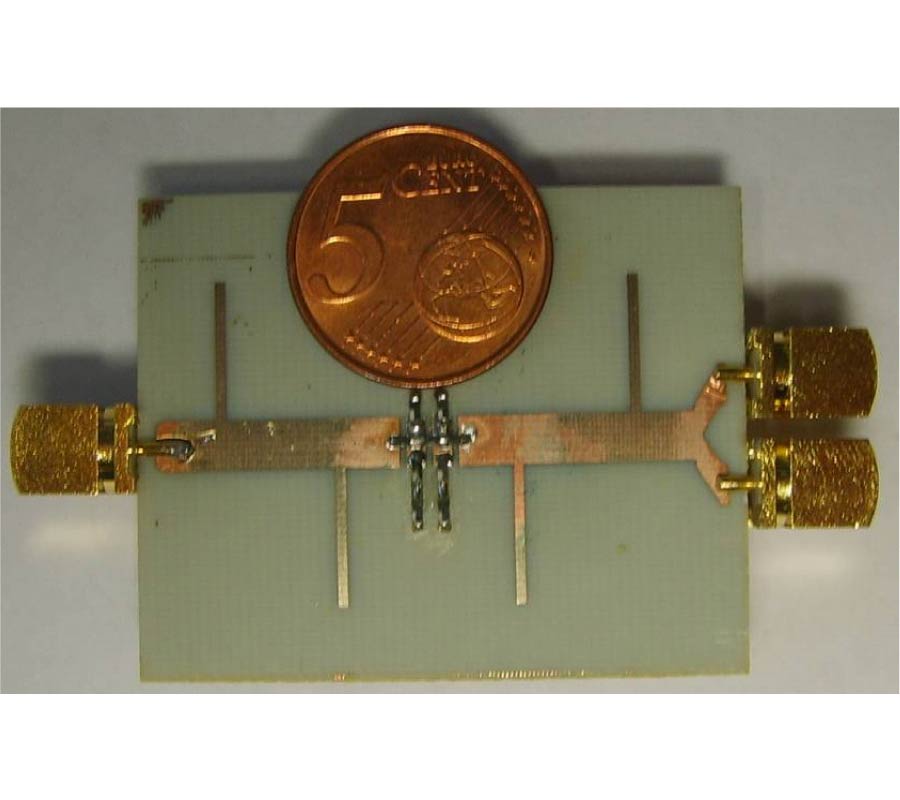
The design and synthesis of quasi-elliptic triple-mode filter with three transmission poles and three transmission zeros are presented in this paper. The transfer and reflection filtering functions are obtained to get the even- and odd-mode admittance. The synthesized admittances give the even- and odd-mode networks, routing structure and coupling matrix of the filter. The microstrip prototype of the quasi-elliptic triple-mode filter is designed and realized to prove the feasibility of the approach. The filter is realized by having a capacitive coupling between the input and the output of a proposed triple mode resonator. The results show an excellent agreement with the theories.
DESIGN AND SYNTHESIS OF QUASI-ELLIPTIC TRIPLE MODE FILTER
2012-07-17
PIER C
Vol. 31, 123-135
Comparing Analytical and Numerical Calculations of Shielding Effectiveness of Planar Metallic Meshes with Measurements in Cascaded Reverberation Chambers
Daniel Mansson and Anders Ellgardt
Large electrical systems or facilities can be satisfactorily shielded by using low-cost meshed metallic nets. Here the shielding effectiveness for two such planar meshes is calculated analytically and verified both experimentally by using cascaded reverberation chambers as well as numerically with results computed using a full wave electromagnetic solver. It is shown that all three methods agree and, in addition, that non-square shaped aperture meshes can be handled with an equivalent square area shaped aperture.
COMPARING ANALYTICAL AND NUMERICAL CALCULATIONS OF SHIELDING EFFECTIVENESS OF PLANAR METALLIC MESHES WITH MEASUREMENTS IN CASCADED REVERBERATION CHAMBERS
2012-07-17
PIER
Vol. 130, 41-66
Extended Optimal Filters for Adaptive-Ontransmit Radar Systems Using Binary Codes
Ana Vazquez Alejos , Muhammad Dawood and Manuel Garcia Sanchez
This study introduces an extended optimal filtering technique for adaptive-on-transmit radar based on the transmission of pseudorandom noise waveforms as a method to simultaneously achieve low sidelobe level and spectral purity without degrading the main peak of the cross-correlation function. The proposed method is an extended version of the classical optimal filtering technique, resulting in longer codes with three simultaneously improved features that usually work in trade-off: 1) the cross-correlation function (CCF) sidelobe level is reduced in direct proportion to the filter length, K; 2) the out-of-band spectral suppression is at least 40 dB for pseudorandom binary sequences (PRBS); and 3) the frequency spectrum tail presents a decay given by K-4, offering larger out-of-band frequency suppression. The proposed technique provides skewsymmetry to the input signal and is tested on PRBS, Barker, and Golay pair of complementary codes. The proposed codes are also demonstrated to be Doppler resistant and offer better multipath capability.
EXTENDED OPTIMAL FILTERS FOR ADAPTIVE-ONTRANSMIT RADAR SYSTEMS USING BINARY CODES
2012-07-16
PIER B
Vol. 42, 225-243
Least Squares Filtering Algorithm for Reactive Near Field Probe Correction
Mohammed Anisse Moutaouekkil , Abdelhak Ziyyat , Mohammed Serhir and Dominique Picard
The probe correction technique applied to reactive near field characterization is based on a deconvolution process. However, the classical deconvolution based on an inverse Fourier transform has a restrictive limitation. It is based on the use of noiseless measurement data. Consequently, measurement noise makes the result obtained by the classical deconvolution based technique inefficient and requires an extremely low noise measurement facility. In this paper, a method to improve the probe correction stability when using corrupted measurement data is presented. The proposed constrained least squares filtering algorithm (CLSF) uses an inverse filtering approach that takes into account the statistical characteristics of the measurement noise. Computations data with electromagnetic software of two different structures validate this method and illustrate its reliability.
LEAST SQUARES FILTERING ALGORITHM FOR REACTIVE NEAR FIELD PROBE CORRECTION
2012-07-16
PIER
Vol. 129, 579-601
Performance Analysis of Polarization-Space-Time Three-Domain Joint Processing for Clutter Suppression in Airborne Radar
Dijun Wu , Zhenhai Xu , Liang Zhang , Ziyuan Xiong and Shunping Xiao
An optimum polarization-space-time joint domain processing (PST-JDP) technique is proposed for clutter suppression which adequately adopts the three-domain information including the polarization, space and Doppler frequency information of the radar echo. The study shows that the polarization information together with the space and Doppler frequency information are effective to significantly enhance the clutter suppression performance for airborne radar. Several new techniques, (i.e., the covariance matrix eigendecomposition, the spectral analysis and the resolution grid method), are utilized for deriving the performance of the optimum PST-JDP. The main factors which affect on the performance of clutter rejection are the clutter degree of polarization, statistical distance of polarization between target and clutter, Doppler frequency of target and input clutter-to-noise ratio. The new optimum PST-JDP method outperforms significantly the traditional optimum space-time processing technology, especially in the case of the slowly or tangentially moving target. The simulation verifies the correctness and efficiency of the model.
PERFORMANCE ANALYSIS OF POLARIZATION-SPACE-TIME THREE-DOMAIN JOINT PROCESSING FOR CLUTTER SUPPRESSION IN AIRBORNE RADAR
2012-07-15
PIER B
Vol. 42, 207-224
Low Cost 60 GHz New Thin Pyralux Membrane Antennas Fed by Substrate Integrated Waveguide
Tristan Sarrazin , Hamsakutty Vettikalladi , Olivier Lafond , Mohamed Himdi and Nathalie Rolland
A low cost technology based on FR4 and thin flexible Pyralux substrate to develop membrane antennas/array with high efficiency and wide bandwidth for high speed V-band communication systems is proposed in this paper. A new low cost thin Pyralux substrate with a thickness of 75 μm, relative permittivity of εr = 2.4 and tanδ = 0.002 is used. First we developed the known classical aperture coupled antennas based on FR4 and pyralux substrate to validate this technology. The simulated and measured antenna radiation parameters for a single patch, 1x4 array of patches using aperture coupled technology give good results in terms of S11 bandwidth, gain and radiation pattern. But the back radiation is found to be high due to some radiation from the slot and the feeding microstrip line. Measurements of the antennas show approximately 9.7% and 10.8% impedance bandwidth (S11= -10 dB) with a maximum gain of 7.6 dBi and 12.4 dBi around 60 GHz, respectively. In order to reduce the back radiation, we developed slot coupled antennas with substrate integrated waveguide (SIW) technology. Measurements show a 10 % and 7.5 % impedance bandwidth with a maximum antenna gain of 7.9 dBi and 12.7 dBi around 60 GHz for SIW single patch and 1 x 4 array antenna, respectively. The efficiency in this case is found to be very good due to very low back radiation. The measured results are in good agreement with the numerical simulations. The new thin substrate used for making the antenna helps easy integration with millimeter wave components and circuits.
LOW COST 60 GHZ NEW THIN PYRALUX MEMBRANE ANTENNAS FED BY SUBSTRATE INTEGRATED WAVEGUIDE
2012-07-15
PIER C
Vol. 31, 109-121
Monopole-Based Rectenna for Microwave Energy Harvesting of UHF RFID Systems
Giuseppina Monti , Fabrizio Congedo , Danilo De Donno and Luciano Tarricone
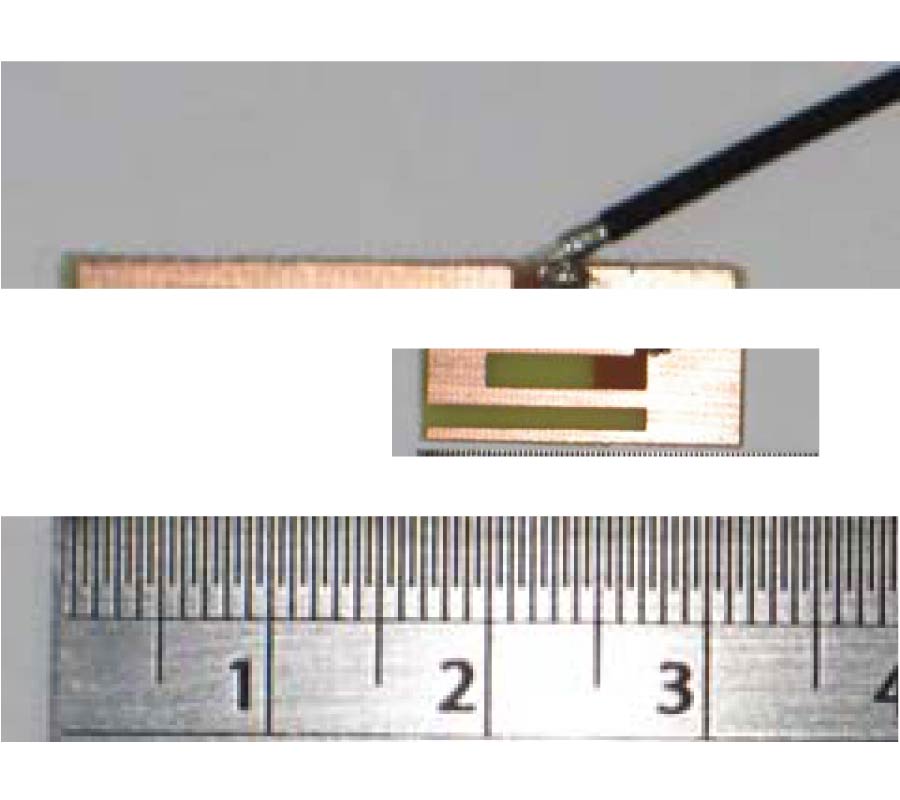
This paper presents a rectifying antenna (rectenna) for the harvesting of the microwave energy associated to UHF (Ultra-High Frequency) Radio Frequency IDentification (RFID) systems. The proposed device uses a capacitively loaded T-shaped monopole with a coplanar waveguide feeding line as receiving antenna and a five-stage voltage multiplier as rectifier. Experimental results demonstrating an RF-to-DC conversion efficiency of about 54% with an input power density of 80 μW/cm2 will be presented and discussed.
MONOPOLE-BASED RECTENNA FOR MICROWAVE ENERGY HARVESTING OF UHF RFID SYSTEMS
2012-07-13
PIER
Vol. 130, 17-40
A New Kind of Non-Acoustic Speech Acquisition Method Based on Millimeter Waveradar
Sheng Li , Ying Tian , Guohua Lu , Yang Zhang , Hui Jun Xue , Jian-Qi Wang and Xi-Jing Jing
Air is not the only medium that can spread and can be used to detect speech. In our previous paper, another valuable medium - millimeter wave (MMW) was introduced to develop a new kind of speech acquisition technique [Li et al., Progress In Electromagnetics Research B, 9, 199-214, 2008]. Because of the special features of the MMW radar, this speech acquisition method may provide some exciting possibilities for a wide range of applications. In the proposed study, we have designed a new kind of speech acquisition radar system. The super-heterodyne receiver was used in the new system so that to mitigate the severe DC offset problem and the associated 1/f noise at baseband. Furthermore, in order to decrease the harmonic noise, electro-circuit noise, and ambient noise which were combined in the MMW detected speech, an adaptive wavelet packet entropy algorithm is also proposed in this study, which incorporates the wavelet packet entropy based voice/unvoiced radar speech adaptive detection method and the human ear perception properties in a wavelet packet time-scale adaptation speech enhancement process. The performance of the proposed method is evaluated objectively by signal-to-noise ratio and subjectively by mean-opinion-score. The results confirm that the proposed method offers improved effects over other traditional speech enhancement methods for MMW radar speech.
A NEW KIND OF NON-ACOUSTIC SPEECH ACQUISITION METHOD BASED ON MILLIMETER WAVERADAR
2012-07-13
PIER
Vol. 130, 1-15
Development and Analysis of Flexible UHF RFID Antennas for ``Green" Electronics
Yasar Amin , Qiang Chen , Li-Rong Zheng and Hannu Tenhunen
In this paper, novel Bowtie antennas which cover complete UHF RFID band (860-960MHz), fabricated on various ultra-low-cost substrates using state-of-the-art printing technologies are investigated as an approach that aims to accommodate the antenna during the package printing process whilst faster production on commercially available paper. The proposed antenna structures are evaluated in reference to circuit and field concepts, to exhibit extreme degree of functional versatility. These antennas are developed to cater the variations which appear in electromagnetic properties and thickness of paper substrate due to various environmental effects. Computed (simulated) and well-agreed measurement results confirm a superior performance of the tag modules while stepping towards next generation of ``green'' tags.
DEVELOPMENT AND ANALYSIS OF FLEXIBLE UHF RFID ANTENNAS FOR ``GREEN
2012-07-13
PIER
Vol. 129, 559-578
The Use of Dielectric Mixture Equations to Analyze the Dielectric Properties of a Mixture of Rubber Tire Dust and Rice Husks in a Microwave Absorber
Ee Meng Cheng , Mohd Fareq Bin Abd Malek , Manjur Ahmed , You Kok Yeow , Kim Yee Lee and Hassan Nornikman
A change in the relative proportions of a mixture of rubber tire dust and rice husks will cause a change in the mixture's electrical permittivity and its ability to absorb electromagnetic energy. An open-ended, coaxial probe was used in conjunction with three dielectric mixture equations (the Kraszewski equation, the Landau equation and the Lichtenecker equation) to obtain the dielectric properties of a mixture of rubber tire dust and rice husks (RTDRH) over the frequency range of 7 GHz to 13 GHz. Lichtenecker's equation for dielectrics proved to be a useful practical formulation for determining the effective permittivity of homogeneous dielectric mixtures. The effectiveness of these dielectric mixture equations in determining the effective permittivity of RTDRH was investigated in this study. A newly developed mixture equation was derived based on these dielectric mixture equations, and it and the existing equations were assessed to determine their effectiveness in determining dielectric properties of such mixtures.
THE USE OF DIELECTRIC MIXTURE EQUATIONS TO ANALYZE THE DIELECTRIC PROPERTIES OF A MIXTURE OF RUBBER TIRE DUST AND RICE HUSKS IN A MICROWAVE ABSORBER
2012-07-12
PIER B
Vol. 42, 181-205
Fd2td Analysis of Electromagnetic Field Propagation in Multipole Debye Media with and Without Convolution
Mauro Feliziani , Silvano Cruciani , Valerio De Santis and Francesearomana Maradei
This paper deals with the time-domain numerical calculation of electromagnetic (EM) fields in linearly dispersive media described by multipole Debye model. The frequency-dependent finite-difference time-domain (FD2TD) method is applied to solve Debye equations using convolution integrals or by direct integration. Original formulations of FD2TD methods are proposed using different approaches. In the first approach based on the solution of convolution equations, the exponential analytical behavior of the convolution integrand permits an efficient recursive FD2TD solution. In the second approach, derived by circuit theory, the transient equations are directly solved in time domain by the FD2TD method. A comparative analysis of several FD2TD methods in terms of stability, dispersion, computational time and memory is carried out.
FD2TD ANALYSIS OF ELECTROMAGNETIC FIELD PROPAGATION IN MULTIPOLE DEBYE MEDIA WITH AND WITHOUT CONVOLUTION