Search Results(13800)

2012-02-20
PIER Letters
Vol. 30, 41-48
Uniplanar Single Corner-Fed Dual-Band Dual-Polarization Patch Antenna Array
Min Wang , Wen Wu and Dagang Fang
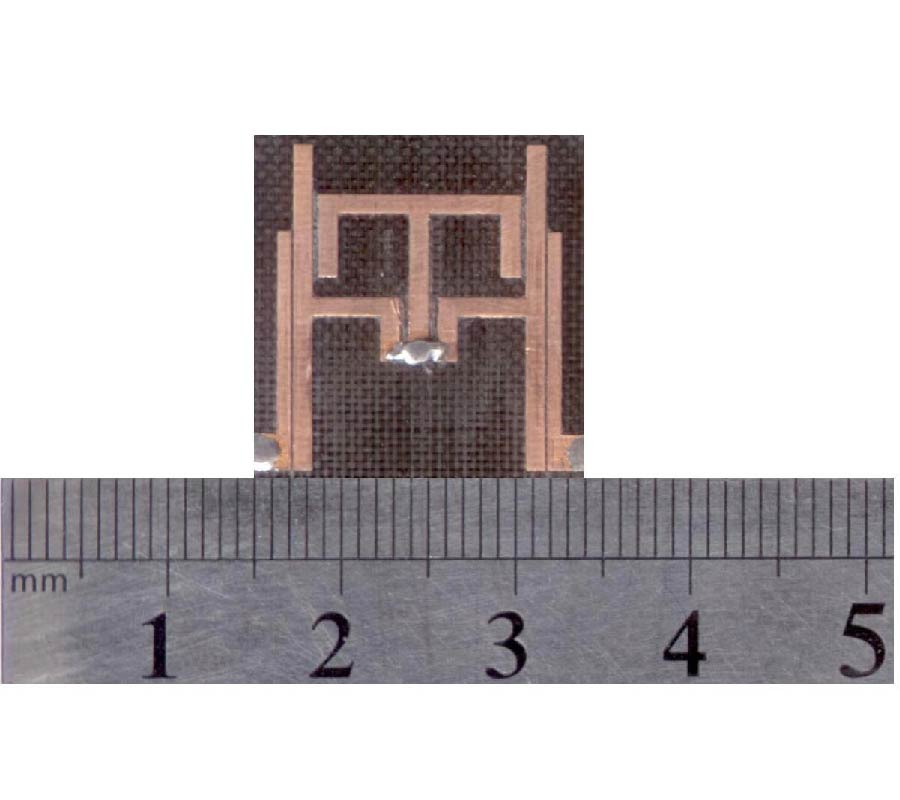
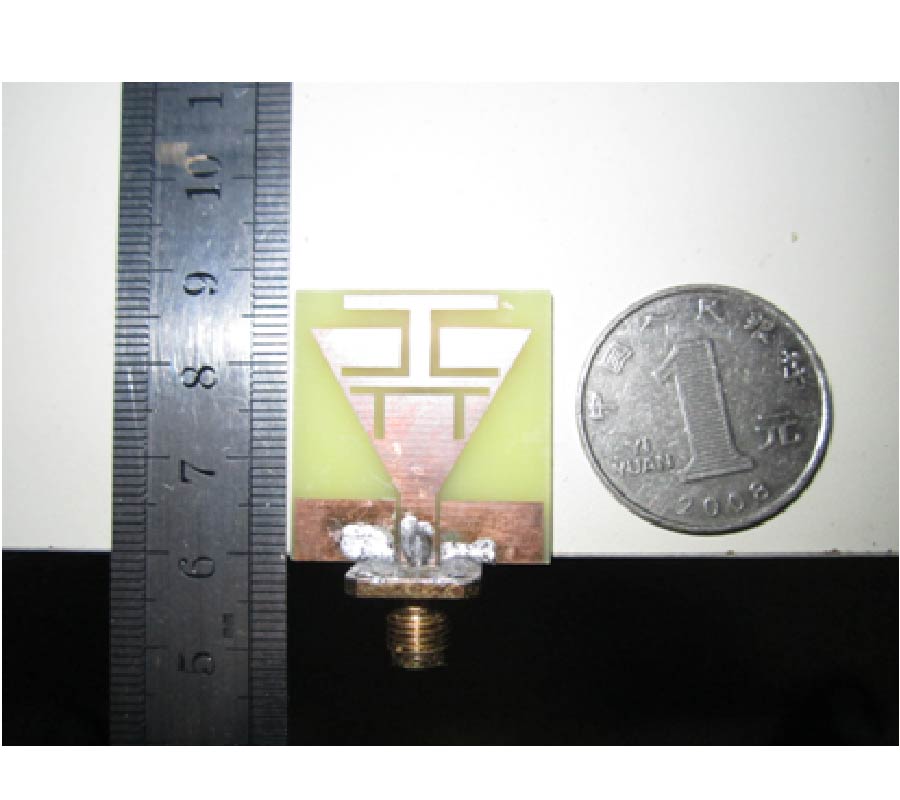
A uniplanar corner-fed patch antenna is presented with single-point microstrip feed and single layer substrate. Two orthogonal polarized dominant modes TM010 and TM001 are excited at two different frequencies. By utilizing a corner-fed structure, impedance matching for two bands can be adjusted much independently and the small ratio between two operating frequencies is easy to achieve. In addition, this simple and compact structure makes the patch antenna very convenient to form an array. A patch antenna operating at 12.5 GHz and 14.25 GHz with two linear orthogonal polarizations has been designed. The frequency ratio is only 1.14. The return loss, current distribution and radiation patterns of the patch element are investigated in detail. An 8 by 8 array has been developed, of which gains more than 23.4 dBi have been obtained at dual frequencies. Measured results agree well with simulated ones, which validate the proposed structure.
UNIPLANAR SINGLE CORNER-FED DUAL-BAND DUAL-POLARIZATION PATCH ANTENNA ARRAY
2012-02-20
PIER C
Vol. 27, 183-196
A Two-Port Antenna for Wireless-Powered UWB-RFID Tags
Yizhu Shen and Choi Look Law
This paper presents a two-port antenna including a receiving port and a transmitting one in the same volume. These two antennas are physically integrated and electrically isolated. The receiving antenna is a linearly polarized narrowband slot for energy harvesting, whereas the transmitting one is a circularly-polarized ultrawideband (UWB) quasi-spiral for signal radiation. The measurement results show that, the slot resonates at 5.8 GHz, and the quasi-spiral has a 10-dB return loss bandwidth of 2.85-5.16 GHz and a 3-dB axial ratio bandwidth of 3.05-4.43 GHz. The electrical isolation between these two antennas is more than 20 dB covering 1-8 GHz. This two-port antenna is a good candidate for wireless-powered UWB-RFID tags.
A TWO-PORT ANTENNA FOR WIRELESS-POWERED UWB-RFID TAGS
2012-02-20
PIER C
Vol. 27, 169-181
Compact Printed Dual Band-Notched U-Shape UWB Antenna
Sanjeev Kumar Mishra and Jayanta Mukherjee
In this article, a low cost, simple, and compact printed microstripfed U-shape monopole ultra-wideband antenna with dual band-notched characteristics is proposed and investigated. By introducing a spiral shaped λ/4 open stub in the microstrip feed line and a pair of L-shaped slots on the rectangular ground patch, dual band notched characteristics can be obtained respectively. The proposed antenna is successfully simulated, designed, fabricated and measured. The measured results show that the proposed antenna with dimensions of 24 mm (Wsub) × 34 mm (Lsub) × 1.6 mm (H) has a large bandwidth over the frequency band from 2.75 GHz to 10.6 GHz with VSWR less than 2, except 3.27-4.26 GHz and 5.01-5.99 GHz frequency bands. The proposed antenna exhibits nearly omnidirectional radiation pattern, stable gain, and small group delay variation over the desired frequency bands.
COMPACT PRINTED DUAL BAND-NOTCHED U-SHAPE UWB ANTENNA
2012-02-20
PIER M
Vol. 23, 249-262
Electric and Magnetic Field Problems with Periodic Circular Cylindrical Symmetry and Their Connection with a Novel Geometrical Interpretation of the Algebraic Operation an±Bn
Jose Antonio Marinho Brandao Faria
This paper deals with the evaluation of the electric and magnetic field generated by a set of N periodically distributed filamentary conductors, in a circular arrangement. The results obtained lead to the computation of a continuous product of distances. In close connection with the computation of such a continuous product, the general problem of the factorization of a sum or difference of two powers, aN±bN, where a and b are positive real numbers and N a positive integer, is addressed.
ELECTRIC AND MAGNETIC FIELD PROBLEMS WITH PERIODIC CIRCULAR CYLINDRICAL SYMMETRY AND THEIR CONNECTION WITH A NOVEL GEOMETRICAL INTERPRETATION OF THE ALGEBRAIC OPERATION aN±bN
2012-02-20
PIER
Vol. 125, 79-95
Estimation Method for Simultaneous Switching Noise in Power Delivery Network for High-Speed Digital System Design
Tong-Hao Ding , Yu-Shan Li , Dong-Chu Jiang , Yong-Zhe Qu and Xu Yan
In this paper, a new method is proposed to estimate the simultaneous switching noise (SSN) directly from the power delivery network (PDN) frequency-domain impedance in order to reduce the time-domain simulation of SSN and computational burden, which is based on the periodic characteristics of the switching current and the SSN produced by one current pulse. The frequency-domain impedance is approximated with several single resonance circuits, which can capture the resonance characteristics of the PDN. The parameters of each resonance circuit are calculated with the rational function. It is also found that the SSN can be suppressed through adjusting the resonant frequencies and the period of switching current. Compared with the single resonance lumped circuit model and multi-resonance distributed circuit model, the performance of the new method for estimating the SSN is verified, which is more accurate than the target impedance method.
ESTIMATION METHOD FOR SIMULTANEOUS SWITCHING NOISE IN POWER DELIVERY NETWORK FOR HIGH-SPEED DIGITAL SYSTEM DESIGN
2012-02-18
PIER M
Vol. 23, 229-247
Multiphysics Modeling of a Magnetic Refrigeration System Based on Superconductors
Houssem Rafik El Hana Bouchekara , Mohammed T. Simsim , M. Boucherma and Hicham Allag
Based on the magnetocaloric effect, magnetic refrigeration at room temperature has, for the past decade, been a promising and environmentally friendly technology predicted to have a significantly higher efficiency than the present conventional methods. However, to the authors' knowledge, so far no prototypes have been presented for large scale applications. This paper presents the modeling of a superconducting-based magnetic refrigeration system for large scale applications. On one hand, electromagnetic computations are undertaken to maximize magnetic field produced in order to get the best performance (temperature span and cooling power) and to limit the mechanical efforts (forces and torque). On the other hand, the thermal modeling aims to evaluate and to optimize the cooling performance.
MULTIPHYSICS MODELING OF A MAGNETIC REFRIGERATION SYSTEM BASED ON SUPERCONDUCTORS
2012-02-18
PIER
Vol. 125, 55-77
GPU Implementation of Split-Field Finite-Difference Time-Domain Method for Drude-Lorentz Dispersive Media
Afsaneh Shahmansouri and Bizhan Rashidian
Split-field finite-difference time-domain (SF-FDTD) meth-od can overcome the limitation of ordinary FDTD in analyzing periodic structures under oblique incidence. On the other hand, huge run times of 3D SF-FDTD, is practically a major burden in its usage for analysis and design of nanostructures, particularly when having dispersive media. Here, details of parallel implementation of 3D SF-FDTD method for dispersive media, combined with total-field/scattered-field (TF/SF) method for injecting oblique plane wave, are discussed. Graphics processing unit (GPU) has been used for this purpose, and very large speed up factors have been achieved. Also a previously reported formulation of SF-FDTD based on the Drude model for dispersive media, is extended to cover Drude-Lorentz model, which is usually needed for materials such as gold. The resulting reduction in the number of variables in this formulation, not only helps in reducing the computational time, but also makes it possible to be implemented in GPU, where its memory limitation is a major concern. As an example for demonstrating the importance of this method in optimization of nanophotonics structures, improvement in the performance of a refractive index sensor, made of an array of nanodisks, using suitable angle of incidence is reported. To the best of our knowledge this is the first report of GPU implementation of SF-FDTD method, capable of analyzing periodic dispersive media under oblique incidence.
GPU IMPLEMENTATION OF SPLIT-FIELD FINITE-DIFFERENCE TIME-DOMAIN METHOD FOR DRUDE-LORENTZ DISPERSIVE MEDIA
2012-02-18
PIER
Vol. 125, 37-53
An Efficient Method for the Computation of Mixed Potential Green's Functions in Cylindrically Stratified Media
Liang Feng Ye , Ke Xiao , Lei Qiu , Shun-Lian Chai and Jun-Jie Mao
Closed-form mixed potential Green's functions (MPGFs) for cylindrically stratified media are derived in terms of quasistatic-wave and surface-wave contributions. In order to avoid possible overflow/underflow problems in the numerical calculations of special cylindrical functions such as Bessel and Hankel functions, a novel form of the spectral-domain MPGFs is developed. Then, a two-level methodology is used for the approximation of the spectral-domain MPGFs. In the first step, the qusistatic components are extracted from the spectral-domain MPGFs, and then transformed into the space domain with the use of the Sommerfeld identity and its derivatives. In the second step, the remaining parts of the spectral-domain MPGFs are approximated in terms of pole-residue expressions via the rational function fitting method (RFFM). The proposed method is efficient and fully automatic, which avoids an analytical cumbersome extraction of the surface wave poles (SWPs), prior to the spectrum fitting. In addition, this method can evaluate the spatial-domain MPGFs accurately and efficiently for both the near- and far-fields. Finally, numerical results for the spatial-domain MPGFs of a two-layer structure are presented and discussed.
AN EFFICIENT METHOD FOR THE COMPUTATION OF MIXED POTENTIAL GREEN'S FUNCTIONS IN CYLINDRICALLY STRATIFIED MEDIA
2012-02-17
PIER C
Vol. 27, 157-167
The Fractal Nature of the Electromagnetic Field Within a Reverberating Chamber
Antonio Sorrentino , Lucio Mascolo , Giuseppe Ferrara and Maurizio Migliaccio
In this paper, a new look at the electromagnetic field in a reverberating chamber (RC) is presented. It follows the fractional Brownian motion (fBm) model and exploits the Hurst parameter as the key parameter to discriminate among various RC configurations. Experiments accomplished at the RC of the Università di Napoli Parthenope, formerly Istituto Universitario Navale (IUN), confirm the physical soundness of the proposed model.
THE FRACTAL NATURE OF THE ELECTROMAGNETIC FIELD WITHIN A REVERBERATING CHAMBER
2012-02-17
PIER C
Vol. 27, 143-156
Design and Development of a Dual Operating Mode Microstrip Patch Antenna for Unmanned Aerial Vehicle Synthetic Aperture Radar
Poi Ngee Tan , Tien Sze Lim , Gobi Vetharatnam and Yee Kit Chan
Microstrip patch antenna has been designed and developed for Unmanned Aerial Vehicle based Synthetic Aperture Radar (UAVSAR). This antenna operates in C-Band at the frequency of 5.3 GHz with a bandwidth of 80\,MHz. The radiation patterns of the antenna were specified to provide a desired scanned area for UAVSAR. The UAVSAR antenna was designed in the form of combination of 3 subpanels to allow dual operating mode (single antenna or dual antenna) selection. Two feed points are provided to the feeding network of each subpanel to reduce undesired power loss. The developed antenna prototype meets the performance requirements of UAVSAR system. It shows promising results in the UAVSAR flight mission conducted in Mersing area, Malaysia for both operating modes.
DESIGN AND DEVELOPMENT OF A DUAL OPERATING MODE MICROSTRIP PATCH ANTENNA FOR UNMANNED AERIAL VEHICLE SYNTHETIC APERTURE RADAR
2012-02-17
PIER M
Vol. 23, 207-227
Three-Dimensional Wedge Diffraction Correction Deduced by the Stationary Phase Method on the Modified Equivalent Current Approximation (Meca)
Hipolito Gomez-Sousa , Jose Angel Martinez-Lorenzo and Oscar Rubiños-López
This paper presents a new method for computing fields diffracted by a wedge for the MECA formulation, which is valid not only for perfect electric conductors but also for lossy penetrable dielectrics. The method is based on the computation of a wedge correction matrix, which establishes a mapping function between fields incident at and diffracted by the wedge. The MECA method is based, in general, upon the oblique incidence of a plane wave at the interface between free space and lossy dielectric media. MECA reduces to the well-studied physical optics (PO) formulation in case of PEC (perfect electric conductor) scatterers. In this work, we consider a scenario involving diffraction caused by a plane wavefront incident on a wedge with flat faces and straight edge. The version of the stationary phase method for three-dimensional equivalent source distributions is employed to calculate the asymptotic contribution of the integration boundary along the edge of the diffraction wedge. This contribution of the critical boundary points is compared to the GTD (geometrical theory of diffraction) diffracted field in order to obtain the correction matrix by which the incident electric field vector is multiplied in MECA. As required to accomplish this comparison, the three-dimensional incident electric field is previously resolved into an edge-fixed coordinate system. Good agreement is demonstrated between full-wave method-of-moments (MoM) results and the results obtained by modifying MECA with our diffraction correction technique. is demonstrated between full-wave method-of-moments (MoM) results and the results obtained by modifying MECA with our diffraction correction technique.
THREE-DIMENSIONAL WEDGE DIFFRACTION CORRECTION DEDUCED BY THE STATIONARY PHASE METHOD ON THE MODIFIED EQUIVALENT CURRENT APPROXIMATION (MECA)
2012-02-17
PIER M
Vol. 23, 195-205
Microwave Imaging of Dielectric Cylinders Using Level Set Method and Conjugate Gradient Algorithm
Khaled Grayaa
In this paper, a level set method for shape reconstruction problems is considered. By measuring the scattered field, we tried to retrieve the localisation and permittivity of buried objects. The forward problem is solved by the method of moments. For solving the inverse problem, we adopt an evolution approach. Therefore, we introduce a level set technique witch is flexible in handling complex shape changes. A conjugate gradient-based method is used in order to define iterative updates for the level set functions with the goal to minimize a given least squares data misfit functional. In particular, the proposed method is capable of creating new holes inside the design domain, which makes the final design independent of Experimental results demonstrate the feasibility and effectiveness of the proposed technique.
MICROWAVE IMAGING OF DIELECTRIC CYLINDERS USING LEVEL SET METHOD AND CONJUGATE GRADIENT ALGORITHM
2012-02-15
PIER Letters
Vol. 30, 29-39
Simple Skewon Medium Realization of dB Boundary Conditions
Ismo Veikko Lindell and Ari Sihvola
Considering the class of bi-isotropic media, a special case called the class of simple skewon (SS) media is defined. The SS medium depends on a single parameter. A plane wave incident on a planar interface of an SS medium is shown to reflect as from a DB boundary with vanishing normal components of D and B field vectors. This offers another possibility to realize the DB boundary conditions in terms of a medium interface. The same property is shown to apply for curved boundaries as well.
2012-02-15
PIER C
Vol. 27, 129-142
Multilayer Dielectric Resonator Antenna Transmitarray for Near-Field and Far-Field Fixed RFID Reader
Saber Zainud-Deen , Shaymaa Gaber , Hend Abd El-Azem Malhat and Kamal Awadalla
A design of multilayer dielectric resonator antenna transmitarray for fixed radio frequency identification (RFID) reader applications is presented at 5.8 GHz. Three layers square dielectric resonator antenna (DRA) elements are mounted on dielectric substrate and used as a unit cell in the transmitarray. A circularly polarized 9 × 9 square DRA transmitarray is designed at 5.8 GHz for far-field RFID applications. The transmitarray produces maximum gain of 20.2 dB. The right-hand circular polarization level is lower than -31 dB at the designed frequency with SLL of -22 dB. A design of 9 × 9 near-field focused DRA transmitarray for fixed RFID at 5.8 GHz is investigated. The properties of the near field-focused transmitarray are compared with that of the far field transmitarray designed at the same operating frequency.
MULTILAYER DIELECTRIC RESONATOR ANTENNA TRANSMITARRAY FOR NEAR-FIELD AND FAR-FIELD FIXED RFID READER
2012-02-14
PIER B
Vol. 38, 387-403
Modified DOA Estimation Methods with Unknown Source Number Based on Projection Pretransformation
Qing-Chen Zhou , Huotao Gao , Fan Wang and Jie Shi
In this paper, our purpose is to develop methods that have high resolution and robustness in the presence of unknown source number, array error, snapshot deficient, and low SNR. The DOA (Direction-Of-Arrival) estimation with unknown source number methods referred as MUSIC-like and SSMUSIC-like methods have shown high resolution in the snapshot deficient and low SNR scenario. However, they need to take several times of fine search on the full space, which bring about high computational complexities. Thus, modified methods are proposed to reduce computational complexities and improve performances further. In the modified methods, we priori use conventional beamforming to get the rough distribution of signals' angle, which helps to reduce computational complexity and connect the technique of projection pretransformation. Then through projection pretransformation, original methods are further simplified and improved. As demonstrated in computer simulations, the modified DOA estimation with unknown source number methods shows not only higher resolution in the snapshot deficient and lower SNR scenario, but also more robustness against array errors. Although the proposed methods cannot replace the array calibration completely, they reduce the requirement of calibration accuracy. Combined with these advantages, it has been shown that the new methods are more suitable in engineering.
MODIFIED DOA ESTIMATION METHODS WITH UNKNOWN SOURCE NUMBER BASED ON PROJECTION PRETRANSFORMATION
2012-02-14
PIER
Vol. 125, 21-35
Planar Symmetric Normal and Complementary Three-Resonance Resonators in Terahertz Band
Ya-Xin Zhang , Shen Qiao , Tao Zhao , Wei Ling and Shenggang Liu
Metamaterials are artificially structured electromagnetic materials which can lead to the realization of phenomena that cannot be obtained with natural materials. In the terahertz frequency regime, metamaterials have distinguished performance and open up a new way to design and construct the functional devices. Based on the structure of metamaterials, planar symmetric normal and complementary three-resonance resonators in Terahertz band are proposed in this paper. Simulation and experimental study have been carried out. The results show that the proposed structure has three distinct and strong resonant bands in THz regime and that symmetric normal structure and complementary structure can realize the three stop-resonances and pass-resonances respectively. For the well-separating of different resonances in the terahertz band, these symmetric three-passband and three-stopband resonators will be used in the design of multiband terahertz devices.
PLANAR SYMMETRIC NORMAL AND COMPLEMENTARY THREE-RESONANCE RESONATORS IN TERAHERTZ BAND
2012-02-14
PIER
Vol. 125, 1-19
Signal Propagation Analysis for Low Data Rate Wireless Sensor Network Applications in Sport Grounds and on Roads
David Lorater Ndzi , M. A. Mohd Arif , Ali Yeon Md. Shakaff , Mohd Noor Ahmad , Azizi Harun , Latifah M. Kamarudin , Ammar Zakaria , Mohd F. Ramli and Mohammad Shahrazel Razalli
This paper presents results of a study to characterise wireless point-to-point channel for wireless sensor networks applications in sport hard court arenas, grass fields and on roads. Antenna height and orientation effects on coverage are also studied and results show that for omni-directional patch antenna, node range is reduced by a factor of 2 when the antenna orientation is changed from vertical to horizontal. The maximum range for a wireless node on a hard court sport arena has been determined to be 70 m for 0 dBm transmission but this reduces to 60 m on a road surface and to 50 m on a grass field. For horizontal antenna orientation the range on the road is longer than on the sport court which shows that scattered signal components from the rougher road surface combine to extend the communication range. The channels investigated showed that packet error ratio (PER) is dominated by large-scale, rather than small-scale, channel fading with an abrupt transition from low PER to 100% PER. Results also show that large-scale received signal power can be modeled with a 2nd order log-distance polynomial equation on the sport court and road, but a 1st order model is sufficient for the grass field. Small-scale signal variations have been found to have a Rice distribution for signal to noise ratio levels greater than 10 dB but the Rice K-factor exhibits significant variations at short distances which can be attributed to the influence of strong ground reflections.
SIGNAL PROPAGATION ANALYSIS FOR LOW DATA RATE WIRELESS SENSOR NETWORK APPLICATIONS IN SPORT GROUNDS AND ON ROADS
2012-02-13
PIER
Vol. 124, 511-525
Frequency-Selective Nanostructured Plasmonic Absorber by Highly Lossy Interface Mode
Yongkang Gong , Kang Li , Jungang Huang , N. J. Copner , Antony Davies , Leiran Wang and Tao Duan
We report on an existence of a highly lossy interface mode (HLIM) in a designed plasmonic nanostructure for perfect absorption of the incident optical waves. Interactions between the single thin-metallic-layer ($TML$) and slits arrays for excitation of the HLIM in the proposed plasmonic absorber are investigated, and eigenfrequency formula for the HLIM is derived. Analytical and numerical results show that the HLIM is frequency-selective, opens a narrow and steep absorption band in photonic stopband of the slits arrays. Due to the HLIM lossy characteristic, surface plasmon polaritons are significantly trapped at the TML interface with absorption close to 100%.
FREQUENCY-SELECTIVE NANOSTRUCTURED PLASMONIC ABSORBER BY HIGHLY LOSSY INTERFACE MODE
2012-02-12
PIER B
Vol. 39, 1-37
Solving for Micro- and Macro-Scale Electrostatic Configurations Using the Robin Hood Algorithm
Joseph A. Formaggio , Predrag Lazic , Thomas Joseph Corona , Hrvoje Stefancic , Hrvoje Abraham and Ferenc Gluck
We present a novel technique by which highly-segmented electrostatic configurations can be solved. The Robin Hood method is a matrix-inversion algorithm optimized for solving high density boundary element method (BEM) problems. We illustrate the capabilities of this solver by studying two distinct geometry scales: (a) the electrostatic potential of a large volume beta-detector and (b) the field enhancement present at surface of electrode nano-structures. Geometries with elements numbering in the O(105) are easily modeled and solved without loss of accuracy. The technique has recently been expanded so as to include dielectrics and magnetic materials.
SOLVING FOR MICRO- AND MACRO-SCALE ELECTROSTATIC CONFIGURATIONS USING THE ROBIN HOOD ALGORITHM
2012-02-12
PIER C
Vol. 27, 115-128
A Dual Band Frequency and Pattern Reconfigurable Dielectric Resonator Antenna
Gulam Nabi Alsath Mohammed , Sridhar Bilvam , Kanagasabai Malathi , R. Rajesh Kumar , N. Karthik and Henridass Arun
A new approach to obtain frequency and pattern reconfiguration in Dielectric Resonator Antenna (DRA) has been proposed. The design consists of two identical aperture coupled DRAs separated by a distance of λ0. A switchable feed based frequency reconfiguration is discussed in which the feed acts as an ideal switch. This design operates at two frequencies viz., 3.6 GHz and 5.2 GHz. These frequencies are independently tuned using trimmers. Further, the slot length of both the DRAs can be tuned independently using movable shorting pins driven by miniature motors. The shorting pins form a part of the ground plane. By varying the slot length of the DRA, the resonant frequency is controlled which in turn helps in gaining pattern reconfiguration. The structure has been designed for lower and middle band frequencies of WLAN, operating between 5.15-5.25 GHz and 5.25-5.35 GHz, respectively. These types of antennas can be employed in MIMO systems for increasing the capacity through Pattern diversity.
A DUAL BAND FREQUENCY AND PATTERN RECONFIGURABLE DIELECTRIC RESONATOR ANTENNA